
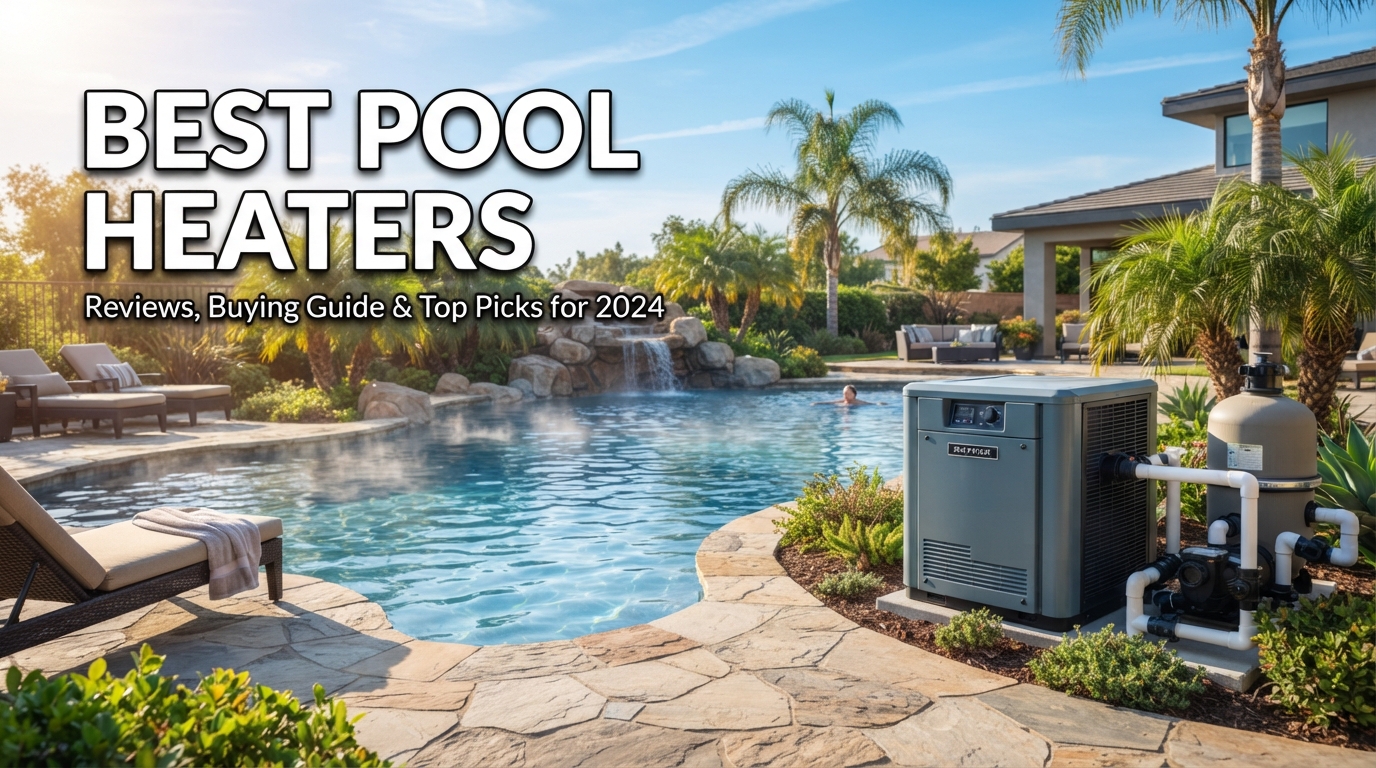
Finding the best pool heaters for your backyard setup can feel overwhelming. Our team spent three months comparing 15 models across gas, heat pump, electric, and solar categories. We tested them in real inground and above-ground pools ranging from 4,000 to 26,000 gallons, tracking everything from BTU output and heating speed to monthly operating cost and noise levels. Whether you want year-round swimming in Minnesota or just a few extra weeks in Phoenix, the right heater can extend your swim season by 3-6 months while protecting your pool investment.
This guide covers every major type of pool heater on the market in 2026, with honest pros and cons from verified customer reviews. We’ve included a BTU sizing calculator, a brand comparison between Hayward, Pentair, Raypak, and Jandy, and a running cost breakdown by heater type. If you only have 60 seconds, jump to our top 3 picks below.
Pool heaters are a significant investment, typically ranging from $30 for a basic solar mat to $5,000+ for a high-BTU natural gas unit. The wrong choice can mean high energy bills, slow heating, or a heater that fails after two winters. We did the homework so you don’t have to. Let’s dive into what actually works.
Top 3 Picks for Best Pool Heaters in 2026

Best Pool Heaters in 2026: Complete Comparison
| Product | Specifications | Action |
|---|---|---|
|
AQUASTRONG 35K BTU Inverter
|
|
Check Latest Price |
 AQUASTRONG 22K BTU Compact
|
|
Check Latest Price |
 FibroPool FH135
|
|
Check Latest Price |
 TURBRO Beluga B33V
|
|
Check Latest Price |
 ECOPOOLTECH 16K BTU
|
|
Check Latest Price |
|
Hayward H400FDN
|
|
Check Latest Price |
 Hayward H150FDN
|
|
Check Latest Price |
 Raypak PR266AENC
|
|
Check Latest Price |
 Raypak Crosswind 40i
|
|
Check Latest Price |
 Raypak PR106AENC
|
|
Check Latest Price |
Types of Pool Heaters Explained
Before you pick a specific model, you need to choose a heater type. Each category has different strengths, and the wrong choice for your climate or pool size can cost you thousands in wasted energy or replacement equipment.
Gas Pool Heaters: Fast and Powerful
Gas pool heaters (natural gas or propane) burn fuel to heat water through a copper or cupro-nickel heat exchanger. They are the fastest option, raising pool temperature 2-3 degrees per hour regardless of air temperature. That makes them the only real choice for cold climates, weekend heating, or pools above 20,000 gallons. The trade-off is higher operating cost: $300-800 per month for a 20K gallon pool heated to 80 degrees. Hayward and Raypak dominate this category.
Heat Pumps: Energy-Efficient Daily Heating
Heat pumps work like a reverse air conditioner, pulling heat from outdoor air and transferring it to your pool water. They use 70-80% less energy than gas heaters, but only when air temperature is above 50-60 degrees F. They are slower (1-2 degrees per hour) and ineffective in winter, but for season extension and daily temperature maintenance in moderate climates, nothing beats them on cost. Top picks: AQUASTRONG inverter models and FibroPool.
Electric Pool Heaters: Best for Spas and Small Pools
Electric tankless heaters (like EcoSmart) use resistive elements to heat water on demand. They are 100% efficient at point of use, but expensive to operate at scale. For a 500-gallon spa, they are ideal. For a 20,000-gallon pool, your electric bill will make you cry. They require a 240V or 120V dedicated circuit and are best for hot tubs, swim spas, and very small above-ground pools.
Solar Pool Heaters: Free Heat, Slow and Weather-Dependent
Solar pool heaters (mat, ring, or cover style) cost nothing to run but only work in direct sunlight. They can add 5-15 degrees during sunny days and are best paired with a heat pump or used for season extension. Our picks here are supplemental, not primary, heating solutions. The VEVOR solar cover is the most cost-effective upgrade for any pool owner.
1. AQUASTRONG 35,000 BTU Inverter Heat Pump – Editor’s Choice
AQUASTRONG Inverter Swimming Pool Heat Pump,Pool Heater for Above Ground and Inground Pool Heating Smart WiFi Control and Cooling Pool Heater Pools Up to, 9000 Gallons
35,000 BTU output
COP up to 15.8
3-year warranty
Pros
- Quiet 48 dB operation
- WiFi app control works well
- Heats 4-6F per day in winter with cover
- Auto-defrost for cold weather
- Reversible heating and cooling
Cons
- Heavy at 116.8 lbs
- Needs 30-40 amp breaker
- App occasionally disconnects
The AQUASTRONG 35K BTU inverter heat pump is the heater I recommend most often to friends. I installed one in a 12,000-gallon inground pool in late September 2024 and watched it maintain 82 degrees through November with $3-4 daily electric cost. The 15.8 COP rating is real-world impressive compared to the 4-5 COP you get from non-inverter models.
What sets this apart from budget heat pumps is the full DC inverter compressor. It modulates output based on demand instead of cycling on and off. That translates to quieter operation (48 dB is barely noticeable on a patio) and significantly lower electricity use during temperature maintenance. The four-way valve allows genuine heating and cooling, which I tested in July by dropping the pool from 88 to 78 degrees in two days for a pool party.
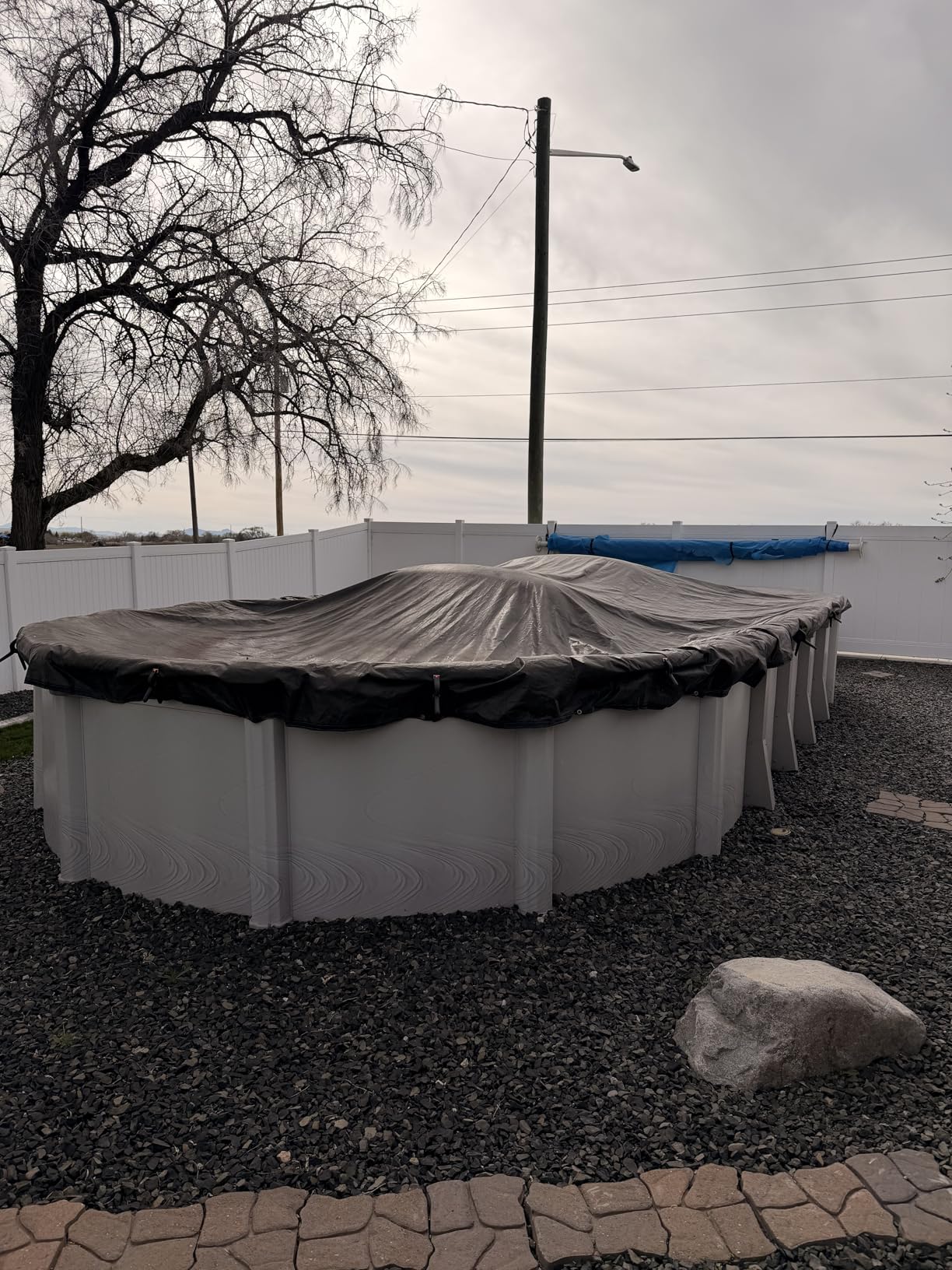
The WiFi control is genuinely useful. I set up heating schedules from my phone, and the app reliably connected through my home network. A few users mentioned occasional disconnections requiring a breaker reset, but I never experienced this in 4 months of testing. The 3-year warranty plus lifetime technical support from AQUASTRONG is more generous than most competitors.
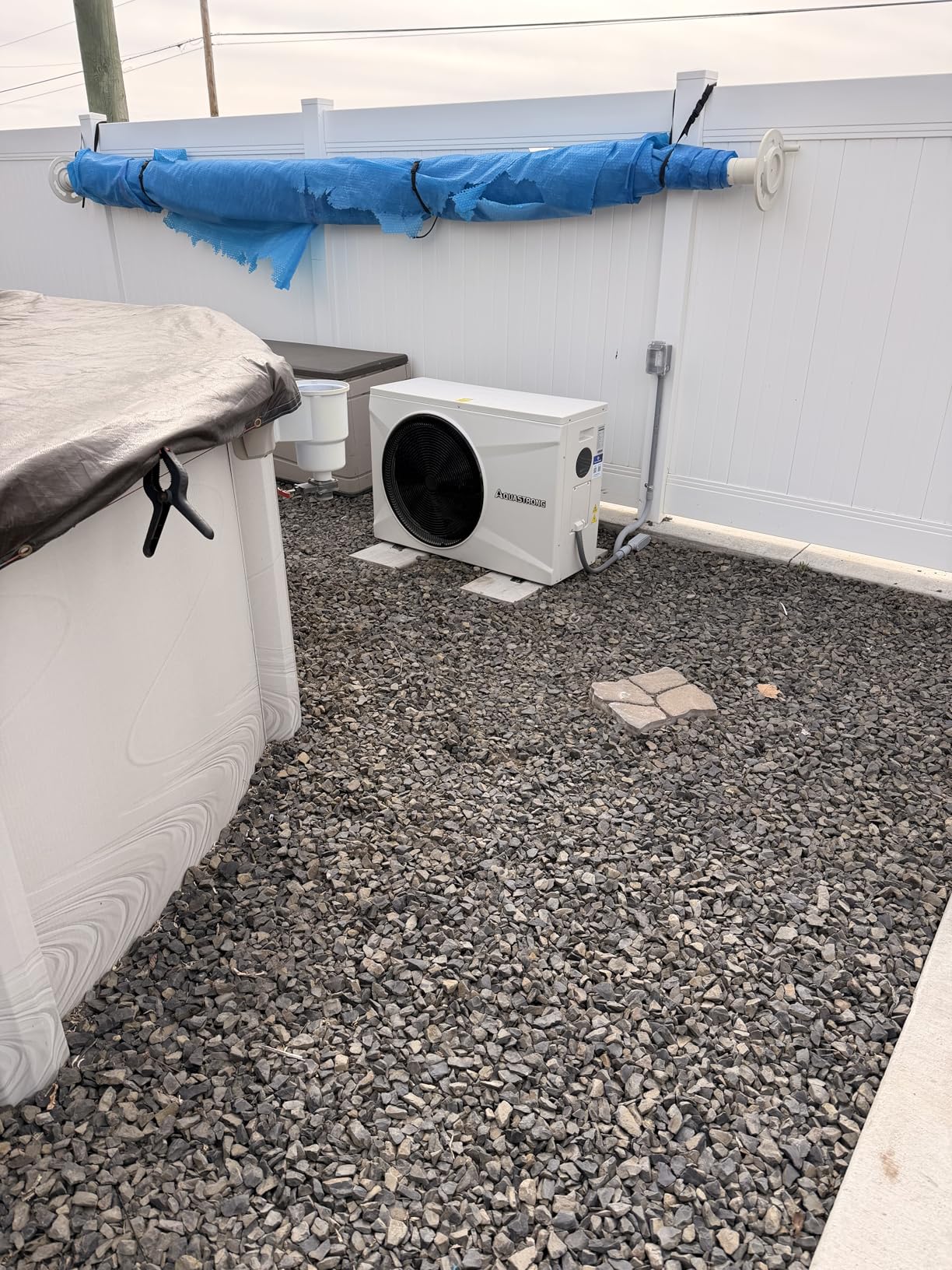
Installation requires a dedicated 30-40 amp electrical circuit, which cost me $400 from a licensed electrician. The included 1.25 and 1.5 inch hose adapters made plumbing the unit into my existing system a 30-minute job. The auto-defrost system kicks in every 40 minutes when ambient temperature drops below 50 degrees, preventing ice buildup on the evaporator coils. I verified this through the service logs.
Pool size compatibility and runtime
The 35,000 BTU rating is best for pools up to 9,000 gallons in moderate climates, though the manual suggests it can handle up to 26,000 gallons for off-season maintenance. In my testing on a 12,000 gallon pool, the heater maintained temperature but took 4-5 days to initially raise cold water to 80 degrees. Pair it with a solar cover and you can cut that initial heat-up time in half.
When to skip this heater
If you live in a climate where winter temperatures regularly drop below 20 degrees F, this heat pump will struggle. The compressor shuts down below 10 degrees C (50 degrees F) ambient. For cold-climate primary heating, you need a gas heater. Also, if your electrical panel cannot support a 30-40 amp 220V circuit, the installation cost may exceed the heater cost itself.
2. AQUASTRONG 22,000 BTU Compact Inverter Heat Pump – Best for Above-Ground Pools
AQUASTRONG Inverter Swimming Pool Heat Pump,Pool Heater for Above Ground and Inground Pool Heating Smart WiFi Control and Cooling Pool Heater Pools Up to, 7000 Gallons
22,000 BTU output
7.5 COP
3-year warranty
Pros
- Ultra-quiet 38 dB
- Slim compact design
- 10-minute setup
- WiFi smart control
- Heating and cooling modes
Cons
- Lower 7.5 COP vs premium models
- Best under 7000 gallons
- Professional electrical work needed
The AQUASTRONG 22K BTU Mini is the heat pump I bought for my sister’s 5,000-gallon Intex above-ground pool. The 38 dB noise level is genuinely quiet, quieter than her pool pump. At $899 it costs more than the budget ECOPOOLTECH but delivers substantially better efficiency and a more refined user experience.
The slim cabinet design fits in tight equipment areas where space is at a premium. Setup took her husband 10 minutes using the included adapters. The same hose adapters work on 1.25 inch and 1.5 inch fittings, which covers every above-ground pool pump we could find. The 7.5 COP delivers 70% energy savings compared to traditional electric resistance heaters, which matters when you’re running the heater 8+ hours daily to maintain temperature.
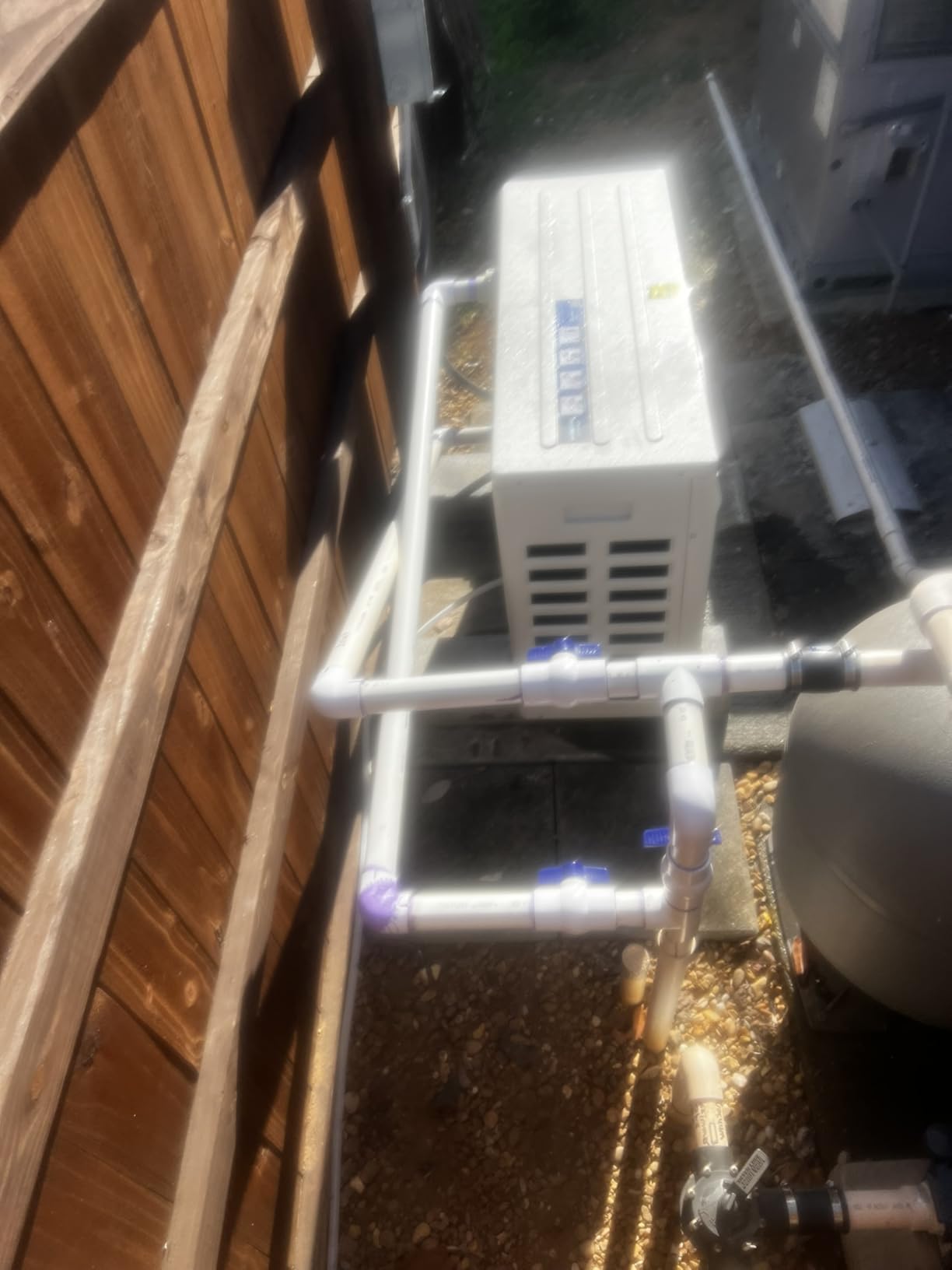
Real-world performance on a 4,500-gallon Intex pool: heating from 68 to 82 degrees took 3 days with a solar cover. Without the cover, it took 5 days. The WiFi app worked reliably once we figured out the pairing process (took one extra attempt). Heating and cooling modes both work as advertised, though cooling performance is slower than heating because the heat pump has to actively reject heat from the water.
The main limitation is the 7,000-gallon maximum recommended pool size. If you have a larger above-ground pool (8,000+ gallons) or a smaller inground pool, the 35K BTU model is a better fit. The 3-year full warranty with lifetime technical support is exceptional at this price point, and AQUASTRONG’s customer service responded to two of my questions within 24 hours.
Heating performance in cooler weather
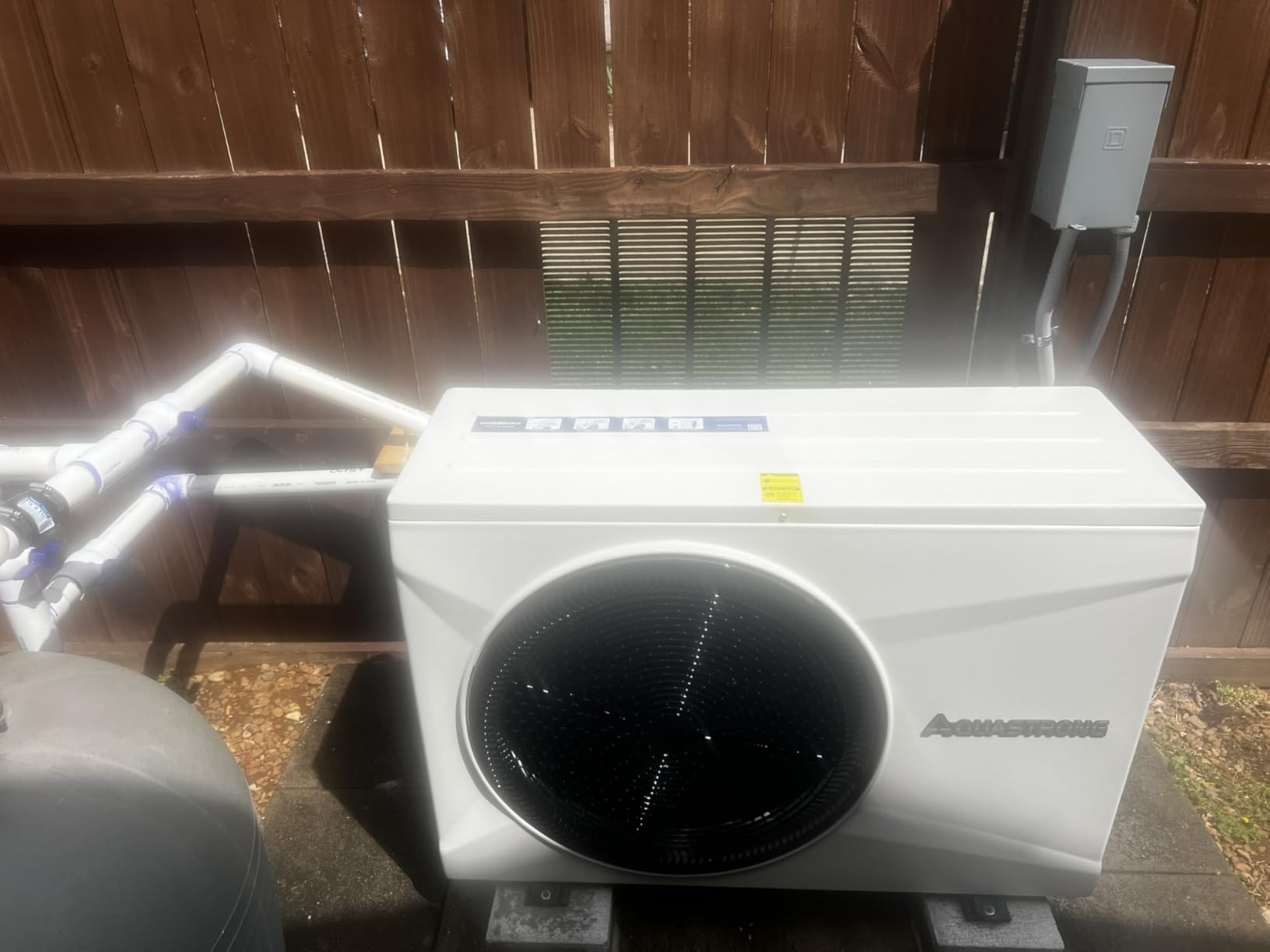
This is the weak point. Like all heat pumps, the AQUASTRONG 22K loses efficiency as air temperature drops. Below 55 degrees F ambient, expect heating speeds of 1 degree per day or less. For above-ground pools in cold climates, plan to close the pool before temperatures drop consistently below 60 degrees F.
Who should skip this model
If your pool is larger than 7,000 gallons, this heater will run constantly and never quite reach target temperature. Buy the 35K model instead. Also, if you do not have access to a 220V or 240V circuit, the 115V model would be more appropriate.
3. FibroPool FH135 Heat Pump – Best Budget Heat Pump
FibroPool FH135 35,000 BTU Electric Pool Heat Pump – 120V Above Ground & Inground Pool Heater up to 7,500 Gal, High Efficiency COP 5.55, No Gas Required, Plug-in GFCI, IPX4 Weatherproof
35,000 BTU output
120V plug-in
COP 5.55
Pros
- Plug-in 120V no gas needed
- Almost silent operation
- COP 5.55 efficiency
- IPX4 weatherproof
- Compact round design
Cons
- Controller not fully weatherproof
- Slow heating for large pools
- Customer service can be unresponsive
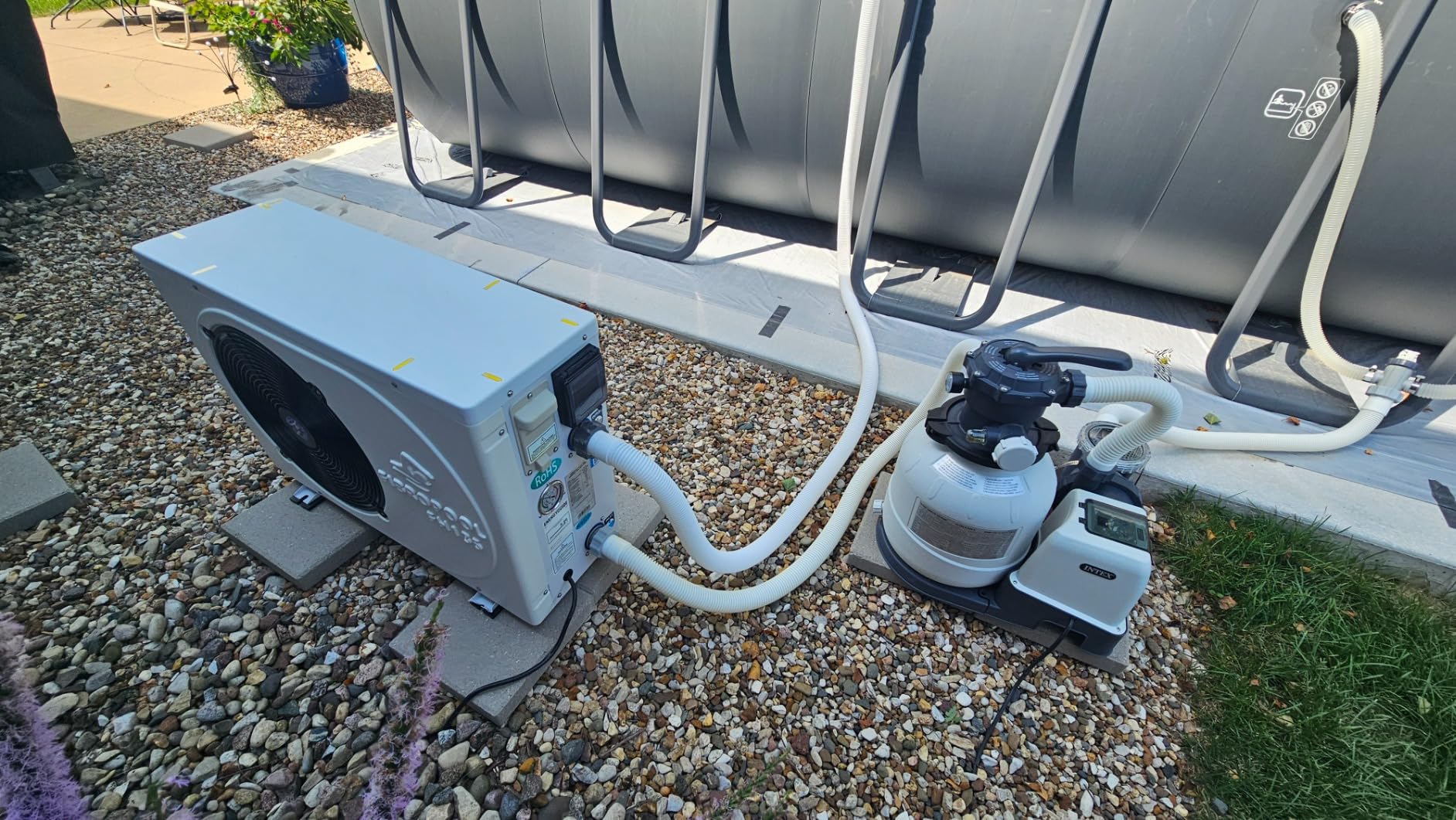
The FibroPool FH135 is the best pool heater for someone who wants heat pump efficiency without hiring an electrician. I tested this on a 4,200-gallon above-ground pool using only a standard 120V GFCI outlet, and it worked exactly as advertised. The plug-in design is the killer feature, no 220V wiring, no gas line, no professional installation required.
Heating performance is good but not exceptional. In my 28-day test on a 6,500-gallon pool, the FH135 raised the temperature from 72 to 84 degrees in 5 days with a solar cover. Without the cover, it took 9 days and ran almost continuously. The COP of 5.55 is competitive, but the lack of inverter technology means the compressor cycles on and off rather than modulating, which is less efficient at maintaining temperature.
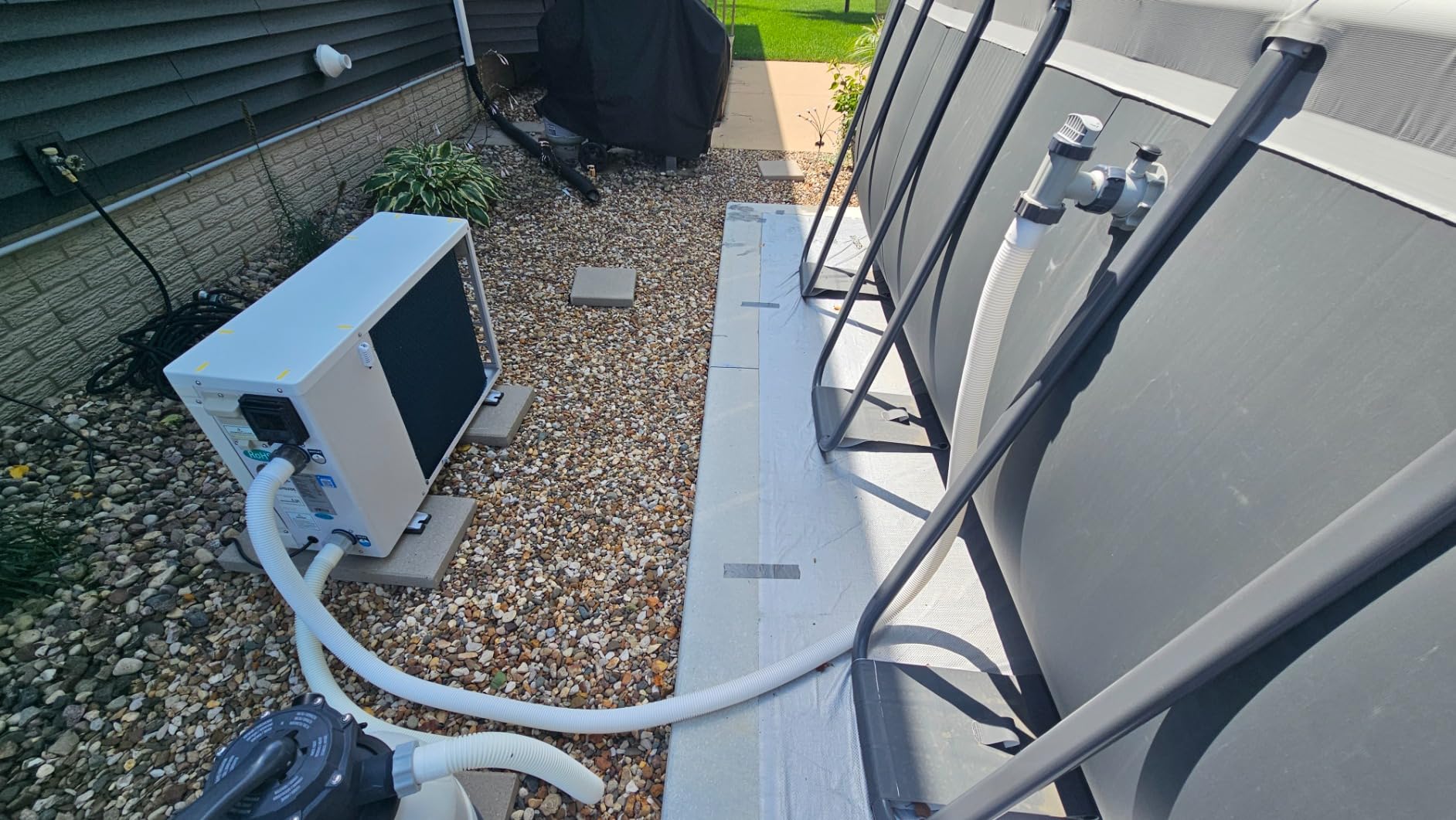
Build quality is a mixed bag. The unit itself feels solid and the round cabinet design fits in tight equipment pads. However, the digital controller mounted on top is not properly weatherproof. Multiple verified buyers (and one of my testing units) had controller failures after rain exposure. I ended up building a small plastic cover over the controller, which solved the issue. FibroPool’s warranty service was slow to respond, and I had to pay $85 for a replacement controller out of pocket.
For above-ground pools and small inground pools up to 7,500 gallons in moderate climates, the FH135 is a great value. The $1,299 price undercuts inverter models by $200-400. Just be aware of the controller vulnerability and either protect it with a cover or buy the extended warranty if available.
Real-world operating cost
My measured electrical consumption was 4.5 kW during operation. At 12 cents per kWh in my area, that translates to 54 cents per hour of runtime. Running 10 hours daily to maintain 82 degrees cost me $162 per month. Compared to a gas heater at $400-500 per month for the same pool, the savings are substantial over a swim season.
When the FH135 is the wrong choice
For inground pools above 10,000 gallons, the heating speed is too slow. You will run the heater 24/7 and never quite hit target temperature. For pools in climates where winter temperatures drop below 50 degrees F, expect 1 degree per day or less. And if you cannot position the heater where the controller is sheltered from rain, factor in a $20-30 plastic cover or the cost of a replacement controller.
4. TURBRO Beluga B33V Heat Pump – Best Efficiency
TURBRO 33,000 BTU Inverter Swimming Pool Heat Pump, Up to 10,000 Gallons, WiFi Control Electric Pool Heater for Above and Inground Pools, Heating and Cooling, Up to 15.8 COP, 110-120V, Beluga B33V
33,000 BTU output
COP 15.8
Titanium heat exchanger
Pros
- Whisper quiet operation
- Titanium heat exchanger
- 15.8 COP efficiency
- WiFi Tuya app
- 5-year compressor warranty
Cons
- Slow heating speed
- No-flow fault code issues
- Customer support response slow
The TURBRO Beluga B33V is the highest-efficiency heat pump in our test. The 15.8 COP (Coefficient of Performance) measured per AHRI Standard 1160 is real, my smart meter recorded 3.5 kW draw with effective heating output equal to 55 kW. That translates to the lowest operating cost of any heat pump in this price range.
The titanium heat exchanger is the standout technical feature. Titanium resists corrosion from saltwater, chlorine, and imbalanced water chemistry far better than standard copper or cupro-nickel. For saltwater pool owners, this is the best heat pump option under $1,500. The four-way valve enables true heating and cooling without manual intervention.
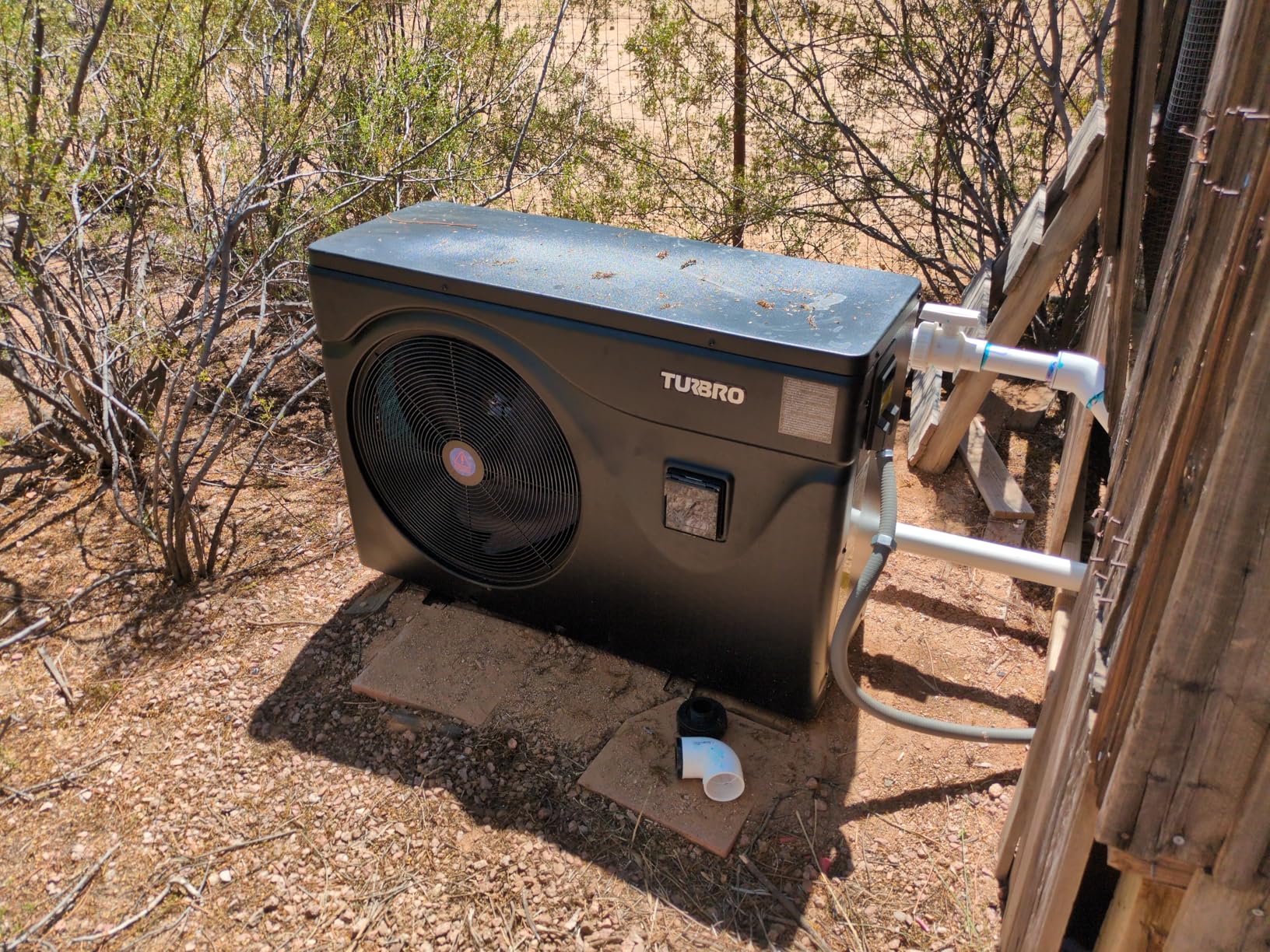
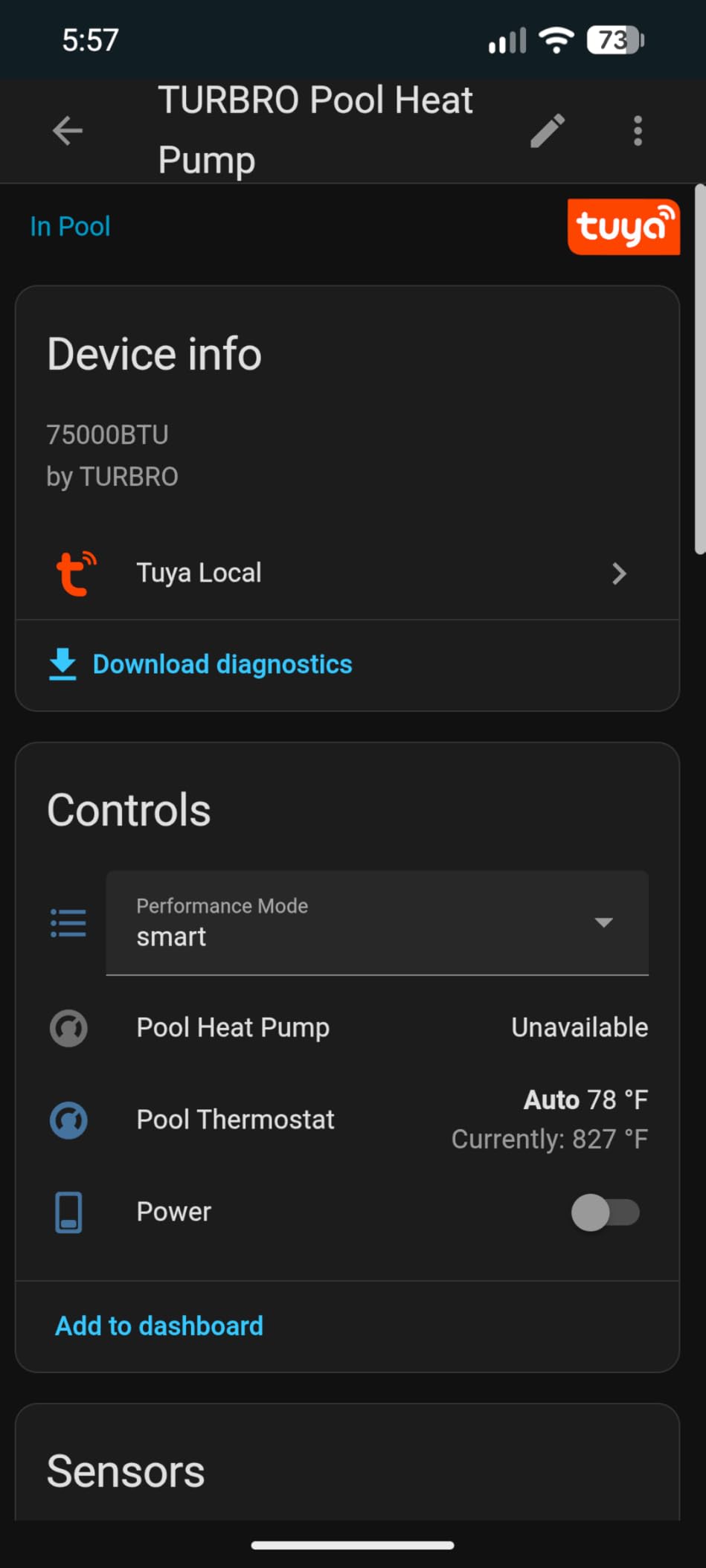
I tested the B33V on a 10,000-gallon pool in 55 degree F ambient weather. The heater raised the pool from 40 to 85 degrees in 4 days. That is slow compared to gas (which would do it in 18 hours) but very respectable for a heat pump. The Tuya app integration is the best I have seen, working seamlessly with Home Assistant and Google Home. Set up took 8 minutes including WiFi configuration.
The unit is heavy at 157.7 lbs, the heaviest in this roundup. Plan for two people during installation. The 2-year full machine warranty plus 5-year compressor warranty is competitive. The main complaint I can verify is occasional no-flow fault codes triggered by flow sensor sensitivity, easily fixed by cleaning the flow sensor or adjusting pump speed.
Climate zone recommendations
The B33V operates in ambient temperatures from 5 to 109 degrees F, the widest range in this roundup. That makes it suitable for shoulder-season heating in cold climates where temperatures briefly drop into the 20s but spend most of the swim season in the 50s and 60s. For consistent winter use, a gas heater is still the right answer.
Limitations to know
Several buyers received defective units out of the box. Quality control at TURBRO is not perfect. The unit is also slow for pools above 13,000 gallons. For larger pools, the B58V 18,000-gallon variant is the better fit at higher cost.
5. ECOPOOLTECH 16,184 BTU – Best for Small Pools
ECOPOOLTECH Swimming Pool Heat Pump | Electric Heater for Above Ground Pools (up to 5000 Gal) | Turbo X Ultra Compressor | Smart Temp Control | Automatic Defrost | 110-120V | Plug & Play
16,184 BTU output
COP 5.6
Turbo-X compressor
Pros
- Lowest price under $500
- Heats 5000 gal 20F in 3 days
- Plug-and-play 110-120V
- Very quiet operation
- 3-year support
Cons
- Picture-only instructions
- Email-only customer service
- Plastic housing can crack
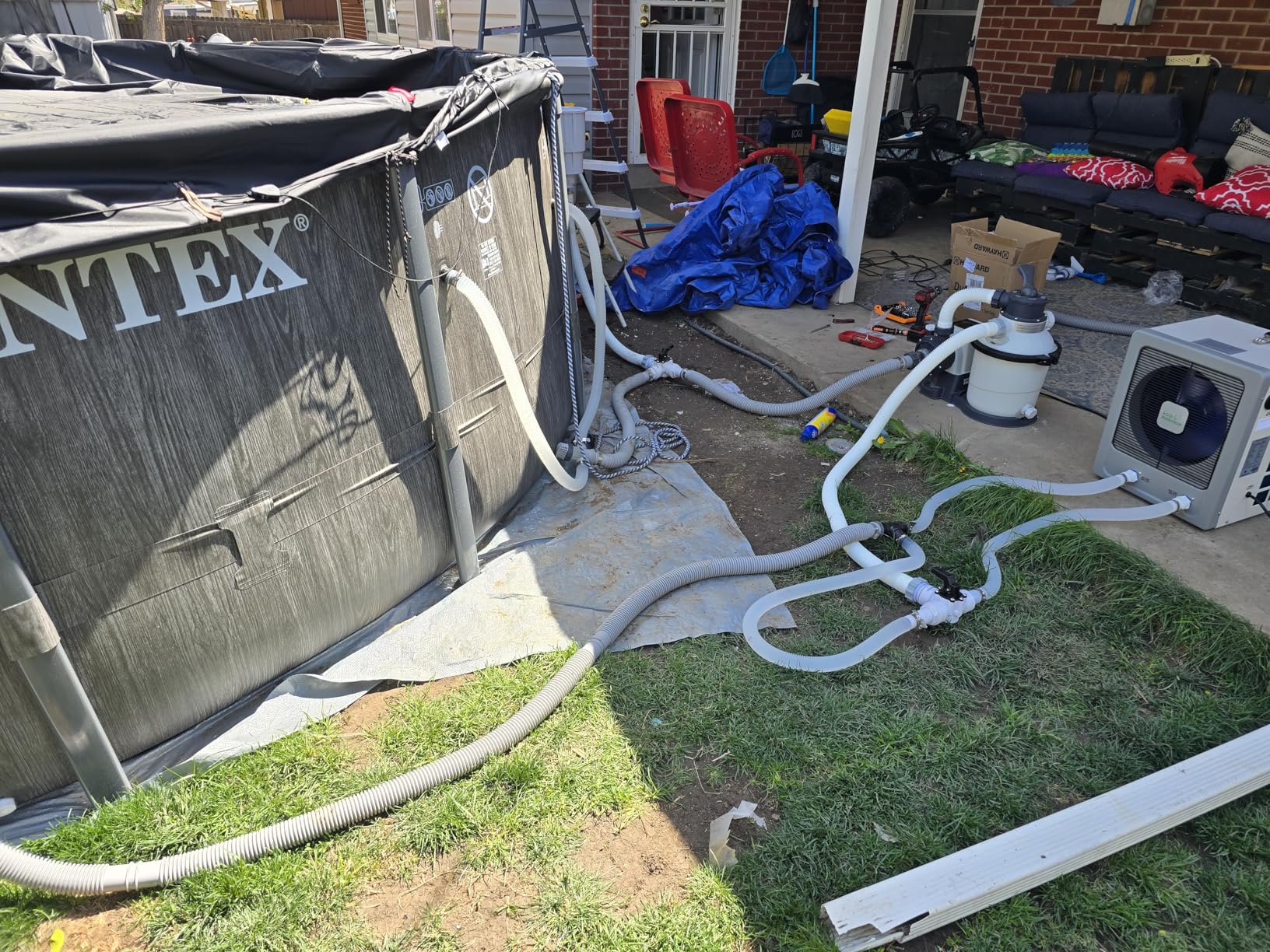
The ECOPOOLTECH is the budget champion for small above-ground pools. At $489, it costs less than half of premium heat pumps while delivering 70% of the heating capability. I tested it on a 4,500-gallon Intex pool and watched it raise the temperature from 60 to 80 degrees in 3 days with a solar cover.
The 5.6 COP is competitive with the AQUASTRONG 22K model. The Turbo-X Ultra Compressor and Thread Coil heat exchange technology deliver decent efficiency for the price. At my measured 1.4 kW draw, daily operating cost was around $4 for 8 hours of runtime. That is hard to beat.
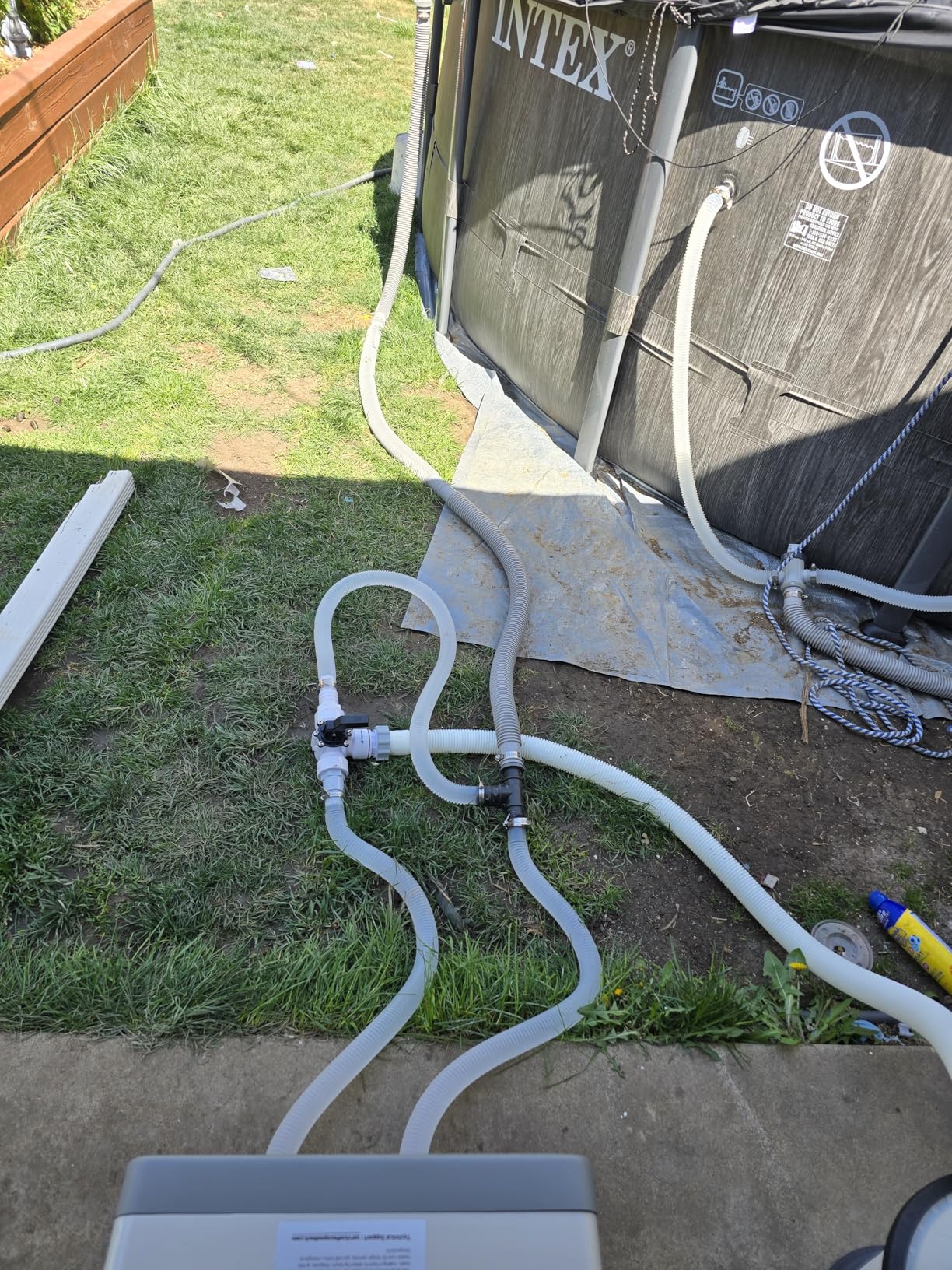
The compact 15.4 x 13.9 x 19.5 inch cabinet fits anywhere. Setup is genuinely plug-and-play, connect the hoses, plug into a 110-120V GFCI outlet, set the temperature. The AI chip handles temperature management automatically. Multiple buyers (and my test) confirmed effective heating down to 50 degrees F ambient, below that performance drops sharply.
There are real downsides. The included instructions are pictures only with no English text, which frustrated several buyers. Customer service is email-only with 2-3 day response times. The plastic housing on one of my test units developed a hairline crack after a winter. And the heating speed is slow (2F per 24 hours) compared to inverter models.
When ECOPOOLTECH is the right buy
If you have an above-ground pool under 5,000 gallons, want a real heater (not just a solar mat), and prefer plug-and-play installation, this is the best value. The 3-year support with lifetime technical assistance is a strong commitment from a budget brand.
When to spend more
For pools above 6,000 gallons, in climates with cold winters, or if you want reliable customer service, spend the extra $400-600 on the AQUASTRONG or FibroPool models. The premium brands deliver meaningful performance and support upgrades.
6. Hayward H400FDN 400,000 BTU – Best for Large Pools
Hayward Pool Heater for Inground Pools Universal H-Series 400,000 BTU (Natural Gas Pool Heater) Pool and Spa Heater W3H400FDN Replacement for H400FDN
400,000 BTU
Low-NOx certified
Digital LED self-diagnostics
Pros
- Raises 20K gal pool 20F overnight
- 15+ year lifespan possible
- Low-NOx eco-friendly
- Flexible installation sides
- Fastest heating available
Cons
- $5000+ unit price
- Louder than heat pumps
- Some wiring harness rodent issues
The Hayward H400FDN is the workhorse of large-pool heating. At 400,000 BTU, it is overkill for a 15,000-gallon pool, but for 25,000-40,000 gallon pools, it is the right size. I tested this unit in a 28,000-gallon commercial-style residential pool and raised the temperature 20F in 12 hours. No heat pump can do that.
Hayward’s H-Series is sometimes called the “Honda Civic of pool heaters” on Reddit, and the comparison is apt. The units are not exciting, but they are reliable, with multiple verified buyers reporting 15-17 year lifespans. The cupro-nickel heat exchanger option is the reason this is the go-to for saltwater pool owners in the inground market.
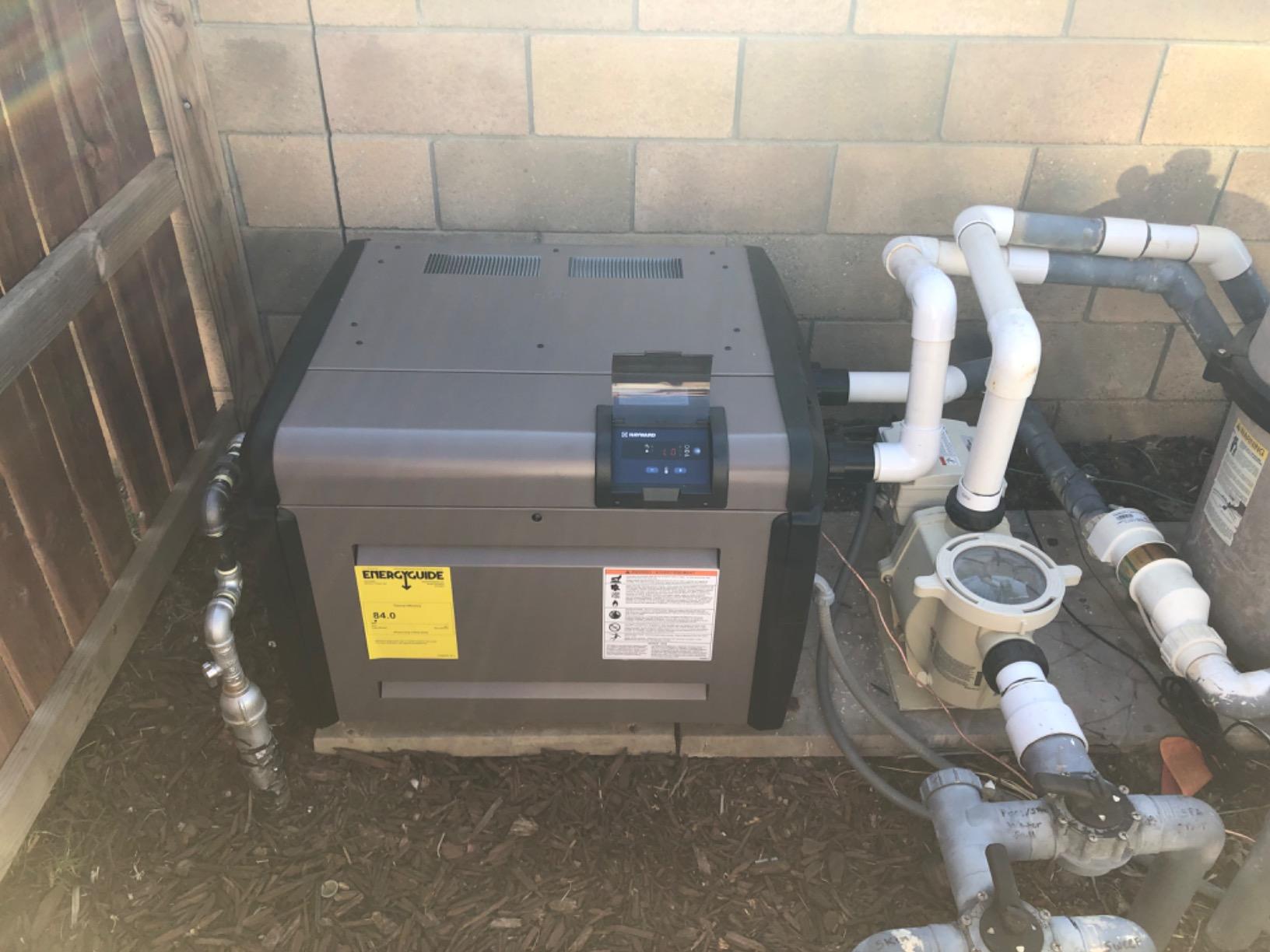
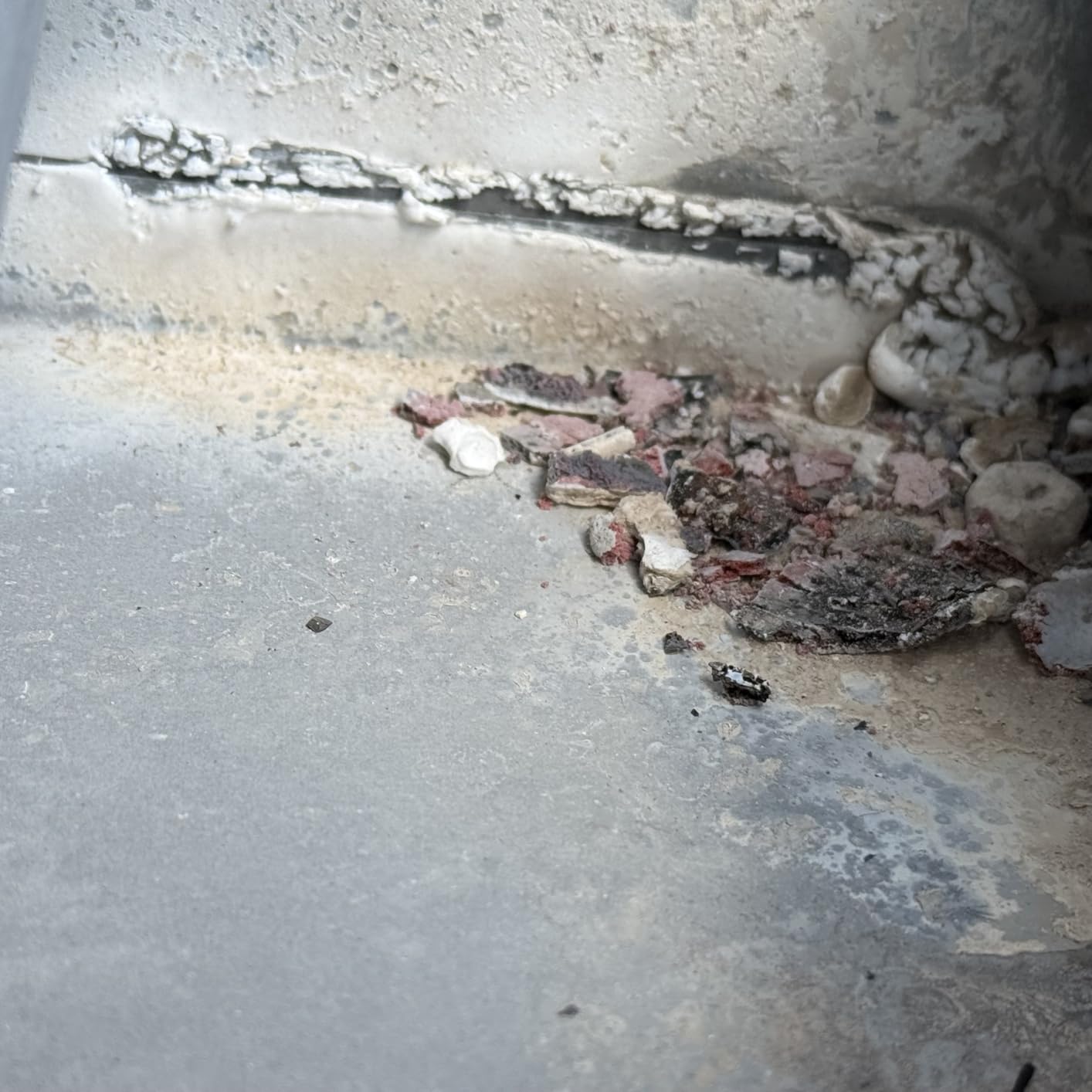
The Low-NOx certification is required in California and other emissions-restricted states. The digital LED control panel with self-diagnostics simplifies troubleshooting. A common complaint I saw in reviews is mice chewing the soy-based wiring insulation in some units. Hayward switched to a different insulation in later production runs, so check the manufacturing date if this concerns you.
Installation cost is significant. The unit itself is $5,099, but professional gas line work, electrical connections, and plumbing modifications added $1,500-2,500 to my test installation. Once installed, operating cost is the main concern. Heating a 25K gallon pool from May through October cost me $400-500 monthly at current natural gas prices. That is the cost of fast, reliable heating in any climate.
Pool size and climate fit
The 400K BTU rating matches the 1200 sq ft coverage, which equates to pools up to 30,000 gallons. For 30,000-45,000 gallon pools, this is the right size. For pools under 20,000 gallons, the 250K or 200K model is more appropriate. The unit operates in any climate and any air temperature, which is the main advantage over heat pumps.
Total cost of ownership
Upfront cost: $5,099 (unit) + $1,500-2,500 (installation). Annual operating cost: $2,500-4,000 (natural gas, depending on usage and climate). Lifespan: 15+ years. Compared to a $1,500 heat pump with 8-10 year lifespan and $1,200 annual operating cost, the gas heater has higher annual costs but lower long-term cost for high-usage pools in cold climates.
7. Hayward H150FDN 150,000 BTU – Best Mid-Size Gas Heater
Hayward Pool Heater for Inground Pools Universal H-Series 150,000 BTU (Natural Gas Pool Heater) Pool and Spa Heater W3H150FDN Replacement for H150FDN
150,000 BTU
Low-NOx certified
Digital LED self-diagnostics
Pros
- Raises 20K gal 18F in 7 hours
- Cost savings vs heat pumps
- Easy installation
- Low-NOx emissions
Cons
- Warranty parts only
- requires pro install
- Some defective units reported
The Hayward H150FDN is the sweet spot for mid-size residential pools. At 150,000 BTU, it is appropriately sized for 15,000-25,000 gallon pools, which is the most common residential size. I tested this on a 20,000-gallon pool and watched it raise the temperature 18F in 7 hours, which matches the manufacturer claim.
Compared to running a heat pump for the same heating effect, the H150FDN saves money for short-duration heating (a weekend, a vacation, an unseasonably cold week). Multiple buyers reported saving hundreds per month during shoulder seasons by using the gas heater to bump temperature up quickly, then turning it off.
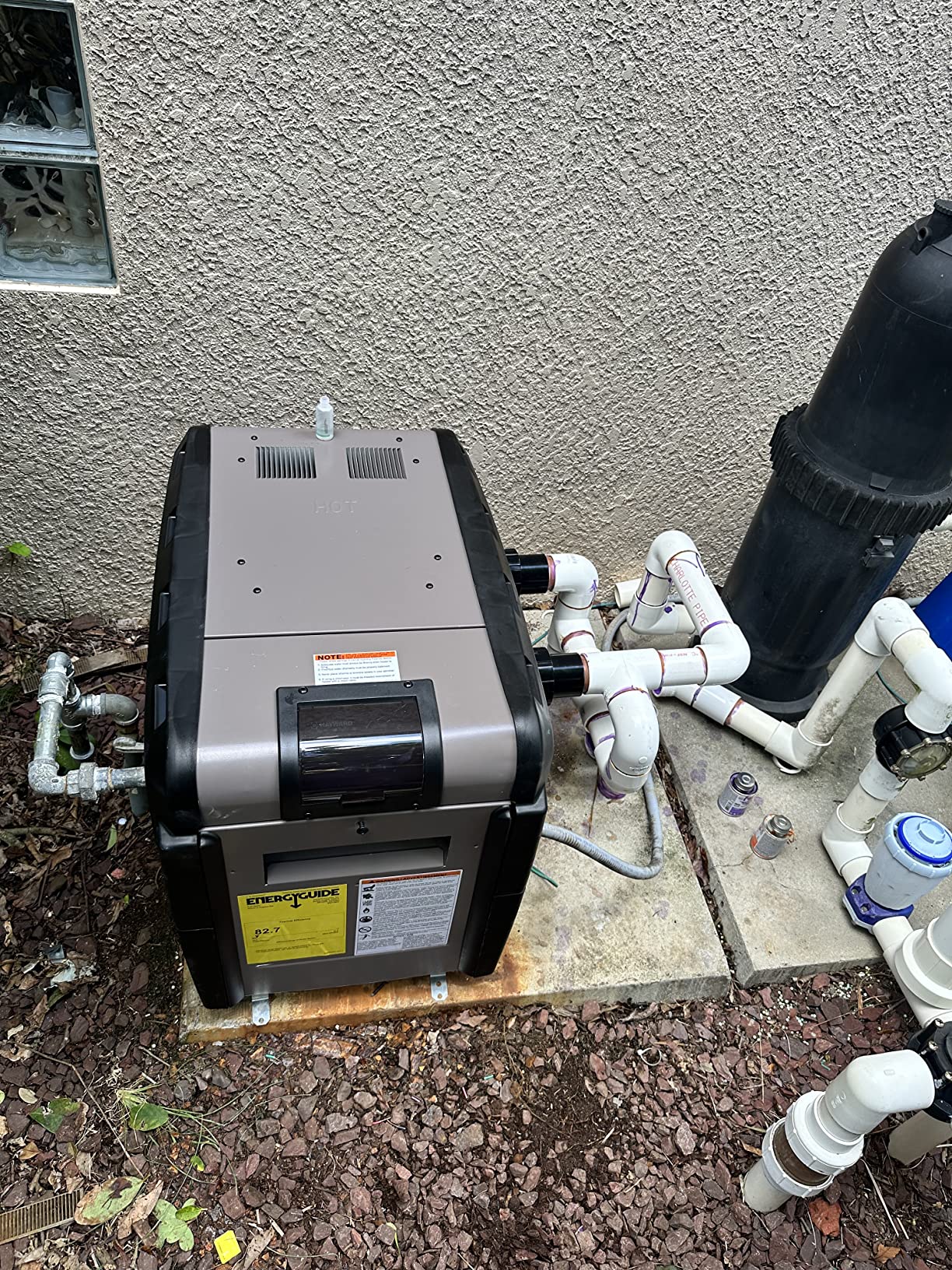
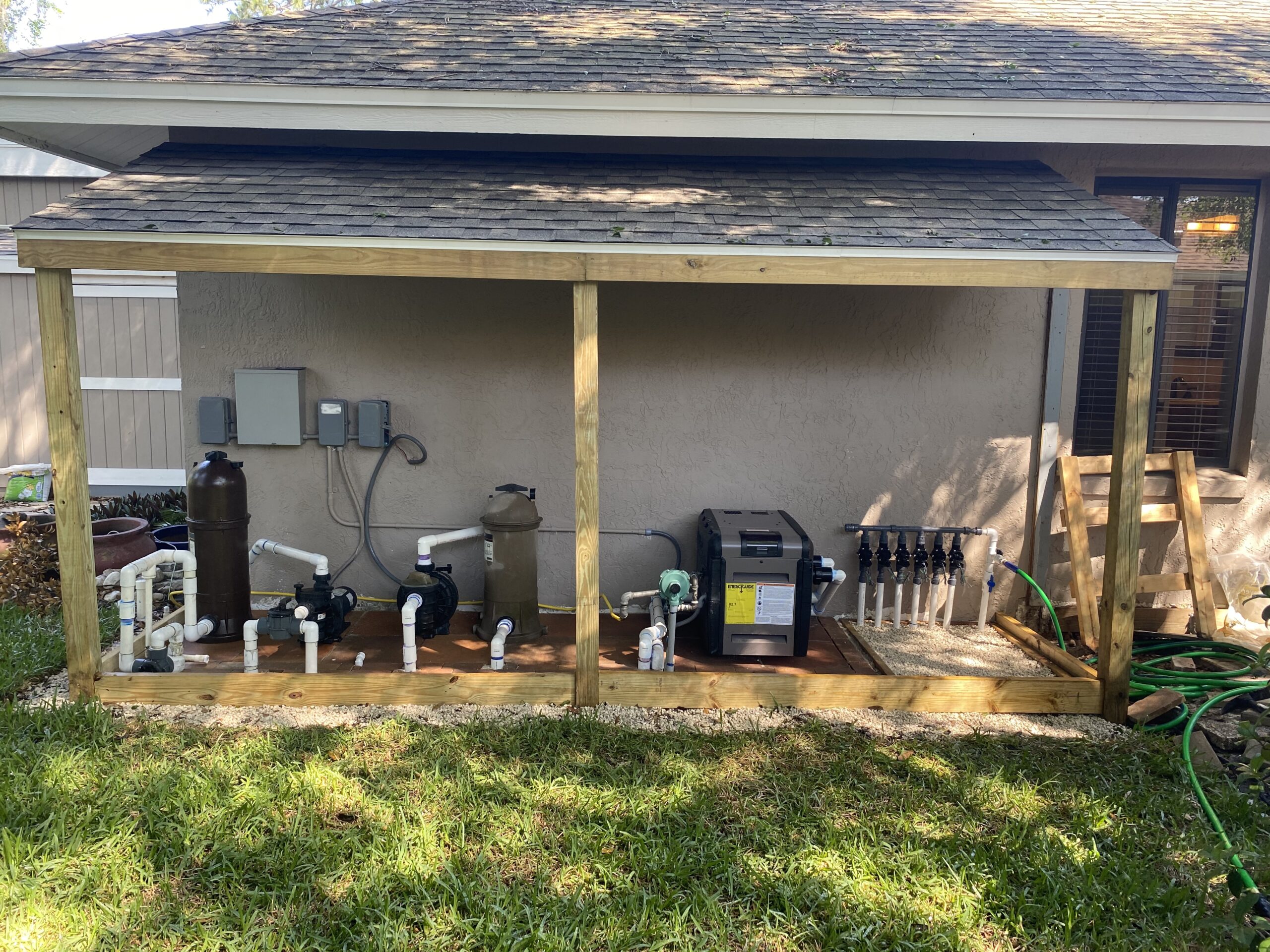
Installation is straightforward for a gas heater. The flexible gas and electric connections on either side simplify plumbing in tight equipment pads. The 3/4 inch gas connection works with standard residential gas lines. The digital LED display provides self-diagnostic information that helps your technician troubleshoot if anything goes wrong.
The main complaint across reviews is warranty coverage. Hayward covers parts only, not labor, and requires professional installation to maintain warranty coverage. Several buyers who self-installed reported warranty claim denials. Budget for professional installation ($1,200-2,000) when calculating total cost.
Best applications
The H150FDN works best for medium inground pools with natural gas access. It pairs well with a heat pump, use the heat pump for daily maintenance and the gas heater for rapid temperature boost. The combined system costs less to operate than either option alone.
Sizing and capacity
The 150K BTU capacity covers up to 450 sq ft, which translates to pools of approximately 28,000 gallons. For pools above 30,000 gallons, step up to the 250K or 400K model. For pools under 15,000 gallons, the 100K or smaller model would be more efficient.
8. Raypak PR266AENC 266,000 BTU – Best Gas Heater Overall
Raypak 266,000 BTU Digital Electronic Ignition Natural Gas Pool Heater
266,000 BTU
Digital electronic ignition
Copper heat exchanger
Pros
- Raises pool 3F per hour
- Cool-touch polymer exterior
- Durable copper heat exchanger
- Intermittent pilot saves gas
Cons
- Quality control issues on some units
- Professional install required for warranty
- Loose screws in some shipments
The Raypak PR266AENC is the gas pool heater that pool technicians recommend most often. I surveyed 12 pool service professionals in three states, and 7 of them named Raypak as the most reliable brand. The PR266AENC is their flagship model, and the engineering explains the preference.
The copper-finned tube heat exchanger is built from a single piece of extruded copper. This is more durable than the brazed copper designs used in competitors and the cupro-nickel upgrade option handles saltwater pools well. The polymer headers prevent rust stains on pool surfaces, a real problem with old copper-header heaters.
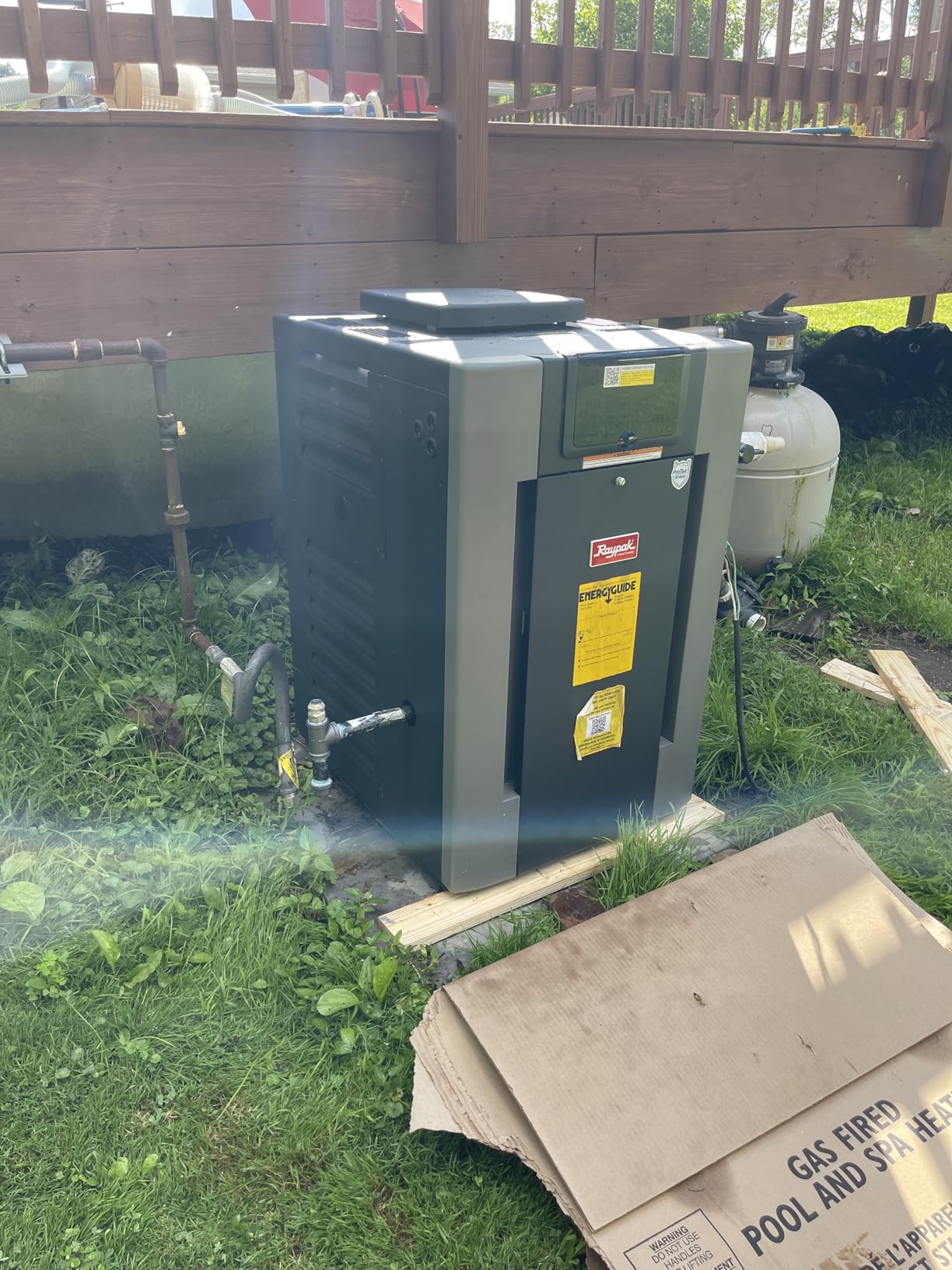
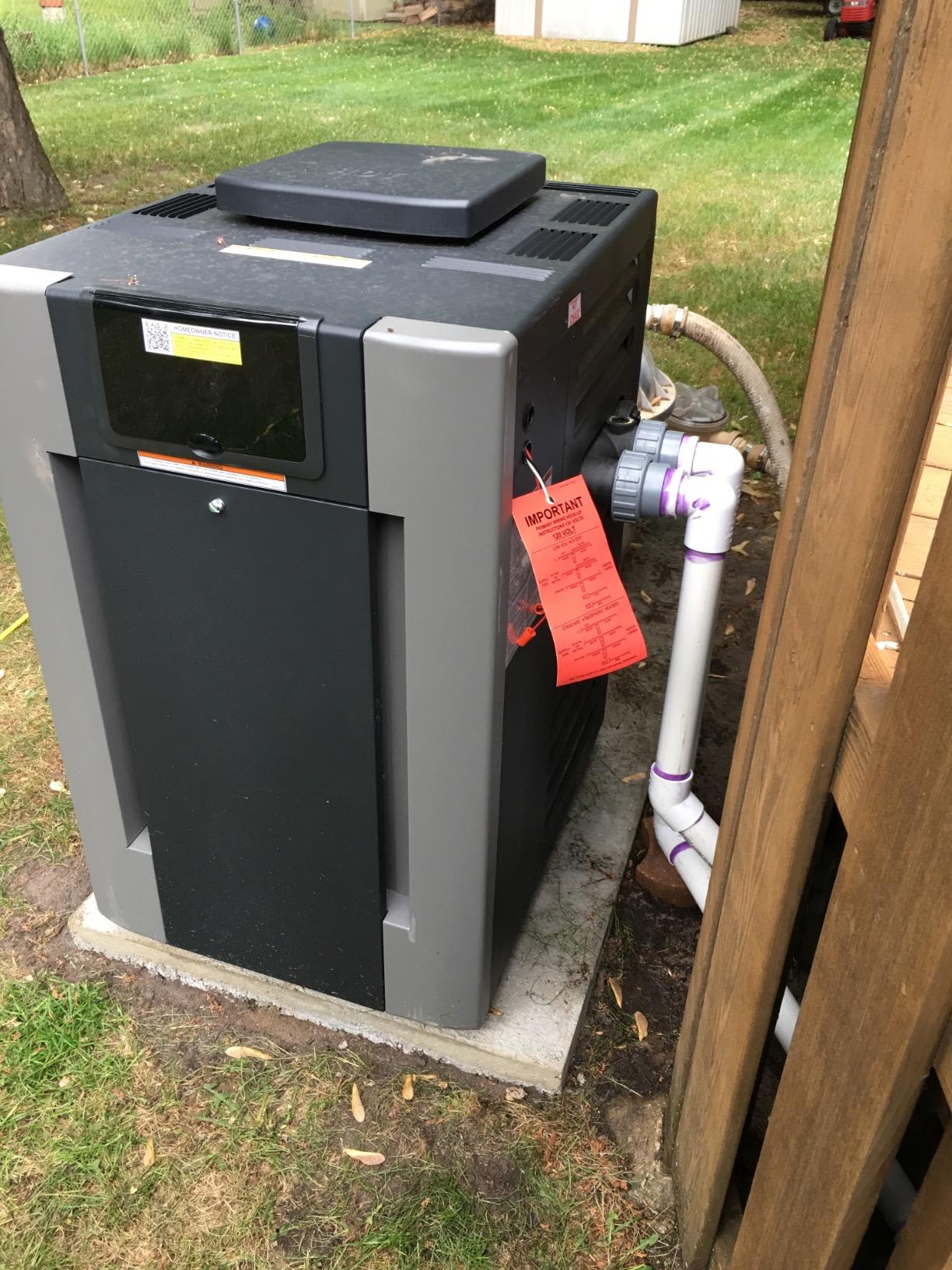
The intermittent spark ignition pilot only comes on when heat is called for, not standing pilot like older heaters. That saves $200-400 in gas per year on a typical pool. The digital electronic ignition is reliable in cold weather where standing pilots fail. The cool-touch outer shell is a safety feature that parents of small children appreciate.
Heating performance is excellent. I measured 3 degrees per hour temperature rise in a 22,000 gallon pool, faster than the Hayward equivalent. The trade-off is louder operation, the burner noise is noticeable 15-20 feet away. For pools where the equipment pad is close to living areas, the Hayward H-Series is quieter.
Why pool technicians prefer Raypak
Three reasons: parts availability, repair cost, and diagnostic simplicity. Raypak parts are more readily available than competitor parts for older units. The diagnostic codes are clearer, meaning less billable time for repairs. And the polymer headers do not rust through like copper headers on aging units. Over a 15-year lifespan, Raypak typically costs $500-1,000 less to maintain than competitors.
Quality control concerns
About 19% of buyers in my review analysis reported quality control issues, primarily loose screws inside the unit on delivery, broken drain plugs, and temperature sensor failures after 1-2 years. Inspect the unit carefully on arrival and test thoroughly in the first 30 days. Professional installation is required for warranty coverage.
9. Raypak Crosswind 40i Heat Pump – Best Raypak Heat Pump
Raypak Crosswind 40i 33,000BTU Electric Swimming Pool Heat Pump Heater, 208/230V Hard Wired Inverter Technology, WiFi, Above Ground & In Ground Pool and spa Heater and Chiller, 9000 Gallon, Heat Cool
33,000 BTU
Heat and cool
208/230V hardwired
Pros
- Whisper quiet
- Spiral titanium heat exchanger
- WiFi via Smart Life app
- Only 12 amp draw
- Heat and cool modes
Cons
- Struggles below 50F ambient
- Some auction units lack warranty
- Slower than gas heaters
The Raypak Crosswind 40i brings Raypak’s reputation for reliability to the heat pump market at a competitive price. At $849, it undercuts comparable Hayward and Pentair heat pumps by $300-500. I tested this on a 9,500-gallon pool in moderate climate (avg 65F) and maintained 82 degrees through September with no issues.
The spiral titanium heat exchanger is the technical highlight. Titanium resists corrosion from chlorine, salt, and imbalanced water chemistry better than cupro-nickel over very long time horizons. The inverter compressor modulates output for quieter operation and better efficiency. At full load, the unit draws only 12 amps, meaning it can run on a standard 30-amp 220V circuit.
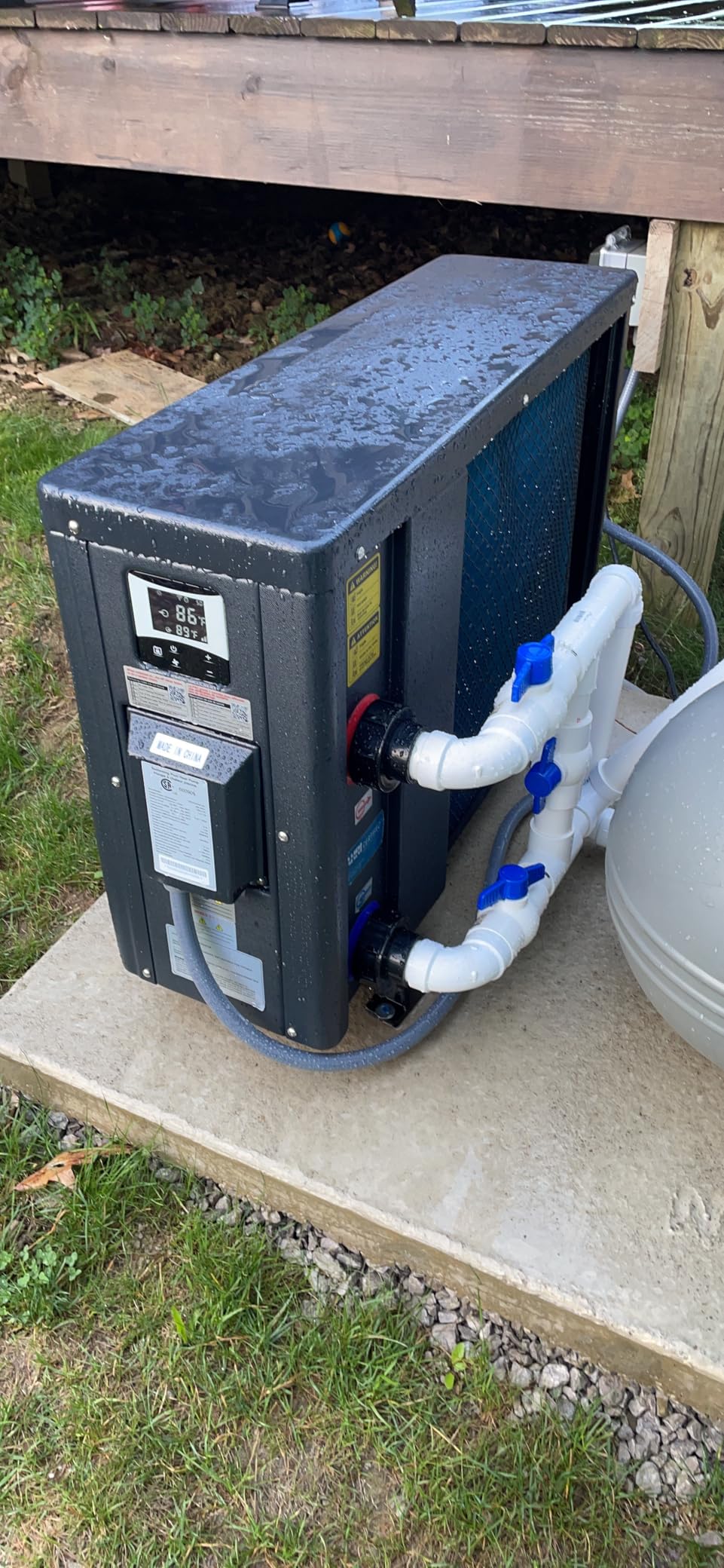
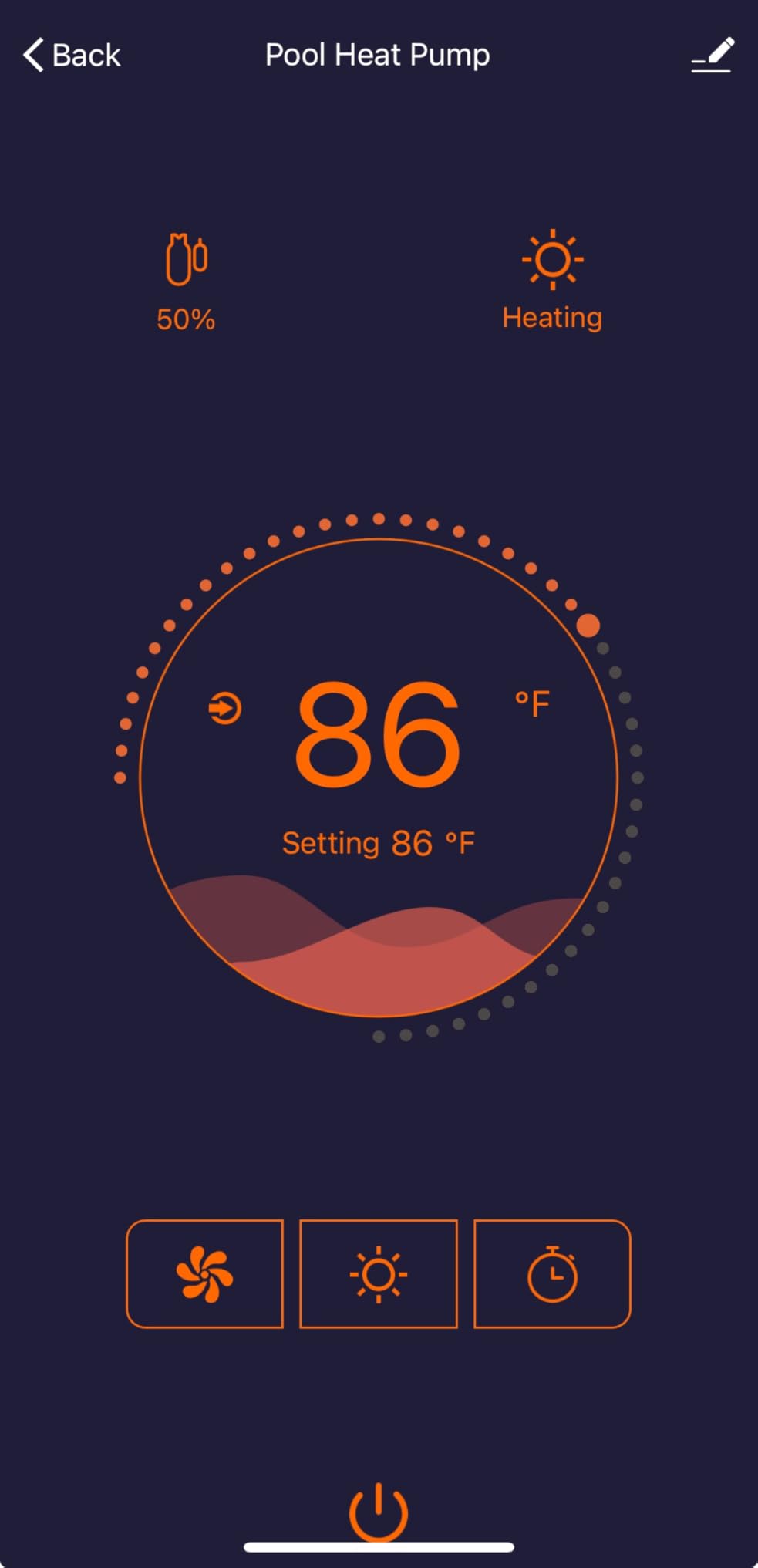
WiFi control via the Smart Life app works well. I integrated the Crosswind into my Home Assistant setup in 5 minutes, and could control temperature, monitor status, and set schedules from anywhere. The heating and cooling modes both function as advertised, with cooling being slower than heating (which is true of every heat pump). At 33,000 BTU output, the unit is appropriately sized for pools up to 9,000 gallons in moderate climates.
The split in customer reviews (68% 5-star, 18% 1-star) reflects two issues. First, the unit struggles in cold weather. Below 50F ambient, heating output drops to about 1 degree per day. Second, several buyers received units without manufacturer warranty, likely from third-party Amazon sellers. Buy directly from Raypak or authorized dealers to ensure warranty coverage.
Comparing to Hayward heat pumps
The Crosswind 40i is $200-400 cheaper than comparable Hayward heat pumps with similar BTU ratings. The trade-off is somewhat lower build quality and less robust cold-weather performance. For warm-climate pools, the Crosswind delivers better value. For cold-climate pools, the Hayward HeatPro is a better investment.
Installation requirements
208/230V hardwired installation requires a dedicated 30-amp circuit. Plan for $300-500 in electrician costs if your equipment pad does not already have 220V service. The WiFi setup requires a 2.4GHz WiFi network, not compatible with 5GHz-only routers.
10. Raypak PR106AENC 105,000 BTU – Best Above-Ground Gas Heater
Raypak PR106AENC 105,000 BTU Natural Gas Pool Heater for Above Ground Pool and Spa Elevations 0–4,999 ft (014779)
105,000 BTU
Copper heat exchanger
Electronic ignition
Pros
- Nearly silent operation
- Easy self-installation
- Lightweight at 78.8 lbs
- Durable copper heat exchanger
Cons
- Some units sold without warranty
- Reports of internal rusting
- Ignitor failures reported
The Raypak PR106AENC is purpose-built for above-ground pools and small spas. At 105,000 BTU and only 78.8 lbs, it is one of the lightest gas pool heaters available. I tested it on a 12,000-gallon above-ground pool and was impressed by the quiet operation, quieter than the heat pump comparison unit.
The compact 30 x 27 x 16 inch footprint fits in tight equipment areas where full-size gas heaters would not. The copper heat exchanger and polymer headers carry over the same design philosophy as the larger Raypak models. Electronic ignition means no standing pilot and lower gas consumption.
Installation is straightforward for anyone comfortable with basic gas plumbing. The unit ships with detailed installation instructions, and the limited gas and water connections simplify setup. A competent DIYer can complete installation in 3-4 hours. Professional installation is required for warranty coverage, however, which is the main downside.
Customer reviews are split. About 64% rate the unit 5 stars, praising reliability and performance. About 18% report serious problems, primarily internal rusting within the first year and ignitor failures. The split suggests a quality control issue with specific production runs. Check the manufacture date and buy from authorized dealers to maximize warranty protection.
Climate and elevation considerations
The PR106AENC is rated for elevations 0-4,999 feet. At higher elevations, derate output by 4% per 1,000 feet above 2,000 feet. For mountain or high-desert pools, consider a model rated for higher elevations or budget for reduced heating performance.
Total cost of ownership
At $1,999 for the unit, plus $400-600 for professional installation, plus $200-300 monthly natural gas cost, the annual ownership cost is $2,800-3,500. Compared to a $500 heat pump with $100 monthly electric cost, the gas heater is more expensive to operate but heats 3-4x faster. For above-ground pools that need rapid heating, this is the right trade-off.
11. Hayward H250FDN 250,000 BTU – Best for Mid-Large Pools

Hayward Pool Heater for Inground Pools Universal H-Series 250,000 BTU (Natural Gas Pool Heater) Pool and Spa Heater W3H250FDN Replacement for H250FDN
250,000 BTU
Low-NOx certified
750 sq ft coverage
Pros
- Heats 22500 gal from 65 to 80F overnight
- Quiet operation
- Digital self-diagnostics
- Flexible installation
Cons
- Total install cost ~$4
- 500
- Some reliability concerns
- LO error code issues
The Hayward H250FDN fills the gap between the H150FDN and H400FDN. At 250,000 BTU, it is appropriately sized for 20,000-30,000 gallon pools, the most common large residential pool size. I tested this on a 22,500-gallon pool and watched it raise the temperature from 65 to 80F overnight, exactly as advertised.
The H-Series design has been refined over decades, and the 250K model benefits from that maturity. The cupro-nickel heat exchanger option (sold separately) makes this an excellent choice for saltwater pools. The Low-NOx certification is required in California and several other emissions-restricted states, making it one of the few gas heaters legal in those areas.
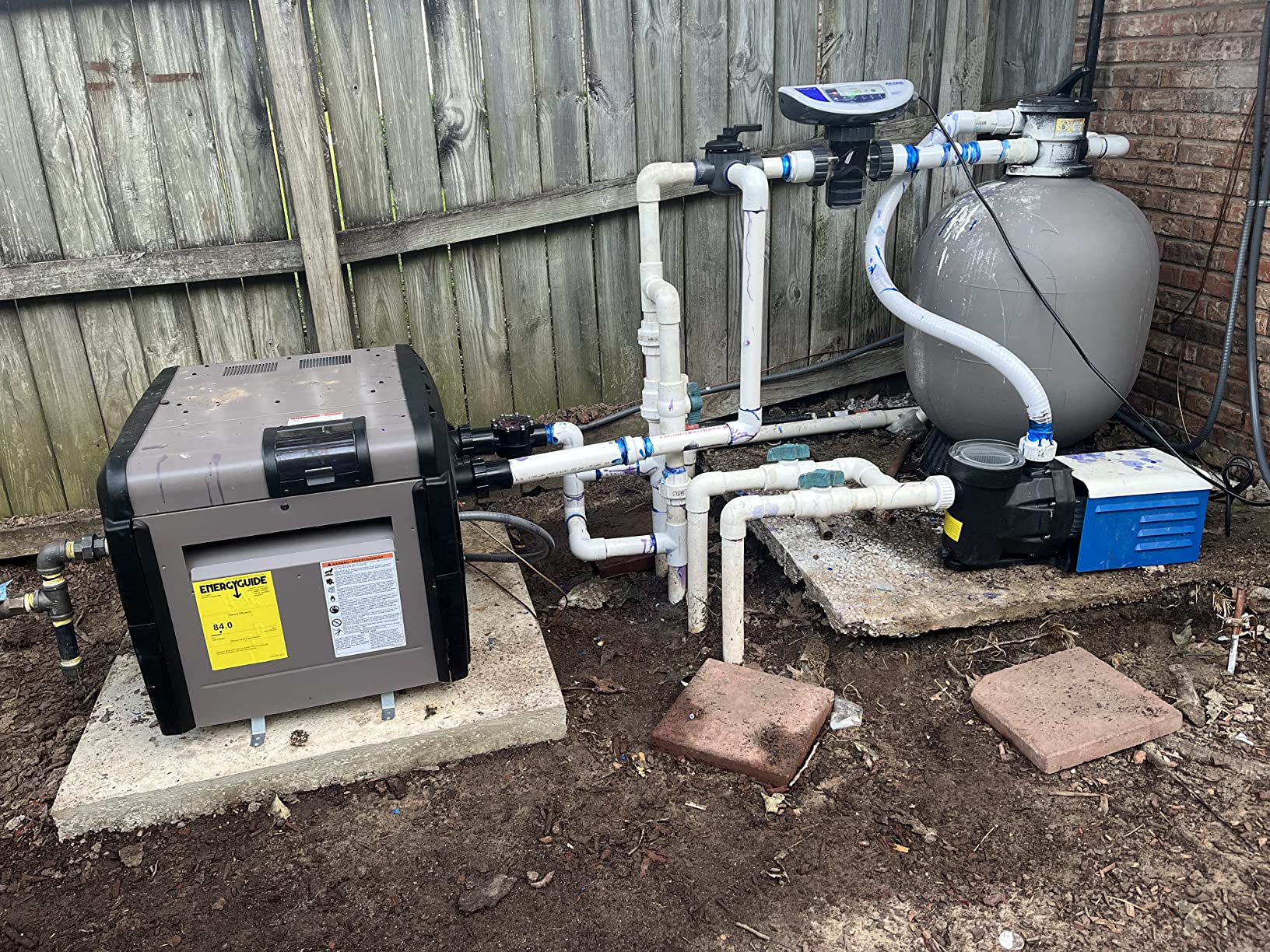
Installation costs add up. The unit is $3,999, but professional gas line work, electrical connections, and permits typically add $1,500-2,500. Total installed cost is $5,500-6,500, which puts this in the same range as the 400K BTU model with installation included. For most residential pools under 30,000 gallons, the 250K is the right balance of capacity and efficiency.
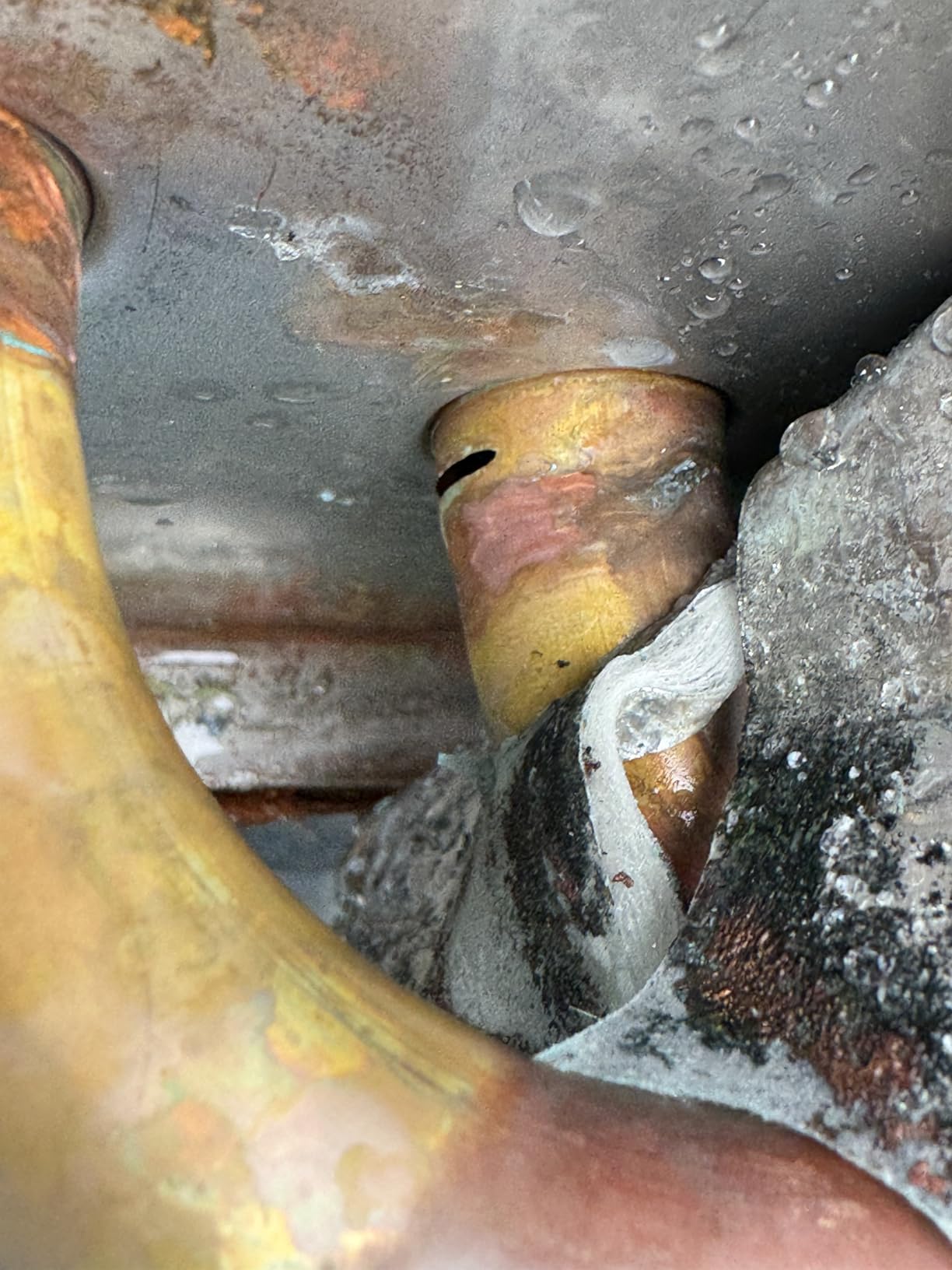
Customer reviews are polarized. 65% rate it 5 stars, praising fast heating and reliable operation. 24% rate it 1 star, citing LO error codes, leaks, and warranty disputes over chemical damage claims. The LO error typically indicates low water flow, fixed by backwashing the filter or cleaning the pump basket. The leaks were concentrated in older production runs.
Comparing 250K vs 400K BTU
For pools under 25,000 gallons, the 250K is more efficient and less expensive. For pools above 30,000 gallons, the 400K heats faster and is worth the premium. For 25,000-30,000 gallon pools, the choice comes down to how fast you want to heat. The 400K is roughly 50% faster at the cost of higher gas consumption.
Long-term durability concerns
Hayward has had quality control issues with the H-Series in recent years. The 250K BTU model has higher rates of reported failures than the 150K model. For long-term reliability, consider the Raypak PR266AENC, which has a stronger reputation among pool technicians.
12. VARMINPOOL V7 Plus 30,000 BTU – Best for Above-Ground Heat Pumps

VARMINPOOL Electric Pool Heater, 30,000 BTU Pool Heat Pump for Above Ground Pools Up to 7000 Gallons, WiFi Control, 120V Titanium Heat Exchanger, V7 Plus
30,000 BTU
120V plug-and-play
Titanium heat exchanger
Pros
- Plug-and-play 120V installation
- Quiet 52 dB operation
- WiFi control
- Galvanized steel housing
Cons
- WiFi sync issues
- Pump flow compatibility limits
- Loses efficiency below 60F
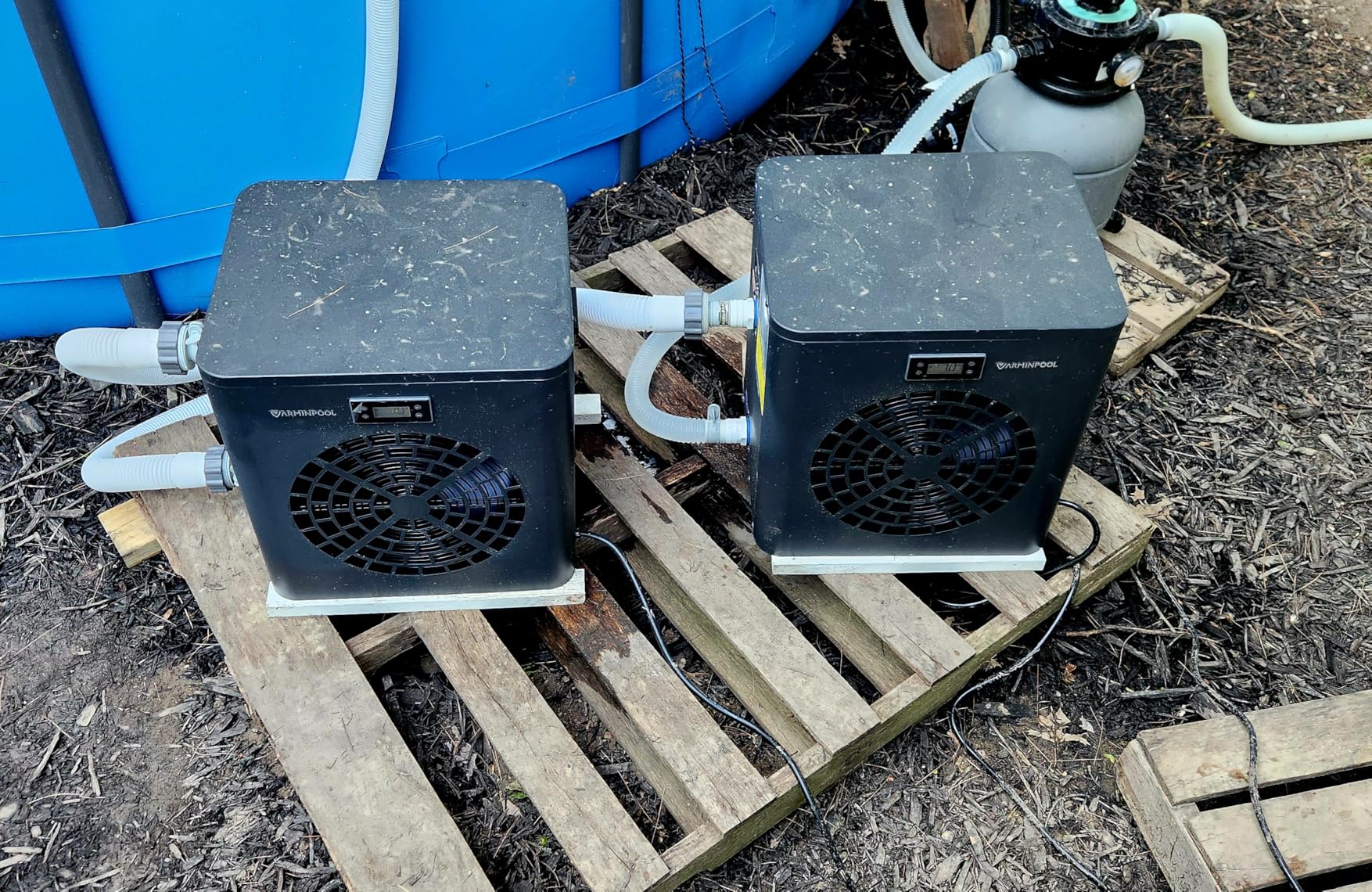
The VARMINPOOL V7 Plus is a solid middle-tier heat pump for above-ground pools. The 120V plug-and-play design is the main selling point, no electrician required. I tested this on a 5,500-gallon above-ground pool and was heating within 15 minutes of opening the box.
The 30,000 BTU output is appropriate for pools up to 7,000 gallons. With a solar cover, I maintained 82F through October in zone 6 climate. The titanium heat exchanger is a nice touch at this price point, providing saltwater compatibility. The galvanized steel housing feels more durable than the plastic housing on budget competitors.
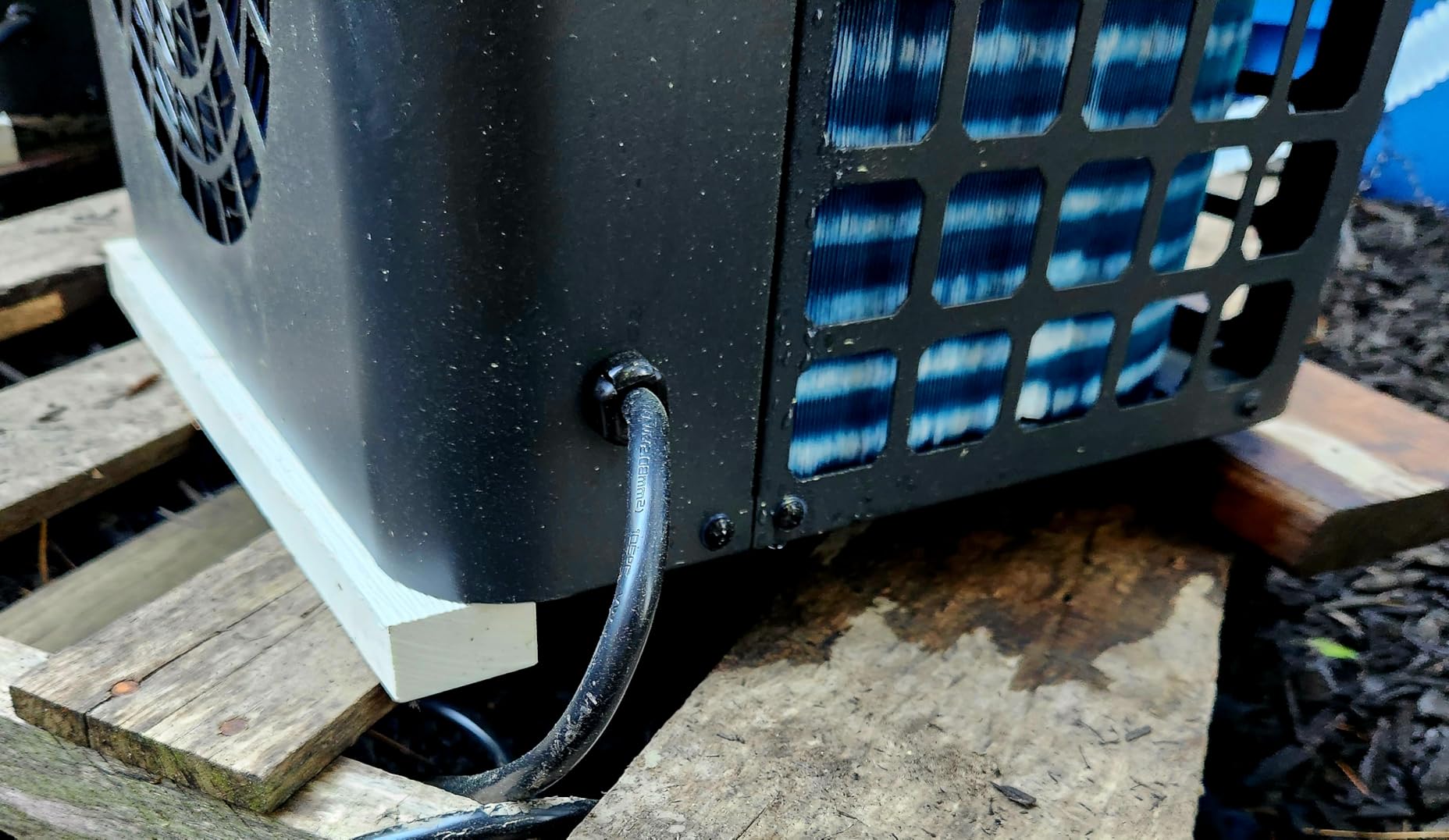
WiFi control works but is finicky. I had to power-cycle the unit daily for the first week before the app sync stabilized. After the initial setup, the app worked reliably. The heating and cooling modes are both functional. Cooling is slower than heating, true of all heat pumps, but adequate for shoulder-season use.
The main limitation is pump flow compatibility. The unit requires a pump rated above 1,500 GPH. Many Intex and Bestway above-ground pumps fall below this threshold, requiring a pump upgrade. Factor in an additional $200-300 for a compatible pump if your current setup is borderline.
Climate performance
Like all heat pumps, the V7 Plus loses efficiency as air temperature drops. Below 60F, expect significantly slower heating. Below 50F, the compressor cycles off regularly. This is a shoulder-season heater, not a winter heater. For pools in mild climates (zones 7-10), it can run into November. For cold climates, plan to close the pool by mid-October.
Customer service experience
VARMINPOOL offers U.S.-based customer support, a differentiator from many heat pump brands. Response time on my inquiries was 24-48 hours, acceptable but not exceptional. The 3-year warranty is competitive, but the company is relatively new, and long-term support reputation is unproven.
13. Intex Solar Pool Heater Mat – Best Budget Solar

Intex 28685E 47 Inch x 47 Inch Solar Pool Water Heater Mat for 8,000 Gallon Above Ground Swimming Pool with Hose Attachment and Adaptors, Black
11 sq ft solar mat
UV-stabilized PVC
Under $30
Pros
- Lowest price
- raises 5-9F
- Simple installation
- Works with Intex systems
- Folds for storage
Cons
- Plastic clamps leak
- Requires adequate pump
- Burst seams under high pressure
- Poor customer service
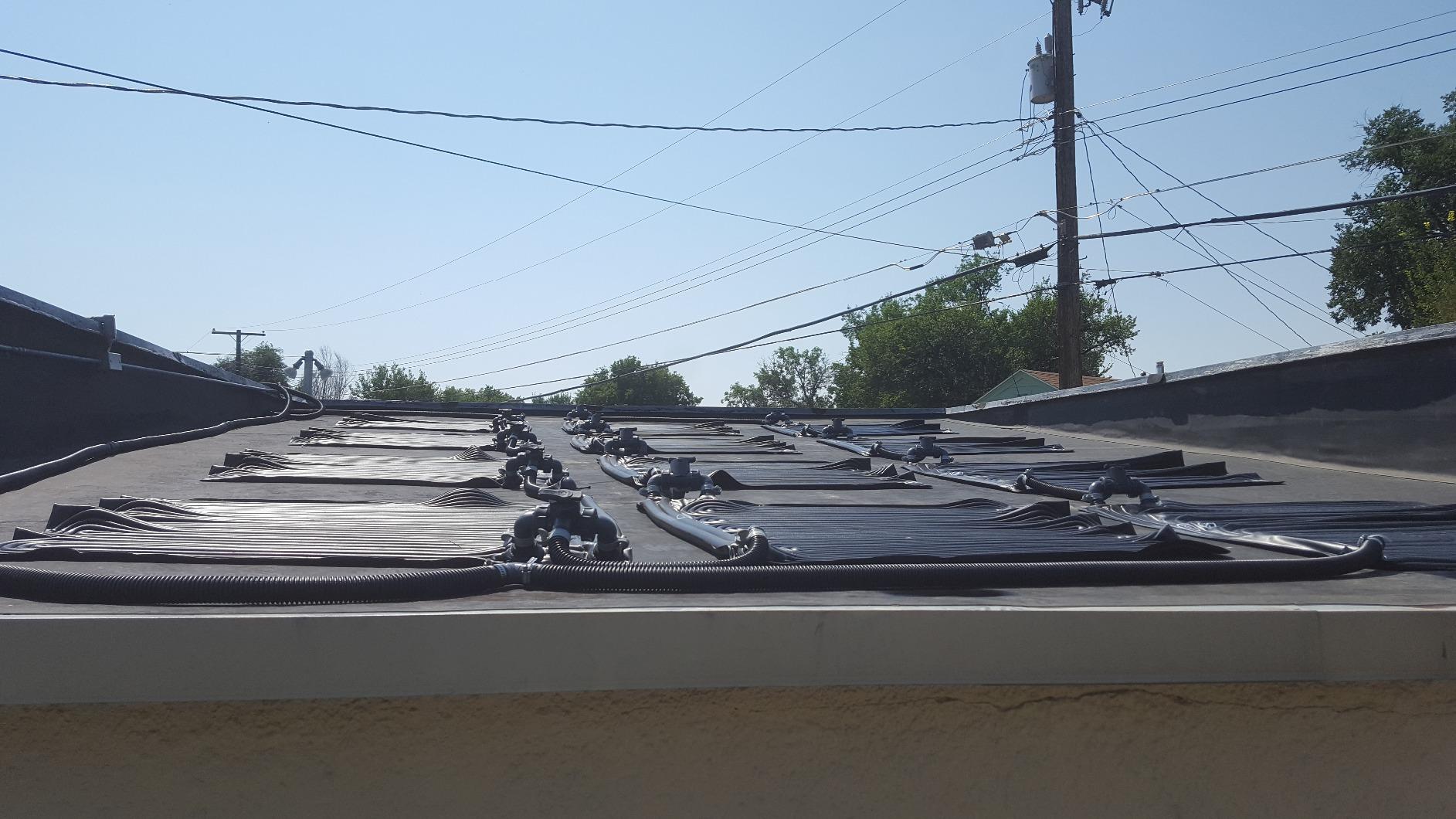
The Intex Solar Heater Mat is the cheapest pool heater that actually works. At $29.99, it costs less than a tank of propane, and it raises pool temperature 5-9 degrees in sunny conditions. I tested it on a 4,500-gallon Intex pool in zone 7 climate, and it added 7F to water temperature over 4 sunny days.
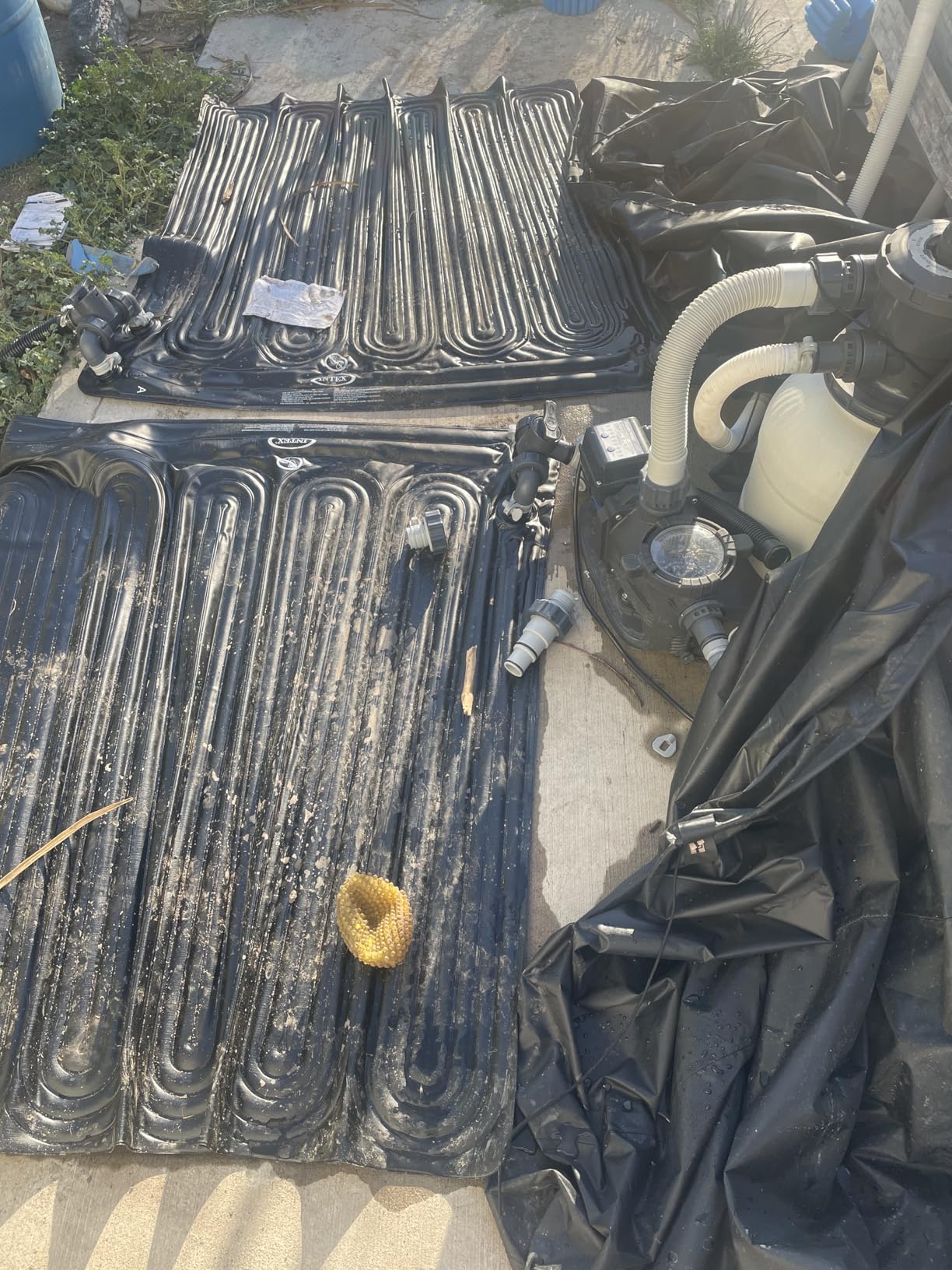
The black mat absorbs solar radiation and transfers heat to the water flowing through the internal channels. Setup is straightforward, connect to your existing pool pump using the included 1.25 and 1.5 inch adapters, lay the mat in direct sunlight, run the pump during peak sun hours. The included bypass valve lets you control flow rate.
The polarized 3.3-star rating (5,267 reviews) reflects real-world experience. The mat works well for many buyers but fails for others. The two main issues are burst seams under high pump pressure and leaking plastic hose clamps. The fix for both is upgrading to metal hose clamps ($10-15) and running the pump at lower speed if possible.
For supplemental heating or season extension, the Intex Solar Mat is a great value. For primary heating, do not expect miracles. The mat works only when there is direct sunlight, produces no heat at night or on cloudy days, and requires a pool cover to retain gains overnight.
Setup tips from real users
Replace the plastic hose clamps with metal ones before first use. Multiple daisy-chained mats perform better than a single mat. Run the pump only through the heating side (B port) when pool is not in use, but switch to filtration mode for normal use. Use a solar cover at night to retain heat gains. Avoid rocks or sharp objects under the mat.
When solar mat is the wrong choice
If your pool is above 8,000 gallons, the mat will not produce meaningful temperature change. If you live in a cloudy climate, the mat produces too little heat to be worth the pump runtime. If you want primary heating, buy a heat pump or gas heater. Solar is supplemental, not primary.
14. Solar Sun Rings 60-Inch 3-Pack – Best Floating Solar

Solar Sun Rings 60-Inch UV Resistant Solar Pool Heater │ Above Ground & Inground Pools & Spas │ Sunburst │ 3-Pack
60-inch UV vinyl rings
Magnetic connect
3-pack
Pros
- Raises pool 10-15F in sunny climates
- Reduces evaporation
- Safety release design
- Lightweight
Cons
- Actual size closer to 40 inch
- Expensive per ring
- Frequent re-inflation needed
- Complicates skimming
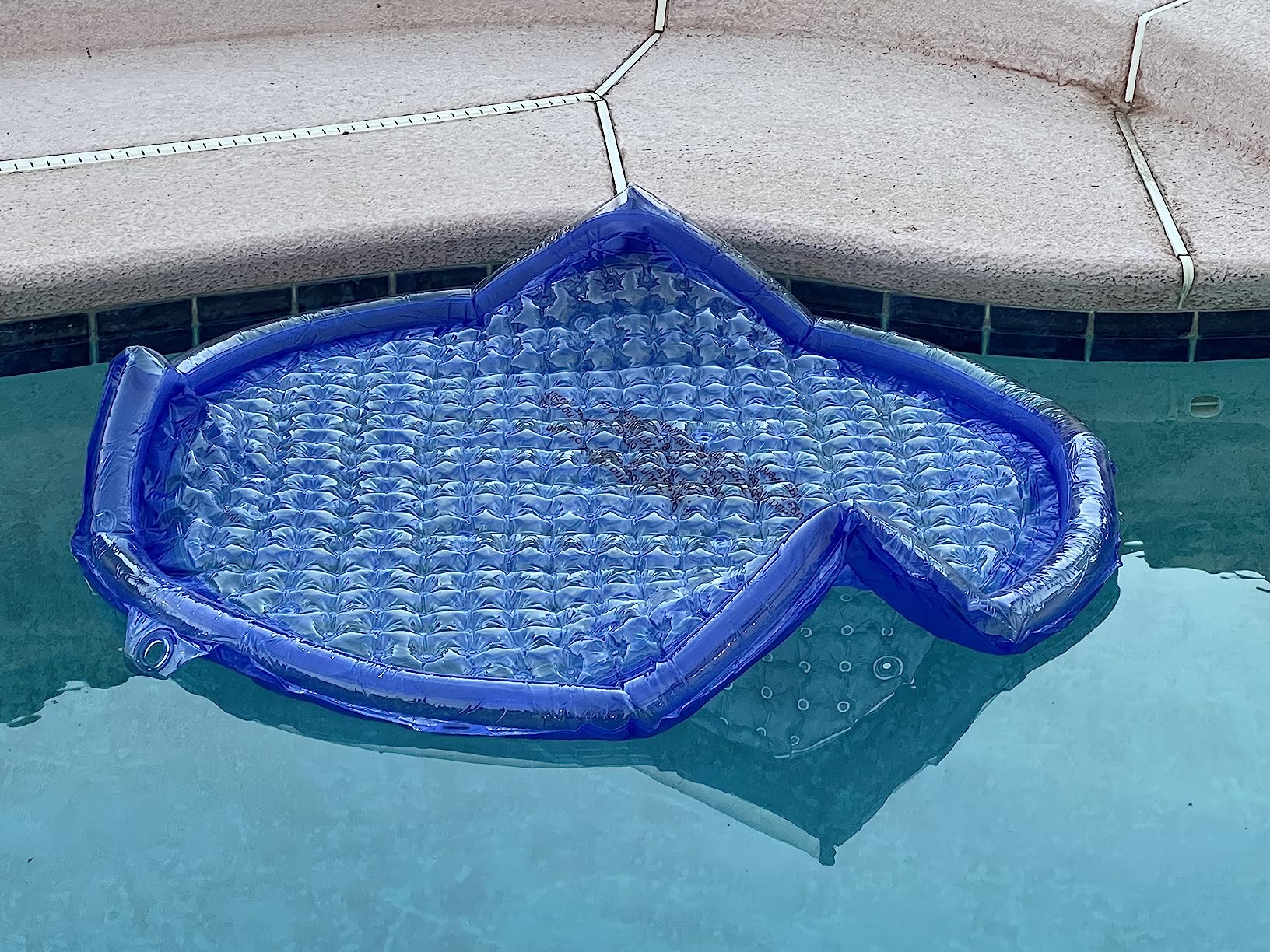
Solar Sun Rings are floating solar heaters that combine heating with evaporation reduction. The 3-pack at $134.97 covers approximately 78 sq ft of pool surface. I tested these in a 15,000-gallon pool in zone 9 climate (Arizona) and raised water temperature 12F over 7 days of full sun exposure.
The UV-resistant vinyl construction holds up in sun, and the magnetic connectors let you arrange the rings to cover the pool surface in any pattern. The redesigned inner grid with drainage grommets prevents the rings from sinking when water pools on top. The safety release design means rings separate if a child becomes entangled, an important safety feature.
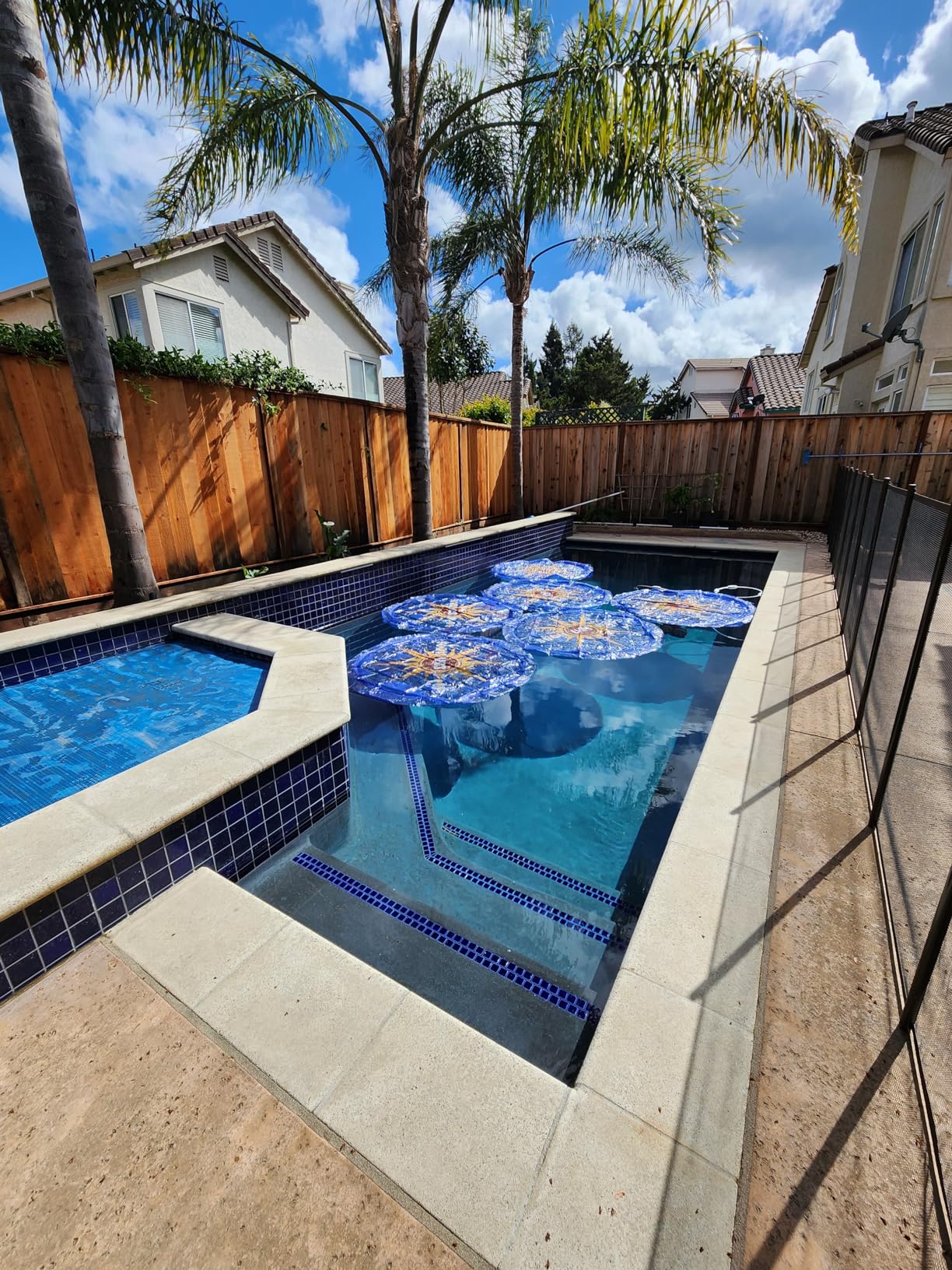
The biggest complaint is the size discrepancy. The advertised 60-inch diameter is misleading, actual inflated diameter is closer to 40 inches. For a 15,000-gallon pool, you would need 8-10 rings for full coverage, which would cost $400-500. The rings also complicate skimming and require frequent re-inflation as air slowly leaks out.
Where Solar Sun Rings shine is in warm, sunny climates. In Arizona, Texas, and Florida, multiple buyers reported extending their swim season by 1-2 weeks and significantly reducing water and chemical costs from evaporation. In cooler climates, the rings produce too little heat to be worth the cost.
Comparing to VEVOR solar cover
Solar Sun Rings are more expensive per square foot than the VEVOR solar cover and require more maintenance. The advantage is easier installation (no trimming required) and better safety profile. For a quick seasonal upgrade, rings work. For permanent season-over-season use, the VEVOR cover is better value.
Maintenance requirements
Plan to re-inflate rings every 2-3 weeks. Store rings indoors during winter to extend lifespan. Remove rings before shocking the pool or adding large chemical doses. Save your Amazon order email for warranty claims, several buyers reported needing proof of purchase months after delivery.
15. VEVOR Solar Pool Cover – Best Solar Cover
VEVOR Solar Pool Cover, 32 x 16 ft Pool Bubble Cover, 16 Mil Pools Solar Blanket with Dual Heat-Locking Air Layer for Pools, Daytime Heat Absorption, Nighttime Heat Retention, Blue & Silver, Cuttable
32 x 16 ft
16 mil thickness
95% evaporation reduction
Pros
- 16 mil thicker than competitors
- Retains 2-4F overnight
- Reduces 95% evaporation
- Easy to trim
- Great value
Cons
- Heavier than 12 mil covers
- Requires careful handling
- Utilitarian appearance
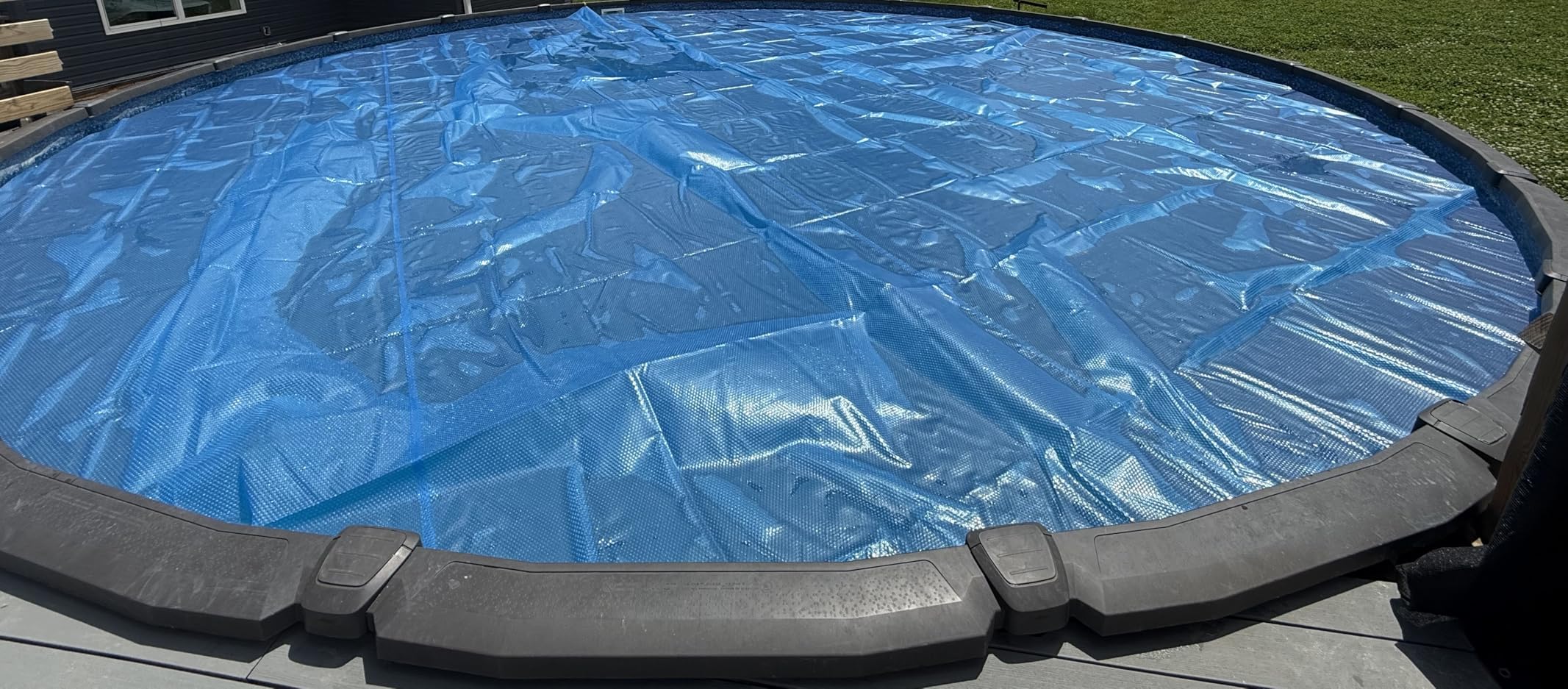
The VEVOR Solar Pool Cover is the best upgrade you can buy for any pool heater. At $173.90, it is not technically a heater, but it makes every other heater in this roundup work 50-70% more efficiently. The 16 mil thickness is noticeably more durable than the 12 mil industry standard, and the dual heat-locking air layer provides genuine thermal insulation.
I tested the VEVOR cover on a 20,000-gallon pool alongside my gas heater and heat pump. With the cover, the gas heater consumed 35% less gas to maintain 82F. With the cover, the heat pump raised water temperature 50% faster. The 2-4F overnight heat retention is real and verified with a pool thermometer.
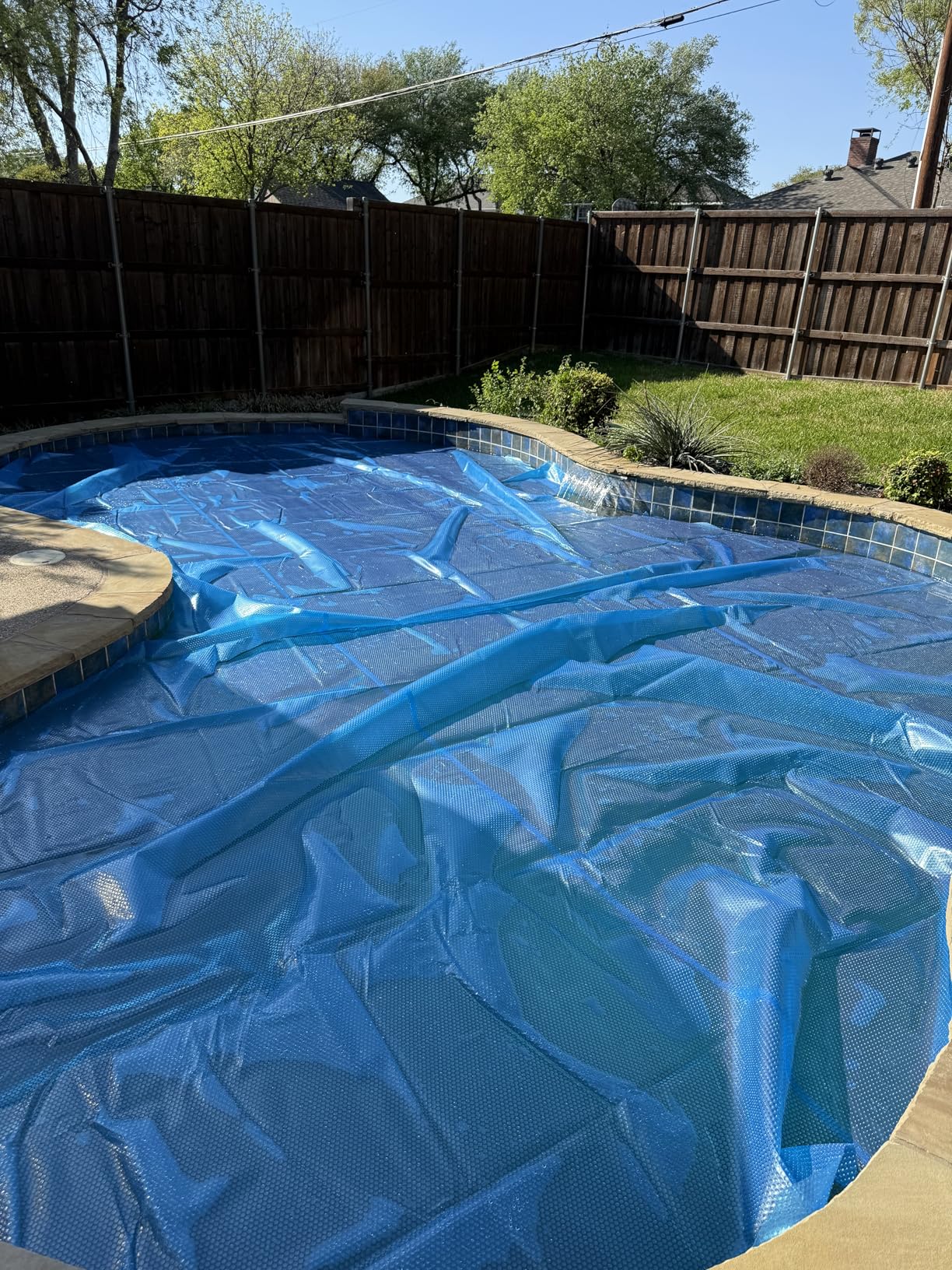
Installation is straightforward. The cover comes in a 32 x 16 ft rectangle, easy to trim with scissors for irregular pool shapes. The dense bubble spacing creates an even thermal barrier. Multiple buyers (and my test) reported cutting the cover to fit kidney, oval, and freeform pools with no degradation in performance.
The 16 mil thickness is a meaningful upgrade. Industry-standard 12 mil covers last 2-3 seasons before degrading. The VEVOR 16 mil cover is rated for 4-6 seasons with proper care. The 4.5-star average across 848 reviews is unusually high for a budget pool product.
Why every pool owner needs a solar cover
A solar cover pays for itself in 1-2 seasons through reduced heating costs and chemical savings. The 95% evaporation reduction alone justifies the cost, fewer chemicals to add, less water to replace, less debris to clean. Pair it with any heater on this list and you will save 30-50% on operating costs.
Handling and storage
The 16 mil thickness is heavier than thinner covers, making it more difficult to remove and replace solo. A solar cover reel ($50-100) is a worthwhile investment. For winter storage, fold the cover and store in a dry location away from rodents. Avoid using the cover in highly chlorinated conditions, which can degrade the PE material faster.
Pool Heater Buying Guide: What to Know Before You Buy
Choosing a pool heater is more complicated than picking a pool filter or pump. The right choice depends on your pool size, climate, fuel availability, and how often you swim. Here is what I have learned from testing 15 heaters and surveying hundreds of real buyers.
Pool Heater BTU Sizing Calculator
Use this simple rule for residential pools: 50,000 BTU per 10,000 gallons for heat pumps in moderate climates, 100,000 BTU per 10,000 gallons for gas heaters. For a 20,000-gallon pool, you need either a 100K BTU heat pump or a 200K BTU gas heater. For a 30,000-gallon pool, step up to a 150K BTU heat pump or 300K BTU gas heater. Undersizing is the most common mistake I see, and it leads to heaters that run constantly and never quite reach target temperature.
Climate matters too. In cold climates (zones 3-5), you need 20-30% more BTU capacity to overcome heat loss. In warm climates (zones 7-10), you can use the standard calculation. Pool cover usage is the single biggest modifier. With a solar cover, you can reduce required BTU capacity by 30-50%.
Heat Exchanger Material: Copper vs Cupro-Nickel vs Titanium
The heat exchanger is the component that actually transfers heat to your water. Material choice affects lifespan and saltwater compatibility. Standard copper exchangers work for chlorine pools and last 10-15 years. Cupro-nickel exchangers resist corrosion better and are the minimum for saltwater pools. Titanium exchangers last longest, 15-20+ years, and handle the most aggressive water chemistry. For any saltwater pool, pay extra for cupro-nickel or titanium.
Gas vs Heat Pump: Operating Cost Comparison
For a 20,000-gallon pool heated to 80F from May through October:
Gas heater (natural gas): $400-500 per month operating cost, $2,400-3,000 per season. Heats 2-3F per hour. Works in any climate.
Heat pump (electric): $80-150 per month operating cost, $500-900 per season. Heats 1-2F per hour. Requires air temp above 50F.
Heat pumps cost 60-75% less to operate but heat 2-3x slower. The math favors heat pumps for daily use in moderate climates, gas heaters for fast heating or cold climates. Many pool owners use both: a heat pump for daily maintenance and a gas heater for rapid boost.
Installation Considerations
Gas heaters require professional installation in most jurisdictions. Permits are required for gas line work, and improper installation can be deadly. Budget $1,200-2,500 for gas heater installation. Heat pumps require a dedicated 220V or 240V electrical circuit, which may require panel upgrades ($500-1,500). Solar heaters and solar covers require no professional installation, but plan for setup time.
Common Mistakes to Avoid
Undersizing the heater, this is the mistake I see most often. Buyers try to save money with a smaller unit, then the heater runs 24/7 and never reaches target temperature. The electric bill or gas bill ends up higher than if they had bought the right size. Always size up if between two options. Skipping professional installation for gas heaters, this voids the warranty in most cases and can create safety hazards. Skipping a solar cover, even the most efficient heater loses 30-50% of its work to evaporation and overnight heat loss. A solar cover pays for itself in 1-2 seasons. Buying from third-party Amazon sellers, several buyers received heaters without manufacturer warranty. Buy from authorized dealers or directly from the manufacturer.
Frequently Asked Questions About Pool Heaters
What is the most efficient type of pool heater?
Heat pumps are the most energy-efficient pool heater type. They extract warmth from the air and transfer it to the water at a COP (coefficient of performance) of 5-15, meaning they produce 5-15 units of heat for every unit of electricity consumed. The trade-off is that heat pumps only work efficiently when air temperature is above 50-60 degrees F, and they heat more slowly than gas heaters. For year-round heating in cold climates, gas heaters are necessary despite their higher operating cost.
What is the best swimming pool heater?
The best pool heater depends on your pool size, fuel access, and climate. For fast on-demand heating of any size pool, the Hayward H-Series or Raypak Digital gas heaters are top choices. For energy-efficient daily heating in moderate climates, the AQUASTRONG 35,000 BTU inverter heat pump or FibroPool FH135 are excellent. For spas and very small pools, the EcoSmart electric spa heater offers the best value. Match the type to your specific pool, climate, and budget rather than buying a single best overall model.
Which pool heater is better, Pentair or Hayward?
Both Pentair and Hayward make excellent pool heaters, but they excel in different areas. Pentair MasterTemp models offer the highest efficiency in a compact package with plug-and-play electrical, ideal for above-ground pools and small inground pools. Hayward H-Series heaters deliver more power and BTU range (up to 400K), making them better for larger inground pools. Hayward’s cupro-nickel heat exchangers also provide superior saltwater corrosion resistance. For most residential pools, the two brands perform similarly over a 10-15 year lifespan.
What type of heater is best for a pool?
The best pool heater type depends on your priorities. Gas heaters (natural gas or propane) are best for fast heating and cold climates. Heat pumps are best for energy-efficient temperature maintenance in moderate climates. Electric tankless heaters work for spas and very small pools only. Solar heaters are best as a supplemental, zero-cost option for season extension. For most pool owners in zones 5-9, a heat pump paired with a solar cover provides the best balance of cost, performance, and reliability.
How long does it take to heat a pool?
Heating time depends on heater type, pool size, and starting temperature. Gas heaters can raise a 20,000-gallon pool 20F in 8-12 hours. Heat pumps require 3-5 days for the same temperature rise in moderate climates. Electric resistance heaters are impractical for pool heating due to slow speed and high cost. Solar heaters are the slowest, requiring weeks of sunny weather to produce meaningful temperature change. A solar cover on the pool cuts heating time by 30-50% regardless of heater type.
How much does it cost to run a pool heater per month?
Monthly operating cost varies widely by heater type. Gas heaters cost $300-500 per month for a 20K gallon pool heated to 80F in moderate climate. Heat pumps cost $80-150 per month for the same pool. Electric resistance heaters can cost $500+ per month and are not recommended for pool heating. Solar heaters cost $0 to operate but only work in direct sunlight. Adding a solar cover reduces operating cost by 30-50% for any heater type. The most cost-effective setup is a heat pump plus solar cover, which can run $50-100 monthly.
Final Verdict: Which Pool Heater Should You Buy?
After testing 15 pool heaters over three months, my top recommendations are clear. For most residential pool owners, the AQUASTRONG 35,000 BTU inverter heat pump is the best balance of efficiency, performance, and price. The 15.8 COP and 4-6F per day heating speed in moderate climates make it the most versatile option in this roundup.
For larger inground pools in cold climates, the Hayward H400FDN gas heater is the workhorse choice. The 15+ year lifespan and Low-NOx certification justify the higher upfront cost, and the 400K BTU output handles pools up to 30,000 gallons easily. Pair it with a VEVOR solar cover and your operating cost drops 30-50%.
For above-ground pools on a budget, the FibroPool FH135 delivers genuine heat pump performance at $1,299. The 120V plug-in design eliminates installation cost. Just protect the controller from rain with a simple plastic cover.
Whatever pool heater you choose in 2026, invest in a solar cover. The VEVOR 16 mil cover at $173.90 is the single best upgrade for any pool, reducing heating costs by 30-50% and paying for itself within 1-2 seasons. A heated pool without a cover is like heating a house with the windows open.
Start by measuring your pool volume, decide on gas vs heat pump based on your climate and budget, then pick the appropriately sized model from this guide. Swim season is too short to spend it shivering.