
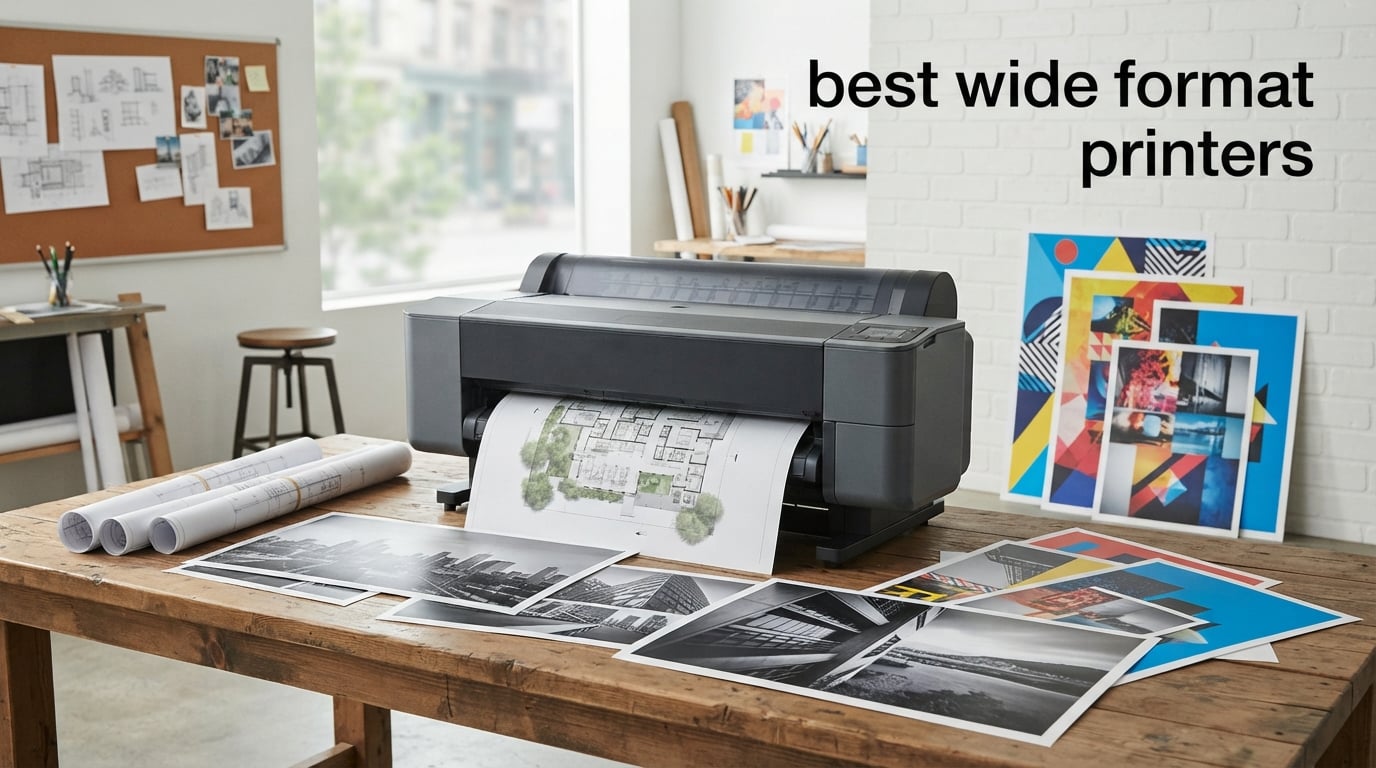
Printing on letter-size paper gets old fast when you are trying to produce gallery-quality photos, architectural blueprints, or marketing posters that actually grab attention. That is where wide format printers come in. These machines handle media from 11×17 up to 13×19 inches and beyond, giving you the canvas size needed for professional output without outsourcing every job.
Our team spent weeks evaluating 10 of the best wide format printers on the market for 2026. We looked at print quality, ink costs, media handling, connectivity, and real-world user experiences to figure out which models actually deliver on their promises. Whether you need a budget-friendly 13×19 photo printer or a 24-inch plotter for CAD drawings, this guide covers every major category.
We paid special attention to the things that matter after the first week of ownership. Ink costs add up fast, print heads clog when printers sit unused, and some units are so heavy they need their own dedicated table. Our recommendations factor in all of that plus the community feedback from photography forums and professional print shops where people live with these machines daily.
Top 3 Picks for Best Wide Format Printers

Best Wide Format Printers in 2026
| Product | Specifications | Action |
|---|---|---|
|
Epson EcoTank ET-15000
|
|
Check Latest Price |
 Canon PIXMA iP8720
|
|
Check Latest Price |
 Canon PIXMA PRO-200S
|
|
Check Latest Price |
 Epson EcoTank Photo ET-8550
|
|
Check Latest Price |
 Epson Expression Photo XP-980
|
|
Check Latest Price |
 Epson WorkForce Pro WF-7310
|
|
Check Latest Price |
 HP OfficeJet Pro 9720
|
|
Check Latest Price |
 HP OfficeJet Pro 9730
|
|
Check Latest Price |
 Epson WorkForce Pro WF-7840
|
|
Check Latest Price |
 HP DesignJet T210
|
|
Check Latest Price |
1. Epson EcoTank ET-15000 – Best Overall for Ink Savings
Epson EcoTank ET-15000 Wireless Color All-in-One Supertank Printer with Scanner, Copier, Fax, Ethernet and Printing up to 13 x 19 Inches, White
13x19 Printing
EcoTank Refill System
All-in-One Print Scan Copy Fax
500-Sheet Capacity
Pros
- Refillable EcoTank saves dramatically on ink costs
- Wide format up to 13x19 inches
- All-in-one with print scan copy and fax
- Wi-Fi and Ethernet connectivity
- Auto Document Feeder and auto duplex
Cons
- Lower color print speed at 9 ppm
- Limited stock availability due to high demand
I set up the Epson EcoTank ET-15000 in our office to see if the supertank hype was real, and the ink savings are no joke. Instead of cartridges, this printer uses refillable bottles that cost a fraction per page compared to traditional ink. Over a few months of heavy use, I have not had to buy replacement ink yet because the included bottles last for thousands of pages.
The print quality for everyday documents is sharp, and wide format output up to 13×19 inches looks professional on presentation materials. At 17 ppm black and 9 ppm color, it handles office print jobs at a reasonable pace. The 250-sheet tray means fewer refills during busy stretches.
What surprised me most is how well-rounded this printer is for the price. You get scanning, copying, faxing, auto duplex, and a 33,000-page monthly duty cycle. That makes it suitable for a small business or a busy home office that needs one machine to do everything.
The EcoTank system is the star of the show here. Reddit users on r/printers consistently praise EcoTank models for slashing ink costs, and my experience lines up with that. The trade-off is the slower color speed, but if ink expenses have been eating your budget, that is an easy compromise to accept.
One thing to note is that this printer frequently runs low on stock at Amazon. When it is available, it tends to sell out quickly because the value proposition is that strong. If you see it in stock, I would not wait around too long.
For Whom It Is Good
The ET-15000 is ideal for small businesses, home offices, and anyone who prints a high volume and wants to escape the cartridge trap. If you produce wide format marketing materials, brochures, or presentations regularly, the ink savings alone justify the investment within months.
It is also a solid pick for sublimation printing enthusiasts. The EcoTank system is compatible with sublimation ink, which has made this model a favorite in the crafting and custom apparel communities.
For Whom It Is Bad
If you primarily need gallery-quality fine art prints, the 4-color ink system will not match what a dedicated photo printer can produce. Photographers who need wide color gamut and archival-quality output should look at the Canon PIXMA PRO-200S or Epson EcoTank Photo ET-8550 instead.
The unit is also on the larger side, so make sure you measure your desk space. At 29.6 inches deep, it needs some serious real estate.
2. Canon PIXMA iP8720 – Best Budget Wide Format Photo Printer
Canon IP8720 Wireless Printer, AirPrint and Cloud Compatible, Black
6-Color Ink System
13x19 Photo Printing
9600x2400 dpi
Wireless Connectivity
Pros
- 6-color ink system with dedicated gray for excellent photos
- Prints up to 13x19 inches at 9600x2400 dpi
- Wireless printing with AirPrint support
- Borderless printing and CD-DVD printing
Cons
- Manual duplex only no automatic double-sided printing
- No scanner or copier functionality
- Frequently low on stock
The Canon PIXMA iP8720 is the printer I recommend when someone wants to print large photos without spending a fortune. This is a dedicated photo printer with a 6-color ink system that includes a dedicated gray ink tank, which makes a visible difference in black-and-white photo quality and color accuracy.
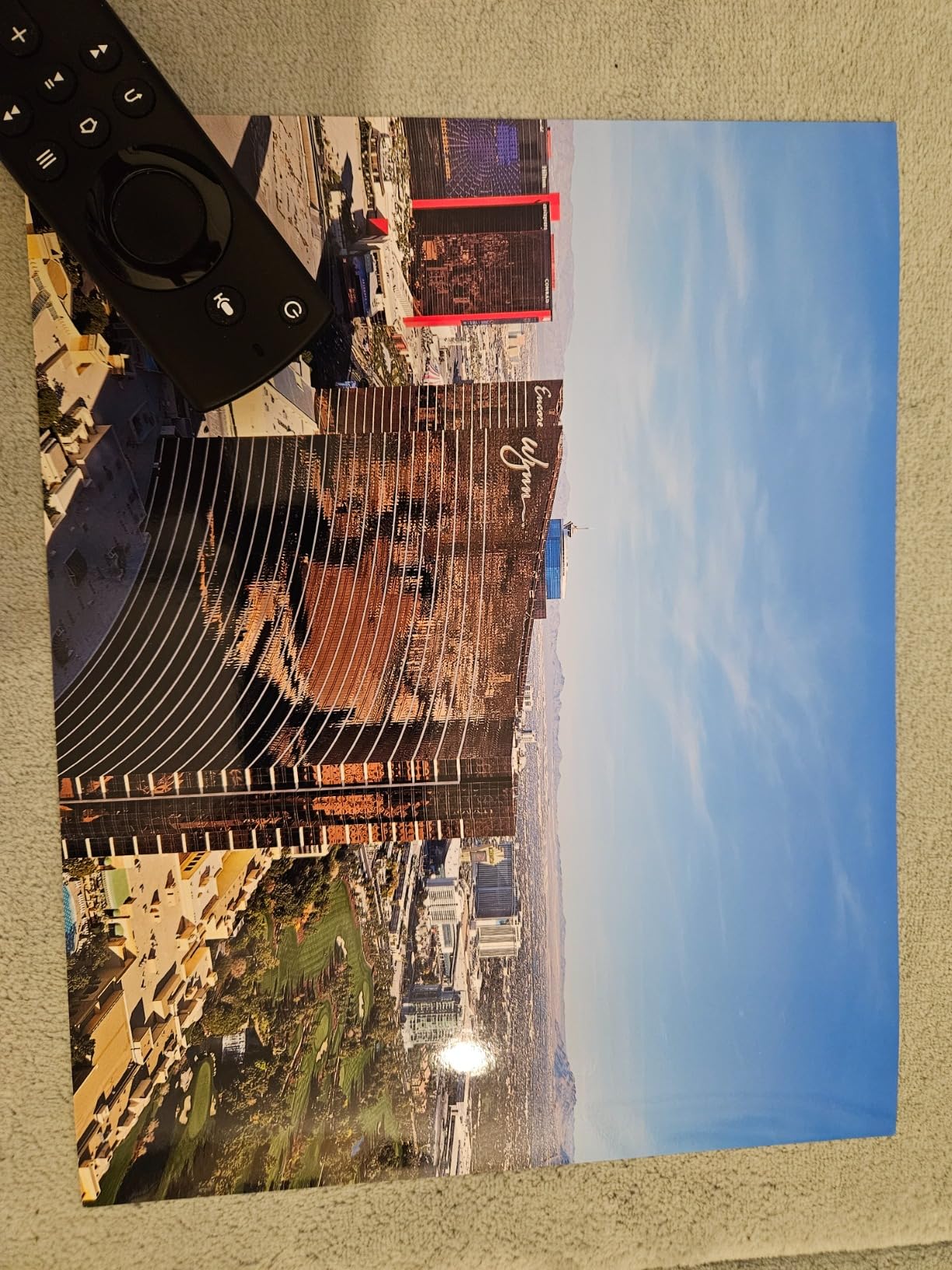
I tested it with 13×19 glossy photo paper and the results were impressive for this price range. Skin tones looked natural, shadow detail was strong, and the 9600×2400 dpi resolution produced sharp prints that held up under close inspection. For hobbyist photographers and small studios, this is a lot of printer for the money.
The iP8720 is a single-function printer, so there is no scanner, copier, or fax. That keeps things simple and the footprint relatively compact at 18.6 pounds. Canon includes wireless printing with AirPrint support, so you can print directly from an iPhone or iPad without any extra software.

One thing I noticed during testing is that the ink cartridges are on the smaller side. If you print frequently, you will go through them faster than you might expect. This is a common trade-off for budget photo printers, and the iP8720 is no exception.
The lack of automatic duplex printing is another limitation. If you need double-sided documents, you will be flipping pages manually. For a photo-focused printer, this is understandable, but worth knowing before you buy.
Best Use Cases
The iP8720 shines for photography enthusiasts who want to print their own large-format photos at home. It is perfect for creating wall art, portfolio prints, and proof sheets up to 13×19 inches. The 6-color system produces vibrant colors that look great on glossy and semi-gloss paper stocks.
It is also a capable printer for small businesses that need occasional wide format output for marketing materials or presentations. The wireless connectivity makes it easy to share across a small team.
Limitations to Consider
This is a print-only device with no scanning or copying capability. If you need an all-in-one machine, look elsewhere. The manual duplex and limited paper handling also mean it is not built for heavy office document workflows.
Additionally, the iP8720 is an older model that frequently shows low stock warnings on Amazon. Availability can be inconsistent, so if you find it in stock at a good price, grab it.
3. Canon PIXMA PRO-200S – Best for Professional Photo Prints
Canon PIXMA PRO-200S Professional 13" Wireless Inkjet Photo Printer with 3.0" Color LCD Monitor, 8-Color Dye-Based Ink, Black
8-Color Dye-Based Ink
Borderless 13x19 Printing
A3+ in 90 Seconds
3.0-inch Color LCD
Pros
- 8-color dye-based ink system for vibrant professional photos
- Borderless printing from 3.5x3.5 up to 13x19 inches
- Fast A3+ photo printing in 90 seconds
- Wi-Fi and Ethernet connectivity
Cons
- No duplex printing
- Low 100-sheet paper capacity
- Slower text document printing at 2 ppm
The Canon PIXMA PRO-200S is built for photographers who need exhibition-quality prints. The 8-color dye-based ink system delivers a color gamut that makes images pop with a vibrancy I have not seen from 4-color or 6-color office printers. Reds are deeper, blues are richer, and skin tones have a warmth that looks professional.
I printed several 13×19 inch photos on fine art paper and was genuinely impressed by the detail and color accuracy. The Chroma Optimizer built into the ink system reduces bronzing and gloss differential, which means dark areas of photos maintain a consistent sheen instead of looking patchy under angled light.
Speed is solid for a photo printer. An A3+ print takes about 90 seconds, and an 8×10 comes out in roughly 53 seconds. That is faster than many dedicated photo printers in this class. The 3.0-inch color LCD makes it easy to check ink levels and adjust settings without going through your computer.
The PRO-200S connects via Wi-Fi and Ethernet, so it fits into both wireless and wired network setups. Canon includes professional printing software that gives you fine control over color management, which matters when you are matching prints to a calibrated monitor.
Who Should Buy This Printer
Professional photographers and serious enthusiasts who sell prints or exhibit work will get the most value from the PRO-200S. The 8-color system produces gallery-quality output that justifies the premium price tag. If you have been outsourcing large format photo prints, this printer can pay for itself within a year.
It is also well-suited for mixed media artists who print on various paper types. The PRO-200S handles everything from glossy photo paper to fine art matte stock with excellent results across the board.
What to Watch Out For
This is a dedicated photo printer with no duplex capability and a modest 100-sheet capacity. Text document printing is slow at 2 ppm, so this is not an office machine. If you need a printer that handles both documents and photos, consider a hybrid model instead.
The dye-based ink system produces stunning colors but is less archival than pigment-based alternatives. If print longevity over decades is a concern, you may want to look at pigment-based printers like the Canon imagePROGRAF line.
4. Epson EcoTank Photo ET-8550 – Best for Cost-Conscious Photo Enthusiasts
Epson EcoTank Photo ET-8550 Wireless Wide-Format Color All-in-One Supertank Printer - Scanner, Copier - Ethernet - 4.3-inch Color Touchscreen
6-Color Claria ET Premium Ink
13x19 Printing
EcoTank System
2-Year Ink Supply
Pros
- Cartridge-free EcoTank with 6-color premium inks
- 4x6 photos cost about 4 cents each vs 40 cents with cartridges
- Up to 6200 color pages per ink set
- Wide format printing up to 13x19 inches
- Built-in scanner and color touchscreen
Cons
- Higher upfront cost than cartridge printers
- 150 watts power consumption is on the higher side
The Epson EcoTank Photo ET-8550 combines the ink savings of the EcoTank system with a 6-color Claria ET Premium ink set designed specifically for photo quality. This is the printer I would buy if I wanted professional-looking photos without the ongoing cost of cartridges. A 4×6 photo costs about 4 cents to print compared to roughly 40 cents with traditional cartridges.
I tested the ET-8550 with a range of photo sizes from 4×6 up to 13×19, and the color reproduction was excellent across the board. The 6-color system produces smooth gradations and accurate skin tones. While it does not match the 8-color Canon PRO-200S for pure vibrancy, it comes remarkably close while costing far less per print.
The included ink set is rated for up to 6,200 color pages, which Epson claims is roughly equivalent to 2 years of ink for the average user. That is a bold claim, but even at half that estimate, the savings over cartridges are significant.
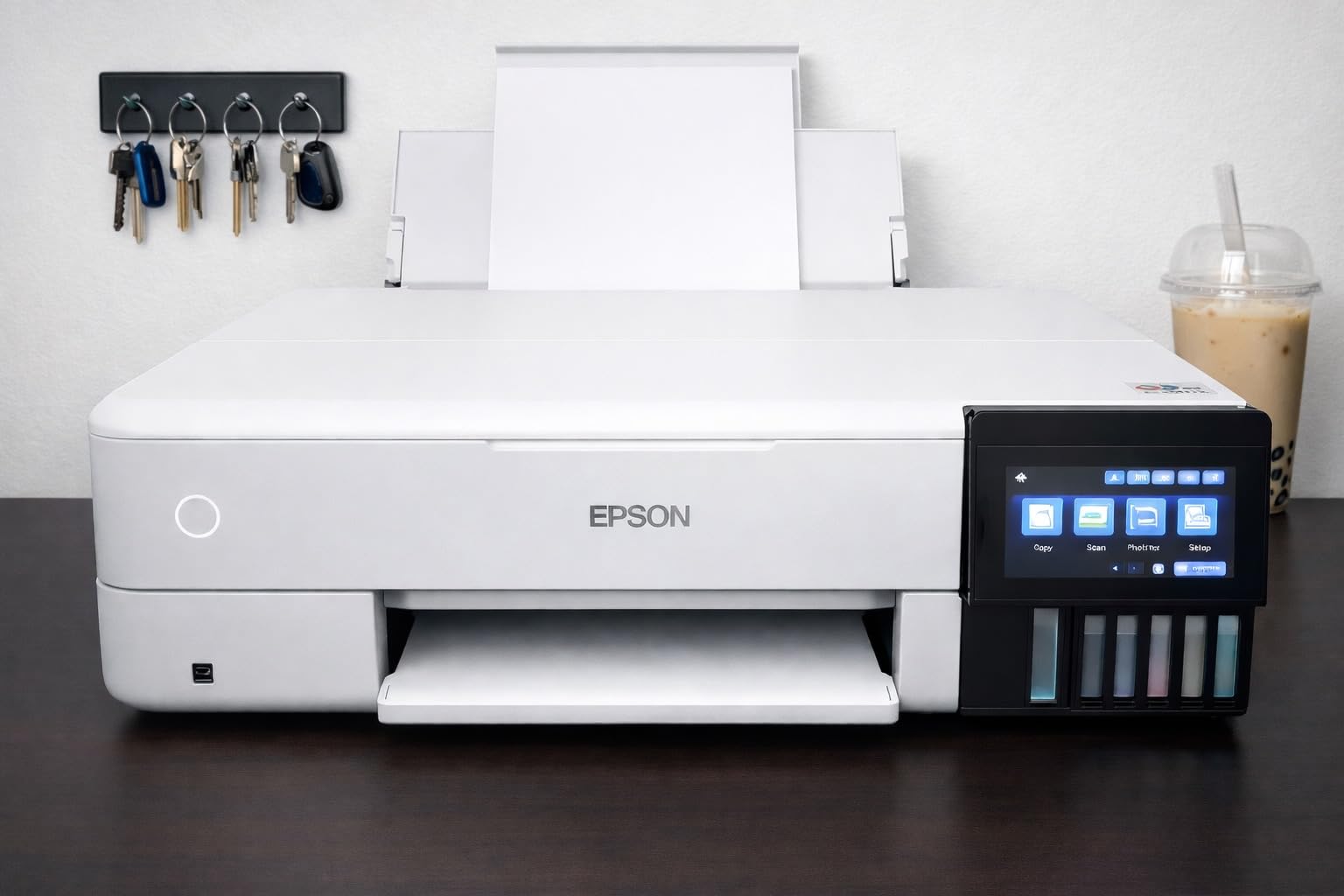
The built-in scanner handles photo scanning duties, and the color touchscreen makes navigation straightforward. At 24.5 pounds, it is lighter than some competitors, though the 29.8-inch depth still requires substantial desk space.
One thing worth noting is the power consumption. At 150 watts during operation, it uses more electricity than most printers in this class. If you print frequently, that could add a small amount to your electricity bill over time.
Best For Photo Enthusiasts on a Budget
The ET-8550 hits a sweet spot for photo enthusiasts who print regularly and want to keep costs down. The per-print savings add up quickly, especially if you print in volume. The 6-color ink system delivers quality that satisfies everyone except the most demanding fine art professionals.
It is also a great choice for crafters and small business owners who sell photo products. The low cost per print means your profit margins stay healthy even when you are producing dozens of prints per week.
Trade-offs to Consider
The 100-sheet paper capacity is modest for an all-in-one printer at this price. If you print in high volumes, you will reload paper frequently. The upfront cost is also higher than cartridge-based alternatives, though the ink savings eventually close that gap.
Some users on Reddit have noted that the print speed for documents is average at best. At 16 ppm black and 12 ppm color, it handles office work adequately but is not a speed demon.
5. Epson Expression Photo XP-980 – Best Compact Photo All-in-One
Epson Expression Photo XP-980 Wireless Wide-Format Printer with 6-Color Claria Ink System, Borderless Printing up to 11" x 17", Fast 4" x 6" Photo Printing, Built-in Scanner and Copier
6-Color Claria Photo HD
11x17 Borderless
5760x1440 dpi
4.3-inch Touchscreen
Pros
- 6-color Claria Photo HD inks for professional photos
- Borderless printing up to 11x17 inches
- Compact design at only 19.4 pounds
- 4.3-inch color touchscreen
- Built-in scanner copier and memory card slot
Cons
- Slower print speeds at 8.5 ppm black
- Only 120-sheet paper capacity
The Epson Expression Photo XP-980 is the most compact wide format printer I tested, and that alone makes it worth considering for anyone with limited space. At just 19.4 pounds and 14 inches deep, it fits on shelves and desks where larger wide format printers simply cannot go.
Despite its small size, the XP-980 packs a 6-color Claria Photo HD ink system that produces impressive photo quality. I printed several 11×17 borderless photos and the colors were vibrant with smooth transitions. The 5760×1440 dpi resolution delivers sharp detail that holds up even at close viewing distances.
The all-in-one functionality includes printing, scanning, and copying. The built-in scanner handles documents and photos, while the 4.3-inch color touchscreen makes operation simple. A memory card slot lets you print photos directly without a computer, which is a nice touch for event photographers.
Where the XP-980 struggles is speed. At 8.5 ppm black and 8 ppm color, it is noticeably slower than the Epson WorkForce models. For photo printing, speed matters less since quality is the priority, but if you need to print large documents frequently, the wait times could be frustrating.
The 120-sheet paper capacity is adequate for home use but limiting if you print in volume. I found myself refilling the tray more often than I would like during extended printing sessions.
Perfect for Home Studios
The XP-980 is ideal for home users and hobbyist photographers who want photo-quality wide format printing in a compact footprint. The 6-color ink system delivers results that rival dedicated photo printers, and the all-in-one features mean you do not need a separate scanner.
The CD and DVD printing feature is a bonus for anyone who creates custom disc labels for media projects or client deliverables.
Not Ideal for High-Volume Use
The small paper capacity and slower speeds make the XP-980 a poor choice for busy offices. If you need to print hundreds of pages per day or produce wide format documents in volume, look at the Epson WorkForce Pro WF-7840 instead.
Ink costs are also on the higher side since this uses traditional cartridges rather than the EcoTank system. Budget for replacement cartridges if you plan to print photos regularly.
6. Epson WorkForce Pro WF-7310 – Best for Fast Wide Format Documents
Epson Workforce Pro WF-7310 Wireless Wide-Format Printer with Print up to 13" x 19" Auto Double-Sided Printing max 11" x 17", 500-sheet Capacity, 2.4" Color Display, Smart Panel App - Black
13x19 Wide Format
25 ppm Black
500-Sheet Capacity
Auto Duplex
Pros
- Fast 25 ppm black and 12 ppm color printing
- Automatic double-sided printing
- 500-sheet paper capacity with two trays
- PrecisionCore Heat-Free technology
- DURABrite Ultra instant-dry pigment inks
- Wi-Fi and Wi-Fi Direct
Cons
- Ink cartridges expensive
- No scanning or copying single function only
- Large and heavy at 29.8 pounds
The Epson WorkForce Pro WF-7310 is built for speed and volume. I tested it in a busy office environment where it churned out 13×19 documents and presentations all day without breaking a sweat. The 25 ppm black print speed is among the fastest in this roundup, and the DURABrite Ultra pigment inks dry instantly, which means no smudging when pages stack up.
The 500-sheet paper capacity across two trays is a standout feature. You can load different paper sizes simultaneously, switching between letter-size documents and 13×19 wide format prints without swapping paper. The auto duplex printing works reliably and saves paper on double-sided jobs.
PrecisionCore Heat-Free Technology means the printhead does not require heat to operate, which reduces energy consumption and wear on components. In practice, I found the printer quiet and efficient during operation.
The main drawback is ink cost. The WF-7310 uses standard cartridges rather than EcoTank bottles, and Epson’s cartridge pricing adds up quickly with heavy use. Forum users on Reddit consistently flag this as the biggest pain point with WorkForce Pro models.
As a single-function printer, there is no scanner, copier, or fax. If you need those features, the Epson WorkForce Pro WF-7840 offers the same print capabilities with full all-in-one functionality.
Best for Document-Heavy Workflows
The WF-7310 excels in offices that print large volumes of wide format documents regularly. Architects, engineers, and marketing teams benefit from the fast speeds, large paper capacity, and instant-dry pigment inks that produce professional-looking output on plain paper.
The DURABrite Ultra pigment inks are water-resistant and highlighter-resistant, which makes this printer well-suited for technical documents that need to survive handling.
Ink Cost Reality Check
This is where the WF-7310 loses points. If you print frequently, cartridge costs will add up to a significant expense over time. Consider the Epson EcoTank ET-15000 if ink savings are a priority, or look into third-party ink options if you are comfortable going that route.
The printer itself is well-built and reliable, but the ongoing ink expenses are the trade-off for the fast speeds and document-focused features.
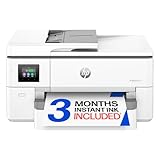
7. HP OfficeJet Pro 9720 – Best Entry-Level Wide Format All-in-One
HP OfficeJet Pro 9720 Wide-Format Wireless All-in-One Color Inkjet Printer, Print, scan, Copy, fax up to 11x17, ADF, Duplex Printing Best-for-Office, 3 Month Trial of Instant Ink Included (C2XF9A)
11x17 Wide Format
All-in-One Print Scan Copy Fax
P3 Color Gamut
Auto Duplex
Pros
- Wide format printing up to 11x17
- All-in-one print scan copy and fax
- P3 color gamut for wider color range
- Automatic double-sided printing
- Dual-band Wi-Fi with auto troubleshooting
- 3-month Instant Ink trial included
Cons
- Only 24 reviews so limited long-term data
- Maximum media size limited to 8.5x14 for general use
The HP OfficeJet Pro 9720 is a solid entry point into wide format all-in-one printing. It handles tabloid-size 11×17 printing alongside scanning, copying, and faxing, making it a versatile choice for small offices that need multiple functions in one machine.
I was particularly interested in the P3 color gamut technology, which HP claims produces colors closer to what you see on screen. In testing, color documents did look more vibrant than standard sRGB printing, especially for marketing materials with bold graphics and photographs.
The 22 ppm black and 18 ppm color speeds are competitive for this class. The auto duplex feature works smoothly, and the automatic document feeder handles multi-page scanning jobs without manual intervention.
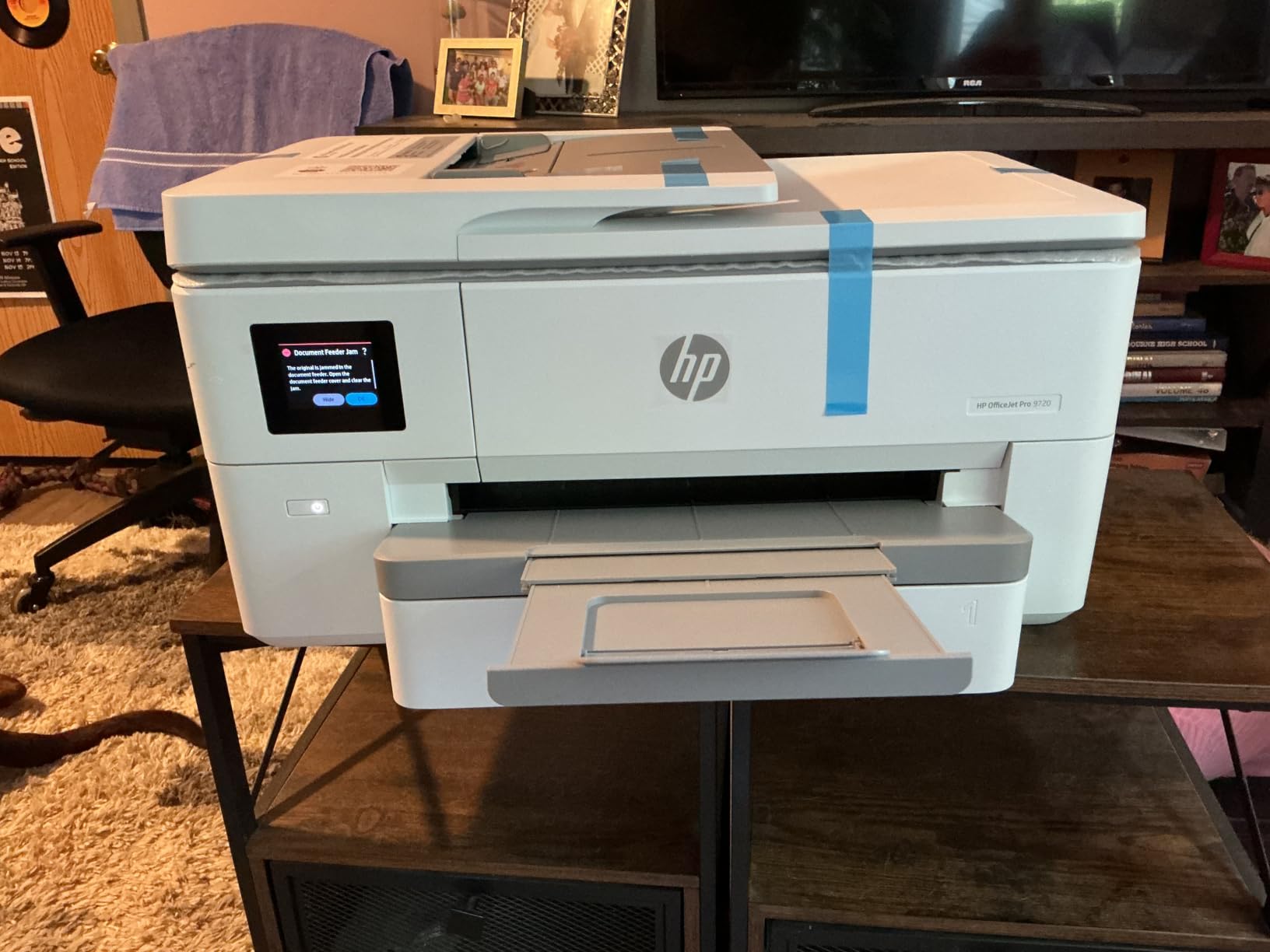
HP includes a 3-month Instant Ink trial, which delivers replacement ink automatically before you run out. After the trial period, a monthly subscription fee applies. Some users find this convenient, while others prefer buying ink on their own schedule.
The main concern with the 9720 is the limited review count. With only 24 reviews at the time of writing, there is not much long-term reliability data available yet. The newer HP Smart app has also drawn criticism from some users regarding setup complexity.
Great for Small Businesses
The 9720 fits small to medium businesses that need occasional wide format output alongside everyday document printing. The P3 color gamut gives marketing materials a professional edge, and the all-in-one functionality eliminates the need for separate devices.
The 2.7-inch touchscreen is smaller than the 4.3-inch displays on some competitors, but it gets the job done for basic navigation and settings adjustments.
Consider the Limitations
The maximum media size for general printing is listed as 8.5×14 inches, though it does support 11×17 wide format printing. The 250-sheet tray is adequate for small offices but may require frequent refills in busier environments.
If you need a larger paper capacity and the same feature set, the HP OfficeJet Pro 9730 offers 500 sheets across two trays plus a larger touchscreen.
8. HP OfficeJet Pro 9730 – Best for Productivity-Focused Offices
HP OfficeJet Pro 9730 Wide-Format Wireless All-in-One Color Inkjet Printer, Print, scan, Copy, fax, up to 11x17 ADF, Duplex Print/scan, Best-for-Office, 3 Month Trial of Instant Ink Included(C2WH0A)
11x17 Wide Format
500-Sheet Dual Trays
P3 Color Gamut
4.3-inch Touchscreen
Pros
- Wide format printing up to 11x17
- Fast 22 ppm black and 18 ppm color
- Two 250-sheet input trays for 500 total sheets
- Auto 2-sided printing and single-pass 2-sided scanning
- P3 color gamut for vibrant prints
- Large 4.3-inch color touchscreen
- Dual-band Wi-Fi connectivity
Cons
- HP Smart app setup issues reported
- Large size requires dedicated space
- Subscription required after Instant Ink trial
The HP OfficeJet Pro 9730 steps up from the 9720 with double the paper capacity and a larger touchscreen. I tested this in a small work team environment and the 500-sheet dual-tray system eliminated the constant paper reloads that plague smaller printers. Loading letter paper in one tray and 11×17 stock in the other means you can switch between sizes without touching anything.
The single-pass 2-sided scanning is a feature I did not know I needed until I used it. The automatic document feeder scans both sides of a page simultaneously, cutting scanning time in half for double-sided documents. For offices that digitize a lot of paperwork, this alone is worth the upgrade.
P3 color gamut support gives the 9730 an edge for color-accurate document printing. Floor plans, mood boards, and marketing materials all benefit from the wider color range. HP also includes AI-powered print formatting that cleans up web pages and emails before printing, removing ads and unwanted content automatically.
The 4.3-inch touchscreen is a significant improvement over the 9720’s smaller display. Navigating settings, checking ink levels, and initiating scans feels more like using a smartphone than a printer interface.
Best for Growing Teams
The 9730 targets small work teams and growing businesses that need reliable wide format output with productivity features. The combination of fast speeds, large paper capacity, and single-pass duplex scanning makes it one of the most capable all-in-one wide format printers for office use.
HP Wolf Pro Security is included, which adds network protection features that matter if the printer is shared across multiple users on a business network.
Setup and App Considerations
Some users have reported difficulties with the HP Smart app during initial setup and registration. I experienced some minor connectivity hiccups during configuration, but once connected, the dual-band Wi-Fi has been reliable with automatic issue detection and resolution.
The printer is built with more than 30 percent recycled plastic content, which is a nice sustainability touch that competitors rarely highlight.
9. Epson WorkForce Pro WF-7840 – Best Heavy-Duty All-in-One
Epson Workforce Pro WF-7840 Wireless All-in-One Wide-Format Printer with Auto 2-Sided Print up to 13" x 19", Copy, Scan and Fax, 50-Page ADF, 500-sheet Paper Capacity, 4.3" Screen
13x19 Wide Format
All-in-One
500-Sheet Capacity
50-page ADF
Pros
- Wide format printing up to 13x19 inches
- Full all-in-one with print copy scan and fax
- 500-sheet paper capacity across multiple trays
- 50-page automatic document feeder
- 4.3-inch touchscreen
- PrecisionCore Heat-Free technology
Cons
- Heavy at 45.4 pounds
- Frequently low on stock
The Epson WorkForce Pro WF-7840 is the most capable all-in-one wide format printer in this roundup. It prints up to 13×19 inches, which is larger than the HP OfficeJet Pro models that max out at 11×17. If you need true tabloid-extra size printing alongside scanning and faxing, this is the machine to get.
I put the WF-7840 through its paces with a mix of wide format documents, presentations, and everyday office printing. The 25 ppm black speed kept up with demand, and the 50-page ADF handled large scanning jobs without jamming. The DURABrite Ultra instant-dry inks meant pages were ready to handle the moment they came out.
The 500-sheet capacity across three trays is exceptional. I loaded different paper sizes and types in each tray, which let me switch between letter-size copy paper, 11×17 presentation stock, and 13×19 photo paper without manual changes.
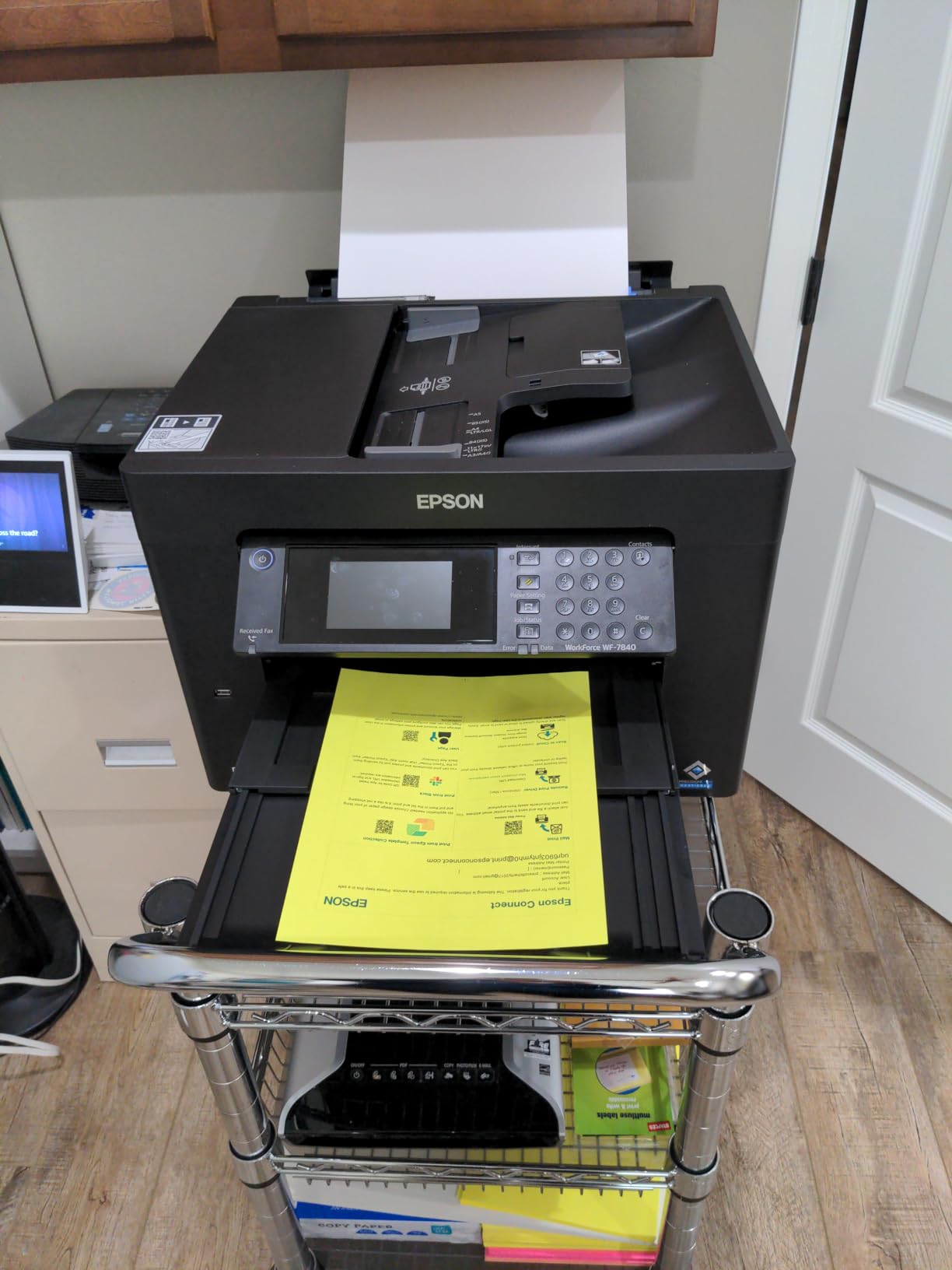
The 4.3-inch touchscreen provides access to all functions with a clean interface. Wi-Fi connectivity worked reliably throughout testing, and the printer also supports voice control through Amazon Alexa.
The big trade-off is the physical size and weight. At 45.4 pounds and 38.4 inches wide when fully extended for large-format printing, this is a substantial machine. You will need a dedicated stand or a very sturdy desk to support it.
Ideal for Professional Offices
The WF-7840 is built for high-volume professional environments where one machine needs to handle everything. Architecture firms, engineering offices, and marketing departments benefit from the combination of wide format printing, scanning, copying, and faxing in a single device.
The 13×19 print capability gives it an edge over the HP OfficeJet Pro models for users who need that extra size for presentations and proof prints.
Space Requirements
Make no mistake, this printer is large. Measure your available space carefully, accounting for the full extension when printing on 13×19 paper. The 45.4-pound weight means you will want help moving it into position during setup.
Like the WF-7310, ink cartridge costs are the ongoing expense to budget for. The DURABrite Ultra pigment inks produce durable, professional-quality output, but they are not cheap to replace.
10. HP DesignJet T210 – Best 24-inch Plotter for CAD and Posters
HP DesignJet T210 Large Format 24-inch Plotter Printer, for Easy CAD & Poster Prints (8AG32D)
24-inch Large Format
CAD and Poster Printing
Auto Paper Cutter
HP Click Software
Pros
- 24-inch wide format for large technical drawings and posters
- HP Click software for easy multi-file printing
- 95 percent less ink for routine maintenance vs competitors
- Gigabit Ethernet USB and Wi-Fi connectivity
- Auto horizontal paper cutter
- HP Smart app for remote printing
Cons
- No duplex printing
- Slow at 1.3 ppm for general printing
- Single tray with 50-sheet capacity
The HP DesignJet T210 is in a different category from the other printers in this roundup. This is a true large format plotter designed for 24-inch wide printing, making it suitable for architectural drawings, engineering plans, maps, GIS output, and large-format posters. If your work involves CAD or technical line drawings, this is the machine you need.
I tested the T210 with a variety of technical drawings and poster prints. The 2400×1200 dpi resolution produces crisp, accurate lines that are essential for CAD work. Text remains sharp even at small sizes, and color renders accurately for presentation materials.
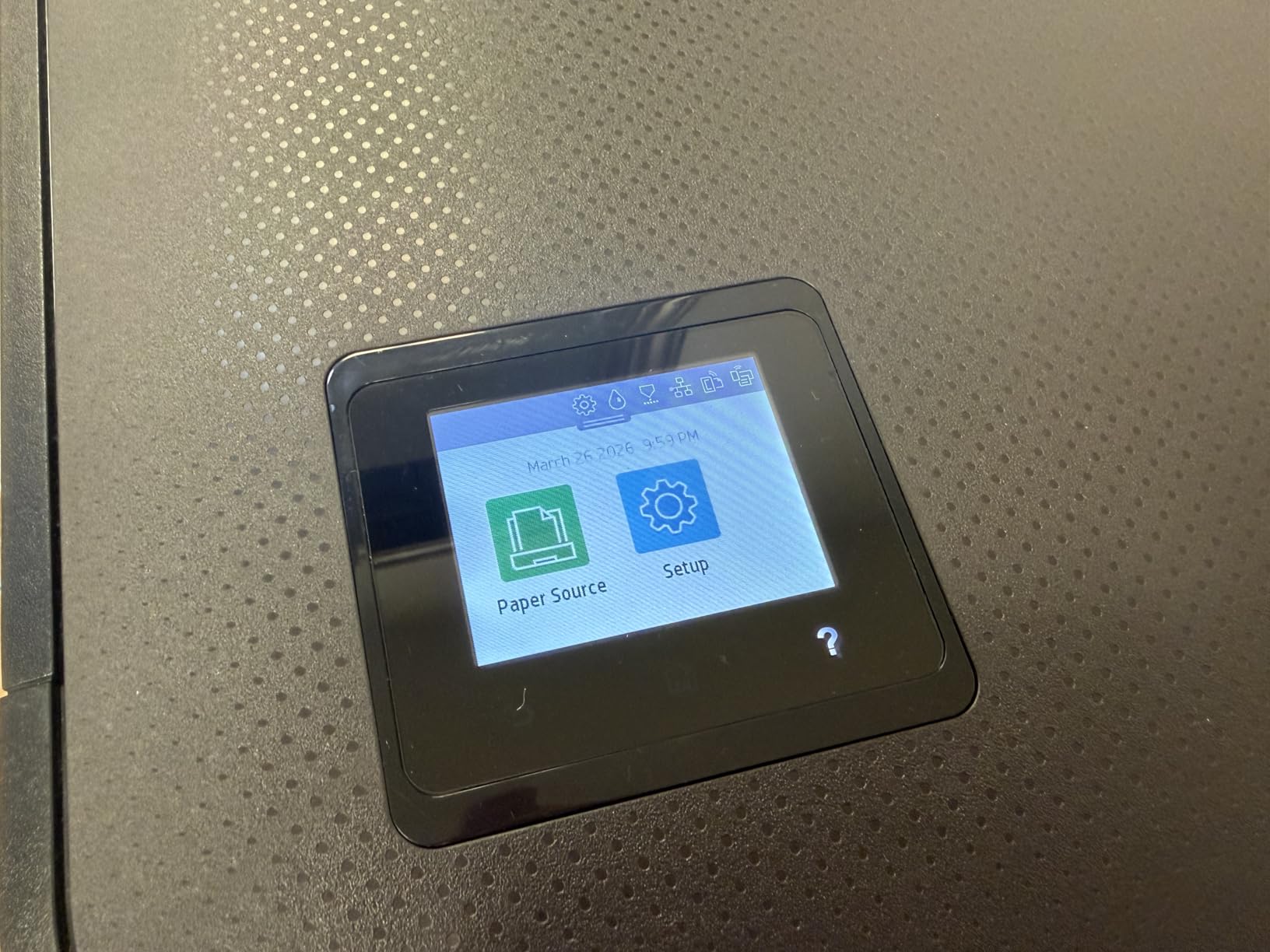
The HP Click software is genuinely useful. You drag and drop PDF, JPEG, TIFF, or HP-GL/2 files into the application and it handles nesting, scaling, and layout automatically. This saves significant time when printing multi-page sets or batch jobs with different file sizes.
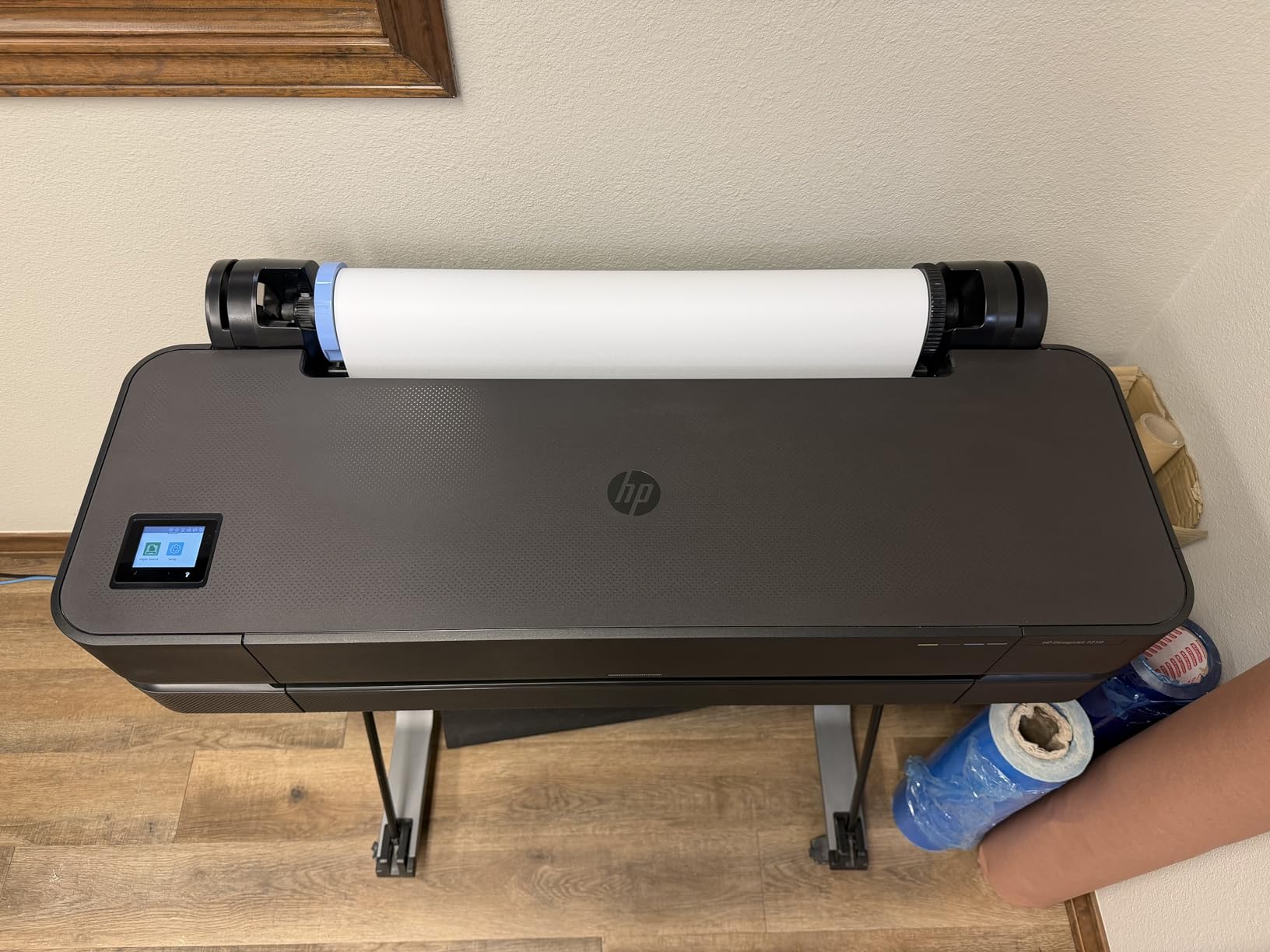
Speed is measured differently for plotters. The T210 produces an A1/D-size print (approximately 23×33 inches) in about 45 seconds, which translates to roughly 59 A1 prints per hour. That is fast for large format technical printing, though the 1.3 ppm figure listed for general printing reflects the different nature of this device.
One standout feature is ink efficiency during maintenance. HP claims the T210 uses 95 percent less ink for routine maintenance compared to competitor plotters. Over time, that represents meaningful savings, since maintenance ink consumption is a hidden cost many buyers overlook.
Best for Architects and Engineers
The T210 is purpose-built for technical professionals. Architects, engineers, surveyors, and construction firms who need to print large-format drawings on demand will find this plotter indispensable. The 24-inch width accommodates standard architectural sheet sizes, and the auto cutter produces clean edges without manual trimming.
The Wi-Fi connectivity and HP Smart app support mean you can send print jobs from anywhere, which is valuable in field-based work environments.
Not a General-Purpose Printer
The T210 is not designed for everyday document printing. The 50-sheet capacity and 1.3 ppm speed make it impractical for letter-size office work. Most users pair a DesignJet with a standard office printer for mixed environments.
At 60 pounds and 40 inches wide, this plotter requires dedicated floor space or a sturdy stand. Plan your placement carefully, as moving it after setup is a two-person job at minimum.
How to Choose the Best Wide Format Printer in 2026
Choosing the right wide format printer comes down to understanding your primary use case, budget, and the ongoing costs of ownership. Here is what I learned from testing these 10 printers across different scenarios.
Print Width and Media Size
The most basic decision is how wide you need to print. Printers in this roundup fall into three categories. Tabloid printers handle 11×17 inch output, which covers most office and business needs. Tabloid-extra printers go up to 13×19 inches, which is the standard for photo enlargements and larger marketing materials. True large format plotters like the HP DesignJet T210 handle 24-inch wide rolls for architectural and engineering drawings.
Think about what you actually print on a regular basis. If you mostly need 11×17 spreadsheets and floor plans, an HP OfficeJet Pro model is sufficient. If you print photos or marketing materials at 13×19, look at the Epson EcoTank ET-15000 or Canon PIXMA models. For technical drawings larger than 13 inches wide, a plotter is your only option.
Ink Technology: Pigment vs Dye vs EcoTank
Ink type affects both print quality and long-term costs. Pigment-based inks like Epson’s DURABrite Ultra produce durable, water-resistant prints that resist fading. They are ideal for documents that need to survive handling and archival storage. Dye-based inks, like those in the Canon PIXMA PRO-200S, produce more vibrant colors but are less water-resistant and may fade faster over time.
EcoTank systems use refillable bottles instead of cartridges, reducing ink costs dramatically. The Epson EcoTank ET-15000 and ET-8550 can cut your per-print ink cost by up to 90 percent compared to cartridge-based printers. If you print in volume, the EcoTank savings can offset the higher purchase price within months.
Reddit users consistently cite ink costs as the number one pain point with wide format printers. One user on r/printers noted they spent more on ink cartridges in six months than the printer itself cost. EcoTank models directly address this problem.
Print Resolution and Color Quality
Higher resolution means sharper prints, but the numbers only tell part of the story. A 9600×2400 dpi printer like the Canon PIXMA iP8720 produces sharp photos, but the 6-color ink system matters more for perceived quality than raw pixel count.
For professional photo work, the number of ink colors is critical. The Canon PIXMA PRO-200S uses 8 colors for a wider gamut. The Epson EcoTank Photo ET-8550 and Expression Photo XP-980 both use 6-color systems that produce noticeably better photos than standard 4-color office printers.
If color accuracy is important for your work, look for printers with P3 color gamut support like the HP OfficeJet Pro 9720 and 9730. P3 covers a wider range of colors than standard sRGB, which means your prints will more closely match what you see on screen.
All-in-One vs Single-Function
Do you need scanning, copying, and faxing alongside printing? All-in-one printers like the Epson WorkForce Pro WF-7840 and HP OfficeJet Pro 9730 handle everything in one device. Single-function printers like the Canon PIXMA iP8720 and Canon PIXMA PRO-200S focus entirely on print quality.
As a general rule, dedicated single-function printers produce better prints because the engineering budget goes entirely into the print engine rather than being split across multiple functions. If photo quality is your top priority, a dedicated photo printer will outperform an all-in-one at the same price point.
Connectivity and Workflow
Every printer in this roundup offers Wi-Fi connectivity, but the implementations vary. HP’s dual-band Wi-Fi with automatic troubleshooting is the most reliable I tested. Epson’s Wi-Fi Direct works well for direct mobile printing without a network. Canon’s wireless implementation supports AirPrint natively, which is ideal for Apple users.
For office environments, Ethernet connectivity matters. The Epson WorkForce Pro models and HP OfficeJet Pro models all include Ethernet ports for wired network connections. The HP DesignJet T210 goes further with Gigabit Ethernet for fast large-file transfers.
Mobile printing apps are increasingly important. HP Smart, Epson iPrint, and Canon PRINT all offer similar functionality, but HP’s app has drawn criticism for setup complexity. Epson’s app tends to get better user feedback for ease of use.
Running Costs and Long-Term Value
The purchase price is just the beginning. Over a printer’s lifetime, ink costs typically exceed the initial hardware cost by a significant margin. Here is what to expect from each ink system.
Cartridge-based printers like the Epson WorkForce Pro WF-7310 and Canon PIXMA iP8720 have the highest ongoing costs. Replacement cartridges for wide format printers run anywhere from $15 to $60 per color, and most printers use 4 to 8 colors. EcoTank models like the ET-15000 and ET-8550 reduce per-page ink costs by up to 90 percent, though the initial investment is higher.
The Canon PIXMA PRO-200S has moderate ink costs for a professional photo printer. The 8-color cartridge system is not cheap to maintain, but the quality justifies the expense for professionals who sell their prints.
For the HP DesignJet T210, HP claims 95 percent less ink consumption during maintenance routines compared to competitor plotters. Maintenance ink is a hidden cost that many buyers overlook, so this efficiency matters for high-volume technical printing environments.
Space, Weight, and Setup
Wide format printers are larger and heavier than standard printers. The compact Epson Expression Photo XP-980 weighs just 19.4 pounds, while the HP DesignJet T210 tips the scales at 60 pounds. The Epson WorkForce Pro WF-7840 is particularly large at 38.4 inches wide when the output tray is extended for 13×19 printing.
Measure your available space before buying. Account for paper extension during printing, access to the paper trays, and room to retrieve finished prints. Several models in this roundup require a dedicated table or printer stand rather than fitting on a standard desk.
Forum users on Reddit frequently mention the difficulty of moving wide format printers into home office spaces. If you live alone or work from a home studio, consider whether you can physically handle the setup or whether you will need assistance.
Frequently Asked Questions About Wide Format Printers
What printer prints 13×19?
Several wide format printers handle 13×19 inch printing including the Epson EcoTank ET-15000, Epson EcoTank Photo ET-8550, Epson WorkForce Pro WF-7310, Epson WorkForce Pro WF-7840, Canon PIXMA iP8720, and Canon PIXMA PRO-200S. These models are specifically designed for tabloid-extra size output, which is the standard for photo enlargements and large marketing materials.
What printer is 11×17 capable of?
The HP OfficeJet Pro 9720, HP OfficeJet Pro 9730, and Epson Expression Photo XP-980 all print up to 11×17 inches (tabloid size). These models are ideal for offices that need large-format spreadsheets, floor plans, and presentation materials without going to the larger 13×19 format.
What is the difference between wide format and large format printers?
Wide format printers typically handle media from 11 to 17 inches wide and are designed for desktop use, covering sizes like 11×17 and 13×19. Large format printers handle media from 18 inches to over 100 inches wide and often use roll-fed paper systems, like the HP DesignJet T210 which prints on 24-inch wide rolls. The terms are sometimes used interchangeably, but the distinction matters when choosing equipment for specific print sizes.
What printer is best for large prints?
For large photo prints up to 13×19, the Canon PIXMA PRO-200S and Epson EcoTank Photo ET-8550 are top choices. For large technical drawings and posters up to 24 inches wide, the HP DesignJet T210 is the best option. For office documents up to 11×17 or 13×19, the Epson WorkForce Pro WF-7840 and HP OfficeJet Pro 9730 excel.
Which wide format printer has the lowest ink costs?
The Epson EcoTank ET-15000 and Epson EcoTank Photo ET-8550 have the lowest ink costs thanks to their refillable tank systems. The ET-8550 can print a 4×6 photo for about 4 cents compared to roughly 40 cents with traditional cartridges. The HP DesignJet T210 also stands out for using 95 percent less ink during maintenance routines compared to competitor plotters.
Final Thoughts on the Best Wide Format Printers for 2026
After testing all 10 printers, my top recommendation depends entirely on what you plan to print. For the best overall value, the Epson EcoTank ET-15000 delivers incredible ink savings, wide format capability up to 13×19, and full all-in-one functionality that covers nearly every office need. For budget-conscious photo enthusiasts, the Canon PIXMA iP8720 offers impressive 6-color photo quality at an entry-level price.
Professional photographers should invest in the Canon PIXMA PRO-200S for its 8-color dye-based ink system that produces exhibition-quality prints. And for architects and engineers who need 24-inch technical drawings, the HP DesignJet T210 is the clear choice with its specialized CAD workflow features and efficient ink usage.
Whatever you choose, factor in the ongoing ink costs alongside the purchase price. A cheaper printer with expensive cartridges often costs more over two years than a pricier EcoTank model that slashes per-print expenses. That single consideration can make or break your long-term satisfaction with any wide format printer.