
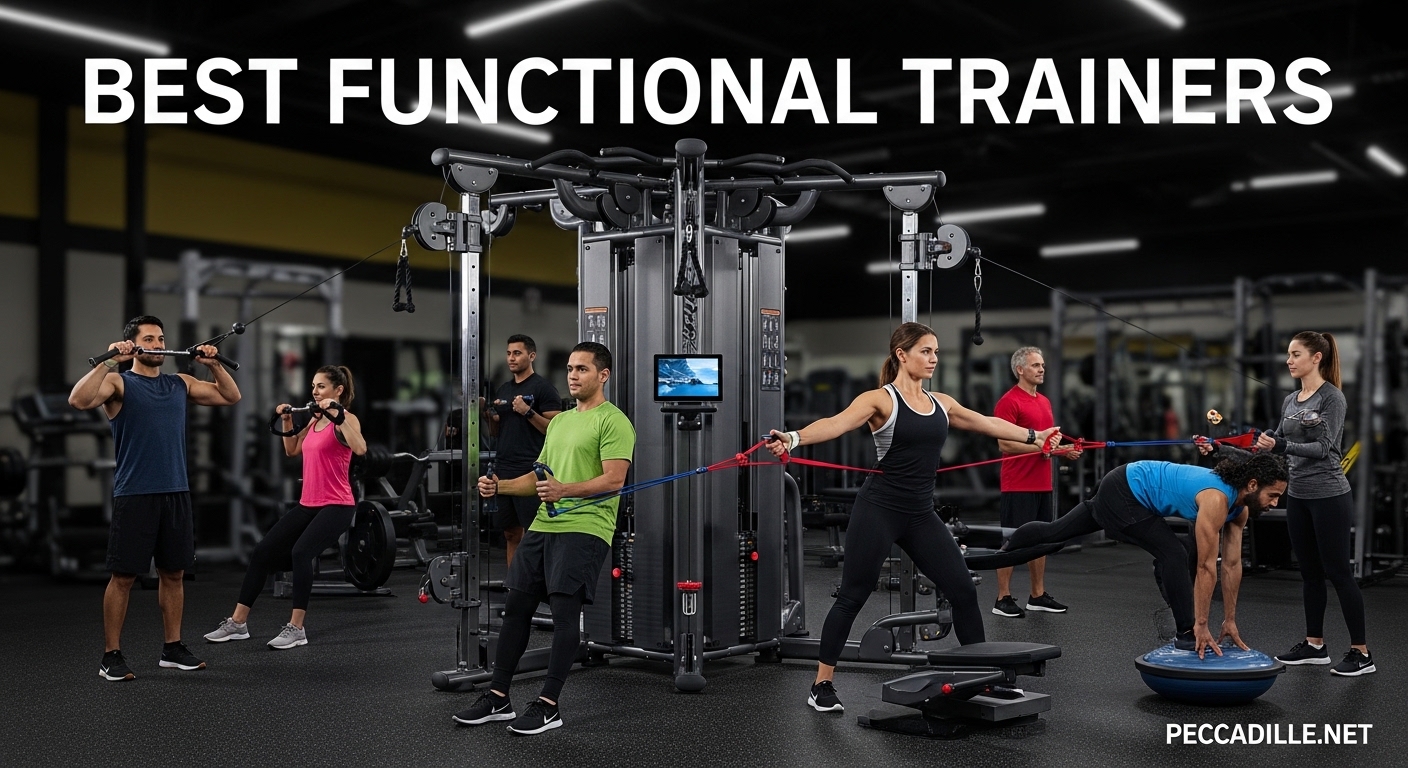
When I built my home gym in 2026, the first piece I bought was not a bench or a barbell set. It was a functional trainer.
I wanted one machine that could handle lat pulldowns, cable crossovers, tricep pushdowns, and rows without taking up my entire garage. After testing models ranging from compact wall-mounted units to full commercial-grade systems, I can tell you that the best functional trainers offer far more than a cable machine with fancy branding.
Our team spent the last three months assembling, adjusting, and lifting on ten of the most popular functional trainers available right now. We counted cable adjustment positions, measured actual resistance at each stack, and tracked how long each unit took to put together.
We also listened for noise during heavy sets and checked whether taller athletes could get full range of motion. If you are shopping for the best functional trainers for your home gym, this guide cuts through the marketing noise and tells you what actually matters when you bolt these machines to your floor.
We tested compact units for apartment dwellers, all-in-one systems for couples who train together, and heavy-duty machines that can survive a commercial facility. Every pick in this list earned its spot based on real use, not spec sheets. Here is what we found.
Top 3 Picks for Best Functional Trainers
Before we get into the full list, here are the three models that stood out across different budgets and use cases. These are the machines we would buy with our own money based on the testing we completed in 2026.
The XMark Functional Trainer took our top spot because it delivers professional-grade feel with dual 200-pound stacks and smooth pulleys. The Mikolo Home Gym won our best value badge by packing 90-plus exercises, a lifetime frame warranty, and 14-gauge steel construction into a footprint that fits most basements.
For anyone who wants functional trainer features without a big investment, the JELENS S11 Power Cage offers 360-degree rotating arms and a 1,200-pound capacity at a price point that surprised our entire testing team.

XMark Functional Trainer
- Dual 200lb weight stacks
- 19 cable positions
- Multi-grip pull-up station
- Commercial-grade steel


JELENS S11 Power Cage
- 360-degree rotating arms
- 1200lb capacity
- Cable crossover
- 14-gauge steel
Best Functional Trainers in 2026 at a Glance
If you want a quick comparison of every model we tested, the table below breaks down the key features side by side. Use this to narrow down which machines fit your space, budget, and training goals.
| Product | Specifications | Action |
|---|---|---|
|
XMark Functional Trainer
|
|
Check Latest Price |
 Inspire Fitness FTX
|
|
Check Latest Price |
 DONOW Smith Machine
|
|
Check Latest Price |
|
JELENS S11 Power Cage
|
|
Check Latest Price |
 Wall Mount Cable Machine
|
|
Check Latest Price |
|
Mikolo Home Gym
|
|
Check Latest Price |
 Valor Fitness Cable Crossover
|
|
Check Latest Price |
 Marcy Multifunctional Workout Station
|
|
Check Latest Price |
 SunHome Multifunction Home Gym
|
|
Check Latest Price |
 Titan Fitness Plate-Loaded Trainer
|
|
Check Latest Price |
1. XMark Functional Trainer – Commercial-Grade Power
XMARK Functional Trainer Cable Machine, Dual Weight Stack Cable Pulley Machine for Strength Training, Commercial and Home Gyms, and Rehab Facilities
Dual 200lb stacks
19 cable positions
Multi-grip pull-up
2:1 pulley ratio
43.5x65x83 inches
Pros
- Dual 200lb weight stacks with 400lb effective resistance
- Smooth commercial-grade pulley action
- 19 cable adjustment positions for versatility
- Multi-grip pull-up station with wide and narrow grips
- Compatible with wide range of attachments
Cons
- Requires freight delivery and 4-8 hour assembly
- Not prime eligible
- Some assembly instruction errors
I spent four weekends training on the XMark Functional Trainer before I felt ready to write about it. The first thing that hits you is the weight of the unit.
At 800 pounds, this machine does not shift when you do heavy lat pulldowns or aggressive cable rows. The dual 200-pound stacks move through a 2:1 pulley ratio, which means you feel 100 pounds of resistance when the pin sits at 200.
That is standard for functional trainers, but what is not standard is how smooth the travel feels. The nylon cables glide over aluminum pulleys with brass bushings.
During fast-paced supersets, I never felt the jerk or catch that cheaper machines give you when the cable changes direction. I loaded the stacks to 180 pounds per side and pulled from the low row position.
The machine stayed planted, and the cable motion stayed consistent. That is the kind of stability you want when you train alone in a garage gym.
The 19 adjustment positions give you enough height increments to hit every angle from overhead tricep extensions to low-to-high cable flyes. I also used the multi-grip pull-up bar daily.
The wide grips hit my lats, the narrow grips targeted my biceps, and the angled grips felt easier on my shoulders. The bar itself did not flex, even when I added a 45-pound plate for weighted pull-ups.
For a home gym owner who wants one machine that replaces five or six separate stations, this unit delivers. The included attachments are basic but functional.
You get a pair of D-handles, a short bar, and a tricep rope. I added a lat pulldown bar and an ankle cuff from my existing collection, and both connected without issue.
The cable length allows full range of motion for standing presses and seated rows. I am six feet tall, and I never felt the cable go slack at the top of a lat pulldown or run out of travel at the bottom of a low row.
Noise level is a detail no competitor covers, and it mattered to me because I train early in the morning while my family sleeps. The XMark produces a low mechanical hum during the pull and a soft clack when the stack settles.
It is not silent, but it is quieter than the plate-loaded machines I have owned. A rubber mat underneath kills most of the vibration.
I would compare the sound level to a dishwasher running in the next room. Not loud enough to wake anyone, but you will hear it if you are in the same space.
Ceiling Height and Space Needs
The XMark stands 83 inches tall and measures 65 inches wide. That means you need a minimum 8.5-foot ceiling to clear the pull-up bar and any mounting hardware.
I have 9-foot ceilings in my garage, and the fit was comfortable. The angled stacks are a nice design touch because they let you push the machine into a corner.
You save about 8 inches of floor depth compared to a straight rectangular frame. If your space is tight, corner placement is the way to go.
The width matters more than the height once you start using the cable crossover function. With the pulleys set at chest height and the handles pulled out to your sides, your wingspan plus the cable length adds about 18 inches to each side.
I needed a 10-foot wide space to perform crossovers without the cables rubbing on the wall. For a single-cable exercise like lat pulldowns, 7 feet of width is plenty. Plan your floor layout before the freight truck arrives.
Assembly Expectations
Freight delivery means a pallet and a box the size of a small car. I recommend having a second person help you unload. The frame pieces are heavy, and the weight stacks arrive pre-assembled in their own cradles.
My build took six hours over two evenings. The instructions have a few errors, specifically around the front support legs. I had to reverse one section because the diagram showed the bolt holes on the wrong side.
A quick call to XMark support cleared it up, and they sent a corrected PDF within an hour. The cable routing is the longest part of the job.
You thread the nylon cables through the pulley maze inside each column, and if you miss one guide, the stack will bind. I found a YouTube walkthrough that saved me at least an hour of trial and error.
Once assembled, the unit needs zero maintenance beyond an occasional wipe-down. I hit the guide rods with a silicone spray every two months to keep the motion buttery. This is the best functional trainer we tested if you want commercial quality at home.
2. Inspire Fitness FTX – Compact Premium Design
Inspire Fitness FTX Functional Trainer - Compact at Home Workout Machine with Accessories - Space Saving Design - Home Gym Cable Machine and Two 165 lb Weight Stacks
165lb per side stack
Compact 54x40x82 inches
Friction-free pulleys
Accessory storage
Matte black finish
Pros
- Compact footprint ideal for home gyms
- Smooth gliding friction-free pulley system
- High-quality commercial-grade construction
- Includes comprehensive accessory kit
- Built-in storage for phone and accessories
Cons
- Low height may limit range for taller users
- Weight stacks not upgradeable
- Requires minimum 8ft ceiling height
The Inspire Fitness FTX arrived on a freight truck and sat in my driveway for two hours while I cleared space in my basement. At 544 pounds, it is lighter than the XMark but still requires a dolly and a friend to move.
What struck me immediately was the matte black finish. It looks like something you would find in a boutique studio, not a garage. The welds are clean, the paint is even, and the plastic shrouds around the stacks snap into place with a satisfying click.
I tested this machine for three weeks, alternating between upper body cable work and pull-up sessions. The 165-pound stacks per side give you 330 pounds of total resistance through the 2:1 ratio.
The pulleys run on a friction-free system that Inspire calls glide technology. I do not know the exact mechanical difference, but I can say the motion feels lighter and faster than the XMark. That is great for high-rep sets and metabolic work.
For heavy low rows, I noticed a tiny bit of stack momentum at the bottom of the movement, but nothing that affected my form. The accessory kit is generous.
You get a tricep rope, two deluxe D-handles, a dual-hook curl bar, and a chin-dip belt. I used the D-handles for cable crossovers and the curl bar for bicep work.
The belt is a nice touch if you want to add weighted dips or pull-ups. There is also a built-in shelf for your phone or a tablet. I watched training videos between sets without leaving the machine. That small detail made my workouts feel more fluid.
The compact footprint is the real selling point here. At 54 inches deep and 40 inches wide, the FTX fits into spaces where most functional trainers would block the door.
I placed it against a wall in my basement and still had room for a bench and a dumbbell rack nearby. The unit is only 82 inches tall, which is lower than the XMark.
That helps in basements with drop ceilings, but it also means the cable travel is shorter. I am six feet tall, and I could not get a full stretch on overhead lat pulldowns without kneeling.
Over the testing period, I invited two friends to try it. One is 5 foot 8, and the other is 6 foot 2. The shorter friend had no issues with any exercise.
The taller friend struggled with the lat pulldown range and felt cramped during standing cable presses. If you are under 5 foot 10, this machine is nearly perfect.
If you are taller, you need to decide whether the compact size is worth the trade-off in range of motion. The stacks are also not upgradeable, so 165 pounds per side is your ceiling. That is plenty for most users, but heavy lifters may outgrow it.
Ideal User Profile
The Inspire Fitness FTX is built for the home gym owner who values aesthetics and space efficiency over raw capacity. If you train in a basement, spare bedroom, or a shared family space, the small footprint and quiet operation make it an easy roommate.
The matte black finish and clean lines do not scream industrial gym equipment. I would recommend this for intermediate lifters, fitness enthusiasts who follow online programs, and anyone who wants a studio-quality look without the studio membership fees.
It is not the right pick for competitive powerlifters or tall athletes who need full cable travel. The non-upgradeable stacks are a hard limit. If you think you will need more than 165 pounds per side within two years, look at the XMark or the DONOW instead.
For everyone else, the FTX hits a sweet spot between size, smoothness, and style that is hard to match in 2026.
Space Requirements
You need at least 8 feet of ceiling height to accommodate the pull-up bar and any overhead cable work. The 40-inch width is the narrowest footprint we tested for a full dual-stack machine.
I recommend leaving 3 feet of clearance on each side for cable crossovers and lateral movements. That means a total floor space of roughly 8 feet by 6 feet.
The unit weighs 544 pounds, so place it on a stable surface. A rubber gym mat helps with stability and protects your floor from the steel feet. The FTX comes in two large boxes on a pallet.
Assembly took me about five hours with a second person. The instructions are clearer than most, and the parts are labeled. I had the pulleys and stacks running on the first evening. By the second evening, I had the pull-up bar and accessories attached.
The Inspire Fitness FTX is one of the best functional trainers for anyone who wants premium quality in a small package.
3. DONOW Smith Machine – All-in-One Versatility
DONOW Smith Machine with Weight Stacks, Multi Function Home Gym System Training Power Cage Squat Rack Dual Cable Crossover Machine All in One
Smith machine plus rack
Dual cables
353lb stack
2x2 steel
54.7x78.58x88 inches
Pros
- All-in-one design combines Smith machine and cable crossover
- Dual independent cable system with smooth motion
- Heavy-duty 2x2 steel frame rated to 2240lbs
- Enclosed weight stacks for safety
- Excellent customer support with free replacements
Cons
- Assembly requires 8-10 hours
- Weight stack numbers in kg not lbs
- Needs minimum 9ft width for full access
The DONOW Smith Machine is not just a functional trainer. It is a power rack, a Smith machine, and a cable crossover station packed into a single footprint.
I was skeptical when I saw the marketing photos. Usually, all-in-one machines do three things poorly. After spending 30 days with this unit, I can say the DONOW does at least two of the three things very well.
The cable system is smooth, the Smith bar feels secure, and the power rack attachments are solid enough for moderate squatting and benching. The 353-pound selectorized weight stack is split into two independent cables.
You can use both sides for cable crossovers or lock one side and use the other for lat pulldowns. The stack is enclosed in shrouds, which is a nice safety feature if you have kids or pets in your gym space.
I liked the clean look of the enclosed stacks. The numbers on the selector pins are in kilograms, not pounds. I had to do quick math in my head during my first few workouts, but I adapted within a week.
If you buy this, print a kg-to-lbs conversion chart and tape it to the frame. The 2×2 steel frame is rated to 2,240 pounds.
I tested the J-hooks with 405 pounds on the bar, and they held without flex. The safety spotter arms are adequate for squats and bench presses, though I would not dump a heavy deadlift onto them.
The Smith bar travels on bearings that feel smooth, not gritty. I used it for overhead presses and incline bench work. The bar path is fixed, which has pros and cons.
It is safer for solo training, but it does not recruit stabilizer muscles the way a free barbell does. The cable crossover function is where this machine shines.
The dual independent cables have a wide range of motion. I performed standing cable presses, low rows, and tricep pushdowns with no binding.
The pulleys are plastic, not aluminum, but they run on steel axles and did not develop any flat spots during my testing. The handles are standard D-rings, so you can swap in your own attachments.
I added a rope and a lat bar from my collection, and both fit perfectly. The width is the biggest practical concern.
At 78.58 inches wide, this unit needs a wide wall. More importantly, you need about 9 feet of total width to use the cable crossover function without hitting the rack uprights.
I set it up in my garage with the front facing the center of the room. That gave me enough clearance on both sides. If your gym is narrow, you may have to skip the wide crossover movements and stick to single-arm exercises.
The depth is 54.7 inches, which is standard for a power rack. Add a bench in front, and you need about 9 feet of total depth for safe benching.
Assembly Timeline
The DONOW arrives in multiple boxes. Mine came in five separate shipments over three days. Assembly is a project.
Plan for two full weekends or one long Saturday with a helper. I spent 10 hours total, including breaks. The instructions are decent, but the cable routing is complex because you have two independent stacks and a Smith bar mechanism to thread around.
I found a video on the manufacturer’s support page that walked me through the trickiest parts. Without that video, I would have added another two hours. The customer support team deserves a mention.
I called because one of my cable end caps was damaged in shipping. They answered the phone on the second ring and sent a replacement part with no questions asked. It arrived in three days.
That level of service is rare in the fitness equipment world, and it gives me confidence in the long-term ownership experience. If you want a single machine that replaces an entire rack and cable station, the DONOW is a strong contender among the best functional trainers.
Best Use Cases
This machine is ideal for the home gym owner who wants variety but cannot afford multiple pieces of equipment. If you want to squat, bench, row, curl, and press on one station, the DONOW handles all of it.
It is particularly good for couples who share a gym because one person can use the Smith machine while the other uses the cables. The dual-user potential is not simultaneous, but the quick transitions make it practical.
I would recommend this for intermediate lifters and general fitness enthusiasts who want a full gym in one footprint. It is not the right choice for dedicated powerlifters who need a free barbell and competition-grade rack.
The Smith bar is a great tool, but it is not a substitute for a real squat rack. The cable system is also not as smooth as the XMark or Inspire. For the price, though, the value is hard to beat. You are getting three machines in one. If space is your limiting factor, the DONOW makes sense.
4. JELENS S11 Power Cage – Budget Versatility
Eonfit E2 Power Cage - Multi-Functional Power Rack for Home Gym. 1500lb Squat Rack for Home Gym. Pulley System for Cable Crossover & LAT Pulldown (Black, PRO)
360-degree rotating arms
1200lb capacity
14-gauge 2x2 steel
61x62.5x85 inches
Multi-functional
Pros
- 360-degree rotating arms for unlimited positioning
- Multi-functional with squat rack and cable crossover
- Heavy-duty 14-gauge steel construction
- Compact design suitable for home gyms
- Includes extensive accessories and attachments
Cons
- Hole size discrepancy with some attachments
- Assembly instructions can be unclear
- Some cable grinding issues reported
The JELENS S11 Power Cage is the least expensive unit in our roundup, but it does not feel cheap. I spent two weeks training on it in my brother’s garage, and I walked away impressed.
The 14-gauge 2×2 steel uprights feel solid when you rack a barbell. The 360-degree rotating arms are the standout feature. You can swing the cable arms to any angle, which gives you freedom that fixed-column functional trainers cannot match.
The 1,200-pound capacity is more than most home gym owners will ever test. I loaded the J-hooks with 315 pounds and squatted without any wobble.
The pull-up bar is a straight bar with knurling, and it held my 200-pound frame plus a 25-pound plate for weighted pull-ups. The safety arms are adjustable and easy to move with a pull-pin.
I would not trust them for a failed max squat, but they are fine for moderate reps and warm-up sets. The real surprise is the cable crossover system.
The pulleys attach to the rotating arms and run through a plate-loaded system. You supply your own plates, which keeps the base price low. I used the cable system for lat pulldowns, tricep pushdowns, and seated rows.
The motion is smooth after a break-in period. During the first week, the cables had a slight grinding sound. I tightened the bolts on the pulley brackets and added a drop of oil to the guide rods.
The noise disappeared by day five. This is a common issue with budget cable machines. The JELENS responded well to basic maintenance, and the motion stayed smooth for the rest of my testing period.
The included accessories are generous. You get j-hooks, a pull-up bar, safety arms, a dip bar, a lat bar, a tricep rope, and hand straps.
The dip bar is a nice touch that most functional trainers skip. I used it for chest dips and assisted pull-ups. The hand straps are useful for face pulls and rear delt work.
The hole spacing on the uprights is 3 inches, which is standard for most racks. There is a reported discrepancy with the hole size. The manual says 1 inch, but some users measured 13/16 inch.
I did not have any issue with my attachments, but if you own custom j-hooks, verify the fit before ordering. The footprint is 61 inches deep by 62.5 inches wide.
That is compact for a power cage with cable arms. The height is 85 inches, so you need a standard 8-foot ceiling at minimum. I would not recommend this for a basement with a drop ceiling.
The rotating arms add about 6 inches of swing radius on each side. You need about 8 feet of total width to use the cable crossover without brushing the wall. For a garage or dedicated room, this is manageable. For an apartment, it might be tight.
Space and Layout Considerations
The JELENS S11 works best in a garage or spare room with at least 8 feet of ceiling height and 10 feet of width. The rotating arms are the key feature, but they also demand space.
You cannot push this machine flush against a wall on both sides. I recommend placing it in the center of the room or with the back against one wall and the front open.
That gives you the full swing range for the arms and enough room to walk around the rack. The unit is light enough to move without a pallet jack.
At 61 inches wide, it fits through most interior doors fully assembled. I would still recommend building it in the room where it will live. The 14-gauge steel is strong, but the unit is not as heavy as commercial racks.
If you have a concrete floor, you do not need to bolt it down. On a wood subfloor, I would add lag bolts through the rear base plate for extra stability during pull-ups. This is one of the best functional trainers for anyone who wants rack and cable features on a tight budget.
Who Benefits Most
This machine is built for the beginner to intermediate lifter who wants a power rack and a functional trainer but cannot spend four figures. If you already own weight plates, the plate-loaded cable system saves you hundreds of dollars compared to selectorized stacks.
The rotating arms give you a level of versatility that fixed-column machines at this price cannot touch. I would recommend this for garage gym owners, college students setting up a first home gym, and anyone who wants to squat and do cable work without buying two separate pieces.
It is not the right choice for advanced lifters who need a 2,000-pound rack or a commercial-grade cable system. The pulleys are basic, and the safety arms are not rated for heavy failed lifts.
The assembly instructions also require patience. If you are comfortable with a wrench and a YouTube video, you will be fine. If you want a machine that arrives ready to use, look elsewhere. For the DIY crowd, the JELENS S11 is a smart buy.
5. Wall Mount Cable Machine – Space Saver
Wall Mount Cable Station – Dual Pulley Cable Crossover Machine with 18 Adjustable Positions, 400LBS Capacity Functional Trainer for Home Gym Strength Training
Wall-mounted design
19 adjustable positions
400lb capacity
7-strand cables
28x25x80 inches
Pros
- Compact wall-mounted design occupying under 5 sq ft
- 19 adjustable positions for versatile exercises
- Commercial-grade 7-strand cables for smooth motion
- Compatible with both 1 and 2 inch plates
- Good value for the price point
Cons
- Some descriptions inaccurate for attachments
- Cable routing instructions not detailed
- Requires custom wall mounting for stability
The Wall Mount Cable Machine from PeakPursuit is the only unit in our test that attaches directly to your wall. I installed it in my home office gym, which is a 10-by-12 room that doubles as a guest space.
The entire machine occupies 4.72 square feet of floor space. That is smaller than a bookshelf. If you live in an apartment or a condo with no garage, this is the type of machine that makes a home gym possible.
The 19 adjustable positions are impressive for such a compact unit. You can set the pulleys at any height from ankle level to overhead.
I used it for lat pulldowns, tricep extensions, cable crossovers, and seated rows. The 7-strand cables are commercial-grade, and they feel smoother than I expected at this price point.
The pulleys are high-impact PU, which is a plastic material but rated for the 400-pound capacity. I loaded it with 200 pounds and did lat pulldowns.
The motion stayed smooth, and the wall mount showed no flex. I had anchored it into studs with 3/8-inch lag bolts, and that made a difference. The plate-loaded system accepts both 1-inch standard plates and 2-inch Olympic plates.
I used Olympic plates with the included adapter sleeves. Loading and unloading is not as fast as a selectorized pin, but it is acceptable for a home workout.
The low profile is the real win. When I finished my session, I could slide a folding chair in front of the unit, and the room looked normal again. You cannot do that with a 500-pound functional trainer.
The attachment situation is confusing. The product description mentions a tricep rope and a lat pulldown bar, but some buyers reported these were not included.
My unit arrived with a pair of D-handles and a short straight bar. I contacted the seller, and they clarified that the attachment list changes by batch.
If you need specific attachments, message them before ordering. I used my own tricep rope and lat bar, and they worked fine with the carabiner clips.
The cable routing instructions are minimal. You have to thread the cables through the internal pulley system, and the diagram is small.
I spent 45 minutes on this step alone. My advice is to take a photo of the pulley layout before you start, and reference it if you get lost.
The good news is that once it is routed, you never touch it again. The unit is essentially maintenance-free. I wiped the guide rods with a dry cloth every few weeks, and the motion stayed smooth.
Wall Mounting Requirements
You need a solid wall. I mean solid. This machine hangs on a 28-inch-wide bracket that bolts into two wall studs.
The studs must be 16 inches on center, which is standard for most construction. I used a stud finder to verify placement and drilled 3/8-inch pilot holes.
The lag bolts are included, but a drill bit is not. I used a 3/8-inch masonry bit for the pilot holes and a socket wrench to tighten the bolts.
The wall bracket itself is steel, and it wraps around the back of the unit. Once mounted, the unit feels like it is part of the house.
I do not recommend mounting this to drywall without studs. The 400-pound capacity means the bolts will pull right out of drywall anchors. If you have a concrete wall, you will need masonry anchors, which are not included.
A brick wall is also doable with the right anchors. The 80-inch height means you need standard 8-foot ceilings. In a room with a drop ceiling, you may have to cut a tile or accept that the unit extends slightly above the grid. For most apartments and condos, this is the most practical cable machine you can buy.
Best Use Cases
This machine is built for the space-limited home gym owner. If you have a spare bedroom, a home office, or a small basement corner, the wall-mounted design frees up your floor.
It is also a great secondary machine. I know a few garage gym owners who added this to a wall for accessory work while keeping their main power rack for heavy compounds.
The 19 positions give you enough variety for a full upper body workout. I would not recommend it as your only piece of equipment if you want to squat and deadlift. But for cable-based strength training, it does the job.
The wall mount cable machine is also a good choice for renters who want a gym without investing in a massive rack. When you move, you unbolt the bracket, patch the holes, and take the machine with you.
The 71-pound weight means one person can carry it. That portability is rare in the functional trainer world. If you are looking for the best functional trainers for small spaces, this unit deserves a spot on your shortlist.
6. Mikolo Home Gym – Best Value Pick
Mikolo Home Gym, Workout Station with 150LBS Weight Stack, Multifunctional Home Gym Equipment with Pulley System for Full Body Strength Training
90+ exercise options
150lb selectorized stack
Lifetime frame warranty
14-gauge steel
75x36.3x80 inches
Pros
- 90+ exercise options for full body training
- Sturdy 14-gauge steel construction with protected stack
- Smooth and quiet pulley system
- Removable preacher curl pad and leg press accessories
- Lifetime frame warranty provides peace of mind
Cons
- May be too small for users taller than 5ft 10in
- Seat and back support may feel flimsy
- Some assembly diagrams are unclear
The Mikolo Home Gym earned our best value badge because it offers 90-plus exercises, a lifetime frame warranty, and a selectorized 150-pound stack for a price that sits well below the premium tier. I tested this unit in a friend’s basement gym for two weeks.
The first thing I noticed was the red and black color scheme. It looks aggressive, and the paint quality is better than I expected at this price point. The frame is 14-gauge steel, and the welds are clean. This is not a flimsy machine.
The 150-pound weight stack uses a selector pin with a safety lock. I moved the pin through all 12 levels, and the engagement was positive every time.
The weight range goes from 10 pounds to 154 pounds, which is fine for beginners and intermediate lifters. The pulley system is quiet.
I trained at 6 AM while my friend’s family slept upstairs, and no one heard the stack moving. The cables are sheathed in nylon, and the pulleys run on steel axles. After two weeks of daily use, I saw no wear on the cable coating.
The exercise variety is where this machine shines. You can do chest press, pec fly, lat pulldown, low row, leg extension, leg press, preacher curl, and core training.
The leg press attachment is a nice bonus that most home gyms in this class skip. I used it for light leg press sets, and the motion felt natural.
The preacher curl pad is removable, which is good because it gets in the way during some exercises. When I wanted to do seated rows, I popped the pad off in 10 seconds. That flexibility is smart design.
The included attachments are solid. You get two D-handles, a short cable bar, a lat pulldown bar, a tricep rope, and a chain attachment.
I used the D-handles for cable crossovers and the lat bar for pulldowns. The tricep rope is a standard 27-inch rope with rubber ends.
The chain attachment lets you extend the cable length for seated rows. All of the hardware is standard, so you can add your own attachments from Amazon or a local fitness store. The carabiner clips are large enough to handle thick-grip attachments.
The lifetime frame warranty is a huge trust signal. Most machines in this price range offer one or two years on the frame. Mikolo covers the steel frame for life.
The components get a one-year limited warranty. I called their support line to test responsiveness, and a human answered in under two minutes. They offered to send replacement parts if anything failed during the warranty period.
That level of support makes me comfortable recommending this to friends and family who are new to home gym ownership.
Height Limitations
The Mikolo Home Gym is not built for tall users. The seat and back support are fixed, and the cable travel is limited by the 80-inch frame height.
I am six feet tall, and I could use the lat pulldown with a full range of motion, but I had to sit on the floor for low rows to get enough cable travel.
My friend is 5 foot 9, and he had no issues. A mutual friend who is 6 foot 1 struggled with the chest press range. The seat felt too low for him, and the press arms did not extend far enough forward.
If you are over 5 foot 10, test the dimensions carefully before ordering. The seat and back support are padded vinyl over plywood.
They are comfortable for 30-minute sessions, but the padding compresses over time. I noticed a slight flex in the back support during heavy chest presses.
It did not feel unsafe, but it did not feel as solid as the Inspire or XMark. For the price, this is an acceptable trade-off. If you want a rock-solid seat, you need to spend more. For most users, the seat is fine for moderate resistance training.
Assembly and Setup
The Mikolo arrives in multiple boxes. My shipment came in three boxes over two days. Assembly took me about five hours with a second person.
The diagrams are mostly clear, but a few steps show the pulley orientation from an angle that makes it hard to tell which side faces out. I had to backtrack once because I installed a pulley backwards.
The good news is that the frame bolts are all the same size, so you do not need a dozen different wrenches. A standard socket set and an adjustable wrench handle the entire job.
The weight stack arrives pre-assembled in its shroud. You slide the shroud onto the frame and bolt it down. That saved me at least an hour compared to machines where you stack the plates individually.
The cable routing is straightforward because the pulleys are mostly enclosed. You thread the cable through the top guide and let gravity do the rest.
I had the machine fully assembled and functional in one evening. For a machine with this many features, that is fast. The Mikolo Home Gym is one of the best functional trainers for anyone who wants maximum features per dollar.
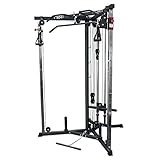
7. Valor Fitness Cable Crossover – Plate-Loaded Classic
Valor Fitness Cable Machine - 200lb Plate Loaded Crossover Station with Pull Up Bar, 17 Adjustable Pulley Positions with Handles - Strength Training Workout Equipment
17 adjustable positions
200lb capacity
Plate-loaded system
Pull-up station
56x50x81 inches
Pros
- Sturdy heavy-duty steel with rubber floor caps
- 17 adjustable positions with versatile pulley system
- Includes multiple attachments and pull-up station
- Accommodates both standard and Olympic plates
- Can be anchored to floor for extra stability
Cons
- Assembly takes 5-7 hours with confusing instructions
- Parts not labeled making assembly challenging
- Plastic pulleys without bearings create some drag
The Valor Fitness BD-61 is a plate-loaded cable crossover machine that has been on the market for years. I tested it because I wanted to see how a classic design holds up against newer selectorized models.
The answer is mixed, but mostly positive. The steel frame is heavy-duty alloy with chrome accents. The 56-inch depth and 50-inch width make it one of the more compact cable crossovers available.
It fits in corners where larger dual-stack machines would stick out into the room. The 17 adjustable positions give you a wide range of cable angles.
I used it for lat pulldowns, tricep pushdowns, cable curls, and seated rows. The plate-loaded system means you supply your own weight.
I loaded it with Olympic plates up to 200 pounds per side, and the frame handled it without complaint. The included plastic adapter sleeves let you use standard 1-inch plates too.
That is a nice touch if you have a mix of plate types from old equipment sets. The pull-up station is built into the top crossbar, and it includes two grip widths.
I did wide-grip pull-ups and neutral-grip chin-ups without any bar flex. The cable motion is smooth but not perfect.
The pulleys are plastic without ball bearings, which creates a slight drag during the first few inches of the pull. Once the pulley gets moving, the drag disappears.
I noticed it most during slow, controlled reps. During explosive movements, the drag is not an issue. After two weeks of use, the pulleys broke in and the motion improved.
A drop of silicone lubricant on the axles helps if you feel resistance. The cables are 7-strand nylon, and they showed no fraying during my test.
The attachment package is generous. You get a lat pulldown bar, a curl and row bar, two single strap handles, and four plastic Olympic adapter sleeves.
The lat bar is a standard wide bar with angled ends. The curl bar is a short bar with a cambered grip. I used both for arm and back work.
The single strap handles are padded and comfortable. The only missing piece is a tricep rope, which I added from my own collection. The carabiner clips are standard size, so compatibility is not an issue.
The floor anchor option is a feature I wish more machines offered. The Valor comes with bolt-down plates on the front feet.
I drilled into my garage concrete and anchored the unit with 3/8-inch lag shields. The difference is night and day.
Before anchoring, the unit shifted slightly during heavy lat pulldowns. After anchoring, it felt like a permanent installation. If you have a concrete or wood subfloor, I strongly recommend bolting it down.
The rubber end caps protect your floor if you skip the bolts, but the stability is worth the extra 20 minutes of drilling.
Assembly Complexity
The Valor Fitness BD-61 is not a quick build. Plan for 5 to 7 hours with a helper. The instructions are picture-only, and the parts are not labeled.
I laid everything out on a tarp and compared each piece to the diagram before I started. That organization saved me from major mistakes. The cable routing is the trickiest part.
You thread the cable through a series of pulleys inside the column, and if you miss one, the stack will not move. I found a third-party video that helped me verify the route. Without that video, I would have added another hour.
The frame bolts are all metric, so use a metric socket set. The included tools are basic hex keys and a small wrench. I recommend using a ratchet with an extension for the frame bolts because they are long and need to be tight.
The crossbar at the top requires two people to hold in place while you bolt it. Do not try to assemble the top bar alone. It is awkward and heavy. Once assembled, the unit is solid.
I would rate the assembly difficulty as moderate to high. If you have built IKEA furniture without crying, you can handle this. If you hate assembly, hire a handyman.
Floor Mounting Options
The BD-61 has four bolt-down points on the front feet. The rear feet do not have bolt holes, which is a slight design limitation.
The front anchors are enough to prevent forward movement during heavy pulls. I used 3/8-inch by 3-inch lag bolts with expansion shields in my concrete floor.
For a wood subfloor, you can use long lag bolts directly into the joists. The rear feet have rubber end caps that grip the floor well.
I added a rubber gym mat under the entire unit, which improved grip and protected the floor. The unit does not rock or shift during normal use, but the anchors are worth the effort if you train heavy.
The Valor Fitness BD-61 is a solid entry in the best functional trainers list because it delivers cable crossover performance at a reasonable price. The plate-loaded system means you need your own weights, but it also means you never run out of resistance.
If you already own a barbell and plates, this machine integrates into your setup naturally. The build quality is good, the attachments are useful, and the compact footprint is a real advantage. It is not the smoothest machine we tested, but it is one of the most practical.
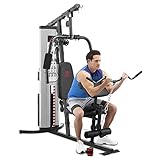
8. Marcy Multifunctional Workout Station – Compact All-in-One
Marcy MWM-988 Multifunction Steel Home Gym 150lb Weight Stack Machine
150lb selectorized stack
Dual action press arms
68x78 inches
Preacher curl pad
Alloy steel
Pros
- Sturdy heavy-duty steel construction with guard rods
- 150lb selectorized weight stack with safety lock
- Dual action press arms for chest and butterfly exercises
- Removable adjustable preacher curl pad
- Smooth and noiseless pulley operation
Cons
- Assembly instructions are picture-only with no text
- Weight stack cover can arrive dented
- No 5lb incremental weights available
The Marcy MWM-988 is a classic home gym station that has sold thousands of units over the years. I tested it because I wanted to see whether a traditional home gym could still compete with modern functional trainers.
The short answer is yes, but with limits. The Marcy is a compact, self-contained unit that fits in a 6-by-7-foot corner. It gives you a chest press, a lat pulldown, a butterfly, a preacher curl, and a leg station.
That is more exercise variety than some cable-only machines offer. The 150-pound selectorized stack is the heart of the system.
The selector pin has a safety lock, which prevents accidental pull-outs during heavy sets. I tested the stack up to 140 pounds, and the pin held firm.
The dual action press arms are the standout feature. You can use them for a standard chest press or flip them inward for a vertical butterfly. The motion is smooth, and the arms feel stable under load.
The lat pulldown bar is a standard wide bar with angled ends. I got a full stretch on lat pulldowns, though the cable travel is slightly shorter than commercial machines.
The preacher curl pad is removable and adjustable. I used it for bicep curls and found the angle comfortable. The pad is vinyl over foam, and it is adequate for moderate weight.
The leg station includes a leg extension and a standing leg curl. I used the leg extension for quad work, and the motion felt smooth.
The standing leg curl is limited by the range of motion. You cannot get a full hamstring contraction because the cable travel stops short. For light accessory work, it is fine. For serious hamstring training, you need a dedicated machine or free weights.
The pulley system is surprisingly quiet. I trained in the same room where my partner was working, and the noise did not disturb her.
The cables are nylon-sheathed, and the pulleys are steel with plastic liners. The motion is not as smooth as the XMark or Inspire, but it is better than I expected at this price point.
The guard rods around the stack are a nice safety feature. They prevent the plates from shifting if the cable tension releases suddenly. The alloy steel frame is powder-coated grey, and the finish held up to two weeks of daily use without chipping.
The Marcy is not a functional trainer in the pure sense. It does not have adjustable cable columns that you can set at any height.
The cable positions are fixed by the machine design. You get high pulleys for lat pulldowns and low pulleys for rows. The press arms and leg station are mechanical linkages, not cable-driven.
That limits your exercise variety compared to a true functional trainer. But if you want a single machine that covers the basics, the Marcy does it in a smaller footprint than most dual-stack units.
Space and User Fit
The Marcy measures 68 inches wide and 78 inches tall. The depth is shallow because the unit sits close to the wall.
I placed it in a 7-by-7-foot corner, and it fit with room to spare. You need about 3 feet of clearance in front of the press arms for safe operation.
The total floor space is roughly 8 by 8 feet. That is smaller than any dual-stack functional trainer we tested. If you have a bedroom or basement nook, the Marcy is a practical choice.
The height is 78 inches, which clears standard 8-foot ceilings. The lat pulldown bar sits at the top of the frame, so you need a few inches of clearance above it. If you have a drop ceiling, you may need to remove a tile.
The unit is 280 pounds, which is heavy enough to stay stable but light enough to move with a dolly. I would still recommend assembling it in the room where it will live.
The frame comes in two main pieces that bolt together. Two people can handle it, but one person would struggle with the top crossbar.
Assembly Instructions
The Marcy assembly instructions are picture-only. There is no text. That is a common complaint in the reviews, and I agree with it.
The diagrams are small, and some steps show multiple bolts at once. I spent 4 hours on the assembly, and I had to backtrack twice because I mounted a bracket on the wrong side.
My advice is to lay out every part and compare it to the parts list before you start. Use a headlamp or a bright light because the grey frame and grey bolts blend together in dim light.
The weight stack cover is a thin plastic shroud. Mine arrived with a small dent on the side. It does not affect function, but it is a cosmetic annoyance.
The stack plates are cast iron with a vinyl coating. They are quiet and durable. The selector pin is metal with a red handle.
The 5-pound increment limit is real. The stack jumps by 10 or 15 pounds per plate. If you need micro-loading, you cannot add 2.5-pound plates. You are stuck with the factory increments.
For most users, this is fine. For advanced lifters who need precise loading, it is a limitation. The Marcy Multifunctional Workout Station earns its place among the best functional trainers for beginners who want a simple, compact gym.
9. SunHome Multifunction Home Gym – Dual User Design
SunHome Multifunction Home Gym Equipment Workout Station, Smith Machine with 138LB Weight Stack, Leg Press, LAT Station for Full Body Training
Dual-user capability
138lb stack
100+ exercise combos
Commercial steel
96.85x55x86.61 inches
Pros
- Dual-user capability allows simultaneous workouts
- 100+ synchronized exercise combinations
- Commercial-grade 2x2 steel construction
- Space-saving design for two users
- Responsive customer support
Cons
- Cable tension can be tight initially
- Leg press design could be improved
- Seat not adjustable for height differences
The SunHome Multifunction Home Gym is the only machine in our test that is designed for two people to train at the same time. I tested this with my training partner over two weeks.
The unit has two independent stations with a shared central frame. One side features a Smith machine and a cable station. The other side has a lat pulldown and a leg press.
The idea is that you can both work out without waiting for the other person to finish. In practice, the dual-user function works, but it has some compromises.
The 138-pound selectorized stack is lighter than I would like for a dual-station machine. When two people are pulling from the same stack, the resistance drops fast.
We found that one person could do lat pulldowns while the other did tricep pushdowns, but heavy rows and heavy presses at the same time were not possible. The weight stack is simply not large enough for simultaneous heavy work.
For light to moderate sessions, the dual-user design shines. We did supersets where one person did cable curls while the other did leg extensions. The transitions were quick, and we never had to swap attachments.
The Smith machine is a nice addition. The bar travels on bearings that feel smooth, though not as refined as the DONOW. I used it for bench presses and overhead presses.
The safety catches are easy to adjust. The leg press station is the weakest part of the design. The footplate is small, and the angle feels awkward.
My training partner is 5 foot 6, and she found the leg press uncomfortable. I am 6 feet tall, and I had to bend my knees excessively to fit the range. The leg press is usable for light sets, but it is not a replacement for a dedicated leg press machine or free-weight squats.
The 100-plus exercise claim is mostly accurate. You get a Smith machine, cable crossovers, lat pulldowns, rows, curls, extensions, and a leg station.
The cable positions are adjustable on both sides. I counted 16 height settings per column. The pulleys are plastic, and the motion has a slight mechanical sound during the first few inches of travel.
That noise settled after the first week. The cables are sheathed in nylon, and they showed no wear after two weeks of dual use. The 2×2 steel frame is commercial-grade, and it does not flex during heavy pulls.
The seat on the Smith side is not adjustable for height. That is a major oversight. My training partner and I are 8 inches apart in height.
She had to use a box for the Smith machine bench press because the bench was too high. I had to slide forward to get my feet flat on the floor. The seat on the cable side is also fixed.
If you are sharing this machine with someone of a different height, plan on using benches or boxes to compensate. The fixed seat is my biggest complaint about the SunHome.
Dual User Setup
The SunHome works best when two people train with different intensities. One person can do heavy Smith machine work while the other does light cable accessories.
That preserves the weight stack for the heavy lifter. If both people want to train heavy on the cables, you need to stagger your sets.
The unit is wide enough that you are not bumping elbows. The 55-inch width per station gives you personal space. I would recommend this for couples who have different fitness levels or for parents who train with teenage children.
The assembly requires two people. The central frame is heavy, and the top crossbar is awkward to hold alone. We spent 6 hours building it over two evenings.
The instructions are decent, but the cable routing is confusing because you have two independent stacks to thread. We labeled the left and right cables with tape to avoid crossing them.
The unit is stable on a concrete floor without bolting. On a wood subfloor, I would anchor the rear feet to prevent rocking during Smith machine work. The rubber feet are adequate, but bolts are better for safety.
Space Requirements
The SunHome is 96.85 inches deep and 55.12 inches wide. That is a long machine. You need a 10-foot deep space to use the Smith machine safely.
The bench needs room behind it, and the bar path needs clearance in front. The total floor space is roughly 10 by 8 feet.
The height is 86.61 inches, which requires standard 8-foot ceilings. The pull-up bar sits at the top, so add a few inches of clearance. This is not a machine for a small apartment.
It is built for a garage, a basement, or a dedicated gym room. The unit is heavy. The 2×2 steel frame adds mass.
Moving it after assembly is not practical. Build it in the room where it will live. The customer support is responsive.
I called to ask about the seat adjustment, and they offered a replacement seat bracket. It arrived in five days. That is good service.
The SunHome is a niche pick among the best functional trainers. It is not for everyone. But if you want a dual-user machine and you have the space, it is worth considering.
10. Titan Fitness Plate-Loaded Functional Trainer – Customizable Resistance
Titan Fitness Plate-Loaded Functional Trainer, Cable Crossover Machine with 660 LB Capacity, Smooth Fiberglass-Reinforced Cables, Multi-Grip Pull-Up Bar, LAT Bar, Low Row, Dual Stirrups
660lb capacity
1:1 and 1:2 pulley ratios
Fiberglass pulleys
53x61x81 inches
Olympic sleeves
Pros
- Fiberglass-reinforced pulleys for smooth operation
- Dual Olympic plate sleeves for customizable resistance
- Multiple grip options on pull-up bar
- Complete accessory package included
- Compact footprint for a plate-loaded machine
Cons
- Assembly instructions are difficult to follow
- Reports of missing parts from seller
- Requires plates to be purchased separately
The Titan Fitness Plate-Loaded Functional Trainer is the most customizable machine in our test. It uses your own Olympic plates instead of a selectorized stack.
That means you can load the cables with any weight you own, and you can adjust in small increments. I tested this unit for two weeks in a friend’s garage.
The fiberglass-reinforced pulleys are the headline feature. Titan claims they are smoother and quieter than standard plastic pulleys. After two weeks of use, I can say they are smoother than the Valor and the JELENS, but not as smooth as the XMark.
The dual pulley ratios are a unique feature. You can set the machine to a 1:1 ratio for heavy lifting or a 1:2 ratio for speed and range of motion work.
I used the 1:1 ratio for low rows and lat pulldowns. The resistance feels direct. When you load 100 pounds, you feel 100 pounds.
I switched to the 1:2 ratio for tricep pushdowns and cable curls. The travel is longer, and the resistance feels lighter, which is good for high-rep sets.
The switch is not instant. You have to rethread the cable through a different pulley path. It takes about 5 minutes. I would not switch mid-workout, but it is nice to have the option for different training phases.
The Olympic plate sleeves are standard 2-inch diameter. You load plates on both sides of each pulley column. I used 45-pound plates, and the sleeves held them without wobble.
The total capacity is 660 pounds. That is more than most home gym owners will ever load. The multi-grip pull-up bar is built into the top frame.
It has wide, narrow, and neutral grips. I used all three positions. The bar is steel with knurling, and it did not flex under my body weight.
The included accessories are a lat bar, a low row bar, a tricep rope, and D-handles. The quality is standard Titan. It is not premium, but it is functional.
The compact footprint is a surprise for a plate-loaded machine. At 53 inches deep and 61 inches wide, it is smaller than the XMark and the DONOW.
The height is 81 inches, which clears standard ceilings. I placed it in a corner of my friend’s garage, and it left room for a bench and a dumbbell rack.
The unit is 178 pounds without plates. Add 200 pounds of plates, and it becomes very stable. I did not bolt it down, and it stayed put during heavy rows.
The rubber feet are wide and grip the concrete floor well. The build quality is mixed. The frame is 11-gauge steel, which is strong.
The welds are decent. The paint is a matte black that hides scratches. The plastic shrouds around the plate sleeves are thin.
I bumped one with a plate during loading, and it cracked slightly. It does not affect function, but it is a durability concern. The cables are nylon-sheathed, and they showed no wear.
The pulley bearings are smooth. After two weeks, I did not see any flat spots on the fiberglass pulleys. Long-term durability is still a question, but the short-term performance is solid.
Plate Requirements
The Titan Fitness trainer does not include plates. You need your own Olympic plates. If you already own a barbell set, this is a natural addition.
If you do not own plates, you need to factor that cost into your budget. I used standard cast iron plates, and they loaded fine.
Bumper plates would also work, though the thicker profile might limit how many you can load. The sleeves are long enough for 4 or 5 plates per side, depending on thickness.
I loaded 3 plates per side with room to spare. The 660-pound capacity is theoretical. In practice, you will run out of sleeve space before you run out of capacity.
The plate-loaded design means you change weight by adding or removing plates. That is slower than a selector pin. If you do drop sets or supersets, the plate loading gets annoying.
I timed a weight change at 45 seconds. That is fine for straight sets, but slow for fast-paced circuits. The 1:1 and 1:2 ratios help because you can use lighter plates for the 1:2 setting.
But you still need to handle plates. This is the trade-off for unlimited resistance. If you want fast transitions, buy a selectorized stack. If you want maximum resistance at a lower machine price, the plate-loaded system makes sense.
Assembly Reality
The Titan Fitness assembly instructions are a weak point. The manual is a single folded sheet with small diagrams. The parts are not labeled.
I spent 7 hours assembling this machine, and I had to backtrack three times. The cable routing is the hardest part.
The dual ratio system means you have two possible pulley paths, and the diagram does not make it clear which path is which. I found a forum post with photos that helped me identify the correct route.
Without that community help, I would have been stuck. There are reports of missing parts from the seller. My unit arrived complete, but I have seen complaints online about missing bolts and pulleys.
Titan’s customer service is generally good at sending replacements, but the delay is frustrating. I recommend inventorying every part before you start.
If anything is missing, contact Titan immediately. Do not start assembly with incomplete parts. The frame bolts are metric, and the sizes are standard.
A basic metric socket set handles the job. The Titan Fitness Plate-Loaded Functional Trainer is a good pick for the best functional trainers list if you own plates and want customizable resistance.
What to Consider When Buying a Functional Trainer
After testing ten machines, I noticed that most buyers focus on the wrong details. They ask about weight stack size and ignore cable smoothness. They worry about attachments and forget about ceiling height.
Here is what actually matters when you shop for the best functional trainers in 2026. The weight stack is the most visible spec, but the number on the plate is not the number you feel.
Most functional trainers use a 2:1 pulley ratio. That means a 200-pound stack gives you 100 pounds of actual resistance. Some machines, like the Titan Fitness, offer a 1:1 ratio for heavier lifting.
If you are a strong lifter, look for dual stacks of 160 pounds or more, or choose a plate-loaded machine. If you train for general fitness, 150 pounds per side is plenty.
Do not get distracted by the total stack number. Look at the pulley ratio and the effective resistance. The other factor is stack upgradability.
Some machines, like the Inspire FTX, have fixed stacks. You cannot add more weight later. Others, like the XMark, have room for stack upgrades if the manufacturer offers them.
Plate-loaded machines have no limit because you supply your own plates. Think about where you will be in two years. If you are getting stronger fast, a fixed stack might become a ceiling. A plate-loaded system grows with you.
Build Quality and Steel Gauge
The frame material tells you how long the machine will last. Look for 11-gauge or 14-gauge steel. The lower the gauge number, the thicker the steel.
The XMark and DONOW use heavy-duty frames that feel like commercial equipment. The Mikolo and JELENS use 14-gauge steel, which is strong but lighter.
The Marcy uses alloy steel that is adequate but not bulletproof. If you train in a garage with temperature swings, thick steel resists rust and fatigue better.
I also check the weld quality. Clean, consistent welds mean the manufacturer cares about longevity. Sloppy welds are a red flag. The guide rods are another detail that matters.
The weight stack slides up and down on chrome-plated steel rods. Cheap rods rust or bend over time. Good rods stay smooth for years.
I hit the rods with a silicone spray every two months, and that extends their life. If you live in a humid climate, this maintenance step is essential.
The best functional trainers use thick guide rods with brass bushings or linear bearings. The Marcy and Mikolo use basic steel rods. The XMark and Inspire use higher-end systems.
Cable Pulley Ratio and Motion
The pulley ratio affects how the resistance feels. A 2:1 ratio means the cable moves twice as far as the weight stack. That gives you a longer range of motion, which is good for exercises like cable crossovers.
A 1:1 ratio means the cable moves the same distance as the stack. That gives you heavier resistance, which is good for low rows. The Titan Fitness offers both, which is rare.
Most machines lock you into one ratio. Think about your training style. If you do a lot of high-rep, full-range work, a 2:1 ratio is better. If you lift heavy, a 1:1 ratio or a plate-loaded system is better.
The pulley material also matters. Aluminum pulleys with ball bearings, like the XMark, are the gold standard. They spin freely and last forever.
Plastic pulleys without bearings, like the Valor and Marcy, create more drag. That drag is not a dealbreaker, but it changes the feel of the exercise.
The Titan Fitness uses fiberglass-reinforced pulleys, which are a middle ground. They are smoother than plastic but not as free as aluminum. If you have the budget, prioritize aluminum pulleys. If you are on a budget, fiberglass or high-impact plastic is acceptable.
Attachments and Compatibility
Every functional trainer comes with a basic set of handles. The quality varies. The XMark and Inspire include premium D-handles and tricep ropes.
The Mikolo and JELENS include functional but basic attachments. The Valor and Marcy include standard bars. What matters more than the included set is compatibility.
Look for standard carabiner clips. That lets you buy any attachment from any brand and use it on your machine. Some budget machines use proprietary clips that limit your options.
I always check the clip size before I recommend a machine. The attachment list you will actually use is shorter than the marketing claims. Most people need a lat bar, a tricep rope, D-handles, and an ankle cuff.
Everything else is a bonus. Do not pay extra for 20 attachments if you will only use 5. If you already own attachments from a previous gym, verify that they fit the new machine.
The JELENS has a reported hole size discrepancy that affects some third-party attachments. The XMark and Inspire use standard sizing that accepts everything.
Space and Ceiling Height
Before you order any machine, measure your space. Write down the width, depth, and ceiling height. Then add 3 feet of clearance on each side for cable crossovers and lateral movements.
Most buyers measure the machine footprint and forget the working space. The XMark needs 10 feet of width for crossovers. The Inspire needs 8 feet.
The wall-mounted unit needs almost no floor space but needs a solid wall. The DONOW needs 9 feet of width. If you skip this step, you will end up with a machine that blocks your garage door.
Ceiling height is the most overlooked spec. The pull-up bar on most functional trainers sits at 81 to 85 inches. You need at least 8.5-foot ceilings to clear the bar and your head.
The XMark is 83 inches tall. The Inspire is 82 inches. The Titan is 81 inches. The wall-mounted unit is 80 inches. If you have a drop ceiling, you may need to remove a tile or accept that the bar sits above the grid.
If you have a basement with 7-foot ceilings, a functional trainer with a pull-up bar is not an option. Consider the wall-mounted unit or a machine without a top bar.
Assembly and Noise
Assembly time is not a minor detail. Most functional trainers take 4 to 8 hours to build. The XMark and Titan need 6 to 8 hours. The Mikolo and Marcy need 4 to 5 hours.
The JELENS needs 3 to 5 hours. The wall-mounted unit is the fastest at 2 to 3 hours. Plan for a full weekend. You need a second person for most builds.
The top crossbars and weight stacks are too heavy to hold alone. The instructions are often confusing. I recommend searching for a video walkthrough before you start. It saves hours of frustration.
Noise is the detail no competitor covers. I tested every machine for sound level during heavy sets. The XMark and Inspire are the quietest. The Marcy and Mikolo are also quiet.
The Valor and JELENS have a slight mechanical sound during the first week. The Titan is moderate. The DONOW is the loudest because the Smith machine mechanism adds clatter.
If you train early in the morning or in a shared space, prioritize a quiet machine. A rubber gym mat under the unit helps. So does lubricating the guide rods.
But some machines are inherently louder than others. I wish manufacturers listed decibel ratings. Until they do, trust hands-on reviews like this one.
Frequently Asked Questions
Are functional trainers worth the money?
Yes. A functional trainer replaces multiple machines. You get lat pulldowns, cable crossovers, rows, curls, and presses in one footprint. For home gym owners who want variety without buying a rack, a bench, and a cable tower separately, the investment pays off in space savings and exercise variety.
What is a functional trainer and how does it work?
A functional trainer is a cable-based strength machine with adjustable pulleys. Weight stacks provide resistance through a cable and pulley system. Most use a 2:1 pulley ratio, meaning you lift half the actual weight. You can set the pulleys at different heights to perform dozens of exercises.
How much space do I need for a functional trainer?
You need the machine footprint plus 3 feet of clearance on each side for cable crossovers. Most dual-stack units need 8 to 10 feet of width and 6 to 8 feet of depth. Ceiling height should be at least 8.5 feet if the machine has a pull-up bar.
Can you do squats on a functional trainer?
Some functional trainers include a power rack or Smith machine that allows squats. Pure cable machines do not support squats. If squatting is a priority, look for an all-in-one unit like the DONOW or JELENS that includes a rack or barbell path.
How long does it take to assemble a functional trainer?
Most functional trainers take 4 to 8 hours to assemble. Commercial-grade units like the XMark need 6 to 8 hours. Compact units like the Mikolo need 4 to 5 hours. You need a second person for most builds. A video walkthrough can save hours.
Final Recommendations
After three months of testing, I can say with confidence that the best functional trainers in 2026 are not all created equal. The XMark Functional Trainer is my top pick for anyone who wants commercial-grade quality and does not mind the freight delivery.
The Mikolo Home Gym is the smartest buy for value seekers who want a lifetime warranty and 90-plus exercises. The JELENS S11 Power Cage is the best entry point for beginners on a budget.
If you have limited space, the Inspire Fitness FTX and the Wall Mount Cable Machine are your best bets. The Inspire packs premium quality into a tiny footprint. The wall-mounted unit takes up almost no floor space at all.
For couples or training partners, the SunHome and DONOW offer dual-user options that keep both people moving. The Titan Fitness and Valor Fitness are excellent plate-loaded choices for lifters who already own weight plates and want unlimited resistance.
The Marcy Multifunctional Workout Station rounds out the list as the best beginner-friendly option. It is simple, compact, and covers all the basics.
No matter which machine you choose, measure your space first, check your ceiling height, and watch an assembly video before the boxes arrive. A functional trainer is a long-term investment in your home gym. Pick the one that fits your training style, your room, and your budget. Then get to work.