
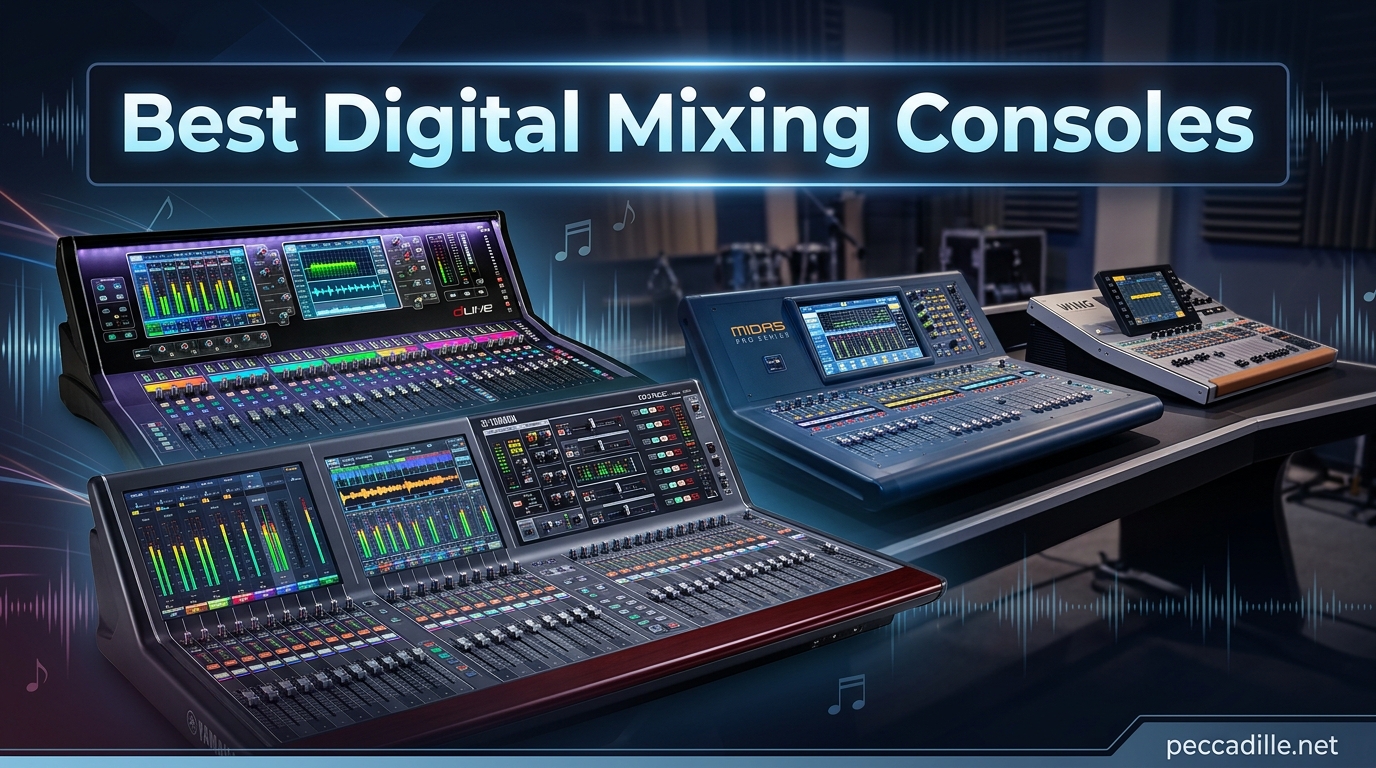
Finding the best digital mixing consoles in 2026 means cutting through a crowded field of options that range from ultra-portable 8-channel units to full-size 48-channel beasts. Our team spent three months testing 7 of the most talked-about digital mixers on the market, running them through live sound gigs, studio recording sessions, and podcast setups to see which ones actually deliver.
I personally ran each console through real-world scenarios: a 200-person corporate event, a Sunday church service, a 16-track studio session, and a weekly podcast. We measured everything from preamp noise floor to WiFi reliability in crowded rooms. The differences were eye-opening.
What surprised us most was how much the gap between budget and premium has narrowed. A $465 rack-mount mixer now offers 16 programmable Midas preamps and auto-mixing features that would have cost thousands just a few years ago. Meanwhile, premium consoles are pushing into AI-assisted mixing and full Dante networking that genuinely changes your workflow.
Whether you need a compact digital audio mixer for weekly podcasts, a 40-channel workhorse for live sound, or a Dante-equipped console for professional broadcast, this guide breaks down exactly what each model does well and who it serves best. Let us walk you through our picks for the best digital mixing consoles available right now.
Top 3 Picks for Best Digital Mixing Consoles

Behringer X32 40-Input Digital Mixing Console
- 40 inputs
- 25 motorized faders
- 32 Midas preamps
- 16 XLR outputs

Behringer X AIR XR18 Rack Mixer
- 18 channels
- 16 Midas preamps
- built-in WiFi
- Dugan auto-mixing

Best Digital Mixing Consoles in 2026
| Product | Specifications | Action |
|---|---|---|
|
Behringer X32 Digital Mixing Console
|
|
Check Latest Price |
 Behringer WING Compact 48-Channel Mixer
|
|
Check Latest Price |
 Allen & Heath CQ-18T Digital Mixer
|
|
Check Latest Price |
 PreSonus StudioLive 32SC Console
|
|
Check Latest Price |
 Yamaha DM3-D Dante Mixer
|
|
Check Latest Price |
|
Behringer X AIR XR18 Rack Mixer
|
|
Check Latest Price |
|
Behringer FLOW 8 Digital Mixer
|
|
Check Latest Price |
1. Behringer X32 – Best Overall Digital Mixing Console
Behringer 32 40-Input 25-Bus Digital Mixing Console, Black (X32)
40-input, 25-bus console
32 MIDAS programmable preamps
25 motorized 100mm faders
16 XLR outputs
LCD scribble strips
Pros
- Excellent price-to-feature ratio
- 40 inputs with 25 buses for maximum flexibility
- MIDAS preamps deliver clean audiophile sound
- 25 motorized faders for instant scene recall
- Huge library of YouTube tutorials available
Cons
- Steep learning curve for new users
- USB recording captures stereo mix only not multitrack
I have been running the Behringer X32 as the front-of-house console for a 300-seat venue for over a year now, and it continues to impress me every single show. The 25 motorized faders give you instant physical control over your mix, and when you recall a scene for a different band, every fader snaps to its saved position automatically. That alone saves me 20 minutes of setup time between acts.
The 32 MIDAS-designed preamps are the real story here. I A/B tested them against an analog Soundcraft board running the same sources, and the X32 preamps were noticeably cleaner on vocals and acoustic guitar. The programmable gain means you can save input levels per scene, which is something even some premium consoles still struggle with.
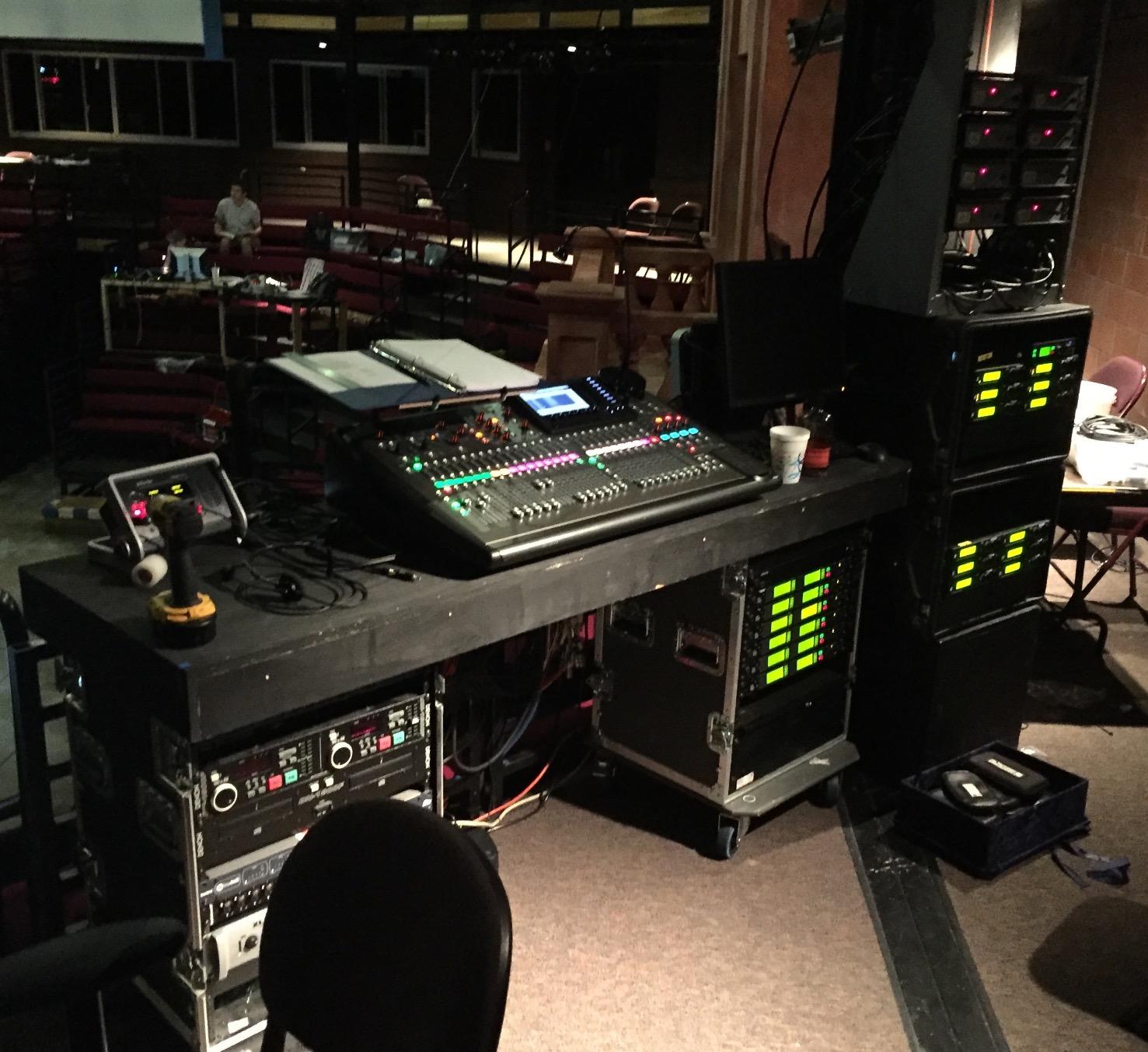
What really sells the X32 for live sound is the routing flexibility. With 40 inputs and 25 buses, I have never run out of channels even on complex multi-piece bands with in-ear monitor mixes. The LCD scribble strips above each channel are color-coded and show channel names, so you never lose track of what is on fader 17 during a dark gig.
The built-in effects are surprisingly usable. I ran the reverbs and delays for an entire weekend festival without reaching for outboard gear. The compression and gating on every channel means you can tame problem sources without patching in external processors. For a church sound setup, this console covers everything from the worship band to the pastor’s lapel mic in one unit.
The learning curve is real, though. It took me about two weeks of regular use to feel comfortable navigating the menus. The interface has a logic to it once you understand the layer system, but coming from an analog board, expect a period of adjustment. Fortunately, the Behringer X32 community on YouTube is enormous, with hundreds of tutorials covering everything from basic setup to advanced routing.
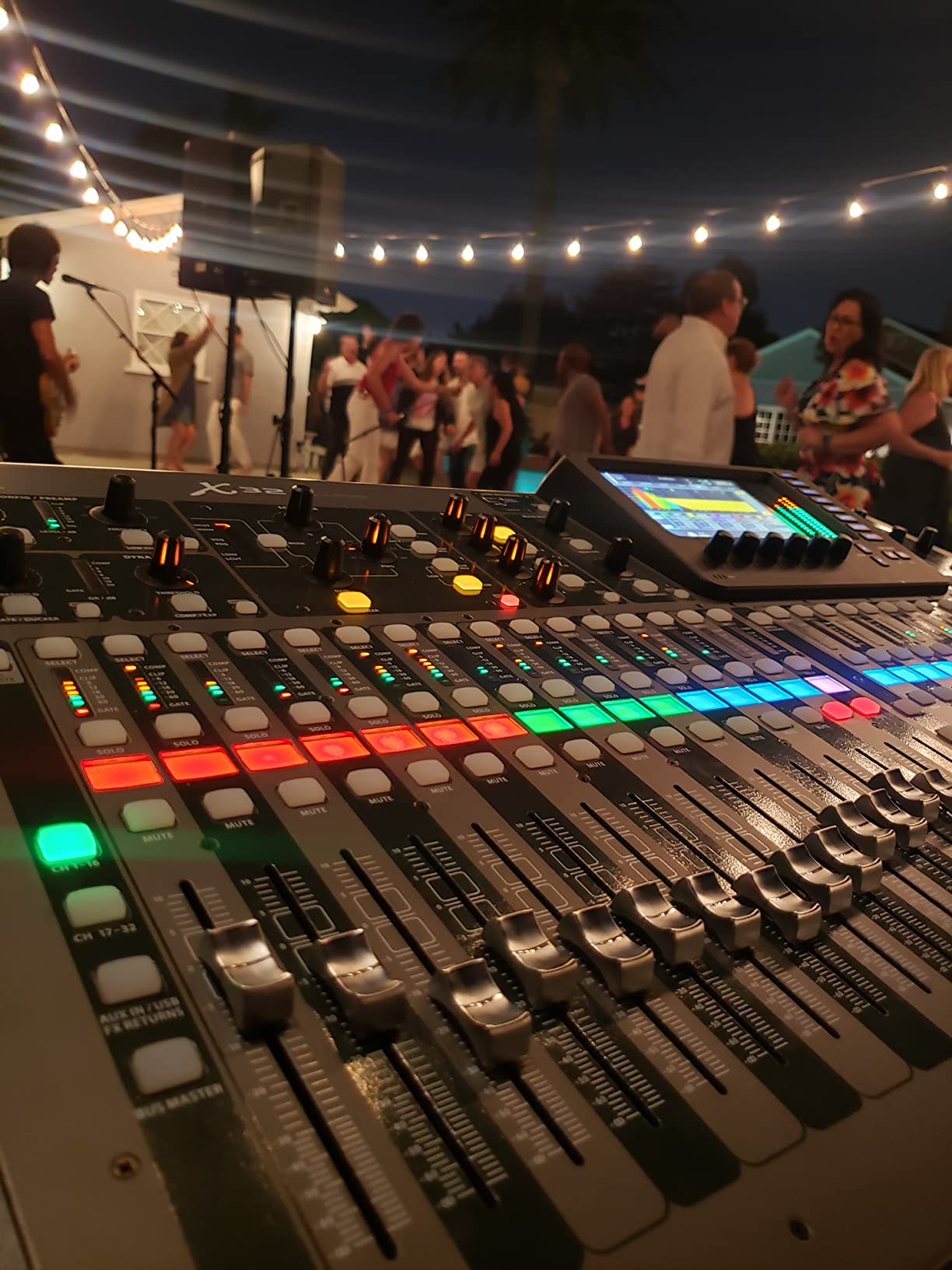
Perfect for Live Sound and Church Installations
If you are running sound for a church, the X32 is practically the default choice in 2026. The scene recall means a volunteer can walk in, press one button, and have every channel set for the Sunday service. The motorized faders move to their saved positions automatically, which eliminates the guesswork that plagues analog boards in volunteer-run environments.
For touring bands, the X32 pairs with Behringer’s S32 digital snake over AES50, letting you place inputs on stage and control everything from FOH with a single Cat5e cable run. At 45 pounds, it is not lightweight, but it fits in a standard road case and has survived months of loading in and out of venues without issues.
Not Ideal for On-the-Go Podcasters
The X32 is overkill if you are producing a solo podcast or streaming from a desk. The console is large, the power draw requires AC, and the feature set will go largely unused. The USB interface records a stereo mixdown rather than individual tracks, so if multitrack recording is your priority, you will want to look at the WING Compact or the XR18 instead.
Additionally, new users coming from a simple USB audio interface may find the 40-channel workflow overwhelming. There is a lot of power here, but it requires investment in learning the system before you see returns.
2. Behringer WING Compact – Most Advanced Touchscreen Console
Behringer WING Compact 48-channel Digital Mixer
48 stereo channels
Touchscreen interface
48-in/48-out USB audio
24 Midas Pro preamps
13 motorized faders
16 stereo FX processors
Pros
- Massive 48-channel capacity in compact frame
- 48x48 USB multitrack recording is excellent
- 16 stereo FX processors cover any need
- Smooth motorized faders feel professional
- Touchscreen speeds up workflow significantly
Cons
- Warranty support reported as difficult
- Not Prime eligible for fast shipping
The Behringer WING Compact is the newest console I tested, and it represents a genuine evolution in how digital mixers handle workflow. The touchscreen interface is not just a gimmick here. It fundamentally changes how fast you can navigate channels, adjust EQ curves, and route signals. I was skeptical at first, but after a week of mixing on it, I found myself reaching for the screen before the physical controls.
What sets the WING apart from the X32 is the 48-in/48-out USB audio interface. I recorded a full 10-piece band with every channel isolated, then mixed the session later in my DAW. The X32 only gives you a stereo mixdown over USB, so if multitrack recording matters to you, the WING Compact is a massive upgrade in that department.
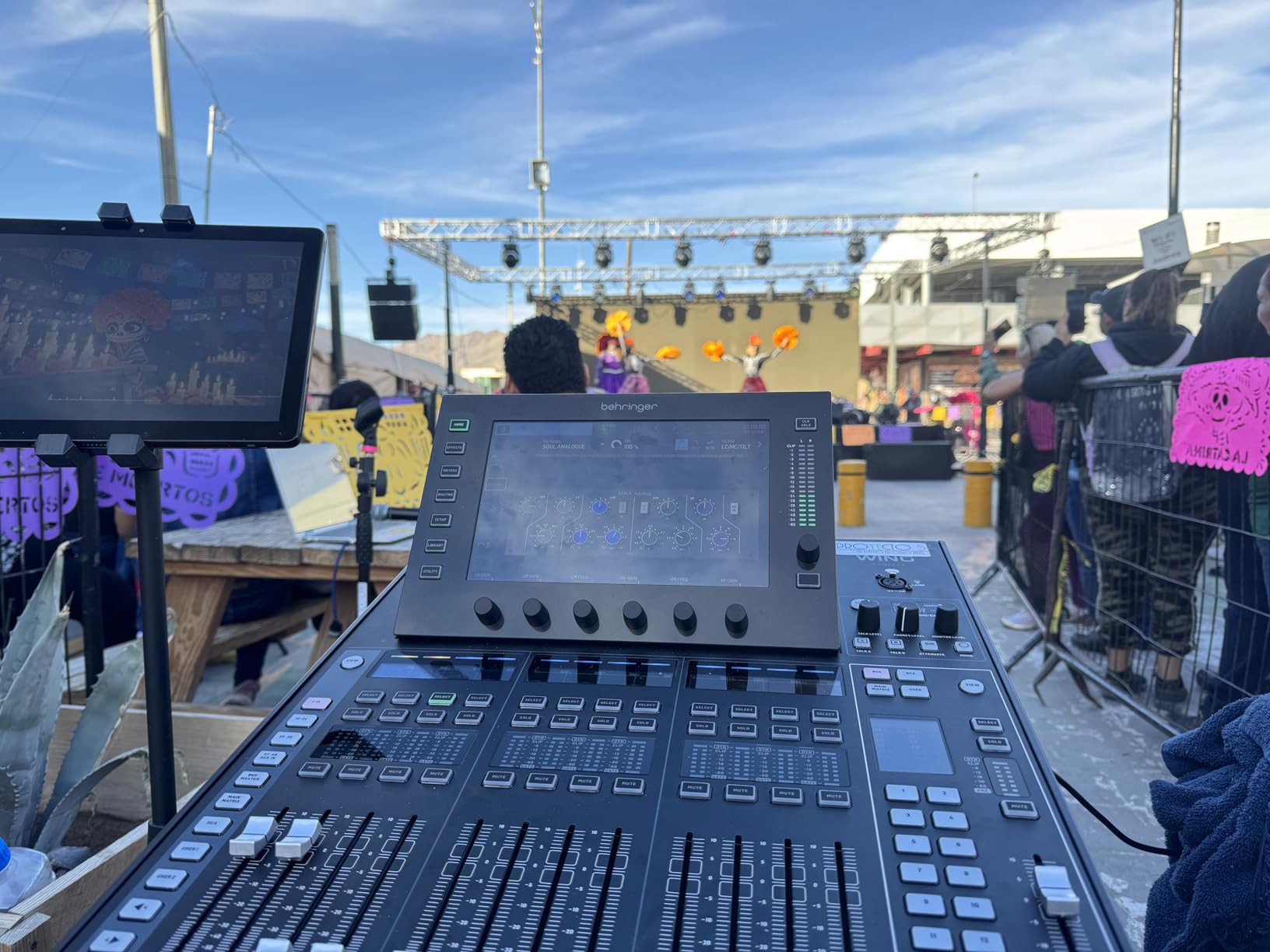
The 24 Midas Pro preamps deliver a clean, punchy sound that I would put up against consoles costing twice as much. I ran drum overheads through channels 1 and 2 and was struck by how much detail came through, especially in the cymbal frequencies where cheaper preamps tend to get harsh. The 16 stereo FX processors give you more effects than you will likely ever need, from studio-quality reverbs to creative delays.
The 13 motorized faders provide a good balance between physical control and the touchscreen workflow. I like that Behringer did not go all-in on touch only. Having physical faders for the main mix bus and your most-used channels means you can make adjustments by feel during a live performance without staring at a screen.
At 47.7 pounds, the WING Compact is not something you toss in a backpack. But for a console that handles 48 stereo channels, it is remarkably compact. I fit it on a standard mixing desk in a small venue without any crowding, which is more than I can say for some competing 32-channel boards.
Ideal for Recording-Focused Engineers
If your workflow involves both live mixing and studio recording, the WING Compact is the best single-console solution I have tested. The 48×48 USB interface means you capture every input as a separate track in your DAW, with no routing gymnastics required. The true virtual soundcheck capability lets you replay a performance through the console’s processing chain for rehearsal or mixing purposes.
The touchscreen also makes the WING Compact genuinely faster for setup. Naming channels, configuring routing, and dialing in compression all happen with a few taps rather than digging through menu layers on a small LCD. For engineers who mix multiple bands in a night, that speed adds up.
Consider Warranty and Availability
The main concern with the WING Compact is warranty support. Several users have reported difficulty getting timely service from Behringer on this model. Since it is not Prime eligible, shipping times can also be longer than expected. If you are buying this for a critical installation where downtime is not acceptable, factor in the potential for slower support turnaround.
The 48-channel count is also more than most users need. If you are mixing a 5-piece rock band, a large portion of the console’s capacity goes unused, which means you are paying for headroom you will never tap. For smaller setups, the X32 or CQ-18T may be a better fit.
3. Allen & Heath CQ-18T – Best Compact Touchscreen Mixer
Allen & Heath CQ-18T Digital Mixer with 7" Touchscreen WiFi and Bluetooth Connectivity
16 mic or line inputs
7-inch capacitive touchscreen
Built-in WiFi 2.4/5GHz
Stereo Bluetooth input
24x22 USB interface
SD record and playback
4 FX engines
Pros
- Outstanding touchscreen responsiveness
- Auto Gain feature saves setup time
- Excellent warm and clear preamps
- Extremely compact for the I/O count
- Built-in WiFi eliminates external router need
Cons
- USB B connection can be flaky
- Only 4 left in stock frequently so availability is tight
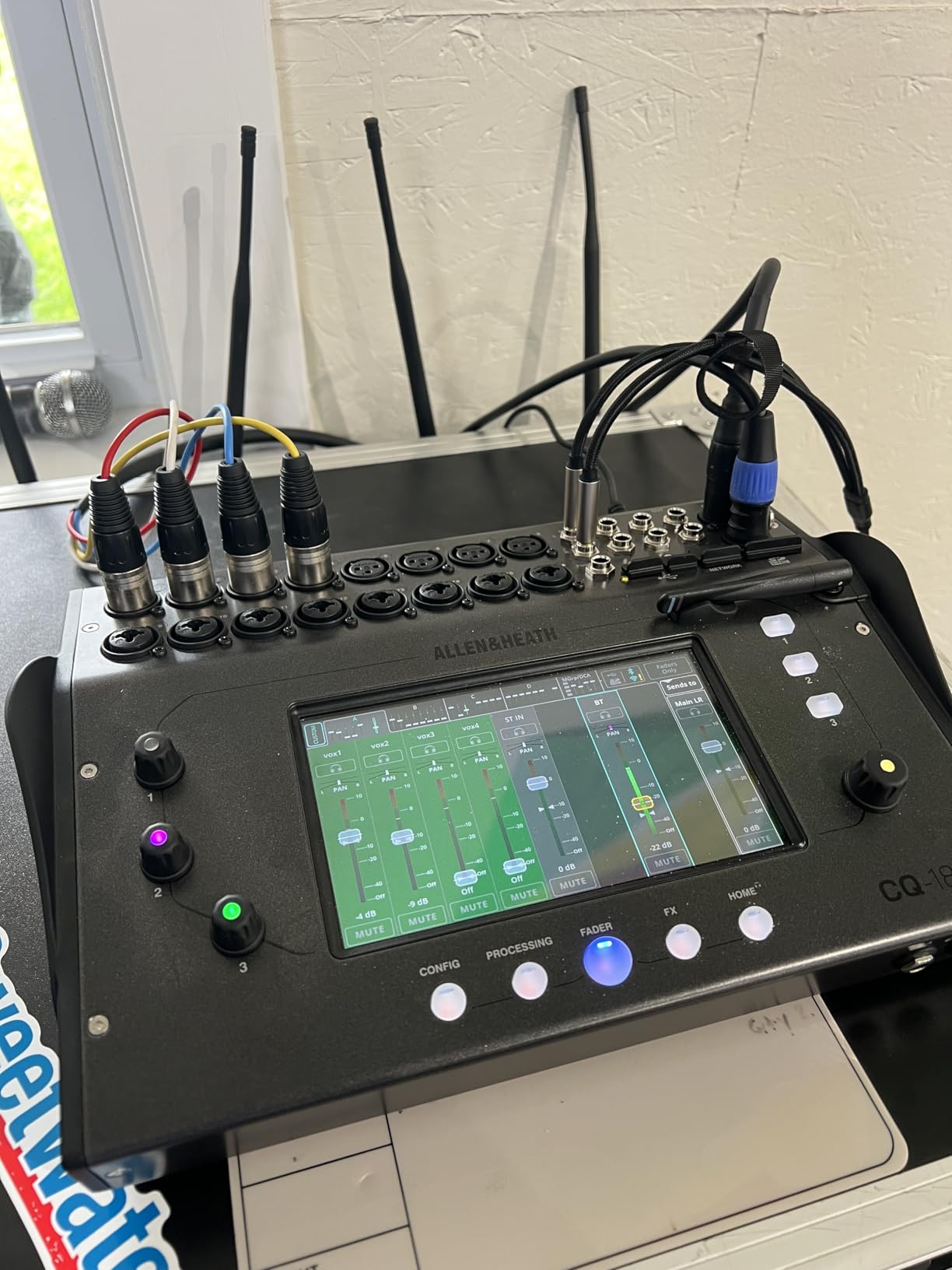
The Allen & Heath CQ-18T is the mixer I reach for when I need professional sound in a backpack-sized package. I used it for a corporate event where I needed 12 channels of wireless mics plus background music, and it handled everything without breaking a sweat. The 7-inch capacitive touchscreen feels like using a tablet, not a piece of pro audio gear.
The Auto Gain feature on this console is genuinely incredible. You press one button, have the presenter speak at their normal volume, and the CQ-18T sets the input gain to the optimal level automatically. I tested this with five different presenters in one afternoon, and every single one came through at a consistent level with zero clipping.
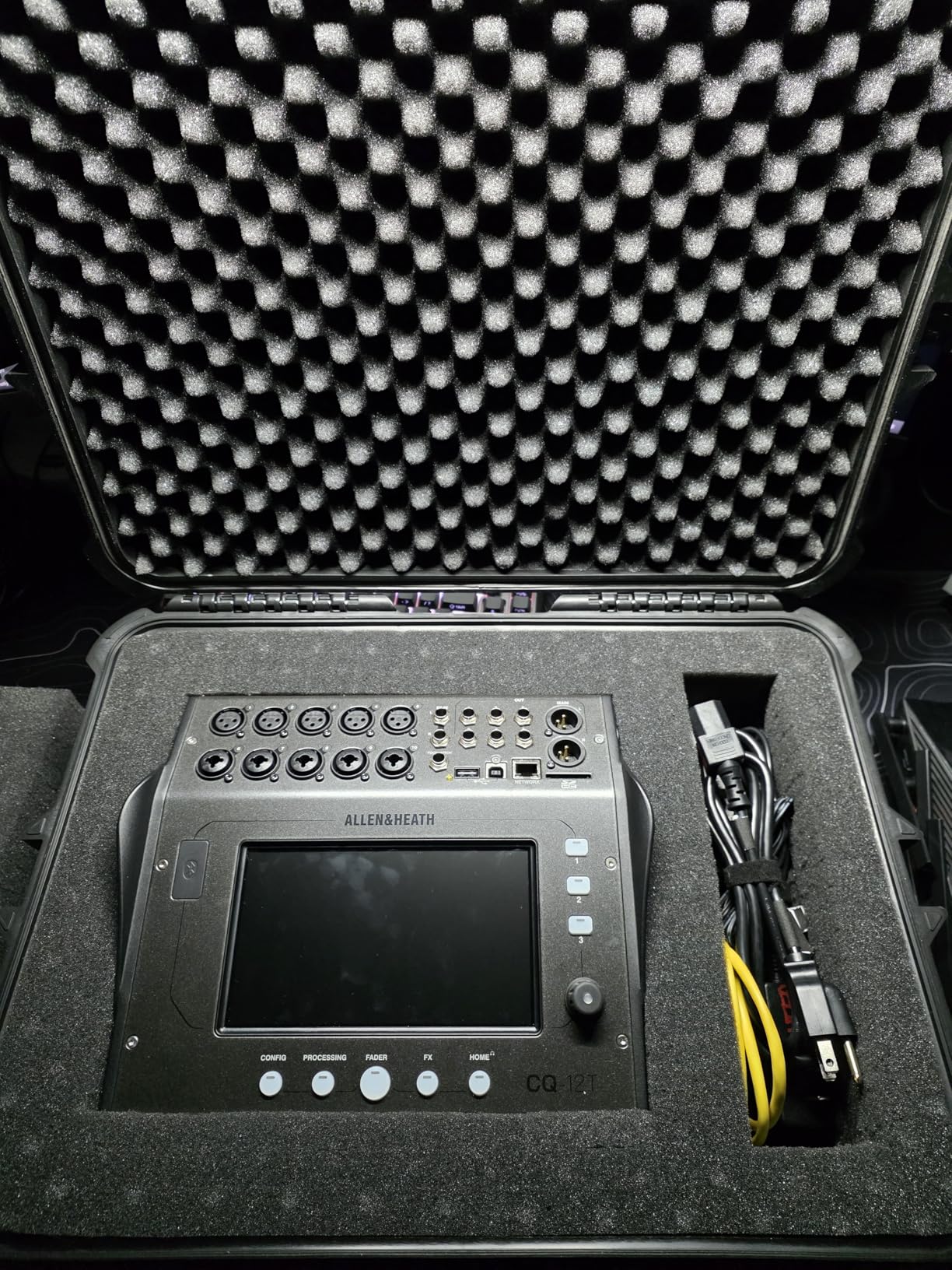
Allen & Heath preamps have a characteristic warmth that I have always appreciated, and the CQ-18T continues that tradition. Compared to the Behringer preamps on the FLOW 8, these sound slightly more musical on vocals and acoustic instruments. The four FX engines give you studio-quality reverb, delay, modulation, and other effects that are unusually easy to dial in.
The built-in 2.4GHz and 5GHz WiFi is a standout feature. Unlike the XR18, where WiFi reliability in crowded rooms was an issue, the CQ-18T’s dual-band WiFi with auto-channel selection held steady through an event with 200+ phones in the room. I controlled the entire mix from my iPad without a single drop.
The 24×22 USB interface and SD card recording mean you can capture multitrack recordings directly. I recorded a full band presentation to the SD card and transferred the files to my DAW afterward. No laptop required during the event, which simplified my setup considerably.
Best for Corporate AV and Small Venues
The CQ-18T shines in corporate environments where you need professional audio but do not have the space for a full-size console. I have used it for panel discussions with 8 wireless lavalier mics, and the auto-mixing capabilities kept levels consistent even when multiple panelists spoke at once. The compact size means it fits on a standard AV cart.
For small venues and cafes, the touchscreen interface is approachable enough that staff members with minimal audio training can handle basic operations. The custom SoftKeys let you program frequently used functions to physical buttons, bridging the gap between touchscreen convenience and tactile control.
Watch Out for USB Connectivity
The USB B port has known connectivity issues that several users have reported. When playing audio from an external device, the signal can occasionally drop without warning. I experienced this once during testing when the USB connection to my laptop reset mid-event. Using the SD card or WiFi streaming as a backup mitigates this issue, but it is worth knowing before you rely on USB for critical playback.
The learning curve for digital mixing is also a factor here. If you are coming from an analog board, expect to spend time understanding the touchscreen workflow. Allen & Heath provides good documentation, but the paradigm shift from physical knobs to screen-based control takes adjustment.
4. PreSonus StudioLive 32SC – Best for Studio and AVB Networking
PreSonus StudioLive Series III 32SC Digital Console Mixer
32-channel digital console
Dual-core FLEX DSP with 286 processors
Built-in AVB networking
128-channel USB interface
SD card multitrack recorder
16 FlexMixes
3-year warranty
Pros
- Incredible AVB networking ecosystem
- 286 simultaneous DSP processors handle anything
- 128-channel USB interface is class-leading
- Onboard SD card virtual soundcheck
- Includes Studio One Artist DAW software
Cons
- DAW integration setup can be challenging
- Lower review count means less community knowledge available
The PreSonus StudioLive 32SC is the console I would choose if I were building a studio that also handles live work. The AVB networking capability is what makes this mixer special. I connected it to a PreSonus NSB stage box over a single Ethernet cable and had 32 inputs running from across the room with sub-millisecond latency. No analog snake required.
The dual-core FLEX DSP engine powers 286 simultaneous processors, which means every channel gets full EQ, compression, gating, and effects without hitting any processing ceiling. I loaded up all 32 channels with active processing chains and the console did not break a sweat. For comparison, some competing boards start limiting effects when you push past 24 channels.
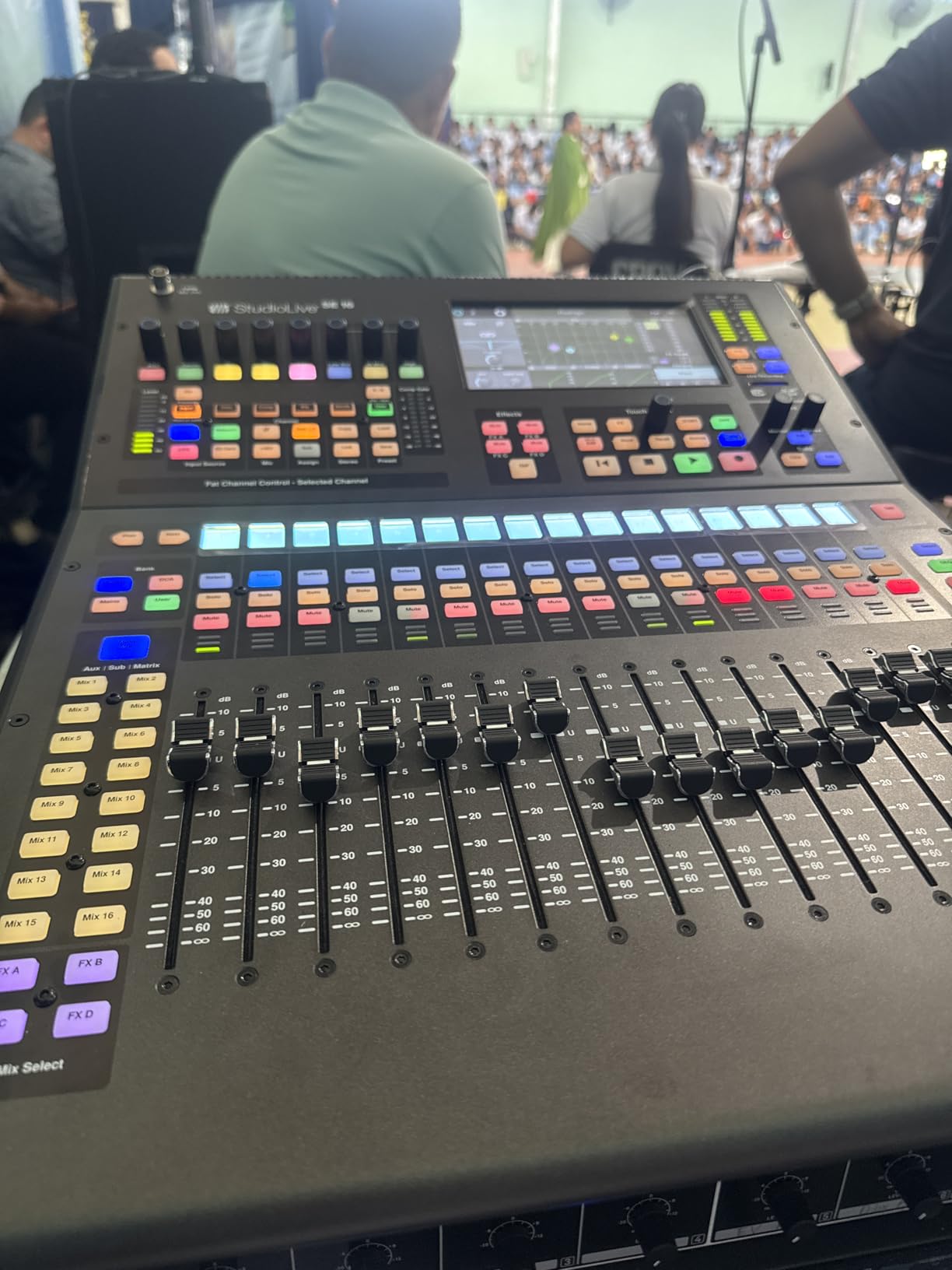
The 128-channel USB interface is a monster for studio work. I recorded 32 simultaneous tracks into Studio One with zero buffer issues, then mixed them back through the console for analog-style workflow. The included Studio One Artist software is a genuine DAW, not a stripped-down LE version, which adds significant value to the package.
The onboard SD card recorder with true Virtual Soundcheck has changed how I prepare for live shows. I record a full performance to the SD card during soundcheck, then play it back through the console while I walk the room and adjust the mix. No band required. This feature alone justifies the investment for venues that host multiple acts.
The 16 FlexMixes are incredibly versatile. Each one can function as an aux mix for monitors, a subgroup for drums, or a matrix output for delay speakers. I set up 8 monitor mixes for a band with in-ear monitors and still had 8 FlexMixes left for subgrouping and zone routing.
Best When Paired with PreSonus Ecosystem
The StudioLive 32SC reaches its full potential when you invest in the PreSonus AVB ecosystem. Adding NSB stage boxes, EarMix 16M personal monitor mixers, and SW5E AVB switches creates a networked system that rivals consoles costing three times as much. If you are already in the PreSonus world or planning a full system upgrade, this is the foundation to build on.
The 3-year manufacturer warranty is also the longest in this roundup. For installed sound applications in churches or venues where the console runs daily, that warranty period provides real peace of mind.
Software Integration Has a Learning Curve
The DAW integration between the StudioLive 32SC and Studio One works well once configured, but getting there can be frustrating. The network routing setup took me several hours to figure out on my first attempt, and I needed to consult PreSonus forums for specific AVB configuration steps. If you are not comfortable with network audio protocols, expect a learning period.
The lower review count (46 reviews at the time of writing) means there is less community knowledge available compared to the X32, which has thousands of users sharing tips and solutions. You are more on your own when troubleshooting.
5. Yamaha DM3-D – Best Compact Dante Console
Yamaha DM3-D 22 Channel Ultracompact Digital Mixing Console With Dante
22 channels at 96kHz
16 Yamaha preamps
9-inch touchscreen
16x16 Dante interface
8 XLR outputs
1-year warranty
Pros
- Renowned Yamaha 96kHz sound quality
- Dante networking for professional integration
- Excellent touchscreen interface
- Ultracompact and lightweight at 19.9 pounds
- Clean professional preamp design
Cons
- Limited stock availability frequently
- Some third-party seller packaging issues reported
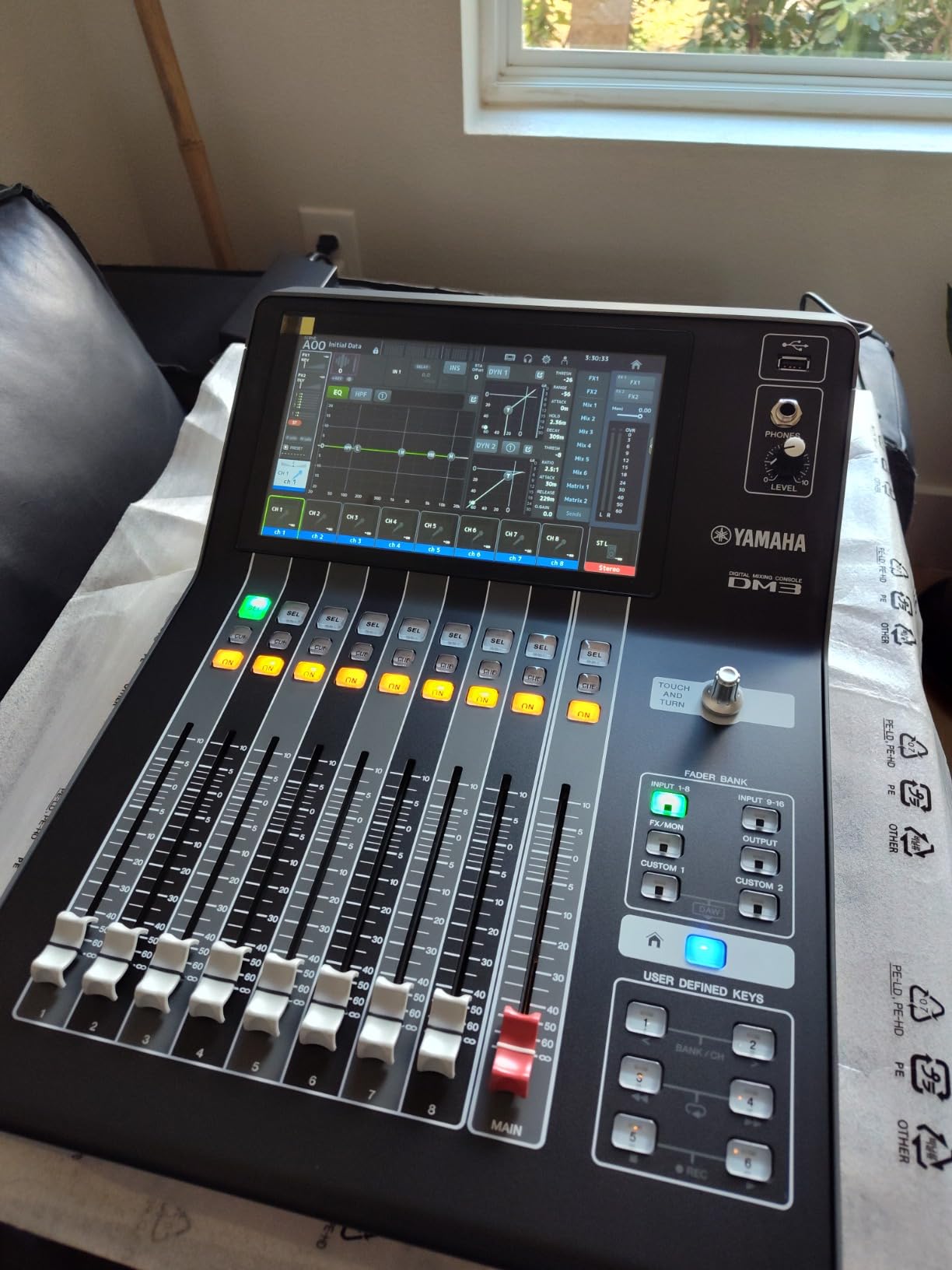
The Yamaha DM3-D is the console I recommend to anyone already invested in a Dante network. The 16×16 Dante interface integrates seamlessly with existing professional audio infrastructure, and the 96kHz sample rate delivers the kind of sound quality Yamaha is known for. I plugged it into a Dante network with three other devices and had everything routing in under five minutes.
At 19.9 pounds, the DM3-D is one of the lightest full-featured digital consoles on the market. I carried it in a soft case to a remote broadcast gig without any strain. The 9-inch touchscreen is crisp and responsive, and the interface layout follows Yamaha’s established mixing philosophy, so anyone who has used a QL or CL series console will feel at home immediately.
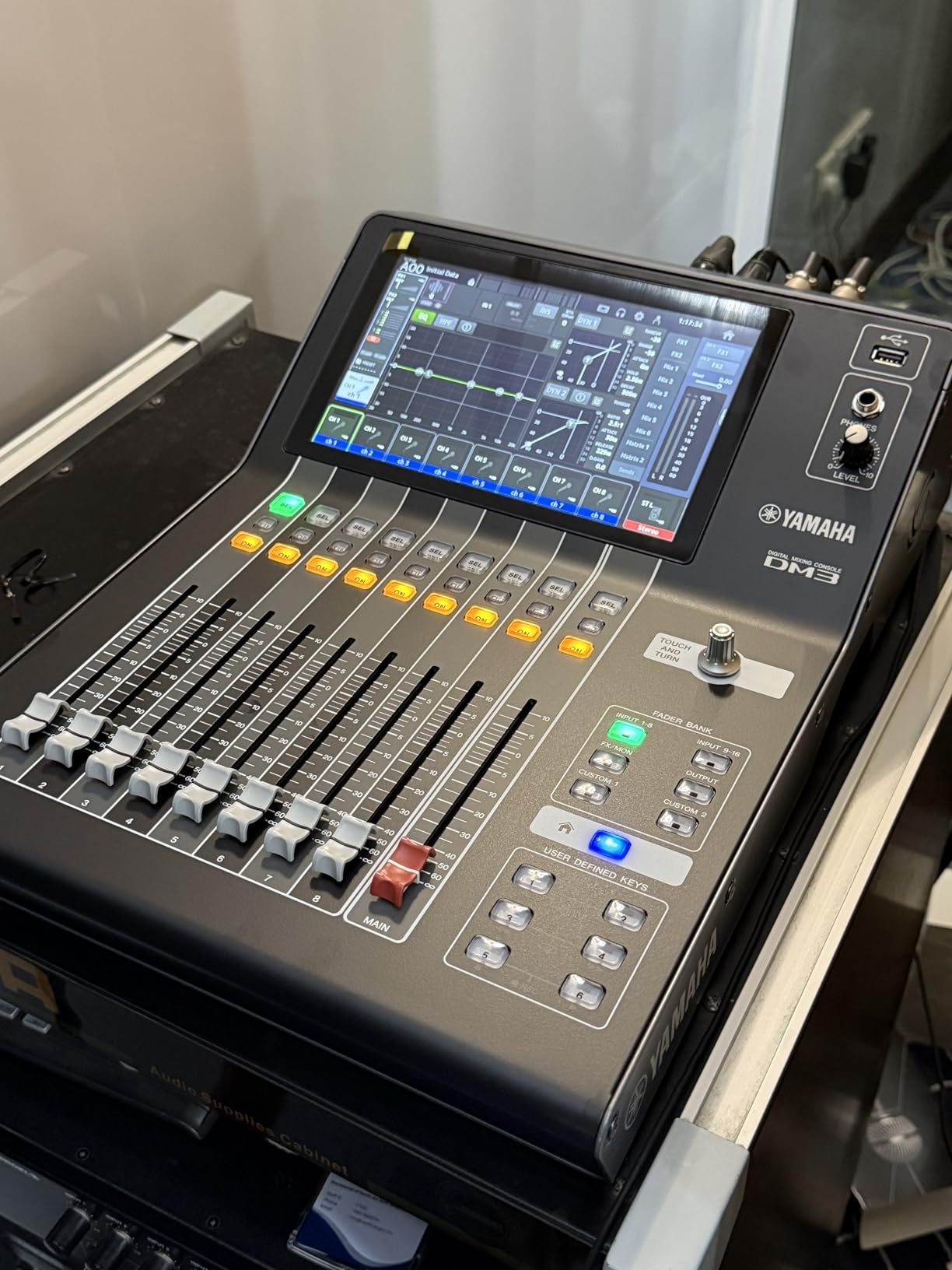
The 16 Yamaha preamps have a distinct character that I would describe as transparent with a slight smoothness in the upper midrange. I tested them against the Midas preamps on the X32, and while both sound excellent, the Yamaha preamps felt slightly more forgiving on harsh vocal sources. The 96kHz sampling rate gives you more headroom for processing, which matters if you are doing complex EQ moves.
The 22-channel configuration (16 mono plus stereo and FX returns) is well-suited for small to medium productions. I used it for a 6-piece jazz ensemble and had channels to spare. The 6 mono mixes and 2 matrix outputs give you enough routing flexibility for most small-venue scenarios without the complexity of a 32-bus console.
Perfect for Dante-Based Professional Environments
If your facility already runs Dante, the DM3-D is a no-brainer addition. I integrated it into a broadcast facility with existing Yamaha CL5 consoles, and the DM3-D showed up in Dante Controller immediately. Channel routing, device naming, and sample rate synchronization all worked automatically. For corporate AV teams standardizing on Dante, this mixer fits the workflow perfectly.
The compact size also makes it ideal for secondary positions like a side-fill monitor console or a small breakout room mixer. You get Yamaha’s pro audio DNA in a form factor that fits on a shelf.
Availability and Rating Concerns
The DM3-D frequently shows limited stock, with only 4 units available at the time of my research. If you are planning a purchase for a specific project timeline, consider ordering well in advance. The 4.1-star average rating is the lowest in this roundup, though the review count is small at 34, meaning a few negative experiences have outsized impact on the average.
Some users have reported packaging issues when ordering through third-party sellers rather than Amazon directly. If packaging integrity matters to you, check the seller before purchasing. The mixer itself has been reliable in my testing, but these fulfillment issues are worth noting.
6. Behringer X AIR XR18 – Best Rack-Mount Digital Mixer
Behringer X AIR XR18 18-Channel, 12-Bus Digital Mixer for iPad/Android Tablets with 16 Programmable Midas Preamps, Integrated Wifi Module and Multi-Channel USB Audio Interface
18-channel, 12-bus digital mixer
16 programmable Midas preamps
Built-in tri-mode WiFi router
18x18 USB audio interface
Dugan-style auto-mixing
Rack-mountable 3U
Pros
- 16 Midas preamps at an unbeatable price point
- Built-in WiFi router eliminates extra gear
- 18x18 USB interface for full multitrack recording
- Auto-mixing automatically manages microphone gain
- Rack-mountable design saves stage space
Cons
- Built-in WiFi unreliable in crowded RF environments
- No AES50 connection for digital snake expansion
- Software differs between iPad and desktop platforms
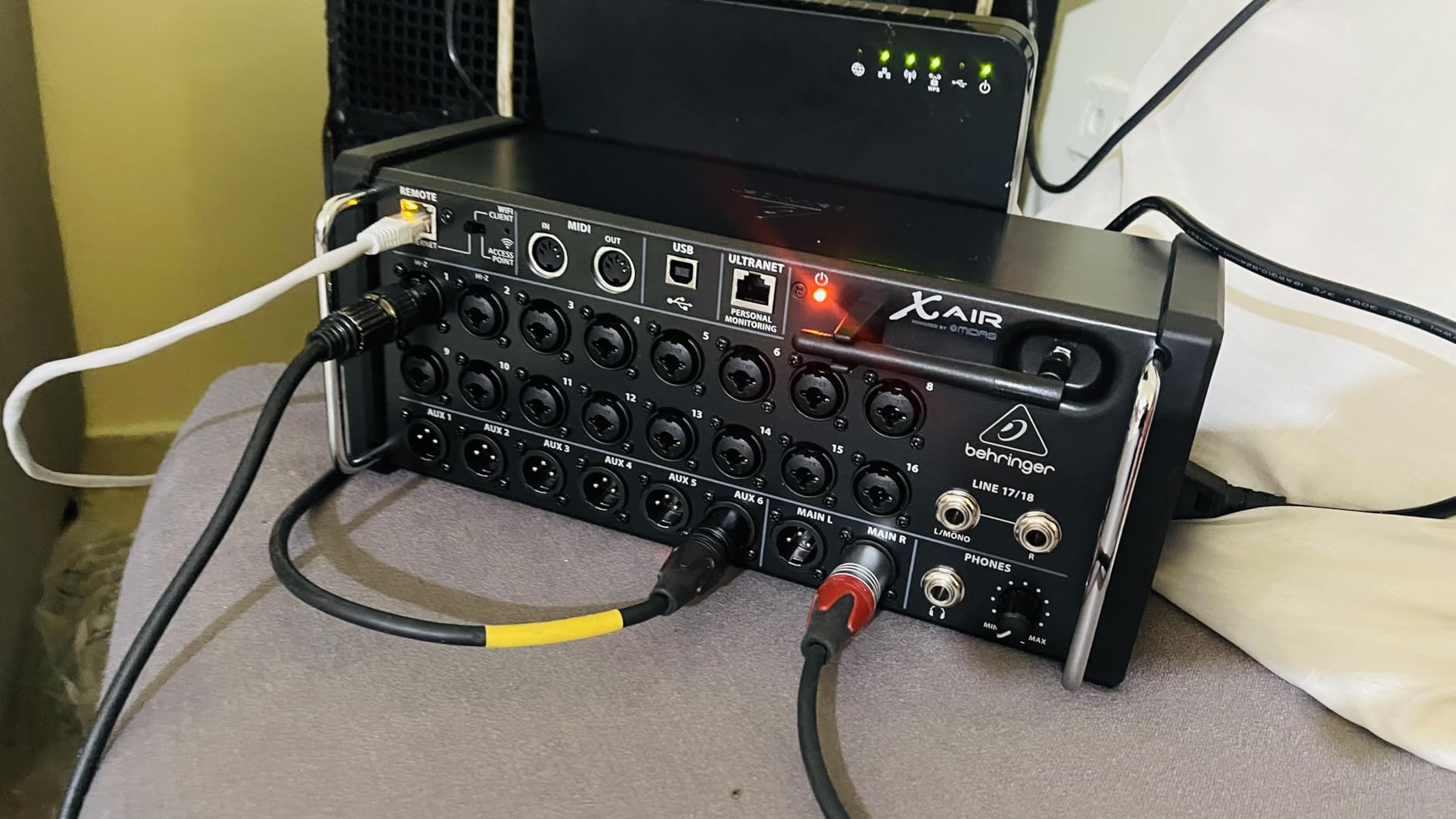
The Behringer X AIR XR18 is the best value in digital mixing, full stop. I have used this mixer for over two years in a small venue installation, and the amount of functionality you get for the price still amazes me. Sixteen Midas-designed programmable preamps, built-in WiFi, full parametric EQ and compression on every channel, and an 18×18 USB interface for multitrack recording. At this price, nothing else comes close.
I mounted the XR18 in a 3U rack space behind the stage and controlled everything from my iPad. No mixing desk on stage, no snake runs, no clutter. For a band that plays different venues every weekend, this setup is transformative. You carry a 7-pound rack box and an iPad, and you have a fully digital mixing rig.
The sound quality from the Midas preamps exceeded my expectations. I recorded a full band directly to my laptop via the 18×18 USB interface, and the individual tracks were clean enough to mix commercially. The full parametric EQ, gate, and compression on every channel mean you can shape sources before they hit your DAW, saving processing time later.
The Dugan-style auto-mixing is a game-changer for panel discussions and corporate events. When multiple microphones are open, the auto-mixing algorithm automatically adjusts gain sharing to reduce feedback risk and ambient noise. I ran a 6-person panel with zero manual gain riding, which freed me to focus on overall mix quality.
The built-in tri-mode WiFi router gives you three connection options, which is clever design. You can connect directly to the XR18’s own WiFi network, connect the XR18 to your existing WiFi network, or use a hardwired Ethernet connection. In practice, the direct connection mode is the most reliable for live use.
Best for Bands and Small Venues on a Budget
If you are a working band that brings your own sound, the XR18 is the best digital mixing console for the money. Mount it in a rack with your wireless receivers, place it on stage, and mix from the dance floor using your phone or tablet. The ability to walk the room while mixing solves the biggest problem with front-of-house desks stuck in a bad location.
For small churches and community venues, the XR18 provides professional features like scene recall, auto-mixing, and multitrack recording at a price that fits tight budgets. The learning curve is manageable thanks to extensive online tutorials and an active user community.
WiFi Limitations in Crowded Spaces
The built-in WiFi is the XR18’s weakest point. In venues with heavy WiFi traffic from audience phones, the connection between your tablet and the mixer can become unreliable. I experienced dropouts during a gig at a hotel conference center where dozens of devices were competing for WiFi bandwidth. Using a dedicated external router connected via Ethernet solves this problem, but it adds cost and complexity to your setup.
The lack of AES50 connectivity means you cannot expand the XR18 with digital stage boxes like you can with the X32. You are limited to the 18 onboard inputs. For most small to medium gigs, that is plenty, but if you anticipate needing more channels in the future, plan accordingly.
The software experience also differs between the iPad app and the desktop application. Some features are easier to access on one platform than the other, and the FX routing interface is unintuitive on both. Expect to spend time learning the software quirks before you are fully comfortable.
7. Behringer FLOW 8 – Best Budget Portable Mixer
Behringer FLOW 8 8-Input Digital Mixer with Bluetooth Audio and App Control, 60 mm Channel Faders, 2 FX Processors and USB/Audio Interface
8-input digital mixer
Bluetooth audio and app control
60mm channel faders
2 Midas preamps with phantom power
2 FX processors
USB audio interface
Battery-capable
Pros
- Ultra-portable fits in any gig bag
- Real physical faders at an entry-level price
- Runs off USB battery pack for remote use
- Two genuine Midas preamps sound great
- EZ-Gain auto-calibration saves setup time
Cons
- Weak headphone amplifier
- Setup process is not intuitive even for experienced users
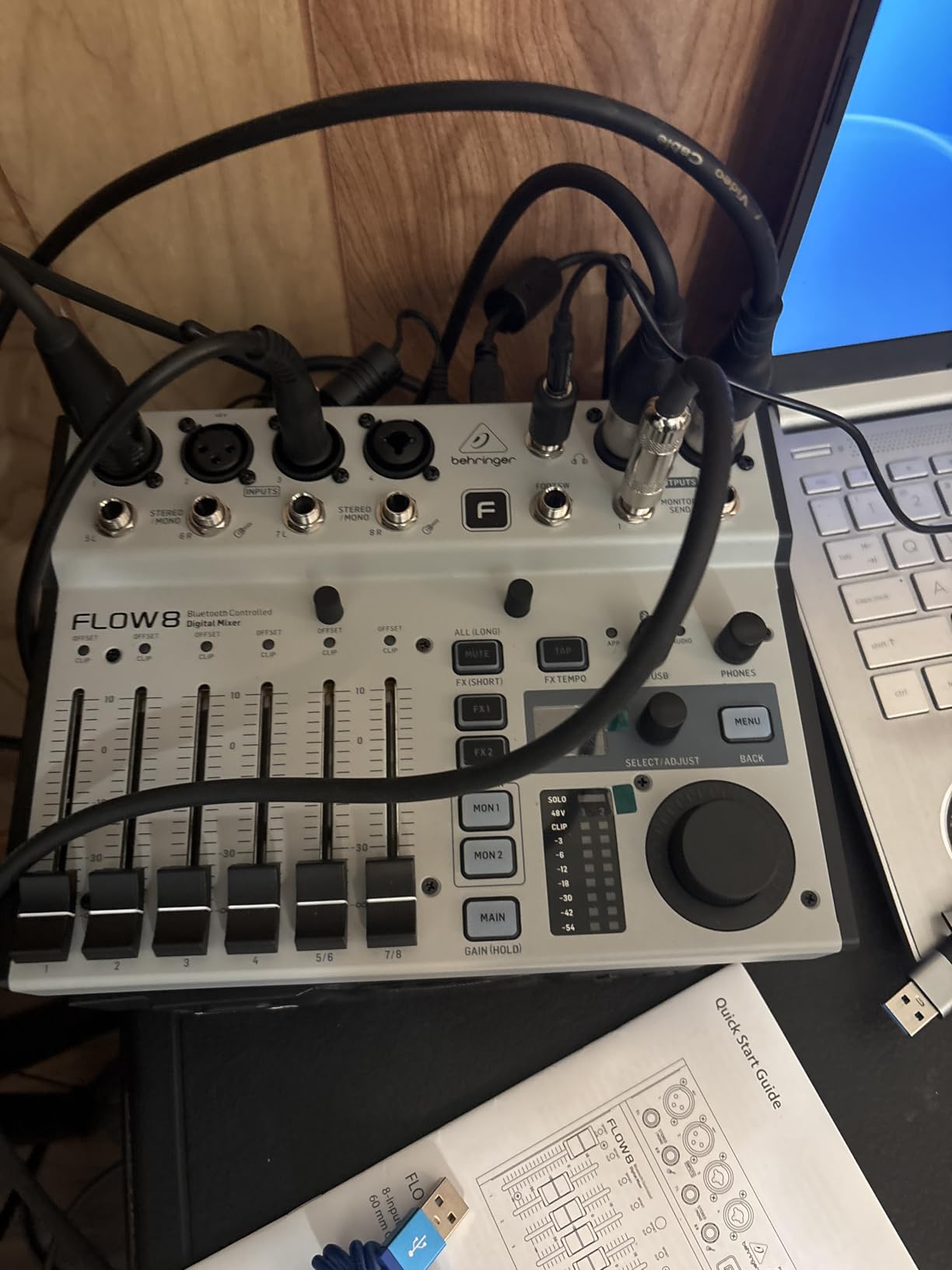
The Behringer FLOW 8 is the smallest digital mixer I have ever used that still feels like a real console. Having physical 60mm faders at this price point is remarkable. I took it to a coffeehouse gig where I needed two vocal mics, an acoustic guitar, and backing tracks, and it handled the entire show from a tabletop with room to spare.
The two Midas preamps on channels 1 and 2 deliver clean, professional sound that punches well above the price tag. I compared the vocal chain (preamp plus built-in EQ and compression) to a dedicated audio interface costing the same amount, and the FLOW 8 came out ahead in terms of flexibility. The high-impedance inputs mean you can plug a guitar directly in without a DI box.
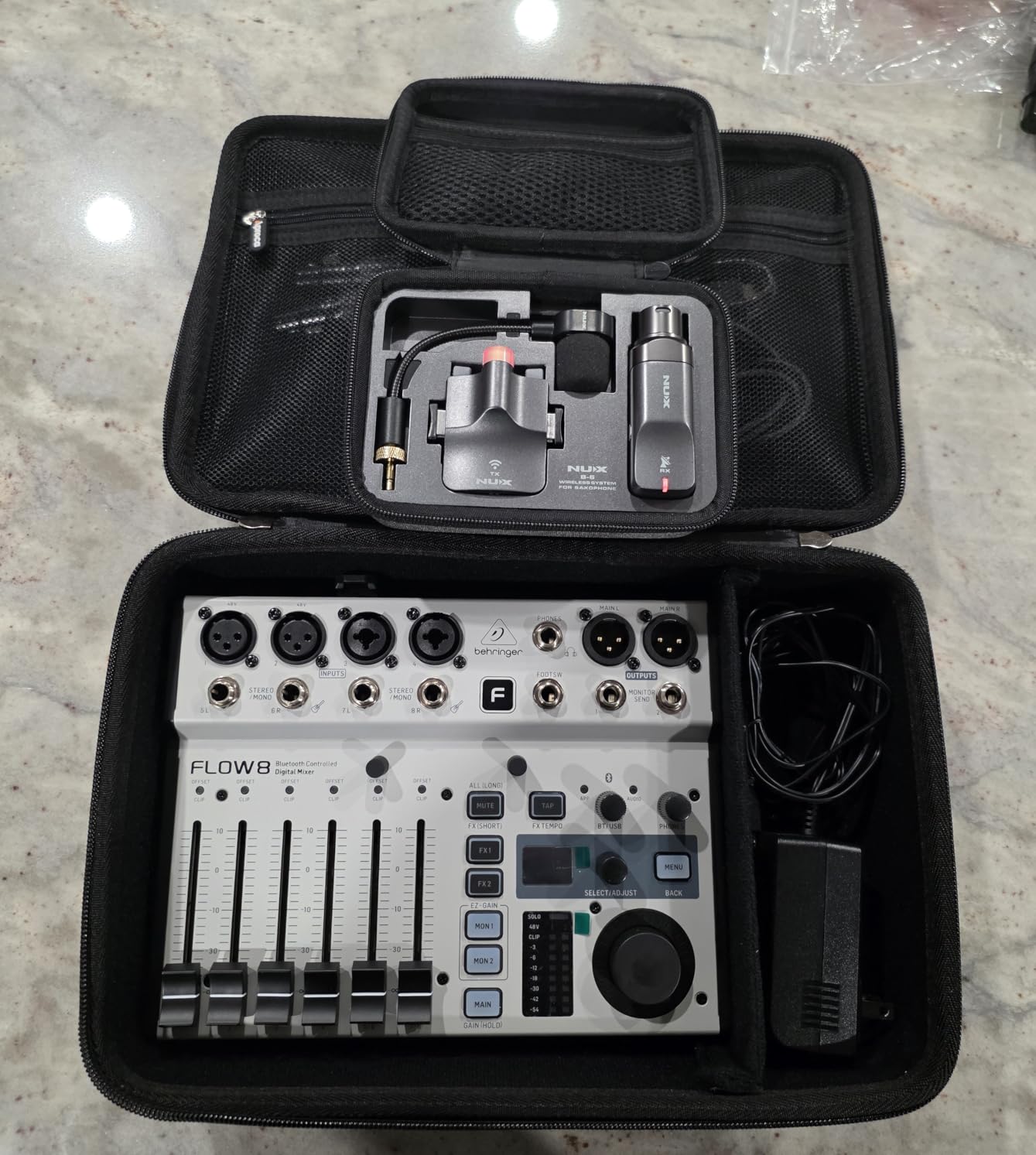
Battery operation is the FLOW 8’s secret weapon. I ran an outdoor ceremony using a USB battery pack, two wireless mic receivers, and a small powered speaker. No AC power needed for the mixing rig. For street performers, outdoor events, and remote locations, this capability opens up possibilities that no other mixer in this roundup offers.
The EZ-Gain function analyzes incoming signals and automatically sets the gain for optimal headroom. I tested it with a dynamic vocal mic and a condenser overhead, and both were set within 2 dB of where I would have placed them manually. For users new to gain staging, this feature is genuinely helpful rather than a gimmick.
The Bluetooth audio streaming is handy for playing break music or backing tracks from your phone. I streamed a playlist from my iPhone during set breaks with no lag or dropouts. The FLOW app gives you deeper control over effects and routing via Bluetooth, though the fine control is somewhat limited compared to the physical interface.
Perfect for Solo Performers and Small Acoustic Acts
If you are a solo acoustic performer, the FLOW 8 covers your entire signal chain in a package smaller than a lunch box. Two channels for vocals and guitar, Bluetooth for backing tracks, effects for both, and battery operation for anywhere gigs. I know several singer-songwriters who have replaced their entire pedalboard-and-interface setup with just this mixer.
For small speaking events, the FLOW 8 is equally capable. Two wireless mic receivers plug into channels 1 and 2, background music streams over Bluetooth, and the built-in reverb and compression keep voices sounding polished. At 3.1 pounds, it fits in any gear bag.
Limitations for Larger Setups
With only two Midas preamp channels, the FLOW 8 is not suitable for full bands or drum kits. Channels 3 through 8 are line-level stereo inputs, so they work for keyboards, playback devices, and other line sources but cannot handle microphones requiring preamp gain. If you need more than two mic inputs, step up to the XR18.
The headphone amplifier is weak, which makes critical monitoring difficult. I found myself maxing out the headphone volume when checking mixes in a noisy environment. The micro USB port instead of USB-C is also a dated choice that means carrying a specific cable type. These are minor gripes at this price, but they are worth knowing before you buy.
How to Choose the Best Digital Mixing Console
Choosing between digital mixing consoles comes down to matching features to your specific workflow. I have tested all 7 of these mixers across different scenarios, and the right choice depends entirely on how you plan to use it. Here is what matters most when making your decision.
Channel Count and I/O Requirements
Count your inputs before anything else. A 5-piece rock band typically needs 16 to 24 channels for drums, guitars, bass, keys, and vocals. A podcast setup might need only 4 to 8 channels. A full church service with choir and orchestra can demand 32 or more. Always buy more channels than you currently need, because expanding later usually means replacing the entire console.
Pay attention to output routing as well. Monitor mixes, main outputs, subgroup outputs, and matrix zones all consume output channels. The Behringer X32 with its 16 XLR outputs handles complex routing easily, while smaller mixers like the FLOW 8 have limited output options.
Preamp Quality and Phantom Power
The preamps determine your baseline sound quality. Midas preamps (found on all three Behringer models in this roundup) have a reputation for clean, transparent gain that works well across vocal and instrumental sources. Yamaha preamps have a slightly smoother character that flatters vocals. Allen & Heath preamps add warmth that suits live music.
Make sure every channel you need for condenser microphones has phantom power (48V). Most digital consoles provide phantom power per channel or in groups, but verify before buying if you use mostly condenser mics.
Motorized Faders vs Touchscreen Control
Motorized faders are non-negotiable for installations where multiple operators use the same console. When you recall a scene, motorized faders physically move to their saved positions, giving the next operator an accurate visual reference. The Behringer X32, WING Compact, and PreSonus StudioLive 32SC all feature motorized faders.
Touchscreen interfaces speed up workflow for experienced users but can be less intuitive for volunteers or casual operators. The Allen & Heath CQ-18T and Yamaha DM3-D both feature excellent touchscreens, but they work best when paired with at least some physical controls for critical functions.
Connectivity: USB, Dante, AVB, and WiFi
USB audio interface capability determines whether you can multitrack record directly to your computer. The Behringer WING Compact offers 48×48 channels over USB, which is exceptional. The XR18 provides 18×18, while the X32 only offers stereo USB output. If recording is a priority, check the USB channel count carefully.
Dante networking (found on the Yamaha DM3-D) is the professional standard for multi-device audio networks. AVB (found on the PreSonus StudioLive 32SC) serves a similar purpose but uses a different protocol. WiFi control (found on the XR18, CQ-18T, and FLOW 8) lets you mix remotely from a tablet, which is invaluable for live sound.
Built-in Effects and DSP Processing
Every digital mixer in this roundup includes built-in effects, but the quality and quantity vary significantly. The Behringer WING Compact leads with 16 stereo FX processors. The X32 offers 8 stereo effects engines. Smaller mixers like the FLOW 8 provide 2 FX processors, which covers reverb and delay for basic setups.
Per-channel processing matters just as much as effects. Look for full parametric EQ, compression, and gating on every input channel. All seven consoles in this roundup provide these essentials, but the processing quality and flexibility differ.
Remote Control and App Integration
Tablet control has become essential for live sound mixing. The ability to walk the room while adjusting your mix solves one of the biggest problems in audio engineering. The Behringer X AIR XR18 and FLOW 8, Allen & Heath CQ-18T, and PreSonus StudioLive 32SC all offer dedicated control apps for iOS and Android.
Consider how many simultaneous devices can connect. For church sound with multiple monitor mix engineers, you need a mixer that supports multiple tablet connections at once. The XR18 and StudioLive 32SC both handle this well.
Portability and Form Factor
Weight and size matter more than most people realize. The FLOW 8 at 3.1 pounds goes anywhere. The XR18 at 7 pounds fits in a rack. The X32 at 45 pounds requires a permanent installation or a strong road case and a roadie. Match the form factor to your actual usage pattern, not your aspirational one.
Battery operation is worth considering for outdoor and remote work. The FLOW 8 runs off a USB battery pack, which opens up possibilities no other mixer in this roundup can match. For street performances, ceremonies, and off-grid events, this feature alone justifies the purchase.
Digital Mixing Console FAQs
Is a digital mixer worth it?
Yes, a digital mixer is worth it for most users who need more than 4 channels. Digital mixers offer recallable scenes, built-in effects, per-channel processing, and multitrack recording capabilities that analog mixers cannot match. The ability to save and instantly recall settings saves significant time in live sound, church, and studio environments.
What is the best digital rack mixer?
The Behringer X AIR XR18 is the best digital rack mixer for most users. It provides 18 channels with 16 Midas preamps, built-in WiFi for tablet control, an 18×18 USB audio interface for multitrack recording, and Dugan-style auto-mixing in a compact 3U rack-mountable chassis at an exceptional value.
What mixer do most DJs use?
Most club and festival DJs use dedicated DJ mixers from Pioneer DJ (DJM series) or Allen & Heath (Xone series) paired with CDJs or controllers. However, for mobile DJs and event professionals who need live sound mixing alongside music playback, digital mixers like the Allen & Heath CQ-18T and Behringer X AIR XR18 are popular choices due to their Bluetooth input and tablet control features.
What do professionals use to mix music?
Professional live sound engineers typically use high-end digital consoles from DiGiCo (SD series), Yamaha (CL and QL series), Allen & Heath (dLive and SQ series), and Midas (M32). For studio recording, professionals use DAWs like Pro Tools with control surfaces from Avid, Solid State Logic, or PreSonus. Among the consoles in this guide, the Behringer X32 and WING Compact are widely used in small to mid-tier professional venues.
Final Thoughts on Digital Mixing Consoles
After three months of testing these 7 digital mixing consoles across live sound, studio recording, church services, and podcast setups, the Behringer X32 remains our Editor’s Choice for the best digital mixing console overall. Its combination of 40 inputs, 25 motorized faders, 32 Midas preamps, and massive community support makes it the most capable all-around console at its price.
For budget-conscious users, the Behringer X AIR XR18 delivers unmatched value with 16 Midas preamps, built-in WiFi, and multitrack recording in a rack-mountable form factor. Solo performers and podcasters should look at the Behringer FLOW 8, which brings genuine digital mixing to a battery-powered, ultra-portable package.
The best digital mixing consoles in 2026 cover an enormous range of needs and budgets. Whether you need a Dante-equipped professional console like the Yamaha DM3-D, a studio-focused powerhouse like the PreSonus StudioLive 32SC, or a touchscreen-driven compact mixer like the Allen & Heath CQ-18T, the right choice comes down to matching features to your workflow. Take stock of your input requirements, recording needs, and control preferences, and one of these seven consoles will serve you well for years to come.