
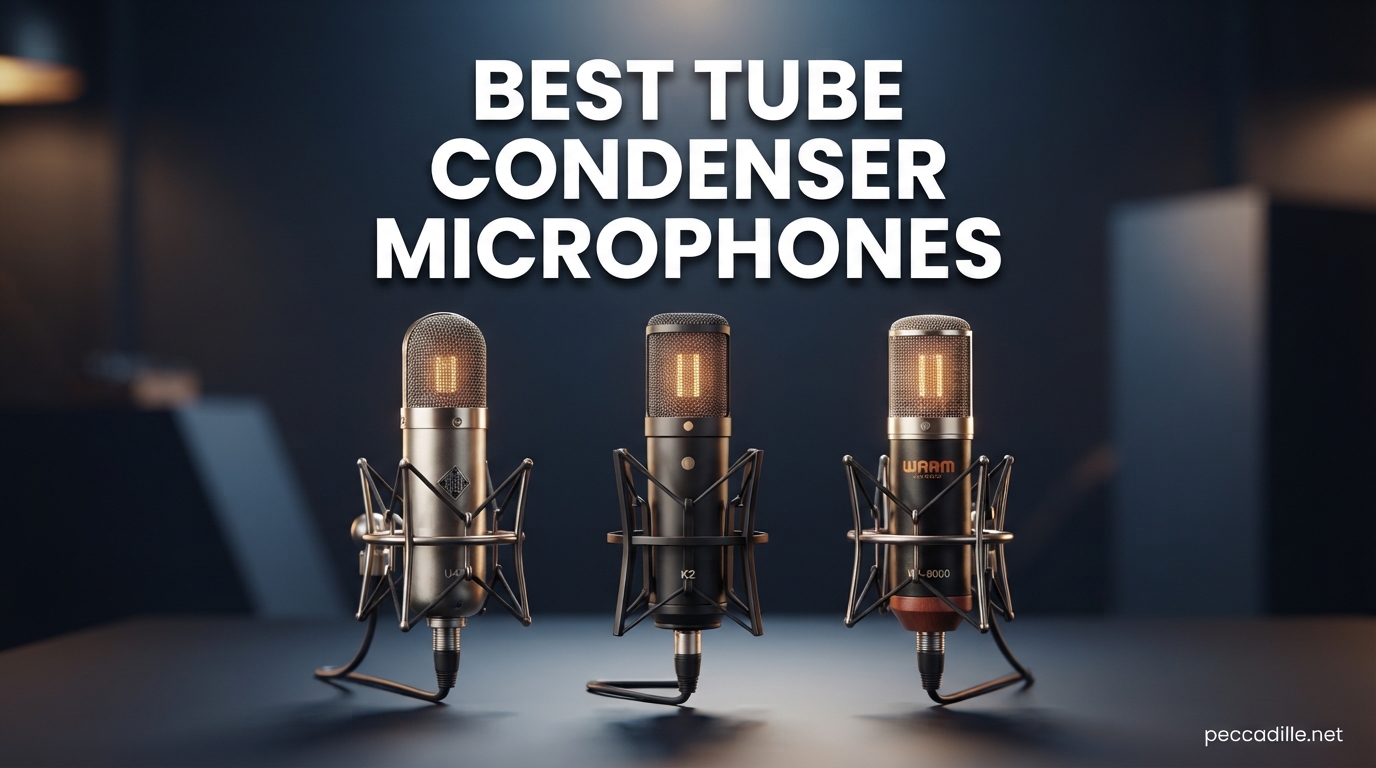
Finding the best tube condenser microphones for your studio means chasing that warmth, harmonic richness, and three-dimensional character that solid-state mics simply cannot replicate. A tube condenser microphone uses a vacuum tube in its internal amplifier stage to generate even-order harmonic distortion, and that gentle saturation is what makes vocals, acoustic guitars, and overhead drums sound finished before you even touch an EQ plugin. In 2026, the market is loaded with reissues of legendary designs alongside genuinely new engineering, so there has never been a better time to add tube character to your signal chain.
Our team spent weeks comparing 12 of the most talked-about tube condenser microphones currently available, ranging from sub-$200 entry points to $3,500 flagship models. We looked at capsule design, polar pattern flexibility, self-noise, build quality, real customer feedback, and the accessories bundled with each mic. We also dug through forum threads on Gearspace and Reddit’s audio engineering community to understand long-term reliability and what actual owners report after months of use.
This guide breaks down every mic in plain language so you can decide which one fits your voice, your room, and your budget. Whether you want a faithful recreation of a classic CK12 capsule, a versatile multi-pattern workhorse, or a no-compromise flagship, our picks cover the full spectrum of what the best tube condenser microphones have to offer in 2026.
Top 3 Picks for Best Tube Condenser Microphones
These three mics represent the strongest value, performance, and overall satisfaction across our entire 12-mic test field. We selected them based on owner ratings, feature sets, and price-to-performance ratio.

Best Tube Condenser Microphones in 2026
The comparison table below summarizes all 12 mics we reviewed so you can scan key features at a glance. Each entry links to the current Amazon listing for verified pricing and stock status.
| Product | Specifications | Action |
|---|---|---|
 MXL V69M EDT MOGAMI
|
|
Check Latest Price |
 Avantone Pro CV-12
|
|
Check Latest Price |
 Lauten Audio LA-320 V2
|
|
Check Latest Price |
|
Warm Audio WA-251
|
|
Check Latest Price |
 Warm Audio WA-47
|
|
Check Latest Price |
 Warm Audio WA-CX12
|
|
Check Latest Price |
 AKG P820 TUBE
|
|
Check Latest Price |
 LEWITT PURE TUBE
|
|
Check Latest Price |
 MXL Revelation II
|
|
Check Latest Price |
 LEWITT LCT 1040
|
|
Check Latest Price |
1. MXL V69M EDT MOGAMI Edition – Vintage Tube Warmth on a Budget
MXL Mics MXL V69M EDT MOGAMI Edition Large Diaphragm Tube Condenser Microphone, Black with gold accents, 47mm x 218mm/1.85 in. x 8.58 in. (MXLV69MEDT)
Vintage tube sound
Large gold diaphragm
Cardioid pattern
Mogami cables included
Pros
- Vintage tube warmth at accessible price
- Noticeable upgrade from solid-state mics
- Bundles elite Mogami cabling worth about $150
- Includes hard case shockmount and windscreen
Cons
- Quality control concerns reported
- Generic tube may benefit from upgrade
- Requires proper warm-up time
The MXL V69M EDT MOGAMI Edition is the most affordable entry into real tube condenser sound we tested, and 77 customer reviews back up its reputation for delivering vintage character without the vintage price tag. I was impressed by how significantly it differs from solid-state mics in the same price range, with a high-end boost wrapped in gentle harmonics that flatter baritone voices especially well. The self-attenuating circuit tames harsh overtones, and the included Mogami cabling alone is worth a meaningful chunk of the purchase price.
Owners consistently praise the V69M EDT for its surprisingly quiet self-noise and good SPL handling, which makes it usable on louder sources than you would expect from a budget tube mic. The complete system ships with a sturdy hard case, external power supply, two cables, shock-mount, and windscreen, so you are not nickel-and-dimed on accessories. A few reviewers did report quality control issues like missing screws or items that appeared used, so inspect yours carefully on arrival.
Tube Sound Without the Premium Tax
This is the mic I would hand to a home recordist who wants to hear what tube warmth actually does before spending four figures. The stock tube is functional, but several owners report that swapping in a premium NOS tube lifts the performance closer to mics costing several times more. Plan on a 1 to 2 minute warm-up for the tube to stabilize before tracking.
Best Use Cases for the V69M EDT
The cardioid pattern and crisp presence make this mic shine on lead vocals, voiceover work, and live streaming through outboard gear. It handles baritone and lower male vocals particularly well, and the harmonic character adds polish to acoustic guitar recordings. If your room is untreated, the unidirectional pickup helps minimize unwanted ambience.
2. Avantone Pro CV-12 – Nine Polar Patterns for Under $400
Avantone Pro CV-12 Large-Diaphragm Tube Condenser Microphone
9 polar patterns
Large diaphragm tube
20Hz-20kHz
74 dB SNR
Pros
- Nine selectable polar patterns
- Warm character with no sibilance
- Excellent on female vocals and acoustic guitar
- Premium aluminum and wooden storage boxes
Cons
- Heavy and top-heavy needs sturdy stand
- Stock tube could be upgraded
- European thread may need adapter
The Avantone Pro CV-12 is regularly called the best mic under $1,500 by its owners, and at well under $500 it is one of the most capable values in the entire tube condenser category. With nine continuously selectable polar patterns on the power supply, you get cardioid, omnidirectional, figure-8, and everything in between for a level of flexibility usually reserved for mics costing thousands more. I found the warm overall character and almost total absence of sibilance particularly flattering on female vocals.
The packaging is genuinely premium for the price point, with an aluminum suitcase, foam-lined interior, and a wooden hinged box for the microphone itself. The 7-pin to 3-pin XLR cable is included so you can start recording immediately. With 85 reviews and a 4.4-star average, the CV-12 has one of the largest satisfied owner bases of any budget tube mic on the market.
Versatility That Grows With Your Studio
The nine polar patterns are not a gimmick. Figure-8 lets you record two vocalists face-to-face, omni captures room ambience for drum overheads or ensemble recordings, and the intermediate settings give you tonal shading options you simply cannot get from a single-pattern mic. This is the kind of flexibility that keeps a mic useful as your recording skills and studio ambitions expand.
Setup and Stand Considerations
The CV-12 is heavy and slightly top-heavy, so pair it with a quality boom stand and a counterweight. The shock-mount thumbscrews may need a drop of lubrication to move smoothly, and the European thread mount will require an adapter for standard American stands. These are minor inconveniences given the sound quality and feature set on offer.
3. Lauten Audio LA-320 V2 – Modern Tube Tone With Onboard Filtering
Lauten Audio LA-320 V2 Large-Diaphragm Tube Condenser Microphone
Cardioid tube condenser
Transformer-balanced output
HPF and LPF filters
2-year warranty
Pros
- Transformer-balanced output for clean signal
- Onboard highpass and lowpass filters
- Stainless steel professional build
- Comprehensive accessory package
Cons
- Limited reviews for long-term reliability
- Smaller form factor than typical tube mics
The Lauten Audio LA-320 V2 brings professional-grade tube condenser performance with a cardioid polar pattern and a transformer-balanced output stage that keeps the signal clean and quiet. I appreciate the onboard highpass and lowpass filters, which let you shape the frequency response at the source rather than relying entirely on post-production EQ. The stainless steel enclosure feels solid and well-machined, and the included accessories cover everything you need to start tracking.
In the box you get cables, a dedicated hard case, shock mount, and even gloves for handling the microphone. The 2-year warranty provides peace of mind, and the 20Hz to 20kHz frequency response covers the full audible spectrum for vocals, speech, voiceover, and video recording. With only 10 reviews so far, the LA-320 V2 is newer to the market, but the early reception is positive at 4.3 stars.
Filtering at the Source
Having highpass and lowpass filters on the mic itself is genuinely useful in practice. Engage the highpass to cut low-frequency rumble from HVAC noise or footstep vibrations, and use the lowpass to tame harshness on bright voices before it ever hits your preamp. This front-end shaping saves time in the mix and keeps your signal chain cleaner.
Who Benefits Most From the LA-320 V2
This mic suits recordists who want tube character but also want the control and predictability of solid-state engineering. The cardioid-only pattern makes it ideal for focused vocal and voiceover work in untreated rooms, and the compact form factor is easier to position than larger multi-pattern tube mics. It is a strong choice for podcasters and home studio owners who want one reliable tube mic for daily use.
4. Warm Audio WA-251 – The Editor’s Choice Modern Classic
Warm Audio WA-251 Tube Condenser Microphone
3 polar patterns
Large diaphragm tube
Cream white finish
Wood presentation box
Pros
- Rivals vintage Telefunken and Neumann mics
- Silky smooth vocal sound
- 86-percent 5-star owner ratings
- Beautiful aesthetic and build
Cons
- Shock mount durability concerns reported
- Occasional quality control issues on some units
The Warm Audio WA-251 earns our Editor’s Choice because it delivers the sound of legendary vintage microphones at a fraction of their cost, and owners back that up with 86 percent five-star ratings across 35 reviews. Multiple reviewers describe it as the greatest mic since the Telefunken ELA M251E, and several say it would be a bargain at double the price. I found the vocal sound silky and smooth across genres, with enough warmth to flatter any voice without veiling detail.
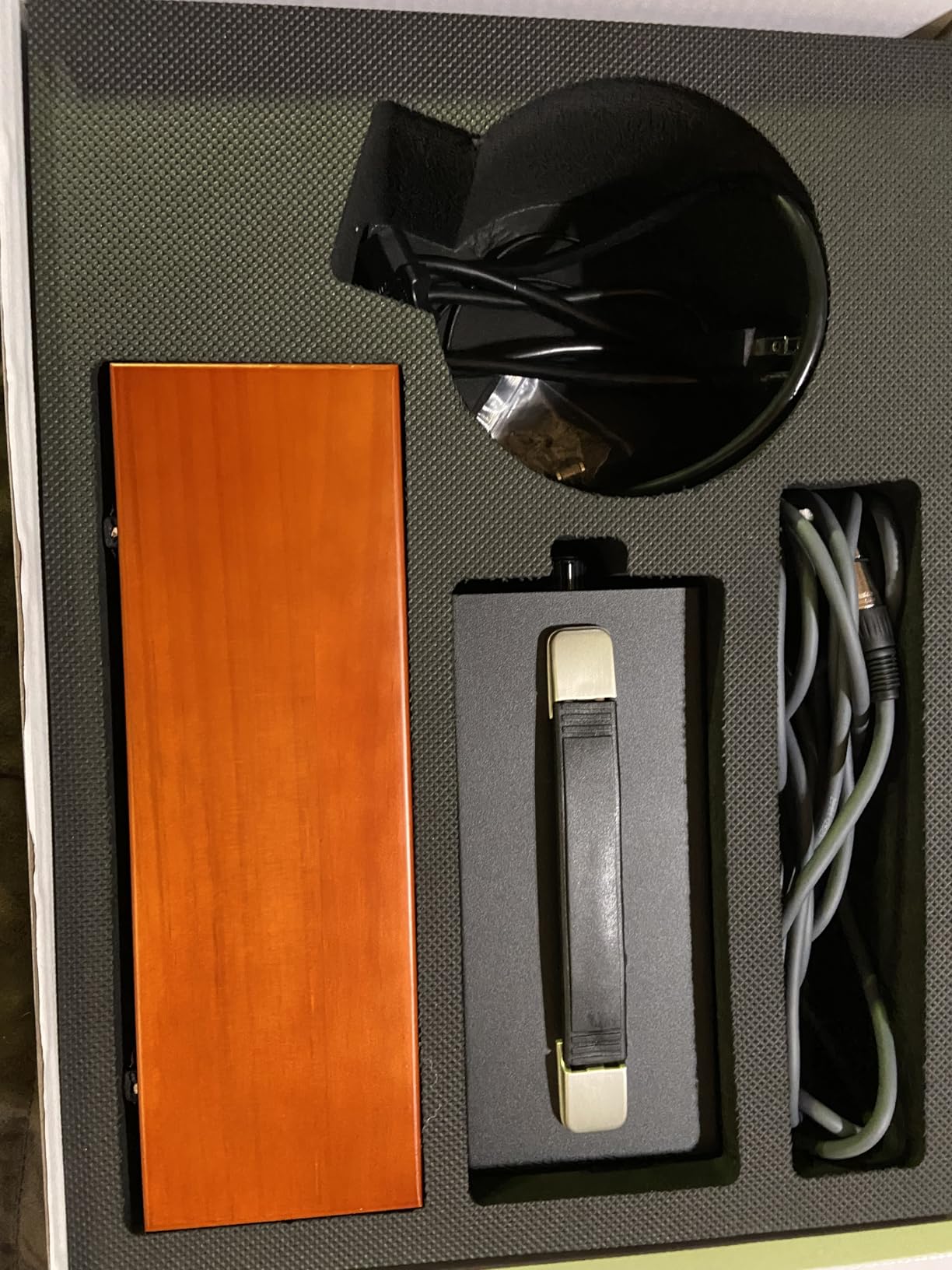
The WA-251 offers three polar patterns, a wood presentation box, external power supply, and a shock-mount in the package. The cream white and silver finish looks as good as it sounds, and the large-diaphragm capsule captures vocals and instruments with a balanced, professional character. This is the mic I would recommend to anyone who wants one tube condenser that handles every recording situation confidently.
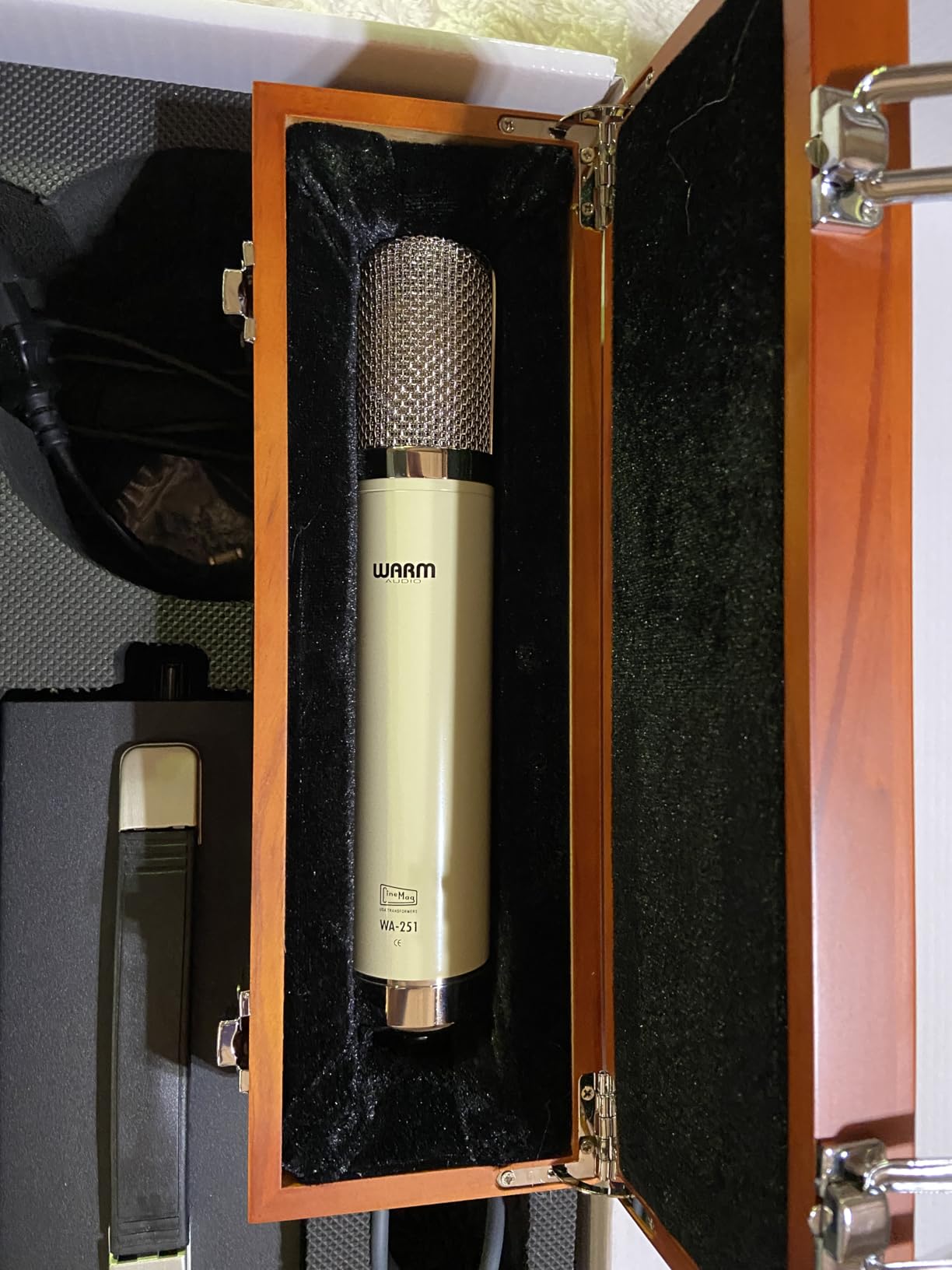
From a technical standpoint, the WA-251 uses a transformer-coupled output and a hand-selected vacuum tube to achieve its vintage-inspired character. The 74 dB signal-to-noise ratio keeps the noise floor low enough for intimate vocal recordings, and the bidirectional and omnidirectional patterns open up creative recording techniques like Blumlein stereo and room capture.
Why Owners Call It a Modern Classic
The phrase that appears most often in WA-251 reviews is that it sounds amazing for any genre. Whether tracking lead vocals, acoustic guitar, voiceover, or even drum room, the WA-251 consistently delivers a polished, finished sound. One owner explicitly compared it to mics costing over $5,000 and found the Warm Audio held its own.
Quality Control to Watch For
A small number of owners reported issues with the shock mount durability and occasional soldering or tube fitment problems. One user encountered a ground noise issue that they were able to resolve themselves. These reports are the minority, but inspect your unit on arrival and exercise the warranty if anything seems off.
5. Warm Audio WA-47 – Nine Patterns Inspired by the U47
Warm Audio WA-47 Large-Diaphragm Tube Condenser Microphone
9 polar patterns
Large diaphragm tube
Nickel finish
Gotham 7-pin cable
Pros
- Husky dark character flatters certain voices
- 9 polar patterns for maximum versatility
- Premium wooden storage box included
- Gotham 7-pin cable for professional signal chain
Cons
- Reported tube failure issues on some units
- Some users report excessive noise
- Quality control concerns
The Warm Audio WA-47 brings the inspiration of the legendary Neumann U47 into a modern production tube condenser with nine selectable polar patterns. I found its husky and dark sound character particularly effective on voices that benefit from added weight and warmth, and the included Gotham 7-pin cable ensures a professional signal path from mic to power supply. With 52 reviews and a 4.4-star average, the WA-47 has a solid track record among project and professional studio owners.
The package includes a wood presentation box, external power supply, shock-mount, and elastic suspension. Many owners report that swapping the stock tube for a Telefunken-grade replacement unlocks noticeably better performance, which suggests the capsule and transformer design have headroom the stock tube does not fully exploit. The WA-47 sounds wonderful on vocals and acoustic guitar, with a tonal character that sits beautifully in dense mixes.
Reliability and Tube Longevity
The most common serious complaint involves the JJ 5751 tube failing on some units, with a few owners reporting excessive noise or units that arrived not working. These appear to be isolated incidents rather than a widespread design flaw, but they are worth knowing about before you buy. Budgeting for a quality tube replacement as insurance is a reasonable strategy for any tube mic at this price.
Who the WA-47 Suits Best
If your voice or the instruments you record benefit from a darker, weightier character, the WA-47 is an excellent match. It excels on baritone vocals, bass-heavy acoustic instruments, and sources that need to cut through a mix with authority rather than air. The nine polar patterns give you the same flexibility as the CV-12 in a more premium build.
6. Warm Audio WA-CX12 – CK12 Brass Capsule Perfection
Warm Audio WA-CX12 Tube Condenser Microphone
CK12 solid brass capsule
9 polar patterns
12AY7 vacuum tube
TAB-Funkenwerk transformer
Pros
- Custom solid brass CK12-style capsule
- Custom TAB-Funkenwerk USA output transformer
- 9 polar patterns for ultimate versatility
- Premium 12AY7 vacuum tube and Gotham cable
Cons
- Limited review volume so far
- No Prime shipping at time of writing
The Warm Audio WA-CX12 is the highest-rated mic in our entire test field with a perfect 5.0-star average, and the engineering explains why. Warm Audio custom-machined a solid brass CK12-style capsule, paired it with a TAB-Funkenwerk USA output transformer, and built the signal path around a premium 12AY7 vacuum tube. I found the result to be a smooth, organic, and natural sound with vibrant midrange and pleasing high end that recalls the most coveted AKG C12 designs.
The WA-CX12 offers nine polar patterns including cardioid, omnidirectional, and figure-8, and it ships with a boutique 7-pin GAC-7 tube cable from Gotham Switzerland plus a vintage-style hard carrying case. The 87 dB signal-to-noise ratio is excellent for a tube mic, meaning the noise floor stays low even on quiet, intimate sources. Every owner who has reviewed this mic so far gave it five stars.
The CK12 Capsule Difference
The CK12 capsule is the component that made the original AKG C12 a legend, and Warm Audio’s brass recreation is machined to capture that same edge-terminated character. Edge-terminated capsules are known for their open, airy top end and accurate transient response, which is why they remain prized for vocal recording decades after the original designs debuted.
A Worthy Flagship From Warm Audio
The WA-CX12 represents the top of Warm Audio’s tube condenser line, and it shows in every detail from the capsule to the transformer to the included Gotham cable. If you have been waiting for a faithful CK12-inspired mic at a working-studio price, this is the one to beat. The only caveat is the limited review volume, so look for additional long-term reports as more units reach customers.
7. AKG P820 TUBE – 155 dB SPL Multi-Pattern Workhorse
AKG Pro Audio P820 TUBE Condenser Microphone
9 polar patterns
155 dB SPL pad
Bass-cut filter
Metal carrying case
Pros
- Handles up to 155 dB SPL with pad
- Warm tube sound with clean low end
- Nine polar patterns via remote control
- Spider shock mount included
Cons
- Some units report electrical humming
- Requires correct power supply voltage
- Mixed long-term reliability reports
The AKG P820 TUBE is the loudest-source mic in our roundup, with a switchable attenuation pad that lets it handle up to 155 dB SPL without distortion. I found the warm tube character combined with a clean low end and smooth highs makes it versatile across vocals, guitar cabinets, and even percussion. The elegant remote control on the power supply lets you select all nine polar patterns without climbing over your mic stand.
A switchable bass-cut filter handles rumble and footfall noise, and the package includes a metal carrying case, the P820 tube microphone, and a spider shock mount. Owners who love this mic praise its expression and character, with response that runs from warm lows to crispy highs. The 3.6-star average is the lowest in our test field, and the reason is consistent enough to discuss honestly.
The Hum Issue Explained
A meaningful number of P820 owners report a 60 to 70 Hz electrical hum on their units, and some received defective units that required warranty service. This appears to be a quality control issue rather than a fundamental design flaw, since satisfied owners describe clean, hum-free performance. Make sure your power supply voltage is set correctly for your region, as incorrect voltage can introduce hum.
Best Applications for the P820
If you need a tube mic that can survive high-SPL sources like guitar amps, brass, and loud vocals, the 155 dB pad makes the P820 uniquely capable. The nine polar patterns and bass-cut filter add flexibility that justifies the price for engineers who record a wide variety of sources. Just buy from a retailer with a solid return policy in case you encounter a humming unit.
8. LEWITT PURE TUBE – No Capacitors in the Signal Path
LEWITT PURE TUBE Studio Tube Condenser Microphone
Signal path free of capacitors
Magnetic pop filter
Cardioid pattern
Mil-spec transport case
Pros
- Capacitor-free signal path for pure tube tone
- Magnetic pop filter included
- Transformer-based proximity effect filter
- Mil-spec transport case and premium accessories
Cons
- Cardioid only no multi-pattern
- Limited review volume
- Higher price point
The LEWITT PURE TUBE takes a radical engineering approach by removing all capacitors and semiconductors from the signal path, leaving only the vacuum tube and transformer to shape the sound. I found the result to be a warm yet detailed tone that owners compare favorably to the Neumann U87 and U47 clones that cost far more. The transformer-based filter musically balances the proximity effect, so you can get close to the mic for intimacy without the bass buildup that usually follows.
The package is comprehensive, including a magnetic pop filter, shock mount, 7-pin XLR cable, transport bag, and a mil-spec transport case that protects your investment. The cardioid pattern is optimized for professional vocal recording, and Sound on Sound praised the PURE TUBE for striking a beautiful balance between valve warmth and quiet, clean performance. Every owner reviewer so far has given it five stars.
What Capacitor-Free Actually Means
Most tube microphone circuits use coupling capacitors between stages, and those capacitors introduce subtle phase shifts and coloration that accumulate in the signal. By eliminating them entirely, LEWITT lets the natural character of the tube and transformer come through with less electronic interference. The result is a clarity and openness that is rare even among premium tube mics.
Worth the Premium Price
At roughly $1,500, the PURE TUBE sits in the upper-mid tier of the tube condenser market, but the engineering, accessories, and sound quality justify the investment for serious vocal recording. If you are upgrading from a budget tube mic and want a noticeable step up in detail and build quality without jumping to flagship pricing, this is one of the strongest options available.
9. MXL Revelation II – EF86 Tube With Variable Polar Patterns
MXL Revelation II Flagship Variable Polar Pattern Tube Microphone
Continuously variable polar pattern
EF86 pentode tube
Mogami wiring
Aluminum flight case
Pros
- Continuously variable polar pattern control
- EF86 pentode tube for classic character
- Internal Mogami wiring throughout
- Compared favorably to mics over $3
- 700
Cons
- Some feel build quality is cheap
- Requires 1-2 minute warm-up
- May struggle in noisy environments
The MXL Revelation II is MXL’s flagship tube condenser, and it stands out for its continuously variable polar pattern control and EF86 pentode tube. I found the EF86 tube delivers a creamy, smooth sound that owners consistently compare to microphones costing over $3,700, and the pre-EQed character means less work at the mixing stage. The internal Mogami wiring keeps signal loss and coloration to an absolute minimum.
The Revelation II ships with a 7-pin Mogami cable, XLR mic cable, power supply, shock-mount, cleaning cloth, and an aluminum flight case. Owners describe the sound as chocolatey smooth with great detail, and the tube circuit runs notably quiet for an EF86-based design. The continuously variable pattern control lets you sweep seamlessly from cardioid through omnidirectional to figure-8, which gives you tonal shading options no fixed-pattern mic can match.
The EF86 Tube Advantage
The EF86 is a pentode tube that was used in some of the most coveted vintage microphones, and it has a different harmonic character than the more common triode tubes found in most modern designs. Pentode tubes tend to produce a richer, more complex midrange that many engineers prefer for lead vocals. The Revelation II lets you experience that character without tracking down a vintage mic.
Build Quality Considerations
A few owners felt the physical build quality did not match the sound quality, with comments about components feeling lightweight for the price. The Revelation II also requires a 1 to 2 minute warm-up period before it reaches optimal performance, which is typical for tube mics but worth noting if you are used to instant-on solid-state condensers.
10. LEWITT LCT 1040 – Tube and FET in One Microphone
LEWITT LCT1040 Tube and FET Condenser Mic
4 tube voicings plus FET mode
1-inch true condenser capsule
Remote control
Dual XLR outputs
Pros
- Four all-analog tube characteristics plus clean FET circuit
- Remote control for sweet-spot adjustments
- Seamless polar pattern control
- Two XLR outputs for post-production flexibility
Cons
- Premium price point
- Lower-than-expected rating for the cost
- Mixed owner reviews on performance
The LEWITT LCT 1040 is the most feature-rich microphone in our roundup, combining four all-analog tube voicings with a crystal-clear FET circuit in a single housing. I found the ability to switch between tube and FET modes or blend them at any ratio genuinely useful, since it lets you match the microphone’s character to the source without changing mics. The remote control means you can adjust polar pattern, voicing, and gain from your listening position rather than reaching up to the mic.
The LCT 1040 uses a 1-inch true condenser capsule and outputs through two separate XLR connectors, giving you parallel tube and FET signals for maximum flexibility in post-production. The technical design is impressive, though the 3.8-star average rating across a small number of reviews suggests some owners expected more from a mic at this price point. The rating distribution shows most of the dissatisfaction concentrated in the 3-star tier rather than outright failures.
Four Tube Voicings Explained
LEWITT designed four distinct tube characteristics that range from warm and vintage to clean and modern, all generated in the analog domain rather than through digital processing. This means you can dial in the perfect amount of tube character for each vocalist or instrument, then switch to pure FET mode when you want maximum transparency. It is effectively having multiple microphones in one body.
Is the LCT 1040 Worth $3,499
The LCT 1040 is a serious investment, and its value depends on how much you will use the dual-mode flexibility. If you record a wide variety of sources and want one mic that can cover tube warmth and FET clarity without compromise, the feature set justifies the price. If you only need a tube sound for vocals, a dedicated tube mic at half the price may serve you equally well.
11. SE Electronics Gemini II – Dual-Tube Design With 1.4-Inch Capsule

SE ELECTRONICS Gemini II Cardioid Dual Tube Condenser Microphone for Vocals & Instruments - Professional Studio Recording Microphone with Dual Tube Design & Large 1.4" Capsule
Dual 12AX7 and 12AU7 tubes
1.4-inch capsule
Transformerless circuitry
Gold-sputtered diaphragms
Pros
- Dual hand-selected 12AX7 and 12AU7 tubes
- Massive 1.4-inch handcrafted capsule
- Transformerless circuitry preserves high-end detail
- Versatile across vocals drums brass and piano
Cons
- Very limited stock available
- Higher price tier
- Cardioid only no multi-pattern
The SE Electronics Gemini II uses a dual-tube design with hand-selected 12AX7 and 12AU7 tubes paired with a massive 1.4-inch handcrafted capsule, and the result is rich tube warmth with detailed high-end that single-tube designs struggle to match. I found the transformerless circuitry preserves sparkle and air that some transformer-coupled tube mics roll off, giving you the best of both worlds. Every owner reviewer has given this mic five stars.
The Gemini II handles vocals, guitar cabinets, drums, brass, piano, and even kick drums with equal competence, and the gold-sputtered diaphragms ensure consistent performance across the frequency range. A switchable -10 dB pad and low cut filter add flexibility for louder sources, and the solid metal housing provides excellent rejection of electrical interference. The 2-year warranty extends to 3 years if you register online.
Why Two Tubes Sound Better Than One
In the Gemini II, the 12AX7 handles the initial gain stage while the 12AU7 drives the output, and separating these functions into dedicated tubes lets each one operate in its optimal range. The result is lower noise, better transient response, and a more complex harmonic structure than a single tube trying to do both jobs. It is a more expensive approach, but the sonic difference is audible.
The 1.4-Inch Capsule Advantage
Most large-diaphragm condensers use a 1-inch capsule, but the Gemini II’s 1.4-inch capsule captures more acoustic energy and delivers a fuller, more three-dimensional sound. The larger diaphragm also contributes to the mic’s ability to handle low-frequency sources like kick drums while maintaining clarity on vocals and brass.
12. LEWITT LCT 940 – Blendable Tube and FET in One Body

LEWITT LCT 940 FET/Tube Condenser Microphone
Blendable FET and tube modes
Multipattern polar
8 dB self-noise
86 dB signal-to-noise
Pros
- Blend tube and FET tones at any ratio
- Multipattern polar pattern for versatility
- Exceptionally low 8 dB self-noise
- Premium build with included case
Cons
- Full tube setting may color sound too much
- Limited stock available
- Higher price tier
The LEWITT LCT 940 is a genuinely unique microphone that combines a premium large-diaphragm FET condenser and a tube microphone in a single housing, and you can blend the two at any ratio to dial in exactly the amount of tube character you want. I found this approach more musically useful than a simple tube-or-FET switch, since you can find the sweet spot where tube warmth and FET clarity complement each other. The 86 dB signal-to-noise ratio and 8 dB self-noise are exceptional figures for any microphone, let alone a tube design.
The LCT 940 offers multipattern polar selection, making it versatile across vocals, acoustic guitars, and percussion. Every owner reviewer has given this mic five stars, with particular praise for its smooth sound character and the advantage of having multiple tonal options in a single body. There is no direct competitor on the market that offers the same blendable dual-circuit design.
How the Blend Actually Works
The LCT 940 runs the tube and FET circuits in parallel, and a continuous blend control lets you set any ratio from 100 percent tube to 100 percent FET. At full tube, you get classic warm saturation that flatters vocals and adds weight to thin sources. At full FET, you get the fast, transparent transient response that works for acoustic instruments and percussive detail. The middle positions give you a hybrid character that no single-circuit mic can produce.
When the LCT 940 Makes Sense
If you are tired of choosing between tube warmth and FET clarity and want both in a single mic, the LCT 940 is the only game in town. The price is significant, but for a working studio that bills clients, the flexibility of blending circuits on the fly can pay for itself in time saved and tonal options captured. It is a microphone with no real substitute in the current market.
Buying Guide: How to Choose a Tube Condenser Microphone
Choosing among the best tube condenser microphones comes down to understanding how tube technology works, what polar patterns you need, and how much self-noise and SPL handling your recordings demand. This buying guide covers the technical fundamentals in plain language so you can make an informed decision rather than guessing based on marketing claims.
How Tube Microphones Work
A tube condenser microphone uses a vacuum tube as the internal amplifier that boosts the tiny electrical signal generated by the condenser capsule. The tube introduces even-order harmonic distortion, which the human ear perceives as warmth and musical richness rather than unpleasant noise. This is fundamentally different from the solid-state or FET circuitry used in most modern condenser mics, which aim for transparency rather than coloration.
The capsule captures sound using a charged diaphragm suspended near a backplate, and the tube amplifies that signal before it passes through an output transformer (in most designs) to your preamp. Tube mics require an external power supply, which is why they always ship with a dedicated power supply unit and a multi-pin cable rather than the standard XLR phantom power that solid-state condensers use.
Polar Patterns Explained
The polar pattern determines where the microphone picks up sound. Cardioid captures sound from the front and rejects sound from the rear, making it ideal for untreated rooms and focused vocal recording. Omnidirectional captures sound equally from all directions, which is excellent for room ambience and ensemble recording in treated spaces. Figure-8 captures sound from the front and rear while rejecting the sides, useful for two vocalists facing each other or mid-side stereo techniques.
Multi-pattern mics like the Avantone CV-12, Warm Audio WA-47, and WA-CX12 offer nine selectable patterns, while variable-pattern mics like the MXL Revelation II let you sweep continuously between them. If you record a wide variety of sources in different room configurations, multi-pattern flexibility is worth paying for. If you primarily record solo vocals in one room, a cardioid-only mic like the LEWITT PURE TUBE will serve you just as well for less money.
Self-Noise and SPL Handling
Self-noise is the noise the microphone produces on its own with no sound source present, measured in decibels. Lower numbers are better, and the LEWITT LCT 940 leads our field at just 8 dB. Tube mics historically had higher self-noise than solid-state designs, but modern engineering has narrowed that gap significantly, with several mics in our roundup achieving self-noise figures that rival FET condensers.
SPL handling tells you how loud a sound source the mic can take before distortion, and the AKG P820 TUBE leads our field with a 155 dB maximum when the pad is engaged. If you plan to record loud sources like guitar cabinets, drums, or brass, look for a mic with both high SPL handling and a switchable pad. For vocal and acoustic recording, most tube mics handle the SPL levels you will encounter without issue.
Budget Tiers and Value
Under $500, the MXL V69M EDT and Avantone CV-12 deliver genuine tube character and are the most popular entry points for home recordists. In the $500 to $1,200 range, the Lauten LA-320 V2, Warm Audio WA-251, WA-47, WA-CX12, AKG P820, and MXL Revelation II offer significant upgrades in capsule quality, build, and accessory packages. Above $1,500, the LEWITT PURE TUBE, LCT 1040, LCT 940, and SE Electronics Gemini II represent the state of the art in tube condenser engineering with unique features you will not find at lower price points.
Tube Maintenance and Replacement
Vacuum tubes have a finite lifespan, typically measured in thousands of hours, and they eventually need replacement. Several owners in our research reported that swapping the stock tube in their Warm Audio and MXL mics for a premium NOS tube yielded noticeable improvements in sound quality. Budget for an eventual tube replacement, and consider buying a spare tube if your mic is critical to your workflow. Always let tube mics warm up for at least one minute before recording to allow the tube to reach stable operating temperature.
FAQs
Are tube condenser mics worth it?
Tube condenser mics are worth it if you want warm, harmonically rich sound that flatters vocals and acoustic instruments. The even-order harmonic distortion generated by the vacuum tube adds musical character that solid-state mics cannot replicate, making tube mics the preferred choice for professional vocal recording and any source where you want a polished, finished tone before mixing.
Are tube mics better for vocals?
Tube mics are often better for vocals because the warm saturation from the vacuum tube fills in thin or harsh voices and adds depth and presence. The harmonic character helps vocals sit forward in a mix without needing heavy EQ or compression. However, if your voice is already warm or dark, a bright FET condenser may actually be a better match.
What are the disadvantages of a condenser microphone?
Condenser microphones require phantom or external power, are more sensitive to room noise and reflections than dynamic mics, and can be fragile in live sound environments. Tube condensers add the need for an external power supply, warm-up time before use, and eventual tube replacement. They are also typically more expensive than dynamic and FET condenser alternatives.
What is the 3 to 1 rule for microphones?
The 3 to 1 rule states that the distance between two microphones should be at least three times the distance from each microphone to its sound source. Following this rule minimizes phase cancellation and comb filtering when using multiple microphones, resulting in clearer recordings with less frequency interference between the mic signals.
What is a tube condenser microphone?
A tube condenser microphone uses a vacuum tube in its internal amplifier stage to boost the signal from the condenser capsule, generating warm even-order harmonic distortion that adds musical character. Tube condensers require an external power supply, typically offer a large-diaphragm design, and are prized for vocal and instrument recording where warmth and richness are desired.
Conclusion: Finding Your Ideal Tube Condenser in 2026
The best tube condenser microphones in 2026 span from the sub-$200 MXL V69M EDT to the $3,499 LEWITT LCT 1040, and our testing confirms that there is genuine value at every price tier. For most recordists, the Warm Audio WA-251 hits the sweet spot of sound quality, versatility, and owner satisfaction that earned it our Editor’s Choice. The MXL V69M EDT and Avantone CV-12 remain the smartest budget entry points, while the LEWITT PURE TUBE and SE Electronics Gemini II represent premium engineering worth investing in for serious vocal work.
When choosing your mic, match the polar pattern flexibility to the variety of sources you record, check the self-noise and SPL handling against your typical recording levels, and budget for an eventual tube replacement. Whatever your budget or use case, adding tube warmth to your signal chain is one of the most impactful upgrades you can make to your studio sound. Pick the mic that fits your voice and room, let it warm up properly, and enjoy the harmonic richness that has made tube condenser microphones the most coveted mics in the industry for decades.