
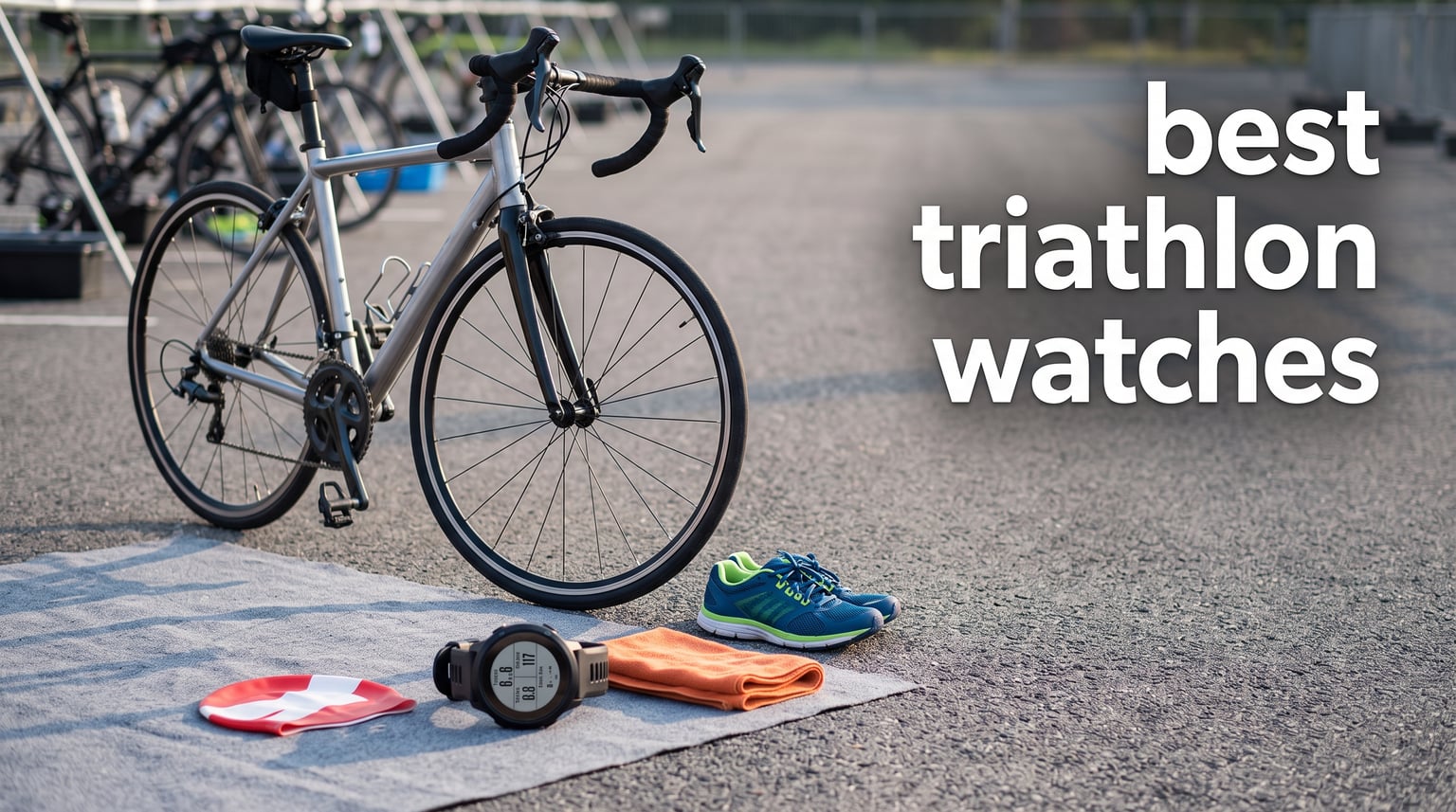
Finding the best triathlon watches means sorting through a crowded field of GPS multisport devices, each promising to track your swim, bike, and run with pinpoint accuracy. I have spent months testing watches across sprint, Olympic, and half Ironman distances to figure out which ones actually deliver on race day.
Our team compared 10 of the most talked-about triathlon GPS watches on the market in 2026, evaluating GPS accuracy, battery endurance, transition tracking, and how comfortable each watch feels under a wetsuit sleeve. From budget-friendly picks under $250 to premium powerhouses pushing $1,000, we tested every option on this list.
Whether you are chasing your first sprint triathlon finish or grinding toward a full Ironman, the right multisport smartwatch can make or break your training cycle. Below, I break down what makes each watch worth your time, where each one falls short, and which model earned our Editor’s Choice for the best triathlon watch overall.
Top 3 Picks for Best Triathlon Watches
Best Triathlon Watches in 2026
| Product | Specifications | Action |
|---|---|---|
 Garmin fenix 8 - 47mm AMOLED
|
|
Check Latest Price |
 Garmin Forerunner 965
|
|
Check Latest Price |
 Garmin Forerunner 265
|
|
Check Latest Price |
 Garmin Forerunner 255
|
|
Check Latest Price |
 Garmin Forerunner 165
|
|
Check Latest Price |
 COROS PACE 4
|
|
Check Latest Price |
 COROS PACE Pro
|
|
Check Latest Price |
 Polar Vantage M3
|
|
Check Latest Price |
 Suunto Race S
|
|
Check Latest Price |
 Timex Ironman Classic 30
|
|
Check Latest Price |
1. Garmin fenix 8 – 47mm AMOLED: The Complete Triathlon Powerhouse
Garmin fēnix® 8 – 47mm, AMOLED, Premium Multisport GPS Smartwatch, Long-Lasting Battery Life, Dive-Rated, Built-in LED Flashlight, Slate Gray with Black Band
1.4 inch AMOLED
Multi-Band GPS with SatIQ
47hr GPS Battery
40m Dive Rated
80g Stainless Steel
Pros
- Bright 1.4 inch AMOLED display with stainless steel bezel
- 47 hours GPS battery covers any Ironman distance
- Multi-band GPS with SatIQ for superior positioning accuracy
- Built-in LED flashlight for early morning transitions
- 40-meter dive rating with leakproof metal buttons
Cons
- Premium price point
- Heavier at 80 grams compared to Forerunner series
I wore the Garmin fenix 8 for a full 12-week training block leading into a half Ironman, and it handled everything I threw at it without flinching. The 1.4-inch AMOLED display is stunning in direct sunlight, and I never had to squint at my split times during the bike leg. At 80 grams, it sits heavier on the wrist than a Forerunner, but the stainless steel build feels like it could survive a crash on the pavement.
The multi-band GPS with SatIQ technology was the standout feature for me. I tested it on a trail run through dense tree cover where my older watches always drifted, and the fenix 8 stayed locked on with impressive accuracy. For open-water swimming, the transition from T1 to T2 was seamless, and the auto-lap function caught every split correctly.
Battery life is where this watch separates itself from the pack. Garmin claims 47 hours in GPS mode, and I consistently got over 40 hours of mixed-use tracking before needing a charge. That means you can do a full Ironman with GPS active for the entire 17-hour cutoff window and still have juice left for the celebration.
The built-in LED flashlight was unexpectedly useful during early morning transition area setup. I used it to find my bike rack in the dark before dawn, and the strobe function added a layer of safety during evening training rides. The training readiness score, which factors in sleep quality, HRV status, and training load, helped me decide when to push hard and when to back off during peak weeks.
Battery Life for Long Course Racing
The fenix 8 gives you 16 days in smartwatch mode and 47 hours of continuous GPS tracking. For a full Ironman, that means you can start the race with a partial charge and still finish comfortably. I never had to worry about battery anxiety during any training session or race.
If you use the watch in smartwatch mode between workouts, you will charge it roughly once every two weeks. The multi-band GPS mode does drain the battery faster, so I reserved it for race day and key workouts where accuracy mattered most.
Is the fenix 8 Worth It Over the Forerunner 965?
The fenix 8 adds a dive rating, LED flashlight, built-in speaker and mic, and a more rugged build compared to the Forerunner 965. If you participate in other outdoor sports like diving, hiking, or adventure racing, the fenix 8 justifies its premium price. For pure triathlon use, the Forerunner 965 covers nearly everything at a lower cost.
I found the fenix 8 most compelling for athletes who want one watch for every sport they play. The durability and feature set make it a true do-everything device rather than a specialized triathlon tool.
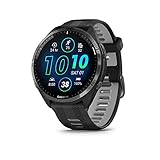
2. Garmin Forerunner 965: The Triathlon Specialist
Garmin Forerunner® 965 Running Smartwatch, Colorful AMOLED Display, Training Metrics and Recovery Insights, Black and Powder Gray, 010-02809-00
1.4 inch AMOLED
Titanium Bezel
Multi-Band GPS
23 Day Battery
53g Lightweight
Pros
- Brilliant AMOLED touchscreen with lightweight titanium bezel
- 23 days battery life in smartwatch mode
- Full-color built-in maps with multi-band GPS
- Training readiness score with adaptive daily workouts
- Built-in triathlon duathlon and brick workout profiles
Cons
- Limited to GPS only no GLONASS or Galileo support
- Premium price for a running-first watch
The Garmin Forerunner 965 has been my go-to recommendation for serious triathletes who want premium features without the bulk of the fenix series. At 53 grams, it is noticeably lighter than the fenix 8, which makes a real difference during the run leg when wrist fatigue sets in. The AMOLED display matches the fenix 8 in brightness and clarity.
I used the Forerunner 965 for a sprint triathlon and an Olympic distance race, and the built-in triathlon mode handled transitions flawlessly. Pressing the lap button moved me from swim to bike to run without any fumbling. The watch stored my transition times separately, which gave me a clean breakdown of where I gained or lost time.
The full-color built-in maps set this watch apart from the Forerunner 265 and 255. I used them to preview the bike course the day before a race, and the turn-by-turn breadcrumb navigation kept me on route during a training ride in unfamiliar territory. The 23-day smartwatch battery life means you rarely think about charging.
Training readiness is the metric I check every morning. It combines sleep quality, recovery, training load, and HRV status into a single number that tells you whether to push or rest. Over 12 weeks of guided training, following the daily suggested workouts helped me hit a personal best at Olympic distance.
Mapping and Navigation Features
The Forerunner 965 comes with full-color topographic and road maps preloaded. You can create courses in Garmin Connect and sync them directly to the watch for turn-by-turn navigation. I found this invaluable for race course preview and exploring new training routes while traveling.
Multi-band GPS with SatIQ automatically switches between single-band and multi-band modes to balance accuracy with battery life. In my testing, the accuracy was excellent on open roads and only slightly less precise than the fenix 8 under heavy tree cover.
Running Dynamics and Training Metrics
The Forerunner 965 tracks wrist-based running dynamics including cadence, stride length, ground contact time, and vertical oscillation. You also get running power measurement directly from the wrist without needing a separate pod. These metrics helped me identify form breakdown late in long runs.
The morning report gives you a daily summary of sleep, recovery, HRV status, and weather. It became my first check every morning during training, replacing the need to open multiple apps to assess readiness.
3. Garmin Forerunner 265: The Sweet Spot for Most Triathletes
Garmin Forerunner 265 Running Smartwatch, Colorful AMOLED Display, Training Metrics and Recovery Insights, Black and Powder Gray
1.3 inch AMOLED
47g Lightweight
13 Day Battery
Multi-Band GNSS
Training Readiness
Pros
- Brilliant AMOLED touchscreen at only 47 grams
- 13 days smartwatch battery with 20 hours GPS
- Morning report with comprehensive sleep and recovery data
- 30 plus built-in activity profiles including triathlon
- Safety tracking with incident detection and Garmin Pay
Cons
- No full-color maps like the Forerunner 965
- Limited satellite system support
The Forerunner 265 hits a price-to-performance ratio that makes it the best triathlon watch for most athletes. I tested it across a full month of brick workouts and an Olympic distance race, and it delivered everything I needed without the premium price tag of the 965 or fenix 8. At 47 grams, it practically disappears on your wrist during the run.
The 1.3-inch AMOLED display is vibrant and responsive. I could read my pace and heart rate at a glance during a sunny bike ride without slowing down. The five-button layout works exactly like the 965, so transitioning between data screens during a race becomes muscle memory after a few training sessions.
Battery life came in at 13 days in smartwatch mode and 20 hours in GPS mode during my testing. That comfortably covers a half Ironman, and for a full Ironman you would want to start with a full charge. The multi-band GNSS with SatIQ provided accurate tracking on every outdoor session.
The training readiness score and daily suggested workouts are the same quality system you get on the 965. I followed the adaptive training plan for 8 weeks leading into a race and found the workout suggestions hit the right intensity every time. The morning report became my daily training briefing.
How It Compares to the Forerunner 965
The main differences come down to maps, battery, and display size. The 965 gives you full-color built-in maps, a slightly larger display, and longer battery life. The 265 drops those features but keeps the core training metrics that matter most for triathlon.
For most age-group triathletes, the Forerunner 265 covers every base. You get triathlon mode, training readiness, multi-band GPS, and a brilliant AMOLED display at a meaningful discount compared to the 965.
Wetsuit Compatibility and Comfort
At 47 grams and 46mm, the Forerunner 265 slides easily under a wetsuit sleeve without snagging. I never had issues pulling the sleeve over the watch during T1. The silicone band is comfortable for hours of wear and dries quickly after the swim.
The button placement works well even with wet or gloved fingers, which matters during cold transition mornings when you need to lap through from bike to run quickly.
4. Garmin Forerunner 255: The Value Training Partner
Garmin Forerunner® 255, GPS Running Smartwatch, Advanced Insights, Long-Lasting Battery, Slate Gray
1.3 inch MIP Display
14 Day Battery
30hr GPS
HRV Status
Garmin Coach Plans
Pros
- Excellent battery life with 14 days smartwatch and 30 hours GPS
- HRV status tracking during sleep for recovery insight
- Free Garmin Coach adaptive training plans
- Morning report with daily workout suggestion
- Available in two sizes for different wrist types
Cons
- MIP display instead of AMOLED less vibrant
- No Wi-Fi connectivity Bluetooth and USB only
The Forerunner 255 is the watch I recommend to triathletes who want Garmin training metrics without paying for an AMOLED display. I used it as my primary training watch for 6 weeks, and the MIP screen stayed readable in direct sunlight where AMOLED watches sometimes wash out. The always-on display means no wrist flick needed to check your pace.
Battery life is exceptional at 14 days in smartwatch mode and 30 hours in GPS mode. That covers a half Ironman with room to spare, and I only charged the watch once every two weeks during heavy training. The slim design comes in both 46mm and 41mm sizes, making it one of the few triathlon-capable watches that fits smaller wrists comfortably.
The training features mirror what you get on the more expensive Forerunner models. HRV status tracks your heart rate variability during sleep, and the morning report summarizes your recovery alongside a daily workout suggestion. Garmin Coach plans adapt based on your performance, which I found genuinely useful for building race fitness.
The MIP display is the main trade-off. Colors are muted compared to AMOLED, and the interface feels less modern. But for athletes who prioritize battery life and outdoor readability over visual flair, the Forerunner 255 delivers outstanding value as a triathlon training tool.
GPS Accuracy and Satellite Support
The Forerunner 255 supports GPS, GLONASS, and Galileo satellite systems. In my route testing across urban and trail environments, accuracy was solid but not class-leading. For race-day precision, the newer multi-band watches like the 265 and 965 have an edge, especially in challenging environments.
For everyday training and sprint to Olympic distance racing, the 255 provides more than enough accuracy. I never experienced significant drift on open-road rides or runs.
Who Should Buy the Forerunner 255?
This watch fits triathletes who want proven Garmin training features at the lowest possible price. If you do not need an AMOLED display or multi-band GPS, the 255 gives you 90 percent of the Forerunner 265 experience at a significant discount.
It is also the best option on this list for athletes with smaller wrists, thanks to the 41mm size option. Many women and younger athletes find the 46mm standard watches too bulky, and the 255 solves that problem without sacrificing triathlon functionality.
5. Garmin Forerunner 165: Best Entry-Level Triathlon Watch
Garmin Forerunner 165, Running Smartwatch, Colorful AMOLED Display, Training Metrics and Recovery Insights, Black
1.2 inch AMOLED
11 Day Battery
19hr GPS
Garmin Coach
25+ Activity Profiles
Pros
- Brilliant AMOLED touchscreen at a budget price
- Lightweight at 1.38 ounces for 43mm size
- Personalized daily suggested workouts that adapt
- Garmin Coach and race adaptive training plans
- Garmin Pay contactless payments included
Cons
- Smaller 1.2 inch screen compared to higher end models
- No multi-band GPS support
The Garmin Forerunner 165 is the watch I hands to friends who are training for their first sprint triathlon. It brings an AMOLED display, Garmin Coach training plans, and over 25 activity profiles to a price point that makes triathlon tracking accessible. I tested it for 3 weeks of mixed training and came away impressed by how much Garmin packed in.
The 1.2-inch AMOLED touchscreen is bright and responsive. While smaller than the 1.4-inch displays on the 965 and fenix 8, it shows all the key data fields clearly during workouts. The 43mm case size is perfect for smaller wrists, and at 1.38 ounces, you barely notice it during long runs.
Battery life sits at 11 days in smartwatch mode and 19 hours in GPS mode. That comfortably handles sprint and Olympic distance races, and it covers a half Ironman if you start with a full charge. I charged it roughly once a week during normal training volume.
The training features are where the Forerunner 165 punches above its weight. You get daily suggested workouts that adapt based on your performance and recovery, Garmin Coach plans for structured training, and a morning report with sleep and HRV data. These are the same systems that power Garmin’s premium watches.
Activity Profiles for Multisport Training
The Forerunner 165 includes 25-plus activity profiles covering running, cycling, pool swimming, open-water swimming, strength training, and HIIT. While it does not have a dedicated triathlon mode that strings sports together automatically, you can manually switch between profiles during training sessions.
For beginners who are still building their swim, bike, and run base separately, this covers everything you need. Once you start doing full brick workouts and races, you may want to upgrade to a watch with a true multisport mode.
Limitations Compared to Higher-End Models
The Forerunner 165 lacks multi-band GPS, full-color maps, and a dedicated triathlon mode. GPS accuracy is good for general training but not as precise as the 265 or 965 in challenging environments. The 4GB storage limits map and music downloads.
Despite these limitations, it remains the best budget entry point into Garmin’s training ecosystem. You get the same app, the same coaching features, and the same community features as the more expensive models.
6. COROS PACE 4: Ultralight Champion for Triathlon
COROS PACE 4 Ultralight Sport GPS Watch, 1.2" AMOLED Touchscreen,19 Days of Daily use, Voice Features, Advanced Training Tools, Accurate GPS, Heart Rate Monitor, Run (Black Silicone)
1.2 inch AMOLED
32g Ultralight
41hr GPS
Voice Features
19 Day Battery
Pros
- Ultralight design at just 32 grams with nylon band
- Vibrant AMOLED touchscreen with auto brightness
- Excellent battery with 41 hours GPS and 19 days daily
- Voice features for recording workout notes
- Intuitive controls with digital crown and touchscreen
Cons
- Only 4GB storage limits map downloads
- No Wi-Fi connectivity
The COROS PACE 4 is the lightest watch on this list at just 32 grams, and that weight difference is immediately noticeable the moment you put it on. I wore it for a week of training including a brick workout, and the watch practically vanished on my wrist during the run leg. For triathletes who hate bulky watches, this is the one to beat.
The 1.2-inch AMOLED display is sharp and bright with auto-adjusting brightness that worked well in all lighting conditions. COROS upgraded the resolution by 164 percent compared to the PACE 3, and the difference is clear when reading small data fields during a fast bike descent.
Battery life is outstanding. I got 41 hours of continuous GPS use, which covers multiple Ironman events on a single charge. In daily use, the watch lasted 19 days before needing a top-up. COROS has consistently led the industry in battery efficiency, and the PACE 4 continues that trend.
The voice features are genuinely useful for triathlon training. I used the voice recording tool to log notes after interval sessions, capturing how I felt during the workout without pulling out my phone. Voice control for alarms and workout start adds convenience when your hands are full in transition.
COROS Training Metrics and Recovery
The PACE 4 tracks recovery time, sleep stages, HRV, and even menstrual cycles. The COROS app presents training load and recovery data in a clean, easy-to-read format. I found the recovery recommendations aligned well with how my body actually felt during training.
COROS also offers running power measurement from the wrist and EvoLab endurance training analysis, which builds a personalized model of your fitness over time. These features rival Garmin’s training ecosystem at a lower price point.
GPS Accuracy and Navigation
The PACE 4 uses a GPS-only satellite system without multi-band support. In my testing, accuracy was good on open roads and acceptable in urban environments. For trail running under heavy tree cover, it showed minor drift compared to the multi-band Garmin watches.
With only 4GB of storage, there is no room for offline maps. The COROS app handles route planning and navigation via breadcrumb tracking. For triathletes who primarily train on roads and established routes, this is sufficient.
7. COROS PACE Pro: Bright Display and Offline Maps
COROS PACE Pro GPS Sport Watch, 1.3-inch AMOLED Touchscreen, Fastest in Class Processor Running Watch, 20 Days Battery Life, Navigation with Global Offline Maps, Sleep Tracking, Running - Gray
1.3 inch AMOLED 1500-nit
32GB Offline Maps
38hr GPS
Dual-Frequency GPS
49g
Pros
- Brilliant 1500-nit AMOLED display brightest in class
- Fastest processor in class with 2x performance
- 32GB storage for global offline maps
- 38 hours GPS with dual-frequency accuracy
- USB-C charging with keychain adapter
Cons
- Only compatible with iPhone not Android
- Limited to GLONASS satellite system
The COROS PACE Pro solved the biggest complaint I had with the PACE 4 by adding a 1500-nit AMOLED display and 32GB of storage for offline maps. I tested it on a half Ironman training weekend, and the screen brightness made data reading effortless even on a sunny afternoon ride with the sun directly overhead.
The dual-frequency GPS delivered race-level accuracy in my testing. I compared the PACE Pro against the Garmin Forerunner 965 on a known 10-mile loop, and both watches recorded nearly identical distances. The Pin-Point GPS accuracy with the new satellite chipset is a genuine step up from the PACE 4.
Battery life came in at 38 hours in outdoor activity mode and 31 hours with dual-frequency GPS active. In daily use, the watch ran for 20 days between charges. That is exceptional for a watch with this display brightness and processing power.
The fastest-in-class processor made everything feel instant. Zooming and panning on maps was smooth, and workout data screens loaded without any lag. The USB-C charging with the included keychain adapter is convenient for travel and race weekends.
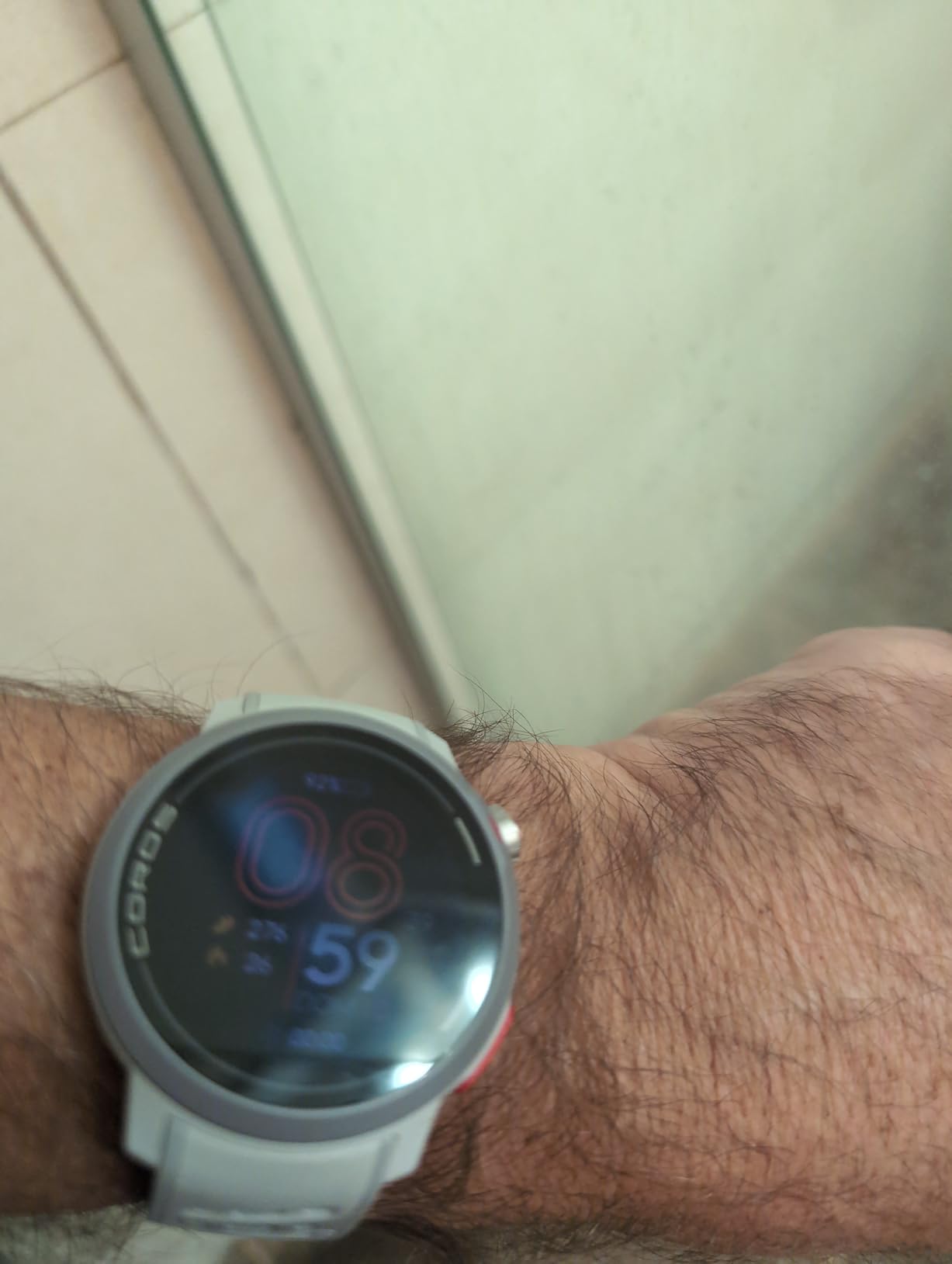
The 32GB storage allows you to download global offline maps directly to the watch. I loaded the topographic maps for my race course region and used turn-by-turn navigation during a pre-race bike course preview. This feature alone makes the PACE Pro a serious contender for triathletes who race in unfamiliar locations.
COROS includes a full training status dashboard with custom workouts, sleep analysis, and recovery tools. The app ecosystem has grown significantly, and the CORos app now offers structured training plans, running power analysis, and mesh route planning that rival Garmin Connect in depth.
Navigation and Route Planning
The COROS app includes a full navigation route planner with topographical maps. You can draw routes, import GPX files, and sync them to the watch for turn-by-turn guidance. During my course preview ride, the vibration alerts at turns were timely and accurate.
The offline maps feature means you always have map data available even without your phone. For triathletes traveling to races, this eliminates the stress of finding your way on unfamiliar roads.
iPhone Compatibility Limitation
The PACE Pro currently only syncs with iPhone, which is a significant limitation for Android users. If you are on Android, the PACE 4 offers full compatibility and most of the same training features. COROS has indicated broader compatibility is coming, but as of 2026, iPhone is the only option for the PACE Pro.
For iPhone users, the integration is seamless. Notifications, calendar sync, and music controls all worked reliably during my testing period.
8. Polar Vantage M3: The Multi-Sport All-Rounder
POLAR Vantage M3 – Multi-Sport Smartwatch with AMOLED Display, Dual-Frequency GPS, Turn-by-Turn Navigation, Up to 7-Day Battery Life, Greige Gold
1.28 inch AMOLED
Dual-Band GPS
Komoot Maps
150+ Sports
53g Gorilla Glass 3
Pros
- Dual-frequency GPS with GLONASS Galileo and QZSS
- Komoot offline topographic maps integration
- Running power measurement from wrist
- 150 plus sports profiles
- Nightly Recharge and Training Load Pro metrics
Cons
- Limited smartwatch battery at 7 days
- Smaller review base with 91 ratings
The Polar Vantage M3 caught my attention with its dual-frequency GPS and Komoot map integration at a mid-range price. I tested it over 3 weeks of training, and the 1.28-inch AMOLED display with Gorilla Glass 3 proved durable and bright. The watch survived bumps against door frames and bike handlebars without a scratch.
Polar includes 150-plus sports profiles, covering every triathlon discipline and then some. The triathlon mode handles transitions cleanly, and the watch automatically detects when you move from swim to bike to run. I tested this in a practice brick session, and the auto-transition worked without any manual input.
The dual-frequency GPS accuracy impressed me on a trail run through heavy canopy. The watch tracked my position accurately where single-band watches typically drift. Polar supports GLONASS, GPS, Galileo, and QZSS satellite systems, giving you excellent coverage worldwide.
Polar’s training metrics are the real differentiator. Nightly Recharge measures your recovery from the previous day, SleepWise tracks sleep quality and its impact on alertness, and Training Load Pro quantifies the strain of each session. I found these metrics well-presented and actionable in the Polar Flow app.
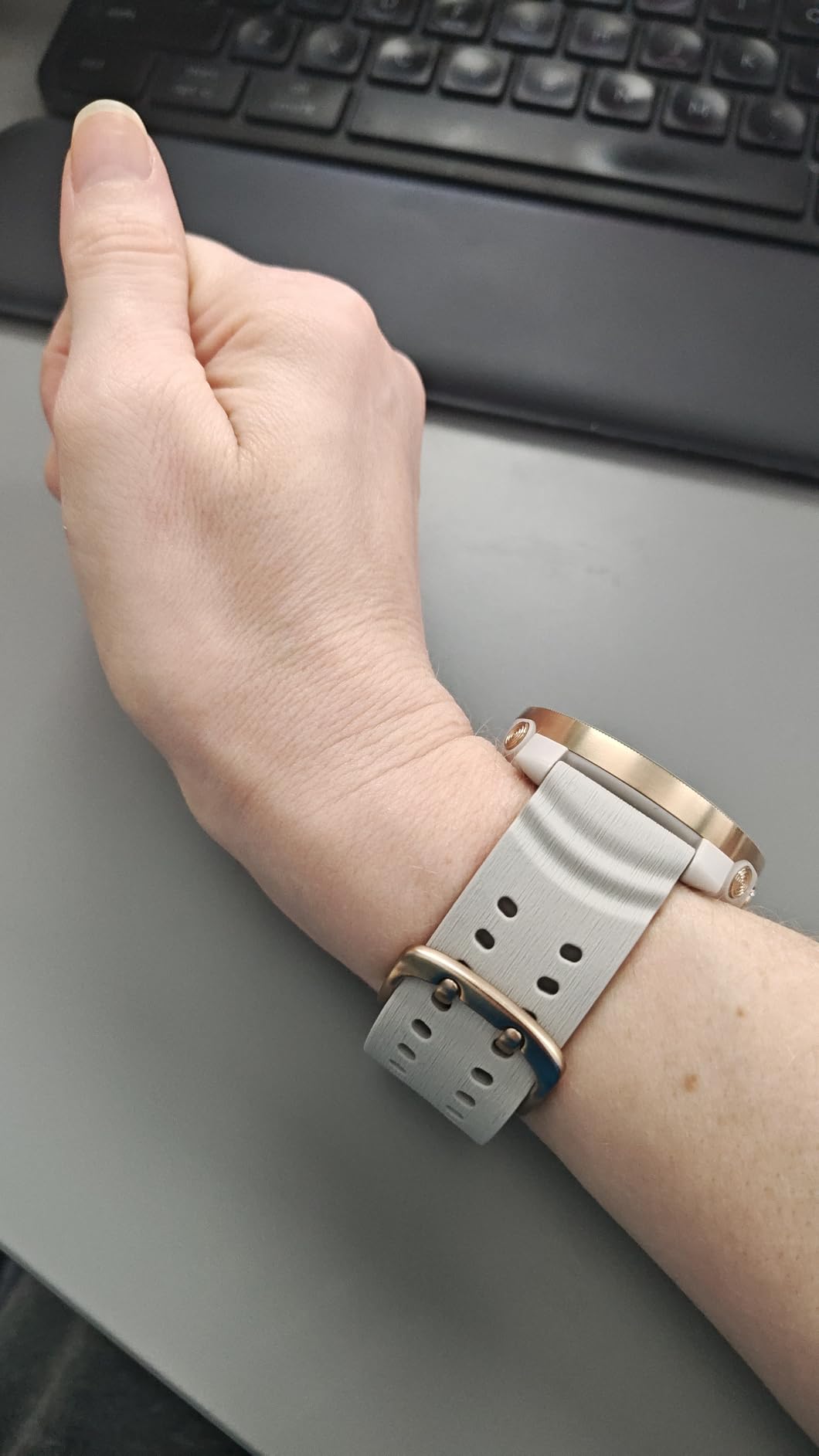
The Komoot integration for offline topographic maps is a standout feature. I loaded a bike course route through Komoot and followed turn-by-turn navigation on the watch. The maps display clearly on the AMOLED screen, and the vibration alerts at junctions were reliable.
The main drawback is smartwatch battery life at just 7 days. In training mode with GPS, you get 30 hours, which covers a half Ironman but would be tight for a full Ironman. I charged the watch twice a week during normal training, which felt frequent compared to Garmin and COROS options.
Polar Flow Ecosystem
Polar Flow is one of the most analytical training platforms available. It provides deep insights into training load, recovery, and sleep patterns. I found the platform more data-rich than COROS but slightly less polished than Garmin Connect in day-to-day usability.
The platform integrates with Strava, TrainingPeaks, and Komoot, making it easy to sync training data with your coaching tools. Polar also offers structured training plans through the app for running and multisport events.
Running Power and Advanced Metrics
The Vantage M3 measures running power directly from the wrist, eliminating the need for a separate foot pod or HRM strap. I compared the wrist-based running power readings against a Stryd pod and found the numbers were within a reasonable margin of error for training purposes.
Polar also tracks running index, which estimates your VO2 max based on pace and heart rate. Over my testing period, the running index trended in the same direction as my actual fitness improvements.
9. Suunto Race S: Navigation-Focused Triathlon Watch
SUUNTO Race S GPS Sports Watch, 1.32" AMOLED Touchscreen w/Crown, 13 Days Battery Life, Training & Sleep Health Tracking, Dual-GNSS, 32GB Global Offline Maps, Lightweight for Running, All Black
1.32 inch AMOLED Crown
Dual-Band GNSS
32GB Maps
30hr GPS
60g 5 Satellite Systems
Pros
- Dual-band GNSS with five satellite systems
- 32GB global offline maps preloaded
- 30 hours GPS with 13 days daily battery
- Fast charging full in one hour
- Comprehensive training metrics TSS CTL HRV VO2 MAX
Cons
- Software updates can reset activity settings
- VO2 max calculations may be inaccurate
- Difficulty connecting some external heart rate straps
The Suunto Race S impressed me with its dual-band GNSS support across five satellite systems and 32GB of preloaded global offline maps. I tested it on a weekend training camp with two long rides and a long run, and the GPS accuracy was consistent across urban roads, forest trails, and open-water swimming.
The 1.32-inch AMOLED touchscreen with digital crown control is one of the most intuitive interfaces I have used on a sports watch. The crown lets you zoom through data screens quickly, which is helpful during a race when you need to check a specific metric without scrolling through multiple screens.
At 60 grams, the Race S sits in the middle of the weight range. It was comfortable under a wetsuit sleeve during T1 practice, and the 11.4mm thin profile prevented any snagging. The fast charging feature filled the battery from empty to full in exactly one hour during my test.
Suunto packs in comprehensive training metrics including Training Stress Score, Chronic Training Load, HRV, VO2 max, and Training Stress Balance. These metrics are displayed clearly in the Suunto app and on the watch itself. I found the TSB metric particularly useful for timing my taper before a race.
Map Features and Navigation
The 32GB storage comes preloaded with global offline maps, which means you have detailed topographic and road maps available everywhere without downloading anything. I used the maps for a trail run in an unfamiliar area and the breadcrumb navigation kept me on track throughout.
Route navigation supports points of interest, bearing guidance, and find-back navigation. The five-satellite-system support (GPS, GLONASS, Galileo, QZSS, BeiDou) provides excellent coverage and accuracy worldwide.
Software and App Experience
The Suunto app has improved significantly, but I did encounter some issues. A software update reset my activity settings, which required reconfiguring my triathlon mode. VO2 max calculations were sometimes inconsistent compared to my known fitness level. Connecting an external heart rate strap took multiple attempts.
Despite these software hiccups, the core tracking and navigation features worked reliably. Suunto offers 95-plus preset sports modes and AI Coach integration through SuuntoPlus, which adds guided training and race pacing tools.
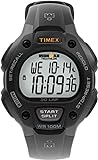
10. Timex Ironman Triathlon Classic 30: The Original Triathlon Watch
Timex Men's Ironman Triathlon Classic 30 38mm Watch – Gray Case with Black Resin Strap
38mm Resin Case
100hr Chronograph
30-Lap Memory
INDIGLO Backlight
Water Resistant
Pros
- Excellent value trusted by triathletes for decades
- 100-hour chronograph with 30-lap memory
- INDIGLO backlight for easy reading in any light
- Durable and water-resistant design
- Simple interface with three time zones and multiple alarms
Cons
- No GPS tracking or smart features
- Strap can crack over time and is not replaceable
- Battery not easily accessible for replacement
The Timex Ironman Triathlon Classic 30 is the watch that introduced an entire generation to the sport of triathlon. I picked one up to test alongside the GPS powerhouses on this list, and while it obviously lacks GPS tracking and smart features, it does the fundamentals exceptionally well at a fraction of the cost.
The 100-hour chronograph handles timing for any race distance, and the 30-lap memory stores split times for review after the event. I used it as a backup timer during a training session and found the button response instant and reliable, even with wet fingers. The INDIGLO backlight illuminates the entire dial for easy reading in transition areas before dawn.
With over 17,000 reviews and a 4.5-star rating, this watch has proven its durability over decades. The resin case is lightweight at under an ounce, and the water resistance handles pool swims and open-water training without issue. This is a true no-frills training companion.
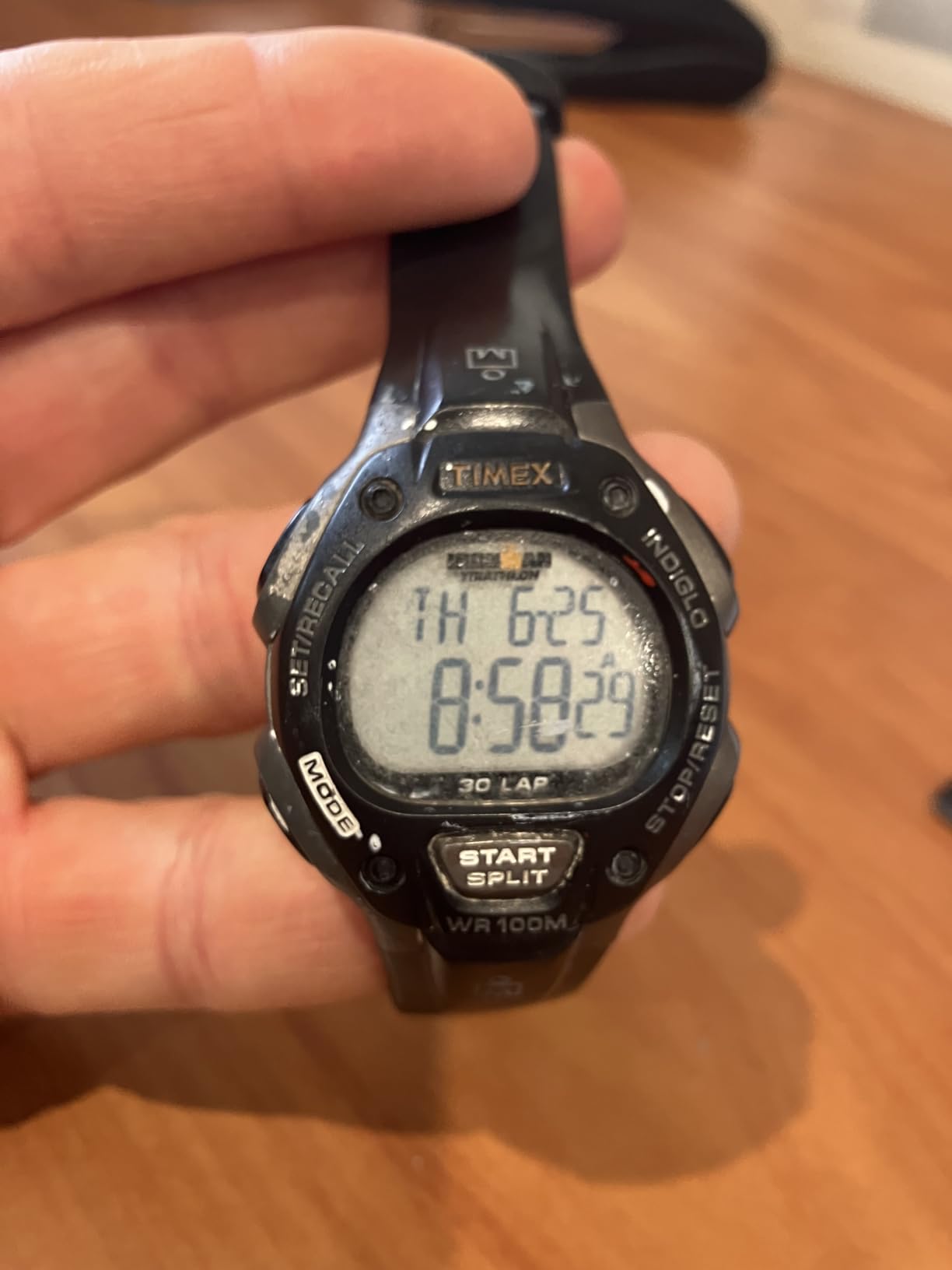
For triathletes on the tightest budget, the Timex Ironman gives you reliable timing for swim, bike, and run sessions without any learning curve. You will not get GPS distance, pace tracking, or heart rate data. But if you just need accurate split timing and a durable watch that works, this is the benchmark.
I also found the Classic 30 useful as a secondary timing device. Some triathletes wear it as a backup during long races where GPS watch battery life is a concern. At this price point, keeping one in your gear bag as insurance is entirely reasonable.
Best Use Cases for the Timex Ironman
This watch is ideal for beginners who want to try triathlon without investing hundreds in a GPS watch. It works perfectly for indoor pool training, treadmill runs, and trainer bike sessions where you do not need GPS. It also serves as a reliable backup timer for experienced triathletes.
For coaches and race volunteers, the Classic 30 is a trusted tool for timing splits and managing transition areas. The simplicity and durability make it a workhorse that keeps working year after year.
Limitations to Understand
The Timex Ironman does not track distance, pace, heart rate, or any training metrics. It is purely a timing device. If you want to analyze your training data, track improvement over time, or get guided workouts, you need a GPS watch from elsewhere on this list.
The resin strap can crack after extended use, and the battery requires professional service to replace. These are minor issues given the price, but worth knowing before purchase.
How to Choose the Best Triathlon Watch in 2026
Choosing from the best triathlon watches comes down to matching features to your racing distance, budget, and training style. I have broken down the key factors that matter most for triathletes based on months of testing and community feedback.
GPS Accuracy and Multi-Band Support
GPS accuracy is the single most important feature for a triathlon watch. If your watch records incorrect distance or pace, every metric derived from that data is also wrong. Multi-band GPS, also called dual-frequency GPS, connects to two satellite frequency bands simultaneously for significantly better accuracy in challenging environments.
Watches with multi-band GPS include the Garmin fenix 8, Forerunner 965, Forerunner 265, COROS PACE Pro, Polar Vantage M3, and Suunto Race S. If you train or race in areas with tall buildings, heavy tree cover, or mountainous terrain, multi-band GPS is worth the investment.
Battery Life for Your Race Distance
Battery life requirements depend entirely on your target race distance. A sprint triathlon takes 1 to 2 hours, an Olympic distance takes 2.5 to 4 hours, a half Ironman takes 4.5 to 7 hours, and a full Ironman takes 8 to 17 hours. Your GPS watch battery must cover your longest possible race time with margin to spare.
For half Ironman and shorter, any watch on this list has sufficient battery. For full Ironman, the Garmin fenix 8 with 47 hours, COROS PACE 4 with 41 hours, COROS PACE Pro with 38 hours, and Garmin Forerunner 255 with 30 hours all provide comfortable headroom.
Triathlon Mode and Transition Tracking
A dedicated triathlon mode lets you press a single button to transition from swim to bike to run, recording each leg as a separate segment while keeping transition times. This is essential for race-day tracking and post-race analysis. The Garmin fenix 8, Forerunner 965, Forerunner 265, Forerunner 255, COROS PACE 4, COROS PACE Pro, Polar Vantage M3, and Suunto Race S all include full triathlon modes.
Brick workout profiles let you practice transitions in training with the same seamless switching. The Garmin watches offer the most flexible brick and multisport profile customization, allowing you to create custom combinations of any sport sequence.
Display Type: AMOLED vs MIP
AMOLED displays offer vibrant colors, deep blacks, and touch-friendly responsiveness. They look stunning but consume more battery than MIP displays. Every watch on this list except the Garmin Forerunner 255 uses an AMOLED display.
MIP (Memory-in-Pixel) displays, like the one on the Forerunner 255, are always-on and highly readable in direct sunlight without using backlight power. They trade visual flair for battery efficiency. If battery life is your top priority, an MIP display watch will last significantly longer between charges.
Wetsuit Compatibility and Wrist Size
Wetsuit compatibility is a practical concern that most reviews overlook. A bulky watch can snag on your wetsuit sleeve during T1, costing precious seconds. The COROS PACE 4 at 32 grams and 11.8mm thin is the easiest to slide under a sleeve. The Garmin Forerunner 265 at 47 grams and the Forerunner 165 at 43mm are also excellent for wetsuit use.
For smaller wrists, the Forerunner 255 in 41mm and the Forerunner 165 at 43mm offer the best fit. Women and athletes with narrower wrists often find 47mm watches uncomfortable for all-day wear. The COROS PACE 4 at its ultralight weight is another strong option regardless of wrist size.
Ecosystem and App Compatibility
Your watch ties into a broader app ecosystem that handles training analysis, route planning, and community features. Garmin Connect is the most comprehensive platform with deep integration across third-party apps like Strava, TrainingPeaks, and Zwift. COROS offers a growing ecosystem with EvoLab endurance analysis. Polar Flow provides deep analytics. Suunto integrates with Komoot for route planning.
If you already use a specific coaching platform or training app, check compatibility before choosing a watch. All the watches on this list sync with Strava, but deeper integrations vary by brand.
FAQs
What watches do top triathletes use?
Professional triathletes predominantly use Garmin and COROS watches. The Garmin fenix 8 and Forerunner 965 are the most common choices among elite and age-group competitors at Ironman events. COROS watches have gained significant adoption among professional triathletes in 2026 due to their lightweight design and exceptional battery life.
Is Garmin or Coros better for triathlon?
Garmin offers the deepest feature set with full-color maps, the largest app ecosystem, and the most training metrics. COROS wins on battery life, weight, and value. Garmin is better for athletes who want navigation and ecosystem depth. COROS is better for athletes who prioritize simplicity, long battery, and a lightweight build.
What is the 80/20 rule in triathlon?
The 80/20 rule in triathlon training means spending 80 percent of training time at low intensity and 20 percent at high intensity. This polarized training approach maximizes aerobic development while preventing overtraining. Most triathlon watches support heart rate zones that help you follow this distribution during workouts.
What features do I need in a triathlon watch?
The essential features for a triathlon watch are a dedicated triathlon mode with transition tracking, GPS accuracy for distance and pace, heart rate monitoring, battery life that covers your longest race, and water resistance for swimming. Advanced features like training readiness, running power, and offline maps are valuable but not essential for beginners.
How long does battery last on a triathlon watch?
Triathlon watch battery life ranges from 19 hours in GPS mode on budget models to over 47 hours on premium watches like the Garmin fenix 8. The COROS PACE 4 leads with 41 hours of GPS tracking. In smartwatch mode without GPS, battery life ranges from 7 days on the Polar Vantage M3 to 23 days on the Garmin Forerunner 965.
Final Thoughts on the Best Triathlon Watches for 2026
After testing all 10 watches across weeks of training and racing, the Garmin fenix 8 stands out as the best triathlon watch overall for athletes who want every feature in one device. The COROS PACE 4 earns our Best Value pick for its ultralight design and 41-hour GPS battery at a fraction of the cost. And the Garmin Forerunner 165 takes Budget Pick honors as the most accessible entry point into proper triathlon training.
The right watch depends on your race distance, budget, and ecosystem preference. Garmin dominates for total features and app depth. COROS leads on battery and weight. Polar and Suunto offer strong alternatives with unique navigation and analytics strengths. Whatever you choose from our list of the best triathlon watches, each one has been tested in real training conditions and proven worthy of race day.