
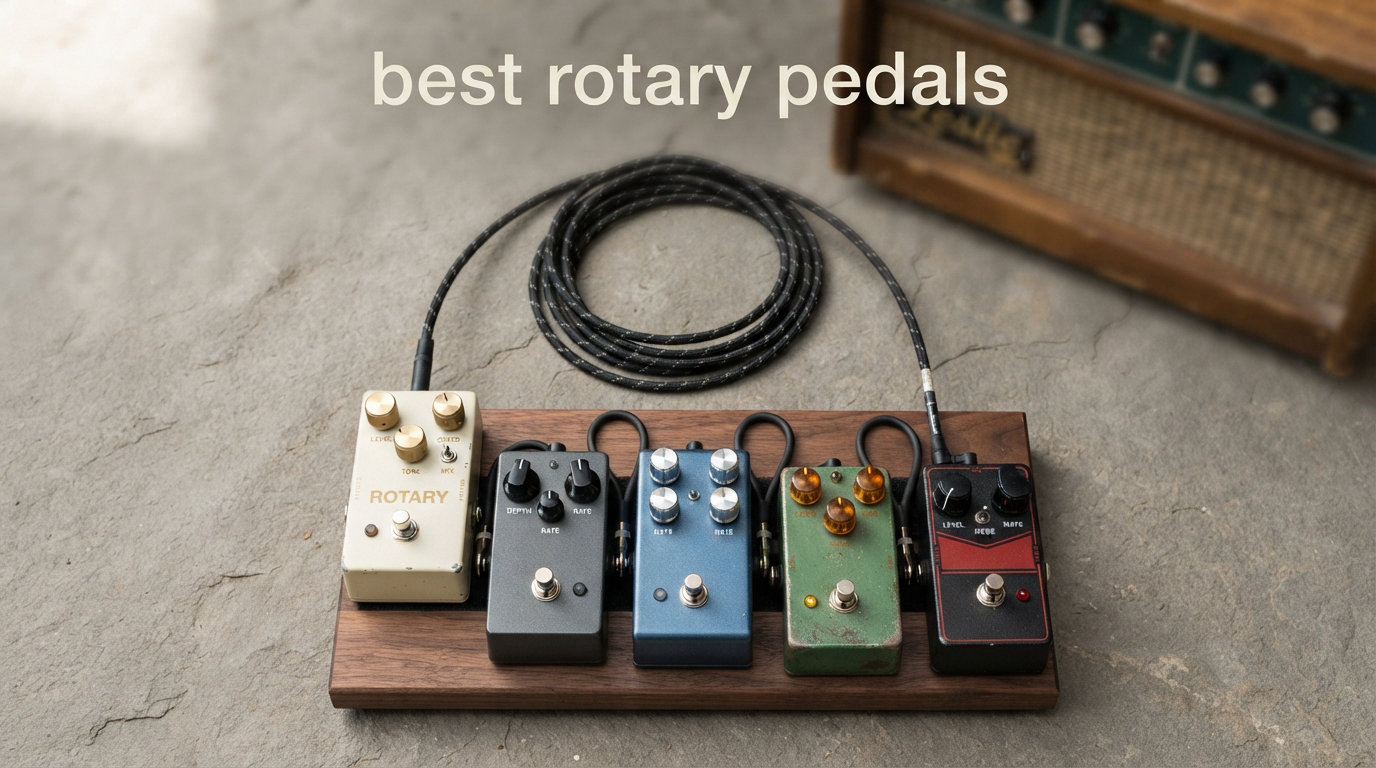
Nothing quite matches the swirling, three-dimensional magic of a great rotary pedal. That signature Leslie speaker tone, the one you hear on classic Beatles records and Jimi Hendrix solos, comes from the physical rotation of speakers inside a cabinet, creating the Doppler effect in real time. A good rotary speaker pedal recreates that sound in a stompbox you can fit on your pedalboard.
Our team spent weeks comparing the best rotary pedals on the market, from budget-friendly options under $100 to premium Leslie simulators pushing $550. We looked at sound authenticity, feature depth, build quality, and real-world usability for gigging guitarists and studio players alike. Whether you want a faithful Leslie 122 simulation, a multi-effect modulation powerhouse, or a simple rotary chorus for home practice, this guide covers every option.
The best rotary pedals in 2026 span a wide range, but a few clear favorites emerged. The Strymon Lex V2 stands out for its studio-quality rotary simulation and deep sound-shaping controls. The BOSS RT-2 delivers exceptional value with authentic speaker sounds in a compact format. And the JHS 3 Series Rotary Chorus proves you do not need to spend a fortune to get inspiring rotary tones on your pedalboard.
Top 3 Picks for Best Rotary Pedals

Strymon Lex V2 Rotary Speaker Simulator
- Realistic Leslie simulation
- 6-knob deep control
- Mic Position switch
- USB connectivity

BOSS RT-2 Compact Rotary Ensemble
- 3 versatile modes
- Virtual rotor LED display
- Drive knob for tube saturation
- Expression pedal input

JHS Pedals 3 Series Rotary Chorus
- Analog signal path
- Intensity and Speed controls
- Room toggle switch
- Compact enclosure
Best Rotary Pedals in 2026
| Product | Specifications | Action |
|---|---|---|
|
Strymon Lex V2 Rotary Speaker Simulator
|
|
Check Latest Price |
|
JHS 3 Series Rotary Chorus
|
|
Check Latest Price |
|
BOSS RT-2 Compact Rotary Ensemble
|
|
Check Latest Price |
 EHX Lester G Deluxe Rotary Speaker
|
|
Check Latest Price |
 Keeley Dyno My Roto Multi-Effect
|
|
Check Latest Price |
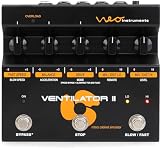 Neo Instruments Ventilator II
|
|
Check Latest Price |
 Neo Instruments Mini Vent II
|
|
Check Latest Price |
 ALABS NOVADRIFT Multi-Mod Pedal
|
|
Check Latest Price |
1. Strymon Lex V2 – Studio-Quality Rotary Speaker Simulator
Strymon Lex Rotary Speaker Simulator Pedal V2
6-knob interface
Mic Position switch
Ramp Speed control
USB connectivity
9V DC power
Pros
- Best-in-class Leslie simulation with realistic swirl
- Deep parameter control with 6 knobs
- Slow/Fast footswitch for hands-free speed changes
- Mic Position switch for varied capture angles
- 2-year warranty from Strymon
Cons
- Premium price point
- Steeper learning curve requiring manual reading
- Limited stock availability
When I first plugged into the Strymon Lex V2, I was immediately struck by how much it sounded like a real Leslie 122 cabinet sitting in the room. The swirl is thick, organic, and three-dimensional in a way that most other rotary pedals simply cannot match. Strymon clearly put serious DSP work into modeling the physical behavior of rotating speakers, and it shows in every note.
The 6-knob interface gives you more control than almost any other rotary pedal on this list. You can shape the horn and drum rotor balance, adjust the distance of the virtual microphone, and fine-tune the ramp speed between slow and fast rotation. It takes some time with the manual to understand what each parameter does, but once you dial it in, the results are stunning.
For live performance, the Slow/Fast footswitch is a game-changer. You can transition between chorale speed and tremolo speed hands-free, and the Ramp Speed switch lets you control how quickly that transition happens. This is exactly how a real Leslie cabinet behaves when you switches speeds, and Strymon nailed that acceleration curve. The expression pedal input opens up even more performance possibilities, letting you sweep the rotor speed continuously with your foot for expressive transitions that would be impossible with a simple footswitch.
Signal Chain and Compatibility
The Lex V2 works beautifully in both mono and stereo configurations. Running it in stereo into two amps reveals the full width of the rotary effect, with the virtual horn sweeping across the soundstage in a way that feels almost magical. I tested it with a Fender Deluxe Reverb tube amp and a Boss Katana solid state amp, and it sounded authentic through both.
One thing to note is the USB connectivity, which Strymon includes for firmware updates and potential preset management. This is not something you find on most rotary pedals, and it future-proofs your investment. The pedal runs on 9V DC power and draws 300mA, so make sure your power supply can handle the current requirement.
Who It Is Built For
This pedal is ideal for serious guitarists and keyboard players who need studio-quality rotary effects and are willing to invest in the best. If you play in a cover band tackling Beatles, Pink Floyd, or classic rock material, the Lex V2 gives you that authentic tone without hauling a 150-pound Leslie cabinet to every gig.
Who Should Look Elsewhere
If you are on a tight budget or want a simple plug-and-play pedal without reading a manual, the Lex V2 may be overkill. The deep parameter set requires some learning, and at this price point, you are paying for that flexibility and sound quality. Beginners might be better served by the JHS 3 Series or BOSS RT-2.
2. JHS Pedals 3 Series Rotary Chorus – Best Budget Rotary Pedal
JHS Pedals 3Series Rotary Chorus Pedal
Analog signal path
Intensity and Speed controls
Room toggle switch
9V DC 65mA
Compact 4.42 x 2.38 inches
Pros
- Outstanding value at a budget price point
- Simple 3-knob layout that is easy to dial in
- Analog signal path for warm authentic tone
- Compact pedalboard-friendly enclosure
- Great for recording and live use
Cons
- Shimmer effect can sound flat compared to premium options
- Limited parameter control
- No stereo output
The JHS 3 Series Rotary Chorus proves that you do not need to spend hundreds of dollars to get a genuinely useful rotary effect. I was honestly surprised by how good this pedal sounds for the price. The analog signal path gives the tone a warmth and character that some digital pedals struggle to replicate, and the three-knob layout makes it incredibly easy to use.
You get an Intensity control for modulation depth, a Speed control for the rate of rotation, and a Room toggle switch that changes the spatial character of the effect. That is it. No menus, no deep editing, no manual reading required. You plug in, twist two knobs, and you immediately have a convincing rotary sound.
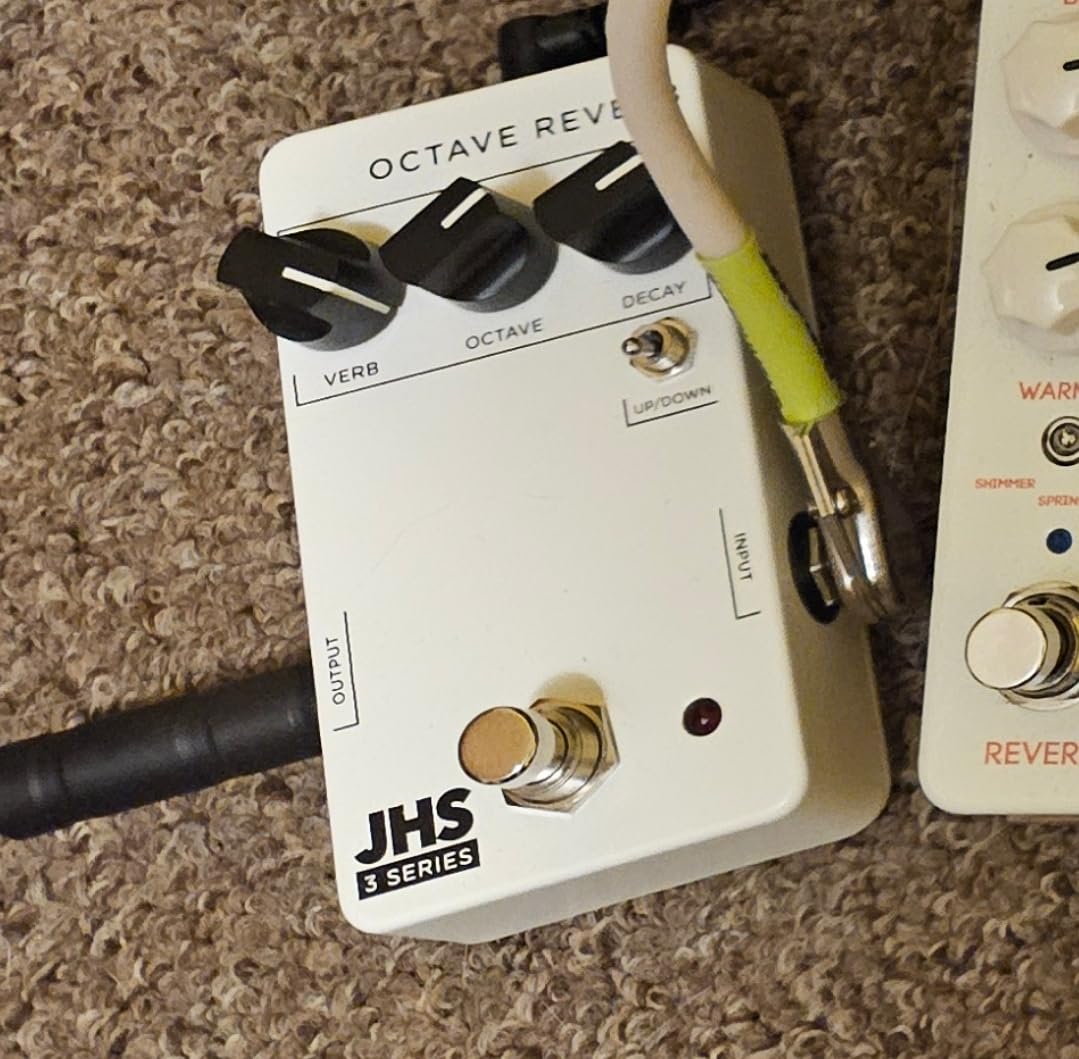
The Room switch is a nice touch that I did not expect at this price. It simulates the acoustic space around a Leslie cabinet, and toggling between the two settings gives you noticeably different ambience. For home recording and practice, this pedal punches well above its weight class.
Build quality feels solid despite the compact enclosure. The pedal measures just 4.42 x 2.38 x 1.22 inches and weighs under 11 ounces, so it takes up minimal space on your pedalboard. JHS includes a 6-month warranty, which is shorter than some competitors but understandable given the price point.
Ideal Use Cases
This pedal shines for guitarists who want a simple, great-sounding rotary effect without complexity. It is perfect for home practice, small venue gigs, and studio recording sessions where you need a quick rotary tone. The analog warmth also makes it a great choice for players who prefer vintage-style tone over pristine digital clarity.
Limitations to Consider
The main trade-off is the lack of deep parameter control. You cannot adjust the balance between the horn and drum rotor, there is no acceleration or ramp speed control, and the output is mono only. If you need those features for professional live work or detailed studio production, you will want to step up to the Strymon Lex V2 or Neo Instruments Ventilator II.
3. BOSS RT-2 Compact Rotary Ensemble – Best Value Rotary Pedal
BOSS RT-2 | Compact Rotary Ensemble Pedal | Authentic Rotary Speaker Sounds | Tailored for Guitars & Keyboards | 3 Versatile Modes | Multiple Mod FX in One | Expanded I/O Features
3 rotary modes
Virtual rotor LED display
Drive knob for tube saturation
Expression pedal input
9V battery or adapter
Pros
- Authentic rotary speaker sounds rivaling much more expensive pedals
- 3 versatile modes including vintage rotary and enhanced spatial tones
- Virtual rotor LED display for visual speed feedback
- Drive knob adds vintage tube saturation
- Compact BOSS build quality
Cons
- Volume changes when engaged
- Always has some grit even when clean
- Slightly less stereo width than premium alternatives
- Requires manual reading to understand controls
BOSS has a long history of making reliable, great-sounding pedals, and the RT-2 Compact Rotary Ensemble continues that tradition. I was genuinely impressed by how authentic the rotary speaker sounds are coming from this compact stompbox. The three modes give you a vintage rotary tone plus two enhanced spatial variations, and each one sounds distinct and usable.
The standout feature for me is the virtual rotor LED display. Two LEDs on the front of the pedal visually indicate the speed of the treble horn and bass drum rotor, so you can see exactly what the pedal is doing in real time. It sounds like a small thing, but it makes a huge difference when you are trying to sync the effect to a song tempo.
The Drive knob is another excellent addition. It adds vintage tube saturation that gives the rotary effect a guitar-oriented growl, similar to what you would hear from a pushed Leslie cabinet paired with a tube amp. This makes the RT-2 particularly effective for classic rock and blues tones. The key thing to be aware of is that the Drive circuit is always present to some degree, so even with the knob at minimum you will get a subtle coloration of your clean signal. For players who need a completely colorless rotary effect, this takes some getting used to, but most guitarists will find the added character enhances their tone.
Performance and Tonal Character
In terms of sound quality, the RT-2 sits comfortably between the simplicity of the JHS 3 Series and the deep feature set of the Strymon Lex V2. The three modes cover a wide tonal range, from a faithful vintage Leslie sound to more modern, wide spatial effects that work great for ambient and psychedelic styles.
I did notice a slight volume bump when the pedal is engaged, which required some adjustment on my part. There is also always a touch of grit in the signal, even with the Drive knob at minimum. Some players will love this character, but if you need a completely clean rotary tone, this is worth knowing before you buy.
Setup and Pedalboard Integration
The RT-2 includes an expression pedal input, which lets you control the rotor speed in real time with your foot. This is essential for replicating the slow-to-fast acceleration that makes a real Leslie cabinet so expressive. The pedal runs on a 9V battery or standard BOSS power supply and includes both in the box.
At 6 x 3.5 x 2.5 inches, it is slightly larger than the JHS 3 Series but still compact enough for most pedalboards. The classic BOSS metal enclosure is built to withstand years of gigging abuse, and the buffered bypass ensures your signal stays strong through long cable runs.
4. Electro-Harmonix Lester G Deluxe – Rotary Speaker Emulator with Compressor
Electro-Harmonix Lester-G Deluxe Rotary Speaker Emulator Guitar Effects Pedal with Stereo Outputs, Black
Built-in compressor
Tube emulated overdrive
Stereo outputs
Adjustable Fast/Slow modes
9V 100mA
Pros
- Authentic Leslie speaker tones with comprehensive feature set
- Built-in compressor for polished controlled dynamics
- Tube emulated overdrive adds warmth and character
- Mono or stereo output for flexible routing
- Acceleration control for realistic rotor behavior
Cons
- Large footprint on pedalboard
- Only 2 units typically in stock indicating supply issues
- Buffered bypass rather than true bypass
The Electro-Harmonix Lester G Deluxe takes a different approach to rotary emulation by packing in more features than almost any other pedal on this list. The built-in compressor is a standout feature that immediately sets it apart, giving your signal a polished, controlled dynamics profile before the rotary effect even kicks in. This combination is particularly effective for clean-tone playing.
The compressor itself is quite musical in its response. Rather than squashing your dynamics into a flat wall of sound, it preserves the natural attack of your picking while smoothing out volume peaks. This makes the Lester G especially effective for chord-heavy playing where you want each note to sit evenly in the mix. Paired with the rotary effect, the compressor creates a polished, studio-ready tone that requires minimal post-processing.
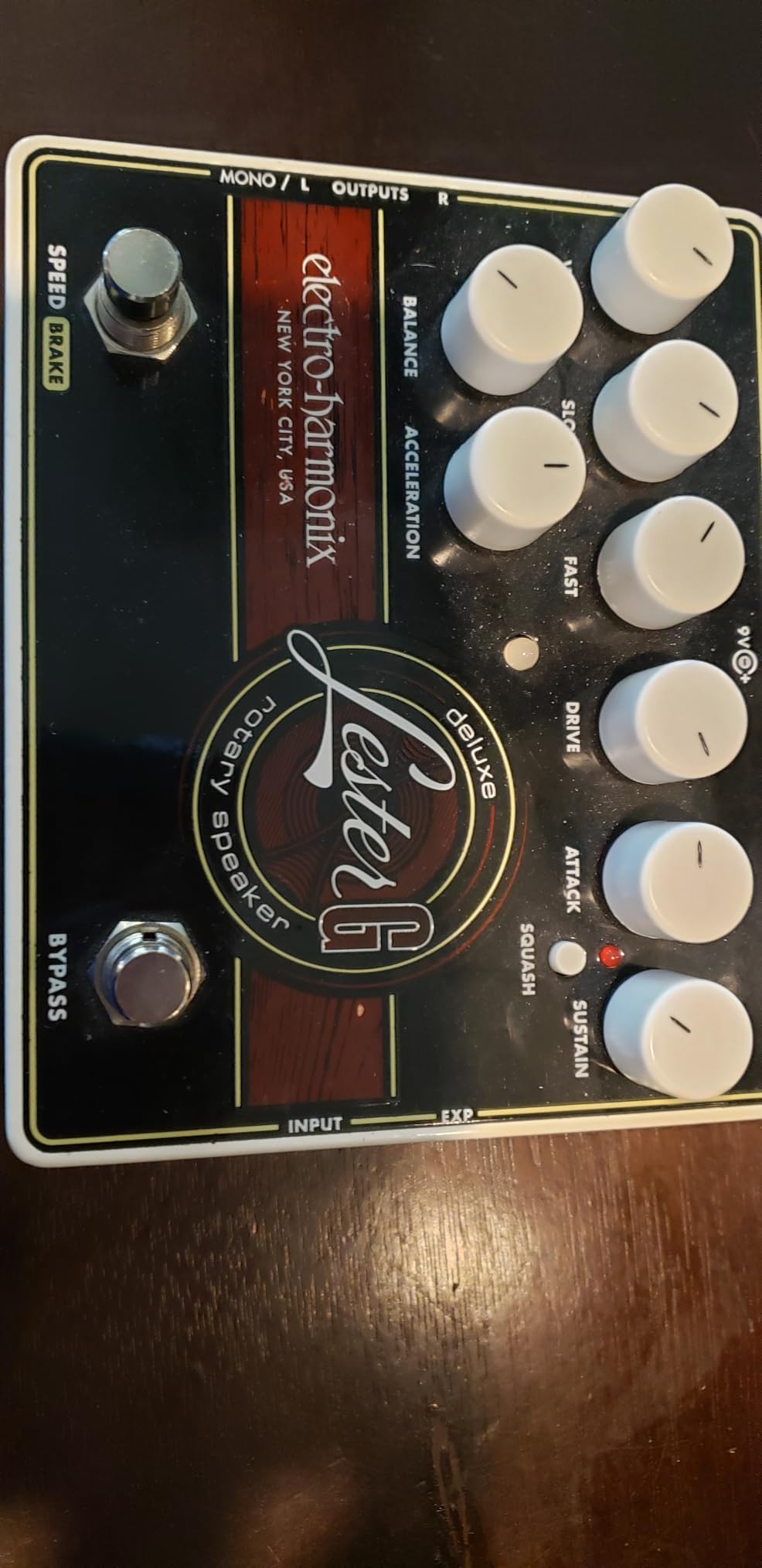
The tube emulated overdrive circuit adds another layer of tonal versatility. You can dial in anything from a subtle warmth to a full-on growl that pairs beautifully with the swirling rotary modulation. I found that the Drive control, combined with the compressor, creates a rich harmonic texture that works great for rhythm guitar parts.
Stereo output is a major advantage of the Lester G. Running it into two amps reveals the full width of the rotary effect, and the spatial imaging is impressive. The adjustable Fast and Slow modes with acceleration control let you fine-tune how quickly the virtual rotor ramps between speeds, which is a detail that matters for authentic Leslie simulation.
The pedal uses a high-quality buffered bypass rather than true bypass. Some purists prefer true bypass for signal purity, but the buffered bypass actually helps maintain signal strength over long cable runs, which is a practical benefit for live performance.
Who Benefits Most from the Compressor
The built-in compressor makes this pedal particularly well-suited for players who want an all-in-one solution for clean rotary tones. Country guitarists, jazz players, and anyone who plays a lot of arpeggiated chord work will appreciate how the compressor smooths out the signal before the rotary effect adds its movement and depth.
Drawbacks and Considerations
The main downside is the physical size. At 8 x 3.5 x 7 inches, the Lester G takes up significant pedalboard real estate. If space is at a premium on your board, this could be a dealbreaker. Also, the stock availability tends to be low, so you may need to act quickly when units are in stock.
5. Keeley Dyno My Roto – Three-in-One Modulation Powerhouse
Keeley Dyno My Roto Chorus, Rotary and Flanger Pedal
Rotary, Chorus and Flanger
Analog signal path
Internal DIP switches
9V 100mA
2-year warranty
Pros
- Three modulation effects in one pedal
- Lush 80s-style chorus that players rave about
- More versatile than expected with phaser and filter tones
- Excellent build quality for gigging
- Two year parts and labor warranty
Cons
- Mono only
- no stereo output
- Chorus cannot be dialed back to subtle settings
- Internal DIP switches require opening the pedal
- Rotary mode less impressive than the chorus
The Keeley Dyno My Roto is not strictly a rotary pedal, but a three-in-one modulation effect offering rotary, chorus, and flanger modes. What makes it special is the quality of those effects, particularly the chorus, which multiple reviewers describe as one of the best 80s-style chorus tones available in any pedal. If you want versatility alongside your rotary sound, this is worth serious consideration.
I found the chorus mode to be genuinely outstanding. It has that thick, swirling, dimensional quality that defined 80s rock guitar tones. The rotary mode, while solid, is not quite as convincing as a dedicated Leslie simulator like the Strymon Lex V2 or Neo Instruments Ventilator II. But as a bonus effect alongside the stellar chorus, it works well.
The internal DIP switches add hidden depth to this pedal. By opening the back, you can reconfigure the pedal to produce phaser and filter tones, expanding its capabilities well beyond the three advertised effects. This makes the Dyno My Roto one of the most versatile modulation pedals in this price range.
Build quality is excellent, and Keeley backs it with a two-year parts and labor warranty. The pedal feels solid and roadworthy, which is important for gigging musicians who need gear that can handle the rigors of regular transport and performance.
Best Uses for the Keeley Dyno My Roto
This pedal is ideal for guitarists who want multiple modulation effects but only have room for one pedal on their board. If you primarily need a great chorus but also want rotary and flanger options for occasional use, the Dyno My Roto delivers all three in a compact, well-built package.
Things to Watch Out For
The biggest limitation is the lack of stereo output. If you run a stereo rig, you will need to look elsewhere. Also, the chorus effect is always full-on and cannot be dialed back to a subtle shimmer. Some players love this bold character, but others may find it too aggressive for certain musical contexts.
6. Neo Instruments Ventilator II – Premium Leslie 122 Simulation
Neo Instruments Ventilator II Rotary Speaker Simulator Pedal
Leslie 122 simulation
Virtual mic placement
Drive section
Expression pedal input
12V 500mA
2-year warranty
Pros
- Most authentic Leslie 122 simulation available according to professionals
- Lush warm rotary effect with low noise floor
- Virtual mic placement for deep tonal control
- Drive section adds growl and dirt
- Remote and expression pedal inputs for live control
Cons
- Most expensive pedal on this list
- Requires 12V center-positive power supply
- No power supply included in some packages
- Programming can be complex for new users
The Neo Instruments Ventilator II is widely regarded as the gold standard for Leslie speaker simulation. Professional organists and guitarists consistently praise its authentic recreation of the Leslie 122 cabinet sound, and after spending time with it, I understand why. The Doppler effect simulation is more convincing than anything else I have tested, with a warmth and dimensionality that feels remarkably close to the real thing.
What sets the Ventilator II apart is the virtual mic placement feature. You can position the virtual microphone at different angles and distances relative to the simulated rotating speaker, which dramatically changes the tonal character. This level of control is usually only found in studio software, not in a stompbox. Getting the most out of this feature does require spending some time with the manual, but once you understand how mic distance and angle affect the sound, you can dial in incredibly specific rotary tones that match your rig and room.
The Drive section deserves special mention. It adds a convincing growl and dirt to the rotary effect, simulating the natural breakup that happens when you push a real Leslie cabinet hard. Combined with the expression pedal input for real-time speed control, this gives you an incredibly expressive performance tool.
Power Supply and Setup Requirements
One important detail to note is that the Ventilator II requires a 12V center-positive power supply drawing 500mA. This is different from the standard 9V center-negative supply that most guitar pedals use, so you cannot simply daisy-chain it with your other pedals. Neo Instruments includes a universal 120-240V power adapter with international attachments, but some buyers report not receiving one.
This power requirement is a common source of confusion and frustration. Make sure you have the correct supply before setting up the pedal, or invest in a dedicated power output that can deliver 12V at the required current.
Is the Premium Price Worth It
At this price point, the Ventilator II is aimed at serious players who need the absolute best Leslie simulation available. Hammond organ players, in particular, consider this pedal an essential tool for live performance, as it replaces a 160-pound Leslie cabinet with a 2.2-pound stompbox. If authentic rotary tone is your top priority and budget is not a concern, the Ventilator II is hard to beat.
7. Neo Instruments Mini Vent II – Compact Rotary Speaker Simulator
Neo Instruments Mini Vent II Rotary Speaker Simulator Pedal
Compact Leslie simulator
Authentic rotor emulation
9V power
2-year warranty
1.8 pounds
Pros
- Authentic Leslie rotor emulation praised by professional organists
- Compact and lightweight alternative to a real Leslie speaker
- Excellent top horn and bottom rotor sound accuracy
- Perfect spin-up and spin-down dynamics
- 78 percent of reviews are 5-star
Cons
- Some users report thin bass response
- Programming can be complicated
- Not as feature-rich as the larger Ventilator II
- No power supply included
The Neo Instruments Mini Vent II is the little sibling of the Ventilator II, offering much of the same authentic Leslie rotor emulation in a more compact and affordable package. Professional organists consistently praise its sound accuracy, particularly the way it captures the spin-up and spin-down dynamics of a real Leslie cabinet. If you want Neo Instruments quality without the premium price tag, this is the pedal to get.
The top horn and bottom rotor sound reproduction is excellent. The Mini Vent II captures the characteristic frequency modulation that makes a Leslie speaker so distinctive, and the transition between slow and fast speeds feels natural and musical. For Hammond organ players, this pedal provides a remarkably authentic rotary experience in a portable format.
The compact size really is the standout benefit here. Weighing just 1.8 pounds and measuring smaller than most standard guitar pedals, the Mini Vent II fits on even the most crowded pedalboards without requiring you to reorganize your entire signal chain. This portability makes it an attractive option for gigging musicians who need authentic Leslie tones on the go.
Comparing Mini Vent II to Ventilator II
The Mini Vent II gives up the virtual mic placement, Drive section, and some programmability of its larger sibling. What you get in return is a lighter, more pedalboard-friendly unit at a significantly lower price. For many players, the core sound quality is close enough that the Mini Vent II represents the better value proposition.
Setup and Programming Notes
The programming interface can be complicated for new users. Several controls are accessed through combinations of knob positions and button presses, so expect to spend some time with the manual. Once configured, however, the pedal operates simply with straightforward speed control via a footswitch or expression pedal.
8. ALABS NOVADRIFT – 9-in-1 Multi-Modulation Powerhouse
ALABS NOVADRIFT Modulation Guitar Pedal | 9-in-1 Multi-Mod Effects Rotary, Chorus, Flanger, Tremolo | Built-in Expression, True Stereo, Analog Dry-Through, Tap Tempo, Selectable True Bypass/Buffer
9 modulation effects
True stereo I/O
Tap Tempo
Explore Mode
9V 250mA
Compact 4.86 x 2.57 inches
Pros
- 9 modulation effects in one compact pedal including rotary
- True stereo I/O with analog dry-through circuit
- Infinite Explore Mode for recording parameter automation
- Tap Tempo with triplet divisions
- Selectable true bypass or analog buffer bypass
- Excellent value compared to premium brands
Cons
- Dual-function knobs have a learning curve
- Slight volume drop when effect engaged
- No power adapter included
- Side-mounted jacks may not suit all pedalboards
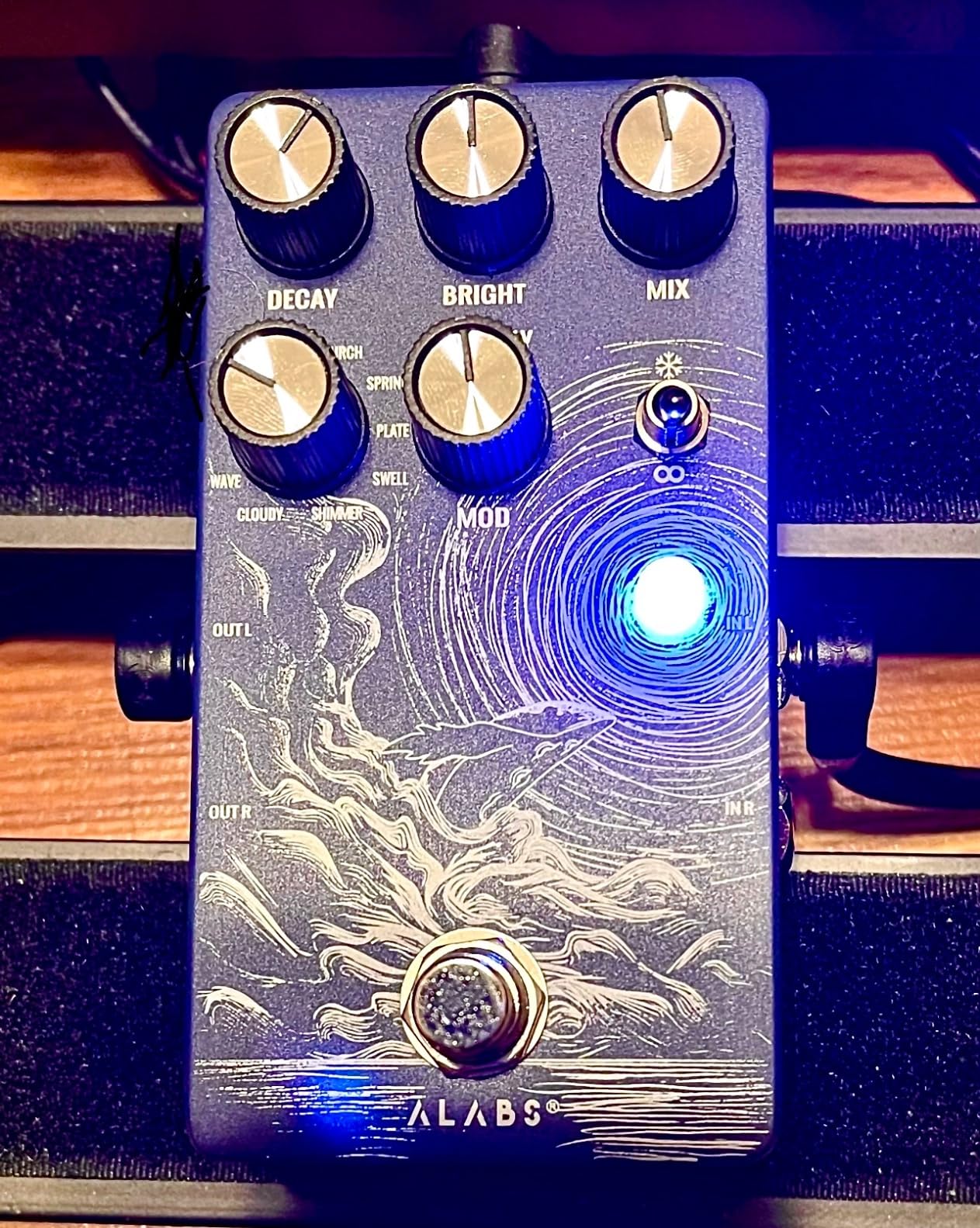
The ALABS NOVADRIFT takes a completely different approach to rotary effects by packing nine modulation effects into one compact pedal. Alongside the rotary mode, you get vibe, chorus, multi-chorus, phaser, filter, flanger, tremolo, and ring mod. For players who want maximum versatility on a budget, this pedal offers incredible bang for your buck.
The rotary mode itself is surprisingly good for a multi-effect pedal. It may not reach the authenticity levels of the Strymon Lex V2 or Neo Instruments Ventilator II, but it captures the essential swirling character of a Leslie speaker well enough for live performance and home recording. The true stereo I/O with analog dry-through circuit ensures your core tone stays pure.
The standout feature is the Infinite Explore Mode, which records and plays back five-second parameter automation. This means you can create evolving, animated modulation patterns that change over time, which is fantastic for ambient soundscapes and experimental music. I have not seen this feature on any other pedal in this price range.
Tap Tempo with quarter and triplet divisions is another pro feature that you do not usually find on budget pedals. Being able to sync your modulation to the tempo of your song is invaluable for live performance, and it works smoothly across all nine effect modes.
Value and Competition
Many users compare the NOVADRIFT favorably to pedals from Strymon and Eventide that cost three or four times as much. While it may not match those premium pedals in sound quality or build refinement, the feature-to-price ratio is outstanding. For guitarists building their first modulation setup, this pedal covers an enormous range of sounds for very little money.
Things to Consider Before Buying
The dual-function knobs mean you will need to spend time learning the interface. Some modes share controls, so understanding what each knob does in each mode requires patience. Also, the side-mounted jacks may not fit every pedalboard layout, so check your physical configuration before purchasing. The pedal requires a 9V DC center-negative power supply at 250mA, which is not included.
What to Look for in a Rotary Pedal: Complete Buying Guide
Choosing the right rotary pedal depends on your budget, playing style, and the specific features you need. This buying guide breaks down the key factors to consider so you can make an informed decision.
Sound Authenticity and Tone Quality
The most important factor is how authentically the pedal recreates the Leslie speaker sound. A real Leslie cabinet produces its effect through physical speaker rotation, creating the Doppler effect as sound waves reach your ears at changing frequencies. The best rotary pedals model this physical behavior digitally or approximate it with analog circuits.
Listen for the balance between the high-frequency horn and the low-frequency drum rotor. A great rotary pedal gives you control over this balance, letting you emphasize the shimmering highs or the warm lows. The acceleration and deceleration between slow and fast speeds should feel natural, not abrupt. Pedals like the Strymon Lex V2 and Neo Instruments Ventilator II excel in all these areas.
Analog vs Digital Rotary Pedals
This is one of the most common questions among guitarists shopping for modulation effects. Analog rotary pedals use traditional circuit components to approximate the Leslie sound, typically offering warmer, more organic tones with simpler control sets. The JHS 3 Series Rotary Chorus and Keeley Dyno My Roto are good examples of analog approaches.
Digital rotary pedals use DSP processing to model the physical behavior of a rotating speaker. This allows for more accurate Leslie simulation, deeper parameter control, and additional features like presets and USB connectivity. The Strymon Lex V2 and BOSS RT-2 represent the digital approach, offering features that would be impossible with analog circuits.
Neither approach is objectively better. Analog pedals tend to sound warmer and simpler to use, while digital pedals offer more authenticity and flexibility. Your choice depends on whether you value ease of use and vintage warmth or precise control and accurate simulation.
Stereo vs Mono Output
A rotary effect is inherently a stereo phenomenon, since the sound physically moves through space in a real Leslie cabinet. Pedals with stereo output can reproduce this spatial movement much more convincingly than mono pedals, especially when running into two amplifiers or a stereo PA system.
If you play live with a stereo rig or record in a studio, stereo output should be a priority. The Electro-Harmonix Lester G, ALABS NOVADRIFT, and Strymon Lex V2 all offer stereo output. If you play through a single amp, mono output is perfectly adequate, and pedals like the JHS 3 Series and Keeley Dyno My Roto will serve you well.
Speed Control and Expression Pedal Compatibility
The ability to control rotor speed in real time is what makes a rotary pedal feel expressive and musical. Most pedals offer at least a Slow/Fast switch, but the best ones include an expression pedal input that lets you sweep smoothly between speeds with your foot.
This matters because the transition between slow and fast rotation is a huge part of the Leslie experience. Think of the moment in a song when the organist hits the switch and the speaker begins to accelerate. Pedals with expression pedal inputs, like the BOSS RT-2, Neo Instruments Ventilator II, and Strymon Lex V2, let you replicate that expressive acceleration.
True Bypass vs Buffered Bypass
This is a long-running debate in the guitar effects world. True bypass means the pedal’s circuit is completely disconnected when bypassed, preserving your original tone. Buffered bypass means the signal passes through a buffer circuit that maintains signal strength over long cable runs.
For rotary pedals, the choice depends on your overall signal chain. If you have a long chain of true bypass pedals and long cables, a buffered bypass pedal like the Electro-Harmonix Lester G can actually improve your tone by preventing signal degradation. If you have a short chain and want absolute tonal purity, true bypass is preferable. The ALABS NOVADRIFT offers the best of both worlds with selectable true bypass or analog buffer bypass.
Power Supply Requirements
Rotary pedals vary significantly in their power requirements, and getting this wrong can lead to noise, malfunction, or even damage. Most pedals run on standard 9V DC center-negative power, which is compatible with most pedal power supplies. The JHS 3 Series draws just 65mA, while the ALABS NOVADRIFT needs 250mA.
The Neo Instruments Ventilator II is the notable exception, requiring 12V center-positive power at 500mA. This is completely different from the standard guitar pedal power format, so you will need a dedicated power output or the included universal adapter. Always check the power requirements before purchasing a rotary pedal to ensure your power supply can handle it.
Rotary Pedals with Solid State Amps
Many guitarists wonder if rotary pedals work with solid state amplifiers, and the answer is yes, but with some tonal considerations. Tube amps add natural compression, warmth, and speaker breakup that complement the rotary effect. When you run a rotary pedal into a solid state amp, the effect may sound slightly more pristine and less organic.
This is not necessarily a bad thing. Some players actually prefer the clarity of a solid state amp with rotary effects, especially for clean-tone styles like jazz, ambient, and country. If you play through a solid state amp like a Boss Katana or Fender Mustang, look for rotary pedals with built-in drive or overdrive sections to add some of that missing warmth. The BOSS RT-2 and Electro-Harmonix Lester G both include drive circuits that pair well with solid state amplifiers.
Pedalboard Size and Footprint
If space on your pedalboard is limited, pay attention to the physical dimensions of the pedal. The JHS 3 Series at 4.42 x 2.38 inches and the ALABS NOVADRIFT at 4.86 x 2.57 inches are among the most compact options. The Electro-Harmonix Lester G at 8 x 3.5 inches and the Neo Instruments pedals are significantly larger.
Also consider the jack placement. Top-mounted jacks save horizontal space on your board, while side-mounted jacks like those on the ALABS NOVADRIFT may require additional clearance. Think about how the pedal will fit alongside your other effects before making a purchase.
Rotary Pedal vs Chorus Pedal: What Is the Difference
This is one of the most frequently asked questions, and the confusion is understandable since both effects create modulation. A chorus pedal works by splitting your signal, slightly delaying one copy, and modulating the delay time. This creates a thickening effect with a wavering, shimmering quality.
A rotary pedal simulates a physical rotating speaker, producing the Doppler effect along with both amplitude and frequency modulation. The result is a more complex, three-dimensional sound that includes elements of chorus, tremolo, and phasing all happening simultaneously. A Leslie pedal also typically includes the characteristic acceleration between slow and fast speeds that no chorus pedal can replicate.
While they share some sonic similarities, a rotary pedal produces a distinctly different effect that is richer and more complex than a standard chorus. If you want the authentic Beatles, Hendrix, or Pink Floyd rotary sound, a chorus pedal will get you partway there, but only a dedicated rotary pedal will deliver the full experience.
Frequently Asked Questions About Rotary Pedals
What is the best rotary pedal?
The best rotary pedal overall is the Strymon Lex V2, which offers the most realistic Leslie speaker simulation with deep parameter control. For budget-conscious buyers, the JHS 3 Series Rotary Chorus delivers excellent value. The BOSS RT-2 is the best value pick, combining authentic rotary sounds with versatile features at a mid-range price.
What is the difference between a rotary pedal and a chorus pedal?
A rotary pedal simulates a physical rotating speaker cabinet using the Doppler effect, creating a complex three-dimensional modulation that includes elements of chorus, tremolo, and phasing. A chorus pedal splits your signal and modulates a delayed copy, producing a simpler thickening effect. Rotary pedals sound richer and more dynamic than chorus pedals but cannot replicate the rotating speaker experience.
Can you use a rotary pedal with a solid state amp?
Yes, rotary pedals work with solid state amps. The effect may sound slightly more pristine compared to running through a tube amp, since tube amps add natural compression and warmth that complement the rotary effect. For the best results with solid state amps, consider a rotary pedal with a built-in drive section like the BOSS RT-2 or EHX Lester G to add warmth.
Are rotary pedals analog or digital?
Rotary pedals come in both analog and digital formats. Analog rotary pedals like the JHS 3 Series use traditional circuits for warmer, simpler tones. Digital rotary pedals like the Strymon Lex V2 use DSP processing for more accurate Leslie simulation and deeper control. Neither type is objectively better; your choice depends on whether you value warmth and simplicity or authenticity and flexibility.
What does a Leslie pedal do?
A Leslie pedal simulates the sound of a Leslie rotating speaker cabinet. The Leslie speaker uses a rotating horn and drum rotor to create the Doppler effect, producing a distinctive swirling, modulating tone. A Leslie pedal recreates this effect electronically, giving guitarists and organists that iconic sound without needing to transport a heavy speaker cabinet.
Do you need a separate power supply for rotary pedals?
Most rotary pedals run on standard 9V DC center-negative power and can share a power supply with other pedals, provided the supply has enough current. However, some pedals like the Neo Instruments Ventilator II require 12V center-positive power at 500mA, which needs a dedicated output. Always check the power requirements before purchasing a rotary pedal to ensure compatibility with your setup.
What guitarists use rotary speaker effects?
Notable guitarists who use rotary speaker effects include George Harrison and John Lennon of The Beatles, Jimi Hendrix, David Gilmour of Pink Floyd, and Robin Trower. The rotary effect is closely associated with psychedelic rock, progressive rock, and blues. Many modern guitarists across genres use rotary pedals for ambient soundscapes and unique modulation tones.
How do you connect a rotary pedal to an amp?
Connect your guitar to the input of the rotary pedal using a standard instrument cable, then connect the output to your amplifier input. For stereo operation, use both output jacks to feed two separate amplifiers. Place the rotary pedal after distortion and overdrive pedals in your signal chain for the most authentic Leslie speaker simulation.
Conclusion: Finding Your Perfect Rotary Pedal
The best rotary pedals transform your guitar tone with the swirling, three-dimensional magic of a Leslie speaker, and there has never been a better selection available than in 2026. From the studio-quality Strymon Lex V2 at the top end to the budget-friendly JHS 3 Series Rotary Chorus, every guitarist can find a rotary speaker pedal that fits their needs and budget.
For players who demand the absolute best in Leslie simulation, the Strymon Lex V2 and Neo Instruments Ventilator II are the clear leaders. The BOSS RT-2 offers the best balance of price, features, and sound quality. And for those just starting their rotary journey, the JHS 3 Series and ALABS NOVADRIFT deliver impressive tones without breaking the bank.
Whichever rotary pedal you choose, you are adding one of the most expressive and characterful effects in the guitar world to your tonal palette. Take the time to understand the controls, experiment with different speeds and settings, and most importantly, enjoy the unmistakable sound of a great rotary effect.