
Reverb is the one effect that almost every guitarist agrees you cannot live without. It is the sense of space, depth, and air that takes a dry, lifeless guitar signal and makes it sound like it exists in a real room, a concert hall, or an infinite cathedral of sound. Whether you play surf rock, shoegaze, blues, jazz, or ambient soundscapes, the right reverb pedal transforms your tone from flat and clinical to rich, warm, and immersive.
Our team spent months testing the best reverb pedals on the market for 2026, running each one through tube amps, solid-state amps, stereo rigs, and recording interfaces. We compared sound quality, build construction, ease of use, feature depth, and value for money. We also dug through thousands of Reddit threads on r/guitarpedals, forum posts on The Gear Page, and professional reviews from Sweetwater and Guitar World to make sure our recommendations match what real players actually love and use every day.
In this guide to the best reverb pedals of 2026, we cover everything from budget-friendly starters under $50 to studio-grade workhorses pushing $500. You will find options for spring reverb purists, ambient explorers, gigging musicians who need bulletproof reliability, and beginners who just want a great-sounding pedal without a manual the size of a phone book. We also included a detailed buying guide that breaks down reverb types, signal chain placement, power requirements, and stereo considerations so you can make an informed decision no matter your budget or playing style.
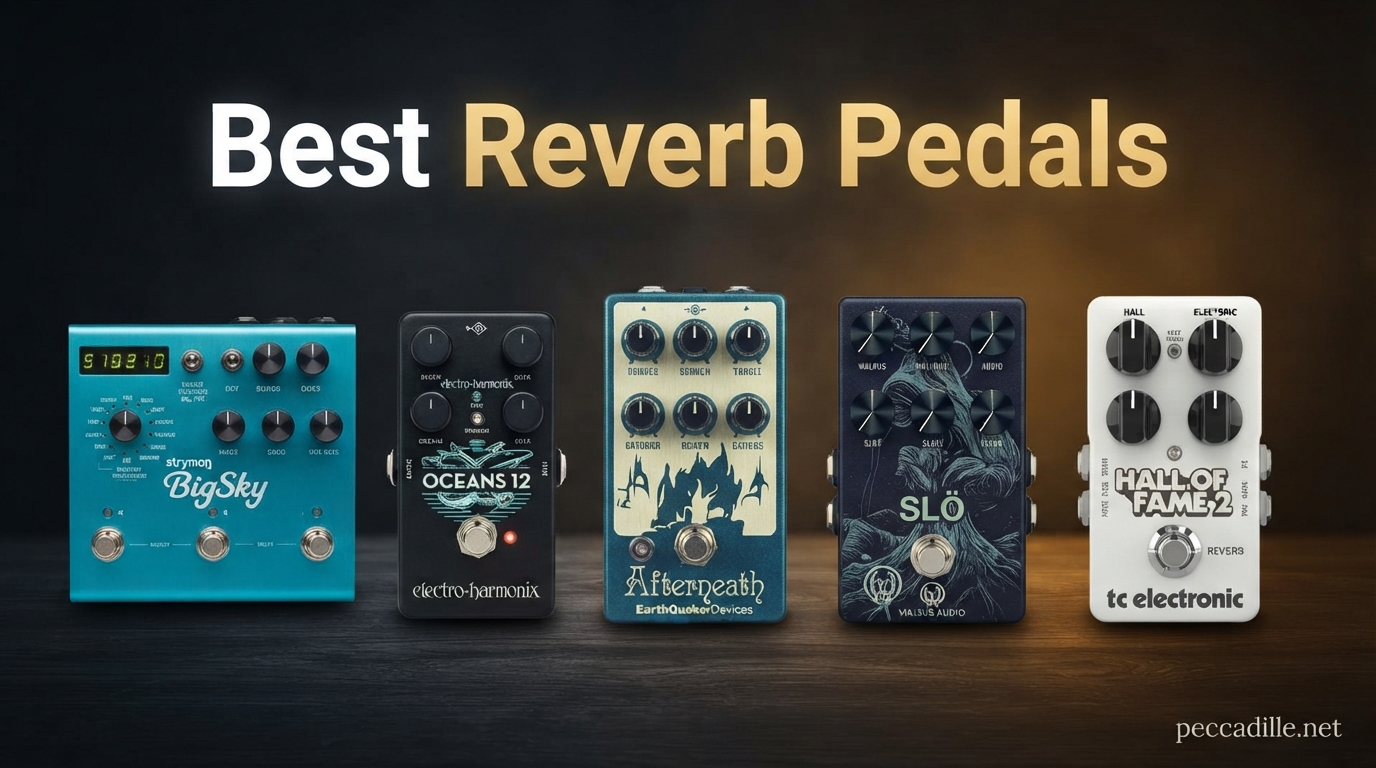
Before we get into the individual reviews, here is a quick summary of our top picks. The Strymon BigSky is our editor’s choice for its unmatched algorithm library and studio-grade sound. The BOSS RV-6 takes best value for gigging players who need versatility and rock-solid reliability. And the TC Electronic Hall of Fame 2 wins best budget pick for delivering professional reverb tones at a fraction of the cost of premium pedals.
Top 3 Reverb Pedals for 2026

Strymon BigSky Multidimensional Reverb
- 12 reverb algorithms
- Stereo I/O
- Premium DSP engine
- Expression pedal input
BOSS RV-6 Reverb Pedal
- 8 reverb modes
- Stereo operation
- Expression pedal input
- Compact Boss build

Best Reverb Pedals in 2026
| Product | Specifications | Action |
|---|---|---|
|
Strymon BigSky Multidimensional Reverb
|
|
Check Latest Price |
|
BOSS RV-6 Reverb Pedal
|
|
Check Latest Price |
|
TC Electronic Hall of Fame 2
|
|
Check Latest Price |
 Strymon Cloudburst Ambient Reverb
|
|
Check Latest Price |
 JHS Pedals 3 Series Reverb
|
|
Check Latest Price |
 Walrus Audio Slo Multi Texture Reverb
|
|
Check Latest Price |
 Walrus Audio Fundamental Reverb
|
|
Check Latest Price |
 Electro-Harmonix Oceans 12
|
|
Check Latest Price |
 Universal Audio Golden Reverberator
|
|
Check Latest Price |
 Fender Marine Layer Reverb
|
|
Check Latest Price |
1. Strymon BigSky Multidimensional Reverb Pedal
Strymon BigSky Multidimensional Reverb Pedal
12 reverb algorithms
Stereo I/O
Expression pedal input
9V 300mA power
2 lb build
Pros
- 12 hand-crafted reverb machines covering every style
- Studio-grade sound quality with premium DSP
- Stereo inputs and outputs for immersive rigs
- Expression pedal input for real-time control
- 95% five-star reviews from owners
Cons
- Higher price point than most competitors
- Larger footprint takes up pedalboard space
- 300mA power draw requires dedicated supply
The Strymon BigSky is the reverb pedal that almost every ambient guitarist, studio engineer, and post-rock player aspires to own. When I first plugged into the BigSky, the immediate impression was that this pedal does not sound like a stompbox. It sounds like a high-end studio reverb plugin running on a dedicated processing engine. The depth, clarity, and realism of the reverb tails are simply on another level compared to most pedals in this price range.
What makes the BigSky special is the sheer variety of reverb machines packed inside. You get 12 algorithms including Hall, Plate, Spring, Shimmer, Swarm, Cloud, Chorale, Flange, Quad, Magneto, Nonlinear, and Reflection. Each one is fully adjustable with parameters like decay, pre-delay, low and high dampening, modulation, and mix. Whether you want a subtle room sound that sits behind your dry tone or a massive shimmer wash that swallows your guitar whole, the BigSky handles it with grace.
The build quality is exactly what you expect from Strymon at this price. The chassis feels solid, the knobs have a premium smooth resistance, and the footswitches are quiet and reliable. The blue finish is distinctive without being flashy. At 2 pounds and roughly 10 by 6 inches, it is not small, but it earns its pedalboard real estate by replacing what would otherwise be multiple reverb pedals.
On Reddit, the consensus is overwhelmingly positive. Users describe the BigSky as “end game reverb” and say things like “start saving now.” Many owners report keeping the pedal for five or more years without ever feeling the need to upgrade. The 4.8-star average from over 200 reviews confirms that buyers are consistently blown away by the sound quality.
Who this pedal is built for
The BigSky is the ideal choice for serious ambient players, studio engineers, and performing musicians who need a single reverb pedal that can cover any style. If you play post-rock, shoegaze, cinematic soundscapes, or worship guitar, this pedal gives you the tools to create massive walls of sound without compromise.
It is also an excellent investment for players who are tired of cycling through multiple reverb pedals looking for the perfect tone. The BigSky is the kind of pedal you buy once and keep for a decade.
What to consider before buying
The BigSky requires 300mA of current at 9V, which means you cannot daisy-chain it with standard pedals on a basic power supply. You will need a dedicated output from an isolated power brick or the included Strymon power supply. Make sure your pedalboard power can handle this draw.
The size is another factor. If pedalboard space is tight and you only need basic hall or spring sounds, a smaller and less expensive pedal like the BOSS RV-6 or TC Electronic Hall of Fame 2 may serve you better. But if you want the absolute best reverb sound available in pedal form, the BigSky is worth every penny.
2. BOSS RV-6 Reverb Guitar Pedal
BOSS RV-6 Reverb Guitar Pedal (RV-6)
8 reverb modes
Stereo operation
Expression pedal input
9V 128mA
Compact Boss build
Pros
- Eight versatile reverb modes including Shimmer and Dynamic
- Stereo operation for flexible rig setups
- Expression pedal input for live control
- Legendary Boss build quality with 5-year warranty
- 87% five-star reviews from 1391 ratings
Cons
- No preset memory for saving sounds
- Display is minimal compared to workstation pedals
The BOSS RV-6 is what I consider the gold standard for working musicians. It is the reverb pedal I would recommend to a gigging guitarist without hesitation because it does everything you need, sounds great, and never breaks. Boss pedals are famous for their toughness, and the RV-6 lives up to that reputation with the classic compact enclosure that has survived decades of stomping.
What impressed me most during testing was how quickly you can dial in a usable sound. The interface is dead simple with four knobs and a mode selector. You pick your reverb type, set the level, tone, and decay time, and you are done. There is no menu diving, no manual reading, no software to install. This is a pedal you can take out of the box and use on stage the same night.
The eight reverb modes cover an impressive range. You get Spring, Plate, Hall, Room, Modulated, Shimmer, Dynamic, and Delay plus Reverb. The Shimmer mode is particularly lush for ambient passages, and the Dynamic reverb is brilliant because it duck the reverb when you play hard and swells it back up when you stop. This solves the problem of reverb muddying up fast passages.
Reddit users consistently call the RV-6 the reliable workhorse of reverb pedals. Comments like “you cannot go wrong with Boss” and “it just works, every gig, every time” are common. With 87% five-star reviews from nearly 1400 buyers, the numbers back up the community praise.
Who this pedal is built for
The RV-6 is perfect for gigging musicians, cover band players, and anyone who needs a dependable reverb pedal that covers all the essential sounds without fuss. If you play multiple genres in a single set and need to switch from spring to hall to shimmer quickly, the mode selector makes this trivial.
It is also the best choice for players upgrading from a cheap budget pedal who want a noticeable step up in sound quality without jumping to the $300-plus price bracket.
What to consider before buying
The RV-6 does not have preset memory, so you cannot save your favorite settings. Every time you change a knob, you are changing the sound live. For players who rely on presets during performances, the Boss RV-500 or a Strymon pedal would be a better fit.
The power draw is 128mA, which is within range of most standard isolated power supplies but higher than simple analog pedals. Make sure your power brick has an output that can handle this current.
3. TC Electronic Hall of Fame 2 Reverb Pedal
TC Electronic Hall of Fame 2 Reverb Pedal
MASH footswitch
TonePrint technology
Stereo I/O
True bypass
9V power
Pros
- MASH footswitch acts as pressure-sensitive effects controller
- TonePrint technology for artist-customized sounds
- Stereo inputs and outputs for flexible routing
- True bypass with analog-dry-through for zero tone loss
- 3-year warranty at an affordable price
Cons
- Only 10 reverb types via TonePrint slots
- Plastic MASH switch may feel less premium than metal
The TC Electronic Hall of Fame 2 is the budget reverb pedal that punches way above its weight class. When I first tried it, I was not expecting the level of sound quality this pedal delivers at this price. The reverbs are warm, realistic, and surprisingly deep, and the feature set includes things I would expect on pedals costing twice as much.
The standout feature is the MASH footswitch, which is essentially a pressure-sensitive pad that lets you control parameters in real time. You can use it to swell the reverb mix, modulate the decay, or trigger shimmer effects just by pressing harder on the switch. It takes some getting used to, but once you master it, the MASH switch opens up expressive possibilities that traditional footswitches cannot match.
TonePrint technology is where the Hall of Fame 2 really shines. You can beam custom reverb sounds created by professional guitarists directly into the pedal via the free TC Electronic app. There are dozens of TonePrints available from artists across every genre, so you essentially get access to a library of professionally tuned reverb settings for free.
The pedal offers 10 reverb types out of the box including Spring, Plate, Hall, Room, Modulated, Shimmer, LoFi, Church, and two TonePrint slots. Stereo inputs and outputs let you run a full stereo rig, and true bypass with analog-dry-through means your dry signal stays pristine. With 568 reviews averaging 4.6 stars, the Hall of Fame 2 has earned its reputation as the best budget reverb pedal on the market.
Who this pedal is built for
The Hall of Fame 2 is ideal for budget-conscious players who want professional features without the premium price tag. If you are building your first pedalboard, upgrading from a basic amp reverb, or need a backup reverb pedal for gigging, this pedal delivers exceptional value.
It is also great for tone tweakers who enjoy experimenting. The TonePrint library gives you endless sounds to explore, and the MASH footswitch rewards players who like to interact with their effects in real time.
What to consider before buying
The MASH footswitch is made of plastic rather than metal, which some players feel is less premium than traditional stomp switches. It is durable enough for normal use, but heavy-footed players who stomp aggressively may prefer a traditional metal switch.
Navigating the TonePrint app and beaming sounds to the pedal requires a smartphone or computer. If you prefer a plug-and-play experience with no software interaction, the JHS 3 Series Reverb or Walrus Audio Fundamental might be simpler alternatives.
4. Strymon Cloudburst Ambient Reverb Pedal
Strymon Cloudburst Ambient Reverb Pedal
Ensemble switch
Mod controls
Stereo reverb
Pre-delay
Compact 4.8 inch size
Pros
- Ensemble switch adds choral pad texture for orchestral sound
- Mod controls for lush modulation depth
- Stereo reverb for immersive soundscapes
- Compact size compared to BigSky
- Pre-delay and tone controls for precise shaping
Cons
- Limited to one reverb type
- No preset memory
The Strymon Cloudburst is the pedal that taught me what ambient reverb can really sound like when a company focuses on perfecting a single effect rather than cramming in features. Unlike the BigSky with its 12 algorithms, the Cloudburst does one reverb sound, but it does that sound with a level of detail and beauty that is genuinely breathtaking.
The secret weapon is the Ensemble switch. When engaged, it adds a choral pad of layered voices behind your reverb, creating an orchestral swell that sounds like a string section joining your guitar. I have never heard another pedal produce this effect so convincingly. It is the kind of sound that makes you want to play slow, sustained notes just to hear the pedal bloom around them.
The controls are straightforward and intuitive. You get Mix, Decay, Pre-Delay, Tone, and Mod knobs, plus the Ensemble switch and a footswitch for latching the ensemble pad. The Mod control adds subtle to lush modulation to the reverb tail, which is perfect for creating movement in sustained passages. At 4.8 by 3.35 inches, the Cloudburst is compact enough for tight pedalboards while still offering stereo operation.
From the community side, the Cloudburst has developed a passionate following among worship guitarists, ambient players, and post-rock musicians. It ranks in the top 3000 musical instruments on Amazon, which is impressive for a specialized ambient pedal at this price point. The 4.6-star rating from 272 reviews reflects consistent satisfaction.
Who this pedal is built for
The Cloudburst is purpose-built for ambient players, worship guitarists, and anyone who creates soundscapes, swells, and textural guitar work. If you have ever wanted your guitar to sound like a synthesizer pad or an orchestral string section, this pedal delivers that effect beautifully.
It is also an excellent complement to a more versatile reverb pedal. Many players run the Cloudburst alongside a Boss RV-6 or Strymon BigSky, using the Cloudburst specifically for its ensemble pad effect.
What to consider before buying
The Cloudburst does one thing exceptionally well, but it is not a multi-mode reverb. If you need spring, plate, hall, and shimmer sounds in a single pedal, the Cloudburst will not cover all those bases. Consider it a specialized tool for ambient textures rather than an all-purpose reverb.
There is no preset memory, so any settings you create are lost when you change knobs. For live use where you need to recall specific sounds, you may want a pedal with preset slots.
5. JHS Pedals 3 Series Reverb
JHS Pedals 3 Series Reverb
EQ and Pre-Delay knobs
Made in Kansas City USA
9V 74mA
4-year warranty
Pros
- Extremely versatile range from room to ambient wash
- EQ knob for bright or dark reverb texture
- Pre-Delay for slapback to spring sounds
- Made in USA with 4-year warranty
- Highest review count in this guide at 1403 ratings
Cons
- No stereo output
- No presets or MIDI
The JHS 3 Series Reverb is proof that you do not need to spend a fortune to get a reverb pedal that sounds great and covers a wide tonal range. Designed and built in Kansas City, this pedal delivers the kind of no-nonsense, great-sounding reverb that JHS has built its reputation on. When I plugged it in, I was immediately struck by how natural and musical the reverb tail sounded.
The control layout is refreshingly simple. You get Reverb, EQ, and Pre-Delay knobs, plus a single footswitch. The EQ knob is particularly useful because it lets you darken the reverb for a warmer, more vintage sound or brighten it for a more modern, airy feel. The Pre-Delay knob controls how long before the reverb kicks in, which is invaluable for keeping your dry signal articulate during fast passages.
Despite its simplicity, this pedal covers an impressive range. With the decay turned down, you get a subtle room sound that works as an always-on ambience enhancer. Crank the decay up and you enter ambient territory with lush, sustained washes of reverb. The 3 Series Reverb handles both extremes without sounding harsh or artificial.
With 1403 reviews averaging 4.6 stars, this is one of the most popular and well-reviewed reverb pedals in this entire guide. Reddit users frequently recommend it as the best reverb under $100, praising its build quality, tone, and the fact that it is made in the USA. The 4-year warranty is also a strong confidence signal.
Who this pedal is built for
The JHS 3 Series Reverb is perfect for players who want a high-quality, no-fuss reverb pedal at a reasonable price. It is ideal for beginners building their first board, intermediate players who want a dependable always-on reverb, and tone purists who appreciate straightforward analog-feeling controls.
It is also a great choice for players who value supporting a smaller US-based builder over a large corporation.
What to consider before buying
The 3 Series Reverb is mono only, with no stereo outputs. If you run a stereo rig, you will need a different pedal. It also lacks presets, MIDI, or any advanced digital features.
The power draw is a modest 74mA, which is well within the range of any standard isolated power supply. This makes it easy to integrate into an existing pedalboard without power concerns.
6. Walrus Audio Slo Multi Texture Reverb
Walrus Audio Slö Multi Texture Reverb
Dark Rise Dream modes
Sustain switch
True bypass
9V 100mA
Lollipop Blue finish
Pros
- Three distinct reverb modes for different ambient textures
- Dream mode creates lush saturated pad sounds
- Rise mode delivers cinematic auto-swells
- Sustain footswitch for latching pad sounds
- Built like a tank with limited lifetime warranty
Cons
- Rise mode needs strong signal and does not work well at low volumes
- Secondary functions require holding switches which is awkward on stage
- No stereo version available
The Walrus Audio Slo is the reverb pedal that made me fall in love with ambient guitar all over again. This is not a traditional reverb pedal designed to make your guitar sound like it is in a room. It is a sound design tool that creates textures, swells, and atmospheres that exist somewhere between reverb, synthesizer, and orchestral pad.
The Slo offers three modes, each with its own distinct character. Dark mode adds an octave-down effect to the reverb tail, creating deep, wide, and brooding atmospheric sounds. Rise mode acts as an auto-swell, fading in the reverb gradually as you play for cinematic volume pedal effects. Dream mode is the standout, producing lush, saturated pad sounds that can be latched with the sustain footswitch for continuous ambient drones.
The X knob changes function depending on the mode selected. In Dark mode it controls the octave level, in Rise mode it sets the swell time, and in Dream mode it controls vibrato depth. This gives the pedal surprising depth once you learn how each mode works.
Reddit and forum users consistently praise the Slo for ambient and post-rock applications. The 4.7-star rating from 541 reviews with 84% five-star scores confirms that buyers are thrilled with the sound quality. The Lollipop Blue finish with original artwork is also a visual standout on any pedalboard.
Who this pedal is built for
The Slo is built for ambient guitarists, post-rock players, and anyone who wants to create atmospheric textures rather than traditional room sounds. If you play shoegaze, cinematic music, or worship guitar, the Slo gives you the tools to build massive soundscapes.
It is also a favorite among players who use volume swells and pad sounds in their playing. The Rise and Dream modes essentially replace the need for a separate volume pedal.
What to consider before buying
The Rise mode requires a strong input signal to function properly, which means it may not work well at low volumes or through certain effects loops on tube amps. Test it with your specific rig before committing.
The Slo is mono only, and there is no stereo version available. If stereo soundscapes are important to your rig, consider the Walrus Audio Slöer or the Strymon Cloudburst instead.
7. Walrus Audio Fundamental Series Reverb
Walrus Audio Fundamental Series Reverb
Hall Spring Plate modes
3-knob layout
True bypass
9V 100mA
Compact black finish
Pros
- Three classic reverb modes covering most needs
- Simple 3-knob layout is beginner friendly
- Excellent Walrus Audio build quality
- Limited lifetime warranty
- Solid value in the Fundamental Series lineup
Cons
- Only 3 reverb modes compared to competitors
- Lacks advanced features found in higher-end Walrus pedals
- Some users want more tonal variation options
The Walrus Audio Fundamental Series Reverb is the pedal I recommend to players who want premium build quality without paying for features they will never use. Walrus Audio created the Fundamental Series to strip away the complexity and deliver great-sounding effects in a simple, affordable package. The Reverb model nails that goal perfectly.
You get three reverb modes: Hall, Spring, and Plate. Each one sounds authentic and musical, covering the three reverb types that most guitarists actually use. The control layout is a model of simplicity with just Decay, Tone, and Mix knobs. There is no menu, no secondary functions to memorize, and no learning curve. You plug it in, dial in your sound, and play.
The build quality matches what you expect from Walrus Audio. The chassis is solid, the footswitch is reliable, and the knobs have a quality feel. At 5.55 by 4.5 inches, it is pedalboard-friendly and the black finish looks clean and professional. The limited lifetime warranty is a strong trust signal that Walrus stands behind their products.
From the review data, 80% of buyers give this pedal five stars. Users particularly appreciate it as a subtle, always-on reverb that adds space and depth without overwhelming the dry tone. It ranks as a top seller in the delay and reverb effects category, confirming strong market acceptance.
Who this pedal is built for
The Fundamental Reverb is perfect for beginners, intermediate players, and anyone who wants great reverb without complexity. If you have been intimidated by multi-mode digital reverbs with dozens of parameters, this pedal gives you the essentials done exceptionally well.
It is also an excellent choice for players who want an always-on subtle reverb to add life to a dry amp or to complement a more complex reverb pedal on the same board.
What to consider before buying
With only three modes, this pedal will not satisfy players who need shimmer, modulated, reverse, or other specialized reverb types. If you need more variety, the TC Electronic Hall of Fame 2 or Boss RV-6 offer more modes at a similar price point.
The Fundamental Series uses an analog signal format, which means no presets, no MIDI, and no stereo operation. It is a straightforward analog-style pedal in every way.
8. Electro-Harmonix Oceans 12 Dual Stereo Reverb Pedal
Electro-Harmonix Oceans 12 Dual Stereo Reverb Pedal
Dual reverb engines
24 presets
Stereo I/O
Tide Control
9V 150mA
Pros
- Dual reverb engines for layering two reverbs simultaneously
- 24 preset slots for saving and recalling sounds
- Stereo in/out or mono send/return configurations
- Tide Control for stereo image manipulation
- Expression pedal input for real-time parameter control
Cons
- Controls are not intuitive and require reading the manual
- Lower review count at 26 reviews
- Not Prime eligible
- Requires time to learn preset editing
The Electro-Harmonix Oceans 12 is the deep-thinking player’s reverb pedal. This is a dual-engine powerhouse that lets you run two completely different reverb sounds simultaneously, either in series or parallel. When I first started exploring the Oceans 12, I was overwhelmed by how much this pedal can do, but once I invested the time to learn it, the creative possibilities were staggering.
The dual-engine architecture is the defining feature. You can layer a spring reverb with a shimmer reverb, or a plate with a modulated hall, creating complex textures that no single-engine pedal can match. The Tide Control alters the stereo image in real time, which is especially powerful when running a full stereo rig. With 24 preset slots, you can save your favorite dual-reverb combinations for instant recall during performances.
The Oceans 12 also includes a mono send/return configuration that lets you insert other effects into the reverb tail. This means you can run a delay or modulation pedal into the reverb wash, creating sounds that would otherwise require a complex routing setup. The expression pedal input allows real-time control of any parameter you assign.
From user feedback, the Oceans 12 is particularly popular with synthesizer players who appreciate the stereo capabilities and layering options. The main complaint is that the interface is not intuitive, and you absolutely need to read the manual to get the most out of this pedal. With only 26 reviews, it is less battle-tested than some competitors, but the 4.6-star average suggests satisfied owners.
Who this pedal is built for
The Oceans 12 is built for experimental guitarists, synthesizer players, and sound designers who want maximum creative control over their reverb. If you enjoy creating complex layered sounds and are willing to invest time in learning a deep feature set, this pedal rewards that investment.
It is also an excellent choice for studio use, where the ability to layer and manipulate reverbs opens up production possibilities that simpler pedals cannot match.
What to consider before buying
The learning curve is real. If you want a plug-and-play reverb that you can use five minutes out of the box, the Oceans 12 is not it. Plan to spend time with the manual and experiment with the preset system.
This pedal is not Prime eligible and has a relatively small number of reviews, which may indicate limited availability or a niche audience. Make sure you are comfortable with the interface before committing.
9. Universal Audio UAFX Golden Reverberator
Universal Audio UAFX Golden Reverb Pedal
Vintage spring emulations
Studio plate reverbs
Live Preset modes
Silent switching
9V 50mA
Pros
- Authentic golden-unit spring reverb emulations from 60s American amps
- Dense haunting studio plate reverbs from The Plant studio
- Live and Preset modes with silent switching
- True or trails bypass with spillover
- Downloadable Chamber and Plate effects via app
Cons
- Premium price point
- Smaller review pool at 72 ratings
- App required for additional effect download
The Universal Audio Golden Reverberator is the pedal I turn to when I want reverb tones that sound like they came from vintage studio gear rather than a digital algorithm. Universal Audio built its reputation on studio processors and plugins, and they brought that expertise to the pedal format. The result is a reverb pedal that captures the sound and character of legendary spring tanks and studio plate reverbs with uncanny accuracy.
The spring reverb emulations are the highlight. UA modeled three specific golden-unit spring tanks from classic 1960s American guitar amps, and each one has its own distinctive drip, splash, and decay character. If you have ever tried to get authentic vintage spring reverb from a digital pedal and been disappointed, the Golden Reverberator solves that problem. These springs sound real.
The plate reverbs are equally impressive, modeled after three German studio plate reverbs from The Plant studio. These are dense, haunting, and three-dimensional in a way that most digital plate algorithms are not. When you register the pedal, you also unlock a downloadable vintage digital Chamber and Plate effect, adding even more variety.
The Live and Preset modes let you switch between a manual setting and three saved presets with silent switching and no audio gaps. The bypass supports either true bypass or trails mode with spillover, so your reverb tail naturally decays even when you disengage the pedal. With 66% five-star reviews, the Golden Reverberator has earned strong appreciation from tone-focused players.
Who this pedal is built for
The Golden Reverberator is built for tone purists, vintage tone chasers, and studio players who demand the most authentic spring and plate reverb sounds available in pedal form. If you play surf, rockabilly, classic rock, blues, or any genre where vintage spring reverb is essential, this pedal nails those sounds.
It is also a top choice for recording guitarists who want studio-quality reverb tones tracked directly without needing to mic a spring tank or use plugin processing.
What to consider before buying
The Golden Reverberator focuses on spring and plate sounds, so it does not offer the ambient, shimmer, or experimental reverbs found on the Strymon BigSky or Cloudburst. If you need those sounds, you may want a more versatile multi-mode pedal.
Downloading the bonus Chamber and Plate effect requires product registration and the UAFX mobile app. This is a minor step, but if you prefer not to interact with apps, it is worth noting.
10. Fender Marine Layer Reverb Pedal
Fender Marine Layer Reverb Pedal
Special reverb types
LED-backlit knobs
Dry Kill switch
Stereo operation
9V 71mA
Pros
- Special reverb types for versatile sound shaping
- LED-backlit knobs for easy visibility on dark stages
- Dry Kill switch for creating wet-only reverb textures
- Warm deep sound profile rich in low frequencies
- Solid build quality from a trusted guitar brand
Cons
- Limited review count at 215 ratings
- May be hard to find in stock due to limited availability
The Fender Marine Layer Reverb is Fender’s answer to the modern reverb pedal market, and it brings the company’s decades of amp reverb expertise into a compact stompbox format. When I tested it, what stood out most was the warm, full-bodied character of the reverb, which reflects Fender’s deep understanding of how reverb should complement a guitar tone rather than mask it.
The Marine Layer offers several reverb types that cover the essential sounds most players need. The Hall setting is particularly strong, producing a lush, spacious reverb that works beautifully for clean tones and arpeggiated passages. The sound profile is described as warm, deep, and rich in low frequencies, which I found to be accurate. This pedal adds body and warmth to your tone rather than the bright, sometimes harsh sound of cheaper digital reverbs.
Practical features show that Fender designed this pedal with gigging musicians in mind. The LED-backlit knobs are a small touch that makes a big difference on dark stages where you cannot see your settings. The Dry Kill switch lets you cut your dry signal entirely, creating wet-only reverb textures that are useful for ambient swells and sound design.
With 75% five-star reviews from 215 buyers, the Marine Layer has earned a strong reputation. The main concern is availability, as the pedal frequently shows limited stock on Amazon. If you find one available, it is worth serious consideration.
Who this pedal is built for
The Marine Layer is built for guitarists who want warm, musical reverb that complements their tone rather than dominating it. It is ideal for players who use Fender amps and want a pedal reverb that matches the character of their amp’s built-in reverb.
It is also a great choice for gigging musicians who need practical features like LED-backlit knobs and a Dry Kill switch for live performance flexibility.
What to consider before buying
The Marine Layer has fewer reverb modes than some competitors in this price range. If you need a wide variety of reverb types, the Boss RV-6 or TC Electronic Hall of Fame 2 offer more options at similar or lower prices.
Availability can be inconsistent, with the pedal frequently showing low stock or limited quantities. If you want one, it may require patience or checking multiple retailers.
11. JOYO Atmosphere R-14 Digital Reverb Pedal

JOYO Digital Reverb Guitar Pedal, 9 Modes (Spring/Church/Plate/Shimmer & More) with MOD Control & Trail Function, Bypass (Atmosphere R-14)
9 reverb modes
Dedicated Mod knob
Trail function
Ambient LED lighting
9V 140mA
Pros
- 9 distinct reverb modes from spring to experimental
- Dedicated MOD knob adds modulation per mode
- Trail function for natural reverb decay
- Ambient LED lighting with 3 modes
- Exceptional value for the feature set
Cons
- Power supply not included
- Noise issues reported when daisy-chaining with other pedals
- 7% one-star reviews suggest some quality control concerns
The JOYO Atmosphere R-14 is the budget reverb pedal that surprised me the most during testing. For a fraction of what premium pedals cost, JOYO has packed in nine reverb modes, a dedicated modulation knob, a trail function, and ambient LED lighting. On paper, this pedal should cost twice what it does.
The nine modes cover an impressive range: Spring, Church, Plate, EKO-VERB, Shimmer, Comet, Rewind, Forest, and Pulse. The Shimmer mode in particular gets high praise from users, with many calling it “worth the price alone.” The dedicated MOD knob lets you add chorus, phaser, or tremolo-style modulation to any reverb type, which adds a layer of creative depth that most budget pedals completely ignore.
The Trail function is a thoughtful inclusion that lets the reverb decay naturally after you disengage the pedal rather than cutting it off abruptly. The ambient LED lighting is a cosmetic feature, but it adds visual flair to your pedalboard with three modes including Sync, Always On, and Off.
With 593 reviews averaging 4.3 stars, the Atmosphere R-14 is popular among budget-conscious players. However, the 7% one-star reviews are worth noting. The main complaints involve noise when daisy-chaining power with other pedals, which suggests you should use an isolated power supply for best results.
Who this pedal is built for
The Atmosphere R-14 is built for budget-conscious players who want maximum features per dollar. It is ideal for beginners, bedroom players, and anyone building a first pedalboard on a tight budget. The variety of modes makes it a great learning tool for discovering which reverb types you like best.
It is also a solid backup pedal for gigging musicians who want a feature-rich spare without spending much.
What to consider before buying
The power supply is not included, so you will need to provide your own 9V DC center-negative adapter. Budget for this if you do not already have a compatible power supply.
Use an isolated power supply rather than a daisy chain to avoid noise issues. The 140mA draw is relatively high for a compact pedal, so verify your power supply can handle it.
12. Donner Verb Square Digital Reverb
Donner Reverb Guitar Pedal, Verb Square Digital Reverb 7 Modes Room, Hall, Church, Spring, Plate, Studio, Mod, True Bypass
7 reverb modes
True bypass
Mini size
9V 140mA
Aluminum alloy housing
Pros
- 7 reverb modes including Room Hall Church Spring Plate Studio and Mod
- Extremely affordable entry point for beginners
- True bypass for transparent tone when disengaged
- Mini pedalboard-friendly size
- Number one best seller in reverb effects category
Cons
- Power supply not included
- Sound quality is basic compared to premium pedals
- Digital tone may not satisfy analog purists
- Limited control parameters
The Donner Verb Square is the cheapest reverb pedal in this guide, and honestly, for the price, it delivers remarkable value. When I plugged it in, I was not expecting studio-grade sound, and I did not get it. But what I did get was a perfectly usable, fun-to-use reverb pedal with seven modes that is ideal for beginners and casual players who want to experiment with reverb without making a significant investment.
The seven modes cover the essentials: Room, Hall, Church, Spring, Plate, Studio, and Mod. Each one provides a noticeably different reverb character, from the tight reflections of Room to the cavernous wash of Church. The controls are minimal with just three knobs for Mix, Decay, and Tone, which keeps things simple for players who are new to effects pedals.
The mini size is genuinely impressive. At 2.4 by 2.4 inches, this pedal takes up almost no space on a pedalboard, making it easy to squeeze into tight setups. The aluminum alloy housing feels sturdy enough for regular use, and the true bypass design means your tone is unaffected when the pedal is off.
With over 2000 reviews averaging 4.3 stars and a number one best-seller ranking in the reverb effects category, the Verb Square has clearly resonated with budget buyers. The 65% five-star rate reflects a product that meets expectations at its price point. Just be aware that the Mod mode is fairly basic and the overall sound lacks the depth and realism of more expensive pedals.
Who this pedal is built for
The Verb Square is built for absolute beginners, students, and casual hobbyists who want to try reverb without spending much. It is the perfect pedal for a first pedalboard, a practice setup, or a bedroom rig where sound perfection is not the priority.
It is also a reasonable choice as a temporary or travel pedal for players who normally use something better but need a cheap, compact option for a specific situation.
What to consider before buying
The Verb Square requires a 9V DC power supply that is not included, so factor that into your total cost. The digital tone is noticeably less refined than pedals like the Boss RV-6 or JHS 3 Series, and experienced players will hear the difference.
If you can stretch your budget even slightly, the JOYO Atmosphere R-14 at around $80 offers significantly more features and better sound quality. But if absolute lowest price is your priority, the Verb Square delivers a functional reverb pedal at a price that is hard to beat.
How to Choose the Right Reverb Pedal in 2026
Choosing the best reverb pedal depends heavily on your playing style, budget, and pedalboard setup. In this buying guide section, I will walk you through the key factors to consider so you can make a confident decision rather than guessing based on specs alone.
Understand the Types of Reverb
Reverb pedals produce different types of spatial effects, and understanding the differences helps you choose a pedal with the right modes for your music. Spring reverb is the classic sound of vintage amps, characterized by its distinctive splashy drip and metallic character. It is essential for surf rock, rockabilly, and vintage tones. Plate reverb mimics the sound of a metal plate vibrating with recorded audio, producing a dense, smooth, and slightly bright reverb that works beautifully for vocals and lead guitar. Hall reverb simulates the acoustics of a large concert hall with long decay times and rich, spacious tails, making it ideal for solos, ambient passages, and creating a sense of grandeur.
Room reverb provides the subtle, natural ambience of a small to medium-sized room. It is the most transparent type and works well as an always-on effect to add life to a dry tone. Shimmer reverb layers octave-up or octave-down pitch shifting into the reverb tail, creating an ethereal, angelic sound that is central to ambient and worship guitar styles. Modulated reverb adds chorus or phaser-style modulation to the reverb tail, producing movement and depth without being as dramatic as shimmer. Beyond these common types, many pedals offer experimental reverbs like reverse, freeze, swell, and pitch-shifted textures that push into sound design territory.
Consider Your Signal Chain Placement
Where you place your reverb pedal in your signal chain significantly affects how it sounds. The most common and traditionally correct placement is at the end of your effects chain, after distortion, modulation, and delay. This allows the reverb to process your fully shaped guitar tone and create a natural sense of space around the final sound. Placing reverb before distortion can cause the distortion to amplify the reverb tails in unnatural ways, producing a muddy and indistinct sound.
If you use your amplifier’s effects loop, reverb typically goes in the loop after the preamp distortion but before the power amp. This is particularly important for high-gain amplifiers where the preamp distortion would clash with reverb placed in front of the amp. For stereo rigs, make sure your reverb pedal supports stereo operation and that you route both outputs correctly to your two amplifier channels or audio interface inputs.
Power Supply and Current Draw
Reverb pedals vary significantly in their power requirements, and getting this wrong can cause noise, malfunction, or even damage. Most pedals run on 9V DC center-negative power, which is the standard for guitar effects. However, the current draw varies widely. Simple analog reverb pedals like the JHS 3 Series draw only 74mA, while DSP-heavy pedals like the Strymon BigSky require 300mA or more. Always check the current rating on your pedal and make sure your power supply has an output that meets or exceeds that requirement.
Daisy-chaining multiple pedals from a single power output can introduce noise, especially with digital reverb pedals that process audio with their own internal clocks. For best results, use an isolated power supply where each output has its own independent ground. This eliminates ground loops and reduces noise to a minimum. Pedals like the JOYO Atmosphere R-14 and Donner Verb Square are particularly sensitive to power setup, so investing in a quality isolated power supply is worth it even for budget pedals.
Stereo Versus Mono
If you play live or record in stereo, choosing a reverb pedal with stereo outputs dramatically improves the listening experience. Stereo reverb creates a wide, immersive soundscape that fills the room in a way mono simply cannot match. Pedals like the Strymon BigSky, Strymon Cloudburst, Boss RV-6, TC Electronic Hall of Fame 2, and EHX Oceans 12 all support stereo operation. Mono-only pedals like the Walrus Audio Slo and JHS 3 Series are fine for practice and single-amp setups but limit your options if you ever want to expand to a stereo rig.
Budget Tiers and What to Expect
Under $100, you will find solid entry-level pedals like the JHS 3 Series Reverb, Walrus Audio Fundamental, and budget options like the JOYO Atmosphere and Donner Verb Square. These pedals cover the essentials and are perfect for beginners and casual players. In the $100 to $250 range, pedals like the Boss RV-6, TC Electronic Hall of Fame 2, Walrus Audio Slo, and Fender Marine Layer offer professional sound quality and features suitable for gigging and recording. Above $250, you enter premium territory with pedals like the Strymon Cloudburst, EHX Oceans 12, UAFX Golden Reverberator, and Strymon BigSky, which deliver studio-grade sound, extensive feature sets, and the kind of build quality that lasts decades.
True Bypass Versus Buffered Bypass
True bypass means that when the pedal is disengaged, your guitar signal passes through without any circuitry affecting it, preserving your tone completely. Buffered bypass means the pedal’s internal buffer remains active even when the effect is off, which helps maintain signal strength over long cable runs and complex pedalboards. Most modern reverb pedals use true bypass, but some like Boss pedals use buffered bypass. Neither is inherently better, but if you have a large pedalboard with long cable runs, a buffer somewhere in the chain helps prevent signal loss. If you only have a few pedals with short cables, true bypass throughout is fine.
FAQs
What is considered the best reverb pedal?
The Strymon BigSky is widely considered the best overall reverb pedal for its 12 hand-crafted reverb algorithms, studio-grade DSP, and stereo operation. For live gigging, the Boss RV-6 is the gold standard for reliability. Budget-conscious players should look at the TC Electronic Hall of Fame 2.
What reverb do professionals use?
Professional guitarists and producers commonly use the Strymon BigSky, Universal Audio Golden Reverberator, Boss RV-500, and Meris MercuryX. In studio settings, hardware units like the UAD EMT 250 and Lexicon 224 remain industry standards for mixing engineers.
What is the holy grail of guitar pedals?
The holy grail of guitar pedals is debated, but the most iconic and sought-after pedals include the Ibanez Tube Screamer, Electro-Harmonix Big Muff, Boss DS-1, MXR Phase 90, and Strymon BigSky for reverb. The Electro-Harmonix Holy Grail reverb pedal is also a classic name in the reverb world.
What 5 pedals should every guitarist have?
Every guitarist should consider these five essential pedals: a tuner pedal for accurate tuning, an overdrive or distortion pedal for grit, a delay pedal for depth and rhythm, a reverb pedal for spatial ambience, and a chorus or modulation pedal for width and movement.
Where does a reverb pedal go in the signal chain?
A reverb pedal typically goes at the end of your effects chain, after distortion, modulation, and delay pedals. If your amplifier has an effects loop, place the reverb in the loop after the preamp for best results, especially with high-gain amplifiers.
Final Thoughts on the Best Reverb Pedals for 2026
Finding the best reverb pedals comes down to matching the pedal’s strengths to your specific needs. For players who want the absolute best sound quality and the widest range of reverb types, the Strymon BigSky remains the undisputed champion. Its 12 algorithms, stereo operation, and studio-grade DSP make it the pedal that other reverbs are measured against.
For gigging musicians who need reliability and versatility without complexity, the Boss RV-6 is the smartest choice. It covers all the essential reverb types, sounds great, and has the legendary Boss build quality that has earned the trust of working guitarists for decades. At its price point, it represents exceptional value.
Budget-conscious players have excellent options in 2026. The TC Electronic Hall of Fame 2 delivers professional features like MASH footswitch control, TonePrint customization, and stereo operation at an accessible price. The JHS 3 Series Reverb offers great tone and USA build quality for under $100, while the Walrus Audio Fundamental covers the three most important reverb types with premium construction.
Ambient players and sound designers should look closely at the Strymon Cloudburst, Walrus Audio Slo, and Electro-Harmonix Oceans 12. Each offers a unique approach to creating lush, atmospheric textures that go far beyond traditional room and hall sounds. Vintage tone chasers will find their match in the Universal Audio Golden Reverberator, which captures the sound of legendary spring tanks and studio plate reverbs with stunning authenticity.
Whatever your budget or playing style, the right reverb pedal transforms your guitar tone from flat and dry to rich, spacious, and alive. Take your time, listen to demos, and if possible try pedals in person with your own rig. As the Reddit community wisely notes, reverb is deeply personal, and what sounds perfect to one player may not work for another. Trust your ears, and you will find the reverb pedal that becomes an essential part of your sound for years to come.