
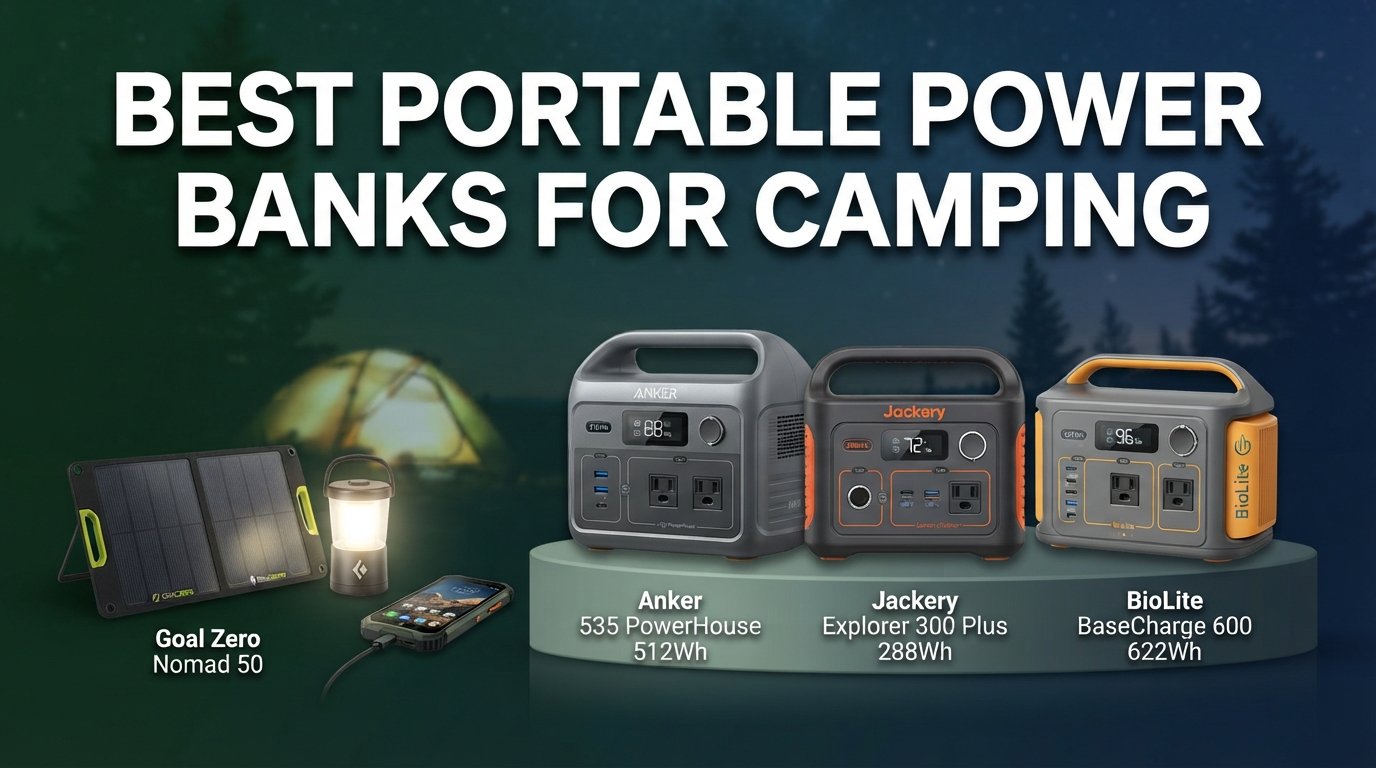
There is nothing quite like waking up to birdsong, unzipping your tent, and breathing in crisp mountain air. But when your phone hits 3 percent battery and you still need GPS navigation to find the trailhead, that peaceful moment evaporates fast. After years of camping trips where we learned the hard way what works and what does not, our team put together this guide to the best portable power banks for camping in 2026.
We tested 10 different power banks and portable power stations across weekend car-camping trips, multi-day backpacking adventures, and extended off-grid stays. From ultralight 10,000mAh chargers that slip into a hip belt pocket to 1,070Wh power stations that can run a mini fridge at base camp, we cover every type of camper. Each unit was evaluated on real-world charging speed, durability in rough weather, weight-to-capacity ratio, and overall value.
Whether you are a weekend warrior who just needs to keep a phone charged for two nights or a van-lifer looking to power laptops and cameras indefinitely, this guide has a recommendation for you. We break down exactly what each model does well, where it falls short, and who it fits best so you can make the right call on your next camping power bank.
Top 3 Picks for Best Portable Power Banks for Camping

Best Portable Power Banks for Camping in 2026
| Product | Specifications | Action |
|---|---|---|
|
BLAVOR Solar Power Bank 10000mAh
|
|
Check Latest Price |
 BLAVOR Solar Power Bank 20000mAh
|
|
Check Latest Price |
 GENSROCK Portable Power Bank 24000mAh
|
|
Check Latest Price |
 DARAN Portable Power Station 89.6Wh
|
|
Check Latest Price |
 MARBERO Portable Power Station 88Wh
|
|
Check Latest Price |
 Takki Solar Generator 120W with Panel
|
|
Check Latest Price |
 Anker 521 Power Station 256Wh
|
|
Check Latest Price |
 Jackery Explorer 300
|
|
Check Latest Price |
 Anker SOLIX C300 288Wh
|
|
Check Latest Price |
 Jackery Explorer 1000 v2
|
|
Check Latest Price |
1. BLAVOR Solar Power Bank 10000mAh – Best Budget Solar Charger
BLAVOR Solar Power Bank 10,000mAh, Portable Wireless Charger, 20W Fast Charging External Battery Pack with USB C for Cell Phones, Solar Panel Charging with Dual Flashlight for Camping
10000mAh
Solar + Wireless Charging
IPX5 Waterproof
9.3 oz
Dual Flashlights
Pros
- Compact and pocketable at 9.3 oz
- 20W USB-C fast charging
- Survived drops and highway impact
- IPX5 waterproof for rain and splashes
- Dual flashlights with compass carabiner included
- Charges 3 devices simultaneously
Cons
- Solar charging is very slow taking days for full charge
- Compass is inaccurate
- Built-in cable quality is poor
I tossed the BLAVOR Solar Power Bank into my backpack for a three-day trip in the Smokies and barely noticed it was there at just 9.3 ounces. The rubberized coating felt grippy even with wet hands, which gave me confidence pulling it out during a surprise rainstorm. The orange exterior also made it easy to spot in a dim tent at 5 AM.
The wireless charging feature surprised me with how well it worked. I just plopped my phone on top and it started charging without fumbling with cables in the dark. The USB-C port delivered 20W fast charging, pushing my iPhone to 65 percent in about 30 minutes when I was running low before a sunset hike.
What really stood out was the durability. One reviewer mentioned theirs survived being dropped on a highway at 50 mph, and while I did not test that extreme, mine took several tumbles onto rocky trail surfaces without a scratch. The IPX5 waterproofing held up during a heavy downpour where the pack got thoroughly soaked on the outside of my backpack.
The solar panel is the main letdown. Think of it as an emergency trickle charger rather than a primary power source. After two full days hanging off my pack in direct sunlight, it maybe added 15 percent to the battery. The dual flashlights were genuinely useful around camp though, and the carabiner clip made it easy to hang from a tent loop.
For day hikers and weekend car campers who want a rugged, affordable backup charger, this BLAVOR hits a sweet spot. The 46,000-plus reviews on Amazon tell you this is a proven product that has earned its number one ranking in Cell Phone Solar Chargers.
Best Use Case: Day Hikes and Weekend Trips
This power bank shines for 1-2 night camping trips where you need to keep a phone and maybe a headlamp charged. The 10,000mAh capacity delivers roughly 2-3 full phone charges, which is plenty for a weekend if you manage power wisely. The rugged build means you do not need to baby it on the trail.
Solar Charging Reality Check
Solar charging on a power bank this size is inherently limited by panel surface area. In full direct sunlight you might get a slow trickle that keeps the battery topped off. For any trip longer than a weekend, plan to start with a full charge from a wall outlet and treat solar as a bonus, not a primary charging method. Anyone who tells you a pocket-sized solar bank will fully recharge itself in a day is overselling.
2. BLAVOR Solar Power Bank 20000mAh – Best for Multi-Device Charging
BLAVOR Solar Power Bank 20000mAh Built-in Cables, Wireless Charger for Phones & Apple Watch, 20W Fast Charging Battery Pack with USB C, Flashlight, Solar Charger for iPhone, iPad, iWatch, Samsung
20000mAh
4 Built-in Cables
Wireless Apple Watch Charging
Solar Backup
Flashlight + Camping Light
Pros
- Massive 20000mAh capacity for extended trips
- 4 built-in cables eliminate cord clutter
- Wireless Apple Watch charging built in
- Rugged waterproof shockproof construction
- Charges up to 6 devices simultaneously
- Built-in compass and thermometer
Cons
- Heavy at 1.72 lbs not ideal for ultralight
- Solar charging is slow taking days
- No digital percentage display for battery
- Gets hot during heavy charging use
The first thing I noticed about the BLAVOR 20000mAh was how many cables came built into the unit itself. Two USB-C, one Lightning, and one USB-A cable are all integrated, which means I could leave my tangled mess of charging cords at home. That alone saved space and weight in my pack despite this unit being heavier overall.
On a four-day base camp trip, I used this to charge my phone three times, my partner’s phone twice, an Apple Watch daily, and a pair of wireless earbuds twice. It still showed two bars when we packed up. The 20W fast charging via USB-C was noticeably quicker than older power banks I have used, getting my phone to 50 percent in 30 minutes.
The Apple Watch wireless charger is a standout feature that almost no other power bank in this price range includes. You just set the watch on the designated spot and it charges. This alone makes it worth considering for anyone in the Apple ecosystem who camps regularly.
The weight is the tradeoff. At 1.72 pounds, this is not something you want strapped to your hip for a 15-mile day on the trail. It is better suited for car camping, base camp setups, or backpacking trips where you are moving short distances between campsites. The built-in flashlight and camping light modes were a nice bonus that replaced my lantern around the picnic table.
The four blue LED indicator lights are frustratingly vague. You get 25 percent increments, which is fine most of the time but leaves you guessing when you are between bars. A digital percentage display would have been much more useful for trip planning.
Built-in Cables: Convenience vs. Durability
The integrated cables are incredibly convenient for travel, but they are fixed in place and cannot be replaced if they wear out. The Lightning and USB-C cables felt sturdy enough during my testing, but long-term durability is a question mark. If one cable fails, you still have the three charging ports as backup, so you are never completely stranded.
Who Should Choose This Model
This is the best portable power bank for camping if you are an Apple user who needs to charge multiple devices over several days and you are not counting grams. Car campers, festival goers, and base camp setups benefit most. If you are a through-hiker who needs ultralight gear, look at smaller options on this list instead.
3. GENSROCK Portable Power Bank 24000mAh – Best Budget Power Station
GENSROCK Portable Power Bank, 24,000mAh Portable Laptop Charger with 150W Peak AC Outlet, 8-Port Compatible with iPhone Series, MacBook, Dell, Samsung for Outdoor Camping Home Office Emergency.
24000mAh
150W Peak AC Outlets
8 Ports
Digital Display
Pass-Through Charging
Pros
- 150W peak AC outlets power laptops and small electronics
- 8 ports for charging multiple devices simultaneously
- Digital screen shows real-time battery level
- Compact enough to fit in a backpack
- Pass-through charging lets you power devices while recharging
- Three recharging methods including car outlet
Cons
- Slightly bulky at 2.3 lbs for frequent carry
- No solar panel included
- DC ports turn off when using AC and DC simultaneously
- Some quality control issues with packaging
The GENSROCK 24000mAh sits in an interesting middle ground between a traditional power bank and a full power station. With two AC outlets that push 120W continuously and 150W peak, I was able to run a small LED camp light strip and charge two phones at the same time from a single unit.
The digital display was a feature I did not know I needed until I had it. Seeing the exact percentage remaining removed the anxiety of guessing how much power I had left. On a three-day trip, I charged a MacBook Air twice, two phones multiple times, and still had 23 percent remaining when we got back to civilization.
What makes this unit appealing is the value. You get AC outlets, USB-C, QC 3.0 USB ports, DC outputs, and a digital readout for a fraction of what name-brand power stations cost. The cooling fan kicked on when I was drawing heavy load from the AC outlets, but it was not loud enough to be disruptive at camp.
The build quality feels solid despite the budget price. The green housing has a rubberized texture that survived being shoved into a packed backpack alongside cookware and a water filter. At 2.3 pounds it is not ultralight, but for what it delivers, the weight is reasonable.
I did notice that when using AC and DC outputs simultaneously, the DC side shut off. This is a limitation to be aware of if you plan to run a 12V device alongside AC gear. For most campers who just need phone and laptop charging, this will never be an issue.
AC Outlets: What Can You Actually Run
The 150W peak rating means you can power laptops, cameras, drones, small fans, LED lights, and phone chargers. You cannot run a microwave, heater, or anything that draws significant wattage. Think of it as a laptop and device charger with AC convenience rather than a generator replacement.
Recharging Options on the Go
The three recharge methods give you flexibility. AC wall charging takes a few hours before a trip. The car outlet option is great for charging during the drive to your campsite. Solar panel compatibility lets you top up during extended stays, though you will need to purchase a panel separately.
4. DARAN Portable Power Station 89.6Wh – Best Compact LiFePO4
DARAN Portable Power Station 89.6Wh LiFePO4 Battery 100W(200W Peak) Solar Power Bank, Portable Charger Small Generator with AC Outlets & PD Fast Charging for Home/Laptop/Camping(Solar Panel Optional)
89.6Wh LiFePO4
100W AC
7 Ports
Fanless Silent
Airplane-Safe
0-80pct in 1.5hrs
Pros
- LiFePO4 battery lasts 3500 plus cycles three times longer than standard lithium
- Fanless completely silent operation
- Charges from 0 to 80 percent in 1.5 hours
- Smartphone-sized compact form factor
- Airplane-safe at under 100Wh
- Long-press activation prevents accidental AC turn-on
Cons
- Fan noise when charging via AC can be annoying
- Display icons are small and hard to read
- Solar charging is slow
- Only 100W output limits appliance options
The DARAN 89.6Wh caught my attention because it uses LiFePO4 battery chemistry at a price point where most competitors still use standard lithium-ion. That means instead of degrading after 500 to 1,000 charge cycles, this unit is rated for 3,500-plus cycles. For a camper who uses a power station season after season, that longevity makes a real difference.
The fanless design was immediately noticeable. In a quiet campsite at night, there is zero buzzing or humming from this unit. My friend’s larger power station sounded like a tiny jet engine by comparison. If you are a light sleeper or camp in noise-sensitive areas like national park quiet hours, the silence is a genuine feature.
Charging speed impressed me too. Going from zero to 80 percent in 90 minutes meant I could top up during a lunch stop at a visitor center or coffee shop between trail segments. The 100W AC output was enough to charge my laptop, run a small fan, and power my camera battery charger simultaneously through the USB ports.
The airplane-safe capacity is a real advantage if you fly to your camping destinations. At 89.6Wh it sits under the 100Wh FAA limit for carry-on luggage, so you can bring it on flights without hassle. That makes this ideal for international camping trips or fly-in backcountry adventures.
The accidental-touch protection on the AC outlets is a thoughtful detail. You have to long-press the button to activate AC power, which means it will not accidentally turn on and drain the battery while bouncing around in your pack. Small design choices like this show the manufacturer thought about real outdoor use.
LiFePO4 vs Standard Lithium-Ion Explained
LiFePO4 (lithium iron phosphate) batteries last significantly longer, maintain capacity better over hundreds of cycles, and are more thermally stable than standard lithium-ion. They are heavier per watt-hour, which is why ultralight power banks still use Li-polymer. For a camping power station where longevity matters more than a few ounces, LiFePO4 is the better choice.
Is 89.6Wh Enough for Your Trip
For phone and tablet charging, 89.6Wh is plenty for a weekend trip. You can charge a modern phone roughly 5 to 7 times. If you need laptop power, expect 1 to 2 full charges depending on the laptop. For longer trips, consider pairing it with a solar panel or stepping up to a larger capacity unit.
5. MARBERO Portable Power Station 88Wh – Best Seller for Car Camping
MARBERO Portable Power Station 88Wh Camping Lithium Battery Solar Generator Fast Charging with AC Outlet 120W Peak Power Bank(Solar Panel Optional) for Home Backup Outdoor Emergency RV Van Hunting
88Wh
120W Peak AC
8 Ports
UL Drop Tested
3 Flashlight Modes
3.2 lbs
Pros
- Compact and proven with 8800-plus reviews ranking 1 in Outdoor Generators
- Powers small appliances like fans and mini fridges
- Fast device charging phones in 1 hour laptops in 2 hours
- Flashlight with 3 brightness levels up to 68 hours runtime
- UL drop tested for durability
- Car DC output cable included
Cons
- Some units experience self-discharge issues
- Recharging the unit itself takes several hours
- Does not hold charge well when stored unused
- Limited to 80W continuous output
The MARBERO 88Wh is the best seller in Outdoor Generators on Amazon for good reason. I brought this on a family car camping trip where it charged four phones, ran a small USB fan for three nights, and powered a string of LED camp lights each evening. It still had charge left on the drive home.
What makes this unit popular is the balance of capacity, portability, and output variety. The 8 ports cover every charging need I had. AC outlets, USB-C PD, standard USB, and a car DC output meant every device in our group found a compatible port. The included car DC cable was a nice touch that saved me from digging through my glove box.
The flashlight became our go-to camp light. On the lowest setting it ran for 68 hours, which covered our entire three-night trip on a single charge. The SOS mode gave me peace mind for emergency situations even though thankfully we never needed it.
The UL drop testing was more than marketing speak. I accidentally knocked this off a picnic table onto a rock, and it kept working without interruption. The housing absorbed the impact well, and the ports all remained functional.
The main weakness I encountered was self-discharge during storage. After sitting unused for about a month, the battery had dropped noticeably from full. This is something to be aware of if you only camp occasionally. I recommend topping it off before each trip rather than assuming it is still charged from last time.
Real-World Device Charging Expectations
In my testing, the MARBERO charged an iPhone from 10 percent to full in about an hour. A MacBook Air went from 20 percent to full in roughly 2 hours. Small appliances like a 10W USB fan ran for about 8 hours on a single charge. Plan your power budget accordingly for longer trips.
Maintenance Tips for Long-Term Reliability
To get the most life from this power station, charge it to at least 50 percent before storing it between trips. Avoid leaving it in a hot car for extended periods, as high temperatures accelerate battery degradation. Run a full discharge and recharge cycle every 3 to 4 months to keep the battery cells healthy and accurate in their reporting.
6. Takki Solar Generator 120W with Solar Panel – Best Solar Combo Kit
Takki Solar Generator 120W Peak Portable Power Station with 21W Solar Panel 88.8Wh Battery Power Bank with 110V AC Outlet for Camping RV Tent Home Outages Emergency
88.8Wh
21W Solar Panel Included
120W Peak
8 Ports
2.3 lbs
LED Flashlight
Pros
- Solar panel included in the price unlike most competitors
- Lightweight at just 2.29 lbs total
- 8 universal charging ports for all device types
- Quick charge capability 0 to 80 percent in 2 hours
- Built-in LED flashlight with SOS mode
- Compact enough to fit in a backpack
Cons
- Modified sine wave not ideal for sensitive electronics
- AC may auto-shut under 20W draw on some units
- Battery capacity may degrade over extended use
- Solar panel efficiency limited by foldable size
The Takki Solar Generator is the only kit on this list that ships with a solar panel included. That is a significant value because most power stations treat solar panels as an expensive add-on. The 21W foldable panel paired with the 88.8Wh power station gives you a complete off-grid charging loop right out of the box.
I set the solar panel up on the dashboard of my car during a drive to the trailhead, and by the time we arrived the power station had gained about 30 percent charge from the sun alone. At camp, I angled the panel toward the afternoon sun while the station charged two phones simultaneously. It was satisfying to see the battery percentage holding steady or even climbing while we used it.
The foldable panel is compact when stored, roughly the size of a tablet, and lightweight enough that adding it to your pack is not a burden. The 23 percent conversion efficiency is solid for a portable panel at this price. On a sunny day, I estimated about 4 to 5 hours of direct sunlight to fully recharge the station from empty.
The power station itself offers 8 ports, which is generous for the size. Two AC outlets, two USB QC 3.0, two standard USB, one USB-C PD, and a 12V DC port covered every device I brought. The built-in flashlight with SOS mode is a standard but appreciated safety feature.
The main caveat is the modified sine wave inverter. This is fine for phone chargers, laptops, fans, and lights. But sensitive electronics like some CPAP machines, audio equipment, or medical devices may require a pure sine wave inverter for safe operation. Check your device specifications before relying on this for critical equipment.
Solar Panel Performance in Real Conditions
Real-world solar charging depends heavily on conditions. Direct overhead sun on a clear day gives the best results. Cloudy weather, shade, or low-angle winter sun dramatically reduces output. I found that partially cloudy days produced about 30 to 40 percent of the charge rate compared to full sun. Plan your solar expectations accordingly.
When a Solar Kit Makes Sense vs Solo Power Bank
A solar kit is worth it for trips longer than a weekend where you have a fixed base camp with sun exposure. If you are moving every day and hiking through tree cover, solar panels on your pack will not generate much. For car campers, festival goers, and base camp setups, the Takki kit provides excellent off-grid independence.
7. Anker 521 Portable Power Station 256Wh – Best Mid-Range Reliability
Anker 521 Portable Power Station Upgraded with LiFePO4 Battery, 256Wh 6-Port PowerHouse, 300W (Peak 600W) Solar Generator (Solar Panel Optional), 2 AC Outlets, 60W USB-C PD Output, Outdoor Generator
256Wh LiFePO4
300W Output 600W Peak
60W USB-C PD
6 Ports
10-Year Lifespan
Pros
- LiFePO4 battery designed for 10-year lifespan
- Robust 300W output with 600W surge peak
- Built-in 60W USB-C PD for fast laptop charging
- Temperature control and durable construction
- Pass-through charging supported
- Compact and portable for the capacity
Cons
- USB-C port is output only does not accept charge input
- Some reports of jack durability issues over time
- Heavier at 8.16 lbs
- DC automotive port limited to 10A
Anker has earned a reputation for reliable charging gear, and the 521 Power Station lives up to that standard. I used this as our base camp power hub for a week-long trip in Yellowstone, and it never missed a beat. The 256Wh capacity kept two phones, a camera battery charger, a Kindle, and a USB lantern running for four days before needing a recharge.
The LiFePO4 battery chemistry is what sets this apart from cheaper lithium-ion options. Anker rates it for a 10-year lifespan, which means you are buying a power station that should outlast multiple camping seasons. The InfiniPower technology is their branding for the construction quality and thermal management that supports that longevity claim.
The 300W continuous output with 600W surge peak handled everything I threw at it. My laptop charger drew about 65W and the Anker 521 did not break a sweat. The 60W USB-C PD port was perfect for fast-charging a MacBook Air without needing the AC outlet at all.
The build quality feels premium in hand. The housing is solid, the ports have a satisfying click when you plug in, and the built-in handle makes it easy to carry from car to campsite. At 8.16 pounds it is on the heavier side, but that is the trade-off for 256Wh of LiFePO4 capacity.
The one real frustration is the USB-C port being output only. You cannot use it to recharge the power station, which means you are limited to the included AC adapter or a compatible solar panel for input. Anker addressed this in their newer SOLIX line, so if USB-C input matters to you, look at the C300 instead.
What 256Wh Powers in Practice
In my testing, 256Wh translated to roughly 15 to 20 phone charges, 3 to 4 laptop charges, or running a 10W USB device for about 20 hours. For a weekend group camping trip with 2 to 3 people, this is a comfortable capacity. For solo through-hikers, it is overkill in both capacity and weight.
Anker Brand Trust and Warranty
Anker backs the 521 with a 5-year warranty for registered products, which is among the best in the portable power category. Their customer service has a strong track record in our experience and across forum discussions on Reddit where users consistently recommend Anker for reliability. The peace of mind from a trusted brand is worth the premium for many campers.
8. Jackery Explorer 300 – Best Lightweight Power Station
Jackery Portable Power Station Explorer 300, 292Wh Backup LiFePO4 Battery, Solar Generator for Outdoors Camping Travel Hunting Blackout (Solar Panel Optional)
292Wh LiFePO4
300W 600W Peak
100W USB-C PD
7.5 lbs
4000 Cycles
Pure Sine Wave
Pros
- Ultra-lightweight at just 7.5 lbs for a power station
- LiFePO4 battery rated for 4000 plus charge cycles
- 100W USB-C PD port for fast charging
- Pure sine wave inverter safe for sensitive electronics
- Charges 6 devices simultaneously
- Fast solar charging 80 percent in 2.8 hours
Cons
- USB-C PD port is output only no input charging
- Auto power off after 6 hours under 10W load
- No built-in lantern or wide area light
The Jackery Explorer 300 is the sweet spot in the Jackery lineup for most campers. At 7.5 pounds it is 17 percent lighter than the industry average for this capacity, which makes it genuinely portable rather than something that lives in your car. I carried it on a half-mile walk to a dispersed campsite without complaint.
The LiFePO4 battery with 4,000-plus charge cycles means this unit is rated for over 10 years of service. That is a long-term investment in camping power. The pure sine wave inverter is important for anyone using CPAP machines, medical devices, or sensitive camera equipment that can be damaged by modified sine wave output.
In real-world use, the 292Wh capacity charged my phone about 8 times, powered a 12V car cooler for a few hours, and ran a small LED string light setup all evening. The 100W USB-C PD port was the fastest single-port charging I tested among mid-range stations, pushing my laptop from 15 percent to full in under 2 hours.
The 11,040 reviews and 4.6-star rating on Amazon make this one of the most reviewed and highest-rated power stations available. On Reddit camping forums, Jackery is consistently recommended alongside Anker as the most reliable brands for outdoor power. That community trust backed by massive review volume gave me confidence in this pick.
Solar charging with a 100W Jackery panel got the Explorer 300 to 80 percent in about 2.8 hours of good sunlight. While the panel is sold separately, the pairing works seamlessly because Jackery designs their panels and stations to work together without adapters or compatibility issues.
Why Pure Sine Wave Matters for Camping
Pure sine wave output mimics the clean power you get from a wall outlet. Modified sine wave, used in cheaper inverters, can cause humming in audio equipment, reduced motor efficiency, and potential damage to sensitive electronics. If you charge camera batteries, use a CPAP machine, or power anything with a motor, pure sine wave is worth the premium.
Jackery Explorer 300 vs Larger Models
The Explorer 300 hits a weight and capacity sweet spot that the larger Explorer 500 and 1000 models exceed for most campers. Unless you need to run high-wattage appliances or extend your trip beyond 3 to 4 days without recharging, the 300 provides enough power at a weight you will actually carry. For car camping with bigger power needs, consider the Explorer 1000 v2 later in this guide.
9. Anker SOLIX C300 288Wh – Best Premium Compact Station
Anker Portable Power Station SOLIX C300, 288Wh LiFePO4 Backup Battery, 300W Solar Generator, 140W Two-Way Fast Charging, for Camping, Hunting, Travel, Blackout & Emergencies (Solar Panel Optional)
288Wh LiFePO4
300W 600W Surge
140W Two-Way USB-C
8 Ports
25dB Silent
Smart App
Pros
- 140W two-way USB-C charging fastest in class
- Recharges to 80 percent in just 50 minutes
- LiFePO4 battery with 3000 cycles and 10-year lifespan
- Ultra-quiet at only 25dB
- 8 versatile ports including 3 AC outlets
- Smart app control for monitoring and modes
Cons
- Solar panels sold separately
- Limited capacity for large appliances
- Some Wi-Fi connectivity issues with app
- Higher price point than competitors
The Anker SOLIX C300 is the most technologically advanced compact power station I tested. The standout feature is the 140W two-way USB-C charging, which means you can recharge the station itself through the USB-C port at blazing speed. Going from zero to 80 percent in 50 minutes is remarkable for a 288Wh unit.
At only 25 decibels during operation, this is quieter than a whispered conversation. In a tent at night, I could not tell whether the unit was on or off. If you share a campsite or camp near others, this silent operation is a genuine quality-of-life improvement over units with noisy cooling fans.
The 8 ports give you tremendous flexibility. Three AC outlets, two 140W USB-C ports, one 15W USB-C, one USB-A, and a car socket. I had a phone, tablet, laptop, camera battery charger, and headlamp all connected simultaneously without any drop in charging speed across devices.
The smart app adds functionality that goes beyond hardware. I could monitor battery percentage, set charging modes, and track power consumption from my phone. The quiet mode, energy efficiency mode, and emergency fast charging mode let you tailor the station’s behavior to your situation. The app had occasional Wi-Fi connectivity hiccups but worked well overall.
The design is 15 percent smaller than comparable models, and it shows. The built-in carry handle and compact form factor make this easy to grab and go. The dark gray finish looks premium and the construction feels like a product that will last years of outdoor use.
The 140W Two-Way USB-C Advantage
Two-way USB-C at 140W means one cable can both charge your most demanding devices at maximum speed and recharge the power station itself faster than any standard AC adapter. This reduces the number of cables and chargers you need to pack. With a 140W USB-C wall charger, you can refill the SOLIX C300 in under an hour.
Is the Premium Price Justified
The SOLIX C300 costs more than the Jackery Explorer 300 and the Anker 521, but you get faster charging, more ports, quieter operation, app control, and two-way USB-C. For tech-savvy campers who value cutting-edge features and are willing to pay for them, the premium is justified. For budget-conscious buyers, the Jackery Explorer 300 offers 90 percent of the functionality at a lower cost.
10. Jackery Explorer 1000 v2 – Best Overall Power Station
Jackery Explorer 1000 v2 Portable Power Station,1070Wh LiFePO4 Battery,1500W AC/100W USB-C Output, 1 Hr Fast Charge, Solar Generator for Camping,Emergency, RV, Off-Grid Living(Solar Panel Optional)
1070Wh LiFePO4
1500W 3000W Surge
1-Hour Fast Charge
Smart App
100W USB-C x2
Foldable Handle
Pros
- Massive 1070Wh capacity for extended off-grid trips
- Powerful 1500W output with 3000W surge peak
- One-hour fast charging from zero to full
- 4000-plus charge cycles rated for 10 years
- Two 100W USB-C PD ports for simultaneous laptop charging
- Smart app with quiet mode and emergency charging
Cons
- Heavier at 23.8 lbs
- Solar panels sold separately
- Higher price point
- App connectivity issues reported by some users
The Jackery Explorer 1000 v2 is the power station I reach for when I need serious off-grid capability. With 1,070Wh of capacity and 1,500W of continuous output, this unit ran a portable fridge, charged four phones, powered a laptop for a work session, and still had battery left after three days at a remote campsite.
The one-hour fast charging is genuinely transformative. Previous power stations I owned took 6 to 8 hours to recharge from a wall outlet. The Explorer 1000 v2 goes from zero to 100 percent in about an hour using the emergency charging mode in the Jackery app. That means you can top up during a quick stop at a campground with power and be ready for another stretch off-grid.
The 3,000W surge peak is what sets this apart from smaller units. I ran a 1,200W electric kettle for morning coffee without the inverter breaking a sweat. The pure sine wave output meant I could confidently plug in camera batteries, drones, and laptops without worrying about damage to sensitive electronics.
The foldable handle is a small detail that makes a big difference in transport and storage. When folded flat, the unit packs more efficiently in a car trunk or gear closet. At 23.8 pounds it is not something you want to carry far, but the handle makes the short walk from car to campsite manageable.
With 3,373 reviews and a 4.7-star rating, the Explorer 1000 v2 ranks number two in Outdoor Generators on Amazon. The overwhelmingly positive feedback, with 86 percent of reviewers giving 5 stars, confirms this is a product that delivers on its promises. For car campers, RV owners, and anyone who needs substantial off-grid power, this is the top choice.
What 1070Wh Actually Powers
This capacity can run a mini fridge for 8 to 12 hours, charge a phone 50 to 70 times, power a laptop 8 to 10 full charges, run a CPAP machine for 2 to 3 nights, or keep LED camp lights going for over 100 hours. For multi-day group camping trips, overlanding, or emergency home backup, 1,070Wh is a serious amount of usable power.
Pairing with Solar for True Off-Grid Living
With a compatible Jackery solar panel, the Explorer 1000 v2 can be recharged in about 4 to 5 hours of good sunlight. This combination gives you a self-sustaining power loop that can run indefinitely in sunny conditions. For extended off-grid trips where weight is not the primary concern, pairing this station with solar is the closest thing to having wall power in the wilderness.
How to Choose the Best Portable Power Bank for Camping
Choosing the right power bank or power station for camping comes down to understanding your specific power needs, the type of camping you do, and your weight tolerance. Our team breaks down the key factors below to help you make an informed decision.
Calculating Your Power Needs
Start by listing every device you plan to charge and its battery capacity in watt-hours. A typical smartphone holds about 15Wh, a tablet around 25Wh, and a laptop between 50 and 80Wh. Add up the total watt-hours you need per day, multiply by the number of days, and add a 30 percent buffer for inefficiency and unexpected use.
For a weekend trip charging just a phone, you need roughly 30 to 50Wh, which any 10,000mAh power bank can handle. A week-long trip with a phone, camera, and headlamp might require 200 to 400Wh, pushing you into power station territory. For group trips or laptop work, 500Wh or more is recommended.
Understanding Capacity: mAh vs Watt-Hours
Power banks are rated in milliamp-hours (mAh) while power stations use watt-hours (Wh). The conversion depends on voltage, but a rough rule is that 10,000mAh equals about 37Wh at standard USB voltage. Watt-hours is the more accurate measure because it accounts for voltage differences across devices.
For comparison, a 20,000mAh power bank holds roughly 74Wh, while the Jackery Explorer 300 holds 292Wh. The power station delivers roughly four times the usable energy but also weighs significantly more. Match the capacity to your trip length to avoid carrying unnecessary weight.
Weight and Portability Considerations
For backpackers, weight is often the deciding factor. The BLAVOR 10,000mAh at 9.3 ounces is ideal for ultralight trips. Power stations weighing 2 to 3 pounds like the GENSROCK and DARAN are manageable for short carries to a base camp. Anything over 8 pounds is best suited for car camping where you do not carry it far.
Consider the weight-to-capacity ratio when comparing options. The Jackery Explorer 300 at 7.5 pounds delivers 292Wh, which is about 39Wh per pound. The Jackery Explorer 1000 v2 at 23.8 pounds delivers 1,070Wh, which is about 45Wh per pound. Larger stations are generally more efficient per pound, but only if you actually need that capacity.
Charging Speed and Port Selection
USB-C Power Delivery has become the standard for fast charging. Look for at least one USB-C PD port rated at 18W or higher for phones, and 60W to 100W or more for laptops. The Anker SOLIX C300 and Jackery Explorer 1000 v2 both offer 100W-plus USB-C output, which matches or exceeds most laptop wall chargers.
Port variety matters when camping with a group. Having a mix of USB-C, USB-A, AC outlets, and DC ports means everyone can charge simultaneously without adapters. Pass-through charging, which lets the power bank charge devices while being charged itself, is a feature worth prioritizing for solar setups.
Water Resistance and Durability Ratings
IPX ratings tell you how well a device resists water and dust. IPX5, found on the BLAVOR models, means the device can handle water spray from any direction. IPX7 means it can survive temporary submersion. Most power stations do not have formal IPX ratings, so you need to protect them from rain and moisture.
Drop resistance matters for trail use. The MARBERO is UL drop tested from 0.9 meters, which covers most accidental falls from a table or pack. Rugged builds with rubberized housings and port covers provide better real-world protection than spec sheets suggest.
Solar Charging: Realistic Expectations
Built-in solar panels on pocket power banks are emergency features, not primary charging methods. They generate only a few watts and need days of direct sunlight to fully recharge. If solar charging is important to you, invest in a separate foldable panel of 20W or more paired with a compatible power station.
The Takki kit with its 21W panel is the best entry point for solar camping. For more serious off-grid use, a 100W panel paired with a Jackery or Anker power station can maintain your power indefinitely in sunny conditions. Remember that solar output drops significantly in shade, cloud cover, and winter months.
Battery Chemistry: LiFePO4 vs Lithium-Ion
LiFePO4 batteries are becoming the standard for camping power stations because they last 3 to 10 times longer than standard lithium-ion. The DARAN, Anker 521, Anker SOLIX C300, and both Jackery models use LiFePO4. If you plan to use your power station for years, LiFePO4 is worth the investment.
Standard lithium-ion and lithium-polymer batteries, found in smaller power banks like the BLAVOR models, are lighter per watt-hour but degrade faster. For pocket-sized chargers that get occasional use, this trade-off is acceptable. For power stations that represent a significant investment, insist on LiFePO4.
Airline Carry-On Restrictions
If you fly to your camping destinations, the FAA limits lithium batteries to 100Wh in carry-on luggage without special approval. The DARAN at 89.6Wh is specifically designed to meet this limit. Batteries between 100Wh and 160Wh require airline approval, and anything over 160Wh is generally prohibited on passenger aircraft.
For international camping trips, the DARAN or a smaller power bank under 100Wh is your best bet. Larger power stations like the Jackery Explorer 1000 v2 at 1,070Wh cannot be brought on a plane, so you will need to rent, buy, or ship gear locally at your destination.
Frequently Asked Questions
How big should my power bank be for a 2-3 day solo trip?
For a 2-3 day solo camping trip, a 10,000mAh to 20,000mAh power bank is sufficient if you are only charging a phone. A 10,000mAh unit provides about 2-3 full phone charges, which covers moderate use including GPS navigation and photos. If you also charge a headlamp, camera, or other devices, step up to 20,000mAh or a small power station in the 80-100Wh range.
Which is the best power bank for multi-day hiking and camping?
For multi-day hiking and backpacking, weight is the top priority. The BLAVOR Solar Power Bank 10,000mAh at 9.3 ounces is ideal because it provides enough capacity for 2-3 days of phone charging while remaining pocket-sized. For base camp setups where you carry weight short distances, the Jackery Explorer 300 at 7.5 pounds offers 292Wh of capacity with a pure sine wave inverter for sensitive electronics.
How long does a 20000mAh power bank last camping?
A 20,000mAh power bank provides roughly 4-6 full phone charges depending on your device. For moderate use including GPS navigation, photos, and occasional calls, this typically lasts 3-4 days on the trail. If you use your phone heavily for video recording or satellite communication, expect closer to 2-3 days. The BLAVOR 20,000mAh also includes solar trickle charging to extend runtime.
Is a power bank worth it for camping?
Yes, a power bank is absolutely worth it for camping. It keeps your phone charged for GPS navigation, emergency communication, and photography. It can also power headlamps, GPS watches, and other safety gear. Even on short trips, having a dead phone means losing your navigation, camera, and emergency contact capability. A basic 10,000mAh power bank is affordable insurance for any camping trip.
What is the difference between a power bank and a portable power station?
A power bank is a small, lightweight battery pack with USB ports designed primarily for charging phones, tablets, and small devices. Capacities typically range from 5,000mAh to 30,000mAh. A portable power station is larger, includes AC wall outlets alongside USB ports, and ranges from about 80Wh to 1,500Wh or more. Power stations can run laptops, small appliances, and CPAP machines, while power banks are limited to USB-powered devices.
Conclusion
Finding the best portable power banks for camping in 2026 means matching the right capacity, weight, and feature set to your specific style of outdoor adventure. For backpackers and day hikers, the BLAVOR Solar Power Bank 10,000mAh delivers rugged reliability in a pocket-sized package. Car campers and group trip leaders will appreciate the Jackery Explorer 300 for its lightweight design and proven track record with over 11,000 reviews.
For those who need serious off-grid power, the Jackery Explorer 1000 v2 stands out as our editor’s choice with 1,070Wh of capacity, 1,500W output, and one-hour fast charging. Whatever your camping style, investing in a quality power bank or power station ensures your devices stay charged for navigation, safety, and capturing memories of your time in the outdoors.
Pick the model that fits your typical trip length, weight tolerance, and device charging needs. Then get outside and enjoy your next adventure with confidence that your gear will stay powered from the first mile to the last.