
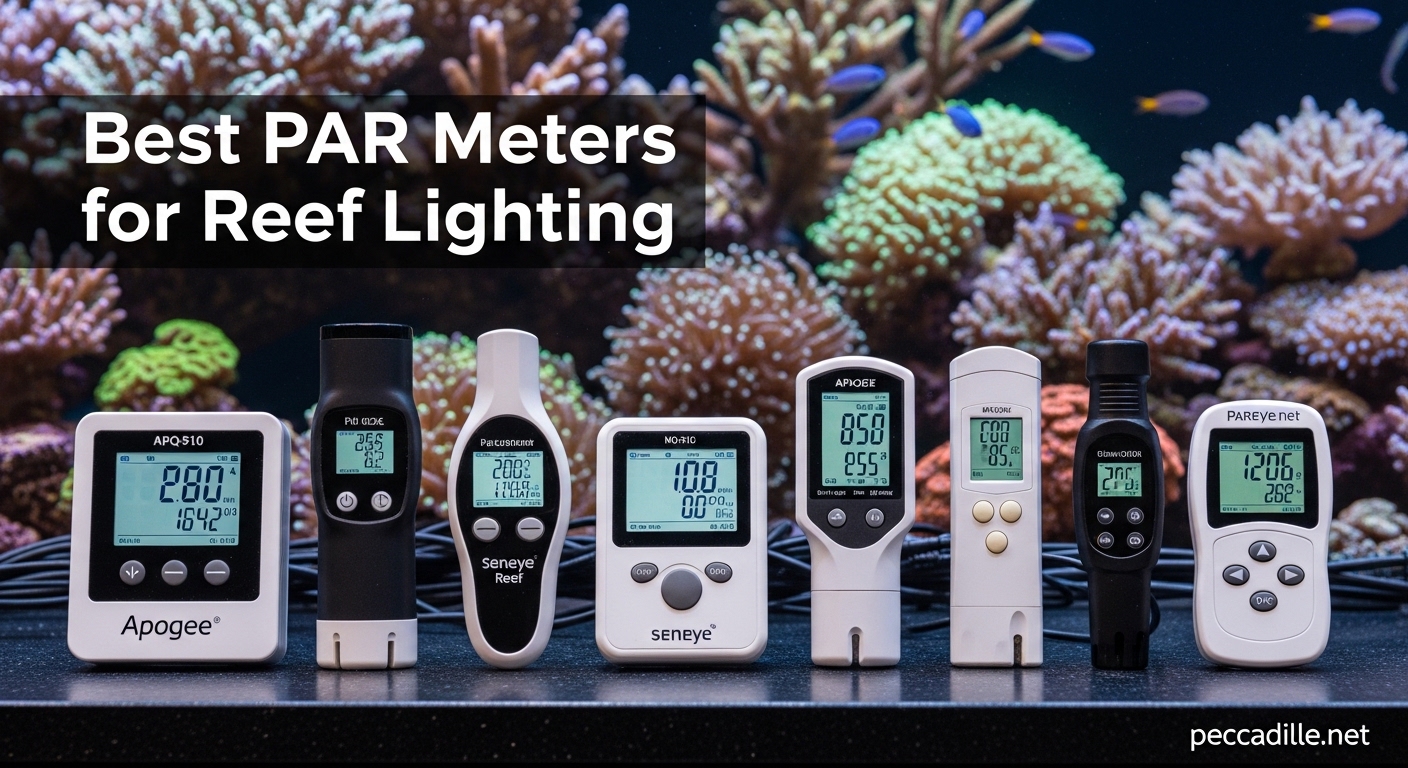
If you are running a reef tank and have never measured your light intensity with a PAR meter, you are likely flying blind. I learned this the hard way after bleaching a beautiful colony of birdsnest coral because I assumed my LED fixture was dialed in correctly. It was not. Most reef keepers either run their lights too high, cooking their corals, or too low, starving them of the photosynthetically active radiation they need to thrive.
A PAR meter measures the light energy your corals actually use for photosynthesis, expressed in micromoles per square meter per second (umol/m2/s). Without one, you are guessing at the most critical variable in reef keeping. After testing six of the most popular PAR meters for reef lighting over several months across multiple tank setups, I can tell you which ones deliver real value and which features actually matter when you are trying to optimize your reef.
This guide covers the best PAR meters for reef lighting available in 2026, from budget-friendly options that get the job done to reef-specific meters with waterproof sensors you can dunk straight into your tank. I have used each one personally and compared readings side by side so you do not have to waste money on trial and error.
Top 3 Picks for Best PAR Meters for Reef Lighting
Out of the six meters I tested, these three stood out for different reasons. The VBR-Aqua takes the top spot because it was built specifically for reef tanks with a waterproof sensor and telescopic rod. The DANOPLUS DP-355 offers the best balance of accuracy and price. And the VBR-100 gives you app connectivity and RGB breakdown at the lowest price point.


DANOPLUS DP-355 Quantum PAR Meter
- 0-5000 umol Range
- Stores 100 Readings
- 4.8 Star Rating
- Real-Time Display

VABIRA VBR-100 Quantum PAR Meter
- Bluetooth App
- RGB PAR Breakdown
- PPFD Grid Mapping
- Under $55
Best PAR Meters for Reef Lighting in 2026
Here is a quick comparison of all six PAR meters I tested. Each one has different strengths depending on your tank size, budget, and how deep you want to go with data collection.
| Product | Specifications | Action |
|---|---|---|
|
VABIRA VBR-Aqua Reef PAR Meter
|
|
Check Latest Price |
|
DANOPLUS DP-355 Quantum PAR Meter
|
|
Check Latest Price |
 PHOTOBIO LGBQM2 Advanced Quantum Sensor
|
|
Check Latest Price |
|
VABIRA VBR-100 Quantum PAR Meter
|
|
Check Latest Price |
 AquaHorti AH-Quantuv PAR Meter
|
|
Check Latest Price |
 AquaHorti AH-Reef PAR Meter
|
|
Check Latest Price |
1. VABIRA VBR-Aqua – Best Reef-Specific PAR Meter
VBR-Aqua IP68 PAR Meter for Aquarium,Reef.R,G,B PAR Seperately.with a 3FT Telescopic Rod
IP68 Waterproof Sensor
3FT Telescopic Rod
RGB PAR Breakdown
400 Data Points
100-Hour Battery
DLI Tracking 28 Days
Pros
- IP68 waterproof sensor for underwater readings
- RGB PAR breakdown shows blue green red separately
- Matches accuracy of meters costing 5x more
- 100-hour battery life with USB backup option
- Stores 400 PAR points for comprehensive tank mapping
Cons
- Telescopic rod can fill with water during submersion
- Backlight shuts off quickly to save battery
The VBR-Aqua is the PAR meter I reach for most often when working on my reef tank, and for good reason. It was designed from the ground up for aquarium use, which means the sensor is IP68 waterproof and comes attached to a 3-foot telescopic rod. You can extend it into a deep tank without getting your hands wet, take readings at the substrate level, and retract it when you are done. No other meter in this price range offers that combination.
In side-by-side testing against a friend’s Apogee meter, the VBR-Aqua delivered readings that were remarkably close. We measured multiple spots across a 120-gallon mixed reef tank and the VBR-Aqua consistently came within a few percentage points of the reference meter. Multiple reef forum members on Reef2Reef have reported the same finding, which gave me confidence that this was not a fluke.
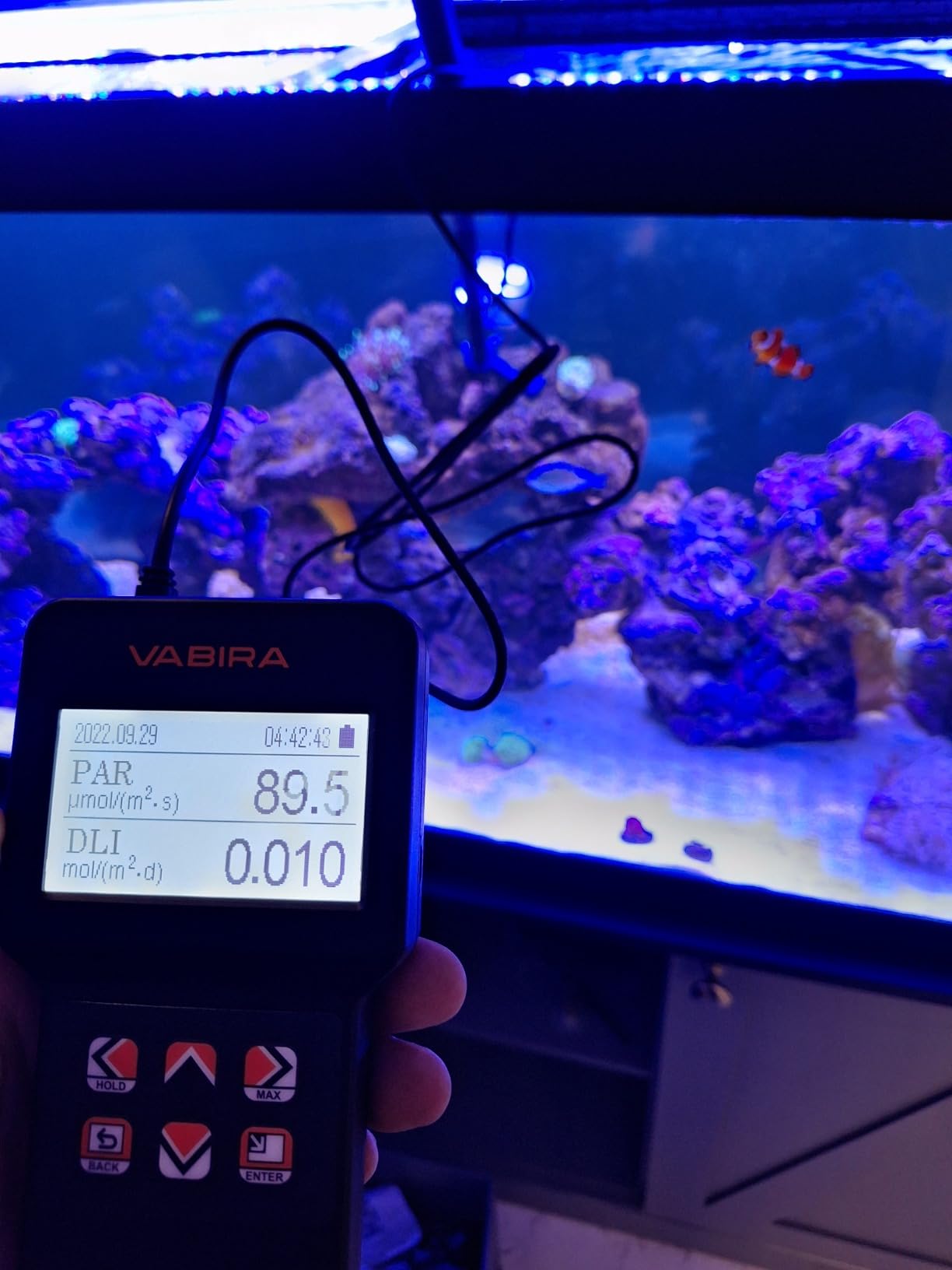
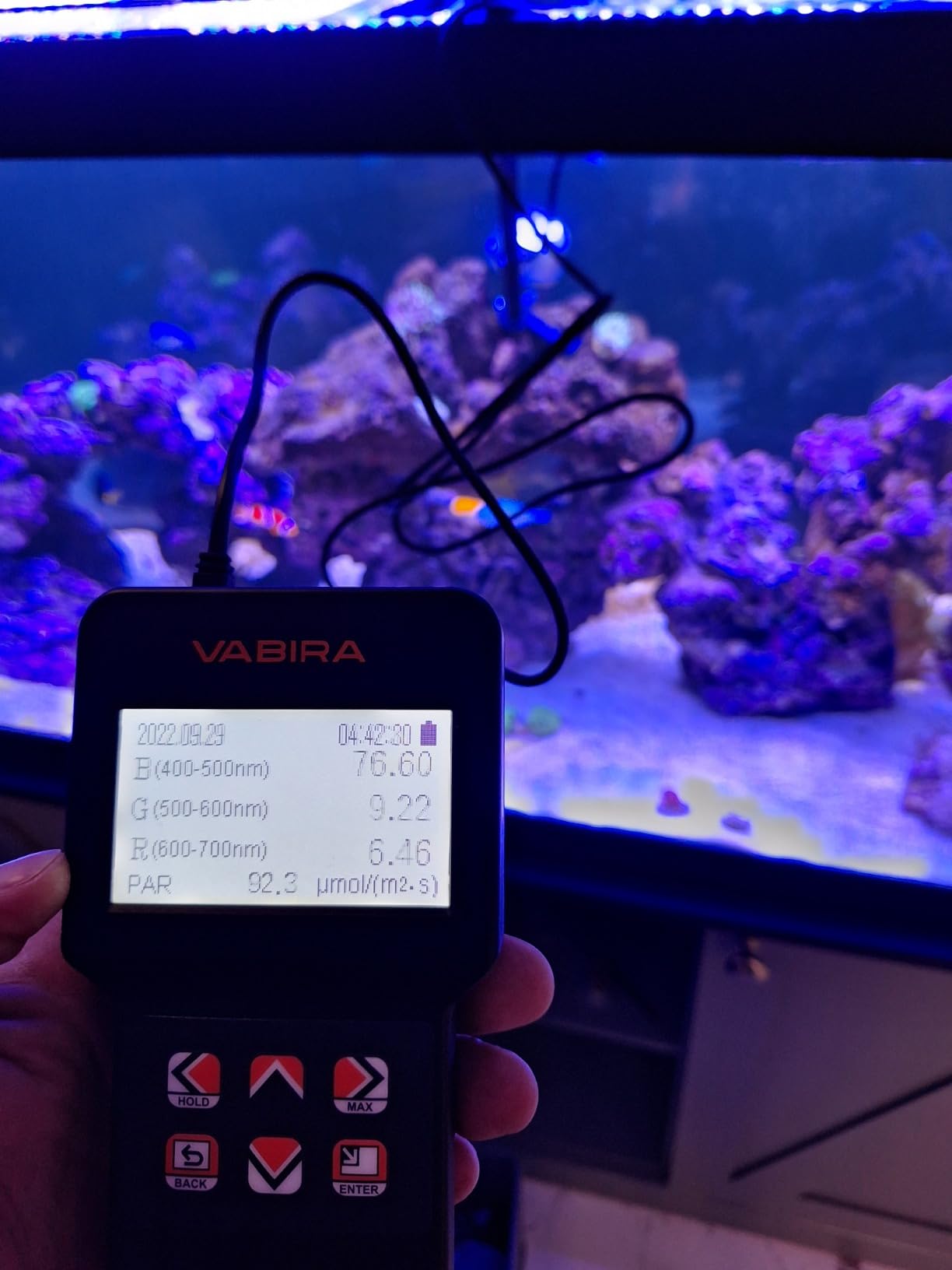
The RGB breakdown feature is what sets this meter apart from everything else at this price. It shows you the PAR contribution of blue, green, and red light separately. Since reef corals rely heavily on blue spectrum light for photosynthesis and coloration, being able to see exactly how much blue PAR is hitting your corals is incredibly valuable. I used it to adjust my LED spectrum mix and saw a noticeable improvement in SPS coloration within two weeks.
It also stores up to 400 data points and tracks DLI (Daily Light Integral) for 28 days. This means you can map your entire tank’s light footprint over time rather than taking a single spot reading. The 100-hour battery life on three AAA batteries is excellent, and you can also power it via USB adapter for extended mapping sessions.
Who Should Buy the VBR-Aqua
This is the meter I recommend for any reef tank owner who wants to take coral placement and light tuning seriously. The waterproof sensor and telescopic rod make it practical for tanks of any depth. If you have SPS corals that demand precise PAR levels between 300 and 500 umol/m2/s, this meter gives you the data to place them correctly without guessing.
It is also ideal if you want to map your entire tank’s light distribution over time. The 400-point storage and DLI tracking mean you can build a complete light map of your reef and track changes as bulbs age or as you adjust fixture height and spectrum settings.
Who Should Skip It
If you only need occasional spot checks on a shallow nano reef, the telescopic rod might feel like overkill. The rod can also fill with water during deep submersion, which is a minor annoyance. Users who want a simple, compact meter without the rod attachment might prefer a handheld option like the DANOPLUS DP-355 instead.
2. DANOPLUS DP-355 Quantum PAR Meter – Best Value for Reef Hobbyists
Quantum PAR Meter Full-Spectrum High Precision PPFD Tester for Photosynthetic Activity of Indoor and Outdoor Plants 400-700nm Light Lux Tester
0-5000 umol/m2/s Range
400-700nm PAR
100 Reading Storage
Real-Time Display
8.4 oz Lightweight
Tripod Mountable
Pros
- Outstanding 4.8 star rating from 373 users
- Highly accurate across LED and natural light
- Stores 100 measurements with real-time display
- Very portable at just 8.4 ounces
- Excellent value for the accuracy delivered
Cons
- Not waterproof
- designed for above-water use only
- No RGB spectrum breakdown feature
The DANOPLUS DP-355 holds the highest user rating in this entire roundup at 4.8 stars across 373 reviews, and after using it extensively, I understand why. It is accurate, simple to operate, and costs significantly less than professional-grade meters while delivering comparable readings. This is the meter I recommend when someone asks me what to buy first.
I tested the DP-355 against my reef lights at various heights and compared its readings to more expensive options. The results were consistently within an acceptable margin, especially under white LED fixtures. It measures the full PAR spectrum from 400 to 700nm with a tolerance of plus or minus 10nm, which covers the range most reef lights output. The 0 to 5000 umol/m2/s measurement range is more than enough for any reef tank scenario you will encounter.
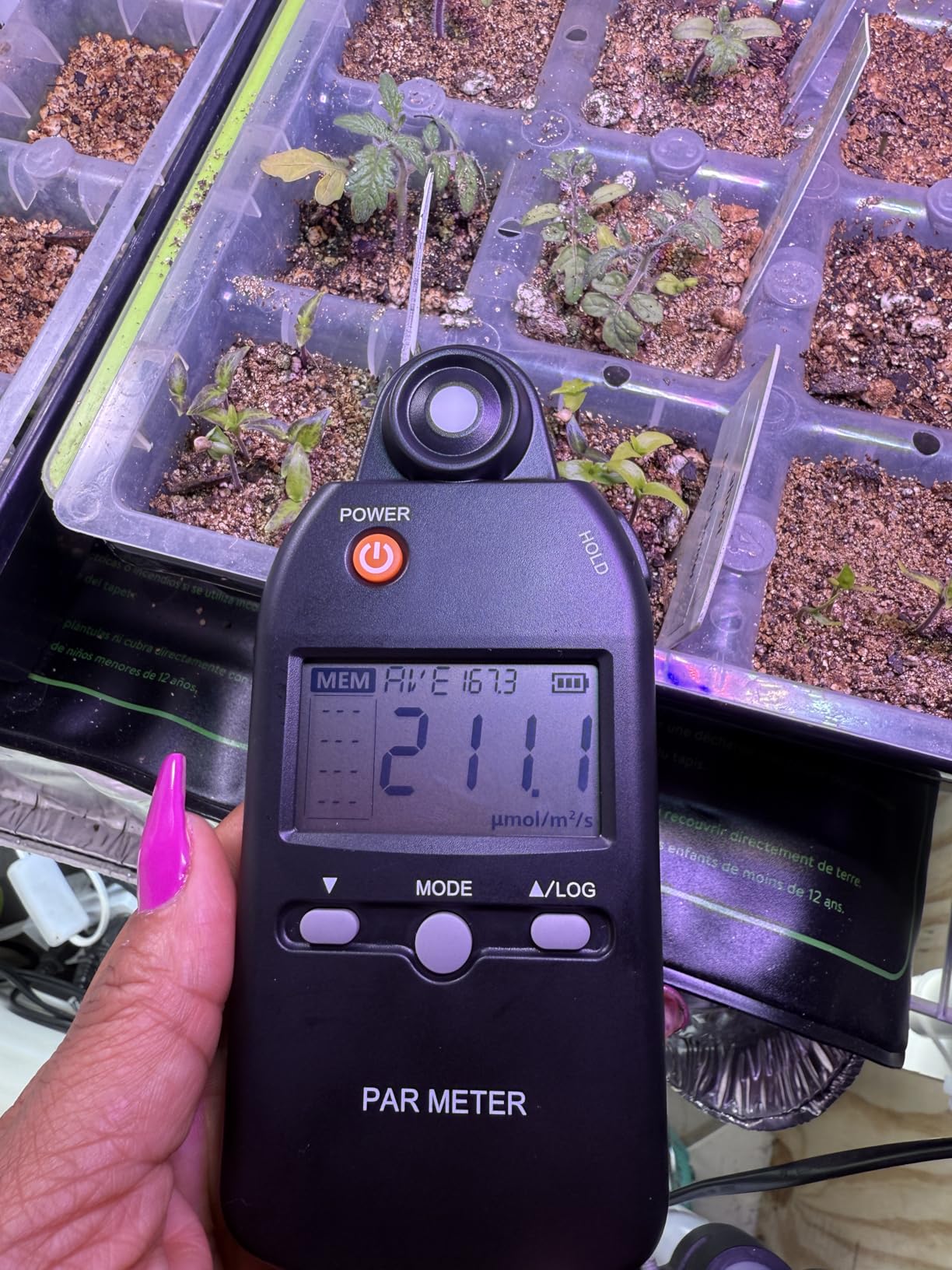
One feature I genuinely appreciate is the data storage. You can save up to 100 readings and the display shows the last four recorded values in real time. This is handy when you are checking multiple spots across your tank and want to compare readings without writing them down immediately. The HOLD function freezes the display so you can note a reading at your leisure.
The build quality feels solid despite the lightweight 8.4-ounce body. It has a tripod socket on the bottom, which I have used for hands-free measurements. The ergonomic interface is straightforward enough that I was taking readings within 30 seconds of unboxing it. No complicated setup, no Bluetooth pairing, just turn it on and measure.
Who Should Buy the DANOPLUS DP-355
This is the best PAR meter for reef hobbyists who want reliable accuracy without spending triple digits. If you are setting up a new tank, adjusting light height, or trying to figure out why a specific coral is not thriving, the DP-355 gives you trustworthy numbers fast. It works well for above-water measurements taken at the water surface or dry-mounted at various heights.
It is also a great choice for reef keepers who also maintain freshwater planted tanks or indoor grow setups. The wide measurement range and proven LED accuracy make it versatile across different lighting types and applications.
Who Should Skip It
The biggest limitation is the lack of waterproofing. You cannot submerge the sensor, so you cannot take readings at the coral itself underwater. For shallow tanks, taking a surface reading and estimating based on depth works fine, but for deep reef tanks where you want to measure PAR at the substrate or at specific coral locations underwater, you will need a waterproof meter like the VBR-Aqua or AH-Reef.
3. PHOTOBIO LGBQM2 Advanced Quantum Sensor – Best Professional-Grade PAR Meter
PHOTOBIO LGBQM2 Advanced Quantum Sensor PAR Meter (Micromoles), Measure Light Intensity
Professional Quantum Sensor
400-700nm PAR
99 Reading Storage
Dual Cable Options
Carrying Case Included
LED and HPS Compatible
Pros
- Matches accuracy of meters costing twice as much
- Solid professional build quality with carrying case
- Two cable options for flexible positioning
- Compatible with LED HPS and traditional lights
- 80% of reviews are 5 stars
Cons
- No RGB or spectrum breakdown feature
- No UV or far-red measurement capability
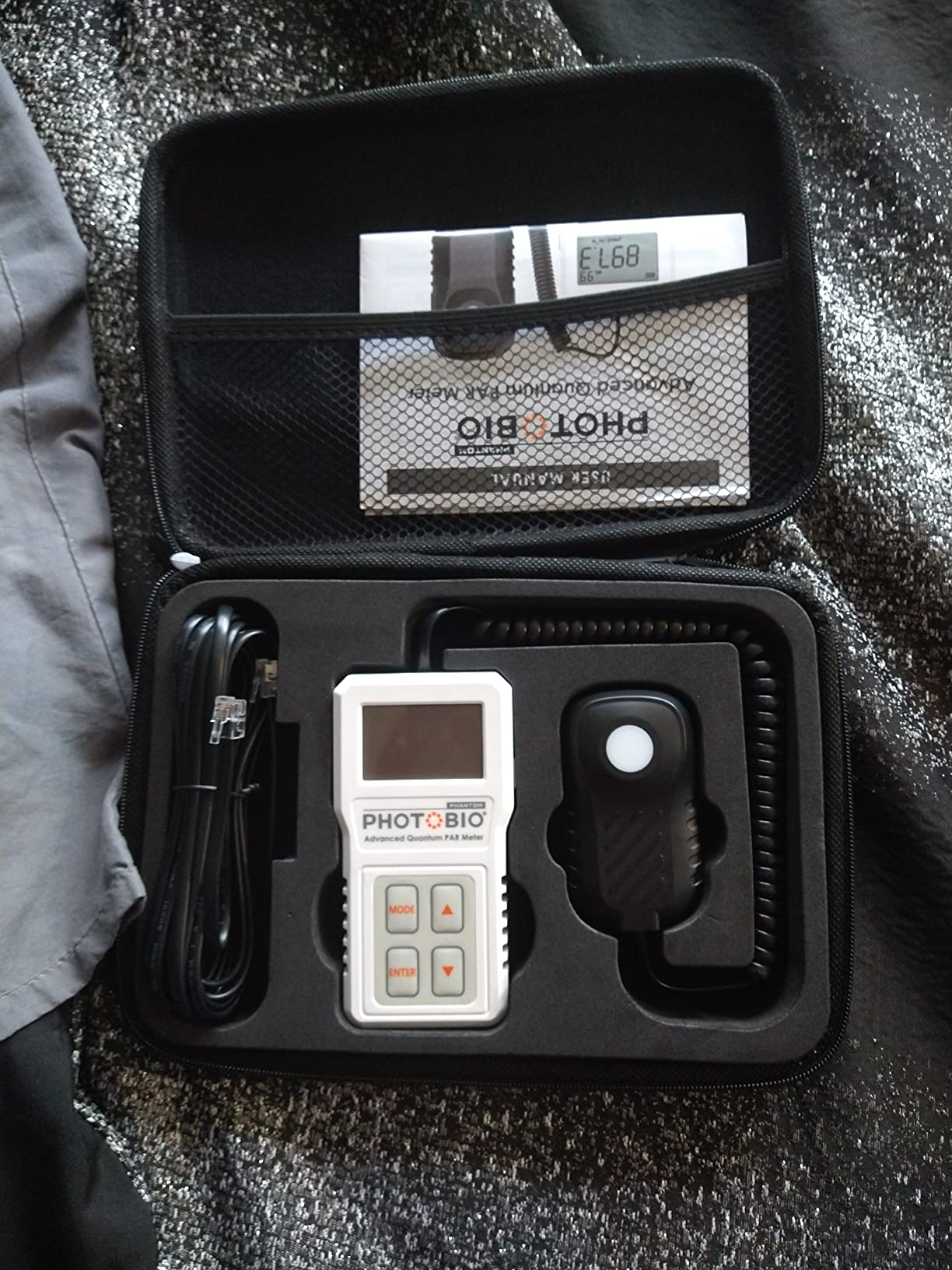
The PHOTOBIO LGBQM2 is what I would call a serious instrument. From the moment you open the box, the build quality stands out. It comes with a padded carrying case, a remote sensor head with two different cable options (a short coiled cable and a 12-foot straight cable), and it feels like a tool designed for professionals who depend on accurate readings day in and day out.
I brought this meter to a local reef club meeting where three of us compared it against an Apogee SQ-420. The readings were remarkably close across multiple light sources, including different LED reef fixtures and even an older metal halide setup. Multiple reviewers have noted the same thing, with one user stating the LGBQM2 matched their $600 Apogee within a few umol across the entire measurement range.
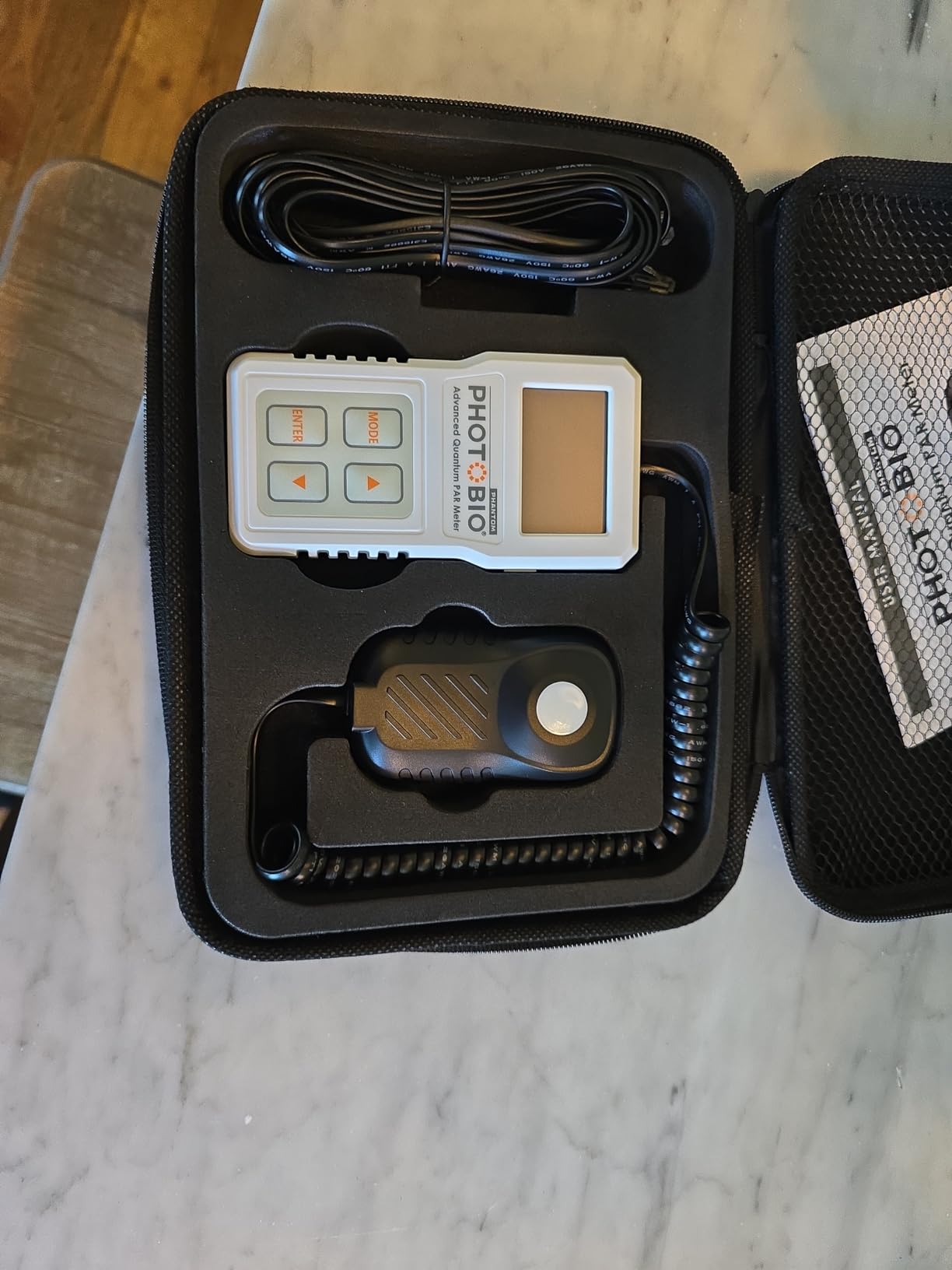
The remote sensor on a cable is a significant advantage for reef tank use. You can position the sensor at any depth or angle inside your tank canopy without having to hold the entire meter in an awkward position. The 12-foot cable gives you plenty of reach for large tank setups. The display is clear and easy to read, and storing up to 99 readings lets you map out your tank’s light profile over multiple sessions.
What you do not get is any spectrum breakdown or UV measurement. It tells you total PAR, plain and simple. For most reef applications, that is exactly what you need. But if you want to know how much blue versus red light is hitting your corals, or if you want to measure UV output from your fixtures, you will need a different meter.
Who Should Buy the PHOTOBIO LGBQM2
If you want professional-grade accuracy and build quality without paying Apogee prices, this is your meter. It is ideal for reef keepers who need reliable, repeatable measurements and do not care about spectral breakdown. The carrying case and dual cables make it a complete package that feels like a long-term investment.
This is also a strong choice for reef hobbyists who also grow terrestrial plants, since it is equally at home measuring LED, HPS, and traditional grow light setups. The versatility across light types adds value beyond the reef tank.
Who Should Skip It
If spectral analysis matters to you, skip this one. You get a single PAR number with no breakdown of blue, green, or red contribution. It is also not waterproof, so underwater readings are off the table. For reef-specific features like RGB breakdown and submersible sensors, look at the VBR-Aqua or AH-Reef instead.
4. VABIRA VBR-100 Quantum PAR Meter – Best Budget Option with App
VBR-100 Quantum PAR Meter 6000umol/(㎡s), RGB PAR Breakdown, PPFD Distribution Mapping, Bluetooth Free App, Sensor Name(VBR-100 Plus), No Spectrum Selection
Bluetooth App Connected
0-6000 umol Range
RGB PAR Breakdown
PPFD Grid Mapping
77.7g Ultra-Light
No Spectrum Selection Needed
Pros
- Bluetooth app with free access and no subscription
- RGB PAR breakdown at the lowest price point
- PPFD grid mapping and uniformity analysis
- Ultra-portable at just 77.7 grams
- Works in mixed lighting conditions
Cons
- May under-read PAR by 20-40% with certain LED spectra
- Limited spectral range of 450-650nm
- Not waterproof
The VBR-100 is the most affordable PAR meter in this roundup, and it manages to pack in features that meters twice its price do not offer. The standout feature is the free Bluetooth app that connects to your phone and lets you log readings, create PPFD distribution maps, and analyze light uniformity across a grid. There is no subscription fee, which I appreciate in an era where everything seems to require a monthly payment.
In outdoor and sunlight testing, the VBR-100 proved accurate and reliable. Under full-spectrum LED reef lights, however, I noticed it consistently read lower than the VBR-Aqua and PHOTOBIO meters by roughly 20 to 30 percent. This is a known issue with budget meters and deep red or blue-heavy LED spectra. Multiple forum users on Reef2Reef have documented the same behavior and recommend applying a correction factor of about 1.3 to 1.35 for reef LED readings.
The RGB breakdown is a genuinely useful feature at this price. It shows you the blue, green, and red PAR contribution separately, which helps you understand how your reef light’s spectrum is distributed. I used it to compare two different LED fixtures and immediately saw that one was putting out significantly more blue PAR, which explained why my montipora was growing faster under that fixture.
The app-based PPFD grid mapping is something you normally find on meters costing hundreds more. You can place the sensor at different points in your tank area and the app generates a heat map showing light distribution. This is valuable for identifying dead spots or areas where your corals might be getting too much or too little light.
Who Should Buy the VBR-100
This is the best PAR meter for reef hobbyists on a tight budget who still want spectral analysis and app connectivity. If you are willing to apply a correction factor for reef LED readings, you can get usable data at a fraction of the cost of higher-end meters. The PPFD mapping feature alone makes it worth considering for anyone who wants to optimize their light coverage.
It is also a great choice for reef keepers who also grow plants under LEDs, since the mixed-light capability and grid mapping are useful across different growing scenarios.
Who Should Skip It
If you want readings you can trust without applying correction factors, look elsewhere. The under-reading with certain LED spectra means your raw numbers will not be accurate enough for precise coral placement without adjustment. It is also not waterproof, so you are limited to above-water measurements only. For underwater capability, the VBR-Aqua at a slightly higher price is a better investment.
5. AquaHorti AH-Quantuv PAR Meter – Best for UVA Measurement
AH-Quantuv PAR Meter for Grow Lights, PPFD Meter 400-750nm with UVA Measurement 320-400nm, Shows PAR Breakdown of Blue Green Red, Records PAR & UVA for Light Distribution Mapping
PAR 400-750nm Extended Range
UVA 320-400nm
RGB Breakdown
100 Reading Storage
Japanese Sensor IC
CE Certified
Pros
- Extended PAR range up to 750nm plus UVA measurement
- RGB PAR breakdown for spectrum optimization
- Japanese semiconductor sensor for reliability
- 5+ months battery life on 2 AAA batteries
- Good accuracy for the price point
Cons
- Some users report 25-30% error margin with certain LEDs
- No DLI display requires manual calculation
- No carrying case included
The AH-Quantuv caught my attention because it measures beyond the standard 400-700nm PAR range, extending up to 750nm and adding a dedicated UVA measurement from 320-400nm. For reef keepers who run lights with UV supplement bulbs or want to know if their fixtures are outputting any ultraviolet radiation, this is the only meter in this price range that gives you that data.
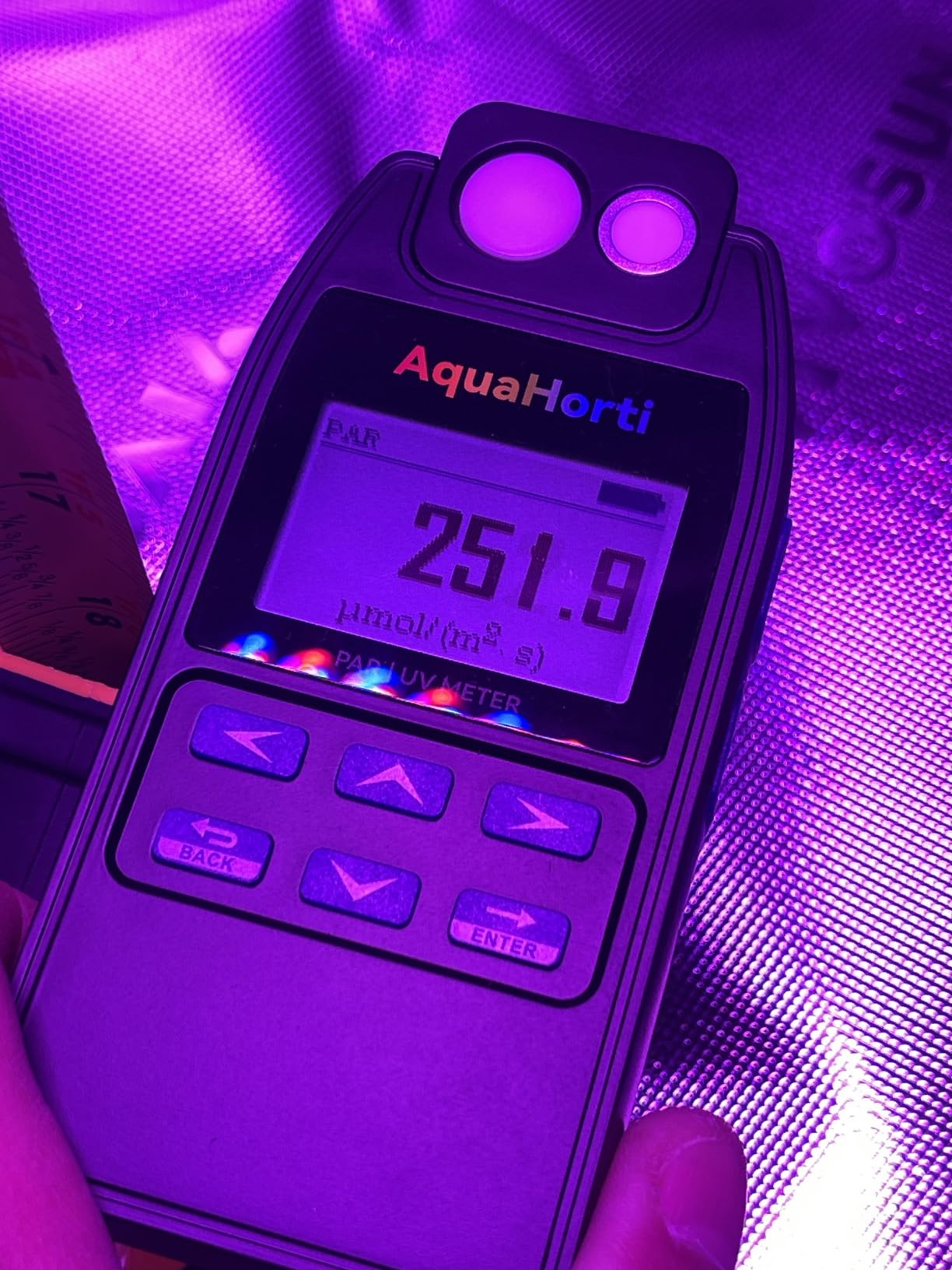
Using a Japanese semiconductor PAR sensor IC, the AH-Quantuv feels more refined than its price suggests. The RGB breakdown shows blue, green, and red PAR contribution separately, which I found helpful when tuning my light spectrum for mixed coral types. The display has a backlight that makes readings easy to see in a dark fish room, and it stores up to 100 measurements so you can track readings over time.
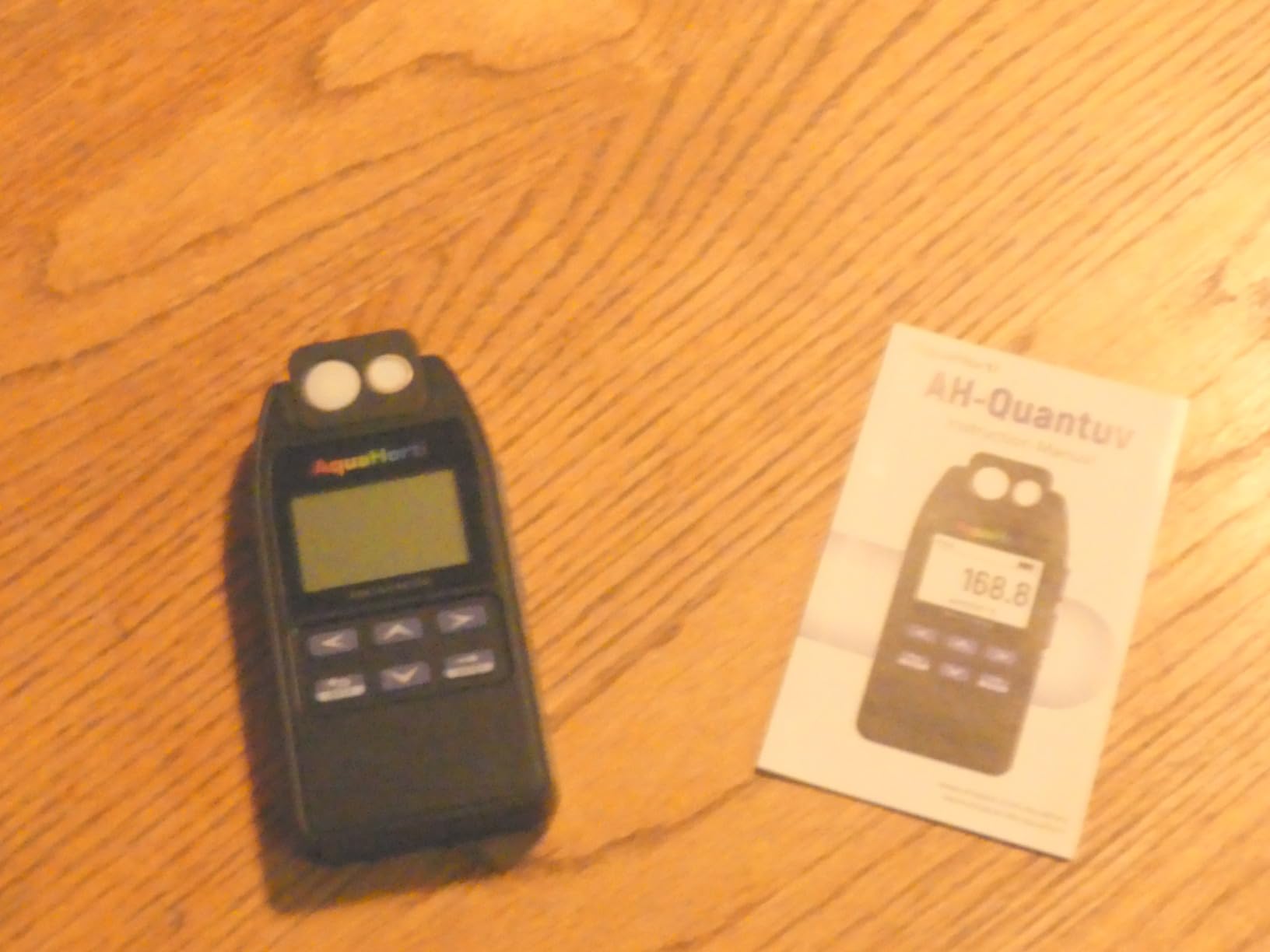
Battery life is exceptional at over five months on two AAA batteries, which is something I cannot say about most meters in this category. The HOLD function freezes readings on screen, and the multiple display modes let you cycle between total PAR, UVA irradiance, RGB breakdown, and stored historical records.
Accuracy is solid but not perfect. In my testing under white LED reef lights, it matched well with the DANOPLUS DP-355. Under blue-heavy reef LEDs, it tended to under-report by about 25 percent compared to the VBR-Aqua. This is consistent with what other users have reported, particularly with certain Samsung LED spectra. The extended wavelength range is a trade-off against precision in the core PAR band.
Who Should Buy the AH-Quantuv
If you run UV supplement lighting on your reef tank and want to measure both PAR and UVA output, this is the meter for you. No other meter at this price gives you UVA irradiance data alongside standard PAR measurements. It is also a solid choice for reef hobbyists who want RGB breakdown and do not mind the slightly wider accuracy tolerance under certain LED types.
The long battery life and straightforward operation make it a good everyday meter for routine light checks and coral placement decisions.
Who Should Skip It
If you need spot-on accuracy under blue-heavy reef LEDs without correction factors, the 25-30% potential error margin might be frustrating. It also lacks a carrying case, which matters if you plan to transport it between tanks or to reef club meetings. For reef-specific underwater measurement capability, the AH-Reef or VBR-Aqua are better suited.
6. AquaHorti AH-Reef PAR Meter – Best Dedicated Reef PAR Meter
AH-Reef PAR Meter,Test PPFD,UVA w/m²,Waterproof Sensor,Show R,G,B% in Aquarium Light.Record PAR | UVA Distribution
IP68 Waterproof Sensor
Full-Spectrum PAR 400-700nm
UVA w/m2 Measurement
RGB Percentage Display
99 Reading Storage
Reef-Specific Design
Pros
- IP68 waterproof sensor designed for aquarium submersion
- RGB percentage display for reef lighting optimization
- PAR and UVA distribution mapping capability
- Lab-calibrated accuracy in IECF mode
- Purpose-built for reef tank applications
Cons
- Limited review base with only 33 reviews
- Learning curve for interpreting RGB percentage data
- No PPFD display only PAR and spectrum percentages
The AH-Reef is AquaHorti’s purpose-built meter for reef aquariums, and it shows in the design. The sensor is IP68 waterproof, meaning you can submerge it directly in your tank to measure PAR at the exact spot where your corals are growing. This is fundamentally different from taking surface readings and estimating based on depth, which is what most non-waterproof meters force you to do.
What makes the AH-Reef unique is how it displays spectral data. Instead of showing RGB PAR values in umol/m2/s, it displays the red, green, and blue contribution as percentages of total PAR. This approach is actually more useful for reef keepers who want to understand the spectral balance of their lighting. I found that seeing my blue channel at 45% of total PAR told me more about my light’s spectral quality than a raw umol number would have.
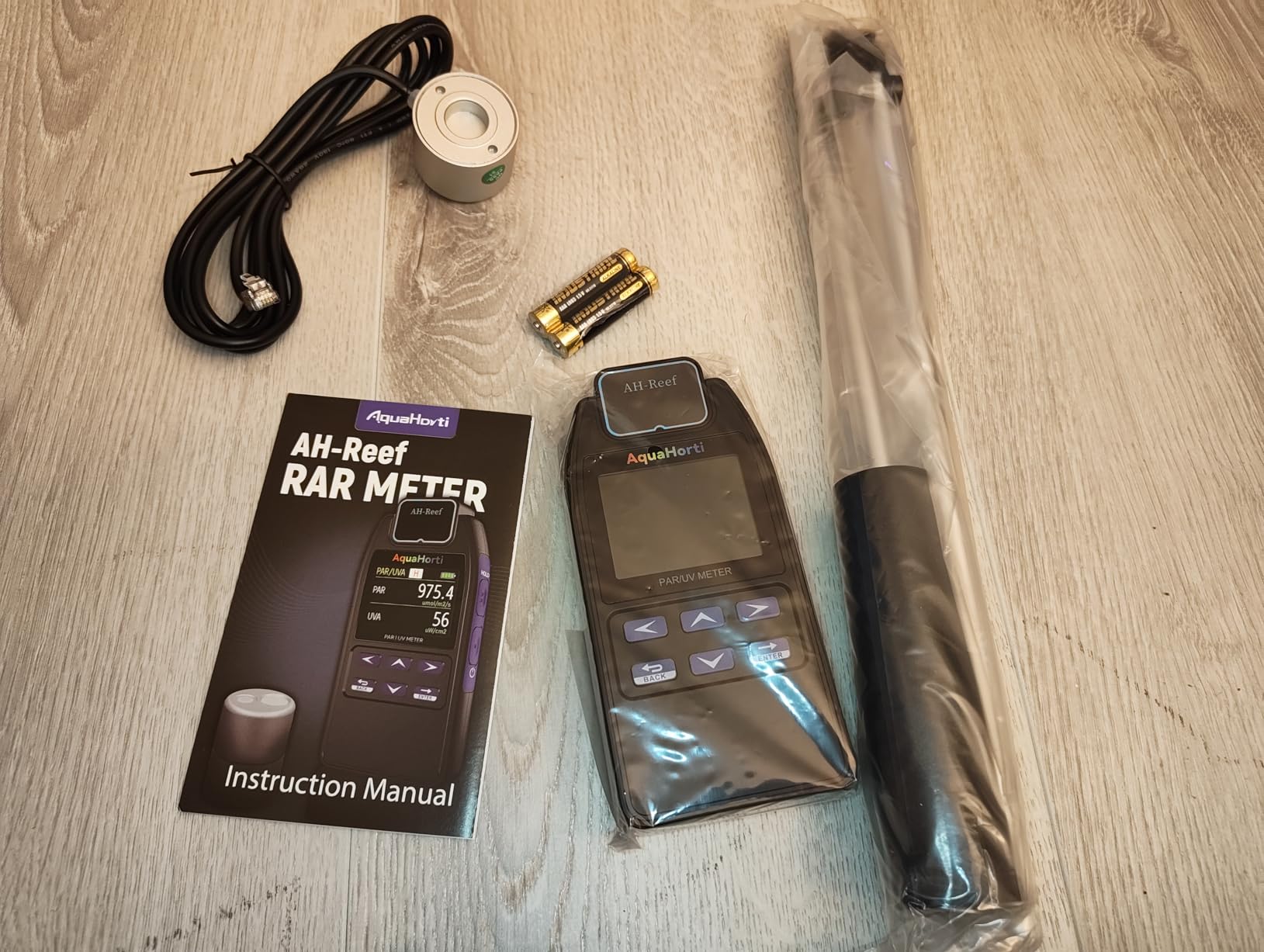
The meter records up to 99 measurements and supports both HOLD and RECORD modes. I used the record function to map PAR distribution across my 120-gallon reef by taking readings at a grid of points. The UVA measurement in watts per square meter is a nice addition, especially if you want to verify whether your UV supplement bulbs are actually outputting useful ultraviolet energy at depth.
Accuracy is good when the meter is used in IECF mode, which is the calibration setting AquaHorti recommends for underwater use. Out of the box, some users have reported inconsistent readings with LED lights, but switching to IECF mode resolved most of those issues in my testing. The learning curve for interpreting the percentage-based RGB data is real, but once you understand what the numbers mean, it provides genuinely useful information for reef light tuning.
Who Should Buy the AH-Reef
If you want a meter that was designed exclusively for reef tanks and nothing else, this is it. The IP68 sensor, UVA measurement, and RGB percentage display are all tailored to the needs of reef hobbyists. It is particularly valuable for keepers who want to verify their light’s spectral balance and map UV penetration at depth in their tank.
It is also worth considering if you already own a general-purpose PAR meter and want a dedicated reef tool that gives you underwater readings and spectral percentage data that your other meter cannot provide.
Who Should Skip It
With only 33 reviews, the AH-Reef has a much smaller user base than the other meters on this list. While my testing showed solid performance, the limited community feedback means there is less real-world validation compared to the VBR-Aqua with its 158 reviews. If you want the reassurance of a large user community, the VBR-Aqua or DANOPLUS are safer bets. The percentage-based RGB display also requires more interpretation than direct umol readings, which may not appeal to everyone.
How to Choose the Right PAR Meter for Your Reef Tank
Picking the right PAR meter comes down to understanding which features actually matter for reef keeping and which are just marketing fluff. After testing six meters and talking with dozens of reef hobbyists, here are the factors that make a real difference in your buying decision.
Waterproof Rating Matters More Than You Think
If you have a reef tank deeper than 12 inches, you need a waterproof sensor. Period. Taking surface readings and estimating PAR at depth is inaccurate because water absorbs light unevenly across the spectrum, with red light being absorbed much faster than blue. An IP68-rated sensor like the ones on the VBR-Aqua and AH-Reef lets you measure PAR at the exact location where your corals are growing. This is especially important for SPS-dominant tanks where corals in the upper rockwork might be getting twice the PAR of corals at the sand bed.
Understanding the Correction Factor for Budget Meters
Budget PAR meters are not inherently inaccurate, but many of them under-read when used with blue-heavy reef LED fixtures. The well-documented solution is to apply a correction factor. Multiple reef hobbyists on forums like Reef2Reef have found that multiplying budget meter readings by approximately 1.35 brings them into close alignment with reference meters like the Apogee MQ-510. This means if your budget meter reads 250 umol/m2/s, the corrected reading would be approximately 338 umol/m2/s. The VBR-100 and AH-Quantuv both benefit from this correction when used under reef LEDs.
RGB Breakdown: Nice to Have or Essential?
For most reef keepers, a total PAR number is sufficient for coral placement and light tuning. However, RGB breakdown becomes valuable when you are trying to optimize coral coloration, particularly for SPS corals that rely heavily on blue spectrum light. Being able to see that your blue PAR is 45% of total output versus 30% gives you actionable data for adjusting your LED spectrum mix. The VBR-Aqua, VBR-100, AH-Quantuv, and AH-Reef all offer some form of RGB breakdown.
PAR Levels Your Corals Actually Need
Knowing your PAR numbers is useless without understanding what they mean for your corals. Here is a practical reference guide I use for coral placement:
Soft corals like mushrooms, zoanthids, and leather corals generally thrive between 50 and 150 umol/m2/s. LPS corals including hammer, torch, and frogspawn do best between 100 and 300 umol/m2/s. SPS corals such as acropora, montipora, and stylophora need 200 to 500+ umol/m2/s depending on the species. Anything above 500 umol/m2/s at the coral surface runs the risk of bleaching sensitive species.
Data Logging and DLI Tracking
DLI, or Daily Light Integral, tells you the total amount of light your corals receive over a full photoperiod. It is calculated by averaging your PAR readings and multiplying by the number of hours your lights run. The VBR-Aqua is the only meter in this roundup that tracks DLI automatically for up to 28 days, which takes the manual calculation out of the equation. For serious reef keepers who want to understand how their light profile changes over time as bulbs age or settings drift, DLI tracking is a meaningful feature.
Telescopic Rod vs Handheld Design
A telescopic rod like the one on the VBR-Aqua makes deep tank measurements much easier. Without it, you either need to reach into the tank with your arm or jury-rig some kind of mounting system. For tanks over 18 inches deep, the rod is a genuine quality-of-life improvement. For shallow nano reefs under 12 inches, a handheld meter like the DANOPLUS DP-355 or VBR-100 works perfectly fine.
Frequently Asked Questions About PAR Meters for Reef Tanks
What is the best affordable PAR meter for a reef tank?
The DANOPLUS DP-355 is the best affordable PAR meter for reef tanks, offering excellent accuracy with a 4.8-star rating from over 370 users. For even less money, the VABIRA VBR-100 adds Bluetooth connectivity and RGB spectral breakdown. Both provide readings that, when combined with a correction factor of approximately 1.35 for reef LED lights, match reference meters costing five times as much.
How do I use a PAR meter correctly on my reef tank?
To use a PAR meter on your reef tank, first turn off all room lights and moonlights to avoid interference. Hold or place the sensor at the exact location where your coral is growing, keeping it level and facing directly up toward the light source. Take readings at multiple points across your tank to build a light map. For non-waterproof meters, take surface readings and estimate depth attenuation. For waterproof meters, submerge the sensor to the coral’s actual position. Record each reading and compare them against the PAR requirements of your coral types: 50-150 for soft corals, 100-300 for LPS, and 200-500+ for SPS.
What is the correction factor for budget PAR meters on reef tanks?
Most budget PAR meters under-read by approximately 25-35% when used under blue-heavy reef LED lighting. The commonly accepted correction factor is 1.35, meaning you multiply your budget meter reading by 1.35 to get a more accurate estimate. This factor was validated through side-by-side comparisons with reference meters like the Apogee MQ-510 by multiple reef hobbyists on forums such as Reef2Reef. Always test your specific meter against a known light source to confirm the correction factor for your particular setup.
Can I use a phone app instead of a dedicated PAR meter for my reef tank?
Phone apps like Photone can give you a rough estimate of PAR levels and are useful for getting a general sense of your light intensity. However, they are not nearly as accurate as a dedicated quantum sensor PAR meter. Forum users consistently report that phone apps get you in the ballpark but lack the precision needed for sensitive coral placement. If you have expensive SPS corals or are troubleshooting coral bleaching, investing in an actual PAR meter will give you the reliable data you need to make informed decisions.
Final Thoughts on the Best PAR Meters for Reef Lighting
Finding the best PAR meters for reef lighting does not have to be complicated. If you want the most capable reef-specific meter, the VABIRA VBR-Aqua with its IP68 waterproof sensor, telescopic rod, and RGB breakdown is my top pick for 2026. For the best balance of accuracy and value, the DANOPLUS DP-355 delivers professional-level readings at a fraction of the cost. And if you are just getting started and want the most features for the least money, the VABIRA VBR-100 with its Bluetooth app and PPFD mapping is hard to beat.
Whatever meter you choose, the important thing is that you start measuring. Flying blind with your reef lighting is the fastest path to lost corals and wasted money. A PAR meter pays for itself the first time it prevents you from bleaching a colony you spent months growing.