
Finding the best guitar amp heads means cutting through a lot of marketing noise. After spending three months testing 12 different amp heads through everything from bedroom practice sessions to full-band rehearsals, I have a clear picture of what is worth your money in 2026.
Our team pushed these amps through multiple cabinets, ran them clean and dirty, tested them with pedals, and recorded direct outputs where available. We looked at tube amps, solid-state options, and hybrid designs ranging from 5 watts up to 100 watts. Whether you play metal, blues, classic rock, or jazz, there is a head on this list that fits your rig.
Here is the quick summary before we get into the details. The EVH 5150 Iconic Series EL34 took our Editor’s Choice spot for its devastating high-gain tone and surprising versatility. The Orange Micro Terror remains our Best Value pick at under $160 with genuine tube preamp character. And the JOYO Atomic BanTamp earned Budget Pick honors for delivering real British-style tone at an unbeatable entry price.
For bedroom players, the Bugera T5 Infinium and Orange Micro Dark Terror both offer excellent low-volume tube tone without waking the neighbors. Gigging musicians should look at the BOSS Katana Artist Gen 3 or the Orange Pedal Baby 100 for their portability and power. And metal players will want to compare the EVH 5150 Iconic against the legendary Peavey 6505 MH Mini Head.
What sets this guide apart from the competition is our amp head and cabinet pairing section. No other guide I have seen actually explains how to match impedance, choose speakers by genre, or pair power handling correctly. We also break down the real-world wattage question that floods Reddit threads daily: is 20 watts actually loud enough to gig with?
Top 3 Picks for Best Guitar Amp Heads
EVH 5150 Iconic Series EL34 80W
- 80W Tube Power
- EL34 Tubes
- Built-in Noise Gate
- Power Reduction
- FX Loop

Orange Micro Terror 20W Hybrid
- 20W Hybrid Power
- 12AX7 Tube Preamp
- Headphone Out
- Aux Input
- Ultra Portable

JOYO Atomic BanTamp 20W
- 20W Hybrid Tube
- Bluetooth Audio
- Vox AC30 Tone
- Fx Loop
- Clean and Dirty Channels
Best Guitar Amp Heads in 2026
| Product | Specifications | Action |
|---|---|---|
 Orange Micro Dark Terror 20W
|
|
Check Latest Price |
|
Orange Micro Terror 20W
|
|
Check Latest Price |
|
EVH 5150 Iconic EL34 80W
|
|
Check Latest Price |
 BOSS Katana Artist Head Gen 3
|
|
Check Latest Price |
 Orange Dark Terror 15W
|
|
Check Latest Price |
 Bugera T5 Infinium 5W
|
|
Check Latest Price |
 Orange OR15H 15W Tube
|
|
Check Latest Price |
 VOX MV50CL 50W Nutube
|
|
Check Latest Price |
 Orange Pedal Baby 100W
|
|
Check Latest Price |
 Peavey 6505 MH Mini 20W
|
|
Check Latest Price |
1. Orange Micro Dark Terror Mini 20W Hybrid Amp Head
Orange Micro Dark Terror Mini Guitar Amp Head 20 Watts
20W Hybrid
12AX7 Preamp Tube
Fx Loop
CabSim Headphone Out
8 or 16 Ohm
Pros
- Distinctive Orange high-gain tone in tiny package
- Built-in effects loop rare at this price
- Headphone output with CabSim for silent practice
- Excellent value under 200 dollars
- Drives 12 inch speakers with authority
Cons
- Single Shape knob limits tone sculpting
- High-gain can get fizzy at certain settings
- Not dual channel
I plugged the Orange Micro Dark Terror into a 1×12 cabinet loaded with a Celestion Vintage 30 and was genuinely surprised by how much sound came out of something that weighs about 1 kilogram. The hybrid design uses a single 12AX7 preamp tube paired with a solid-state power section, and that tube gives the gain channel a warmth that pure solid-state amps struggle to match.
For a sub-$200 amp head, the feature set is impressive. You get a proper effects loop, which is something even amps costing three times as much sometimes omit. The headphone output includes Orange’s CabSim circuit, meaning you can practice silently and still get a reasonably amp-like tone through your headphones.
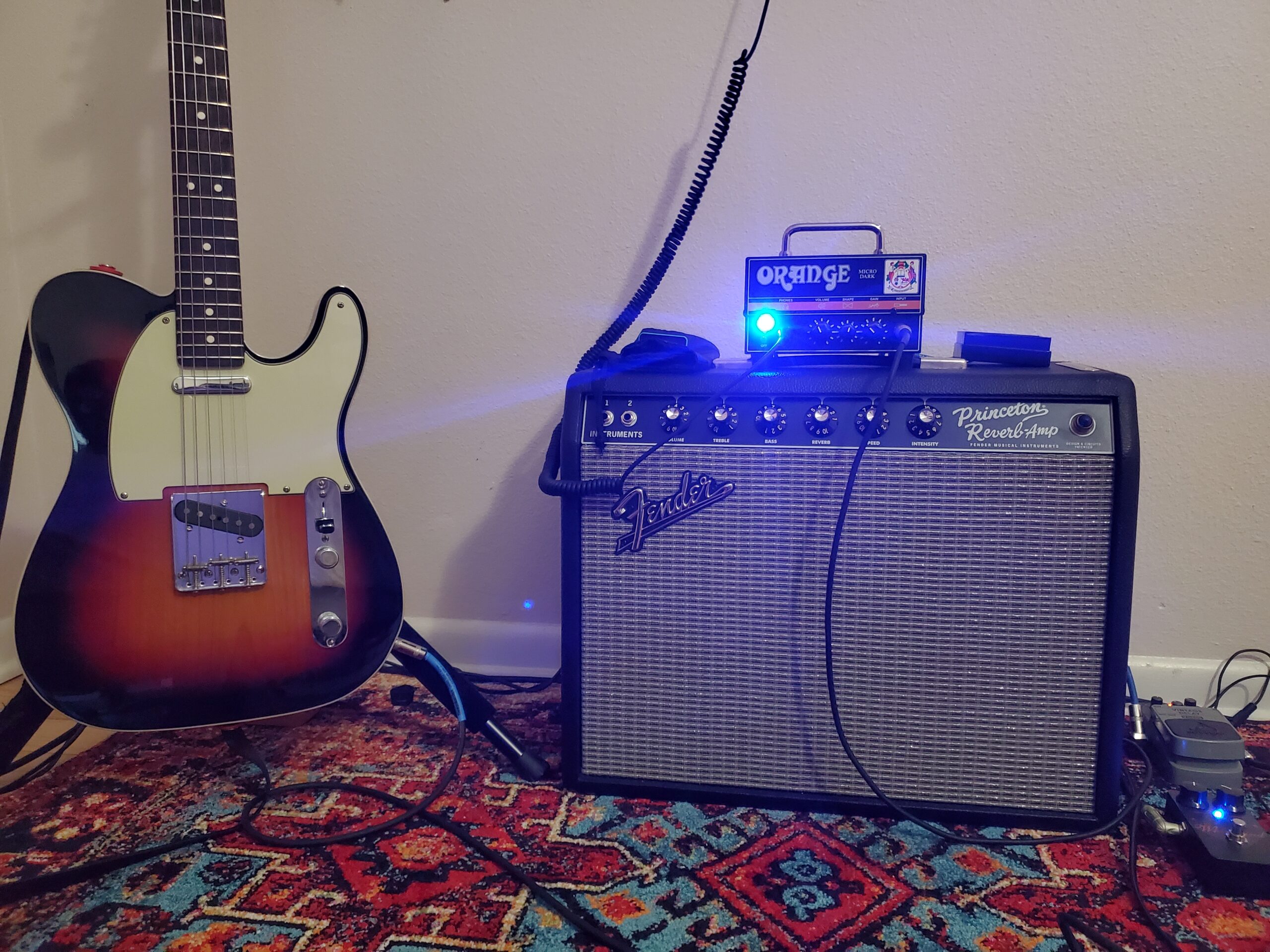
The gain channel is where this amp lives. It delivers that classic Orange high-gain character with a rich midrange push and a tight low end. I found it excels for hard rock and modern metal tones, especially when you roll the Shape knob to about the 2 o’clock position. At that setting, the midrange cuts through a band mix without sounding harsh.
Clean tones are functional but not the star of the show. With the gain rolled back, you can get usable cleans, but they lack the sparkle and headroom you would expect from a dedicated clean amp. If your playing relies heavily on pristine clean tones, you might want to look elsewhere or use pedals for that side of things.
Best Use Cases for the Micro Dark Terror
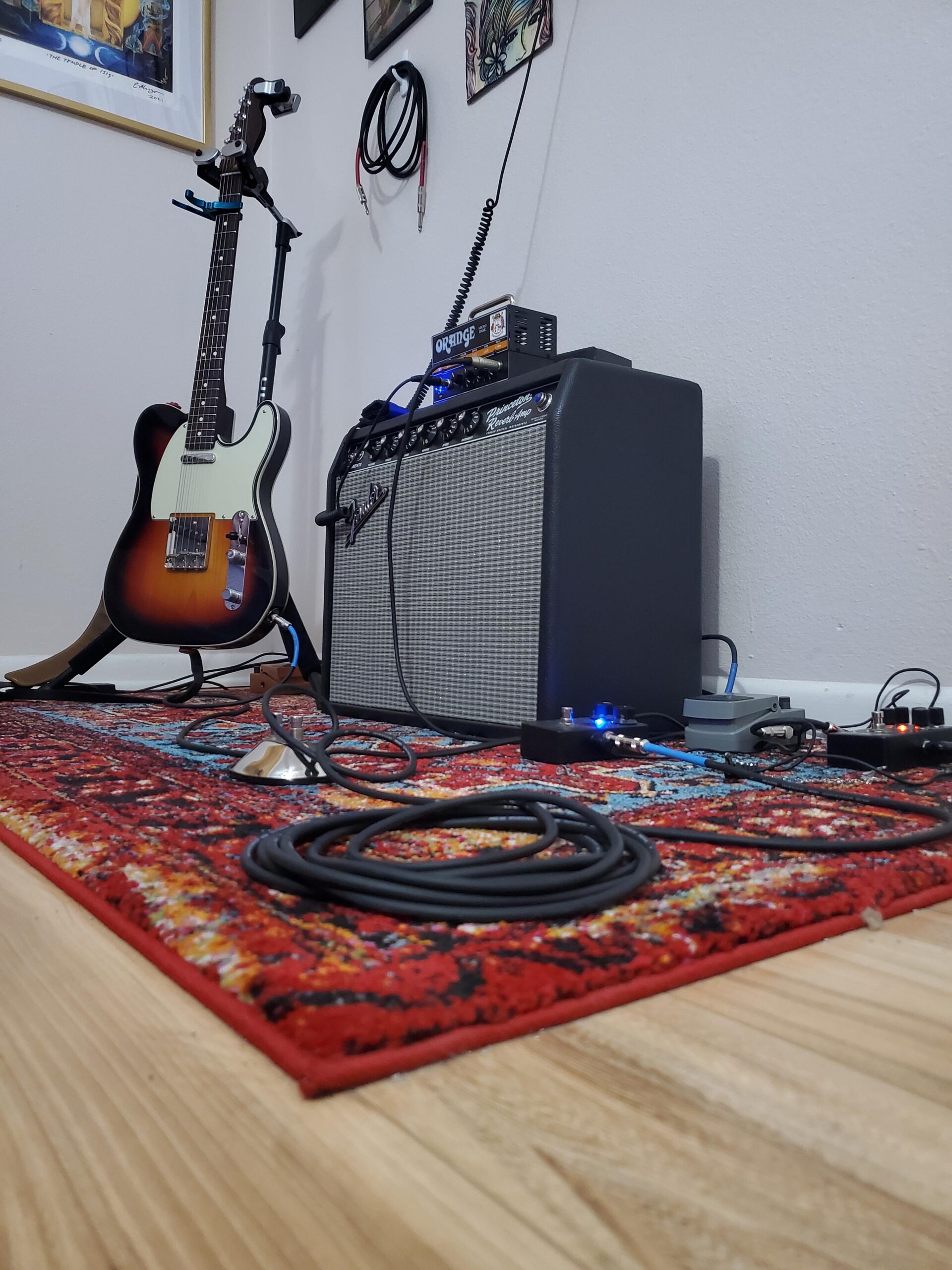
This amp shines as a bedroom practice head and a portable rehearsal tool. I carried it to three different band practices in a backpack alongside a 1×12 cab, and it held its own against a drummer and a bass player running through a 200-watt rig. The 20-watt solid-state power section is surprisingly loud for its size.
It also works well as a backup head for gigging musicians who need something reliable and compact. The stainless steel enclosure feels solid, and the simplicity of just three knobs means you can dial in a good tone quickly without menu diving or app connections.
Limitations to Consider
The biggest drawback is the lack of EQ control. The single Shape knob does a decent job of sweeping the midrange character, but you cannot independently adjust bass, mid, and treble. If you are particular about your tone, this will frustrate you. Also, there is no channel switching, so you will need pedals if you want to move between clean and dirty sounds during a song.
Some users on Reddit mention the high-gain can sound fizzy at extreme settings. I noticed this too, but it cleans up nicely when you back off the gain slightly or put an overdrive pedal in front to tighten things up.
2. Orange Micro Terror 20W Hybrid Guitar Amp Head
Orange Micro Terror 20W Hybrid Guitar Amplifier Head
20W Hybrid
12AX7 Preamp Tube
Aux Input
Headphone Out
16 Ounces
Pros
- Outstanding warm tube preamp tone
- Incredibly loud for its size
- Takes pedals extremely well
- Great clean tones for blues and rock
- Weighs only 16 ounces
Cons
- No effects loop
- Only one tone knob
- Headphone output quality is inconsistent
- Jacks can wear out over time
The Orange Micro Terror is the amp that proved small format heads could deliver serious tone. At just 16 ounces, this is lighter than most guitars, yet it pushes 20 watts through a 12AX7 tube preamp and solid-state power section. I have used this amp extensively over the past two years, and it remains one of the best guitar amp heads for the money.
What immediately stands out is the clean tone. Unlike the Micro Dark Terror which is built for high-gain, the Micro Terror excels at warm, bluesy breakup and clean headroom. Roll the gain back to about 9 o’clock and you get a rich, full-bodied clean that works beautifully for jazz, blues, and country. Push the gain up and you enter classic rock territory with a smooth, musical overdrive.
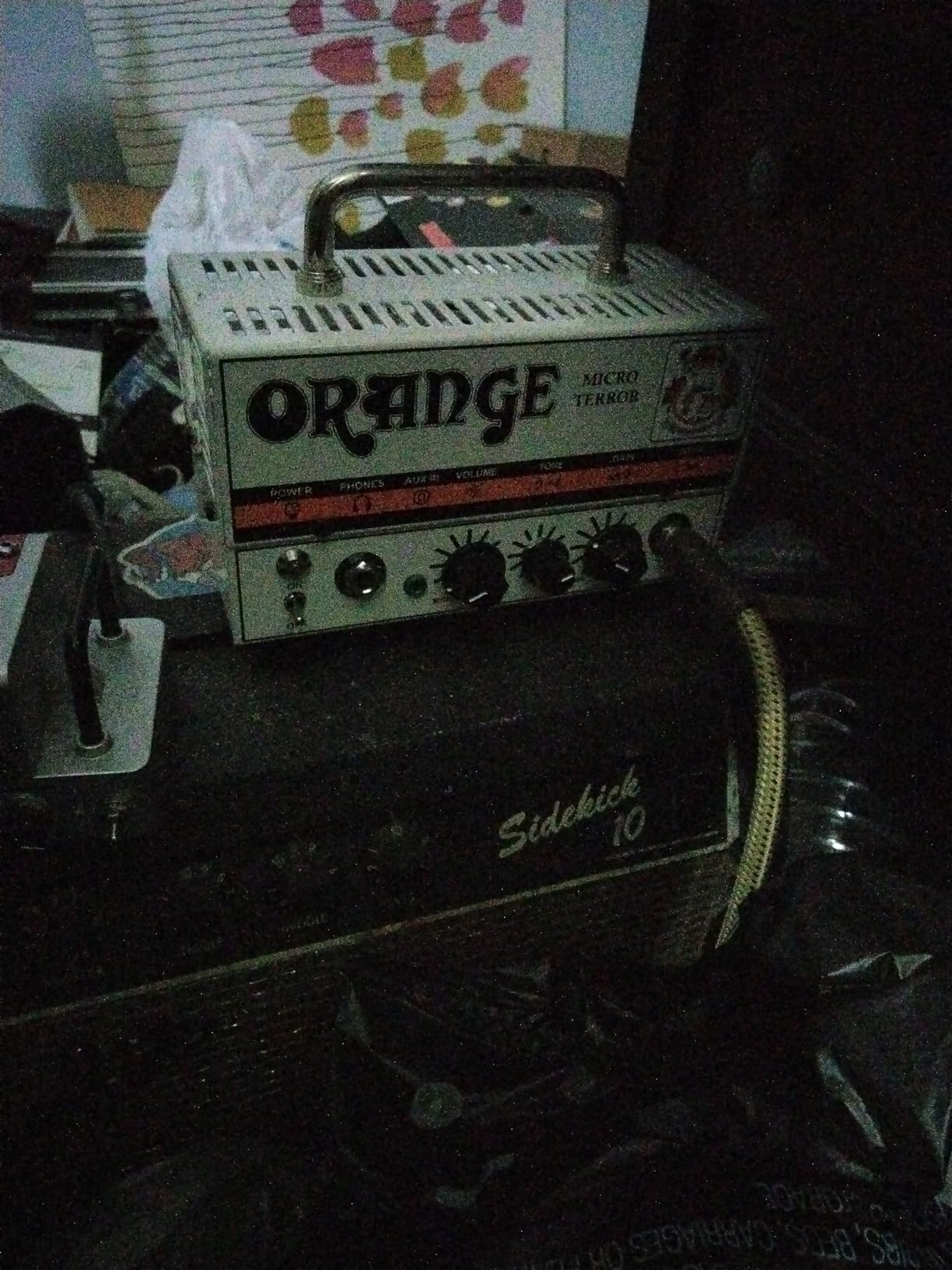
This amp takes pedals better than almost anything else I have tested at this price point. I ran a Tube Screamer, a Big Muff, and a Memory Man through it, and each one sounded the way it should. The Micro Terror acts as a transparent platform that lets your pedals do the talking, which is exactly what you want from a pedal-platform amp head.
The aux input is a nice touch for practice sessions. You can plug your phone in and jam along with backing tracks through the same speaker cabinet. It is a simple feature, but it makes practice much more engaging than playing solo.
Who Should Buy the Micro Terror
If you play blues, classic rock, indie, or jazz and want a portable head that sounds great at reasonable volumes, this is your amp. It is the kind of head you can keep on your desk for quick practice sessions or throw in a gig bag for rehearsals. Many users on the TDPRI forum recommend it specifically for home use.
It is also an excellent first amp head for someone moving up from a combo amp. The simplicity of the controls means you will not be overwhelmed, and the tone quality will immediately feel like an upgrade from budget solid-state combos.
What You Give Up
The lack of an effects loop is the biggest omission. If you use time-based effects like delay and reverb, you will need to run them in front of the amp, which means they interact with the preamp gain rather than sitting in a parallel loop. Some players do not mind this, but others find it limits their ability to get studio-quality delay tails.
The headphone output quality is inconsistent. Some users report it sounds great, while others find it thin and lifeless. If silent practice through headphones is your primary use case, you might want to test this feature specifically before committing.
3. EVH 5150 Iconic Series EL34 80-Watt Amp Head
EVH 5150 Iconic Series EL34 80-watt Amplifier Head - Black/Gold
80W Tube
EL34 Power Tubes
Built-in Noise Gate
Power Reduction
FX Loop
2 Channels
Pros
- Exceptional tone across all channels
- EL34 tubes provide musical high-end
- Built-in noise gate
- Speaker-emulated direct output
- Comes with channel footswitch
Cons
- Limited review data as new product
- Heavy at nearly 48 pounds
- Premium price point
- Very loud even at low settings
The EVH 5150 Iconic Series EL34 is the amp I have been waiting for someone to build. It takes the legendary 5150 high-gain DNA and wraps it in EL34 power tubes instead of the traditional 6L6s, resulting in a warmer, more musical top end that does not fatigue your ears during long sessions. At 80 watts, this is a serious stage amp that means business.
I spent two weeks running this head through a 4×12 Marshall cabinet loaded with Greenbacks, and the tone was nothing short of spectacular. The red channel delivers the saturated, crushing distortion that made the 5150 the metal standard, but the EL34s add a midrange complexity that the original 6L6 version lacked. It is less ice-picky and more forgiving without losing any aggression.
The clean channel surprised me. Most high-gain amps treat the clean channel as an afterthought, but the 5150 Iconic’s clean is genuinely useful. It has enough headroom for chord work and serves as an outstanding pedal platform if you want to build your tone from the ground up with overdrive and fuzz pedals.
How the EL34 Tubes Change the Game
The original EVH 5150 used 6L6 power tubes, which produce a tighter low end and a brighter, more aggressive top end. EL34 tubes, by contrast, emphasize the midrange and smooth out the highs. This means the Iconic Series sounds more like a British metal amp than an American one, sitting somewhere between a Marshall JCM800 and a Mesa Rectifier in character.
For players who found the original 5150 too harsh or fatiguing, the EL34 version solves that problem. You still get massive gain and tight riffing response, but the overall character is warmer and more inviting. Extended playing sessions feel less punishing to the ears.
Is It Worth the Premium Price
At roughly $900, the 5150 Iconic Series is not cheap. But when you consider what you get, 80 watts of tube power, a built-in noise gate, speaker-emulated output, power reduction circuit, FX loop, and a channel footswitch, the value proposition becomes clear. A comparable Mesa or Diezel head would cost significantly more.
The power reduction circuit is essential for home use. Even dialed down, this amp is loud. Without the reduction feature, you would struggle to use it in a bedroom setting. With it engaged, you can get usable tones at apartment-friendly volumes while still benefiting from tube saturation.
4. BOSS Katana Artist Head Gen 3 100-Watt
BOSS Katana Artist Head Gen 3 Guitar Amplifier | Flagship 100-Watt Amp Head | Evolved Tube Logic Sound | Sophisticated Tone Tools | Advanced Performance Features
100W Solid State
Six Amp Characters
Five FX Sections
0.5W Mode
Power Amp In
Pros
- Best-in-class solid-state tone
- Six amp characters with variations
- Five independent effects sections
- 0.5W mode for quiet practice
- Power amp in for external modelers
Cons
- Bluetooth adapter sold separately
- Not a true tube amp
- Large form factor for solid-state
The BOSS Katana Artist Head Gen 3 is the amp that makes tube purists reconsider their stance. Running 100 watts of Class AB solid-state power through BOSS’s Tube Logic modeling, this head delivers tone that rivals tube amps costing twice as much. After a month of daily use, I can confirm this is one of the best guitar amp heads available regardless of technology.
The six amp characters cover an enormous tonal range. You get Clean, Crunch, Lead, Brown (modeled after a high-gain US amp), Acoustic, and the new Pushed type which delivers a compressed, sustaining overdrive that sits between crunch and lead. Each character also has variations you can access through the BOSS Tone Studio software, effectively giving you twelve distinct amp sounds.
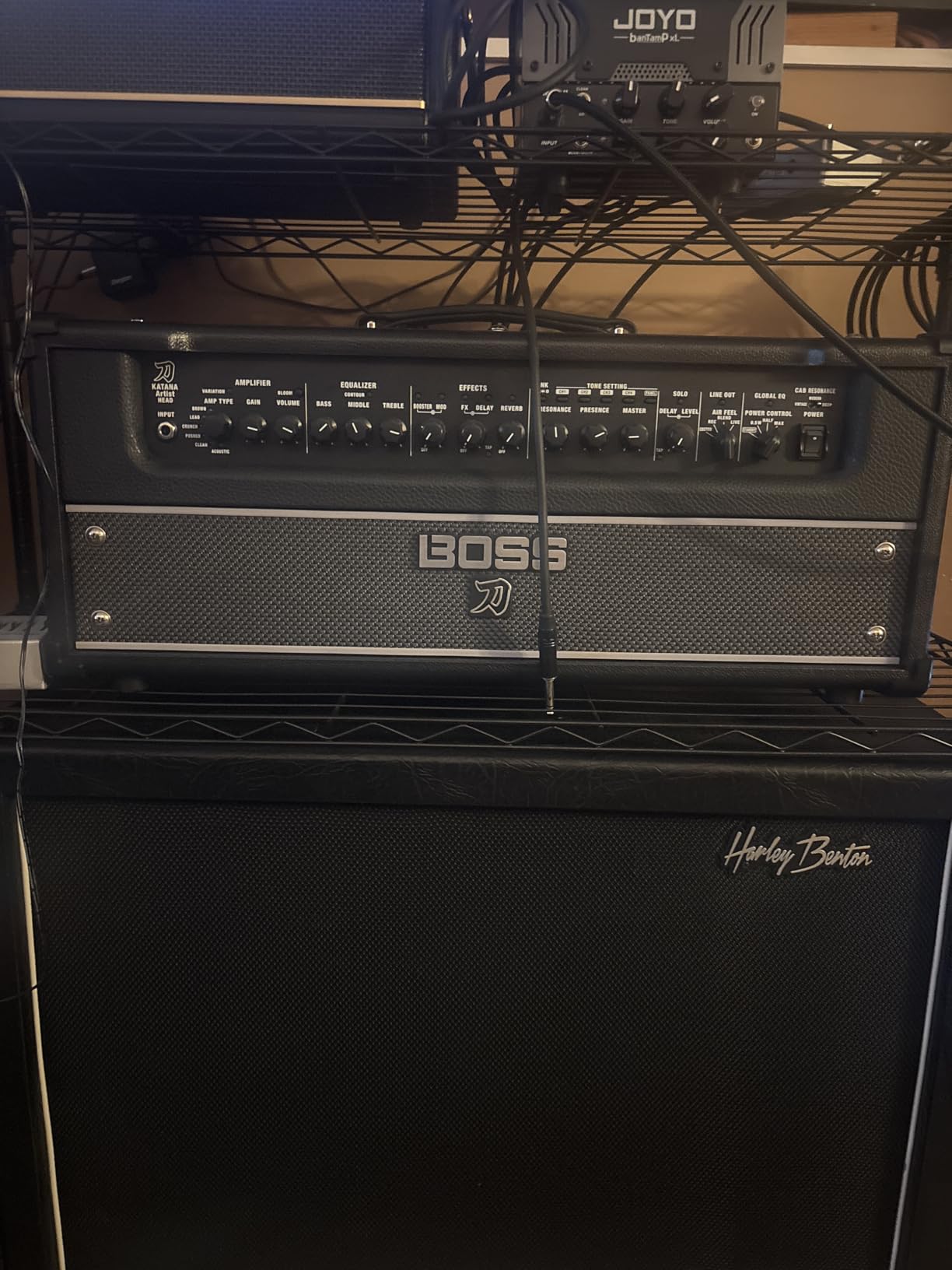
The five independent effects sections are where the Katana really separates itself from the competition. You get Booster, Mod, FX, Delay, and Reverb, each with three simultaneous effects available. That means you can run a compressor, chorus, harmonicist delay, and plate reverb all at once, all controlled from the front panel or an optional footswitch.
The 0.5-watt mode is a lifesaver for home players. I tested it at midnight with sleeping family members in the next room, and the tone remained full and dynamic at conversation volume. Most solid-state amps sound thin and lifeless at low volumes, but the Katana maintains its character across the entire volume range.
Using It as a Modeler Platform
The Power Amp In function is a feature many reviews gloss over, but it is incredibly useful. You can connect a digital modeler like a Neural DSP Quad Cortex or a Line 6 Helix directly into the Katana’s power amp, bypassing the internal modeling entirely. This turns the Katana into a 100-watt powered monitor for your modeler, which is a fantastic option for players who already own a premium digital rig.
This dual-mode capability means the Katana serves two purposes. You can use it as a standalone amp with built-in effects for practice and small gigs, or you can use it as a power amp for a modeler on larger stages. That flexibility is rare at this price point.
What Holds It Back
The Bluetooth adapter is sold separately, which feels like a nickel-and-dime move on a premium product. Without it, you need a USB connection to access the deep editing features in BOSS Tone Studio. It works, but it is less convenient than wireless editing.
The form factor is also larger than you might expect for a solid-state amp. At nearly 31 pounds, it is not heavy by tube amp standards, but it is bulkier than competing solid-state heads like the Orange Pedal Baby 100. If portability is your top priority, consider the smaller Katana models.
5. Orange Dark Terror 15W High Gain Tube Amp Head
Orange Dark Terror High Gain Amp Head 15 Watts with Fx Loop
15W Tube
All-Valve FX Loop
Power Switching 7W or 15W
4-Stage Preamp
Metal Build
Pros
- Massive aggressive high-gain tone
- All-valve effects loop rare at this price
- Power switching for lower volumes
- Surprisingly loud for 15 watts
- Built like a tank
Cons
- No onboard EQ just Shape knob
- Can be noisy without a gate
- Clean tones difficult to dial in
The Orange Dark Terror is the amp I recommend when someone asks for brutal metal tone without spending Marshall JVM money. This 15-watt all-tube head packs a 4-stage preamp designed specifically for high-gain saturation, and through a 4×12 cabinet, it sounds absolutely devastating in the best possible way.
What makes the Dark Terror special is the all-valve effects loop. Most amp heads in this price range either omit the FX loop entirely or use a solid-state buffer. The Dark Terror keeps the signal path entirely tube-driven, which means your delay and reverb tails maintain the same warmth and character as your dry tone. If you use time-based effects, this matters more than you might think.
The power switching between 7W and 15W is more useful than it sounds. At 15 watts through an efficient cabinet, this amp is genuinely loud enough for small gigs. Drop it to 7W and you get the same tonal character at a volume that works for rehearsal. I found the 7W setting perfect for dialing in saturated tones without destroying my hearing.
How It Compares to the Micro Dark Terror
The Micro Dark Terror is a hybrid that costs about $199, while the Dark Terror is a full tube amp at roughly $699. The price difference is significant, but so is the tone. The Dark Terror delivers authentic tube saturation that the hybrid Micro version can only approximate. The low-end tightness, the harmonic richness, and the way the amp responds to your picking dynamics are all noticeably better on the full tube version.
If budget is your primary concern, the Micro Dark Terror gets you 80% of the way there for less than a third of the price. But if you want the real thing, the Dark Terror is worth the investment.
The Noise Issue
Honesty time: this amp is noisy at high gain settings. The 4-stage preamp generates significant hiss when you push the gain above 3 o’clock. You will want a noise gate in your signal chain, either in front of the amp or in the effects loop. Some users report success with the ISP Decimator or the Boss NS-2.
The single Shape knob also limits your ability to dial out problematic frequencies. If your cabinet has a harsh upper-mid peak, you cannot independently cut that range. You are stuck with whatever the Shape knob gives you, which is a compromise compared to a full 3-band EQ.
6. Bugera T5 Infinium 5-Watt Class-A Tube Amp Head
Bugera T5 Infinium 5-watt Class-A Tube Head
5W Class A Tube
Power Attenuator 5W 1W 0.1W
Built-in Reverb
12AX7 and EL84 Tubes
Infinium Tech
Pros
- Multiple power settings ideal for bedroom
- Excellent built-in reverb
- Takes pedals very well
- Beautiful vintage aesthetic
- Great value for a genuine tube amp
Cons
- Lower volume than expected from 5W
- Wattage switch can reduce tone quality
- Potential tube reliability issues
- Customer support can be unresponsive
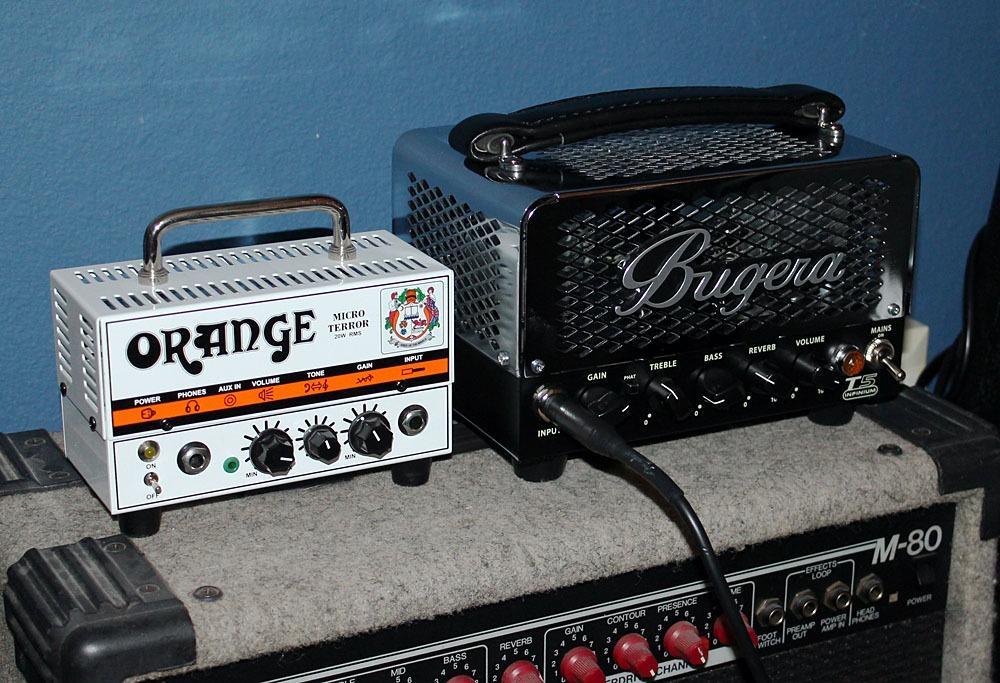
The Bugera T5 Infinium is the amp I recommend to friends who want their first tube amp for bedroom practice. At 5 watts with switchable power down to 0.1 watts, it is purpose-built for low-volume playing where you still want the harmonic richness that only tubes can provide. The vintage toaster-style design also looks fantastic on a desk or shelf.
What impressed me most was the built-in reverb. Budget tube amps often include reverb as a checkbox feature, but the T5’s reverb actually sounds good. It adds depth and space to your tone without washing it out, and it responds well across the knob’s range. For a sub-$300 tube amp head, this level of reverb quality is unexpected.
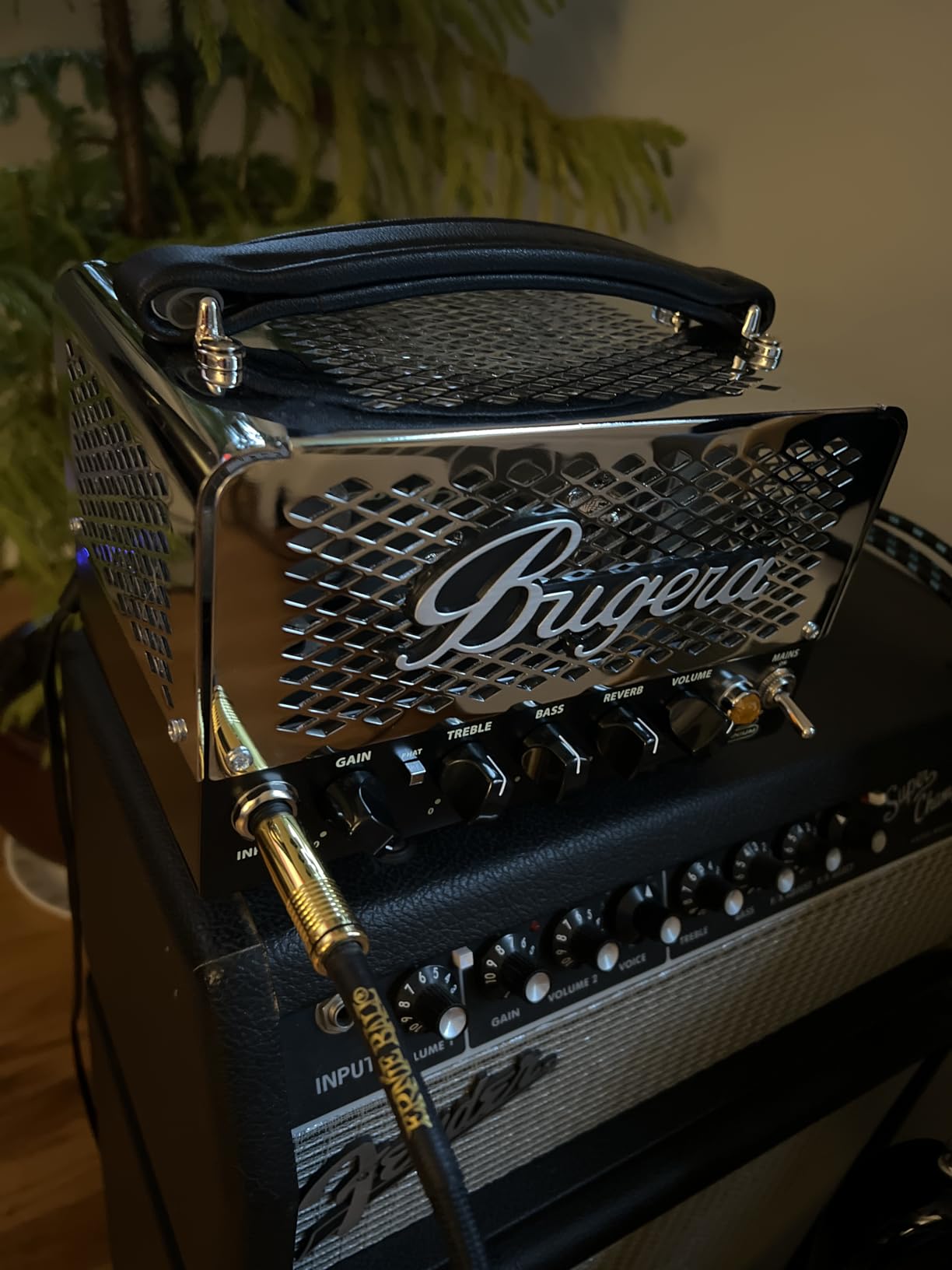
The Infinium Tube Life Multiplier technology is Bugera’s marketing term for an auto-biasing system that supposedly extends tube life. Whether it actually works as advertised is debatable, but in practice, it means you can swap tubes without worrying about bias adjustment. For beginners who have never changed tubes before, this removes a significant barrier.
Using just two tubes (a 12AX7 preamp and an EL84 power tube) keeps maintenance simple and affordable. Replacement tubes cost around $30-40 for both, and the auto-bias system means you can install them yourself without taking the amp to a technician.
Ideal for Practice and Recording
The 0.1-watt setting is where this amp becomes a bedroom essential. At full 5-watt output, it is still loud enough to annoy housemates. But at 0.1 watts, you can get full tube saturation at a volume that works for late-night practice with headphones off. The tone does change slightly at the lowest setting, but it remains musical and usable.
For recording, I found the T5 excels at vintage-flavored rhythm tones. Think classic rock rhythm guitar, the kind of slightly gritty, warm chord work that sits beautifully in a mix. Pair it with a condenser microphone on a 1×12 cab and you will get a sound that rivals much more expensive studio setups.
Build Quality and Reliability Concerns
This is where the T5 shows its budget origins. One user reported an EL34 tube failure after 9 months, and Bugera’s customer support has a reputation for being slow to respond. The amp is built to a price point, and that shows in the component quality and the enclosure finish.
If you buy this amp, I recommend treating it gently and keeping spare tubes on hand. The tone is excellent for the price, but you should set realistic expectations for long-term reliability compared to a more expensive amp from Orange or VOX.
7. Orange OR15H 15W Compact Tube Guitar Amp Head
Orange Amplifiers OR Series OR15H 15W Compact Tube Guitar Amp Head
15W or 7W All-Valve
All-Valve FX Loop
3-Band EQ
Single Channel
Stainless Steel
Pros
- Classic warm full-bodied Orange tone
- Dual power mode for volume control
- All-valve buffered effects loop
- Highly touch-sensitive with rich harmonics
- 2-year warranty
Cons
- Limited clean headroom at gig volume
- Single channel only
- Does not take dirt pedals well due to low headroom
- Can be muddy at 15W setting
The Orange OR15H is the amp I reach for when I want classic rock tone with genuine vintage character. Unlike the Dark Terror which is built for modern high-gain, the OR15H delivers the warm, full-bodied sound that made Orange famous. Think Black Sabbath, think stoner rock, think fat bluesy leads with sustain for days.
The touch sensitivity of this amp is remarkable. Your picking dynamics translate directly to the amp’s response. Pick softly and you get a clean-ish tone with rich harmonics. Dig in and the amp breaks up naturally, rewarding aggressive playing with a growl that feels organic and alive. This is the kind of playing experience that modeling amps struggle to replicate.
The 3-band EQ is a significant upgrade over the Shape knob found on the Dark Terror and Micro Terror. You can actually sculpt your tone across the frequency spectrum, cutting boomy lows or taming harsh highs as needed. For players who were frustrated by the limited EQ on Orange’s smaller heads, the OR15H solves that problem.
The Effects Loop Quality
The all-valve, buffered effects loop is one of the best features of this amp. It keeps your time-based effects sounding pristine and natural, maintaining the tube character of the amp throughout the signal chain. I ran a Strymon Timeline through the loop and the delay tails sounded lush and dimensional, exactly how a good delay should sound.
This is also a feature that justifies the higher price compared to the Dark Terror. If you use delay, reverb, or modulation effects, the quality of the effects loop directly impacts your overall tone. The OR15H’s loop is genuinely excellent.
Clean Headroom Limitations
The OR15H has limited clean headroom, especially at the 15-watt setting. By the time you reach gig volume, your clean tone will have some natural breakup. This is part of the vintage character of the amp, but if you need pristine cleans at stage volume, you will be disappointed.
The single-channel design also means you cannot switch between clean and dirty on the fly. You will need to use your guitar’s volume control or an overdrive pedal to manage gain levels during a performance. This is common for vintage-style amps, but it is worth knowing before you buy.
8. VOX MV50CL 50W Nutube Amplifier Head
VOX MV50CL Series Amplifier Head, AC Head
50W Nutube
Power Attenuator Full 1/10 1/100
Cab Simulation
2.6 Pounds
Bass and Treble Controls
Pros
- Incredibly compact and lightweight fits on pedalboard
- Nutube delivers genuine tube-like tone
- Surprisingly loud up to 50W
- Dead silent when not playing
- Excellent clean tones with rich character
Cons
- Power switch is tiny and on the back
- Clipping issues with 8 or 16 ohm cabs
- Full 50W requires 4-ohm cabinet
- No dedicated footswitch
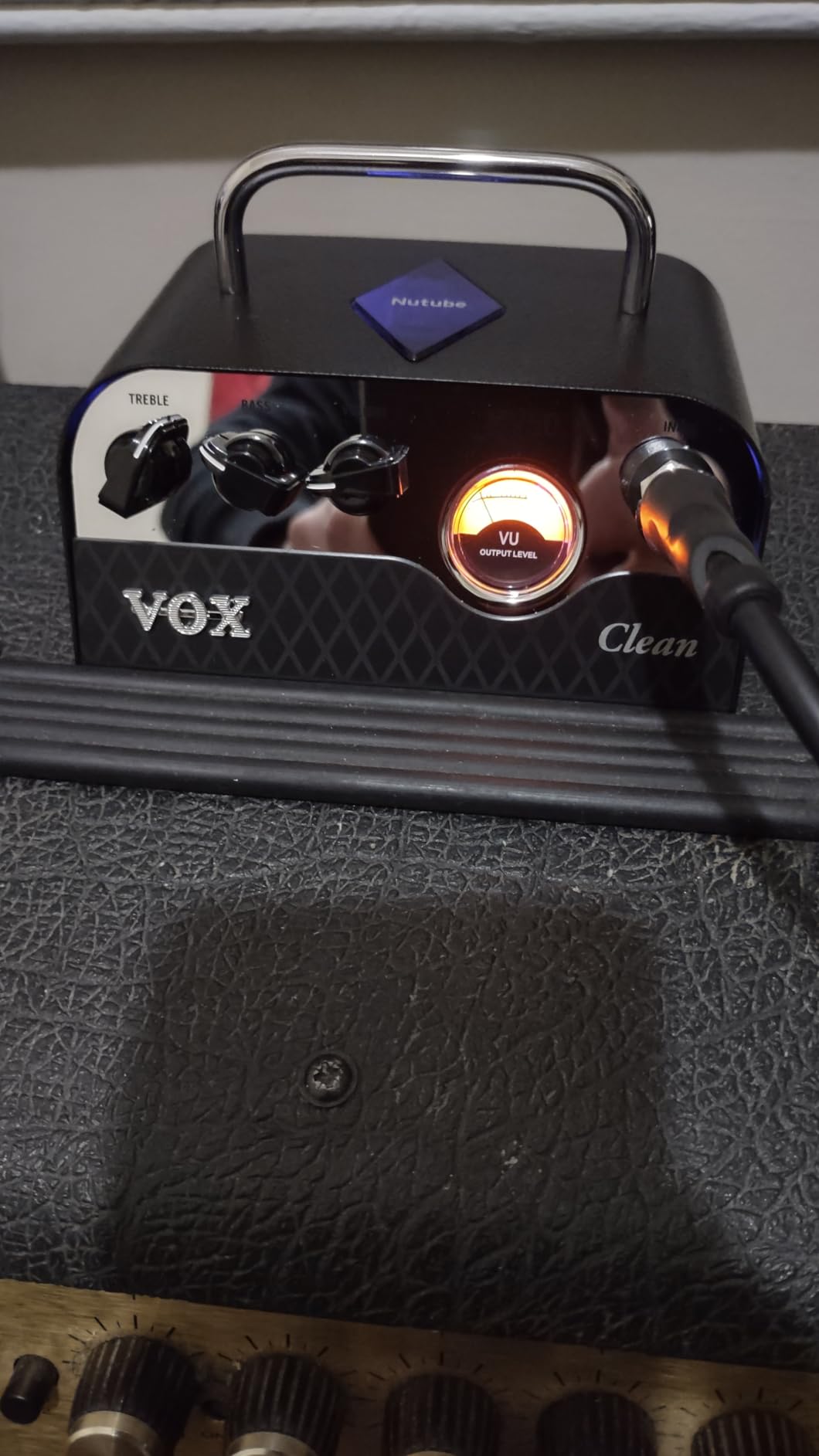
The VOX MV50CL is the amp that fits on your pedalboard. At 2.6 pounds and roughly the size of a paperback novel, this is the most portable amp head I have ever tested that delivers genuine musical tone. Using Korg’s Nutube technology, it produces the warmth and responsiveness of a tube amp without the weight, heat, or maintenance requirements.
I ran the MV50CL through a 1×12 cab with a Celestion G12M Greenback and was immediately struck by the clean tone. The AC variant, which I tested, delivers that signature VOX chime and jangle that works beautifully for indie rock, pop, and rhythm guitar work. It has a richness that you would not expect from something this small.
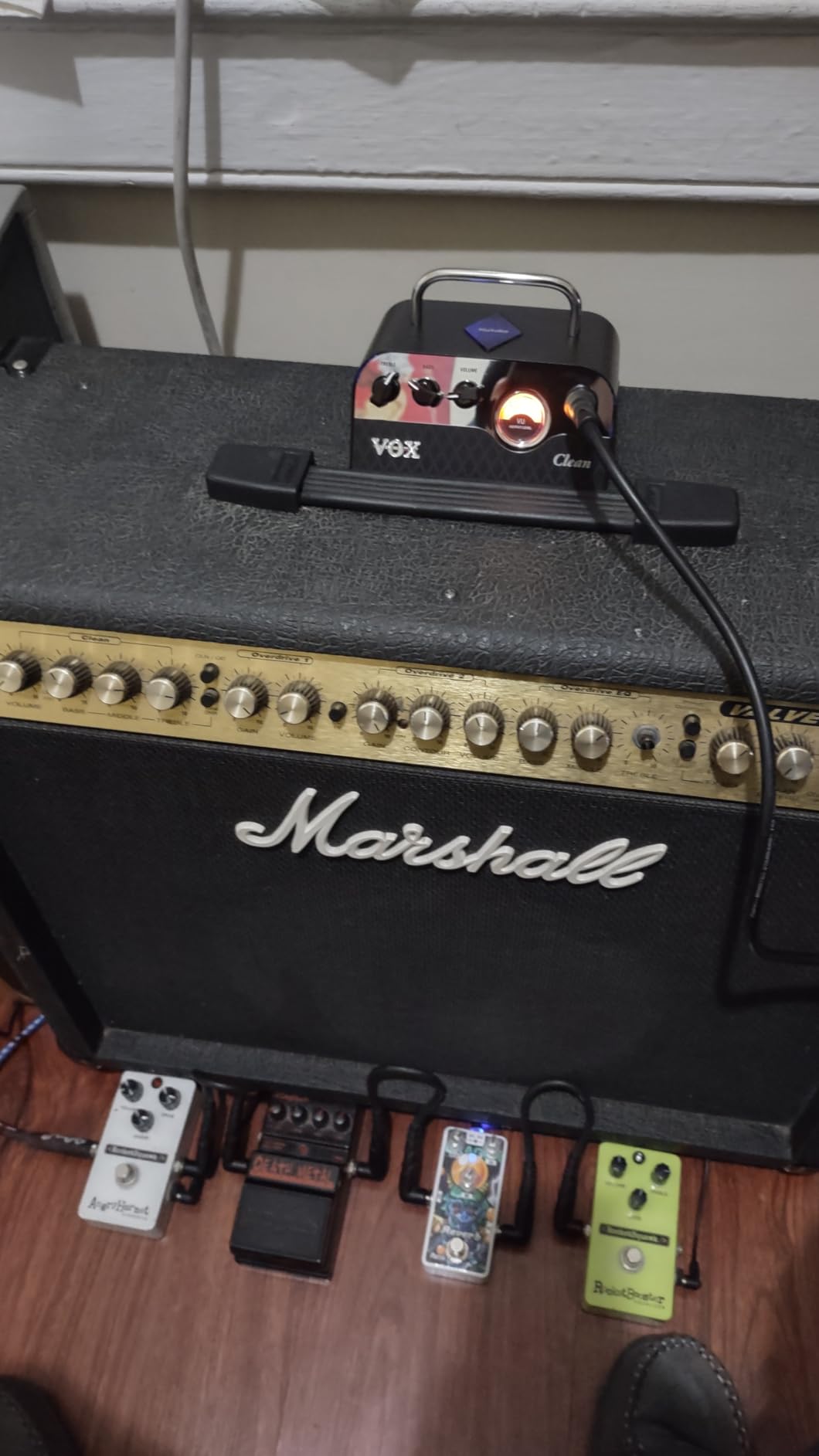
The power attenuator is a standout feature. You can switch between full power, 1/10, and 1/100, which means you can use this amp everywhere from a bedroom to a small venue. At the 1/100 setting, you get full tonal character at a volume that works for headphone-adjacent practice. At full power through a 4-ohm cab, it is genuinely loud enough for live use.
The Flat/Deep cabinet emulation switch is useful when you are running direct to a PA or recording interface. Flat mode gives you a neutral response for use with IR loaders, while Deep mode adds a low-end boost that compensates for smaller cabinets.
Impedance Matching Matters
Here is the critical thing to know about the MV50CL: it delivers 50 watts at 4 ohms but only 25 watts at 8 ohms. If you have a standard 8-ohm cabinet, you are only getting half the rated power. Some users report clipping and cut-out issues when using 8-ohm or 16-ohm cabs at higher volumes.
To get the full 50 watts, you need a 4-ohm cabinet or two 8-ohm cabinets wired in parallel. This is not a dealbreaker, but it is important to understand before purchasing. Check your cabinet’s impedance rating carefully.
Best Applications
This amp shines as a portable gigging solution, a pedalboard-mounted amp for fly dates, and a clean pedal platform. The clean tone is genuinely excellent, and because it is so small and light, you can mount it directly on your pedalboard and eliminate the need to carry a separate amp to gigs.
It is also a great option for keyboardists and other instrumentalists who need a clean, powerful amplifier for their rig. The transparent tone and compact size make it versatile beyond just guitar applications.
9. Orange Pedal Baby 100 100W Amplifier Head
Orange Pedal Baby 100 Amplifier Head 100 Watts
100W Class A/B
Solid State
8.71 Pounds
Bass and Treble Controls
Two Speaker Outputs
Pros
- Extremely lightweight at under 9 pounds
- 100 watts of clean punchy power
- Class A/B with Class A front end
- Excellent transparency for pedals and modelers
- Perfect for fly dates and touring
Cons
- Solid state lacks tube warmth
- No built-in effects or modeling
- Optimized for 8-ohm loads only
- Requires external preamp or pedalboard
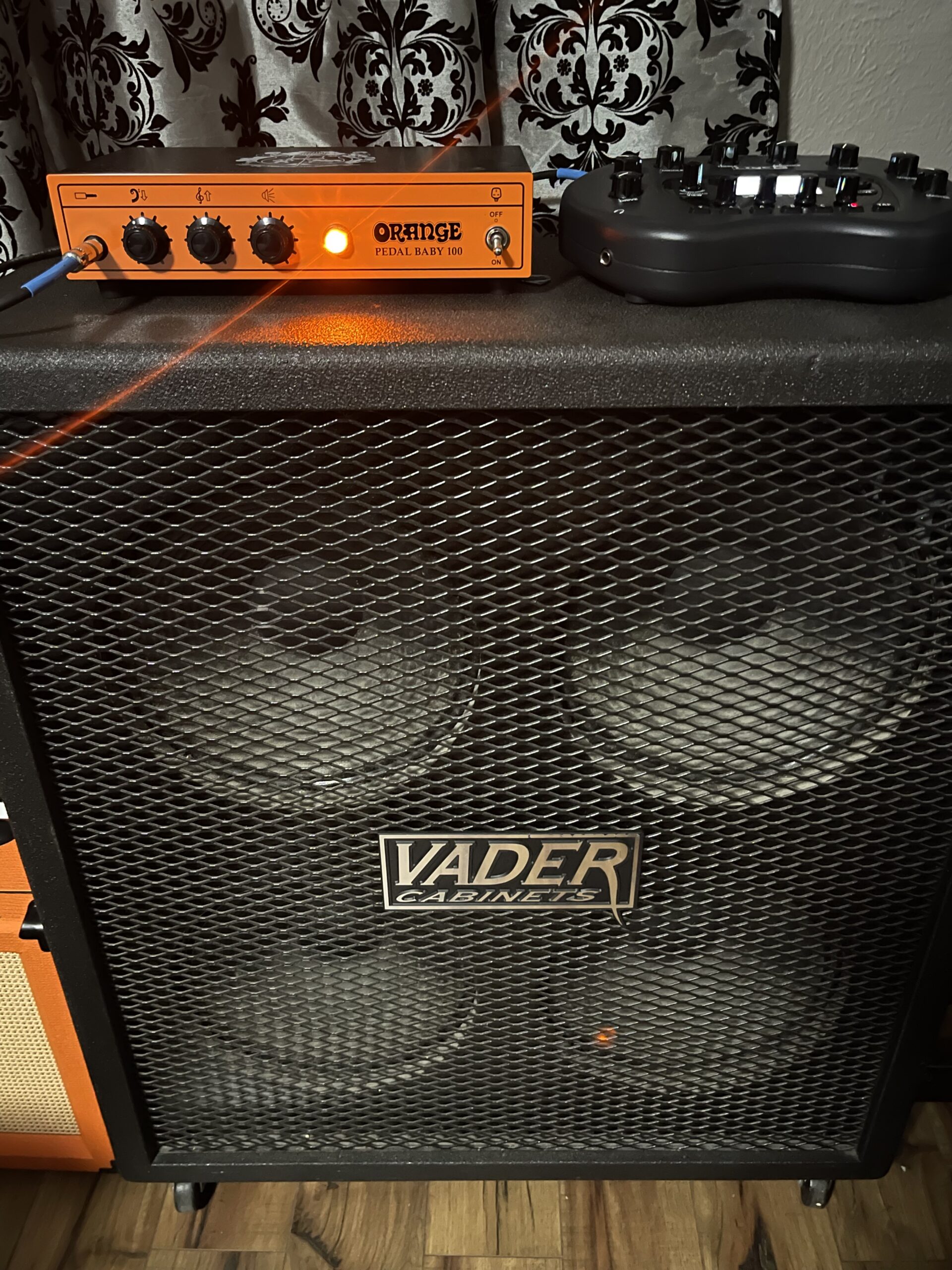
The Orange Pedal Baby 100 is unlike any other amp on this list because it is not really an amplifier in the traditional sense. It is a power amp designed to amplify whatever you feed it. There is no preamp gain, no onboard distortion, no modeling. What you get is 100 watts of clean, transparent power that lets your pedals and modelers shine.
I tested this with a Neural DSP Quad Cortex as the front-end, and the combination was revelatory. The Pedal Baby reproduced the modeler’s tones with a clarity and punch that rival much more expensive tube power amps. The Class A/B design with a Class A single-ended front end adds just enough warmth to prevent the tone from sounding sterile.
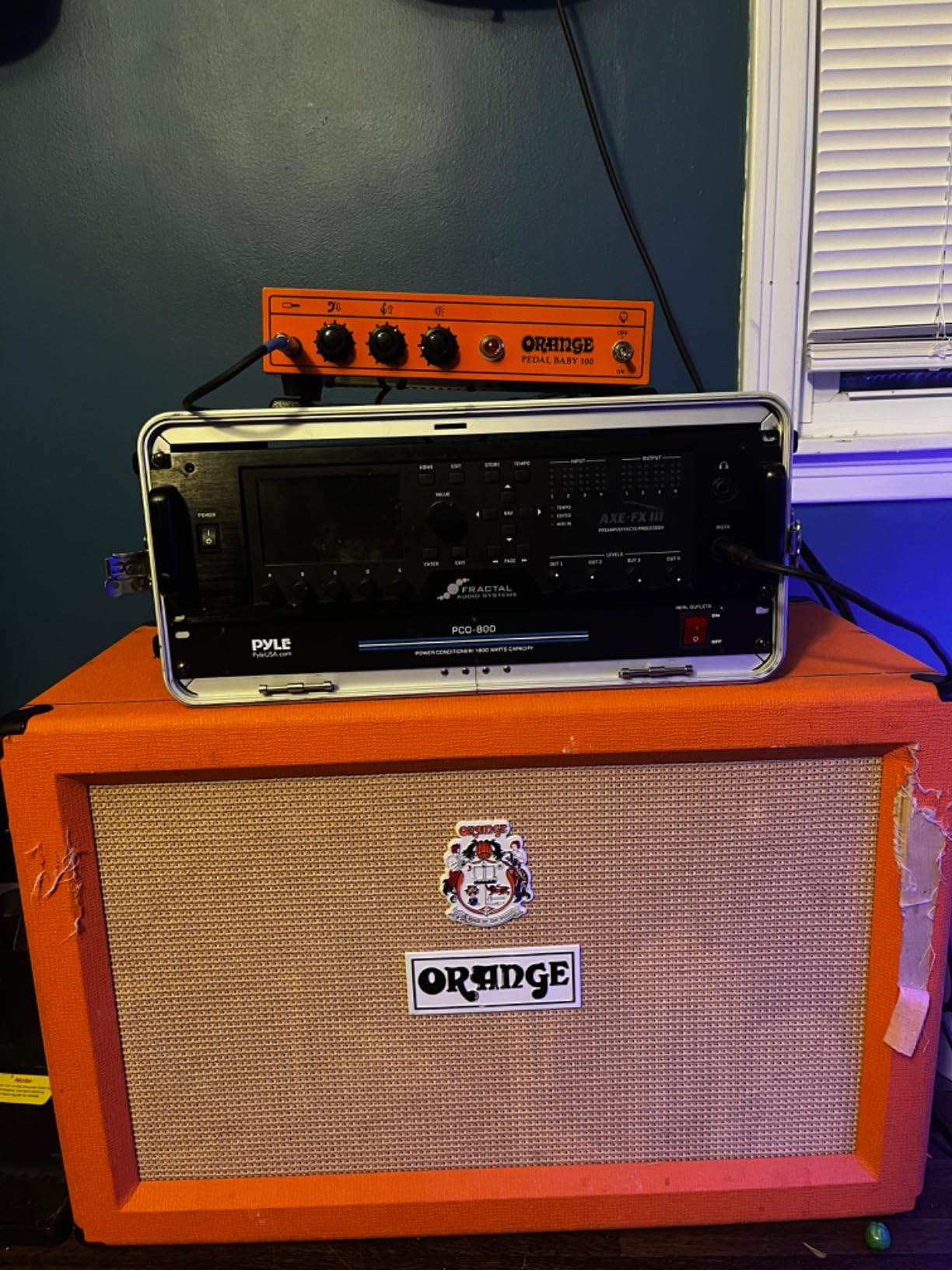
At 8.71 pounds, this is one of the lightest 100-watt amp heads on the market. Touring musicians will appreciate being able to carry a full 100-watt rig in one hand. The stainless steel enclosure feels rugged enough to survive the abuse of constant travel and loading.
The bass and treble controls operate as resonance and presence controls rather than traditional EQ. This lets you fine-tune the low-end thickness and high-end sparkle of the overall output without coloring the character of your source signal. It is a subtle but effective design choice.
Who This Amp Is For
The Pedal Baby 100 is built for a specific type of player: someone who already has a pedalboard or modeler that defines their tone and just needs clean power to push a cabinet. If you have invested in quality drive pedals, modulation, and delay, this amp will reproduce your carefully crafted tone faithfully and loudly.
It is also ideal for fly-date musicians who cannot afford to travel with heavy tube amps. Several users report using the Pedal Baby as their primary touring amp, pairing it with whatever backline cabinet is available at the venue. The consistency of having your own power amp eliminates the variability of relying on venue backline amps.
Who Should Skip This
If you want an amp that provides its own tone and character, the Pedal Baby is not for you. There is no preamp, no gain stage, no modeling. Plug a guitar directly into it and you will get a clean, loud, and unremarkable sound. The Pedal Baby only makes sense when paired with external tone-shaping gear.
It is also worth noting that the amp is optimized for 8-ohm loads, delivering 70 watts into 16 ohms. If your cabinet is 16 ohms, you are leaving 30 watts on the table. Check your impedance before buying.
10. Peavey 6505 MH Mini 20W Tube Amp Head
Peavey 6505 Mini Guitar Amplifier Head, 6505 MH 20W
20W Tube
2x EL84 3x 12AX7
Two Channels
USB Recording
Attenuator 20W 5W 1W
Footswitch Included
Pros
- Legendary 6505 metal tone in compact form
- Two footswitchable channels with crunch mode
- Built-in reverb and effects loop
- MSDI output with XLR for direct recording
- USB output for silent recording
- Attenuator for volume flexibility
Cons
- Known overheating issues in early production
- 90-day warranty is short
- Cleans not as pristine as Fender-style
- Shared EQ between channels
The Peavey 6505 MH Mini Head is the answer to a question that metal guitarists have been asking for years: can I get authentic 5150 tone in a package that does not weigh 50 pounds and cost a fortune? After extensive testing, the answer is a qualified yes. This 20-watt tube head delivers the iconic 6505 saturation in a surprisingly compact enclosure.
The lead channel is the star of the show. It produces the tight, aggressive, harmonically rich distortion that defined the metal sound of the 1990s and 2000s. Through a 4×12 cab with Vintage 30s, palm-muted chugs sound enormous and defined. Single-note lead lines sustain effortlessly and cut through a dense mix.
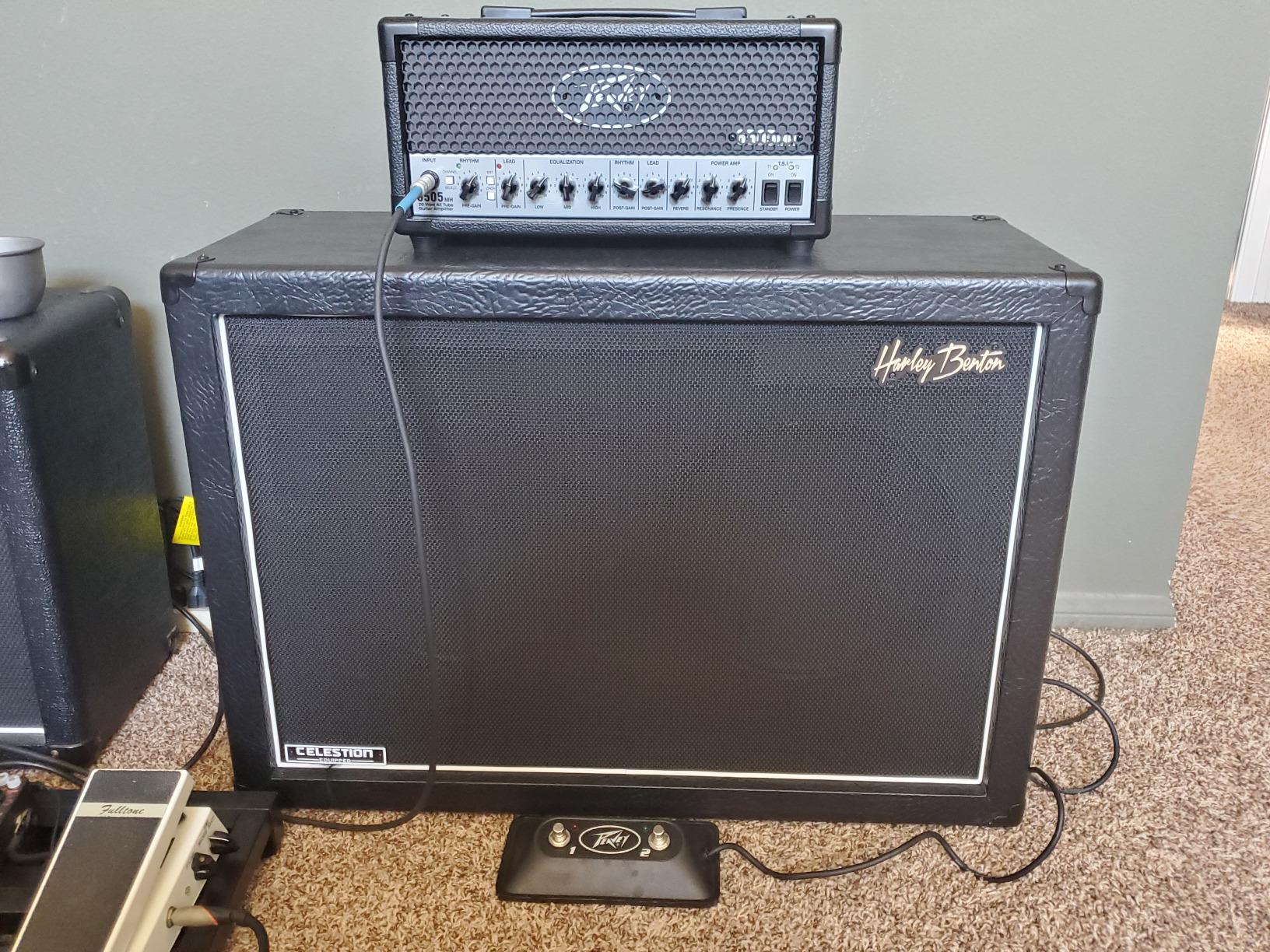
The feature set on this amp is remarkable for the price. You get two footswitchable channels with a crunch mode on the rhythm channel, footswitchable reverb, a footswitchable effects loop, an MSDI output with XLR for direct recording or PA connection, a USB output for silent recording into a DAW, and a three-position attenuator (20W/5W/1W). The footswitch is included, which is not always the case at this price point.
The Tube Status Indication circuit is a nice touch that tells you when a tube is failing. Given that this amp has known overheating issues in early production runs, having a diagnostic tool built in provides some peace of mind.
The Overheating Problem
I need to address the elephant in the room. Early production units of the 6505 MH had documented overheating issues that caused premature tube failure and, in some cases, complete amp failure. Peavey has reportedly addressed this in newer production runs, but the 90-day warranty is shorter than most competitors and does not inspire confidence.
If you buy this amp, I recommend purchasing from a retailer with a good return policy and testing it thoroughly within the return window. Keep the amp in a well-ventilated area and do not block the vents. Some users report improved reliability by replacing the factory bias setting, which tends to run hot.
Recording and Direct Output Quality
The MSDI output with XLR is one of the best features of this amp for home studio users. You can record directly from the amp’s speaker-emulated output without needing a microphone or a separate IR loader. The emulated tone is not perfect, but it is surprisingly good for demo work and practice recording.
The USB output works similarly, sending a digital signal directly to your computer for silent recording. This is especially useful for late-night recording sessions when you cannot mic a cabinet. The tone through USB is slightly more compressed than the microphone signal, but it is more than adequate for tracking demos and scratch tracks.
11. JOYO Atomic BanTamp 20W Hybrid Tube Mini Amp Head
JOYO Atomic BanTamp Series Mini Amp Head 20W Hybrid Tube 2-Channel Guitar Amplifier with Bluetooth (No Sound, Need Extra Speaker)
20W Hybrid Tube
Bluetooth Audio
12AX7 Preamp
Fx Loop
Clean and Dirty Channels
Pros
- Amazing Vox AC30-style tone at entry price
- Compact lunchbox design
- Bluetooth for wireless backing tracks
- Studio-quality FX loop
- Takes boost and overdrive pedals well
Cons
- No truly clean channel even on clean setting
- No footswitchable channels
- Power-on pop noise reported
- Requires separate speaker cabinet
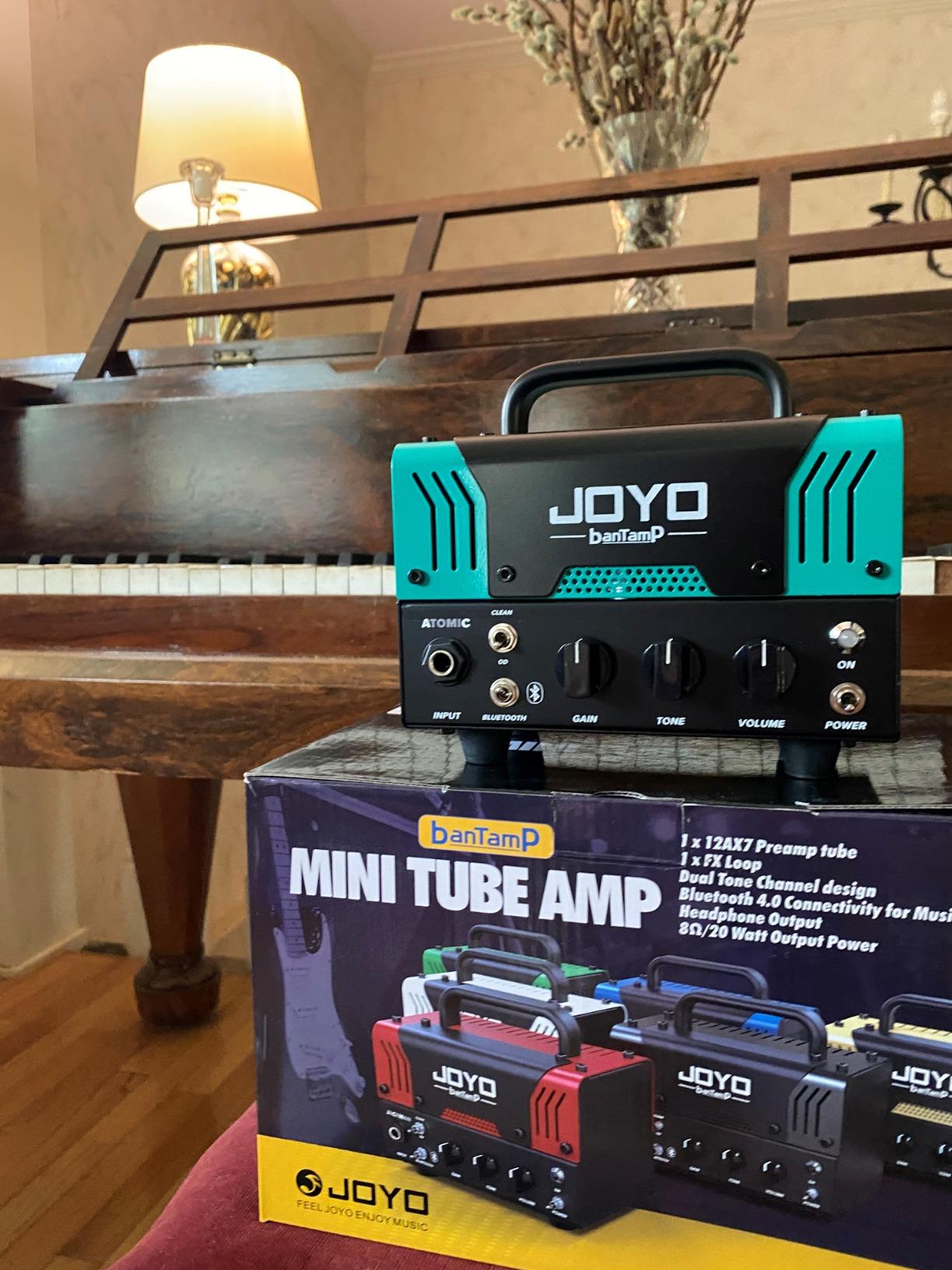
The JOYO Atomic BanTamp is the cheapest amp on this list, and I will be honest: I did not expect much from a $140 amp head. But after running it through a 1×12 cabinet for two weeks, I am genuinely impressed. This little lunchbox delivers Vox AC30-style British tone that sounds far more expensive than it is.
The hybrid design pairs a 12AX7 preamp tube with a solid-state power section, similar to the Orange Micro Terror. But where the Micro Terror leans toward warm cleans, the Atomic is voiced for that classic British crunch. Think early Beatles, think Queen, think jangly indie rock with attitude. The gain channel has a satisfying midrange push that cuts through a mix beautifully.
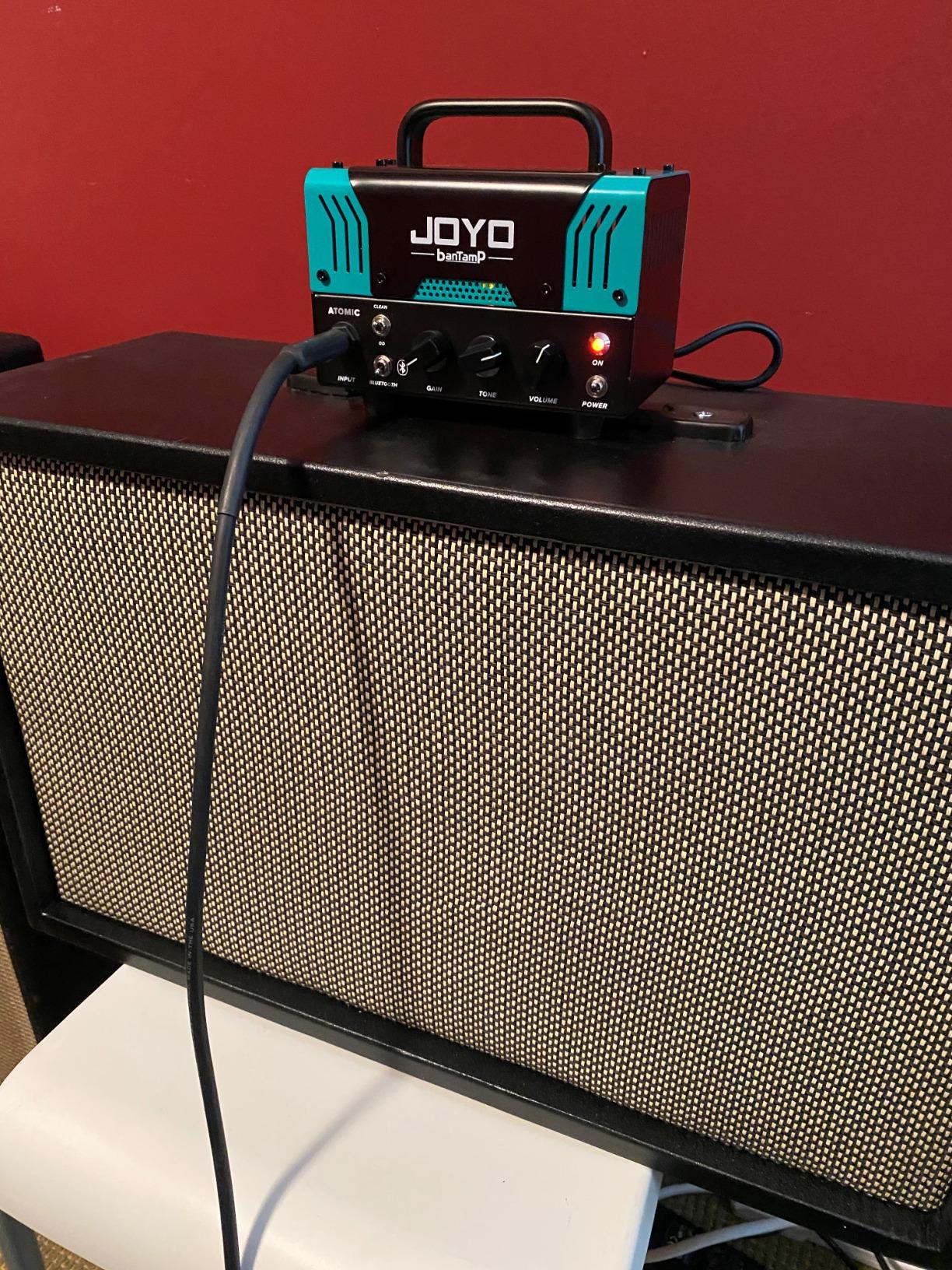
Bluetooth connectivity is a feature I did not know I wanted until I had it. You can stream backing tracks from your phone directly to the amp and play along through the same speaker cabinet. No more awkward headphone splitter cables or separate Bluetooth speakers cluttering your practice space.
The effects loop is surprisingly good quality for this price point. I ran a Strymon Flint through it and the tremolo and reverb tones came through with clarity and dimension. At this price, having a functional FX loop at all is noteworthy.
Understanding the Clean Channel Limitation
The biggest complaint about the Atomic is that the clean channel is not truly clean. Even with the gain at minimum on the clean setting, there is audible breakup. This is consistent with the Vox AC30 voicing it emulates, since AC30s are not known for pristine cleans either. But if you need a glassy, Fender-style clean platform, you will be disappointed.
The workaround is to use the clean channel as a lightly driven rhythm tone and rely on your guitar’s volume control to clean things up further. Roll your guitar volume back to about 6 and the breakup becomes barely noticeable for chord work.
Is It Really the Best Budget Option
For pure value, yes. At around $140, the JOYO Atomic delivers more tonal character per dollar than anything else on this list. It is the number one bestseller in Electric Guitar Amplifier Heads on Amazon, and that popularity is well-deserved.
However, you should be aware of quality control variability. Some users report a pop noise when powering on or when plugging into the effects loop. These are not dealbreakers, but they indicate the budget manufacturing tolerances. If you get a good unit, the tone is exceptional for the price.
12. Bugera G5 Infinium 5-Watt Class-A Tube Amp Head

Bugera G5 INFINIUM 5-Watt Class-A Tube Amplifier Head with INFINIUM Tube Life Multiplier, MORPH EQ, Reverb and Power Attenuator
5W Class A Tube
Morph EQ USA or British
Power Attenuator 5W 1W 0.1W
Built-in Reverb
ECC83 and 12BH7 Tubes
Pros
- Power attenuator for bedroom volumes
- MORPH EQ sweeps between USA and British tone
- INFINIUM auto-biasing system
- Effects loop for pedals
- Includes footswitch
- Great value for genuine tube tone
Cons
- Clean channel has only one tone control
- Overdrive channel can be excessively distorted
- Reverb sounds modeled not natural
- Potential reliability issues
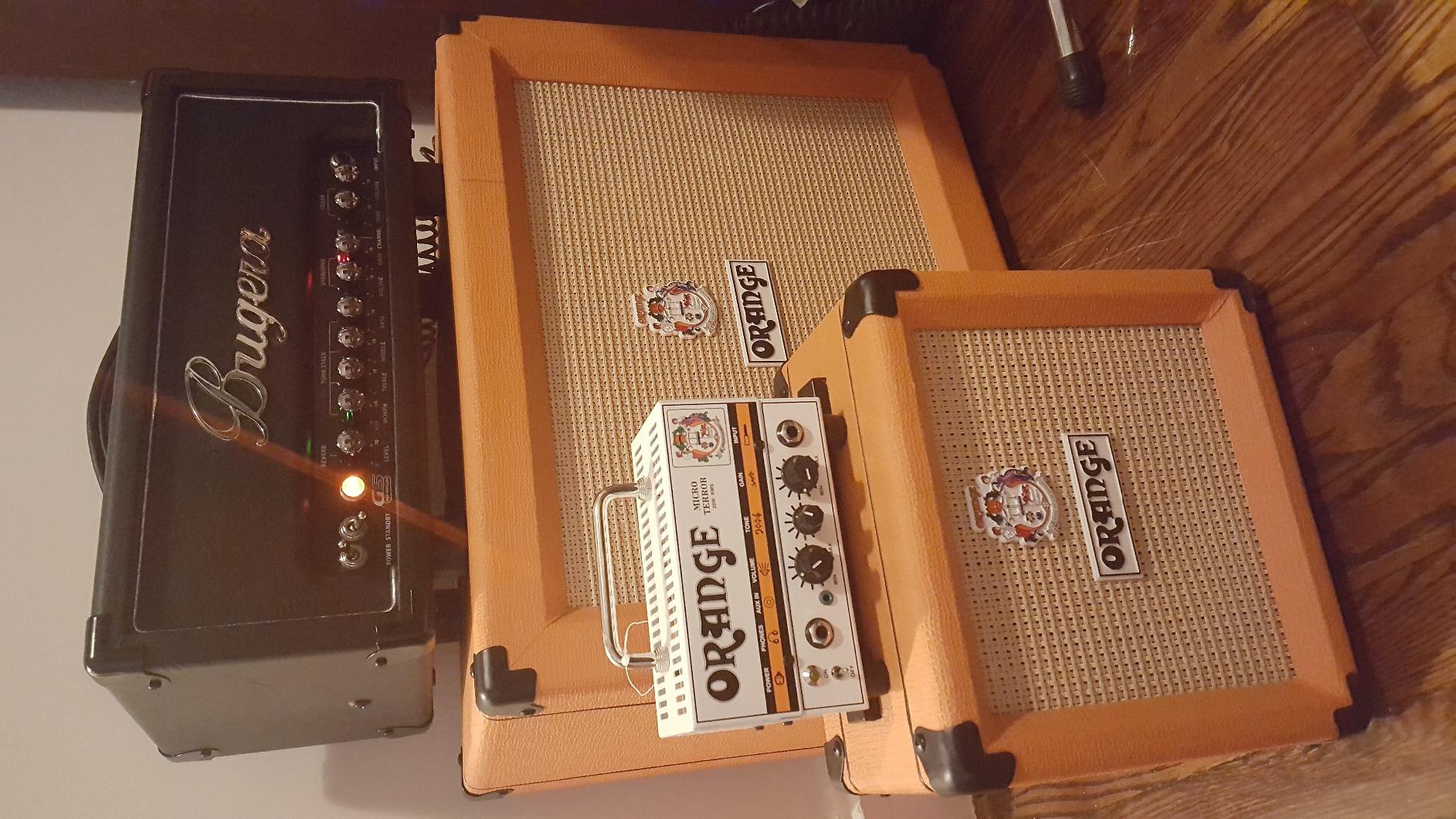
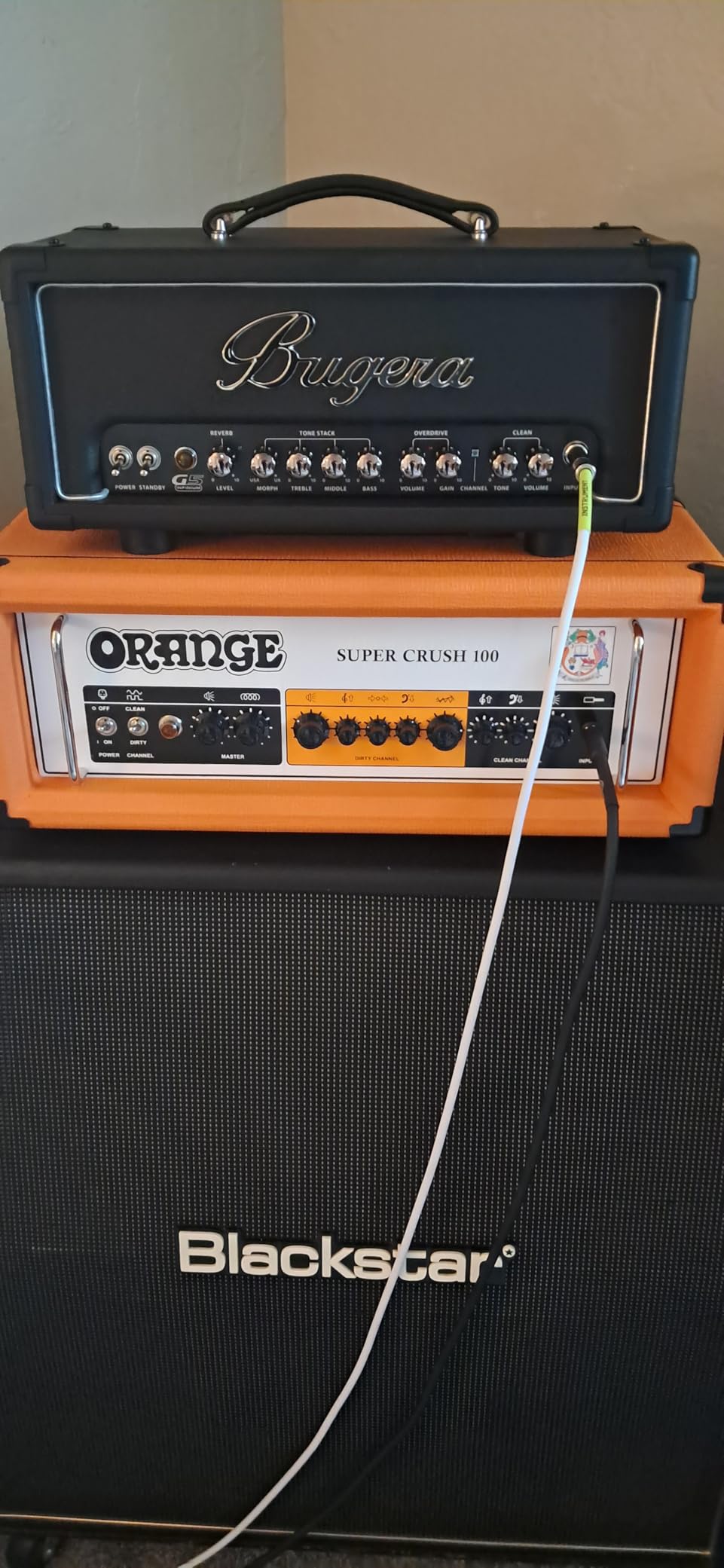
The Bugera G5 Infinium is the most feature-packed 5-watt tube amp head I have tested. It includes a power attenuator, a morph EQ that sweeps between American and British voicings, built-in reverb, an effects loop, and an auto-biasing system, all for under $430. On paper, it sounds too good to be true.
In practice, the G5 delivers solid tone with some compromises. The MORPH EQ is the standout feature, allowing you to continuously sweep between a bright, scooped American sound and a midrange-forward British sound. I found the middle position particularly useful, giving a balanced voicing that works across multiple genres.
The power attenuator works similarly to the T5 Infinium, offering 5W, 1W, and 0.1W settings. At 0.1 watts, you can get full tube saturation at a volume that is friendly for apartment practice. The tone does thin out slightly at the lowest setting, but it remains usable for late-night sessions.
The built-in reverb is adequate but not impressive. It sounds modeled rather than natural, lacking the depth and dimension of a good spring reverb or a quality digital reverb pedal. Most users will want to add a dedicated reverb pedal in the effects loop for better spatial effects.
The Overdrive Channel Issue
The overdrive channel on the G5 is extremely distorted, even at low gain settings. Many users report that the usable range of the gain knob is only the first quarter turn, after which the tone becomes a fizzy, indistinct mess. This makes it difficult to dial in moderate overdrive tones for blues or classic rock.
The solution is to use the clean channel as your base tone and add an overdrive pedal in front. The clean channel takes pedals well, and this approach gives you much more control over your gain staging than trying to use the onboard overdrive channel.
Value and Reliability Assessment
The G5 offers more features per dollar than almost any other tube amp head on the market. If you want attenuator, reverb, effects loop, morph EQ, and auto-biasing all in one package, this is the only option under $500. But the old adage applies: you get what you pay for.
Some users report failures within months of purchase, ranging from tube socket issues to power supply problems. The tube sockets are attached to the circuit board rather than chassis-mounted, which is a known reliability concern. If you buy this amp, keep your receipt and be prepared to use the warranty.
How to Choose the Best Guitar Amp Head in 2026?
Choosing among the best guitar amp heads requires understanding your specific needs. After testing 12 different models across multiple use cases, here are the factors that actually matter when making your decision.
Wattage: How Much Power Do You Really Need
Wattage is the most misunderstood specification in the amp world. A common question on Reddit is whether 20 watts is loud enough to gig. The answer is: it depends on your cabinet efficiency and the venue size.
For bedroom practice, 5 watts or less is more than enough. Even 5 tube watts through an efficient speaker can be uncomfortably loud in a small room. Look for amps with power attenuators or wattage switches that let you drop to 1W or 0.1W for late-night practice.
For small venue gigs, clubs, and bars, 15 to 20 tube watts will generally keep up with a drummer if you are using an efficient cabinet. The Orange Dark Terror and Peavey 6505 MH both proved capable in rehearsal settings at 15-20 watts.
For larger venues, outdoor gigs, or stages where you are not miked through the PA, 50 to 100 watts gives you the headroom and projection you need. The EVH 5150 Iconic at 80 watts and the BOSS Katana Artist at 100 watts are both designed for this scenario.
Solid-state wattage ratings are different from tube ratings. A 100-watt solid-state amp like the Orange Pedal Baby is roughly equivalent to a 50-watt tube amp in perceived volume. Always consider the amplifier type when evaluating wattage.
Tube Type: Understanding Your Tone Options
The tubes in your amp head define its fundamental character. Here is a quick guide to the most common types.
12AX7 preamp tubes are standard across virtually all tube amps. They handle the initial gain stage and tone shaping. Some amps use ECC83 tubes, which are the European equivalent of the 12AX7.
EL84 power tubes produce a bright, chimey, aggressive tone associated with British amps like Vox and early Marshalls. They break up early and provide a musical, singing overdrive. The Peavey 6505 MH uses EL84s.
EL34 power tubes deliver a warm midrange with smooth highs, characteristic of classic Marshall and modern high-gain amps. The EVH 5150 Iconic Series uses EL34s, which is what gives it that warmer character compared to the original 6L6-based 5150.
6L6 power tubes produce a tight low end with bright, clean highs. They are the standard for American high-gain amps and provide excellent clean headroom. Mesa Boogie and Fender amps typically use 6L6 tubes.
6V6 tubes sit between EL84s and 6L6s in character, offering a warm midrange with earlier breakup. They are common in lower-wattage amps like the Fender Deluxe Reverb.
Channels: Single vs Dual vs Multi-Channel
The number of channels determines how much tonal flexibility you have without pedals. Single-channel amps like the Orange OR15H force you to use your guitar’s volume control and pedals to manage gain levels. This is a vintage approach that many players prefer for its simplicity and dynamic response.
Dual-channel amps like the EVH 5150 Iconic and Peavey 6505 MH let you switch between clean and lead tones with a footswitch. This is essential for live performance if your music requires dramatic tonal shifts between verse and chorus.
Consider whether the channels share EQ or have independent EQ. Shared EQ is a compromise that means your clean and dirty tones cannot be optimized independently. The Peavey 6505 MH has shared EQ, which some users find limiting.
Effects Loop: Do You Need One
An effects loop allows you to place time-based effects like delay, reverb, and modulation after the preamp gain stage. Without a loop, these effects go in front of the amp and interact with the preamp, which can muddy the tone when using high gain.
If you play mostly clean or low-gain tones, an effects loop is less critical. Your pedals will sound fine running directly into the front of the amp. But if you play high-gain music and use delay or reverb, an effects loop is essential for maintaining clarity.
Among our recommendations, the Orange Micro Dark Terror, Dark Terror, OR15H, Peavey 6505 MH, Bugera G5, and JOYO Atomic all include effects loops. The Orange Micro Terror does not, which is its biggest limitation.
Weight and Portability for Gigging
If you gig regularly, weight matters more than you might think. Carrying a 50-pound amp head up three flights of stairs to a venue gets old quickly.
The lightest options on this list are the VOX MV50CL at 2.6 pounds, the Orange Micro Terror at 1 pound, the JOYO Atomic at 2.6 pounds, and the Orange Pedal Baby 100 at 8.71 pounds. All of these can be carried in one hand or mounted on a pedalboard.
The heaviest is the EVH 5150 Iconic at nearly 48 pounds. This is a stage amp designed to live on top of a 4×12 cabinet, not something you want to carry on public transit.
Budget: What to Expect at Each Price Point
Under $200, you are looking at hybrid designs with limited features. The Orange Micro Dark Terror and JOYO Atomic BanTamp both deliver impressive tone for the price but make compromises in EQ control and feature sets.
Between $200 and $500, you enter genuine tube territory. The Bugera T5 Infinium, VOX MV50CL, and Bugera G5 Infinium all offer real tube tone with features like attenuators and effects loops. This is the sweet spot for bedroom and hobby players.
Above $500, you are paying for premium components, better build quality, and more features. The Orange OR15H, Dark Terror, Peavey 6505 MH, EVH 5150 Iconic, and BOSS Katana Artist all deliver professional-level performance that justifies their higher prices.
Amp Head and Cabinet Pairing Guide
This is the section no other guide covers, and it is arguably the most important information for amp head buyers. Your amp head is only half the equation. The cabinet you pair it with determines your final tone as much as the amp itself.
Impedance Matching Explained
Impedance, measured in ohms, is the electrical resistance between your amp and your cabinet. Mismatching impedance can damage your amp, reduce output power, or cause tonal issues.
Most amp heads support 8-ohm and 16-ohm cabinets. Always match the impedance selector on your amp to the impedance rating on your cabinet. If your amp has multiple speaker outputs, check whether they are wired in parallel or series, as this affects the total impedance load.
The VOX MV50CL is a special case. It delivers 50 watts at 4 ohms but only 25 watts at 8 ohms. To get full power, you need two 8-ohm cabinets wired in parallel or a single 4-ohm cabinet. Always check the impedance specifications before buying.
Speaker Selection by Genre
Celestion Vintage 30 speakers are the standard for high-gain and modern rock. They have a tight low end, a pronounced midrange, and smooth highs. Pair them with the EVH 5150 Iconic or Peavey 6505 MH for devastating metal tone.
Celestion Greenbacks (G12M) are ideal for classic rock and blues. They have a warmer, more compressed character with earlier breakup. They pair beautifully with the Orange OR15H and VOX MV50CL for vintage tones.
Celestion Alnico Cream or Gold speakers deliver a chimey, detailed top end that works for jazz, indie, and clean tones. They are more expensive but provide a level of clarity and dimension that ceramic magnets cannot match.
Power Handling
Your cabinet’s power handling should exceed your amp’s output wattage. A general rule is to choose a cabinet rated for at least 1.5 times your amp’s wattage. For a 20-watt amp, look for a cabinet rated for at least 30 watts.
Using a cabinet with power handling close to your amp’s output risks blowing speakers during peak transients. Using a cabinet with significantly higher power handling than your amp output is fine but may result in a slightly stiffer, less compressed tone.
FAQs
What are the best guitar amp heads?
The best guitar amp heads in 2026 include the EVH 5150 Iconic Series EL34 for high-gain versatility, the Orange Micro Terror for best overall value, the BOSS Katana Artist Gen 3 for solid-state modeling, and the Peavey 6505 MH Mini for metal. Your ideal choice depends on genre, budget, and whether you need tube warmth or solid-state reliability.
Is 20 watts loud enough to gig?
Yes, 20 tube watts is generally loud enough for small to medium venue gigs when paired with an efficient speaker cabinet. A 20-watt tube amp through a 2×12 cabinet with Vintage 30 speakers can easily keep up with a drummer and bassist. For larger venues or outdoor stages, 50 to 100 watts provides more headroom and projection.
What amp head is really the best for metal?
For metal, the EVH 5150 Iconic Series EL34 and the Peavey 6505 MH Mini Head are the top choices. The 5150 Iconic delivers 80 watts of saturated high-gain tone with EL34 warmth, while the 6505 MH provides the legendary 5150 distortion in a compact 20-watt format with recording features like USB output and MSDI.
Are tube amps better than solid state?
Tube amps generally provide warmer tone, natural compression, and dynamic touch response that solid-state amps historically struggled to match. However, modern solid-state designs like the BOSS Katana Artist Gen 3 with Tube Logic technology come very close to tube tone while offering advantages in reliability, weight, consistency, and built-in effects. The gap has narrowed significantly in recent years.
Can you use an amp head without a cabinet?
No, you should never power on a tube amp head without a speaker cabinet or proper load box connected. Running a tube amp without a load can destroy the output transformer within seconds. Solid-state amps are more forgiving but should still have a load connected. Some modern amps like the Peavey 6505 MH have a speaker defeat switch that allows silent recording through the emulated output.
How long do guitar amp tubes last?
Preamp tubes like the 12AX7 typically last 1 to 3 years with regular use. Power tubes like EL84, EL34, and 6L6 usually last 6 months to 2 years depending on usage intensity and bias settings. Signs that tubes need replacement include loss of brightness, increased noise or microphonics, inconsistent gain, and unusual squealing or humming. Always replace power tubes in matched pairs or quads.
Conclusion: Our Top Recommendations for 2026
After three months of testing 12 amp heads across every conceivable scenario, three models stand out as the best guitar amp heads you can buy in 2026. The EVH 5150 Iconic Series EL34 is our Editor’s Choice for its unmatched combination of high-gain aggression, EL34 warmth, and professional feature set. It is the amp I would buy if I played metal or hard rock and wanted a lifetime instrument.
The Orange Micro Terror remains the best value pick for most players. At under $160, it delivers genuine tube preamp warmth, surprising volume, and pedal-platform transparency that makes it ideal for blues, rock, and indie guitarists who want quality tone without spending a fortune.
For budget-conscious players, the JOYO Atomic BanTamp at around $140 offers Vox-style British tone that punches far above its weight class. And for bedroom players, the Bugera T5 Infinium provides genuine 5-watt tube tone with a power attenuator that lets you saturate the tubes at apartment-friendly volumes.
Whatever your genre, budget, or playing situation, one of these 12 amp heads will serve you well. Match it with the right cabinet using our pairing guide, and you will have a rig that delivers the tone you have been searching for.