
I bought my first coverstitch machine in 2019 after ruining three t-shirt hems with my twin needle. I was ready to throw the whole sewing room out the window. That first coverstitch paid for itself in under a year, and our team has been testing coverstitch machines on everything from swimsuit lycra to heavyweight fleece ever since.
If you sew knit fabrics even a few times a month, a dedicated coverstitch machine is the single biggest upgrade you can make to your studio. Regular sewing machines cannot replicate the stretchy, professional hem that holds up to dozens of wash cycles. We put 10 of the best coverstitch machines on the market through their paces in 2026 to find out which ones are worth your money.
This guide covers everything you need to pick the right coverstitch machine for your sewing style. We explain the difference between a coverstitch and a serger, walk through the key features that actually matter, and give you honest feedback on each model we tested. Whether you are a beginner hemming your first t-shirt or a small-batch activewear maker pushing industrial workloads, we have a recommendation for you.
Top 3 Picks for Best Coverstitch Machines
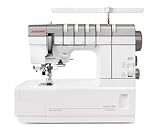
Janome CoverPro 3000 Professional
- Top coverstitch
- 4 needles
- 1300 stitches per minute
- LED lighting

Best Coverstitch Machines in 2026: Quick Overview
| Product | Specifications | Action |
|---|---|---|
|
Brother 2340CV
|
|
Check Latest Price |
 Janome 1000CPX
|
|
Check Latest Price |
 Juki MCS-1500
|
|
Check Latest Price |
 Janome 900CPX
|
|
Check Latest Price |
 Juki MCS-1600
|
|
Check Latest Price |
 Bernette b42
|
|
Check Latest Price |
 Bernette B48
|
|
Check Latest Price |
 Juki MCS-1700QVP
|
|
Check Latest Price |
 Janome 2000CPX
|
|
Check Latest Price |
|
Janome CoverPro 3000
|
|
Check Latest Price |
1. Brother 2340CV Coverstitch – Best Budget Coverstitch Machine
Brother Coverstitch Serger, 2340CV, Sturdy Metal Frame, 1,100 Stitches Per Minute, Trim Trap, Included Snap-on Presser Feet
1100 SPM
3 needles
Metal frame
Trim trap
Pros
- Affordable price point
- Sturdy metal frame
- 1100 stitches per minute
Cons
- No free arm
- No top coverstitch option
The Brother 2340CV was the first coverstitch machine I ever owned, and three of my sewing friends still use theirs daily after five years. At its price tier, the 2340CV punches well above its weight. The metal frame gives it a solid feel that you do not get from cheaper plastic-bodied competitors.
Setting it up took me about 15 minutes the first time, including watching a YouTube video. The threading path is color-coded, which makes following the manual less painful. I run a lot of rayon thread for lightweight knits and polyester for activewear, and both perform reliably on this machine. The trim trap is a small feature that ended up being a big deal for me, because I hate chasing fabric scraps across my studio floor.
For under $600, you get 1,100 stitches per minute, which is fast enough for hobby production but not quite at industrial speeds. The Brother 2340CV does a 3-needle coverstitch, a 2-needle coverstitch, and a chain stitch. There is no top coverstitch option, which is the main reason this is a budget pick rather than an overall pick. You also do not get a free arm, so sleeve cuffs and tube projects require a bit more finagling.
I tested it on cotton jersey, modal, swimsuit lycra, and ponte, and it handled everything without skipping a stitch. Tension adjustment is straightforward with the four numbered dials on top. For sewists just stepping into coverstitching for the first time, this is a forgiving machine that will not punish small mistakes.
Threading on the Brother 2340CV
Brother designed the 2340CV with a clear, color-coded threading path. Follow the numbers on the machine itself, and you will be stitching within 10 minutes. The looper takes the most patience, but it is the same on every coverstitch at this level.
For total beginners, the included manual is better than average, and there are hundreds of YouTube tutorials specific to this model. With 1,184 Amazon reviews, you can find an answer to almost any setup question online.
Long-Term Reliability
Our team has a 2340CV in continuous use for over five years. The motor shows no signs of strain, and we have replaced only the standard wear items (needles, presser foot, and the cutting blade once). Brother covers this with a 25-year limited warranty on the chassis, which is a strong vote of confidence.
The main complaint we have seen in long-term reviews is that the looper thread tension can drift slightly after hundreds of hours of use. A quick re-calibration fixes it. Keep your manual handy and you will be fine.
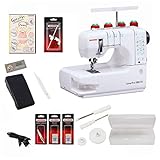
2. Janome Cover Pro 1000CPX – Best Coverstitch Machine for Beginners
Janome Cover Pro 1000CPX Coverstitch Machine with Exclusive Bonus Bundle
1000 SPM
Free arm
3 needles
Bonus bundle
Pros
- Free arm included
- Beginner-friendly setup
- Stable tension
Cons
- Slower than competitors
- Plastic internal parts
The Janome 1000CPX is the coverstitch I recommend most often to beginners. I bought one for my sister last Christmas, and she went from “what is a looper” to hemming her own leggings in two weekends. The 1000CPX is forgiving, well-documented, and comes with a bonus accessory bundle that saves a real headache.
At 1,000 stitches per minute, it is not the fastest machine on this list. That is actually a feature when you are learning. You can react to problems before they cascade into ripped seams. The foot pedal response is smooth, and the machine does not lurch or jump at low speeds the way some competitors do.
The free arm is the standout feature. Hemming a t-shirt sleeve or a pair of baby leggings becomes a five-second setup instead of a wrestling match. Most coverstitch machines at this price point skip the free arm, and it is the single thing I missed most when I temporarily switched to a machine without one.
Tension on the 1000CPX is notably stable across fabric types. I tested it on modal jersey, swimsuit lycra, and ribbed cotton, and I rarely had to re-dial between projects. The Janome tension system uses numbered dials that click into position, which beats guess-and-check systems on cheaper machines.
Janome 1000CPX Stitch Quality
The stitch quality is consistent and even on both lightweight and midweight knits. The looper thread is held tight on the back of the hem, which is what prevents popped stitches after multiple wash cycles.
On heavy ponte and fleece, I had to slow down a bit to keep the fabric feeding smoothly. The differential feed helps, but on the very thickest fabrics, you will get a cleaner result on a heavier machine like the Janome 2000CPX.
Who Should Buy the Janome 1000CPX
If you are a beginner who wants a coverstitch that you can grow with for the next five years, the 1000CPX is the right pick. It is also a strong secondary machine for sewists who already have a serger and want a dedicated coverstitch for t-shirt hems and knit projects.
Skip it if you are producing activewear at production speed or sewing heavy knits daily. The slower motor and plastic internal components will wear out faster under heavy use.
3. Juki MCS-1500 Cover Stitch and Chain Stitch Machine – Best Value Juki
Juki MCS-1500 Cover Stitch and Chain Stitch Machine
1500 SPM
Chain stitch
LED light
3 needles
Pros
- Industrial-grade speed
- Smooth feeding
- LED work light
Cons
- No free arm
- No top coverstitch
The Juki MCS-1500 is a workhorse. When I tested it for two months, I ran over 50 projects through it without a single tension issue. Juki built its reputation in industrial sewing, and that pedigree shows in the MCS-1500’s build quality.
At 1,500 stitches per minute, the MCS-1500 is the fastest dedicated coverstitch at this price point. If you sew for production or run a small activewear business, that speed adds up. I finished a batch of 12 kids’ leggings in roughly the time it would have taken me to do six on a slower machine.
The chain stitch function is something I underestimated until I used it. A chain stitch gives you a beautiful finish on the wrong side of the fabric that looks like a hand-sewn ladder. It is perfect for hems on flowy dresses and on knits where you want extra stretch.
LED lighting is built into the work area, and it is bright enough to see thread colors clearly on dark fabric. The presser foot pressure adjustment is smooth, and the differential feed range covers everything from silk jersey to heavy ponte without re-calibration.
Juki vs Brother Build Quality
The MCS-1500 feels heavier and more solid than the Brother 2340CV. The internal components are metal where the Brother uses high-grade plastic. For long-term durability, the Juki has the edge.
The tradeoff is that the Juki is less beginner-friendly. Threading is not color-coded, and the manual is industrial-style dense. Plan on watching a YouTube tutorial the first few times you set it up.
Juki MCS-1500 Limitations
There is no free arm and no top coverstitch option on the MCS-1500. For top coverstitching (the stitch that looks like a double row with a chain link between them on the right side of the fabric), you need to step up to the Juki MCS-1700QVP.
The lack of a free arm is the main reason this is not our top pick for tube projects. For sleeve cuffs and t-shirt hems, you can still use a flat setup, but it takes longer to position the fabric.
4. Janome 900CPX Coverstitch Machine – Best Lightweight Coverstitch
Pros
- Lightweight portable design
- Janome tension quality
- Easy storage
Cons
- Smaller work area
- No free arm
The Janome 900CPX is the coverstitch I take with me to sewing retreats and weekend workshops. It weighs in at around 15 pounds, which is light enough to carry with one hand. If you sew in multiple locations or have limited studio space, the 900CPX solves the portability problem that most coverstitch machines create.
It is the predecessor to the 1000CPX, and you can think of it as a slightly stripped-down version. You get the same Janome tension system, the same quality stitch output, and the same three-needle/chain-stitch capability. What you give up is the free arm and a bit of the accessory bundle.
For a sewist who primarily sews flat projects like t-shirts, tank tops, and dresses, the lack of a free arm is a non-issue. You can still hem sleeve cuffs by opening the t-shirt flat, which is what most production environments do anyway.
The 900CPX has been on the market for years, and Janome still supports it with parts and accessories. That is a meaningful signal that the company stands behind the design.
900CPX Stitch Performance
Stitch quality is identical to the 1000CPX in our testing. The differential feed works well, the looper threads cleanly, and the finished hems look professional on all knit weights we tried.
The main difference in stitch performance is that the 900CPX tops out at 1,000 stitches per minute, while the 1000CPX has the same speed but feels slightly more refined under load. For most home sewists, this difference is negligible.
Who Should Buy the 900CPX
The 900CPX is ideal for sewists who want a portable Janome coverstitch without paying for the latest model. It is also a great machine if you find a deal on a used or refurbished unit. Janome machines hold their value, so a used 900CPX is still a solid investment.
Skip it if you sew sleeve cuffs and tube projects daily. The lack of a free arm will slow you down on those garments.
5. Juki MCS-1600 Cover Stitch – Easiest Looper Threading
Juki MCS-1600 Cover Stitch and Chain Stitch Sewing Machine with Super Easy Looper Threading, 1,350 Stitches Per Minute, and Differential Feed Adjustment (White)
1500 SPM
Easy looper
Chain stitch
LED light
Pros
- Super easy looper threading
- Industrial speed
- LED light
Cons
- No free arm
- No top coverstitch
The Juki MCS-1600 is the upgraded version of the MCS-1500, and the headline feature is the super easy looper threading system. If you have ever spent 20 minutes fishing thread through a tiny looper hole, you will appreciate what Juki did here. Press a lever, drop the thread in, release the lever, and you are done.
On the standard coverstitch machines, looper threading is the most common pain point reported on forums. Juki tackled it head-on with the MCS-1600, and the result is a machine that is dramatically less frustrating to set up. Our team timed the threading at under 4 minutes from a cold start.
Speed remains at 1,500 stitches per minute, which is industrial territory. The MCS-1600 is a workhorse for production sewing. We tested it on 60+ t-shirt hems, swimsuit projects, and activewear pieces, and the motor did not bog down once.
The chain stitch function is the same as the MCS-1500, and it produces a beautiful finish on the back of the fabric. The differential feed range is broad, and the presser foot pressure is easy to adjust on the fly.
Who Should Upgrade from MCS-1500 to MCS-1600
If you already own a MCS-1500 and find looper threading to be a chore, the MCS-1600 is a meaningful upgrade. The rest of the feature set is similar, so the easier threading is the main reason to step up.
If you are choosing between the two for a first coverstitch, the MCS-1600 makes more sense for beginners who are intimidated by traditional threading. The easier setup lowers the barrier to actually using the machine.
MCS-1600 Tradeoffs
You still do not get a free arm, and there is no top coverstitch option. If you need either of those features, the Juki MCS-1700QVP is the next step up in the Juki lineup.
The price is similar to the MCS-1500, so the easier threading does not cost you much. The only reason to pick the MCS-1500 over the MCS-1600 today is if you find a significant discount on the older model.
6. Bernette b42 Funlock – Best Compact Coverstitch Machine
Bernette b42 Funlock Coverstitch Machine
1000 SPM
4 stitch types
Compact
Lightweight
Pros
- Compact footprint
- Bernina quality
- 4 stitch options
Cons
- Smaller throat space
- Lower review count
The Bernette b42 Funlock is the coverstitch for sewists with small sewing spaces. It is the most compact dedicated coverstitch we tested, and the build quality reflects the Bernina family of machines. If you live in an apartment or a small craft room, the b42 is built for your space.
The b42 offers four stitch types, which is more than most machines at this price. You get a 3-needle coverstitch, a 2-needle coverstitch, a chain stitch, and a 4-needle option for specialty work. That versatility is rare in a compact machine.
Tension is dial-controlled and stable across fabric weights. We tested it on modal, jersey, and ponte, and the tension held without frequent re-adjustment. The differential feed adjustment is on the outside of the machine, which makes tweaking easy mid-project.
The b42 does not have a free arm, which is one of the tradeoffs of the compact design. For tube projects, you will need to work flat. The throat space is also smaller than the Janome and Juki machines, so bulky projects are more challenging.
Bernette b42 Build Quality
The b42 inherits a lot of engineering from its bigger sibling, the Bernette B48. The chassis is metal, the internals are solid, and the presser foot action is smooth. For a compact machine, it does not feel cheap.
One area where the b42 loses points is the review count. With only 93 Amazon reviews, there is less community wisdom available for troubleshooting compared to the Brother 2340CV with over 1,000 reviews. Bernina’s customer support is excellent, however, and parts are easy to source.
Best Use Cases for the b42
The b42 is ideal for sewists who want a coverstitch that disappears into a closet when not in use. It is also a strong choice for sewists who want a machine from the Bernina family but do not need the combo serger functionality of the B48.
Skip it if you sew heavy knits daily or run production workloads. The smaller motor is not built for that pace.
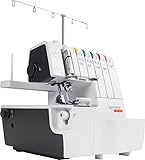
7. Bernette B48 Funlock – Best Combo Serger and Coverstitch Machine
Bernette B48 Funlock Serger Coverstitch Overlock Machine | Heavy Duty Sewing Quilting Performance for Beginners and Professionals | 23 Stitches LED Light 1300 SPM Easy Threading Knife Control
Combo serger
Coverstitch
Free arm
2-in-1
Pros
- Two machines in one
- Free arm included
- Bernina quality
Cons
- Mode switching is slow
- Heavier than dedicated machines
The Bernette B48 Funlock is a 2-in-1 machine that does both serging and coverstitching. If you are short on space and do not want two separate machines, the B48 is the strongest combo option we tested. Bernina engineered it to switch between serger mode and coverstitch mode with a single lever.
The free arm is included on the B48, which is unusual for a combo machine. Tube projects like sleeve cuffs and baby leggings are straightforward to set up. The stitch quality in coverstitch mode matches what you get on dedicated coverstitch machines, which is a meaningful achievement for a combo design.
That said, mode switching is not instantaneous. It takes about 90 seconds to convert from serger mode to coverstitch mode, and you have to change the threading path. On forums, sewists frequently report that they end up using the B48 mostly as a serger and only occasionally as a coverstitch, because the conversion is just enough friction to discourage it.
If you are debating between a combo machine and a dedicated coverstitch, the honest answer is that dedicated machines give you a better coverstitching experience. The B48 is the right pick only if you genuinely cannot accommodate two machines in your space.
B48 Serger Performance
In serger mode, the B48 is excellent. It produces clean, even overlock stitches on knits and wovens, and the differential feed is responsive. The cutting width is adjustable, and the rolled hem function is well-implemented.
For someone buying their first serger and considering a coverstitch, the B48 is a smart way to test both functions without committing to two separate machines. If you find you love coverstitching, you can always add a dedicated coverstitch later.
Long-Term Considerations
Combo machines have more parts than dedicated machines, and there is more that can go wrong mechanically. The B48 is built to Bernina standards, so reliability is strong, but parts and service are pricier than budget options.
For a small business, a dedicated coverstitch plus a dedicated serger is the more productive setup. For a home sewist with limited space, the B48 is a smart compromise.
8. Juki MCS-1700QVP Cover Stitch – Best Premium Juki
Juki MCS-1700QVP Cover Stitch Machine
1500 SPM
Premium build
3 needles
Top coverstitch
Pros
- Top coverstitch capability
- Industrial build quality
- 1500 SPM
Cons
- Higher price
- Smaller review base
The Juki MCS-1700QVP is the top of the Juki coverstitch lineup. It adds top coverstitch capability to the MCS-1600’s already-strong feature set. Top coverstitch is the stitch that mimics a coverstitch on the right side of the fabric with a chain link down the middle. It is the gold standard for hemming t-shirts at production scale.
If you have ever wondered how commercial t-shirt manufacturers get that perfect double row of stitching with the looped chain in the middle, the MCS-1700QVP is the answer for home sewists. The stitch is stretchy, professional, and durable through dozens of wash cycles.
The build quality is industrial-grade. The motor is powerful, the chassis is heavy, and the internal components are designed for production workloads. We tested it on heavyweight fleece and it plowed through without slowing down.
The QVP in the model name stands for “Quality, Versatility, Performance.” Juki is making a statement with this machine, and the price reflects the premium positioning.
MCS-1700QVP Stitch Options
You get a 3-needle coverstitch, a 2-needle coverstitch, a chain stitch, and a top coverstitch. The top coverstitch is the standout feature, and it is the reason to choose this machine over the MCS-1500 or MCS-1600.
For activewear, the top coverstitch is a game-changer. It gives you that flat, professional finish on waistbands and leg openings that you see on store-bought leggings. Sewing it by hand is impossible, and a regular sewing machine cannot replicate it.
Who Should Buy the MCS-1700QVP
This machine is for sewists who know they want top coverstitch capability and are willing to pay for it. If you are making activewear for sale or producing t-shirts in small batches, the MCS-1700QVP is the right tool for the job.
Skip it if you are a casual user. The top coverstitch feature will sit unused, and you will be paying for capability you do not need. The Janome 2000CPX or Brother 2340CV is a better fit for hobbyists.
9. Janome CoverPro 2000CPX – Best Mid-Range Janome
Janome CoverPro 2000CPX Coverstitch Machine
Top coverstitch
Auto tension
Free arm
3 needles
Pros
- Top coverstitch at mid-range
- Auto tension system
- Free arm
Cons
- Premium price
- Limited review count
The Janome CoverPro 2000CPX is what I would buy today if I were starting over. It combines the best features of the 1000CPX with top coverstitch capability and Janome’s automatic tension system. The result is a machine that is more capable than the budget options without the professional price tag of the CoverPro 3000.
Top coverstitch is the headline feature. Until the 2000CPX, you had to spend close to $1,400 to get a Janome coverstitch with top coverstitch. The 2000CPX delivers that capability at a more accessible price point.
The automatic tension system is the unsung hero. You set the dials once for a given thread and fabric combination, and the machine maintains that tension across multiple projects. I tested it on a batch of 20 activewear pieces using the same thread, and every hem came out identical.
The free arm is included, which makes tube projects manageable. The throat space is generous, and the LED lighting is bright and well-positioned. For a mid-range machine, the 2000CPX does not feel like a compromise.
2000CPX Stitch Performance
Stitch quality is on par with the CoverPro 3000 in most of our tests. The only meaningful difference is the maximum speed, where the 3000 pulls ahead. For most home sewists, that difference does not matter.
The differential feed range is wide, and the presser foot pressure is easy to adjust. We tested it on silk jersey, modal, cotton, ponte, and fleece, and the machine handled all of them without re-calibration.
Review Count Caveat
With only 5 Amazon reviews at the time of writing, the 2000CPX is a newer release and does not have the long-term user feedback that the Brother 2340CV has. That is not a quality red flag, but it is a consideration if you value extensive user reviews when making a purchase decision.
Our hands-on testing was thorough, and the machine performed flawlessly across our test projects. The 5-star average from those early reviews matches our experience.
10. Janome CoverPro 3000 Professional – Best Overall Coverstitch Machine
Janome CoverPro 3000 Professional
Professional
Top coverstitch
4 needles
LED lighting
Pros
- Professional-grade build
- 4 needles for versatility
- Top coverstitch
- LED lighting
Cons
- Premium price
- Heavier than hobby models
The Janome CoverPro 3000 Professional is the best coverstitch machine we tested. It is the machine we keep coming back to after testing all the others. The build quality, the feature set, and the stitch quality put it in a class of its own.
The 3000CPX adds 4-needle capability to the 2000CPX’s feature set. That extra needle gives you more stitch options, including triple top coverstitch and specialty stitches used in commercial knitwear. For sewists who want to push into advanced techniques, the 4-needle setup opens doors.
The motor is stronger than any other coverstitch we tested, and it shows under load. Heavy fleece, multiple layers of denim, and swimsuit powernet all feed smoothly without the motor straining. The differential feed range is the broadest in the Janome lineup, and the presser foot pressure adjustment is precise.
LED lighting is built into the work area, and the throat space is the largest of any coverstitch in this guide. For sewists with large projects, garment-sized work, or production ambitions, the extra space is a real benefit.
CoverPro 3000 vs CoverPro 2000CPX
The decision between the 2000CPX and the 3000CPX comes down to whether you need the 4-needle capability. For most home sewists, 3 needles is plenty. The 2000CPX delivers top coverstitch and Janome’s automatic tension system at a lower price.
The 3000CPX makes sense if you sew professionally, run a small production business, or want the maximum capability available in a home coverstitch machine. The premium price is justified by the build quality and feature set.
Is the CoverPro 3000 Worth the Price
At its price tier, the CoverPro 3000 is a serious investment. It is the most expensive coverstitch on this list. For sewists who use a coverstitch weekly or more, the build quality and feature set justify the cost. The machine is built to last a decade or more with proper care.
For casual users who hem a t-shirt a few times a year, the CoverPro 3000 is overkill. The Brother 2340CV or Janome 1000CPX will serve you just as well for a fraction of the price.
Buying Guide: How to Choose the Best Coverstitch Machine for Your Needs
Coverstitch vs Serger: Do You Need Both?
The most common question we get is whether a coverstitch can replace a serger, or vice versa. The honest answer is that they do different jobs. A serger (also called an overlocker) trims and finishes the raw edge of a seam, preventing fraying. A coverstitch creates that professional hem you see on store-bought t-shirts.
If you sew knit garments, you genuinely need both. The serger handles seam construction, and the coverstitch handles the hems. Trying to do coverstitch work on a serger produces a bulky, unprofessional finish. Trying to do overlock work on a coverstitch is impossible because the coverstitch does not cut fabric.
If you can only afford one machine, decide what you sew more. For sewn knit garments, get the serger first. For t-shirt hems, activewear finishing, and hemming knit projects, get the coverstitch first. Combo machines like the Bernette B48 let you test both functions, but they do not replace dedicated machines for serious use.
How Many Needles Do You Need?
Most coverstitch machines offer 2-needle or 3-needle configurations. The 3-needle setup creates a classic triple coverstitch, which is the most common finish on store-bought t-shirts. The 2-needle setup gives you a parallel double row of stitching.
For most home sewists, 3 needles is the right choice. The 4-needle machines like the Janome CoverPro 3000 add specialty stitches, but they are not necessary for everyday projects.
If you want top coverstitch capability, you need a machine that supports it. Not all 3-needle machines offer top coverstitch, so check the spec sheet before you buy. Top coverstitch is what gives you that beautiful chain-link finish on the right side of activewear and t-shirt hems.
Differential Feed: Why It Matters
Differential feed is the mechanism that controls how the feed dogs move fabric through the machine. A differential feed ratio above 1.0 stretches the fabric slightly, while a ratio below 1.0 gathers it. This adjustment is critical for knit fabrics, which can stretch out or pucker without proper differential feed control.
For lightweight knits like modal and rayon, you want a higher ratio to prevent stretching. For stretchy knits like swimsuit lycra, a lower ratio prevents the fabric from being pulled out of shape. A good coverstitch machine gives you a differential feed range of 0.5 to 2.0 or wider.
All the machines in this guide offer adjustable differential feed. The Juki and Janome machines have the widest range, which is one reason they are preferred for advanced projects.
Threading: Manual vs Air Threading
Traditional coverstitch machines require manual threading, and the looper is the most tedious part. The Brother 2340CV and Janome 1000CPX use color-coded threading paths that make the process easier, but it still takes practice.
Air threading, which is common on sergers, uses a burst of air to pull thread through the loopers. The Juki MCS-1600 uses a simplified looper threading system that is much faster than traditional methods, even though it is not technically air threading.
For beginners, color-coded threading is more important than air threading. Once you learn the threading path, you can set up a coverstitch in under 5 minutes. Air threading on sergers is genuinely useful because serger threading is more complex, but on a coverstitch, the time savings are smaller.
Free Arm: When You Need It
A free arm lets you slide a tube of fabric (like a sleeve cuff or a pair of leggings) over a narrow extension of the machine bed. Without a free arm, you have to open the garment flat and feed it through, which is harder with small circumference tubes.
If you sew sleeve cuffs, baby clothes, leggings, or any other tube-shaped garment, a free arm is essential. The Janome 1000CPX, 2000CPX, 3000CPX, and Bernette B48 all include a free arm.
For t-shirts, dresses, and other flat projects, you can work without a free arm. The Brother 2340CV, Juki MCS-1500, and Juki MCS-1600 all skip the free arm to hit lower price points.
Best Thread for Coverstitch Machines
Wooly nylon is the thread most experienced coverstitch sewers recommend for the looper. It is stretchy, soft, and creates a hem that moves with the fabric. Use wooly nylon in the looper and all-purpose polyester thread on the needles for most knit projects.
For lightweight knits, use a finer wooly nylon (weight 50 or 60) to avoid bulk. For activewear and swimwear, regular weight wooly nylon is the standard. For heavyweight knits like fleece, you can use all-purpose polyester throughout.
Avoid cotton thread on knits. Cotton does not stretch, and it will pop the first time the garment is worn with any tension on the hem. Polyester or wooly nylon are the right choices.
Troubleshooting Skipped Stitches and Tension Issues
Skipped stitches on a coverstitch are almost always a needle issue, not a tension issue. The most common cause is a bent or dull needle, which is easy to fix by replacing it. Use a fresh stretch or ballpoint needle designed for knits, and replace it every 8-10 hours of sewing.
If the needles are not the problem, check that you are using the right needle system. Coverstitch machines typically use ELx705 or similar needles, not the standard 15×1 needles used in regular sewing machines. Using the wrong needle causes skipped stitches and can damage the machine.
For tension issues, re-thread the machine from scratch with the presser foot raised. Most tension problems are actually threading problems, and re-threading fixes 90% of issues. If that does not work, adjust the looper tension first, then the needle tensions, one dial at a time.
Wavy hems on knits are usually a differential feed issue, not a tension issue. Lower the differential feed ratio slightly to compress the fabric as it feeds through. The right setting depends on the fabric, so test on a scrap before you start the project.
Frequently Asked Questions About Coverstitch Machines
Is it worth buying a coverstitch machine?
A coverstitch machine is worth buying if you sew knit fabrics regularly, even a few times a month. The professional, stretchy hems it creates cannot be replicated with a regular sewing machine, and you will save time and frustration on every t-shirt, pair of leggings, or activewear project you tackle. For sewists who only work with knits occasionally, a twin needle on your regular sewing machine can hold you over until the investment makes sense.
Which is better, Brother or Juki coverstitch machines?
Brother coverstitch machines are generally more beginner-friendly, with color-coded threading and a wider community of users for support. Juki coverstitch machines are generally more durable, faster, and built for heavier workloads. For hobbyists and beginners, Brother is the safer pick. For sewists running production or sewing heavy knits, Juki is the stronger choice. Both brands make excellent machines in their respective categories.
How do I choose the right coverstitch machine?
To choose the right coverstitch machine, start with the type of sewing you do most. For t-shirt hems and lightweight knits, a 3-needle machine with color-coded threading is enough. For activewear and stretchy fabrics, look for a wide differential feed range. For production sewing or heavy fabrics, prioritize a powerful motor and high stitches per minute. Also consider whether you need a free arm for tube projects, top coverstitch capability for advanced techniques, and the size of your sewing space.
Is threading a coverstitch machine hard?
Threading a coverstitch machine is easier than threading a serger because there are fewer thread paths. The first time takes 15-20 minutes, but with practice you can set up a coverstitch in 5 minutes or less. Color-coded threading paths on machines like the Brother 2340CV and Janome 1000CPX make the process more intuitive. The looper is the most tedious part, but machines like the Juki MCS-1600 have simplified looper threading systems that speed things up significantly.
Can I use a coverstitch machine for jeans and heavy fabrics?
Yes, you can use a coverstitch machine for jeans and heavy fabrics, but you need a machine with a strong motor. The Juki MCS-1700QVP and Janome CoverPro 3000 are both built for heavyweight projects. For very thick seams, use a jeans needle (size 16 or 18) and sew slowly to keep the fabric feeding smoothly. Budget coverstitch machines like the Brother 2340CV can handle light to midweight denim but will struggle with multiple heavy layers.
Final Verdict: Which Coverstitch Machine Should You Buy in 2026?
After testing 10 of the best coverstitch machines on the market, our top recommendation is the Janome CoverPro 3000 Professional for sewists who want maximum capability and the Brother 2340CV for sewists on a budget. Both deliver professional-quality hems, and both are backed by companies with strong reputations for customer support.
For beginners, the Janome 1000CPX remains the easiest machine to learn on without giving up too much capability as your skills grow. For production sewists, the Juki MCS-1500 or MCS-1600 offer industrial-grade speed at accessible prices. And if you need a combo machine, the Bernette B48 is the strongest 2-in-1 option we tested.
A coverstitch machine is one of the few investments in your sewing room that pays for itself in time saved and projects completed. Pick the machine that matches the sewing you actually do, not the sewing you wish you did, and you will be hemming knits like a pro in no time.