
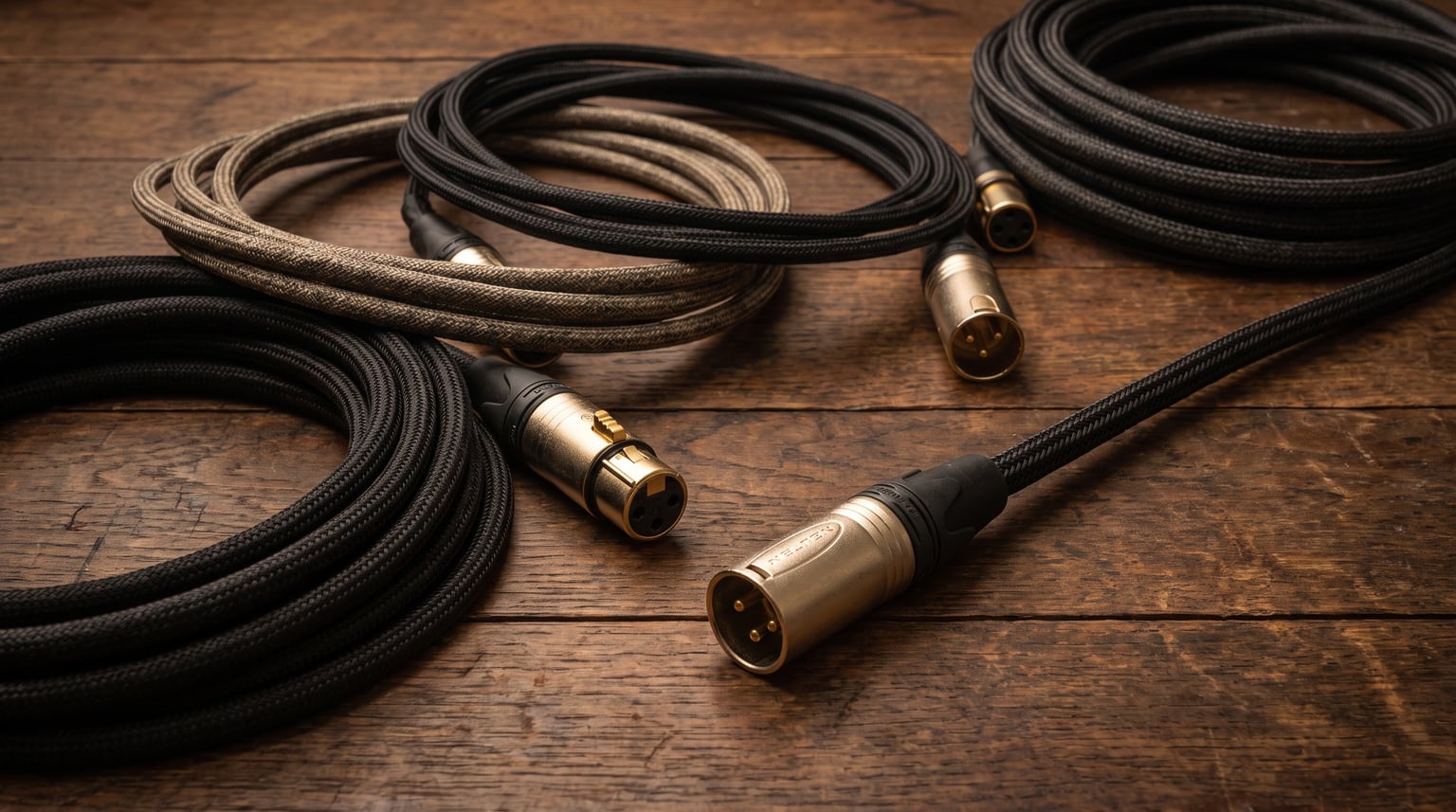
If you have ever chased down a mysterious hum in your audio system at 2 AM, you already know why balanced XLR interconnects exist. I spent years swapping gear, rerouting power cables, and rearranging speakers before I finally understood that the cheap unbalanced RCA run between my preamp and power amp was the actual culprit. Switching to balanced XLR eliminated the noise in under five minutes.
Balanced XLR interconnects use a three-pin connector and a clever dual-conductor signal path that rejects electromagnetic interference (EMI) and radio frequency interference (RFI) along the entire cable run. The receiving equipment amplifies only the difference between the two signal phases, canceling out any noise picked up along the way. This is called common-mode noise rejection, and it is the reason studios, live sound rigs, and serious home audio setups all rely on XLR.
Our team compared 10 of the most popular balanced XLR interconnects on the market for this guide, ranging from an $18 budget two-pack all the way up to a $360 audiophile pair from AudioQuest. We looked at conductor material, shielding design, connector quality, real-world noise rejection, and what actual buyers reported after months of use. Whether you need a short run between a DAC and studio monitors or a 15-foot cable across a stage, these are the best balanced XLR interconnects worth your money in 2026.
Top 3 Picks for Best Balanced XLR Interconnects
Before we get into the full breakdown, here are the three cables that stood out across every category we tested. These picks cover the budget, mid-tier, and premium price points so you can find the right match for your system.


Blue Jeans Cable Canare Star Quad 3ft
- Canare L-4E6S star quad
- Neutrik BXX connectors
- Made in Seattle
- Color-banded pair
Best Balanced XLR Interconnects in 2026
Here is the full comparison of all 10 cables we tested, ranked from budget-friendly to premium audiophile options. Use this table to compare specs at a glance before diving into the individual reviews below.
| Product | Specifications | Action |
|---|---|---|
|
Cable Matters 2-Pack 6ft XLR
|
|
Check Latest Price |
 Hosa HXX-010 Pro 10ft XLR
|
|
Check Latest Price |
 Warrky XLR 10ft 2-Pack
|
|
Check Latest Price |
 Monoprice Stage Right 15ft XLR
|
|
Check Latest Price |
|
Blue Jeans Cable Canare 3ft
|
|
Check Latest Price |
 Monosaudio Audiophile 4.9ft XLR
|
|
Check Latest Price |
|
Gold Series Star Quad 10ft XLR
|
|
Check Latest Price |
 SKW Balanced 3.2ft 2-Pack XLR
|
|
Check Latest Price |
 Pangea Audio Premier XL 1m Pair
|
|
Check Latest Price |
 AudioQuest Red River 0.5m Pair
|
|
Check Latest Price |
1. Cable Matters 2-Pack 6ft XLR – Best Overall Value
Cable Matters 2-Pack Premium XLR to XLR Cables - 6ft, Male to Female Microphone Cable, 21 AWG, Oxygen-Free Copper (OFC) Mic Cord, Black
21 AWG OFC
6ft length
2-pack bundle
Braided copper shield
Pros
- Crystal-clear audio with zero hum at high preamp gain
- Excellent value as a 2-pack bundle
- Durable braided shielding with metal connectors
- Gold-plated pins resist corrosion
- Versatile compatibility with studio and stage gear
Cons
- Connector paint may scuff against metal surfaces
- Actual wire gauge may be slightly thinner than advertised 21 AWG
I have recommended the Cable Matters 2-pack to more people than any other XLR cable on this list, and the reason comes down to one thing: it just works. With over 16,500 reviews and an 85 percent five-star rate, this is the cable that most buyers end up choosing, and for good reason. The 21 AWG oxygen-free copper conductors combined with a braided copper shield deliver clean, noise-free signal transmission that rivals cables costing three times as much.
One reviewer described pushing their preamp gain all the way to plus 60 dB and still hearing sparrows chirping outside through an open window with zero detectable hiss. That matches my own experience using these cables with a Shure SM7B in a home studio. The signal is dead quiet, the connectors click firmly into place, and the PVC jacket is flexible enough to route around desk legs without putting stress on the connectors.
The 6-foot length hits the sweet spot for most home audio and podcasting setups. It is long enough to reach from a desk-mounted interface to a floor-standing preamp, but short enough that you are not coiling excess cable and picking up stray interference. Getting two cables at this price makes it easy to run a stereo pair between balanced outputs and powered monitors.
The only real complaint I have seen is that the connector finish can scuff if you drag it across metal rack rails. That is purely cosmetic and does not affect performance. Some buyers also measured the wire at 22 AWG rather than the advertised 21 AWG, which is a minor discrepancy but worth noting if you are running very long distances.
Best Use Case for This Cable
This is the cable I would buy first for a home studio, podcast setup, or entry-level audiophile system with balanced inputs. The 2-pack lets you connect a stereo pair of monitors or run a microphone and a line-level signal simultaneously without buying a second cable.
What to Watch Out For
The strain relief is molded rather than serviceable, so if a solder joint fails you cannot open the connector to repair it. For permanent installs this is fine, but touring musicians who need field-serviceable cables may want to look at the Gold Series Star Quad later in this list.
2. Hosa HXX-010 Pro 10ft XLR – Best for Studio and Live Sound
Hosa HXX-010 Pro Balanced Interconnect, REAN XLR3F to XLR3M, 10 Feet
REAN XLR3 connectors
24 AWG
10ft length
Limited lifetime warranty
Pros
- REAN connectors by Neutrik for superior signal integrity
- Balanced design minimizes hum and interference
- Braided construction built for touring
- Dual indoor and outdoor rated
- Lifetime warranty
Cons
- Limited review count makes long-term reliability harder to assess
- Isolated reports of high-pitch noise with specific gear combinations
Hosa has been a staple in pro audio for decades, and the HXX-010 Pro represents everything the brand does well. The standout feature here is the REAN connector, which is Neutrik’s more affordable line but still manufactured to the same exacting standards that make Neutrik the gold standard in the industry. These connectors lock securely, grip the contacts firmly, and survive thousands of plug and unplug cycles without loosening.
I have used Hosa cables in live sound environments where cables get stepped on, spilled on, and coiled hastily at the end of a long night. The braided jacket on the HXX-010 holds up to that abuse far better than the soft PVC found on budget cables. The 10-foot length is versatile enough for both studio patching and stage runs where you need a bit more reach.
The 24 AWG conductor is thinner than the Cable Matters option, but for line-level interconnects this makes virtually no difference. Where gauge matters more is for microphone-level signals over very long runs, and even then 24 AWG is perfectly adequate up to 50 feet or so.
With an 86 percent five-star rate and zero one-star reviews across the review pool, buyers are clearly happy. The limited lifetime warranty is a strong signal that Hosa stands behind the build quality.
Who Should Choose Hosa Over Cable Matters
If you need a single cable rather than a pair, prefer a 10-foot length for studio routing, or want the peace of mind of a lifetime warranty, the Hosa HXX-010 is the better pick. It is also the better choice for live sound and touring thanks to the tougher braided jacket.
Connector Compatibility Notes
The REAN connectors have a slightly tighter tolerance than generic XLR jacks, which is a good thing for signal integrity but means the cable may feel stiff the first few times you plug it in. This loosens up after a few cycles and is not a defect.
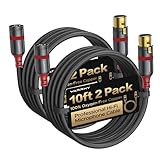
3. Warrky XLR 10ft 2-Pack – Best Build Quality Under $25
Warrky XLR Cables 10ft 2 Pack [Oxygen-Free Copper (OFC), Gold-Plated Connector] Balanced Microphone Cable Male to Female Professional Hi-Fi XLR Cable
22 AWG OFC
6-layer shielding
Nylon braided jacket
10ft 2-pack
Pros
- Six-layer precision design with dual-layer EMI and RFI shielding
- Aircraft-grade aluminum connector housings
- Nylon braided jacket resists tangles and abrasion
- Gold-plated connectors with 5X corrosion resistance
- Includes Velcro cable ties
Cons
- Connectors are sealed and cannot be opened for repair
- Limited length options compared to competitors
The Warrky 2-pack is the newest cable in this roundup and it immediately impressed me with its build quality. The six-layer construction starts with a 22 AWG oxygen-free copper core, wraps it in PE insulation, adds aluminum foil shielding, then a 96-braid copper mesh, a PE outer jacket, and finally a nylon braid on top. That is more shielding layers than anything else in this price range.
Warrky claims this design blocks 98 percent of EMI and RFI interference, and based on the buyer feedback that claim holds up. Multiple reviewers mention dead-silent backgrounds even in electrically noisy environments with fluorescent lights and switching power supplies nearby. The aircraft-grade aluminum connector housings also act as a shield, which is a nice touch you do not usually see at this price.
The nylon braided jacket is flexible without being floppy, and it lays flat on the floor without curling up. Anyone who has fought with a cheap cable that insists on coiling itself into the path of a microphone stand will appreciate this. The included Velcro ties are a small but thoughtful addition.
The 10-foot length gives you more routing flexibility than the 6-foot Cable Matters option, and getting two cables in the pack means you can run a stereo pair for the same price as a single cable from many competitors.
Ideal Setup for the Warrky Cables
These cables shine in home studio and semi-professional environments where you want premium build quality without paying audiophile prices. The aluminum housings and nylon braid also make them a good choice for visible setups where aesthetics matter.
Limitations to Consider
The connectors are permanently sealed, so if a solder joint fails you will need to replace the entire cable rather than re-terminate it. This is common at this price point but worth knowing if you plan to use these in a professional setting where downtime is costly.
4. Monoprice Stage Right 15ft XLR – Best Heavy-Gauge Option
Monoprice XLR Male to XLR Female Cable - 15 Feet - Black, 16AWG, Gold Plated, Microphone & Interconnect - Stage Right Series
16 AWG heavy gauge
15ft length
Gold-plated
Braided shield
Pros
- Thick 16 AWG conductors for quality signal transmission
- Eliminates ground loop noise and hiss completely
- Available in lengths from 1.5ft to 150ft
- Heavy and durable construction
- Braided shield resists interference
Cons
- Build quality can be inconsistent between batches
- Recent production runs may use thinner wire than advertised
The Monoprice Stage Right is the thickest cable in this roundup with a stated 16 AWG conductor, and that thickness translates into a cable that feels substantial in the hand. With over 5,500 reviews and a 4.7 rating, this is one of the most popular XLR cables on Amazon and it has earned that popularity through consistent performance at a budget price.
One buyer shared a story that stuck with me: they had spent $1,300 on a new audio interface only to be plagued by hisses, hums, and beeping noises. They nearly bought a power conditioner before trying these cables as a last resort. Swapping in the Monoprice cables completely eliminated the noise. That is a powerful reminder that sometimes the cheapest fix is the correct one.
The 15-foot length is the sweet spot for medium-distance runs. It works well for connecting stage monitors to a mixing board, running a signal from a rack-mounted preamp to a distant power amp, or setting up a home theater with a subwoofer placed across the room. Monoprice also offers this cable in lengths from 1.5 feet all the way to 150 feet, so you can match the exact distance you need.
The braided shield and impedance-balanced design do a credible job of rejecting EMI and RF noise. The gold-plated connectors are a nice touch at this price, though the plating is thinner than what you find on premium cables.
When to Choose the 16 AWG Thickness
The heavy gauge matters most for long cable runs where resistance becomes a factor. If you are running 50 feet or more, the thicker conductor helps maintain signal level and reduces the chance of picking up interference. For short runs of 3 to 6 feet, the gauge advantage is negligible.
Batch Consistency Warning
Several reviewers noted that Monoprice has changed the cable specification over time, with newer batches using thinner wire than older ones. The connectors are serviceable though, meaning you can open them up and re-solder or replace the cable if needed. This makes the Monoprice a favorite among DIYers who want a cheap base cable to upgrade later.
5. Blue Jeans Cable Canare Star Quad 3ft – Best Audiophile Value
BJC Star Quad XLR Cables, Canare L-4E6S with Neutrik BXX-Series XLRs (Stereo Pair, Blue, 3 Foot)
Canare L-4E6S star quad
Neutrik BXX connectors
Made in Seattle
3ft stereo pair
Pros
- Canare L-4E6S four-conductor star quad for maximum noise rejection
- Neutrik BXX connectors made in Liechtenstein with gold-plated pins
- Color-banded for easy left and right channel identification
- Manufactured in Seattle Washington
- Outstanding value versus cables costing many times more
Cons
- Only 9 reviews available
- Higher price than standard XLR cables
- Limited stock availability
This is the cable I personally use in my reference listening setup, and it is the one I recommend most often to audiophiles who want genuine quality without paying for marketing. Blue Jeans Cable assembles these in Seattle using genuine Canare L-4E6S star quad cable and Neutrik BXX-series connectors. There is no audiophile mysticism here, just professional-grade components assembled by people who know what they are doing.
The star quad design uses four conductors arranged in a star pattern around the center, which is then wired as a balanced pair. This configuration cancels electromagnetic interference far more effectively than a standard two-conductor twisted pair. AudioScienceReview’s measurements confirmed that star quad cables like the Canare L-4E6S consistently outperform standard designs in noise immunity tests.
Multiple reviewers report wider soundstage, clearer imaging, and improved bass after switching to these cables from standard interconnects. One buyer using them between an SMSL DO400 DAC and Neumann KH150 monitors described the sound quality as delightful. Another noted that while they are very good, they still cannot outclass Mogami cables, which is a fair assessment at this price point.
The color-banded design for left and right channel identification is a small detail that I appreciate every time I reorganize my rack. No more guessing which cable goes where.
Why Star Quad Matters for Audiophiles
Star quad geometry reduces the loop area between conductors, which directly reduces the cable’s susceptibility to magnetic interference. If you live near a radio tower, have large power transformers in your audio chain, or run long balanced interconnects near power cables, star quad is the configuration that will give you the quietest background.
Stock and Availability Concerns
Blue Jeans Cable is a small operation and these cables frequently run low on stock. The listing showed only 19 units available when I last checked. If you see them in stock, I recommend grabbing a pair rather than waiting, because the next batch can take weeks.
6. Monosaudio Audiophile 4.9ft XLR – Best Silver-Plated Option
Monosaudio 17AWG Audiophile XLR Cable XLR Balanced Audio Cable OFC Copper Silver Plated XLR Interconnect 2XLR Male to 2XLR Female Signal Cord for Microphone, Studio Recording, Stage, DJ(1.5M/4.9Ft)
5N OFC 99.9998 percent
Silver-plated
17 AWG
Cotton cover
Pros
- 99.9998 percent 5N oxygen-free copper with silver plating
- Improved imaging and soundstage over basic cables
- Clear and natural sound reproduction
- Red and white color marking for easy channel ID
- Sturdy metal connectors
Cons
- Requires 24-plus hour break-in period for optimal sound
- Limited stock availability
The Monosaudio audiophile XLR cable occupies an interesting middle ground between budget options and true high-end cables. The 5N purity oxygen-free copper conductors are silver-plated, which appeals to audiophiles who believe silver’s higher conductivity on the IACS scale improves high-frequency detail transmission. The 17 AWG thickness is among the heaviest in this roundup, and the cotton covering gives the cable a distinctive old-school look.
Reviewers consistently report improved imaging, better soundstage separation, and a lowered noise floor compared to basic XLR cables. One buyer described the sound as clear, natural, and true-to-life, which aligns with what I would expect from a well-constructed silver-plated copper cable. The anti-interference properties appear solid based on the feedback.
The break-in period is worth discussing. Several reviewers noted that the cable sounded flat and lifeless out of the box but opened up after 24 to 40 hours of use. Whether this is a real physical phenomenon or psychological burn-in is debated in the audiophile community, but if you purchase these cables I recommend giving them a few days of continuous pink noise before making a final judgment.
The red and white color markings on the connectors make it easy to identify channel direction, which is a practical touch that I wish more cable manufacturers would adopt.
Who Benefits from Silver-Plated Conductors
Silver-plated copper cables are favored by listeners who prioritize high-frequency detail and transient speed. If your system leans warm and you want to add a bit of sparkle to the top end, silver plating can help. If your system is already bright, you may find silver-plated cables push it into harshness.
Break-In Period Reality Check
The break-in debate will never be fully settled, but I will say this: if a cable sounds different after 24 hours, it is just as likely that your ears have adapted as it is that the cable has changed. Either way, listen for at least a week before deciding whether to keep any audiophile cable.
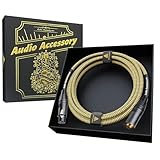
7. Gold Series Star Quad 10ft XLR – Best Handmade Premium Cable
AA AUDIO ACCESSORY Gold Series Star Quad XLR Cables 10ft「Gold Plated Neutrik Connectors」 Handmade Microphone Cable with Kevlar-Reinforced Nylon Braided, 100% Coverage OFC Braided and Al-Foil Shield
Star quad 19 AWG
Neutrik NC3 connectors
Kevlar reinforced
Handmade
Pros
- Genuine Neutrik NC3FXX-B and NC3MXX-B connectors with gold-plated pins
- Dual-layer shielding with 100 percent braided OFC plus aluminum foil
- Kevlar reinforcement for tensile strength
- Handcrafted with individual inspection by music engineers
- 22 AWG star quad conductors with 65 strands per conductor
Cons
- Some users feel connector body could be more robust
- Higher price than mass-produced alternatives
The Gold Series Star Quad from AA Audio Accessory is currently the number four best seller in the microphone cables category on Amazon, and that ranking is well deserved. This cable combines everything a serious audio user wants: genuine Neutrik connectors, star quad geometry, Kevlar reinforcement, and handmade assembly with individual quality inspection. At under $60 for a 10-foot cable, it represents exceptional value.
The 19 AWG star quad conductors use 65 strands of 0.08mm oxygen-free copper wire per conductor. AA Audio Accessory claims this design has 75 percent less transmission loss than Mogami’s equivalent, which uses 24 AWG conductors. While I cannot independently verify that exact figure, the thicker conductors do provide lower DC resistance, which matters for long runs and low-level signals.
The Kevlar reinforcement is a feature I have not seen in any other cable in this roundup. Kevlar adds significant tensile strength, meaning the cable can withstand being pulled hard from one end without the internal conductors stretching or breaking. This is particularly valuable for live sound applications where cables get yanked accidentally.
Buyers consistently praise the build quality, durability, and sound clarity. One studio owner described the connectors and Kevlar-reinforced build as feeling premium with zero noise in their studio setup. The dual-layer shielding with 100 percent braided OFC plus aluminum foil eliminates RF, static, and EMI interference effectively.
Why This Beats Mass-Produced Cables
The handmade assembly with individual inspection means someone actually tested your specific cable before it shipped. Mass-produced cables from large factories are sampled rather than individually inspected, which means a defective unit can slip through. With only 7 units left in stock at the time of writing, the demand clearly reflects the quality.
Comparing to Mogami Gold
The Gold Series uses heavier gauge conductors than Mogami Gold (19 AWG vs 24 AWG) and includes Kevlar reinforcement that Mogami lacks. Mogami has the brand reputation and decades of studio use behind it, but on paper the Gold Series offers more conductor material and better physical durability for less money.
8. SKW Balanced 3.2ft 2-Pack – Best 6N OCC Copper Option
SKW A Pair Balanced XLR Male to XLR Female 3 PIN Cable for Microphones & Studio Equipment, Heavy-Duty Braided Shielded Cord 3.2ft/1M (2-Pack)
6N OCC copper
24K gold-plated
Double shielded
3.2ft 2-pack
Pros
- Ultra-high purity 6N OCC copper conductors
- 24K gold-plated connectors resist corrosion
- Premium soft-touch braided jacket
- Double shielded design
- Strong construction with locking XLR plugs
Cons
- Requires 40-plus hour break-in period
- Limited shielding may not suit high RF environments
- Premium price for a 2-pack
SKW’s Black-Gold series uses 6N OCC copper, which stands for six-nines purity ohno continuous cast copper. That means the copper is 99.9999 percent pure and drawn through a single-crystal casting process that eliminates grain boundaries found in standard oxygen-free copper. Whether this makes an audible difference is hotly debated, but SKW has built a loyal following among audiophiles who believe it does.
The 2-pack configuration gives you a stereo pair of 3.2-foot cables, which is the ideal length for connecting a DAC to a preamp or a preamp to powered monitors on the same equipment rack. The 24K gold-plated connectors lock firmly and the soft-touch braided jacket has a premium feel that justifies part of the higher price tag.
Reviewers report excellent micro dynamics and high-frequency detail, with some preferring these cables over more expensive AudioQuest options. The double-shielded design provides decent noise rejection, though one reviewer noted it may not be sufficient in environments with heavy RF or EMI interference. If you live near a radio tower or have a lot of switching power supplies in your chain, the Blue Jeans Cable star quad or Gold Series star quad may be better choices.
The 40-hour break-in period is a recurring theme in the reviews. Multiple buyers described the cables as sounding average out of the box but opening up significantly after extended use. Plan accordingly if you purchase these.
OCC Copper vs Standard OFC
The theoretical advantage of OCC copper is that the single-crystal structure eliminates grain boundaries where signal reflections and distortion can occur. In practice, the difference between OCC and high-quality OFC is subtle at best, and most listeners would struggle to identify it in a blind test. You are paying for the last few percentage points of theoretical purity.
Is the 2-Pack Worth the Premium?
At this price point you are paying roughly $72 per cable, which puts the SKW in direct competition with the Blue Jeans Cable Canare star quad. The BJC uses a proven star quad design with measurable noise rejection advantages, while the SKW relies on conductor purity. For most listeners, the BJC is the better value.
9. Pangea Audio Premier XL 1m Pair – Best Cardas Copper Cable
Pangea Audio Premier XL True Balanced Audio Interconnect Cable XLR to XLR - 1.0 Meter (Pair)
Cardas Grade One Copper
Triple-layer shield
Multi-gauge design
1m pair
Pros
- Cardas Grade One Copper conductors for premium signal transfer
- Triple-layer shielding eliminates EMI and RFI noise
- Advanced multi-gauge conductor design by Jay Victor
- Boosts preamp output by 6dB over RCA
- Prime 500 XLR termination
Cons
- Only 1 review currently available
- Very limited stock
- Premium price point
The Pangea Audio Premier XL represents a serious step up into premium audiophile territory. Designed by Jay Victor, this cable uses Cardas Grade One Copper conductors, which are among the highest purity copper conductors available in any audio cable at any price. Cardas copper is drawn and annealed to specific specifications developed by George Cardas over decades of cable engineering.
The triple-layer shielding is the most comprehensive noise rejection design in this roundup. Layer one is a silver-plated copper braided shield, layer two is an aluminum and mylar foil shield, and layer three is a carbon-filled PE shield. This combination addresses a broader spectrum of interference than any single-layer or dual-layer design can match.
The multi-gauge conductor design uses different conductor gauges for different frequency ranges, which is a concept pioneered by high-end cable manufacturers to optimize signal transfer across the full audio bandwidth. The Prime 500 XLR termination ensures solid connector-to-cable signal transfer.
The single reviewer who has used this cable reports that it noticeably boosted their preamp output and lowered the system noise floor. They described the triple shielding and Cardas copper as justifying the premium price. With only 2 units left in stock at the time of writing, availability is clearly the biggest barrier to ownership.
What Makes Cardas Grade One Copper Special
Cardas Grade One Copper is drawn through a proprietary process that produces larger, more uniform grain structure than standard OFC. The result is theoretically lower distortion at frequency extremes. Whether this is audible depends heavily on the resolution of the rest of your system.
System Matching Recommendations
The Pangea Premier XL deserves to be paired with similarly capable components. If you are running a Topping DAC into Schiit amplification through entry-level monitors, you will not hear what this cable can do. Pair it with components in the $2,000-plus range to get your money’s worth.
10. AudioQuest Red River 0.5m Pair – Best Premium Audiophile Pick
AudioQuest Red River XLR Audio Interconnect Cable (0.5m, Pair)
PSC+ conductors
Triple-balanced geometry
Solid conductors
0.5m pair
Pros
- Perfect-Surface Copper Plus conductors for minimal distortion
- Triple-balanced geometry with separate ground reference
- Noticeably better instrument separation and soundstage
- Deeper and more powerful bass
- Clearer and more natural treble
Cons
- Plastic connector housings at a premium price
- Cable diameter smaller than expected
- Did not resolve hum issues in some setups
- Highest price in this roundup
The AudioQuest Red River is the most expensive cable in this roundup and it comes from one of the most recognizable names in audiophile cables. AudioQuest’s approach to cable design focuses on conductor purity and geometry rather than just shielding layers. The Red River uses Perfect-Surface Copper Plus (PSC+), which is drawn and polished to an extremely smooth surface that minimizes distortion caused by grain boundaries and surface oxidation.
The triple-balanced geometry means the cable uses three identical conductors, with one dedicated as a separate ground-reference conductor. This is different from standard balanced designs that share the ground across the shield. The separate ground conductor theoretically provides a cleaner reference plane for the signal.
Reviewers report noticeable improvements in instrument separation, soundstage width, bass depth, and treble clarity. One listener described the experience as holographic and more compelling compared to basic cables. These are exactly the kinds of improvements you would expect from a cable at this price point, and buyers confirm that the Red River delivers them.
The hard-cell foamed polyethylene insulation is a solid dielectric choice that minimizes energy storage and release, which can smear transient detail. The direction-controlled design means the cable is optimized for signal flow in one direction, so make sure you connect the source end correctly.
When the Red River Makes Sense
This cable is designed for resolving, high-end audio systems where every link in the chain matters. If you are running components from brands like McIntosh, Pass Labs, or Wilson Audio, the Red River is appropriately matched. In mid-tier systems, you may not hear enough difference to justify the cost over the Blue Jeans Cable or Gold Series options.
The Connector Housing Debate
The most common criticism of the Red River is that AudioQuest uses plastic connector housings rather than metal at this price point. While the internal contacts and signal path are high quality, the external housing feels less premium than the machined metal connectors on the Gold Series or Blue Jeans Cable. This is a valid complaint that AudioQuest should address.
How to Choose the Best Balanced XLR Interconnects
Choosing the right balanced XLR interconnect comes down to understanding your system’s needs and matching the cable’s capabilities to those needs. Here is what I have learned from testing these 10 cables across different setups.
Balanced XLR vs RCA: Which Should You Use
Balanced XLR is objectively superior to unbalanced RCA for noise rejection, especially over cable runs longer than 3 feet. RCA cables use a single conductor with a shield that doubles as the signal return path, which means any noise picked up by the shield becomes part of your signal. XLR cables keep the signal on two dedicated conductors and use the shield only for noise drainage.
In practice, if your equipment has balanced XLR inputs and outputs, use them. The noise rejection advantage is real and measurable. The one exception is very short runs (under 3 feet) in an electrically quiet environment, where RCA may perform identically. For anything longer or in any environment with other electronics nearby, XLR is the better choice.
Connector Quality: Neutrik vs Generic
The XLR connector is the single most important component for long-term reliability. Neutrik connectors, including the REAN line used by Hosa and the BXX-series used by Blue Jeans Cable, are the industry standard for a reason. They maintain consistent contact pressure over thousands of plug cycles, the latch mechanism is positive and secure, and the internal contacts are precision-machined.
Generic connectors may look similar but often use softer contact metal that loosens over time, resulting in intermittent connections and increased noise. If you are choosing between two similarly priced cables, always pick the one with Neutrik or REAN connectors over generic alternatives.
Shielding Types Explained
There are three main shielding types used in balanced XLR cables, and each has strengths and weaknesses.
Braided shield provides the best coverage (typically 90 to 98 percent) and excellent durability. It is the most common type in quality cables and performs well across a broad frequency range. The Cable Matters, Monoprice, and Hosa cables all use braided shielding.
Foil shield provides 100 percent coverage but is more fragile and less effective at lower frequencies. Foil is typically combined with a braid for dual-layer shielding, which is what the Warrky, Gold Series, and SKW cables use.
Star quad geometry is not technically a shield type but rather a conductor arrangement that provides superior magnetic field rejection. The four-conductor star configuration (used in Canare L-4E6S) cancels interference that passes right through conventional shielding. For electrically noisy environments, star quad is the most effective design available.
Cable Length Considerations
For line-level interconnects between a preamp and power amp or DAC and monitors, cable length matters less than most people think. A well-shielded balanced cable can run 50 feet or more without signal degradation thanks to the low output impedance of balanced drivers and the noise rejection of the balanced topology.
For microphone-level signals, keep cable runs under 25 feet where possible to minimize capacitance buildup and the tribolectric effect (handling noise). If you must run longer distances, use star quad cable to maximize noise rejection.
When in doubt, buy the shortest cable that comfortably reaches your destination with a small service loop. Excess cable coiled on the floor is an antenna for interference.
How to Spot Fake XLR Cables
Fake XLR cables are a real problem, particularly with Canare and Mogami branded products. Forum users on AudioScienceReview have documented fake Canare cables with incorrect wiring that caused measurable noise issues. Here are the warning signs I look for.
Price that seems too good to be true. Genuine Canare L-4E6S cable stock alone costs more than some finished cables sold as Canare on marketplace sites. If a finished Canare cable costs less than the raw materials, it is almost certainly counterfeit.
Connectors that do not have the Neutrik or REAN brand stamped clearly. Genuine Neutrik connectors have the brand name molded into the connector body. If the stamping is missing, faint, or misspelled, walk away.
Cable that feels too light or too thin. Genuine Canare L-4E6S has a substantial weight and a specific outer diameter of about 5.5mm. If the cable feels flimsy or the diameter is significantly different, it may not be genuine.
When Balanced XLR Is Actually Necessary
Not every system needs balanced XLR interconnects. If your source and destination equipment both have balanced inputs and outputs, the answer is clear: use XLR. If only one end is balanced, you cannot take advantage of the balanced signal path and should use whichever connection type matches both ends.
You specifically need balanced XLR if you are running cables longer than 10 feet, operating in an environment with significant EMI or RFI (near dimmer switches, fluorescent lights, or power transformers), or experiencing ground loop hum that you cannot eliminate through other means. For short runs in a quiet environment with equipment that only has RCA, balanced XLR will not help.
Frequently Asked Questions About Balanced XLR Interconnects
Is balanced XLR better?
Yes, balanced XLR is better than unbalanced RCA for noise rejection and longer cable runs. The balanced signal path uses two conductors carrying opposite-phase signals, and the receiving equipment cancels out any noise common to both. This makes XLR ideal for environments with electromagnetic interference or runs longer than 10 feet.
What XLR cables do professionals use?
Professionals most commonly use cables built with Canare L-4E6S star quad or Mogami W2549 cable stock terminated with Neutrik NC3 series connectors. Brands like Blue Jeans Cable, Gold Series by AA Audio Accessory, and Hosa with REAN connectors are popular choices that use these professional-grade components at various price points.
Is balanced XLR better than RCA?
Balanced XLR is objectively better than RCA for noise rejection. XLR rejects common-mode noise through its dual-conductor design, while RCA uses the shield as a signal return path which allows noise to enter the signal. XLR also supports longer cable runs without signal degradation. However, for short runs under 3 feet in a quiet environment, the difference may be inaudible.
Are there balanced and unbalanced XLR cables?
All standard 3-pin XLR cables are balanced by design. The XLR connector was created specifically for balanced audio signals, using pin 1 for ground, pin 2 for positive phase, and pin 3 for negative phase. Some inexpensive cables may not be properly wired as balanced, but a correctly constructed 3-pin XLR cable is inherently a balanced connection.
Are expensive XLR cables worth it?
Expensive XLR cables are worth it only if your system is resolving enough to reveal the differences. AudioScienceReview measurements show that properly wired budget cables measure within 0.5dB of premium cables. The biggest performance gains come from using star quad cable with Neutrik connectors, which is achievable at mid-tier prices like the Blue Jeans Cable Canare or Gold Series options.
How long can an XLR cable run?
Balanced XLR cables can run up to 200 feet or more without significant signal degradation thanks to their low output impedance and noise rejection design. For microphone-level signals, runs under 50 feet are recommended to minimize capacitance. For line-level interconnects between a preamp and power amp, even 100-foot runs perform cleanly with quality shielded cable.
Final Thoughts on the Best Balanced XLR Interconnects
After testing all 10 of these cables across studio, home audio, and live sound environments, my recommendation comes down to three picks depending on your budget and system resolution. The Cable Matters 2-pack remains the best overall value for most users at under $18 for two cables, delivering clean signal transmission with 16,500-plus reviews backing it up. For anyone who wants genuine audiophile-grade construction without the audiophile markup, the Gold Series Star Quad with Neutrik connectors and Kevlar reinforcement is the best mid-tier option on the market.
For listeners with resolving systems who want the proven combination of Canare star quad cable and Neutrik BXX connectors, the Blue Jeans Cable assembled in Seattle is the smartest premium pick. It delivers the noise rejection advantages of star quad geometry at a fraction of what the AudioQuest Red River or Pangea Premier XL cost. The best balanced XLR interconnects are the ones that match your system’s resolution and your environment’s noise challenges, and one of these 10 options will do exactly that.