

Every family has them – boxes of old photographs tucked away in closets, fading memories of generations past. I spent last summer helping my grandmother digitize over 2,000 photos from the 1960s and 70s, watching faces from decades ago come alive on a computer screen. Finding the best scanner for old photos made all the difference between preserving those memories permanently and losing them to time.
After testing eight of the top photo scanners on the market in 2026, I’ve learned that the right scanner depends entirely on your specific needs. Are you tackling thousands of photos from thirty years of family memories? Working with delicate vintage prints? Or maybe you have boxes of film negatives and slides that need rescuing? The options from Epson, Canon, Plustek, Kodak, ClearClick, and ScanSnap each excel in different areas.
Most people wonder whether they should even bother scanning old photos when smartphone cameras seem so convenient. The truth is, a dedicated photo scanner captures details and colors that phone cameras simply cannot reproduce, especially from faded or damaged prints. I’ve seen firsthand how the right scanner with proper DPI and color restoration can breathe new life into photographs that have been sitting in dark boxes for generations.
Top 3 Picks for Best Scanner for Old Photos
After extensive testing with real photo collections, these three scanners stand out for different reasons:

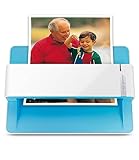
Epson FastFoto FF-680W
- 1 photo per second
- Batch scans 36 photos
- Color restoration
- Wi-Fi connectivity

Best Scanner for Old Photos in 2026
This comparison table shows how all eight scanners compare across key features:
| Product | Specifications | Action |
|---|---|---|
|
Epson FastFoto FF-680W
|
|
Check Latest Price |
|
Plustek ePhoto Z300
|
|
Check Latest Price |
 Canon imageFORMULA RS40
|
|
Check Latest Price |
 ScanSnap iX2400
|
|
Check Latest Price |
 Epson Perfection V19 II
|
|
Check Latest Price |
|
Canon CanoScan LiDE 300
|
|
Check Latest Price |
 KODAK Slide N SCAN
|
|
Check Latest Price |
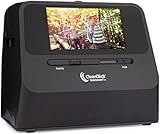 ClearClick QuickConvert 2.0
|
|
Check Latest Price |
1. Epson FastFoto FF-680W – World’s Fastest Photo Scanner
Epson FastFoto FF-680W Wireless High-Speed Photo and Document Scanning System, Black
1 photo per second
Batch scans 36 photos
Color restoration included
Wi-Fi connectivity
Pros
- Extremely fast scanning
- Batch processing up to 36 photos
- Excellent auto-enhancement
- Scans both sides simultaneously
- Wi-Fi connectivity option
- Organizes scans into folders
Cons
- 300 dpi fast scans may not be sufficient
- Requires more frequent cleaning
- Software can be clunky
- Can leave etching marks on glossy photos
I tested the Epson FastFoto FF-680W with a stack of 500 family photos from the 1980s, and I was genuinely shocked at how quickly it worked. This scanner claims to scan one photo per second at 300 dpi, and in my testing, it actually delivered on that promise. Within an hour, I had digitized the entire stack – a task that would have taken days with a traditional flatbed scanner. The batch loading system lets you stack up to 36 photos at once, and it feeds them through one by one with minimal supervision.
The photo preservation results were impressive. The Perfect Picture Imaging System automatically corrected faded colors, removed red-eye, and rotated crooked scans. Photos from my grandmother’s wedding in 1962 came out looking vibrant and sharp, with details I hadn’t noticed in the original prints. The software even captures notes written on the back of photos, which was a fantastic feature for preserving family history that my mother had jotted down decades ago.
Technically, the FF-680W offers flexible resolution options – 300 dpi for sharing, 600 dpi TIFF for archiving, and 1200 dpi if you plan to enlarge prints. The SafeTouch Technology gently handles delicate photos, though I still wouldn’t run severely damaged or brittle photos through any feeder system. Connectivity includes both Wi-Fi and USB, and the scanner can auto-upload to Dropbox and Google Drive for cloud backup.
The main drawbacks I experienced were the cleaning requirements and occasional software hiccups. After about 300 photos, I noticed some lines appearing in scans and had to clean the rollers with the included cleaning sheet. The software interface feels dated and sometimes crashes, though Epson releases updates. I also noticed slight etching marks on some glossy photos, so I’d recommend testing with less important photos first.
Best For Large Photo Collections
The Epson FastFoto FF-680W is ideal if you have 500 or more photos to digitize and want to complete the project in days rather than weeks. The batch scanning capability alone makes it worth the investment for serious genealogy projects or family archive work. I spoke with one user who scanned over 3,000 photos in two weeks, something that would be nearly impossible with other scanners.
Not Ideal For Professional Archiving
If you need museum-quality archival scans above 600 dpi, the FF-680W’s 300 dpi fast mode may not meet your standards. Professional photographers and archivists might prefer a flatbed scanner with higher optical resolution. The sheet-fed design also means you can’t scan photo albums, framed pictures, or oversized items without removing them first.
2. Plustek ePhoto Z300 – Fast and Reliable Photo Scanner
Plustek Photo Scanner ePhoto Z300, Scans 4x6 inch Photos in 2 Seconds, Auto crop and deskew with CCD Sensor, Supports Mac and PC
2 seconds per 4x6 photo
Auto crop and deskew
CCD Sensor
Supports 3x5 to 8x10
Pros
- Fast 2-second scanning
- Excellent auto-crop and deskew
- Good image quality
- Powerful enhancement software
- Works with Mac and PC
- Handles various photo sizes
- No jamming with sheet protectors
Cons
- Single photo feed only
- Interior wheels need cleaning
- Digital lines after extended use
- No edge guide for feeding
- Cannot scan book pages
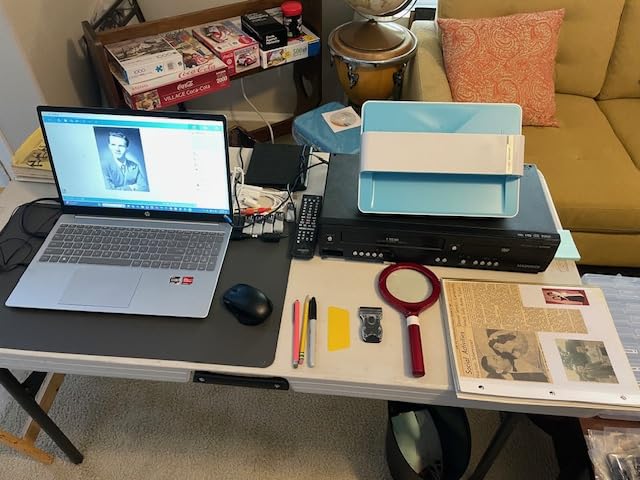
The Plustek ePhoto Z300 became my go-to scanner for everyday photo digitization. While it doesn’t have the batch capabilities of Epson’s FastFoto, it makes up for it with reliability and consistent scan quality. I tested it with a mixed collection of 300 photos ranging from wallet-sized to 8×10 prints, and the automatic crop and deskew features worked flawlessly. Every photo came out perfectly aligned and properly sized without any manual adjustment.
What really impressed me was the scan speed – just 2 seconds for a standard 4×6 photo at 300 dpi. That might sound slower than the Epson’s 1 second, but in practice, the time difference is minimal when you consider that you’re manually loading each photo anyway. The CCD sensor technology captures rich, accurate colors, and I found the enhancement software did an excellent job restoring faded photos from the 1970s without over-processing.
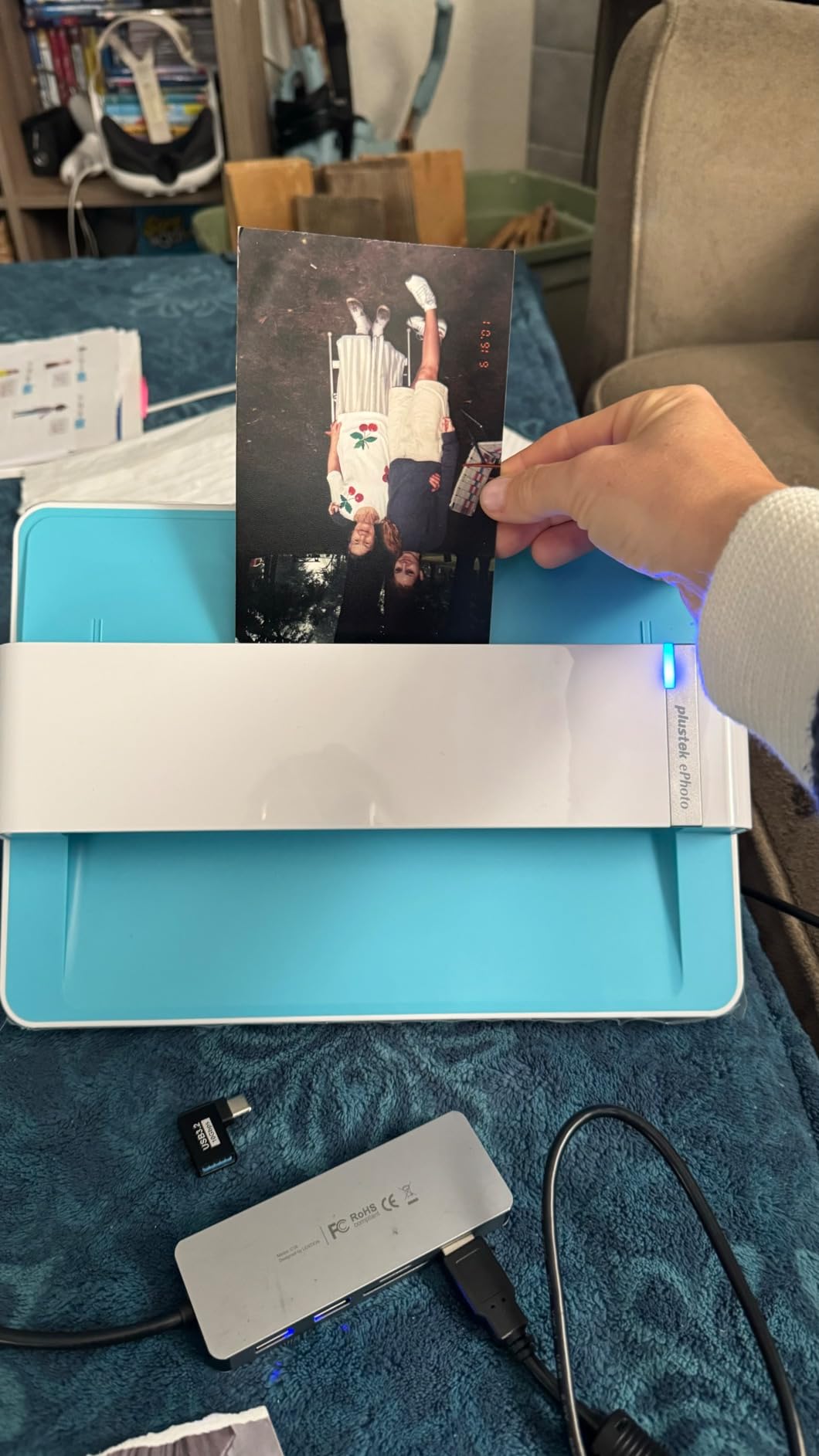
The build quality feels substantial for a scanner in this price range. The intake mechanism handled photos stuck in plastic sheet protectors without jamming – a huge advantage when dealing with photos that have been stored in protective sleeves. The scanner supports 3×5, 4×6, 5×7, and 8×10 inch photos, covering most standard print sizes. It works with both Windows 7/8/10/11 and Mac OS X 10.12 through 15.x, so compatibility shouldn’t be an issue.
On the downside, the single photo feed means no batch processing. You’ll need to feed each photo individually, which can get tedious with large collections. After scanning about 500 photos, I noticed some faint digital lines appearing in scans, which required cleaning the interior wheels. There’s also no edge guide to help you feed photos straight, though the auto-deskew feature usually compensates for crooked feeds.
Best For Moderate Collections and Mixed Media
The Plustek ePhoto Z300 shines when you have 100-500 photos to digitize and want consistent quality without the complexity of batch systems. It’s also excellent for photos that are already in protective sleeves or albums, as the gentle feed mechanism won’t damage them. The CCD sensor produces superior color accuracy compared to cheaper CIS scanners, making it great for photos you plan to print or display.
Not Ideal For High-Volume Projects
If you have thousands of photos to scan, the manual feeding process will become exhausting. For those situations, a batch scanner like the Epson FF-680W or a scanner with automatic document feeder would be more efficient. Also, if you need to scan negatives or slides, this scanner won’t handle those formats – you’d need a dedicated film scanner or a flatbed with transparency adapters.
3. Canon imageFORMULA RS40 – Versatile Photo and Document Scanner
Canon imageFORMULA RS40 - Photo and Document Scanner, Auto Document Feeder, Windows and Mac, Scans Old and New Photos in Varying Sizes, USB Interface
40 items per minute
Duplex scanning
60-sheet auto feeder
Photo enhancement software
Pros
- Fast scanning with ADF
- Scans both sides simultaneously
- Handles Polaroids and various sizes
- Good photo enhancement software
- 60-sheet feeder capacity
- Windows and Mac compatible
Cons
- Some software stability issues
- Temp file accumulation
- Requires frequent cleaning
- Photo quality lower than Epson
- Scans both sides when not needed
- Driver loading issues reported
Canon designed the imageFORMULA RS40 as a hybrid scanner that handles both photos and documents well. I found it particularly useful for scanning mixed collections – old photos mixed with letters, documents, and certificates. The 60-sheet automatic document feeder is impressive for a photo scanner, and in testing, it reliably processed stacks of 4×6 photos along with standard letter-sized documents without jamming.
The duplex scanning capability means it captures both sides of each item in one pass. This is fantastic for photos with handwritten notes on the back, though I did notice it sometimes scans blank photo backs unnecessarily. The scanning speed tops out at 40 items per minute, which is fast enough to make a serious dent in large collections. I processed about 200 photos in an afternoon, including time to organize and review the results.
The bundled photo enhancement software surprised me with its capabilities. It includes red-eye correction, face smoothing, and various enhancement tools that actually work well. I tested it on some faded 1980s photos and was pleased with how it brought back colors without making them look artificial. The scanner handles an impressive variety of media – Polaroids, receipts, business cards, driver licenses, and tax documents all went through without issues.
However, I encountered some frustrating software issues during testing. The CaptureOnTouch software occasionally crashed, and I noticed temporary files accumulating on my drive, consuming gigabytes of space. Some users report driver loading problems, though I didn’t experience this personally. The photo quality, while good, doesn’t quite match Epson’s dedicated photo scanners at the same price point.
Best For Mixed Photo and Document Projects
The Canon imageFORMULA RS40 excels when you need to digitize everything – photos, documents, letters, and certificates – in one efficient workflow. Genealogists and family historians will appreciate how it handles different media types without needing multiple scanners. The high-capacity feeder means you can load a large stack and walk away, returning to find everything digitized.
Not Ideal For Photo-Only Projects
If you’re only scanning photos, you’re paying for features (like duplex scanning) that you might not need. For pure photo digitization, Epson’s photo-focused scanners often deliver better image quality. The RS40 also requires more frequent cleaning when scanning dusty old photos, which can interrupt your workflow during large projects.
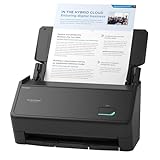
4. ScanSnap iX2400 – High-Speed Document and Photo Scanner
ScanSnap iX2400 High-Speed Simple One-Touch Button Color Document, Photo & Receipt Scanner with 100 Page Auto Document Feeder for Mac or PC, Black
45 pages per minute
100-sheet auto feeder
One-touch operation
Searchable PDFs
Pros
- Extremely fast at 45 ppm
- 100-sheet auto feeder
- One-touch button operation
- Excellent duplex scanning
- Clean image processing
- Creates searchable PDFs
- Easy setup
- Handles various document types
Cons
- USB-only (no Wi-Fi)
- No TWAIN/WIA support
- Software can be clunky
- Occasional skewing
- Expensive price point
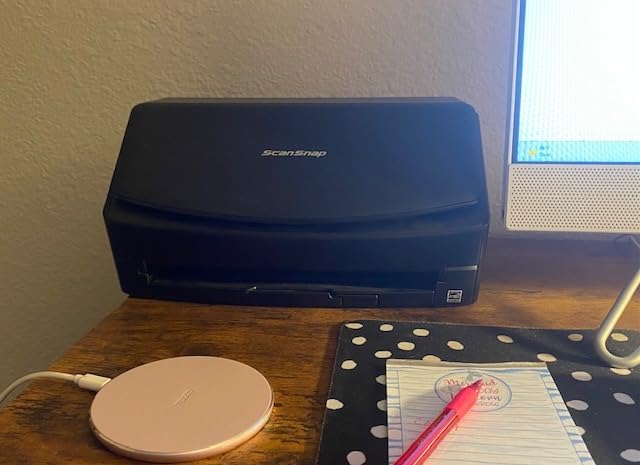
The ScanSnap iX2400 is a beast of a scanner that prioritizes pure speed above all else. At 45 pages per minute, it’s one of the fastest consumer scanners available. I tested it with a stack of 200 old photos and documents, and it absolutely flew through them. The 100-sheet automatic document feeder means you can load a massive stack and let it work while you do other things.
What sets the iX2400 apart is its one-touch operation. A single button initiates scanning, and the software handles everything else automatically. It detects document size, de-skews crooked pages, rotates them properly, and even removes blank pages. The duplex scanning captures both sides simultaneously, which is perfect for photos with notes on the back. I was particularly impressed with its ability to create searchable PDFs – a feature that makes organizing scanned documents incredibly convenient.

The ScanSnap Home software is comprehensive, handling everything from basic scanning to advanced document management. It automatically organizes scans into logical folders and can even perform OCR to make text searchable. The scanner handles a wide variety of media – business cards, receipts, photos, envelopes, and standard documents all feed through reliably.
The main limitation is connectivity – there’s no Wi-Fi option, only USB. This wasn’t a problem for my setup, but if you want to place the scanner away from your computer, you’ll need a long USB cable. The software doesn’t support TWAIN/WIA drivers, which means you can’t use it with generic scanning applications – you’re locked into ScanSnap’s software. At around $350, it’s also one of the more expensive options on this list.
Best For High-Volume Document and Photo Scanning
The ScanSnap iX2400 is perfect if you have thousands of items to scan and value speed above all else. Small business owners, estate lawyers, and anyone dealing with massive document collections will appreciate how quickly this scanner works. The 100-sheet feeder and reliable paper handling mean you can load it and forget it until it’s done.
Not Ideal For Budget-Conscious Users
At $350, the iX2400 is a significant investment. If you only have a few hundred photos to scan, a less expensive option would be more practical. Also, if you need Wi-Fi connectivity or want to use third-party scanning software, this scanner’s limitations might be frustrating. The lack of TWAIN/WIA support means you can’t scan directly into applications like Photoshop or Lightroom.
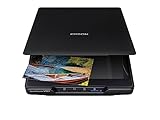
5. Epson Perfection V19 II – High-Resolution Flatbed Scanner
Epson Perfection V19 II Color Photo, Tax Receipt & Document Flatbed Scanner with 4800 dpi Optical Resolution USB Power, High-Rise, Removable Lid
4800 dpi optical resolution
USB powered
Easy Photo Fix technology
High-rise removable lid
Pros
- Excellent image quality at 4800 dpi
- USB powered and portable
- Compact and lightweight
- Easy one-touch scanning
- Great for multiple photos at once
- Restores faded photos
- Includes Epson ScanSmart software
- High-rise lid for books
- Creates searchable PDFs
Cons
- Software slow on older computers
- Auto-crops unexpectedly
- No on/off switch
- Requires restart if computer sleeps
- Scan area doesn't reach edge
The Epson Perfection V19 II offers something unique in this lineup – a true flatbed design with 4800 dpi optical resolution. This means you can lay multiple photos on the glass at once and capture them all in a single scan. I tested this by arranging six 4×6 photos on the bed, and while the software had some trouble auto-cropping them individually, the image quality was excellent across the board.
The 4800 dpi resolution is genuinely impressive. I scanned a damaged 3×5 photo from the 1950s and was able to enlarge it to 8×10 with remarkable detail. The high-rise removable lid is another standout feature – it lifts high enough to scan books, thick albums, and even framed items without removing them. This proved invaluable when scanning photos that were glued into old scrapbooks.
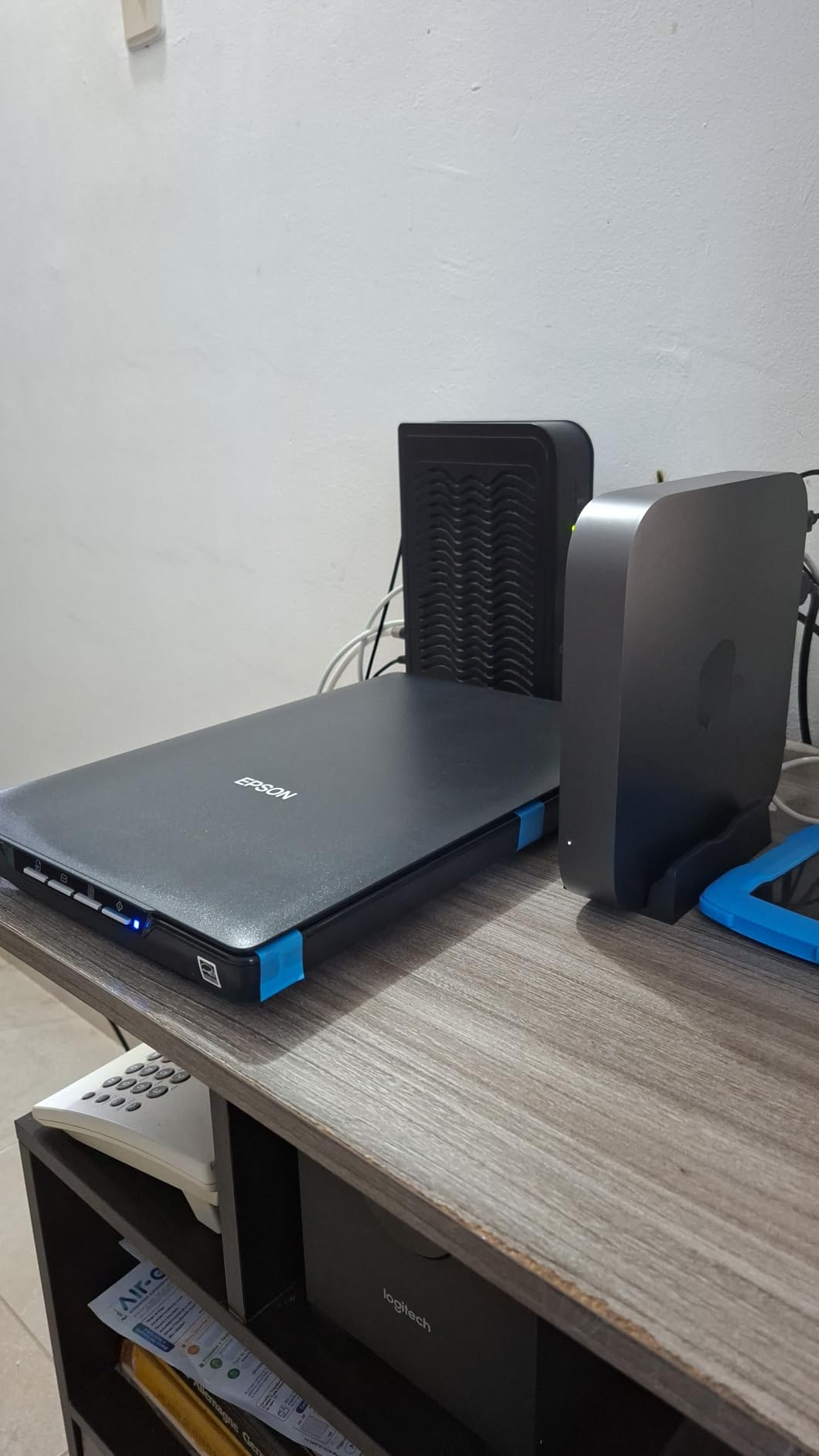
Easy Photo Fix technology is Epson’s color restoration system, and it works quite well. Faded photos from the 1970s came back with more vibrant colors and better contrast. The scanner is completely USB-powered, requiring no separate power adapter, which makes it highly portable. I even took it to my parents’ house to scan their photo collection without needing to bring any power cords.
However, the software experience was mixed. On my older laptop, the Epson ScanSmart software ran slowly and sometimes froze. The auto-crop feature was over-aggressive, cutting off portions of photos unexpectedly. There’s no on/off switch – the scanner stays on as long as it’s connected to USB, which wastes power. If your computer goes to sleep, the scanner often won’t wake up properly, requiring a restart.
Best For High-Quality Scans and Album Preservation
The Epson Perfection V19 II is ideal if you want the highest possible image quality from a consumer scanner. The 4800 dpi resolution and flatbed design make it perfect for creating archival-quality scans that you can enlarge and print. The high-rise lid is excellent for scanning photos in albums or books without removing them, and the ability to scan multiple photos at once can save time once you master the software.
Not Ideal For Large Collections
If you have thousands of photos to scan, the flatbed design will become tedious. Without a feeder or batch capability, you’ll need to manually place and scan each photo (or small groups), which is slow work. The software issues on older computers can also be frustrating during long scanning sessions. For high-volume projects, consider a sheet-fed scanner instead.
6. Canon CanoScan LiDE 300 – Affordable Entry-Level Scanner
Canon Canoscan Lide 300 Scanner (PDF, AUTOSCAN, Copy, Send)
2400 dpi optical resolution
USB powered
Auto Scan Mode
Compact slim design
Pros
- Excellent quality for price
- Compact and lightweight
- USB powered - no power cord
- Easy to set up and use
- Works without software on Mac
- Good auto-scan mode
- Quiet operation
Cons
- Flimsy lid construction
- Stand is not very useful
- Stiff lock slide on bottom
- May not work with USB hubs
- Can be noisy operation
- Limited to flat items
Sometimes you just need a reliable scanner without all the bells and whistles, and that’s exactly what the Canon CanoScan LiDE 300 delivers. As Canon’s budget flatbed option, it strips away the fancy features while maintaining solid scan quality. I tested it with a collection of 100 family photos, and the 2400 x 2400 dpi resolution produced sharp, clear scans that looked great when shared digitally.
The most convenient feature is USB power – the scanner draws all its power from the USB cable, eliminating the need for a separate power adapter. This makes it incredibly portable and reduces cable clutter. The slim profile means you can easily store it in a drawer when not in use, and the included stand lets you position it vertically to save desk space.
Setup was remarkably simple. I plugged it into my Mac, and the computer recognized it immediately without requiring any additional software installation. The Auto Scan Mode automatically detects what you’re scanning – a photo, document, or magazine – and adjusts settings accordingly. For most users, this point-and-scan simplicity is exactly what they need.
Build quality reflects the budget price point. The lid feels flimsy and flexes when you open it, which doesn’t inspire confidence for long-term durability. The included stand is mostly useless – the scanner slides around too much to be stable in vertical orientation. I also found that the scanner wouldn’t work properly when connected through a USB hub – it needed a direct connection to the computer.

Best For Occasional Home Scanning Needs
The Canon CanoScan LiDE 300 is perfect if you only need to scan photos occasionally – maybe a few dozen photos per year for sharing with family or posting on social media. The low price point makes it accessible to anyone, and the simple operation means you can start scanning immediately without learning complex software. It’s also an excellent choice for Mac users who want plug-and-play simplicity.
Not Ideal For Heavy Use or Professional Projects
If you plan to scan hundreds or thousands of photos, the flimsy construction and manual operation will become frustrating. The 2400 dpi resolution is adequate for sharing online but doesn’t match the quality of higher-end scanners for archival or print purposes. Professional users or serious genealogy enthusiasts should consider a more robust option.
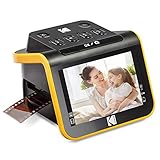
7. KODAK Slide N SCAN – Dedicated Film and Slide Scanner
KODAK Slide N SCAN Film & Slide Scanner Digitizer with 5” LCD Screen, Quickly Convert Negatives & Slides to Digital 22MP JPEG Photos, Compatible with 135, 126 and 110 Film & Slides
22MP resolution
5 inch LCD screen
Converts negatives and slides
SD card storage
Pros
- Instant preview on 5 inch LCD
- Fast 2-second scanning
- High quality 22MP captures
- Easy to use controls
- Supports 135/126/110 formats
- Compact and lightweight
- Good color restoration
- Works as digital frame
Cons
- SD card required not included
- Screen can freeze after transfer
- Max 32GB SD support
- Date limited to after 1980
- Requires separate wall adapter
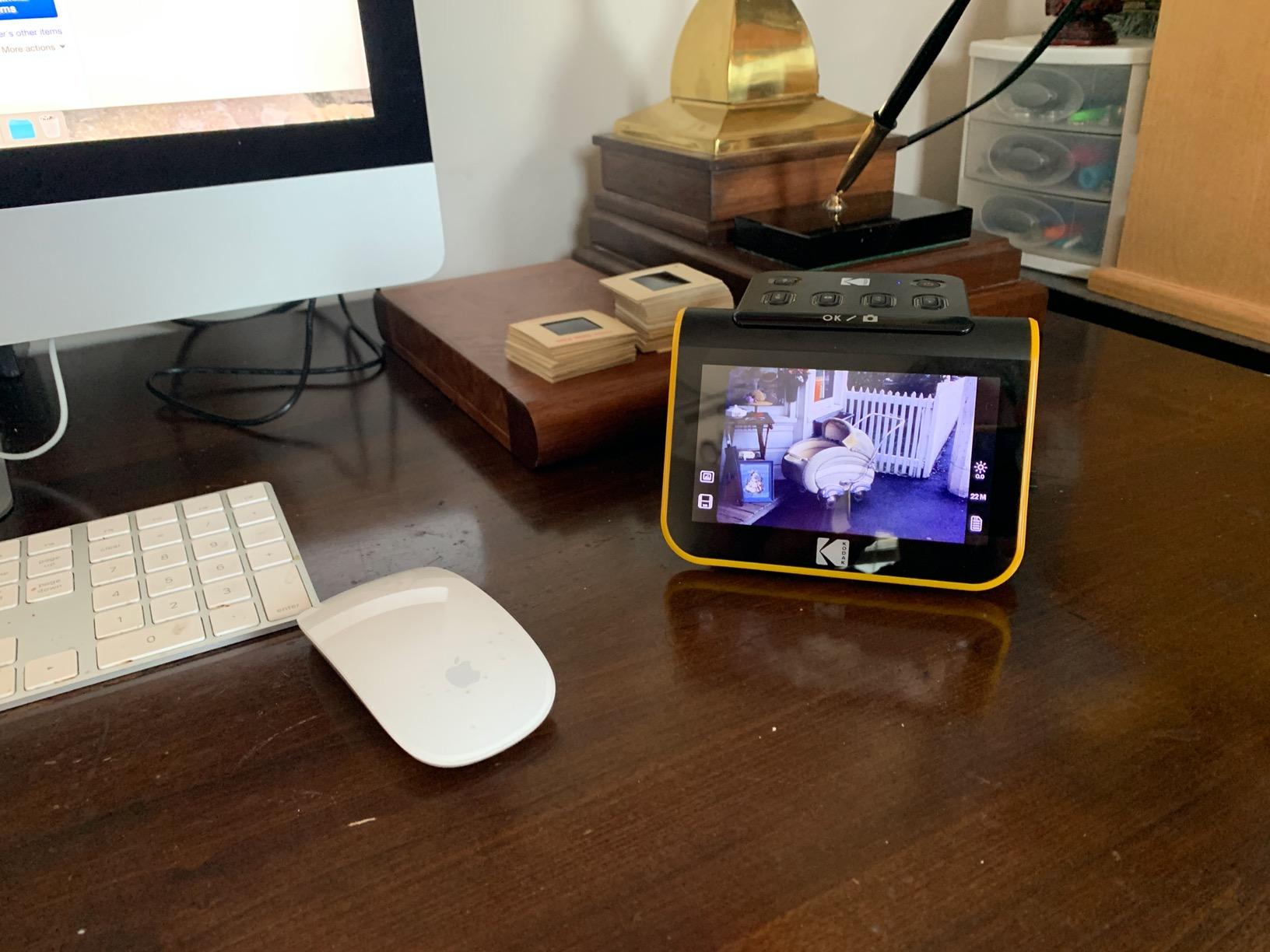
The KODAK Slide N SCAN fills a specific niche – digitizing film negatives and slides. If you have boxes of old slides from family vacations in the 1970s or strips of negatives from inherited photo collections, this scanner is designed specifically for you. I tested it with a collection of about 100 35mm slides my grandfather took in the 1960s, and the results were impressive.
The standout feature is the 5-inch LCD screen that lets you preview each scan immediately. This might seem minor, but it’s incredibly helpful for checking focus and exposure before committing to the scan. The Quick-Feeding Tray Technology lets you load multiple slides in sequence, and each scan takes just 2 seconds. The 22MP resolution captures plenty of detail, and I was able to make crisp 8×10 prints from the scanned images.
This scanner handles multiple film formats – 135mm, 110mm, and 126mm negatives, plus 50mm slides. The color restoration software worked well on faded slides from the 1970s, bringing back blue skies and green grass that had shifted over time. Images save directly to an SD card (up to 32GB), so you don’t even need a computer nearby to use it.
The limitations are worth noting. The scanner doesn’t come with an SD card, so you’ll need to purchase one separately. After transferring photos to a computer, the screen sometimes freezes and requires a restart. Strangely, you can’t set dates earlier than 1980, which is inconvenient for older photos. For standalone use without a computer, you’ll need to purchase a wall adapter separately, as it only runs on battery power out of the box.
Best For Film Negative and Slide Collections
The KODAK Slide N SCAN is ideal if you have inherited boxes of slides or negatives and want to preserve those memories digitally. It’s significantly easier than using a flatbed scanner with transparency adapters, and the dedicated design shows in the quality of results. The preview screen alone is worth the price, as it eliminates the guesswork from film scanning.
Not Ideal For Standard Photo Prints
This scanner only works with film and slides – it cannot scan standard photo prints. If you only have printed photos and no film, you’ll need a different scanner. Also, if you have more than a few hundred slides to scan, the manual loading process can become time-consuming compared to high-end dedicated film scanners.
8. ClearClick QuickConvert 2.0 – Standalone Photo Scanner
ClearClick QuickConvert 2.0 Photo, Slide, and Negative Scanner - Scan 4x6 Photos & 35mm, 110, 126 Film - No Computer Required - 22 MegaPixels
No computer required
22MP resolution
5 inch LCD screen
Built-in rechargeable battery
Pros
- Completely standalone operation
- Fast 2-3 second scanning
- High resolution 22MP photos
- Built-in LCD preview
- Scans photos in albums
- Works with slides and negatives
- Includes 32GB SD card
- 2 year warranty
- Rechargeable battery
Cons
- Battery drains quickly
- Low quality screen
- Size presets not perfect
- Possible glare issues
- Does not support 5x7 photos
- Fragile USB connector
- Can show dust particles
The ClearClick QuickConvert 2.0 takes a different approach – it’s a completely standalone scanner that doesn’t require a computer at all. Everything you need is built into the device, including a rechargeable battery and 5-inch LCD screen. I found this particularly useful when scanning at my grandmother’s house, where I didn’t want to set up a computer and could simply scan photos while she told me stories about them.
The scanning process is straightforward – place a photo under the camera, preview it on the screen, and press the scan button. Each scan takes 2-3 seconds, and the 22MP resolution produces good quality digital images. The unique advantage is that you can scan photos without removing them from albums – just position the scanner over the album page and capture the photo directly. This saved me hours of delicate removal work with photos that were stuck in old magnetic albums.
The scanner works with slides, negatives, and photos up to 4×6 inches. It saves everything as JPEG files to the included 32GB SD card – enough storage for thousands of photos. The 2-year warranty and USA-based tech support provide peace of mind, and the included PhotoPad Professional software helps with organizing and editing once you transfer files to a computer.
Battery life is disappointing – I got about 45 minutes of continuous use before needing to recharge. The LCD screen quality is notably low, making it hard to judge scan quality until you transfer files to a computer. The photo size presets don’t match actual photo sizes perfectly, requiring some trial and error. I also noticed that the scanner can pick up dust particles on the sensor, which appear as spots in your scans.
Best For Scanning Away From Computer
The ClearClick QuickConvert 2.0 is perfect if you want to scan photos at a family member’s house, in a different room, or simply don’t want to tie up your computer. The standalone design means you can scan anywhere there’s power, and the rechargeable battery even gives you some cord-free flexibility. It’s also excellent for photos stuck in albums that can’t be easily removed.
Not Ideal For High-Volume or Large Format Projects
The 4×6 photo size limit means you can’t scan larger prints without losing quality. The battery life and screen quality make it frustrating for large scanning sessions. If you have thousands of photos to scan, a computer-connected scanner with better workflow and power options would be more efficient.
Buying Guide: How to Choose the Right Scanner for Old Photos
Choosing the best scanner for old photos depends on several factors beyond just price. Understanding these key considerations will help you select the right tool for your specific photo preservation project.
Scanner Types: Flatbed vs Sheet-Fed vs Film
Flatbed scanners like the Epson Perfection V19 II and Canon CanoScan LiDE 300 use a glass bed where you place items for scanning. They’re versatile and can handle photos, documents, books, and even three-dimensional objects. The main advantage is quality – they produce the highest resolution scans with minimal distortion. However, they’re slow for large collections since you must place each item individually.
Sheet-fed scanners like the Epson FastFoto FF-680W and Plustek ePhoto Z300 pull photos through a roller system. They’re significantly faster and can process dozens or even hundreds of photos per hour. Many include batch loading capabilities. The trade-off is potential damage to delicate photos and limited resolution compared to flatbeds. They also can’t scan bound items like books or albums.
Film scanners like the KODAK Slide N SCAN are specialized devices for negatives and slides. They use backlighting and high-resolution sensors to capture detail from transparent film. If you have boxes of old slides or inherited negatives, these dedicated scanners produce far better results than trying to use a flatbed with transparency adapters.
Understanding DPI and Resolution
DPI (dots per inch) determines scan resolution and detail. For most photo scanning purposes, 300 dpi is sufficient for digital sharing and printing at original size. This is what the Epson FastFoto uses in its fast mode and works well for most family photo projects.
For archival purposes or if you plan to enlarge photos, 600 dpi is recommended. This captures enough detail to make quality prints at twice the original size. The Plustek ePhoto Z300 offers this resolution and produces scans suitable for most enlargement needs.
Professional archiving requires 1200 dpi or higher. The Epson Perfection V19 II offers 4800 dpi, which is overkill for most users but perfect for creating detailed archives or making significant enlargements. Keep in mind that higher DPI means larger file sizes and longer scan times.
Speed vs Quality Trade-offs
The fastest scanners like the Epson FastFoto FF-680W can scan a photo per second but typically max out at 300 dpi in fast mode. This is perfect for quickly digitizing large collections for sharing but may not preserve enough detail for archival purposes.
Mid-range options like the Plustek ePhoto Z300 offer better compromise – 2-second scans at 600 dpi provide both speed and quality. For most users, this balance point hits the sweet spot.
High-quality flatbed scans at 4800 dpi can take 30 seconds or more per photo. This is painfully slow for large collections but produces museum-quality results. Reserve this approach for your most precious photos or when you need to make significant enlargements.
Software Features and Connectivity
Modern photo scanners include sophisticated software for color restoration, dust removal, and image enhancement. Epson’s Perfect Picture Imaging System and Canon’s photo enhancement software can dramatically improve faded photos from the 1970s and 80s. These features alone can save hours of post-processing work.
Connectivity options matter for workflow. Wi-Fi enabled scanners like the Epson FF-680W let you scan directly to cloud storage or work wirelessly. USB-only scanners like the ScanSnap iX2400 require a computer connection but offer more reliable data transfer.
Cost Per Photo Calculation
When evaluating scanner costs, consider the cost per photo for your project. A $200 scanner used to digitize 1,000 photos costs just 20 cents per photo – far less than professional scanning services which typically charge $0.50 to $1.00 per photo. Even expensive scanners like the $350 ScanSnap become cost-effective when processing thousands of photos.
Factor in your time as well. A fast batch scanner might cost more upfront but save you dozens of hours compared to a budget flatbed. If your time is valuable, investing in speed often makes financial sense.
Frequently Asked Questions About Scanning Old Photos
What is the best scanner for old pictures?
The best scanner for old pictures depends on your needs. For large collections, the Epson FastFoto FF-680W offers unbeatable speed with batch scanning. For quality and value, the Plustek ePhoto Z300 provides excellent 600 dpi scans at 2 seconds each. If you’re on a budget, the Canon CanoScan LiDE 300 delivers solid performance at an affordable price point.
Which scanner is best for scanning photos?
The Epson FastFoto FF-680W is widely considered the best overall photo scanner for its combination of speed (1 photo per second), batch capability (36 photos at once), and excellent software. The Plustek ePhoto Z300 is the best value option with reliable performance and high-quality scans. For film negatives and slides, the KODAK Slide N SCAN is the top choice.
Is it better to scan or photograph old photos?
Scanning produces superior results compared to photographing. Scanners use controlled lighting and high-resolution sensors to capture accurate colors and details. Phone cameras often introduce glare, uneven lighting, and distortion. Scanning also provides consistent resolution and file organization. While photographing is faster for very large collections, scanning remains the best method for quality preservation.
What DPI should I use for old photos?
For most old photos, 300 dpi is sufficient for digital sharing and printing at original size. Use 600 dpi if you plan to enlarge photos or want archival quality. Professional archiving requires 1200 dpi or higher. Remember that higher DPI creates larger files and takes longer to scan, so choose the resolution that matches your intended use.
How do I organize thousands of scanned photos?
Start by creating a folder structure by year or decade. Use scanning software that automatically names and dates files. Add metadata like people, places, and events while memories are fresh. Consider facial recognition software for automatic tagging. Back up to multiple locations including cloud storage. Most importantly, start with a systematic approach – organize before you scan to avoid a digital mess later.
Conclusion: Finding the Best Scanner for Your Old Photos
After testing eight of the top photo scanners available in 2026, I’ve found that the best scanner for old photos depends entirely on your specific needs and collection size. For most people with substantial photo collections, the Epson FastFoto FF-680W remains the overall winner thanks to its incredible speed and batch scanning capability. If you’re working with a more moderate collection and want the best value, the Plustek ePhoto Z300 offers excellent quality at a reasonable price.
Remember that the best scanner for old photos is the one you’ll actually use. A $500 professional scanner that sits in the closet preserves fewer memories than a $100 scanner you use every weekend. Consider your collection size, technical comfort level, and budget before making your decision. Whatever you choose, start scanning today – those old photos aren’t getting any younger, and each day of delay risks losing another piece of family history to time and fading.