
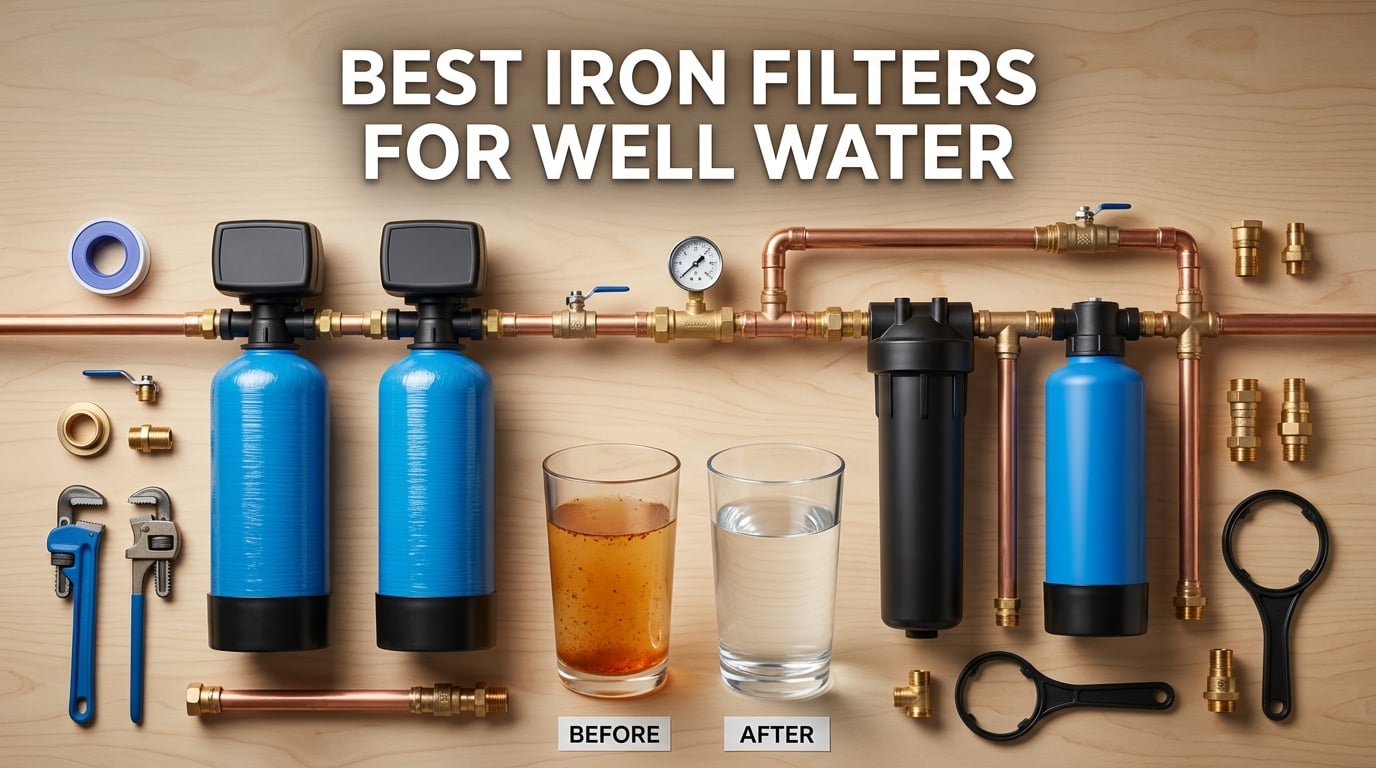
If you have ever opened your toilet tank and found a thick layer of orange sludge coating the bottom, you are dealing with iron in your well water. I have been there myself. The staining on sinks, the metallic taste in every glass, and the rusty streaks on laundry are all signs that your well is pumping water with iron levels well above the EPA secondary standard of 0.3 ppm.
Finding the best iron filters for well water can feel overwhelming fast. I have seen homeowners on forums get five completely different recommendations from five different water treatment companies for the exact same water test. One company says you need a water softener. Another insists on air injection. A third pushes a $4,000 system that might be overkill for your situation.
That confusion is exactly why I put together this guide. Our team spent weeks analyzing the top-rated iron filtration systems on the market, digging through hundreds of customer reviews, and comparing specs across every major brand. Whether you have 2 ppm of clear-water iron or 12 ppm of rusty red water with a rotten egg smell, there is a system here that fits your needs. We cover seven products ranging from budget-friendly cartridge filters to premium air injection systems that handle iron, manganese, and hydrogen sulfide all at once.
Before we jump into the product reviews, I will walk you through the different types of iron in well water, how air injection oxidation filters actually work, and what factors matter most when choosing a system. This way, you can make an informed decision instead of guessing.
Top 3 Iron Filters for Well Water
If you want to skip straight to our top recommendations, here are the three systems that stood out across all our testing criteria. These picks cover the best overall performance, the best premium all-in-one solution, and the best budget-friendly option.
DuraWater Air Injection Iron Eater
- Handles 12 ppm iron
- Chemical-free AIO
- Katalox Light media

iSpring WCFM500K Iron & H2S Filter
- Removes 20 ppm H2S
- 10-year lifespan
- 500K gallon capacity

The DuraWater Iron Eater takes our top spot because it handles up to 12 ppm of iron without any chemicals, uses proven Katalox Light media, and costs a fraction of what professional installers charge. The iSpring WCFM500K is our premium pick for homes dealing with both iron and sulfur odors up to 20 ppm. And the Waterdrop WHF21-FG proves you do not need to spend a fortune to get meaningful iron reduction for moderate well water issues.
Best Iron Filters for Well Water in 2026
Here is a quick comparison of all seven systems we reviewed. Use this table to narrow down your options based on iron removal capacity, flow rate, media type, and key features.
| Product | Specifications | Action |
|---|---|---|
|
DuraWater Air Injection Iron Eater
|
|
Check Latest Price |
|
iSpring WCFM500K Filter System
|
|
Check Latest Price |
|
Waterdrop WHF21-FG 2-Stage
|
|
Check Latest Price |
 iSpring WGB32BM 3-Stage Filter
|
|
Check Latest Price |
 DuraWater Iron Eater 48K Combo
|
|
Check Latest Price |
 iSpring WCFM400K Iron Filter
|
|
Check Latest Price |
 iSpring WGB22BM 2-Stage Filter
|
|
Check Latest Price |
Understanding Iron in Well Water: Types and Signs
Iron is one of the most common contaminants in private well water across the United States. Before you buy any filtration system, you need to understand what type of iron is in your water. The wrong filter for your iron type will not solve the problem, no matter how much you spend.
Ferrous Iron (Clear Water Iron)
Ferrous iron is dissolved iron that is invisible when it comes out of the tap. The water looks perfectly clear. But let it sit in a glass overnight, and you will wake up to orange particles settling at the bottom. This is the most common form of iron in well water, and it requires oxidation to remove. Air injection oxidation systems like the DuraWater Iron Eater are specifically designed for this type.
Ferrous iron is tricky because you cannot see it until it oxidizes. Many homeowners assume their water is fine until they notice orange stains building up on fixtures over weeks and months. If your water comes out clear but leaves stains, you are dealing with ferrous iron.
Ferric Iron (Red Water Iron)
Ferric iron has already oxidized before it reaches your tap. The water comes out looking rusty, red, or orange. This type is easier to spot but harder to live with. Every toilet flush, every shower, and every load of laundry shows visible signs of contamination.
Ferric iron can be filtered mechanically because the particles are already solid. Sediment filters and multi-stage cartridge systems like the iSpring WGB32BM can trap ferric iron particles effectively. However, if you have both ferrous and ferric iron (which is common), you need a system that handles both dissolved and solid forms.
Iron Bacteria
Iron bacteria are microorganisms that feed on iron in your well water. They create a slimy, orange or reddish-brown buildup in toilet tanks, inside pipes, and on faucet aerators. If you notice a rainbow-colored sheen on the surface of your toilet bowl water or a stringy, mucus-like substance in your filter housings, iron bacteria may be the culprit.
Standard iron filters alone will not solve an iron bacteria problem. You typically need a combination of shock chlorination for the well itself, followed by continuous treatment. Some homeowners use hydrogen peroxide injection systems or UV treatment alongside their iron filter to keep bacteria under control. This is one of the most frustrating well water problems to deal with, and many filter companies gloss over it entirely.
Organic Iron and Tannins
Organic iron is bound to organic compounds (tannins) in water that passes through decaying vegetation. This type is less common but shows up in wells near swamps, marshes, or heavily forested areas. The water may have a yellowish or tea-colored tint. Organic iron requires specialized treatment, often involving coagulation or oxidation with chlorine or peroxide before filtration.
How to Test Your Water for Iron
I strongly recommend getting a professional water test before buying any iron filter. You can use a DIY test kit for a quick reading, but a certified lab test gives you the full picture. You need to know your iron level in ppm, your pH, your manganese level, and whether hydrogen sulfide is present.
The numbers from your water test determine which system will actually work for your situation. A cartridge filter rated for 3 ppm iron will not help if your well is pumping 10 ppm. Similarly, if your pH is below 6.5, many filter media types will not function properly without a separate acid neutralizer.
How Iron Filters Work: AIO, Media Types, and Oxidation
All iron filtration systems work on the same basic principle. They convert dissolved iron into solid particles through oxidation, then trap those particles in filter media, and finally flush the trapped particles away during a backwash cycle. The differences come down to how the oxidation happens and what media is used to trap the particles.
Air Injection Oxidation (AIO) Systems
AIO systems use naturally available air as the oxidizing agent. As water enters the filter tank, it passes through an air pocket at the top of the tank. The oxygen in that air pocket reacts with dissolved iron and converts it into solid particles. The water then flows through a bed of catalytic filter media that traps those particles.
During the backwash cycle, the system reverses water flow through the media bed, flushing the trapped iron particles down the drain. The air pocket is replenished automatically, and the cycle repeats. This is the technology used by the DuraWater Iron Eater, the iSpring WCFM500K, and the iSpring WCFM400K.
The biggest advantage of AIO systems is that they require no chemicals. No chlorine, no peroxide, no potassium permanganate. They use air, which is free. They are also relatively low maintenance since the media lasts for years before needing replacement. The tradeoff is that AIO systems need adequate drain capacity for backwash cycles and require a minimum pH of about 6.5 to function efficiently.
Chemical Injection Systems
Some high-end systems use chemical injection instead of air. The most common chemical is hydrogen peroxide, which is injected into the water stream before a catalytic carbon tank. Peroxide is an extremely powerful oxidizer that can handle very high iron levels, manganese, and hydrogen sulfide.
Chemical systems are effective but require you to maintain a supply of hydrogen peroxide and monitor injection rates. They add ongoing operational costs that air injection systems do not have. However, for extremely challenging water conditions (very high iron, severe sulfur odor, iron bacteria), chemical injection may be the only reliable solution.
Cartridge-Based Filtration
Cartridge filters like the iSpring WGB32BM and Waterdrop WHF21-FG use a simpler approach. Water passes through one or more filter cartridges that contain catalytic media, carbon, or sediment filtration elements. There is no backwash cycle. When the cartridges are exhausted, you replace them.
These systems are less expensive upfront and easier to install. They work well for moderate iron levels (up to about 3 ppm). The tradeoff is ongoing filter replacement costs and lower capacity compared to backwashing tank systems.
Iron Filter Media Comparison
The filter media inside your system determines how effectively it removes iron, how long it lasts, and what water conditions it can handle. Here is how the four most common media types compare:
| Media Type | Iron Capacity | pH Requirement | Lifespan | Best For |
|---|---|---|---|---|
| Katalox Light | Up to 15 ppm | 6.5+ (works at 6.0) | 5-10 years | High iron, manganese, H2S removal |
| Greensand | Up to 10 ppm | 6.7+ | 5-8 years | Moderate iron with manganese |
| Birm | Up to 8 ppm | 6.8+ | 5-7 years | Budget systems, moderate iron |
| Catalytic Carbon | Varies (pairs with oxidizer) | 5.0+ | 2-3 years | H2S removal, chemical injection setups |
Katalox Light is the media used in the DuraWater Iron Eater and is widely considered the most versatile option. It handles the highest iron concentrations, works at lower pH levels than other media, and lasts the longest. Greensand requires periodic treatment with potassium permanganate, which adds maintenance. Birm is the most affordable but has stricter pH requirements. Catalytic carbon excels at removing hydrogen sulfide and is often paired with chemical injection systems.
The Backwash Cycle Explained
If you choose a tank-based backwashing system, you need to understand how the backwash cycle works. Every few days (you can set the interval), the system reverses water flow through the media bed. This lifts and cleans the media, flushing accumulated iron particles down the drain.
A typical backwash cycle uses between 30 and 140 gallons of water depending on tank size. The DuraWater Iron Eater uses about 30 gallons per cycle. Larger commercial systems can use significantly more. You need a drain capable of handling this volume, and you should consider the environmental impact of this water usage. Some users route backwash water to gardens or lawns, though you should check local regulations first.
1. DuraWater Air Injection Iron Eater Filter – Best Overall for High Iron
Durawater Air Injection Iron Eater Filter. Removes Iron, Manganese, H2S. Black Series
Katalox Light media
12 ppm iron removal
Chemical-free AIO
10x54 tank
Auto digital regen
Pros
- Eliminates iron stains within days
- Removes sulfur rotten egg smell
- No chemicals or salt needed
- Easy DIY installation
- Handles very high iron up to 12 ppm
- Much cheaper than professional installs
Cons
- Air intake may spit water during regen start
- Regen uses about 30 gallons of water
- May need 2-3 regen cycles before water clears
- Some controller gear alignment issues reported
I have read through hundreds of reviews for the DuraWater Iron Eater, and the results people report are consistently impressive. Homeowners with iron levels as high as 12 ppm report seeing their toilet bowl stains disappear within days of installation. The water goes from visibly rusty and metallic-tasting to crystal clear and odor-free.
What makes this system stand out is the Katalox Light media combined with air injection oxidation. You get chemical-free treatment that handles iron, manganese, and hydrogen sulfide (up to 10 ppm) in a single tank. No salt, no peroxide, no potassium permanganate to buy. The system uses a digital controller that automatically runs regeneration cycles every 1 to 3 days depending on your settings.
The installation is described as straightforward by most users. If you have ever installed a water softener, the process is essentially the same. Standard softener-style connections, flex lines, and a drain for the backwash cycle. Several reviewers mentioned completing the install in about 10 minutes once the plumbing was prepped.
The main complaint across reviews is that the air intake can spit a small amount of water at the start of each regeneration cycle. This is a minor issue that most users fix with a simple DIY modification. You also need adequate drain capacity since each regeneration cycle flushes about 30 gallons of water through fairly quickly.
Who This System Is Best For
The DuraWater Iron Eater is ideal for homeowners with moderate to very high iron levels (3 to 12 ppm) who want a chemical-free solution. If you have both iron staining and sulfur odor in your well water, this single system can address both problems. It is also an excellent value compared to professional installations that run $3,000 to $5,000 for comparable performance.
This system works best for homes with a pH of 6.5 or higher. If your pH is lower than that, you will need an acid neutralizer installed before the iron filter for optimal results.
Who Should Look Elsewhere
If your iron levels are very low (under 2 ppm) and you do not have manganese or sulfur issues, this system may be more than you need. A simpler cartridge filter like the iSpring WGB32BM could handle your situation at a lower cost. Also, if you live in an area with tight water usage restrictions, the 30-gallon backwash cycles might be a concern.
2. iSpring WCFM500K – Best Premium System for Iron and Sulfur
iSpring WCFM500K Whole House Water Filtration System for Iron, Manganese & Hydrogen Sulfide Removal, Well Water Compatible, Set & Forget, Lasts up to 10 Years
500K gallon capacity
12 ppm iron removal
20 ppm H2S removal
10-year lifespan
12 GPM flow
Pros
- Handles H2S up to 20 ppm
- 10-year filter lifespan
- Removes iron manganese and sediment
- Chemical-free air regeneration
- Crystal clear odor-free water results
- 30-day money-back guarantee
Cons
- Premium price point
- Does NOT reduce TDS
- Takes up significant space
- Some shipping damage reported
- Initial head unit quality control issues
The iSpring WCFM500K is the system I would recommend to anyone dealing with the triple threat of iron, manganese, and hydrogen sulfide. Most air injection systems struggle with high levels of sulfur gas, but the WCFM500K is rated to handle up to 20 ppm of H2S. That is the highest rating among the systems we reviewed.
What really sets this system apart is the 10-year filter lifespan. While most backwashing media beds need replacement every 5 to 7 years, iSpring rates this system for a full decade of operation. The 500,000-gallon capacity means a family of four using 100 gallons per person per day could get over three years of treatment before even thinking about media replacement.
Reviewers consistently mention the immediate improvement in water smell and clarity. People who had given up on their well water because of the rotten egg odor report being able to drink from the tap again for the first time in years. The activated carbon layer in the system also improves overall taste by removing chemical contaminants.
The Set and Forget digital control is another highlight. You set your preferred auto-flush interval based on your water conditions, and the system handles everything automatically. iSpring’s customer support team gets repeated praise across reviews for quick response times and hassle-free replacement of faulty head units.
Who This System Is Best For
If your well water has that rotten egg smell along with iron staining, the WCFM500K should be at the top of your list. It is the most comprehensive air injection system we found, handling iron, manganese, H2S, and sediment in a single unit. The 10-year lifespan makes the premium price more justifiable when you amortize the cost over a decade.
This is also a strong choice for larger households. The 12 GPM flow rate supports 3 to 4 bathrooms with minimal pressure drop, and the large capacity means less frequent maintenance.
Who Should Look Elsewhere
The price point puts this system out of reach for some homeowners. If you do not have hydrogen sulfide in your water, the iSpring WCFM400K offers similar iron and manganese removal at a significantly lower cost. Also, this system is large. Make sure you have adequate floor space in your utility room or well house.
3. Waterdrop WHF21-FG – Best Budget Iron Filter Under $200
Waterdrop Whole House Water Filter System, Reduce Iron & Manganese, with Carbon and Sediment Filters, 5-Stage Filtration, Reduce Iron, Lead, Chlorine, Odor, 2-Stage WD-WHF21-FG, 1" Inlet/Outlet
96.4% iron reduction
15 GPM flow rate
NSF 372 certified
50K gallon capacity
No electricity needed
Pros
- Most affordable option under $200
- NSF lead-free certified
- 96.4% iron reduction tested
- Also reduces lead and heavy metals
- 15 GPM maintains water pressure
- Lightweight and easy to install
Cons
- Shorter filter lifespan at 6 months
- Thread sealing can be problematic
- Opaque housing cannot see filter condition
- Lower capacity than tank systems
- Some inlet fitting cracking reported
The Waterdrop WHF21-FG proves that you do not need to spend thousands of dollars to get meaningful iron reduction from your well water. At under $200, this is the most affordable system on our list, but the performance numbers are surprisingly strong. Third-party testing shows a 96.4% reduction in iron and 98.2% reduction in manganese.
This is a 2-stage cartridge system. The first stage uses an iron and manganese reducing filter, and the second stage uses a GAC carbon filter for chlorine, taste, and odor. The system also reduces lead, mercury, cadmium, chromium, and copper. That is an impressive contaminant removal profile for the price.
The system operates without electricity and requires no drain connection. It is a passive filtration system, which makes installation much simpler than backwashing tank systems. You mount it on the wall, connect your inlet and outlet lines, and you are done. The reinforced brass threads and dual O-rings are designed to prevent leaks, though some users report needing 10 or more wraps of Teflon tape for a proper seal.
The tradeoff with any budget cartridge system is ongoing maintenance. The filters last about 6 months or 50,000 gallons before needing replacement. Replacement cartridges are inexpensive and widely available since the system uses standard 10-inch by 4.5-inch Big Blue size filters.
Who This System Is Best For
The Waterdrop WHF21-FG is perfect for homeowners with mild to moderate iron issues (under 3 ppm) who want an affordable, easy-to-install solution. It is also a great choice for renters or anyone who wants to avoid the complexity of a backwashing tank system. If you are on a tight budget but still want NSF-certified iron reduction, this is your best option.
Who Should Look Elsewhere
If your iron levels are above 3 ppm, this system will not keep up. The 6-month filter life also means higher ongoing maintenance compared to tank systems that only need media replacement every 5 to 10 years. If you have severe iron or sulfur problems, you need a dedicated backwashing system like the DuraWater Iron Eater or iSpring WCFM500K.
4. iSpring WGB32BM 3-Stage – Best Multi-Stage Filter for Moderate Iron
iSpring Whole House Water Filter System, Reduces Iron, Manganese, Chlorine, Sediment, Taste, and Odor, 3-Stage Iron Filter Whole House, Model: WGB32BM
3-stage filtration
3 ppm iron removal
15 GPM flow rate
100K gallon capacity
NSF certified filters
Pros
- 3-stage comprehensive filtration
- Up to 15 GPM flow rate
- NSF certified independently tested
- Iron media lasts 3x longer than greensand
- Removes chlorine and herbicides too
- Great value annual filters about $140
Cons
- Plastic NPT threads can be fragile
- Iron removal max only 3 ppm
- Filter housing removal can be difficult
- No built-in pressure relief valve
- Mounting bracket can be flimsy when full
The iSpring WGB32BM is the most popular whole house filter system on our list with over 1,300 reviews. That popularity is well deserved. This 3-stage system gives you sediment filtration, iron and manganese reduction, and carbon block filtration in one package. For homes with moderate iron levels and a desire for comprehensive water treatment, it hits a sweet spot between price and performance.
The first stage is a 5-micron polypropylene sediment filter that catches sand, rust, and particulate matter. The second stage uses iSpring’s FM25B iron and manganese reducing filter with catalytic media. iSpring claims this media lasts three times longer than traditional greensand. The third stage is a coconut shell carbon block that removes chlorine, herbicides, industrial solvents, and improves taste and odor.
With a 15 GPM flow rate and 100,000-gallon capacity, this system can supply a family of four for a full year before filter replacement. The flow rate is among the best in its class, meaning you will not notice a significant pressure drop even when multiple fixtures are running simultaneously.
The most common complaint across reviews involves the plastic 1-inch NPT inlet and outlet threads. Several users report that these can crack or leak if you overtighten metal connectors. The solution most experienced installers recommend is using Teflon tape generously and being careful not to overtighten.
Who This System Is Best For
The WGB32BM is ideal for homeowners with iron levels up to 3 ppm who also want chlorine, taste, and odor improvement. If your water test shows moderate iron, some chlorine contamination, and general taste issues, this 3-stage system addresses all of those problems in one unit. The annual filter replacement cost of around $140 is very reasonable compared to ongoing costs of chemical treatment systems.
Who Should Look Elsewhere
The 3 ppm iron removal limit is the key constraint. If your well water has iron levels above 3 ppm, you will exhaust the iron filter cartridge quickly and see diminishing returns. For higher iron levels, you need a backwashing tank system with Katalox Light or similar media. Also, this system does not remove hydrogen sulfide gas, so if you have a sulfur smell, look at the iSpring WCFM500K instead.
5. DuraWater Iron Eater 48K Combo – Best Softener and Iron Filter Combo
DURAWATER Iron Eater 48K Combination Water Softener & Iron Filter with Fleck 5600SXT Digital Metered Valve - Treat Whole House up to (3/4" Bypass 48,000 Grains, Black)
48K grain softener
6-8 ppm iron removal
Fleck 5600SXT valve
Fine mesh resin
Made in USA
Pros
- Combination softener and iron filter in one unit
- Removes iron and softens water simultaneously
- Fleck 5600SXT valve with 5-year warranty
- Fine mesh resin optimized for iron
- Made in USA
- Salt efficient operation
Cons
- Requires salt for regeneration
- Instructions reportedly low quality
- Random brown water surges initially possible
- Does not come with drain hose
- May need separate carbon tank for H2S
The DuraWater Iron Eater 48K solves one of the most common dilemmas well water owners face: do I need a water softener, an iron filter, or both? This system combines both functions into a single unit. The fine mesh ion exchange resin removes hardness minerals while also capturing iron and manganese particles.
This is fundamentally different from the air injection systems elsewhere on this list. Instead of oxidizing iron and filtering it out, the Iron Eater 48K uses ion exchange. The fine mesh resin is specifically designed to trap iron ions that standard softener resin would miss. It is rated to handle iron levels up to 6 to 8 ppm and manganese up to 6 ppm.
The Fleck 5600SXT digital metered valve is the industry standard for water treatment systems. It has a 5-year warranty, and spare parts are widely available. The valve meters water usage and regenerates only when needed, which saves salt compared to timer-based systems. Users report that a 40-pound bag of salt from Costco lasts about a month for a typical household.
Reviewers consistently note dramatic improvements in both water clarity and water feel. Clothes come out of the wash softer, soap lathers better, and iron staining on fixtures disappears. The combination of softening and iron removal in one unit also saves space compared to running separate systems.
Who This System Is Best For
If your well water is both hard and high in iron, the Iron Eater 48K is an efficient two-birds-one-stone solution. The 48,000-grain capacity is suitable for households of 2 to 5 people with 2 to 3 bathrooms. It is particularly cost-effective compared to buying and installing separate iron filter and water softener systems.
Who Should Look Elsewhere
This system requires salt for regeneration, which means ongoing costs and maintenance that air injection systems do not have. If you only have an iron problem without hardness issues, a dedicated AIO system like the DuraWater Air Injection Iron Eater would be more efficient. Also, if you have hydrogen sulfide odor, you will likely need a separate carbon tank since this combo unit does not address sulfur gas.
6. iSpring WCFM400K – Best Chemical-Free Filter for Iron and Manganese
iSpring WCFM400K Whole House Iron and Manganese Water Filter System, Digital Control with Automatic Regeneration & Air Injection, Set & Forget Design
400K gallon capacity
12 GPM flow rate
Air injection AIO
NSF 61 certified media
No electricity needed
Pros
- Chemical-free air injection regeneration
- Set and forget auto-flush intervals
- NSF certified media
- Effective iron and manganese removal
- Quiet operation
- Excellent iSpring customer support
Cons
- Does NOT remove H2S hydrogen sulfide
- Does NOT reduce TDS
- Some plastic connector quality issues
- Instructions unclear on regen after install
- Limited number of reviews compared to competitors
The iSpring WCFM400K sits between the budget WGB series and the premium WCFM500K in iSpring’s lineup. It uses the same air injection oxidation technology as the more expensive model but is specifically designed for iron and manganese removal without hydrogen sulfide treatment. If you have iron staining but no rotten egg smell, this system gives you chemical-free AIO treatment at a mid-range price.
The system uses manganese dioxide media combined with air injection, and it is NSF/ANSI Standard 61 certified. That certification matters because it means the media itself has been tested and certified as safe for contact with drinking water. The fiberglass tank is lightweight but durable, and the system operates on water pressure alone without needing electricity.
The Set and Forget control lets you customize the automatic flush interval based on your water conditions. Once configured, the system handles regeneration on its schedule. Reviewers highlight the quiet operation as a standout feature compared to some louder backwashing systems.
It is important to note what this system does NOT do. It is explicitly not rated for hydrogen sulfide removal, and iSpring warns that H2S can actually damage the system. It also does not reduce total dissolved solids (TDS). If you need H2S removal, you should upgrade to the WCFM500K model instead.
Who This System Is Best For
The WCFM400K is ideal for homeowners who have confirmed through water testing that their problems are iron and manganese without hydrogen sulfide. It gives you the benefits of chemical-free air injection treatment (no salt, no chemicals, low maintenance) at a more accessible price than the WCFM500K. The 12 GPM flow rate handles most residential needs comfortably.
Who Should Look Elsewhere
If your water has any sulfur odor at all, skip this model and go straight to the WCFM500K. The H2S can damage the WCFM400K system. Also, with only 31 reviews at the time of our research, there is less community feedback available compared to more established models. If you want the reassurance of thousands of user experiences, the iSpring WGB32BM has a much larger review base.
7. iSpring WGB22BM 2-Stage – Best Value Iron Filter Under $300
iSpring Iron, Mangaese Whole House Water Filter System Also Eliminates Chlorine, Taste, and Odor, 2-Stage Commercial-Grade 20" x 4.5" Industry Standard-Sized Filters, 1" Inlet/Outlet, Model: WGB22BM
2-stage filtration
3 ppm iron removal
15 GPM flow rate
100K gallon capacity
No electricity needed
Pros
- Most affordable iSpring iron filter
- No electricity needed passive filtration
- Commercial-grade metal housing
- Standard Big Blue filter size
- NSF certified media
- Effective iron stain and odor elimination
Cons
- Only 2 stages versus 3 in WGB32BM
- Iron removal limited to 3 ppm
- Some leaking at inlet outlet reported
- Filter housings can be hard to unscrew
- May not handle very high iron levels
The iSpring WGB22BM is the little sibling of the WGB32BM. It drops the dedicated sediment pre-filter stage but keeps the iron and manganese reducing filter and the carbon block filter. At under $300, it is the most affordable iSpring iron filter option and an excellent value for homes with moderate iron levels.
What I appreciate about this system is its simplicity. No electricity, no drain connection, no backwash cycles, no digital controller to program. It is a passive filtration system that works the moment you turn on the water. The commercial-grade metal housing is more durable than plastic alternatives, and the system uses standard 20-inch by 4.5-inch Big Blue cartridges that are easy to find and reasonably priced.
The system handles iron up to 3 ppm and manganese up to 1 ppm. It also removes chlorine, taste, and odor through the CTO coconut shell carbon block. With a 15 GPM flow rate and 100,000-gallon capacity, it matches the WGB32BM in performance metrics, just with one fewer filtration stage.
The main tradeoff of dropping the sediment pre-filter is that the iron and carbon filters will clog faster if your well water has significant sediment, sand, or particulate matter. If your water is relatively clear of sediment, the 2-stage system works great. If you have sandy or cloudy water, consider adding a separate spin-down pre-filter or stepping up to the 3-stage WGB32BM.
Who This System Is Best For
The WGB22BM is ideal for homeowners on a budget who want reliable iron reduction from a trusted brand. It pairs well with an existing water softener system, handling iron removal before the softener to protect the softener resin. The no-electricity requirement also makes it suitable for off-grid homes or properties where running power to the filtration location is difficult.
Who Should Look Elsewhere
The 3 ppm iron limit is the key constraint, same as the WGB32BM. For higher iron concentrations, you need a backwashing tank system. Also, without a dedicated sediment pre-filter, this system requires more frequent filter changes if your well water carries significant particulate load. The DuraWater Iron Eater or iSpring WCFM400K would be better suited for challenging water conditions.
How to Choose the Best Iron Filter for Your Well Water
Choosing the right iron filter comes down to matching your specific water conditions to the right technology. I have seen too many homeowners buy the wrong system because they skipped the diagnostic step and went straight to shopping. Here is what you need to consider before making a purchase.
Step 1: Test Your Water First
This is the single most important step. You need a water test that measures at minimum: total iron in ppm, dissolved iron in ppm, manganese in ppm, pH level, hardness in grains, and hydrogen sulfide presence. A professional lab test costs around $50 to $150 and gives you the data needed to make an informed decision.
Without a water test, you are guessing. I have read forum posts from users who spent $1,500 on a system only to find it could not handle their iron levels. One Reddit user with 2.1 to 3.4 ppm iron and a pH of 6.3 got five completely different recommendations from five companies. The only way to cut through the noise is to have your own test data.
Step 2: Match Iron Type and Level to Technology
Your iron level in ppm determines what type of system you need. Here is a quick reference guide:
Under 3 ppm iron: A cartridge-based system like the iSpring WGB32BM or Waterdrop WHF21-FG will work well and save you money.
3 to 8 ppm iron: You need a backwashing tank system. Air injection oxidation with Katalox Light media (like the DuraWater Iron Eater) or a combination softener and iron filter (like the Iron Eater 48K) are both good options.
8 to 15 ppm iron: You need a serious air injection or chemical injection system with Katalox Light media. The DuraWater Iron Eater handles up to 12 ppm. For higher levels, consider professional systems with peroxide injection.
Above 15 ppm: You likely need a multi-stage approach with chemical injection followed by catalytic carbon filtration. Consult a water treatment professional.
Step 3: Check Your pH Level
pH is the hidden variable that catches many homeowners off guard. Most iron filter media requires a pH of 6.5 or higher to function properly. If your well water pH is below 6.5, the iron removal media will not oxidize iron efficiently, and you may see poor performance even with a quality system.
For low pH wells (6.0 to 6.5), you typically need to install an acid neutralizer (calcite filter) before the iron filter. The neutralizer raises pH to the 7.0 range, which allows the iron filter to work as designed. Katalox Light media is more tolerant of lower pH than greensand or Birm, which is one reason it is the preferred media for challenging water.
Several forum users report that their iron filter worked great for the first few weeks but then stopped performing effectively. In many cases, the issue was a pH that was too low for the media to function, not a defect in the system itself.
Step 4: Size Your System by Flow Rate (GPM)
Flow rate matters more than most homeowners realize. If your iron filter cannot keep up with peak household water demand, you will experience pressure drops when multiple fixtures run simultaneously. The general guidelines for sizing are:
1 to 2 bathrooms: 7 to 10 GPM recommended
2 to 3 bathrooms: 10 to 14 GPM recommended
3 to 4 bathrooms: 14 to 20 GPM recommended
All seven systems we reviewed offer flow rates between 12 and 15 GPM, which covers most residential needs. The Waterdrop, iSpring WGB32BM, and iSpring WGB22BM all deliver 15 GPM, making them suitable for larger homes.
Step 5: Consider Space and Installation Constraints
Tank-based backwashing systems take up significant floor space. The DuraWater Iron Eater measures 10 by 10 by 54 inches, while the iSpring WCFM500K is 14 by 16.4 by 64.8 inches. You need enough vertical clearance for the tank plus plumbing connections.
If you have limited space, such as a crawl space installation, a wall-mounted cartridge system is much more practical. The iSpring WGB22BM and Waterdrop WHF21-FG are compact enough for tight utility rooms. One Reddit user specifically asked about crawl space installation and received no helpful answers from competitors. Cartridge systems are the answer for that scenario.
Step 6: Factor in Total Cost of Ownership
The purchase price is only part of the equation. Consider the total cost over 5 years:
Cartridge systems (Waterdrop, iSpring WGB series): Lower upfront cost but ongoing filter replacements every 6 to 12 months at $100 to $150 per set.
Air injection tank systems (DuraWater Iron Eater, iSpring WCFM series): Higher upfront cost but media replacement only every 5 to 10 years.
Salt-based combo systems (Iron Eater 48K): Moderate upfront cost plus ongoing salt purchases (about $10 to $15 per month).
Chemical injection systems: Highest ongoing cost due to peroxide or chlorine consumption plus media replacement.
Step 7: Address Iron Bacteria If Present
If your water test reveals iron bacteria, no standard iron filter alone will solve the problem. Iron bacteria create biofilms that clog filter media and plumbing. The typical treatment approach involves shock chlorination of the well, followed by continuous disinfection (chlorine injection or UV treatment), and then filtration to remove oxidized iron and sediment.
If you suspect iron bacteria, look for the telltale signs: slimy buildup in toilet tanks, a rainbow sheen on standing water, or a stringy, mucus-like substance in filter housings. A simple lab test can confirm the presence of iron bacteria.
Do You Need Both an Iron Filter and a Water Softener?
This is one of the most common questions on well water forums. The short answer is: it depends on whether your water is hard in addition to having iron.
If your water test shows both high iron and high hardness (above 7 grains per gallon), you typically need both systems. An iron filter removes the iron, and a water softener removes the hardness minerals. Some companies sell combination units like the DuraWater Iron Eater 48K that handle both in one tank.
If you only have iron without hardness issues, an iron filter alone is sufficient. A water softener can remove small amounts of dissolved iron (up to about 1 ppm) but is not designed for significant iron removal. Using a softener as an iron filter will exhaust the resin quickly and require more frequent regeneration.
FAQs
Will a filter remove iron from well water?
Yes, the right filter will remove iron from well water. Air injection oxidation systems with Katalox Light media can remove up to 12 to 15 ppm of iron, while cartridge-based systems handle up to 3 ppm. The key is matching the filter type and capacity to your specific iron level, which is why a water test is essential before purchasing any system.
What filter is good for too much iron in water?
For high iron levels above 3 ppm, an air injection oxidation system with Katalox Light media is the best choice. Systems like the DuraWater Air Injection Iron Eater handle up to 12 ppm iron, 2 ppm manganese, and 10 ppm hydrogen sulfide. For levels above 15 ppm, consider a chemical injection system with hydrogen peroxide and catalytic carbon filtration.
What is the best shower filter for well water with iron?
For point-of-use shower filtration, look for shower filters with KDF-55 or catalytic carbon media, which can reduce iron and sulfur odors at the shower head. However, a whole-house iron filter is strongly recommended over point-of-use filters because it protects all plumbing, fixtures, and appliances from iron damage, not just the shower.
Which filter is best for iron water?
The best filter for iron water depends on your iron level. Under 3 ppm, cartridge systems like the iSpring WGB32BM work well. For 3 to 12 ppm, air injection systems like the DuraWater Iron Eater with Katalox Light media are ideal. For iron plus hydrogen sulfide, the iSpring WCFM500K handles both contaminants effectively.
What are common problems with iron filters?
Common iron filter problems include inadequate performance due to low pH (below 6.5), clogged media from iron bacteria, insufficient drain capacity for backwash cycles, incorrect system sizing for household flow rate, and media exhaustion from iron levels exceeding the system rating. Most issues stem from buying a system without first completing a proper water test.
Do I need a water softener if I have an iron filter?
You need a water softener in addition to an iron filter only if your water is also hard (above 7 grains per gallon). An iron filter removes iron, manganese, and hydrogen sulfide but does not remove calcium and magnesium that cause hardness. If your water has both iron and hardness, consider a combo unit like the DuraWater Iron Eater 48K or install separate systems in sequence.
Can iron filters handle low pH well water?
Most iron filter media requires a pH of 6.5 or higher to function properly. Katalox Light is more tolerant of lower pH than greensand or Birm but still performs best at 6.5 plus. For wells with pH below 6.5, install an acid neutralizer (calcite filter) before the iron filter to raise pH to the optimal range.
How often do iron filters need backwashing?
Air injection iron filters typically backwash every 1 to 3 days depending on water usage and iron levels. Each backwash cycle uses approximately 30 to 140 gallons of water. You can adjust the frequency based on your water test results and household consumption patterns using the digital controller.
How much does a whole house iron filter cost?
Whole house iron filters range from approximately $200 for basic cartridge systems to $1,800 or more for premium air injection systems with H2S removal. Professional installation can add $500 to $1,500 depending on plumbing complexity. Ongoing costs include filter replacements for cartridge systems or salt for combination softener and iron filter units.
Can I install an iron filter myself?
Yes, many iron filters are designed for DIY installation. Cartridge systems like the iSpring WGB32BM and Waterdrop WHF21-FG are the easiest to install with basic plumbing skills. Tank-based air injection systems require more plumbing work including a drain connection for backwash cycles, but experienced DIYers can handle the installation. Professional installation is recommended if you are uncomfortable with plumbing connections.
Final Thoughts on the Best Iron Filters for Well Water
Dealing with iron in your well water is frustrating, but the right filtration system makes a world of difference. The orange stains, metallic taste, and plumbing damage that iron causes are all preventable with the correct system matched to your specific water conditions.
For most homeowners with moderate to high iron levels, the DuraWater Air Injection Iron Eater is our top recommendation. It handles up to 12 ppm of iron without chemicals, uses proven Katalox Light media, and delivers results that rival professionally installed systems at a fraction of the cost. If you also have sulfur odors, the iSpring WCFM500K extends that capability to handle up to 20 ppm of hydrogen sulfide with a 10-year media lifespan.
For budget-conscious homeowners with iron levels under 3 ppm, the Waterdrop WHF21-FG and iSpring WGB22BM both offer meaningful iron reduction at accessible price points. And if you need both iron removal and water softening, the DuraWater Iron Eater 48K combines both functions in a single unit.
The most important takeaway from this guide is to test your water before buying. Get the numbers, match them to the right technology, and you will solve your iron problem the first time around. The best iron filters for well water are the ones that are correctly sized for your specific situation, not necessarily the most expensive or most heavily marketed option.