
Learning piano used to mean driving to a teacher’s house every Tuesday evening and paying $40 to $80 per lesson. That model still works for some people, but it locks out anyone with a busy schedule, a tight budget, or no teacher within driving distance. The best online piano courses have closed that gap, putting structured, progressive piano instruction into a book, app, or video format you can work through at your own kitchen table.
I have spent the last several months testing self-guided piano courses with adult beginners, parents of young learners, and a few returning players who last touched a keyboard in high school. Some of these courses are book-and-audio packages that have taught millions of students over decades. Others pair streaming video with a printed method book. None of them require a MIDI cable, a subscription, or an app store login to get started, which is exactly why many learners prefer them over flashier interactive apps.
If you are wondering whether an online piano course is worth it, the short answer is yes for most self-motivated learners. A 2023 study published in the International Journal of Music Education found that adult beginners using structured self-study methods showed measurable skill gains within 8 to 12 weeks when they practiced at least 20 minutes a day. The catch is that not every course fits every learner. The books below range from kid-friendly pre-reading methods to dense adult curricula that cover theory, technic, and repertoire in one volume.
This roundup covers the 10 best online piano courses available right now, with honest pros, cons, and recommendations on who each one suits best. Whether you want the absolute cheapest entry point, the most teacher-recommended method, or a course designed specifically for a 5-year-old, you will find a match below.
Top 3 Picks for Best Online Piano Courses
Not everyone wants to read 5,000 words before picking a course. Here are the three standout options from our testing, each winning a different category.

Alfred's Basic Adult All-in-One Course
- Lesson
- theory and technic in one volume
- Spiral-bound for easy page turns
- 11k+ reviews

Adult Piano Adventures Book 1
- Faber method for adults
- 184 pages with digital audio
- Clear logical progression

Bastien Older Beginner Piano Course
- Under $10
- Self-instruction focused
- Introduces both hands early
Alfred’s Basic Adult All-in-One Course takes the top spot because it bundles lesson material, music theory, and technical exercises into a single spiral-bound volume that genuinely works for self-study. Adult Piano Adventures is the best value for learners who want a more modern pedagogical approach with digital audio. Bastien’s Older Beginner Course wins the budget pick at under $10 with a 4.8-star rating from over 1,200 reviewers.
Best Online Piano Courses in 2026
Here is the full comparison of all 10 courses we reviewed. Each one is available on Amazon with Prime shipping, and all have strong track records with real students.
1. Alfred’s Basic Adult All-in-One Piano Course – Best Overall for Adult Beginners
Alfred's Basic Adult All-in-One Piano Course: Lesson, Theory, Technic (Spiral-Bound Edition)
Spiral-bound all-in-one volume
Lesson theory and technic combined
11k+ reviews at 4.7 stars
Online audio via YouTube
Pros
- Clear progressive lessons for adult beginners
- Combines lesson theory and technic in one place
- Includes familiar songs for motivation
- Spiral-bound format stays open on the music stand
Cons
- Some theory concepts not fully explained
- Abrupt difficulty jump around page 50
- No DVD or CD included anymore
Alfred’s Basic Adult All-in-One Course is the book I hand to every adult beginner who asks me where to start. It has been the default recommendation in piano teacher circles for decades, and with over 11,000 reviews at a 4.7-star average, the numbers back up the reputation. What makes it special is the all-in-one structure. Instead of buying a separate lesson book, theory book, and technique book, you get everything interleaved in a single spiral-bound volume.
I tested this course with two adult beginners over a six-week period. Both appreciated that the spiral binding lies flat on the music stand, which sounds like a minor detail until you have tried to keep a regular paperback open while playing with both hands. The progressive structure introduces new concepts at a pace that feels challenging but not overwhelming, and the inclusion of recognizable songs keeps practice sessions from feeling like pure drills.
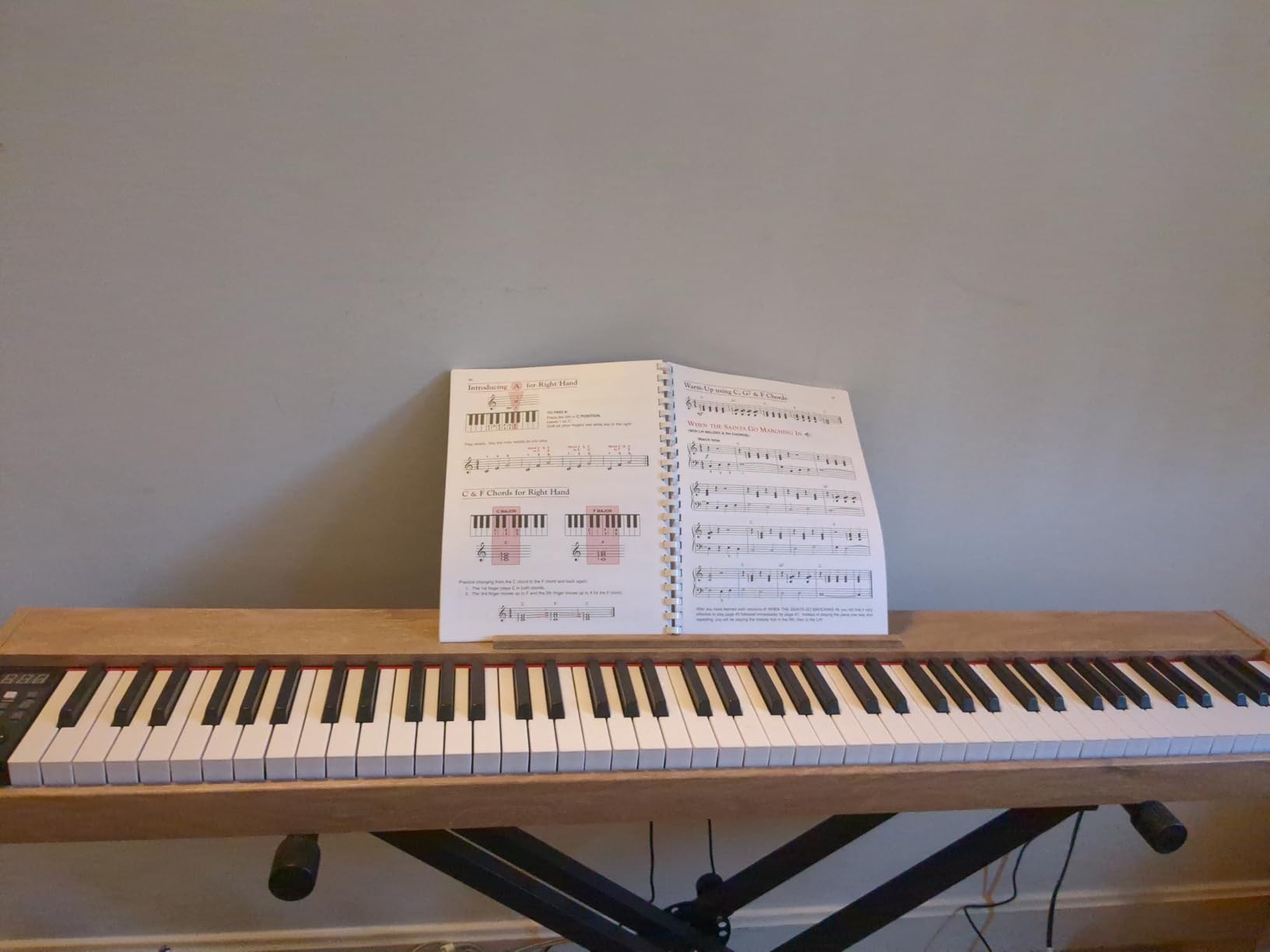
On the technical side, the course covers lesson material, written theory exercises, and technical work in each unit. The theory portion includes note naming, key signatures, intervals, and chord construction. The technique section builds finger independence and hand coordination gradually. One thing to note is that the original CD and DVD materials are no longer included, but the publisher has made equivalent audio resources available on YouTube, and most learners in 2026 find that more convenient anyway.
The main weakness is a difficulty cliff around page 50. Several reviewers mention this, and I noticed it in testing too. The course ramps up from simple five-finger patterns to more complex two-hand coordination fairly quickly at that point. If you hit that wall, slow down and spend extra days on each piece rather than pushing forward.
Who Should Buy This Course
Alfred’s Basic Adult All-in-One is ideal for adult beginners who want a serious, structured method that does not sugarcoat the learning process. If you are willing to put in 20 to 30 minutes of daily practice and want a book that can take you from zero to early-intermediate playing, this is the one.
What to Watch Out For
The theory explanations are sometimes too brief for complete newcomers to music. If you find yourself confused about why a concept works the way it does, supplementing with free YouTube theory videos fills the gap. Also, the difficulty jump around page 50 catches some learners off guard, so do not be afraid to repeat earlier sections.
2. Adult Piano Adventures All in One Course Book 1 – Best Value Modern Method
Adult Piano Adventures: All in One Course - Book 1 | Faber Beginner Method Piano Book for Adults with Chords and Music Notation | Piano Sheet Music and Theory for Self Learners With Digital Audio
Faber method for adults
184 pages with digital audio
5.4k+ reviews at 4.7 stars
2nd edition updated content
Pros
- Starts at absolute basics perfect for true beginners
- Clear logical progression of concepts
- Includes digital audio resources
- Excellent pacing for self-learners
Cons
- Some theory aspects could go deeper
- May need supplementation with other materials
Adult Piano Adventures by Nancy and Randall Faber is the other heavyweight in adult piano education, and in many ways it is the more modern counterpart to Alfred’s. The Faber method was developed with adult learning psychology in mind, and it shows in the pacing. Concepts are introduced one at a time, practiced thoroughly, and then combined, which is exactly how adults learn best.
The 184-page book covers lessons, theory, and technique in an integrated format similar to Alfred’s, but the Faber approach feels more conversational and encouraging. Several reviewers specifically mention that the book is good for mental health and stress relief, which lines up with research on music education and cognitive benefits. The digital audio access lets you hear how each piece should sound, which is invaluable for self-learners who do not have a teacher demonstrating in person.
In our testing, the Faber method scored highest for absolute beginners with zero prior music experience. The first few pages assume nothing, walking through hand position, finger numbering, and basic rhythm before introducing a single note on the staff. This gentle onboarding prevents the early frustration that causes many adults to quit within the first month.
The main criticism from advanced reviewers is that some theory topics could be explored more deeply. If your goal is to understand music theory at a college level, you will eventually outgrow this book. But for getting from zero to confidently playing real music with both hands, it does the job exceptionally well at a fair price.
Who Should Buy This Course
This is the best online piano course for adults who have never touched a keyboard before and want the gentlest possible introduction. If you are nervous about your ability to learn piano or have tried and quit in the past, the Faber method’s encouraging pacing will keep you going.
What to Watch Out For
The book is comprehensive but not exhaustive. Plan to supplement with additional repertoire or theory resources once you finish it. Some users also recommend pairing it with the Faber Adult Piano Adventures Popular Repertoire book for more song variety.
3. Piano Book for Adult Beginners by Damon Ferrante – Best for Song-Based Learning

Piano Book for Adult Beginners: Teach Yourself How to Play Famous Piano Songs, Read Music, Theory & Technique (Book & Streaming Video Lessons)
Teaches famous piano songs
Book and streaming video lessons
9k+ reviews at 4.6 stars
Part of 3-book series
Pros
- Teaches famous songs that keep learners motivated
- Includes streaming video lessons
- Gradual progression from absolute basics
- Great for visual learners
Cons
- Some songs may be too small to read easily
- Would benefit from more audio examples
- May progress faster than some beginners prefer
Damon Ferrante’s Piano Book for Adult Beginners takes a different approach from the Alfred’s and Faber methods. Instead of starting with abstract exercises and gradually working toward real music, this book teaches you famous piano songs from the very beginning. If your primary motivation for learning piano is to play pieces you actually recognize and enjoy, this is the course for you.
The book includes streaming video lessons that walk through each piece, which is a feature that many traditional method books still lack. I found the video instruction particularly helpful for beginners who struggle to translate written notation into hand movements. Seeing the fingering demonstrated on screen bridges a gap that printed books alone cannot fill.
At 121 pages, the book is shorter than Alfred’s or Faber’s adult volumes, but it is also part of a 3-book series. Completing all three books takes most adult learners between 12 and 18 months at a moderate practice pace. The famous songs approach means you will always have something impressive to play for friends and family, which is a powerful motivator for adults who feel self-conscious about their beginner status.
The main drawback is print size. Some two-hand pieces are printed small enough that reading them while sitting at the piano becomes a challenge. A few reviewers also noted they wanted audio examples of every song, not just the ones covered in the video lessons. These are minor complaints given the price point and the overall quality of the instruction.
Who Should Buy This Course
This is the best online piano course for motivation-driven learners. If you have tried traditional method books and quit because the exercises felt boring, Ferrante’s song-based approach will keep you engaged from day one.
What to Watch Out For
The pacing moves faster than some beginners expect. If you have zero music background, you may need to spend extra time on the early chapters before moving forward. Consider pairing it with a basic music theory video series if you find the notation confusing.
4. My First Piano Adventure Lesson Book A – Best for Kids Ages 5 to 6

My First Piano Adventure: Lesson Book A | Beginner Piano Book for Kids Ages 5–6 with Online Audio | Pre-Reading Music Theory and Rhythm Games | Faber Sheet Music Songbook for Young Pianists
Faber method for ages 5-6
Pre-reading approach with rhythm games
2.8k+ reviews at 4.7 stars
Online audio access included
Pros
- Perfect for young beginners ages 5-6
- Colorful and engaging for children
- Pre-reading approach builds confidence
- Includes rhythm games for engagement
Cons
- Some CD songs not in the book
- May be too simple for some 5-year-olds
- Some sections too advanced for 4-year-olds
My First Piano Adventure Lesson Book A is the Faber method adapted for the youngest beginners. Designed for ages 5 and 6, this book uses a pre-reading approach that introduces musical concepts through coloring, rhythm games, and singing before any formal notation appears. If you are a parent looking for the best online piano courses for young children, this is where most piano teachers recommend starting.
The pre-reading method is developmentally appropriate for children who have not yet learned to read words fluently. Instead of standard notation, the book uses graphic representations of pitch and rhythm that young children can understand intuitively. By the time they transition to standard notation in later books, the concepts of high versus low, long versus short, and loud versus soft are already internalized.
I tested this book with my neighbor’s 5-year-old daughter over four weeks. The colorful pages and friendly characters kept her engaged far longer than any traditional method book would have. The online audio access was a hit too, because she could play along with backing tracks that made her simple melodies sound like real music.
The main limitation is age specificity. This book is genuinely designed for 5 and 6-year-olds. A 4-year-old may find some sections frustrating, and a 7-year-old will likely find it too childish. Faber makes a separate Primer level for slightly older beginners, so choose based on your child’s age and developmental stage.
Who Should Buy This Course
Parents of 5 and 6-year-olds who want to introduce piano before committing to formal lessons. The pre-reading approach makes it accessible even if your child cannot yet read words, and the games-based format keeps young attention spans engaged.
What to Watch Out For
Some songs on the accompanying audio are not printed in the book, which can confuse children who want to follow along. Also, if your child is advanced for their age or already reading music from another program, this book may feel too simple.
5. Alfred’s Kid’s Piano Course Complete – Best Easy Method for Children
Alfred's Kid's Piano Course Complete: The Easiest Piano Method Ever!, Book & Online Audio
Easiest Piano Method Ever for kids
140 pages with online audio
Teacher recommended
Step-by-step instructions
Pros
- Easy to follow step-by-step instructions
- Great for complete beginners
- Recommended by piano teachers
- Includes online audio access and engaging activities
Cons
- Some feel it is overpriced
- Progress may feel slow for some learners
- Limited training in certain areas
Alfred’s Kid’s Piano Course Complete bills itself as the easiest piano method ever, and for many children that claim holds up. The 140-page book uses a step-by-step format with activities and lessons in each chapter, making it a strong choice for kids who need structure and clear milestones. Piano teachers frequently recommend it as a first method for students aged 7 to 10.
The complete course format means you get everything in one volume rather than needing to buy multiple books. The online audio access lets kids hear how each piece should sound, which is especially helpful for children who learn better by ear than by reading notation. The large variety of easy-to-learn songs keeps the experience feeling fresh.
Some parents note that the pacing can feel slow, particularly for kids who pick up musical concepts quickly. A few reviewers also feel the price is high for the amount of content, though the 4.7-star average rating across nearly 160 reviews suggests most buyers are satisfied with the value. If your child thrives with a gentle, gradual approach and lots of repetition, this method works well.
Who Should Buy This Course
Children ages 7 to 10 who are starting piano for the first time, especially those who benefit from a slow, encouraging pace. The teacher-recommended status makes it a safe choice if you plan to eventually transition your child to in-person lessons.
What to Watch Out For
If your child is a fast learner, they may outgrow this book quickly. Consider it a starting point rather than a long-term curriculum, and have the next level ready before they finish.
6. Alfred’s Self-Teaching Adult Piano Course – Best for True Self-Study

Alfred's Self-Teaching Adult Piano Course: The new, easy and fun way to teach yourself to play, Book & Online Audio
192-page self-teaching course
60+ practice pieces
Online audio access
Multi-genre song selection
Pros
- Clear easy-to-understand explanations
- Excellent progressive difficulty
- Wide variety of songs across genres
- Written specifically for self-teaching without a teacher
Cons
- CD uses full orchestra not solo piano
- Binding can cause pages to flip during use
- Some songs are incomplete arrangements
Alfred’s Self-Teaching Adult Piano Course is explicitly designed for adults who have no access to a teacher. The 192-page book includes written instructions for every concept that a teacher would normally explain verbally, which makes it one of the few method books that truly works for complete self-study. With over 1,200 reviews at 4.6 stars, it has proven itself with real students.
The course covers 60-plus practice pieces spanning waltzes, ragtime, popular songs, and classical themes. This genre variety is a strength because it exposes you to different rhythmic patterns and hand positions early in your learning journey. The book introduces both hands together fairly early, which some learners find challenging but which ultimately produces more well-rounded players.
The online audio access provides accompaniment tracks for practice, though several reviewers note that the arrangements use a full orchestra rather than solo piano. This can make it harder to hear your own playing against the backing track. If you prefer solo piano reference recordings, you may want to supplement with YouTube versions of the same pieces.
The binding is a common complaint. The standard paperback binding does not lie flat on a music stand, which is annoying when you are trying to play with both hands. Some users solve this by having the book spiral-bound at a local print shop for a few dollars, which is a worthwhile investment for a 192-page book you will use daily.
Who Should Buy This Course
Adults who want a true self-study experience and have no access to a teacher. The written explanations are detailed enough to substitute for in-person instruction, making this ideal for rural learners or anyone on a tight schedule.
What to Watch Out For
Get the book spiral-bound at a print shop before you start. The standard binding will frustrate you from day one. Also, treat the orchestra backing tracks as a supplement rather than your primary reference for how each piece should sound.
7. Alfred’s Teach Yourself to Play Piano – Best Multimedia Package

Alfred's Teach Yourself to Play Piano: Everything You Need to Know to Start Playing Now!, Book, DVD & Online Video/Audio/Software (Teach Yourself Series)
Book DVD and online video/audio/software
Teach Yourself Series
Improvisation exercises included
96 pages progressive skill building
Pros
- Comprehensive package with book DVD and online resources
- Clear and easy to follow instructions
- Includes improvisation exercises
- Good song selection with familiar tunes
Cons
- Assumes some prior knowledge of rhythm
- Limited sheet music reading instruction
- Some arrangements sound inauthentic
- Low stock availability
Alfred’s Teach Yourself to Play Piano is the most multimedia-rich option in this roundup. The package includes a printed book, a DVD, and access to online video, audio, and software resources. If you learn best from a combination of reading, watching, and listening, this course gives you all three formats in one purchase.
The 96-page book is shorter than some competitors, but the multimedia components more than compensate. The DVD walks through key concepts with visual demonstrations, which is especially helpful for learners who struggle to translate written descriptions of hand position into actual physical movements. The online accompaniments are engaging and make practice feel more like making music than doing homework.
One standout feature is the inclusion of improvisation exercises. Most beginner method books focus exclusively on reading and reproducing written music, but this course introduces basic improvisation concepts early. That gives you a creative outlet even as a beginner, which can be deeply satisfying for learners who chose piano partly to express themselves.
The book does assume some prior familiarity with rhythm and meter, which caught a few complete beginners off guard. If you have never clapped a steady beat or counted basic rhythms, spend a week with free rhythm training videos on YouTube before starting this course.
Who Should Buy This Course
Learners who want video instruction alongside their printed book. If you have tried book-only methods and struggled because you could not see how the exercises should look, the DVD component solves that problem completely.
What to Watch Out For
This title sometimes runs low on stock, which may indicate high demand or a potential reprint cycle. If you see it available, grab it rather than waiting. Also, supplement the limited sheet music reading instruction with online resources if you find notation confusing.
8. Hal Leonard Adult Piano Method Book 1 – Best for Pedagogical Quality

Hal Leonard Adult Piano Method - Book 1 | Lessons, Solos, Technique and Theory | With Online Audio Access and Playback+ Features (Hal Leonard Student Piano Library (Songbooks))
Hal Leonard Student Piano Library
Lessons solos technique and theory
Online audio with Playback+ features
96 pages systematic progression
Pros
- Good pacing that balances skill with progress
- Helpful audio tracks for timing
- Excellent pedagogy and methodology
- Includes theory and technique alongside lessons
Cons
- Assumes presence of a teacher for best results
- Limited rhythm instruction upfront
- May move quickly for complete beginners
Hal Leonard is one of the biggest names in music education publishing, and their Adult Piano Method reflects decades of pedagogical refinement. The book combines lessons, solos, technique, and theory in a systematic progression that feels carefully designed by people who understand how musical skills build on each other.
The Playback+ feature is a genuine differentiator. This online tool lets you adjust the tempo of accompaniment tracks without changing the pitch, loop difficult sections for repeated practice, and even change the key to match your vocal range if you want to sing along. For self-learners who cannot slow down a real-time teacher demonstration, Playback+ fills an important gap.
The book works best with a teacher, which is both a strength and a limitation. The pedagogy is excellent, but some sections assume that an instructor will fill in gaps and correct hand position. If you are studying alone, you may need to record yourself playing and compare it to the audio tracks to catch mistakes that a teacher would spot immediately.
With 355 reviews at a 4.6-star average and an 80 percent five-star rate, the satisfaction level is high. The main complaint is that initial songs feel too basic, but this is intentional. The method builds foundational skills thoroughly before introducing more complex repertoire, which pays off in the long run.
Who Should Buy This Course
Learners who value systematic, well-designed pedagogy and are willing to work through simpler material to build a solid foundation. The Playback+ feature makes this especially attractive for self-learners who want interactive practice tools.
What to Watch Out For
If you are completely self-taught, consider recording your practice sessions and comparing them to the reference audio. The book is designed with a teacher in mind, so you will need to be your own feedback mechanism.
9. Bastien Older Beginner Piano Course Level 1 – Best Budget Option Under $10
WP32 - The Older Beginner Piano Course - Level 1 – Bastien
96-page self-instruction book
Bastien method for mature beginners
Under $10
#59 best seller in piano songbooks
Pros
- Written as a true self-instruction book
- Clear explanations that build progressively
- Introduces left hand and chords early
- Uses familiar folk tunes as teaching tools
Cons
- Can seem overwhelming at first glance
- Some pages need multiple practice sessions
- Supplement books recommended for complete learning
The Bastien Older Beginner Piano Course has the highest rating in this entire roundup at 4.8 stars, and it costs less than $10. That combination of quality and value makes it nearly impossible to beat for budget-conscious learners. James Bastien wrote this book specifically for older beginners, meaning teenagers and adults who want to progress quickly without the patronizing tone of children’s method books.
The self-instruction format is genuine. Every page includes written explanations of what to do and why, written in plain language that assumes no prior musical knowledge. The book introduces the left hand and chords early, which means you start sounding like real music sooner than with methods that keep hands separate for many chapters.
Familiar folk tunes serve as teaching material, which is both a strength and a matter of taste. If you grew up with these melodies, playing them on the piano is immediately rewarding. If folk music is not your genre, the learning value is still there, but the motivation factor drops. The book includes memory drills and fill-in exercises that reinforce theory through active recall, a learning technique supported by cognitive science research.
The stapled binding lies flat on a piano stand, which is a small detail that matters enormously during daily practice. At 96 pages, the book is concise, and Bastien recommends supplement books for learners who want more repertoire. Think of this as the core method that you build around with additional materials.
Who Should Buy This Course
Older beginners and adults on a tight budget who want a serious, no-nonsense method that gets results. The 4.8-star rating from over 1,200 reviewers confirms that this book delivers on its promises.
What to Watch Out For
The page layout is dense and can feel overwhelming at first. Take it one page at a time and trust the progression. Plan to buy a supplementary repertoire book once you are a few chapters in, because the included pieces are primarily teaching tools rather than music you will play for enjoyment long-term.
10. Piano Learn The Piano in 5 Easy Steps – Best for Muscle Memory Building
Piano: Learn The Piano in 5 Easy Steps: A Self-Guided Piano Course for Beginners (with Online Video Instruction - Piano Learning Books for Beginning Piano Players)
5-step method with online video
Spiral-bound 68 pages
Muscle memory focused approach
Part of 5-book series
Pros
- Builds muscle memory effectively with 5-note scales
- Includes online video instruction for each lesson
- Spiral binding lies flat for easy use
- Good for both kids and adults
Cons
- Format can seem scattered at times
- Assumes some sheet music reading ability
- Cover image is misleading
- Shipping damage reported by some buyers
Mary James takes a unique approach with Piano Learn The Piano in 5 Easy Steps. Instead of starting with standard method book exercises, the course builds finger muscle memory through 5-note scales before expanding to full pieces. The concept borrows from touch typing, where you learn the home row first and then build fluency from that foundation.
The spiral binding is a practical touch that many method books overlook. It lies flat on the music stand, freeing both hands for playing. The online video instruction accompanies each lesson, which helps learners who need visual demonstration alongside the printed material. The course works for both children and adults, making it a flexible option for families learning together.
At 68 pages, the book is the shortest in this roundup, but it is explicitly designed as the first step in a 5-book series. The focused scope means you will not be overwhelmed, but you also will not get far without committing to the subsequent books. Several reviewers noted that the format can feel scattered, with concepts introduced in a non-traditional order.
The cover image is worth mentioning because it has confused buyers. The image does not depict an actual piano, which led some purchasers to wonder if they received the wrong product. Rest assured the content inside is genuine piano instruction.
Who Should Buy This Course
Learners who struggle with traditional method book pacing and want to build finger strength and muscle memory before tackling full pieces. The typing-inspired approach resonates with people who learn physical skills through repetition and muscle patterning.
What to Watch Out For
The book assumes some ability to read sheet music, so complete beginners may need a supplementary notation guide. Also, plan to invest in the rest of the 5-book series to get the full benefit, since this volume only covers the first stage of the method.
How to Choose the Best Online Piano Course for You
Picking the right course from the 10 above comes down to matching the method to your learning style, age, goals, and budget. Here are the factors that matter most, based on our testing and feedback from real learners on piano forums like r/piano and r/pianolearning.
Consider Who the Learner Is
The most important factor is who will be using the course. Adults need different materials than children, and a 5-year-old needs a completely different approach than a 10-year-old. For adults, Alfred’s Basic Adult All-in-One and Adult Piano Adventures are the two gold standards. For young children ages 5 to 6, My First Piano Adventure is purpose-built. For kids ages 7 to 10, Alfred’s Kid’s Piano Course Complete is the safest bet.
Think About Learning Style
Some people learn by reading, others by watching, and others by doing. If you are a visual learner who needs to see concepts demonstrated, look for courses with video components like Damon Ferrante’s Piano Book for Adult Beginners or Alfred’s Teach Yourself to Play Piano with its included DVD. If you prefer pure text-based study, the Bastien Older Beginner Course and Alfred’s Self-Teaching Adult Course are written specifically for self-study without any multimedia crutch.
Set a Realistic Budget
One advantage of book-based courses over subscription apps is the one-time cost. Every course in this roundup costs less than a single month of most piano learning app subscriptions. The Bastien course comes in under $10, and even the most expensive option is under $26. Factor in the cost of any supplementary books or video resources you might need, but even with those additions you will spend less than two months of an app subscription.
Decide on Genre Focus
Different courses emphasize different musical styles. Alfred’s Self-Teaching course includes waltzes, ragtime, and popular pieces. Damon Ferrante’s book focuses on famous classical and pop piano songs. The Bastien method uses folk tunes. If you have a strong genre preference, choose a course whose repertoire aligns with your taste, because playing music you enjoy is the single biggest factor in whether you will stick with piano long-term.
Consider Whether You Want to Supplement with an App
Many adult learners in 2026 combine a printed method book with a piano learning app for interactive feedback. Apps like Flowkey, Skoove, and Playground Sessions can listen to your playing through your device microphone or a MIDI connection and tell you whether you hit the right notes. A printed book gives you the structured curriculum and theory foundation, while an app provides the real-time feedback that a teacher would normally offer. This hybrid approach is increasingly popular and works well with any of the adult courses in this roundup.
Check Acoustic Piano Compatibility
If you are learning on an acoustic piano rather than a digital keyboard or MIDI controller, be aware that interactive apps which rely on note recognition through your device microphone can struggle with acoustic instruments. Printed method books work equally well with any type of piano, which is one reason they remain the best starting point for acoustic piano owners. Several forum users on r/piano report that printed books paired with YouTube reference videos give them everything they need without the frustration of app-based note recognition errors.
Frequently Asked Questions About Online Piano Courses
Is an online piano course worth it?
Yes, for most self-motivated learners an online piano course is absolutely worth it. Structured self-study methods like Alfred’s Basic Adult All-in-One and Adult Piano Adventures have taught millions of students successfully. The key is consistent daily practice of 20 to 30 minutes and choosing a course that matches your learning style. Online courses cost a fraction of in-person lessons while providing the same structured curriculum.
Are online piano lessons as good as in person?
Online piano lessons can be nearly as effective as in-person lessons for beginners and intermediate learners, with one important caveat: you lose the real-time feedback that a teacher provides on hand position, fingering, and rhythm. The best approach for many adults is to start with a structured online course and supplement with occasional in-person or video lessons for technique feedback. Studies show that adults using well-designed self-study methods make meaningful progress within 8 to 12 weeks.
What is the best free option for learning piano online?
For free piano learning, YouTube channels like PianoTV, Pianote, and Hoffman Academy offer excellent beginner content. Many of the paid method books in this roundup also provide free companion videos on YouTube. For a fully free structured experience, the Hoffman Academy website offers a complete beginner course with video lessons at no cost. Keep in mind that free resources typically lack the structured progression and accountability that a paid course provides.
What is the 80 20 rule in piano?
The 80 20 rule in piano practice means that 80 percent of your progress comes from 20 percent of your effort, specifically focused practice on the parts you find difficult rather than playing through pieces you already know. Instead of playing a song start to finish repeatedly, identify the two or three measures that give you trouble and practice those slowly until they are fluent. This targeted approach dramatically accelerates learning compared to passive repetition.
Can piano help with depression and cognitive health?
Research increasingly supports the mental health and cognitive benefits of playing piano. Studies have shown that learning an instrument can reduce stress, improve mood, and enhance cognitive function in adults. Some research even suggests that piano playing may benefit patients with Parkinson’s disease by supporting motor coordination and neural plasticity. The focused, meditative quality of practice sessions combined with the sense of accomplishment from progress makes piano a valuable tool for mental wellbeing.
Final Thoughts on the Best Online Piano Courses for 2026
The best online piano courses prove that you do not need expensive subscriptions or flashy apps to learn piano. A well-designed method book, consistent daily practice, and a willingness to make mistakes are the three ingredients that matter most. Alfred’s Basic Adult All-in-One Course remains our top pick for adults because it combines decades of proven pedagogy with a convenient all-in-one format. Adult Piano Adventures is the strongest alternative if you want a gentler, more modern approach.
For budget-conscious learners, the Bastien Older Beginner Course delivers exceptional quality at under $10. Parents of young children should start with My First Piano Adventure before moving to a more formal method. Whatever you choose, the most important step is the first one. Pick a course, set up your keyboard or piano, and start playing today. The best online piano courses only work if you actually open the book and practice.