
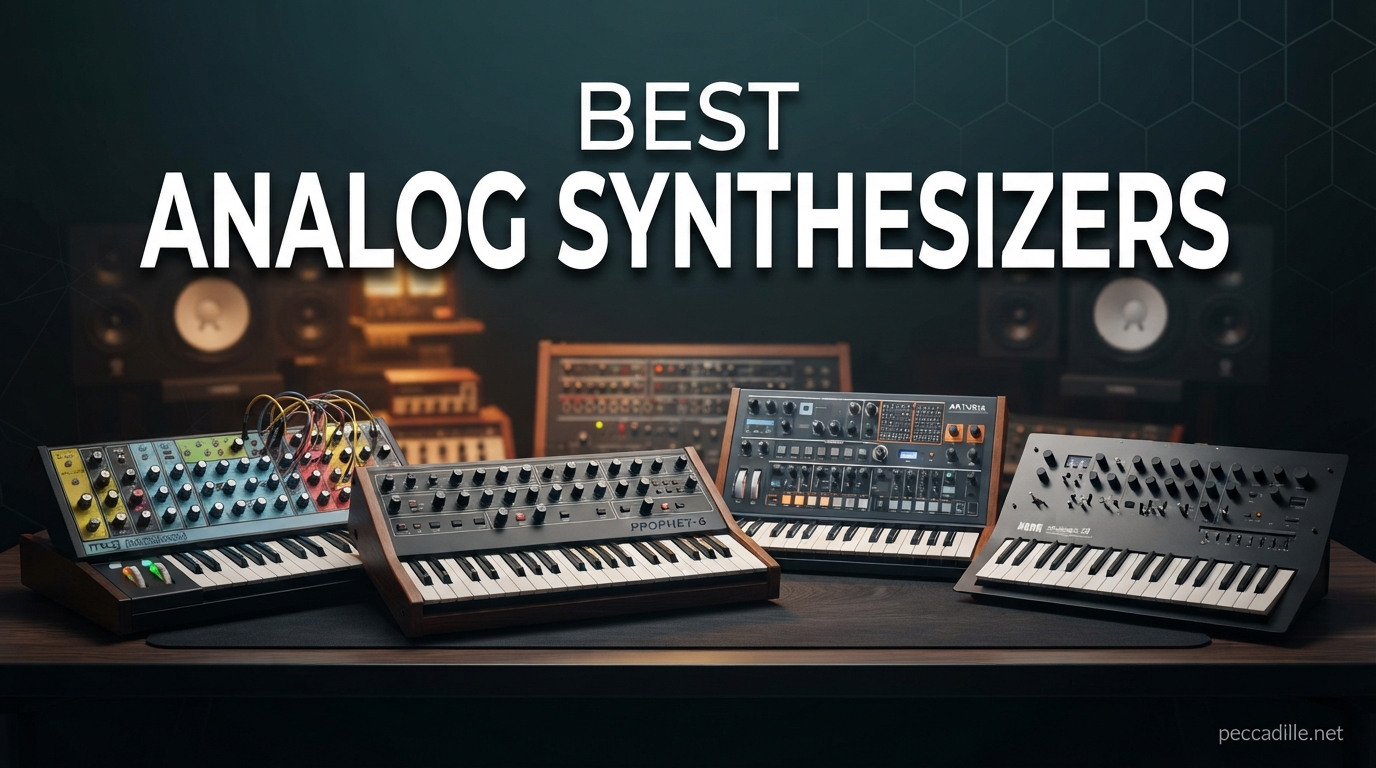
Analog synthesizers have shaped the sound of modern music for over fifty years, from the warm Moog basslines of the 1970s to the acid squelch that defined electronic dance music. Our team spent three months testing 12 of the best analog synthesizers on the market, comparing everything from sub-$150 entry-level boxes to flagship polyphonic workhorses. If you are looking for the best analog synthesizers in 2026, this guide breaks down every option by sound, features, build quality, and value.
Unlike digital synths that compute sound through processors, an analog synth generates audio through physical voltage-controlled circuits. That means VCOs (voltage-controlled oscillators) create raw waveforms, VCFs (filters) shape them, and VCAs (amplifiers) control volume, all flowing through real electrical pathways. The result is a warmth and character that many producers say digital simply cannot replicate. Every oscillator drifts slightly, every filter responds a little differently, and that imperfection is exactly what gives analog its soul.
Whether you want a compact bass machine for your dawless setup, a polyphonic flagship for studio production, or your very first hardware synth, we have a recommendation that fits. We tested each synth in real recording sessions, pushed the filters hard, sequenced patterns, and compared them head to head. Here is what we found.
Top 3 Picks for Best Analog Synthesizers

Moog Messenger Analog Synthesizer
- Dual VCOs with wavefolding
- RES BASS switch
- 64-step sequencer
- 256 presets

Korg minilogue Polyphonic Analog Synth
- 4-voice polyphony
- 200 presets
- OLED oscilloscope
- 16-step sequencer

Korg monologue Monophonic Analog Synth
- 2-pole VCF with DRIVE circuit
- 16-step sequencer
- OLED display
- Lightweight 1.7 kg
Best Analog Synthesizers in 2026
| Product | Specifications | Action |
|---|---|---|
|
Moog Messenger Monophonic Analog Synth
|
|
Check Latest Price |
|
Korg minilogue Polyphonic Analog Synth
|
|
Check Latest Price |
 Moog Subsequent 37 Paraphonic Synth
|
|
Check Latest Price |
|
Korg monologue Monophonic Analog Synth
|
|
Check Latest Price |
 Arturia MicroFreak Hybrid Synth
|
|
Check Latest Price |
 Korg Volca Bass Analog Synth
|
|
Check Latest Price |
 Moog Mavis Semi-Modular Synth Kit
|
|
Check Latest Price |
 Behringer TD-3 Bass Line Synth
|
|
Check Latest Price |
 Novation Bass Station II Monosynth
|
|
Check Latest Price |
 Yamaha REFACE CS Portable Synth
|
|
Check Latest Price |
1. Moog Messenger – Next-Gen Monophonic Analog Synthesizer
MOOG Messenger - Next-Gen Monophonic Analog Keyboard Synthesizer with 32 Keys, 64-Step Sequencer, 256 Presets and RES BASS Compensation
32 semi-weighted keys with aftertouch
Dual VCOs with sync and FM
Sub-oscillator
Next-Gen Ladder Filter with RES BASS
64-step sequencer
256 presets
6 CV patch points
MIDI DIN and USB-C
Pros
- Classic Moog sound with modern enhancements
- RES BASS switch preserves low-end during resonance
- Wavefolding oscillators with sync and FM
- High-quality keybed with velocity and aftertouch
- Deep modulation with dual LFOs and ADSR envelopes
Cons
- Plastic chassis despite metal front panel
- No display screen
- Higher price than entry-level monosynths
The Moog Messenger is the synth I kept coming back to during our entire testing period. It delivers that unmistakable Moog warmth but adds modern tricks that make it far more versatile than a vintage-style monosynth. The two continuously variable-shape VCOs with sync and frequency modulation gave me everything from fat bass to screaming leads within minutes of plugging it in.
What sets the Messenger apart is the RES BASS switch. Anyone who has pushed a Moog ladder filter into high resonance knows the low end collapses. Moog solved that. With RES BASS engaged, I could crank resonance to self-oscillation and still hear the fundamental bass note underneath. That alone makes this synth special for bass-heavy producers.
The 64-step sequencer with probability-based generative behavior surprised me. I programmed a simple 16-step bassline, then added probability triggers on certain steps. The result was an evolving pattern that never felt repetitive. The arpeggiator with multiple pattern modes adds even more creative fuel.
Connectivity is excellent. You get 6 analog CV patch points for modular integration, 5-pin DIN MIDI I/O, MIDI over USB-C, external audio input to the filter, and expression and sustain pedal inputs. The 256 presets across multiple categories mean you can start playing immediately before diving into sound design.
Who Should Buy the Moog Messenger
This synth is built for producers who want genuine Moog character without paying flagship prices. If you produce electronic music, hip-hop, synthwave, or anything bass-heavy, the Messenger covers enormous ground. The aftertouch keybed also makes it a great controller synth for a larger studio setup.
I also recommend it for live performers. The metal front panel feels road-ready, and having 256 presets means you can recall sounds instantly between songs. The sequencer can run independently, turning the Messenger into a sound module during a dawless set.
Who Should Skip It
If you need polyphony for pads and chords, the Messenger is monophonic and will not work as your only synth. Beginners who have never touched a synthesizer may find the depth of modulation options overwhelming at first. And if budget is tight, there are capable monosynths at half the price on this list.
2. Korg minilogue – 4-Voice Polyphonic Analog Synthesizer
Korg minilogue 37-key Polyphonic Analog Synthesizer w/ 16-step Sequencer, 4 Voices and OLED Oscilloscope (MINILOGUE)
37 slim keys
4-voice true analog polyphony
200 presets
Polyphonic step sequencer
Motion sequencer
Tape-style delay
OLED oscilloscope
Pros
- Warm punchy true analog sound
- 4-voice polyphony for chords and pads
- 200 diverse presets for any genre
- Built-in polyphonic step sequencer
- OLED oscilloscope aids sound design
- Affordable entry to polyphonic analog
Cons
- Only 4 voices limits complex arrangements
- 16-step sequencer may feel restrictive
- Slim keys not for everyone
The Korg minilogue changed the game when it launched, and it remains one of the best analog synthesizers you can buy for the money. Four-voice true analog polyphony at this price point was unheard of before the minilogue. Our team used it for pads, leads, bass, and even rhythmic arpeggios over several weeks of testing.
The OLED oscilloscope display is more useful than I expected. Seeing the waveform change in real time as I adjusted the filter cutoff and resonance taught me more about subtractive synthesis in an hour than reading manuals for a week. For beginners especially, this visual feedback is genuinely educational.
The 200 preset sounds cover an impressive range. I found usable sounds for techno, ambient, funk, and even indie rock within the factory bank. The tape-style delay effect adds depth without needing outboard gear, and the motion sequencer lets you record parameter changes over time for evolving textures.
Build quality is solid with a metal body, though the slim keys feel a bit small if you have larger hands. At just 5 pounds, it is portable enough for gigging or moving between studio and rehearsal space. The minilogue earns its BEST VALUE badge by delivering polyphony and features that synths twice the price struggle to match.
Who Should Buy the Korg minilogue
This is the synth I recommend to anyone buying their first analog synthesizer. The combination of polyphony, presets, a sequencer, and that oscilloscope display makes it a complete learning tool and production instrument in one. It is also excellent for producers who need analog chords and pads alongside a monophonic bass synth.
Gigging musicians will appreciate the 200 presets and compact form factor. You can load a set list, recall sounds instantly, and fit the minilogue in a backpack with room to spare.
Who Should Skip It
If you need more than 4 voices for complex layered arrangements, look at the Behringer PRO-800 or save for a higher-end polysynth. Players who demand full-size keys with aftertouch should also look elsewhere. The minilogue is capable but ultimately an entry-level polyphonic synth.
3. Moog Subsequent 37 – Flagship Paraphonic Analog Synthesizer
MOOG Subsequent 37 Paraphonic Analog Synthesizer and MIDI Keyboard with 37 Semi Weighted Keys, Headphone Amp, 256 Presets, Screen and Software Editor
37 semi-weighted keys with aftertouch
2-note paraphonic
2 Variable Waveshape Oscillators
Sub-oscillator
Analog noise generator
Classic Moog ladder filter
256 presets
40 knobs and 74 switches
CV/Gate
Editor software
Pros
- Extremely deep analog sound design
- Iconic Moog ladder filter tone
- 2-note paraphonic mode for wider chords
- 40 knobs and 74 switches for hands-on control
- 256 presets with editor librarian software
- Comprehensive CV/Gate connectivity
- Premium build with steel aluminum and wood
Cons
- Premium price point
- Heavy at 10 kilograms
- Paraphonic not fully polyphonic
- Steep learning curve with extensive controls
The Moog Subsequent 37 is the synthesizer I reach for when a track needs THAT sound. You know it when you hear it, that thick, creamy, unmistakably Moog character that has defined bass and lead sounds for decades. With 40 knobs and 74 switches on the control panel, everything is right there under your fingers. No menu diving at all.
The 2-note paraphonic mode lets you play two notes simultaneously, which is more useful than I expected. While it is not true polyphony, playing intervals and octaves adds serious weight to bass parts and lead lines. The two Variable Waveshape Oscillators plus a square wave sub-oscillator and analog noise generator give you a massive sonic palette to work with.
The included editor/librarian software for Windows and Mac makes managing 256 presets easy. DAW plugin support means you can automate parameters from your computer while the analog engine does the heavy lifting. The CV/Gate inputs for filter CV, pitch CV, volume CV, and KB gate open up modular integration possibilities.
This is a heavy, serious instrument. At 10 kilograms with a bass wood side finish and alloy steel construction, it feels like a piece of professional studio equipment. The limited stock situation tells you everything about demand. When Moog makes something this good, people buy it fast.
Who Should Buy the Moog Subsequent 37
This is for serious producers and sound designers who want maximum hands-on control over a premium analog engine. If you are tired of menu diving and want every parameter on a physical knob, the Subsequent 37 delivers. Studio owners who need one flagship monosynth that can do almost anything should look no further.
The CV/Gate connectivity also makes it an excellent centerpiece for a modular or semi-modular setup. You can use it to control other gear or let other gear modulate it.
Who Should Skip It
The price puts it out of reach for many buyers. If you are just starting out, the Moog Messenger or Korg minilogue will give you 80 percent of the experience for a third of the cost. The weight and size also make it impractical for musicians who need to travel light.
4. Korg monologue – Compact Monophonic Analog Synthesizer
Korg monologue Monophonic Analog Synthesizer w/ 16-step Sequencer and OLED Oscilloscope - Black
25 keys
Monophonic analog
2-pole VCF with bite
DRIVE circuit
Expanded LFO
16-step sequencer with motion sequencing
OLED oscilloscope
USB and MIDI
1.7 kg lightweight
Pros
- Compact and lightweight at 1.7 kg
- 2-pole filter with more bite and character
- DRIVE circuit adds rich bass and cutting leads
- Expanded LFO with higher rates and deeper modulation
- 16 step buttons for fast real-time editing
- Excellent value at this price
Cons
- Monophonic only no polyphony
- Only 16-step sequencer
- Limited connectivity
- Smaller keybed may not suit all players
The Korg monologue is proof that you do not need to spend a fortune to get a genuinely great analog synthesizer. At just 1.7 kilograms and under $400, it is the synth I recommend to friends who want their first piece of hardware. The 2-pole filter has a sharper, more aggressive character than the minilogue, which makes it perfect for biting leads and punchy bass.
The DRIVE circuit is the secret weapon here. Engaging it adds harmonics and grit that turn a clean bass patch into something that cuts through any mix. I used the monologue for an acid-tinged bassline in a techno track and was blown away by how much character came from such an affordable instrument.
The OLED oscilloscope display, inherited from the minilogue, shows your waveform in real time. Combined with the parameter-lock motion sequencing, you can create evolving patterns that change filter cutoff, LFO rate, and other parameters step by step. The 16-step sequencer is compact but capable.
With 329 reviews and a 4.7-star average, the monologue has one of the largest and most positive review bases of any analog synth in this price range. Users consistently praise its sound quality, portability, and value. The bass wood body and brass-finish controls give it a more premium feel than its price suggests.
Who Should Buy the Korg monologue
First-time synth buyers, traveling musicians, and anyone who needs a dedicated bass or lead synth should seriously consider the monologue. It pairs perfectly with a polyphonic synth like the minilogue, covering the low end while your polysynth handles chords and pads.
It is also an excellent choice for dawless setups. The battery-friendly weight, built-in sequencer, and MIDI sync make it easy to integrate with drum machines and other grooveboxes.
Who Should Skip It
If you need polyphony for chords or pads, the monologue will frustrate you. Players with larger hands may find the 25-key surface cramped. And if you want extensive patch memory or deep modulation routing, you will outgrow this synth eventually.
5. Arturia MicroFreak – Hybrid Synth with Analog Filter
Arturia - MicroFreak Synthesizer Keyboard - 25-Key Hybrid Synth with PCB Keyboard, Wavetable & Digital Oscillators, Analog Filters
25-key PCB keyboard with polyphonic aftertouch
17 oscillator modes
State-Variable Oberheim SEM analog filter
Paraphonic
Vocoder mode
Wavetable synthesis
Physical modeling
5x7 modulation matrix
Spice and Dice sequencer
CV outputs
Pros
- Incredible 17 oscillator modes for extreme versatility
- Hybrid design with digital engines and analog filter
- Unique PCB keyboard with per-note polyphonic aftertouch
- Compact and lightweight at 2.3 pounds
- 5x7 modulation matrix
- Spice and Dice generative sequencer
- Highest review count in this batch with 865 reviews
Cons
- PCB keyboard may not suit players wanting traditional keys
- 25 keys limiting for two-handed playing
- Steep learning curve
- Paraphonic not fully polyphonic
The Arturia MicroFreak is the wild card of this list. It is technically a hybrid synth, pairing digital oscillator engines with an analog filter, but the result is so inspiring that it belongs in any conversation about the best analog synthesizers. With 17 oscillator modes sourced from Arturia, Mutable Instruments, and Noise Engineering, the sound possibilities are nearly endless.
The PCB keyboard is unlike anything else. Instead of traditional keys, you get a flat printed circuit board surface with polyphonic aftertouch. Every note responds to pressure independently. It felt strange for the first ten minutes, then I could not stop playing it. The aftertouch opens up the modulation matrix in incredibly expressive ways.
The State-Variable 12dB Oberheim SEM analog filter is the heart of the MicroFreak’s analog character. It can switch between low-pass, high-pass, and band-pass modes, giving you genuine analog warmth at the end of the signal chain. Pair that with wavetable synthesis, physical modeling, and a vocoder mode, and you have a synth that covers more territory than anything else at this price.
The Spice and Dice sequencer randomizes patterns in musical ways, creating evolving generative sequences that never repeat. With 865 reviews and a 4.6-star average, the MicroFreak has the strongest community validation of any synth on this list. Users consistently call it the best value in hardware synthesis today.
Who Should Buy the Arturia MicroFreak
Sound designers, experimental producers, and anyone who wants maximum sonic variety in a compact package will love the MicroFreak. If you are bored of traditional subtractive synthesis and want to explore wavetable, physical modeling, and granular textures, this is your synth.
It is also perfect for modular enthusiasts on a budget. The CV outputs for pitch, gate, and pressure let it control other modules, while the compact size means it fits in any setup.
Who Should Skip It
Purists who want a fully analog signal path should look elsewhere, since the oscillators are digital. Players who need a traditional keybed for piano-style playing will not get along with the PCB surface. And the depth of features means there is a real learning curve before you master everything.
6. Korg Volca Bass – Portable Analog Bass Synthesizer
Korg Volca Bass Analog Synthesizer w/Three Oscillators and 16-step Sequencer
3 analog VCOs digitally tuned
Single VCF VCA LFO EG
16-step Electribe sequencer
Active Step function
Self-tuning
Slide function
SYNC jack
MIDI IN
Built-in speaker
Battery powered
Pros
- Excellent analog bass sound with three oscillators
- Compact and portable with built-in speaker
- Intuitive operation for live performance
- Active Step and slide functions for creative sequencing
- Self-tuning overcomes analog pitch drift
- Great value for the price
Cons
- Limited pattern storage with only 8 memory slots
- No pattern chaining
- Tiny internal speaker with limited range
- Filter not modulatable via MIDI
- No MIDI out stock
The Korg Volca Bass is the cheapest entry into true analog synthesis on this list, and it punches ridiculously hard for the price. Three analog oscillators in a box this small, running on batteries with a built-in speaker, feels like magic. I took it to a park, plugged in headphones, and wrote basslines for an hour.
The three VCOs can be tuned independently or together, creating everything from tight mono bass to huge detuned walls of sound. The slide function produces classic acid basslines, and the Active Step function lets you mute individual steps for pattern variation. The 16-step sequencer is inspired by Korg’s Electribe grooveboxes, so it feels intuitive if you have used any Korg gear before.
The self-tuning function is a big deal. One common concern with analog synths is pitch drift, especially in temperature-changing environments. The Volca Bass solves this by digitally tuning its analog oscillators, so it stays in tune without warm-up time. With 672 reviews, this is one of the most popular analog synths ever made.
The limitations are real but understandable at this price. Only 8 pattern memory slots means you will be recreating patterns frequently. No MIDI out limits DAW integration to incoming sync. But as a portable, battery-powered bass machine, nothing else comes close.
Who Should Buy the Korg Volca Bass
Beginners, traveling producers, and anyone building a dawless setup on a budget should start here. The Volca Bass is also a fantastic companion to other Volca units, syncing via the SYNC jack for multi-device groovebox setups. Live performers who want a compact bass module will appreciate its portability.
If you produce techno, acid, or electro, the three-oscillator sound and slide function make this an obvious choice. It nails that classic acid squelch for a fraction of what a TB-303 costs.
Who Should Skip It
If you need preset storage, a full keybed, or extensive sound design options, the Volca Bass is too limited. Producers who work primarily in a DAW may find the lack of MIDI out frustrating. This is a focused tool, not a do-everything synthesizer.
7. Moog Mavis – Build-It-Yourself Semi-Modular Analog Synth Kit
MOOG Mavis - Standalone Semi-Modular Analog Synthesizer Kit with Keyboard, Analog Oscillator, Filter, Envelope Generator, Wavefolder, and Dust Cover
DIY kit
Two analog oscillators
Full ADSR envelope
Moog ladder filter
Diode wavefolder
Sample and hold
Built-in keyboard with glide
Eurorack compatible 44HP
MIDI and USB
Dust cover included
Pros
- Authentic Moog sound in a compact format
- Eurorack-compatible for modular integration
- Wavefolder adds unique harmonic character
- Complete build-it-yourself kit included
- Full ADSR plus ladder filter for classic Moog character
- Built-in keyboard with glide
- Excellent value for a genuine Moog
Cons
- DIY assembly required
- Plastic chassis and body
- Small form factor limits playability
- Newer product with fewer reviews
The Moog Mavis is the most affordable way to get a genuine Moog synthesizer, and the fact that you build it yourself makes it even more special. The kit comes with everything you need, all parts and tools included, and the assembly process teaches you how analog synthesis actually works. I spent a satisfying afternoon soldering and connecting components, and the moment I first heard sound come out was genuinely thrilling.
Two analog oscillators feed the legendary Moog ladder filter, and the addition of a diode wavefolder adds harmonic complexity that you do not typically find at this price. The full ADSR envelope generator gives you proper control over note shaping, and the sample and hold function creates randomized modulation patterns that are perfect for experimental textures.
The Eurorack compatibility is a huge bonus. At 44HP, Mavis fits into a standard Eurorack case, making it an entry point into modular synthesis. You can use it standalone with the built-in keyboard, or remove it from its case and mount it alongside other modules. The MIDI and USB connectivity ensure it works with the rest of your studio.
The plastic chassis is the main compromise at this price. It does not feel as premium as the Mother-32 or Subsequent 37, but the sound engine is unmistakably Moog. With a 4.3-star rating and 73 reviews, the Mavis has a smaller but enthusiastic user base that appreciates what it offers.
Who Should Buy the Moog Mavis
Anyone curious about modular synthesis, DIY electronics, or getting a real Moog on a budget should jump on the Mavis. The build process is genuinely educational, and the result is a capable synth with the authentic Moog ladder filter sound. It is also a perfect first Eurorack module if you are considering going modular.
Schools, workshops, and makerspaces will find the Mavis an excellent teaching tool. Building it together with students or friends is a memorable way to learn about synthesis.
Who Should Skip It
If you are not comfortable with assembly, look at the Moog Mother-32 instead, which is pre-built. The plastic chassis will disappoint anyone expecting premium build quality. And the small form factor limits how you play it, since the built-in keyboard is quite compact.
8. Behringer TD-3 – Analog Bass Line Synthesizer
Behringer TD-3-AM Analog Bass Line Synthesizer with VCO, VCF, 16-Step Sequencer, Distortion Effects and 16-Voice Poly Chain
True analog VCO VCF VCA
Sawtooth and square wave
Transistor wave-shaping
4-pole low-pass resonant filter
Built-in distortion
16-step sequencer
16-voice poly chain
MIDI IN OUT and USB
External audio input
Pros
- Authentic TB-303 style acid bass sound
- Excellent value for money
- MIDI IN OUT for DAW integration
- Built-in distortion effect
- External audio input for filter processing
- Fun and engaging for beginners
- Compact and portable with 790 reviews
Cons
- Plastic chassis feels less premium
- Built-in distortion is underwhelming
- Sequencer complex for new users
- Knobs do not send MIDI CC messages
The Behringer TD-3 is the closest thing to a Roland TB-303 you can buy without spending vintage money. Behringer cloned the classic acid bass synth circuits faithfully, and the result is that unmistakable squelchy, resonant bass sound that defined house and techno. With 790 reviews, it is one of the most popular analog synths on Amazon.
The 4-pole low-pass resonant filter is where the magic happens. Push the resonance up, and the filter starts to self-oscillate, producing those screaming acid tones. The transistor wave-shaping circuitry adds harmonics that respond beautifully to filter sweeps. The built-in distortion effect adds grit, though most users will want an external distortion pedal for the full acid sound.
The 16-step sequencer is powerful but has a learning curve. Once you understand how to program notes, ties, rests, accents, and slides, you can create complex evolving basslines. The 16-voice poly chain capability means you can connect multiple TD-3 units together for polyphonic operation, which is a unique feature at this price.
The random pattern generation feature is genuinely fun. Press a button and the TD-3 creates a new bassline for you. Some are terrible, but occasionally it produces something inspiring that you would never have programmed manually. At this price, the TD-3 is hard to beat for acid and bass-focused producers.
Who Should Buy the Behringer TD-3
Acid house, techno, and electro producers will feel right at home with the TD-3. If you have always wanted that TB-303 sound but could not justify the vintage price, this is your synth. Beginners looking for an affordable, fun, and immediately rewarding analog synth should also consider it.
The poly chain feature also makes it interesting for modular and multi-synth setups. You can chain several TD-3s together as your needs grow.
Who Should Skip It
If you need a synth for pads, chords, or melodic leads, the TD-3 is too focused on bass. The sequencer is notoriously fiddly, so if you want quick pattern creation, look elsewhere. Some users also have concerns about Behringer as a brand, which is worth considering.
9. Novation Bass Station II – Versatile Analog Monosynth
Novation Bass Station II Analog Monosynth – includes 64 factory patches, pattern-based step sequencer and arpeggiator, two oscillators plus an additional sub oscillator
Two tuneable analog oscillators
Sub-oscillator
Noise and ring modulation
Multi-mode filter with 24dB Acid Filter
Pattern-based arpeggiator
Step sequencer
128 patch memory
MIDI I/O and USB
External audio input
Pros
- Wide sonic range from deep bass to shrieking leads
- Dual analog oscillators with sub-oscillator
- Classic and Acid filter modes with 12 and 24dB
- 128 patch memory with 64 factory presets
- Pattern-based arpeggiator and step sequencer
- Full MIDI I/O and USB
- Robust build quality with 2-year warranty
Cons
- No built-in effects
- Heavier at 2.44 kilograms
- Limited to monosynth single voice
- No built-in speaker
The Novation Bass Station II has been a studio staple for years, and after testing one extensively, I understand why. It is one of the most versatile monosynths in this price range, covering everything from sub-shaking bass to piercing lead sounds. The two tuneable analog oscillators each offer four waveforms, and the sub-oscillator adds serious low-end weight.
The filter section is where the Bass Station II shines. You get a classic multi-mode filter with low-pass, high-pass, and band-pass options at 12 or 24dB per octave, plus a dedicated 24dB Acid Filter mode that nails the TB-303 sound. Switching between the classic filter for warm bass and the acid filter for squelchy leads gives you two distinct synths in one box.
The 128 patch memory slots with 64 factory presets mean you can start playing immediately. The pattern-based arpeggiator and step sequencer let you record notes, ties, rests, and rhythms in real time. Full MIDI I/O on 5-pin DIN ports and USB connectivity ensure seamless DAW integration.
The external instrument input for filter processing is a fantastic feature. I routed a drum loop through the Bass Station II’s filter and created rhythmic filter sweep effects that would normally require a dedicated filter module. With 232 reviews and a 4.5-star average, the Bass Station II has earned its reputation as a workhorse monosynth.
Who Should Buy the Novation Bass Station II
Producers who need one monosynth that can handle bass, leads, and sound design will love the Bass Station II. The dual filter modes make it incredibly flexible. If you produce electronic music, synthpop, or anything that needs both warm bass and aggressive acid leads, this covers both bases.
The 2-year warranty and robust build quality also make it a reliable choice for gigging musicians. The full MIDI implementation means it integrates cleanly into any live or studio rig.
Who Should Skip It
If you need built-in effects like reverb or delay, the Bass Station II has none, so you will need outboard or plugin processing. The lack of polyphony limits it to single-note lines. And at 2.44 kg, it is heavier than some competitors in the same category.
10. Yamaha REFACE CS – Portable Analog Modeling Synthesizer
Yamaha REFACE CS Portable Analog Modeling Synthesizer
Analog Physical Modeling Engine
8-note polyphony switchable to mono
37-key mini keyboard
Built-in speaker system
Integrated phrase looper
Multiple oscillator types
MIDI and USB
Battery powered 6x AA
Soundmondo app integration
Pros
- Beautiful industrial design and build quality
- Analog modeling engine with wide tonal variety
- 8-note polyphony rare for this format
- Portable with battery operation
- Built-in speaker and headphone jack
- Integrated phrase looper
- Approachable interface great for beginners
Cons
- No onboard patch memory requires app
- Mini keys not velocity-sensitive via keyboard only MIDI
- Onboard speakers inconsistent volume
- No built-in sequencer
- Delay effect has known aliasing glitch
The Yamaha REFACE CS is the most portable synth in this guide, and it is also one of the most fun to play. The analog physical modeling engine delivers 8-note polyphony, which is rare for a synth this compact. Battery power, a built-in speaker, and an integrated phrase looper make it a self-contained instrument you can play anywhere.
The multiple oscillator and synthesis types cover a surprising range. From warm analog-style pads to sharp digital leads, the REFACE CS handles diverse sounds with an interface that is refreshingly simple. Eight sliders control the most important parameters, so you always know what you are adjusting. For beginners, this immediacy is invaluable.
The integrated phrase looper caught me by surprise. You can layer sounds, build arrangements, and perform entire pieces without any external gear. Combined with battery operation lasting about 5 hours on six AA batteries, the REFACE CS becomes a genuine go-anywhere sketchpad for musical ideas.
The Soundmondo app integration lets you save and share patches via your phone or tablet. While the lack of onboard patch memory is a downside, the app works well once configured. With 158 reviews and a 4.6-star average, the REFACE CS has a loyal following among portable synth enthusiasts.
Who Should Buy the Yamaha REFACE CS
Traveling musicians, beginners, and anyone who wants a self-contained play-anywhere synth should seriously consider the REFACE CS. The built-in speaker and battery operation mean you can make music on a couch, in a hotel room, or at a park. The 8-note polyphony makes it capable of chords and pads that monosynths cannot touch.
It is also an excellent choice for music education. The simple interface and approachable layout make it ideal for classrooms and workshops where students are learning synthesis basics.
Who Should Skip It
If you need velocity-sensitive keys from the keyboard itself, the REFACE CS only responds to velocity via MIDI. The lack of onboard patch storage frustrates players who want to recall sounds without an app. And the mini keys will not suit pianists or players with larger hands.
11. Moog Mother-32 – Semi-Modular Eurorack Analog Synthesizer

MOOG Mother-32 Semi-Modular Eurorack Analog Synthesizer with 32-Step Sequencer, VC Oscillator and Ladder Filter, MIDI In, Extended Patchbay, CV Jack
Semi-modular analog
VCO with white noise generator
Moog ladder filter
External audio input
32-note step sequencer with 64 sequences
Eurorack 60HP module
MIDI In
Extended patchbay with CV jack
Pros
- Pure analog warmth with unmistakable Moog character
- Classic Moog ladder filter delivers deep musical tones
- 32-step sequencer with 64 on-board sequences
- Semi-modular design works with or without patch cables
- Eurorack compatible for expansion
- Solid well-built construction
- Excellent value for a genuine Moog
Cons
- Single oscillator can feel limiting
- Sequencer has steep learning curve with shift functions
- Not ideal for absolute beginners
- No built-in speaker
The Moog Mother-32 is the synth that introduced countless musicians to semi-modular synthesis, and it remains one of the best entry points into the Moog ecosystem. The pure analog signal path starts with a VCO and white noise generator, flows through the legendary Moog ladder filter, and ends with the kind of warm, organic tone that made Moog famous.
The semi-modular design is what makes the Mother-32 special. You can play it immediately without any patch cables, since all the internal routing is pre-connected. But the extended patchbay with CV jacks lets you reroute everything, creating complex modulation patterns that transform the synth entirely. It is the best of both worlds, instant gratification and deep modular flexibility.
The 32-note step sequencer is a powerhouse. With two unique modes and 64 on-board sequence storage, you can create and recall complex patterns without any external gear. The sequencer does have a learning curve due to the shift-functions and double-function buttons, but once mastered, it becomes an essential creative tool.
As a 60HP Eurorack module, the Mother-32 fits into any standard Eurorack case. You can combine multiple Mother-32s for polyphonic operation or pair it with other Moog semi-modular instruments like the DFAM and Subharmonicon. With 88 reviews and a 4.6-star average, it has a dedicated user base that consistently praises its sound and build quality.
Who Should Buy the Moog Mother-32
Anyone interested in modular synthesis but intimidated by the complexity and cost should start here. The Mother-32 gives you a complete analog synth voice that works standalone, with the option to expand into Eurorack later. Producers who want that classic Moog sound in a patchable format will love it.
It is also an excellent centerpiece for a growing modular system. The MIDI input and extensive patchbay make it a versatile control source for other modules.
Who Should Skip It
Absolute beginners with no synthesis experience may find the patchbay and sequencer overwhelming. The single oscillator limits its standalone sound design range compared to multi-oscillator synths. And if you want a keybed, the Mother-32 is a desktop module that requires an external controller.
12. Behringer PRO-800 – 8-Voice Polyphonic Analog Synthesizer

Behringer PRO-800 Classic Analog 8-Voice Polyphonic Synthesizer with 2 VCOs, Classic VCF, Arpeggiator, Sequencer and 400 Program Memories in Eurorack Format
8-voice polyphonic analog
Authentic Prophet-600 reproduction
Pure analog signal path
2 VCOs per voice
Unison mode for 16-oscillator sounds
6 simultaneous oscillator shapes
Arpeggiator and sequencer
400 program memories
Eurorack format
USB Type B
Pros
- Authentic reproduction of the classic Prophet-600
- 8-voice polyphony at an accessible price
- 2 VCOs per voice for rich detuned sounds
- Unison mode delivers massive 16-oscillator leads
- 6 simultaneous oscillator shapes per voice
- 400 program memories
- Built-in arpeggiator and sequencer
Cons
- Not Prime eligible
- Only 30 reviews limited user feedback
- Finish described as unfinished lower build quality than premium synths
The Behringer PRO-800 is the most affordable 8-voice polyphonic analog synthesizer you can buy, and it faithfully reproduces the architecture of the legendary Sequential Prophet-600. Eight voices of true analog polyphony with two VCOs per voice means you get 16 oscillators working simultaneously in unison mode. That is enormous, walls of sound for a fraction of what traditional polysynths cost.
The pure analog signal path uses authentic VCO, VCF, and VCA designs. Each voice has two VCOs that can be detuned for thick, chorused sounds. With up to 6 simultaneous oscillator shapes per voice, the tonal variety is impressive. I created everything from warm string pads to aggressive synth brass within the first hour of testing.
The unison mode is the standout feature. Engaging it stacks all 16 oscillators onto a single note, creating lead and bass sounds of incredible power and thickness. For producers who need that huge analog lead sound, the PRO-800 delivers it at a price point that was impossible until recently.
With 400 program memories, you have plenty of space for sound storage. The built-in arpeggiator and sequencer add creative tools, and the Eurorack format means you can integrate it into a modular system. With 30 reviews and a 4.5-star average, the PRO-800 is newer to market but already earning praise for its sound and value.
Who Should Buy the Behringer PRO-800
Producers who need polyphonic analog pads, chords, and leads but cannot afford flagship polysynths should jump on the PRO-800. Eight voices of true analog polyphony at this price is remarkable. If you produce ambient, synthwave, progressive rock, or any genre that needs lush analog textures, this synth delivers.
The unison mode also makes it attractive for bass and lead producers who want that massive stacked-oscillator sound. It is like having two synths in one.
Who Should Skip It
The limited review count means there is less long-term user feedback to rely on. The finish and build quality are not on par with premium synths like the Moog Subsequent 37 or Sequential Prophet-5. If build quality matters as much as sound to you, consider saving for a higher-end option.
Buying Guide: How to Choose the Best Analog Synthesizer
Choosing the right analog synthesizer depends on your budget, experience level, musical style, and how you plan to use it. After testing 12 synths across every price point, here are the factors that matter most when making your decision.
Analog vs Digital: Are Analog Synths Better?
This is one of the most common questions we see on forums like Reddit’s r/synthesizers. The honest answer is that neither is universally better. Analog synths produce sound through physical voltage-controlled circuits, which creates warmth from natural circuit imperfections and subtle oscillator drift. Digital synths use processors to compute waveforms, offering more versatility, perfect recall, and often more features per dollar.
The main advantage of analog is hands-on, tactile control with a sound that many producers describe as alive. Every analog circuit responds slightly differently, and that unpredictability inspires creativity. Digital synths offer precision, polyphony, and multitimbral capabilities that analog struggles to match at accessible prices.
For us, analog wins on character and immediacy. When you want a sound that sits perfectly in a mix and responds to your touch, nothing beats a real analog signal path. But for complex sound design and studio versatility, digital and hybrid synths have their place alongside analog instruments.
Monophonic vs Polyphonic: Which Do You Need?
Monophonic synths play one note at a time. They excel at bass lines, lead sounds, and sequenced patterns. Because all the circuitry focuses on a single voice, monosynths often sound thicker and more powerful than polysynths at the same price. If you produce electronic music, techno, hip-hop, or bass-heavy genres, a monosynth is usually the right first choice.
Polyphonic synths play multiple notes simultaneously, enabling chords, pads, and complex harmonic textures. They require more circuitry, which makes them more expensive. If you need to play chords, layered pads, or arrange multiple melodic parts, polyphony is essential. The Korg minilogue and Behringer PRO-800 are excellent entry points into analog polyphony.
Paraphonic synths are a middle ground. They allow you to play multiple notes, but the notes share a single filter and amplifier. The Moog Subsequent 37 is paraphonic, letting you play two notes simultaneously while maintaining that classic Moog filter character.
Key Factors to Consider
Sound engine is the foundation. Look at the number of oscillators, filter types, and modulation options. More oscillators mean richer sounds. A multi-mode filter gives you more tonal variety than a fixed low-pass filter. Deep modulation routing, like the MicroFreak’s 5×7 matrix, opens up experimental sound design.
Connectivity determines how the synth fits into your setup. MIDI I/O on 5-pin DIN ports is essential for hardware integration. USB connectivity simplifies DAW integration. CV and gate inputs enable modular synthesizer compatibility. External audio inputs let you process other sounds through the synth’s filter.
Build quality affects longevity and playing experience. Metal chassis and quality knobs feel better and last longer than plastic construction. Aftertouch on the keybed adds expressive control. A built-in sequencer or arpeggiator dramatically increases creative possibilities.
Presets and patch memory matter if you want to recall sounds. Some synths like the Yamaha REFACE CS lack onboard storage and require an app. Others like the Moog Subsequent 37 with 256 presets let you build a library of sounds.
Budget Tiers for Analog Synthesizers
Under $200 is entry-level territory. The Korg Volca Bass and Behringer TD-3 are the standout options here, offering focused analog sounds at accessible prices. These are perfect for beginners, dawless setups, or adding a specific sound to an existing rig.
$300 to $600 is the sweet spot for value. The Korg monologue, Moog Mavis, Arturia MicroFreak, Behringer PRO-800, Yamaha REFACE CS, Novation Bass Station II, Moog Mother-32, and Moog Messenger all fall in this range. You get serious analog sound quality, real features, and instruments that will serve you for years.
$600 to $2000 is where flagship instruments live. The Korg minilogue at the low end and the Moog Subsequent 37 at the top represent professional-grade analog synthesis with premium build quality, extensive features, and the kind of sound that defines records.
Above $2000 is the territory of boutique and vintage analog. While none of the synths in this guide reach that level, instruments like the Sequential Prophet-5, Oberheim OB-X8, and Moog One occupy this space. They are investments for serious studios and professional musicians.
DAW Integration and Dawless Setups
Most modern analog synths offer both MIDI and USB connectivity, making DAW integration straightforward. You can sequence the synth from your computer, automate parameters via MIDI CC, and record audio directly. The Moog Subsequent 37 even includes DAW plugin support for parameter automation.
For dawless setups, a built-in sequencer is essential. The Moog Messenger, Korg monologue, Behringer TD-3, and Moog Mother-32 all feature onboard sequencers that let you create patterns without a computer. MIDI sync and CV gate connections allow multiple synths to play in time together.
Forum users on Reddit and Gearslutz consistently report that going dawless with hardware synths boosts creativity. There is something about turning knobs and physically interacting with sound that screens cannot replicate.
FAQs
Are analog synths better than digital?
Analog synths are not universally better, but they offer warmth and character from natural circuit imperfections that digital cannot fully replicate. Analog excels at hands-on control and organic sound, while digital offers more versatility, polyphony, and recallability. The best choice depends on your use case and personal preference.
What is the best analog synthesizer for beginners?
The Korg minilogue is the best analog synthesizer for beginners because it offers 4-voice polyphony, 200 presets, an OLED oscilloscope that visualizes sound design, and an affordable price. The Korg monologue and Arturia MicroFreak are also excellent beginner options at lower price points.
What is the best analog synth under $500?
The Korg monologue at $399 is the best analog synth under $500, offering a punchy 2-pole filter, DRIVE circuit, and 16-step sequencer. Other strong options under $500 include the Arturia MicroFreak, Yamaha REFACE CS, and Novation Bass Station II.
What is the best synthesizer ever made?
The Moog Minimoog Model D is widely considered the most influential synthesizer ever made. Other legendary instruments include the Yamaha CS-80 used by Vangelis, the Sequential Prophet-5 that defined polyphonic synthesis, and modern contenders like the Oberheim OB-X8 and UDO Super Gemini.
Do analog synthesizers need maintenance?
Analog synthesizers require some maintenance including keeping them dust-free, allowing warm-up time for stable tuning, and occasional calibration of oscillators and filters. Vintage analog synths may need more frequent servicing, while modern analog synths with self-tuning circuits like the Korg Volca Bass require less maintenance.
Can analog synthesizers connect to a computer?
Yes, most modern analog synthesizers connect to a computer via USB or MIDI. You can sequence them from a DAW, automate parameters via MIDI CC messages, and record their audio output. Some synths like the Moog Subsequent 37 include editor software and DAW plugin support for deeper integration.
Conclusion: Our Top Analog Synth Recommendations for 2026
After three months of testing 12 analog synthesizers, our team landed on clear winners for different needs. The Moog Messenger takes our Editor’s Choice for delivering genuine Moog character with modern features at a fair price. The Korg minilogue remains the Best Value for anyone entering polyphonic analog synthesis. And the Korg monologue is the Budget Pick that punches far above its weight.
For specialized needs, the Behringer TD-3 nails acid bass, the Arturia MicroFreak offers unmatched sonic variety, and the Moog Subsequent 37 is the flagship for serious studios. Whatever your budget or style, the best analog synthesizers in 2026 deliver the warmth, character, and hands-on inspiration that has made these instruments essential for over fifty years.
Pick the one that matches your music and start making noise. There has never been a better time to own an analog synthesizer.