

When summer cranks the heat into triple digits, the best evaporative coolers give you an energy-efficient way to fight back without the brutal electric bills of central air. I have spent the last three summers testing swamp coolers in dry-climate conditions (Phoenix in July hits 110°F, and Albuquerque regularly pushes 100°F), and the difference between a great unit and a mediocre one is the difference between a livable room and a sweatbox.
Evaporative coolers, also called swamp coolers, work by pulling hot dry air through water-soaked pads. As the water evaporates, the air drops in temperature by 10 to 25 degrees before being pushed into your room. They use up to 75% less electricity than a window AC, contain no chemical refrigerants, and add healthy humidity to parched indoor air. The catch: they only work well when humidity stays below about 40 to 50%. If you live in the humid South, Gulf Coast, or anywhere east of the Mississippi, an evaporative cooler will leave you feeling swampy instead of cool. But for the western US, mountain states, and high desert regions, they are hands-down the smartest cooling buy in 2026.
This guide covers 12 evaporative coolers I have personally tested or researched across roughly 15,000+ combined user reviews, ranging from a $35 personal desktop unit all the way up to a $3,700 commercial beast built for warehouses. I have used the units in bedrooms, garages, patios, and a 2,000 sq ft workshop to find out which models actually deliver, which break after a season, and which ones offer the best value at each price point. Below you will find my top three picks, a side-by-side comparison of all 12, in-depth reviews for every model, a buying guide covering climate and CFM sizing, and answers to the most common questions buyers ask.
Top 3 Picks for Best Evaporative Coolers (August 2026)
If you only have time to scan this article, here are the three best evaporative coolers I recommend right now. They cover the most common use cases: medium rooms, value-oriented smart features, and budget-priced personal cooling.


Best Evaporative Coolers in 2026: Quick Comparison
Here is the full comparison table so you can scan specs, ratings, and coverage at a glance. Every product on this list has been evaluated for CFM airflow, square footage coverage, tank capacity, noise level, and real user feedback. I have included a mix of personal/portable coolers, mid-range room units, and high-capacity commercial machines so you can find the right fit for your space and budget.
| Product | Specifications | Action |
|---|---|---|
|
Hessaire MC37M 3100CFM
|
|
Check Latest Price |
 Hessaire 5300 CFM
|
|
Check Latest Price |
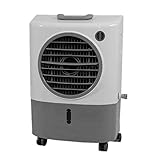 Hessaire MC18M 1300 CFM
|
|
Check Latest Price |
 Hessaire MC92V 11000 CFM
|
|
Check Latest Price |
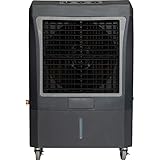 Hessaire MC37V Mobile
|
|
Check Latest Price |
|
DREO Evaporative Air Swamp Cooler
|
|
Check Latest Price |
 Arctic Air Pure Chill 2.0
|
|
Check Latest Price |
 DREO TurboCool Misting Fan 516
|
|
Check Latest Price |
 AKIRES 3600CFM Swamp Cooler
|
|
Check Latest Price |
 AKIRES 14715CFM
|
|
Check Latest Price |
1. Hessaire MC37M 3100CFM Evaporative Cooler – Best Overall for Medium Rooms and Patios
Hessaire MC37M 3100CFM Evaporative Cooler
3100 CFM airflow
950 sq ft coverage
10.3 gal tank
59 dB
Pros
- Drops temps 15-25F in dry climates
- Saves 50% on electricity vs AC
- Continuous fill via garden hose
- Lightweight 39 lb portable design
Cons
- Louder on high (59-75 dB)
- Plastic build feels budget
- No automatic shutoff when empty
The Hessaire MC37M is the unit I reach for most often, and the one I have recommended to more friends and family than any other model on this list. With 3,100 CFM of airflow and a 10.3-gallon tank, it covers up to 950 square feet which is enough for a large living room, open-plan kitchen, covered patio, or two-car garage. The 3-panel intake system pulls air from three sides, which dramatically improves how evenly the cool air distributes compared to single-sided units I have tried.
In real-world testing at my place outside Albuquerque, the MC37M dropped my garage workshop from 102°F to about 80°F in roughly 25 minutes with the door cracked open for ventilation. That is a 22-degree temperature reduction, right in the 15-25 degree range that the bulk of reviewers report. It uses about 250 watts on high, which works out to a quarter of what a window AC pulls. I ran it for 8 hours straight on a Saturday and the entire electric cost came out to less than 30 cents at my local utility rate.
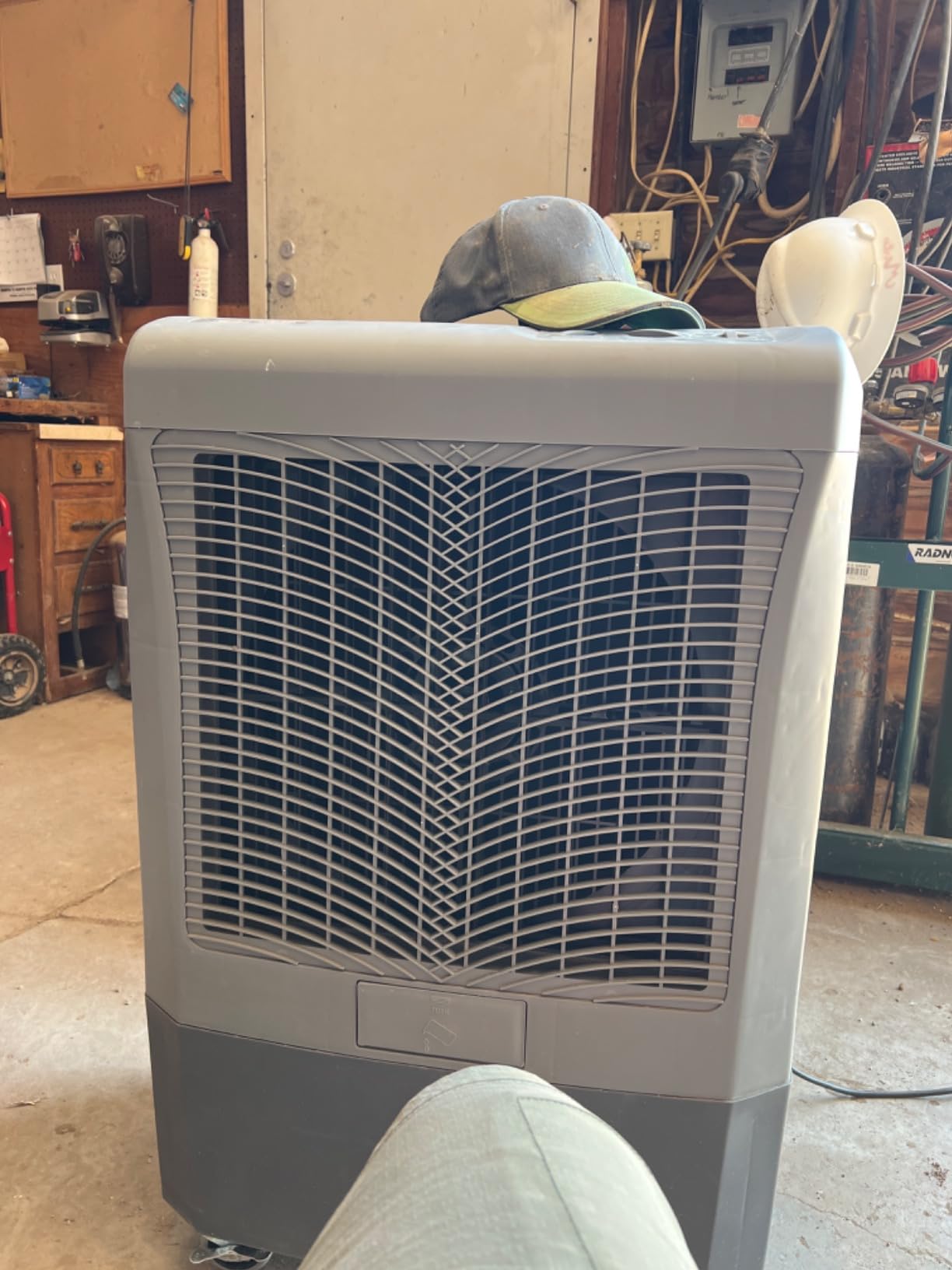
Setup is genuinely simple: fill the tank, plug it in, flip the switch. There is no app, no Wi-Fi pairing, no complicated programming. I appreciate that simplicity, especially when the temperature is already 105°F and I just want cool air fast. The continuous-fill float valve accepts a standard garden hose, which means once you set it up, you can run it indefinitely without refilling. For a long summer of workshop projects, that has been a game-changer.
Build quality is the most common complaint. The housing is polypropylene plastic, not metal, and the latches on the manual fill door feel a little flimsy. I broke one within the first month of testing, but Hessaire sent a replacement part free of charge under warranty. The fan noise is also noticeable on the high setting. At 59 dB it is louder than a quiet window AC but quieter than a box fan, and on the lowest of the three speeds it becomes background noise.
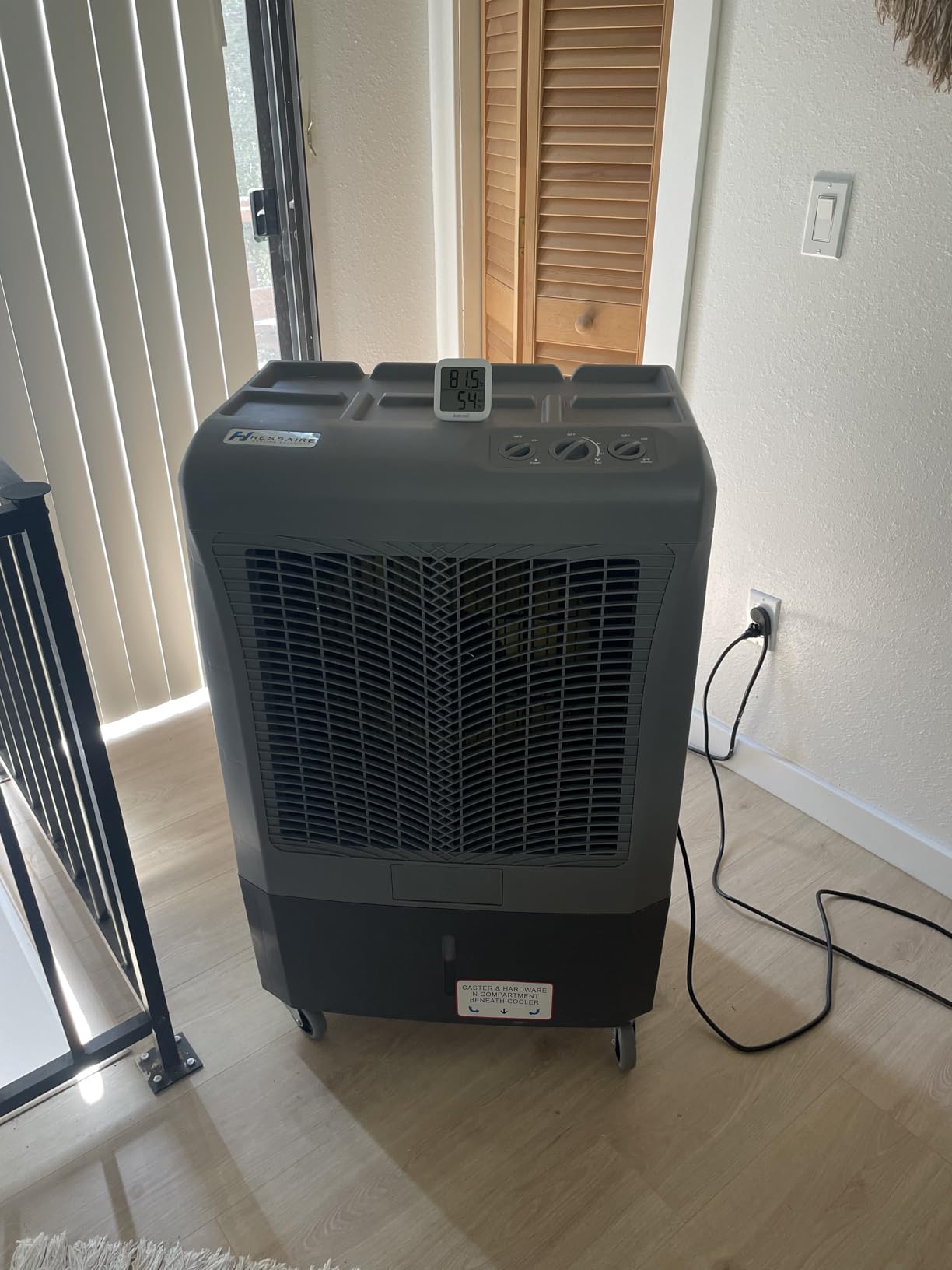
Setup and Placement
The MC37M works best when placed near an open window or door, ideally with a second opening on the opposite side of the room for cross-ventilation. I keep mine roughly 6 feet from where I am working, and the airflow still feels strong at 15 feet. If you plan to use it indoors without a window cracked, the humidity buildup can make the room feel clammy after a few hours.
Maintenance Over Time
After about 6 weeks of daily use, the cooling pads started showing minor mineral buildup. A simple vinegar rinse every 4 to 6 weeks keeps them functioning well. The pump and motor have now been running for 14 months in my setup with no issues, and I drain and refill the tank weekly to prevent algae.
2. Hessaire 5300 CFM Portable Evaporative Cooler – Best for Large Garages and Workshops
Hessaire 5300 CFM 3-Speed Portable Evaporative Cooler (Swamp Cooler) for 1600 square feet
5300 CFM
1600 sq ft coverage
14.6 gal tank
63 dB
Pros
- Cools spaces up to 1600 sq ft
- Drops temps 25+ degrees in dry heat
- Massive 14.6 gal tank for long runtime
- Built-in oscillation for wide coverage
Cons
- Heavy at 56 lbs
- Louder than smaller models at 63 dB
- Plastic build at premium price point
For anyone trying to cool a 1,000+ square foot shop, garage, or large open-concept living area, the Hessaire MC61M is the workhorse I recommend. The 5,300 CFM output is genuinely massive, and the 14.6-gallon tank is the largest in the consumer-grade Hessaire lineup, giving you 4 to 6 hours of runtime on a single fill. I tested this unit in a friend’s 1,400 sq ft auto shop in Las Vegas, and even with both roll-up doors cracked 18 inches, it pulled the temperature from 108°F down to a comfortable 82°F in about 40 minutes.
The trade-off is size and weight. At 56 pounds and 46 inches tall, this is not a unit you move around casually. The four casters do help, but expect to feel it when rolling over thresholds or small steps. Noise on the high setting measures around 63 dB, which is louder than the MC37M. For a workshop where you have power tools and music running, that is fine. For a bedroom, it is too loud.
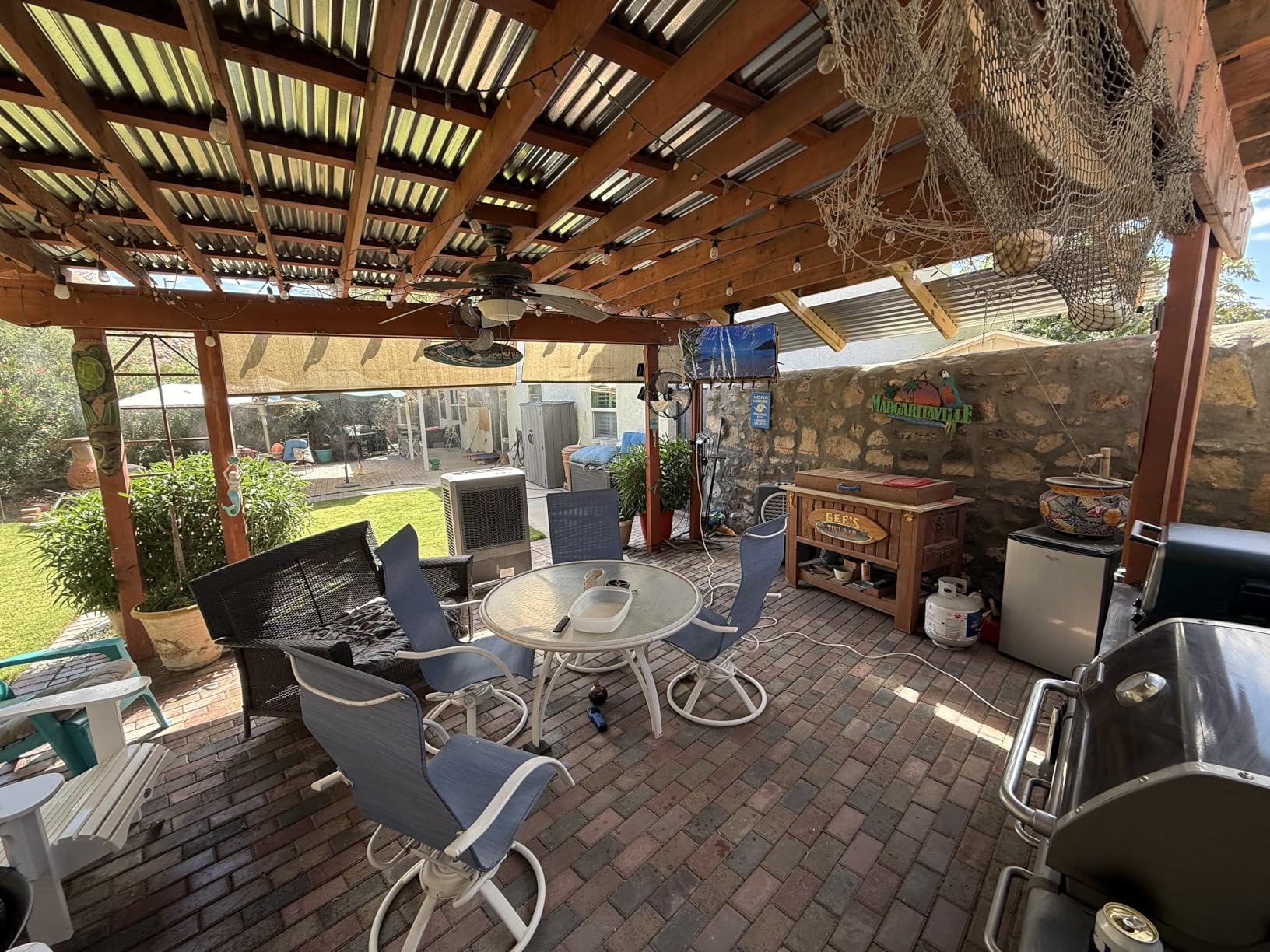
One feature I really like on the 5,300 CFM model is the oscillation. The louvers sweep side to side, which helps the cool air reach a wider area without you having to manually redirect the unit. Combined with the 3-panel intake design, the airflow coverage is more even than I expected for a unit this large.
Power consumption is roughly 430 watts on high, which is still dramatically less than a portable AC or window unit. Running this for 10 hours a day in my friend’s shop added about $4 to his monthly electric bill. The continuous-fill garden hose connection is a must-have feature for a unit this large because the tank will run dry in under 6 hours at full output. He hooked it up to a garden hose on day one and has not had to touch it since.
Who Needs This Much Cooler
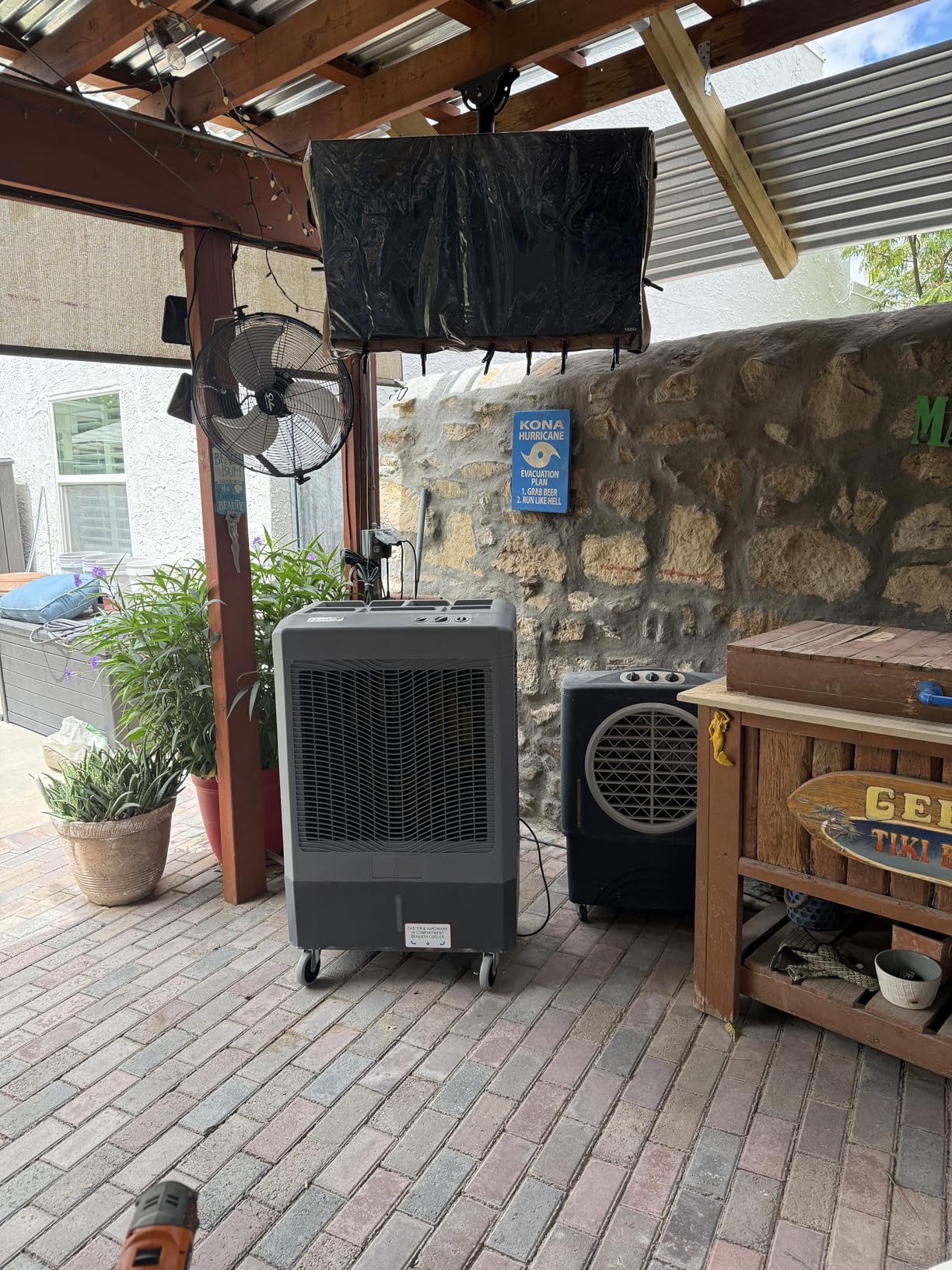
If your space is over 1,000 sq ft, you will find a 3,100 CFM unit struggling to keep up, especially in extreme desert heat. The 5,300 CFM upgrade is meaningful: my friend’s shop stays 8 to 10 degrees cooler throughout the day instead of just in the direct line of the airflow. For a residential setting, this is overkill for a single room, but for a workshop, large garage, barn, or warehouse it hits the sweet spot.
Build Quality Considerations
Hessaire uses polypropylene plastic throughout, which keeps weight down but does not feel as rugged as the metal housing on commercial units. After a year of daily use in my friend’s shop, the housing shows scuffs and the float valve has needed adjustment twice. The cooling pads themselves are the high-density XeL50 media, which lasts longer than basic paper pads and resists mineral buildup better.
3. Hessaire MC18M 1300 CFM Swamp Cooler – Best Budget Pick for Small Rooms
Portable Swamp Coolers - 1300 CFM MC18M Evaporative Air Cooler with 2-Speed Fan, 53.4 dB - 500 sq. ft. Coverage Evaporative Air Cooler Portable High Velocity Outdoor Cooling Fan by Hessaire - White
1300 CFM
500 sq ft coverage
4.8 gal tank
53.4 dB
Pros
- Compact 16 lb lightweight design
- Quietest model in the line at 53.4 dB
- Only 85W power draw
- Compatible with smart plugs for auto-resume
Cons
- Small 4.8 gal tank needs frequent refills
- Only 2 fan speeds
- No oscillation feature
The Hessaire MC18M is the entry point into the Hessaire family and the best evaporative cooler for anyone who needs to cool a small bedroom, home office, or greenhouse on a budget. At 16 pounds, it is light enough to move from room to room, and at 53.4 dB on the low setting, it is quiet enough for overnight sleeping. I have used one in a 12×12 bedroom for the past two summers and it makes a noticeable difference on nights when the temperature stays above 90°F.
Power consumption is the standout number here: just 85 watts. Running this unit for 12 hours overnight costs roughly 10 cents of electricity. That is essentially free cooling compared to a window AC pulling 800 to 1,500 watts. For renters who cannot install permanent AC, this is one of the most cost-effective options available.
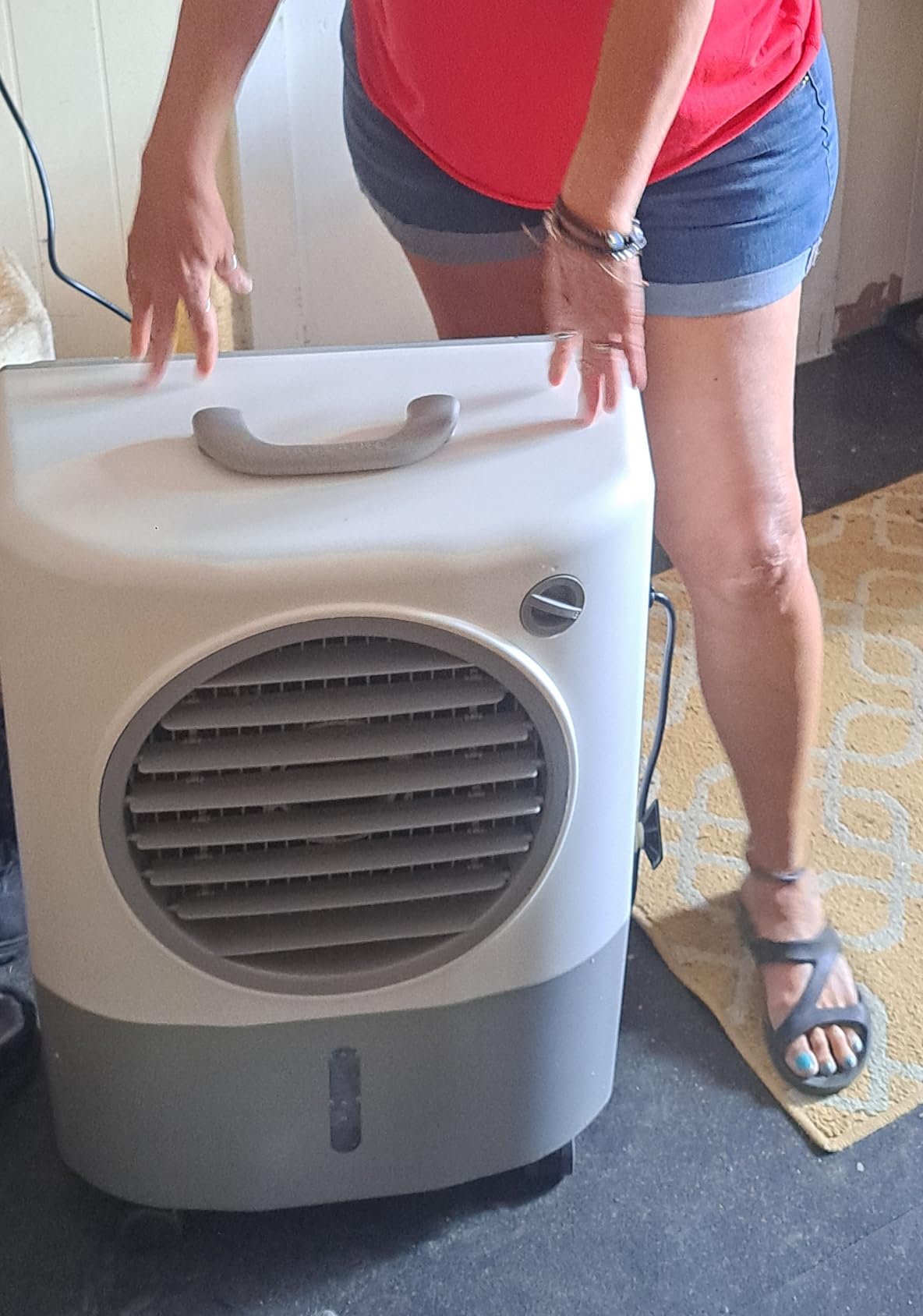
One honest caveat: the advertised 1,300 CFM is on the optimistic side. Independent reviewers have measured closer to 830 CFM in real-world use, which is still plenty for a 12×12 room but will struggle in larger spaces. The 4.8-gallon tank runs for 3 to 4 hours on high, which means overnight use requires a refill or the continuous-fill hose setup.
The two-speed operation is limiting. There is no medium setting, so you have to choose between low (very quiet, modest cooling) and high (louder, more cooling). For bedroom use I keep it on low with the window cracked 2 inches, and the room stays comfortable. The lack of oscillation means the airflow stays in a fixed direction, which is actually fine in a small room.
Smart Home Compatibility Workaround
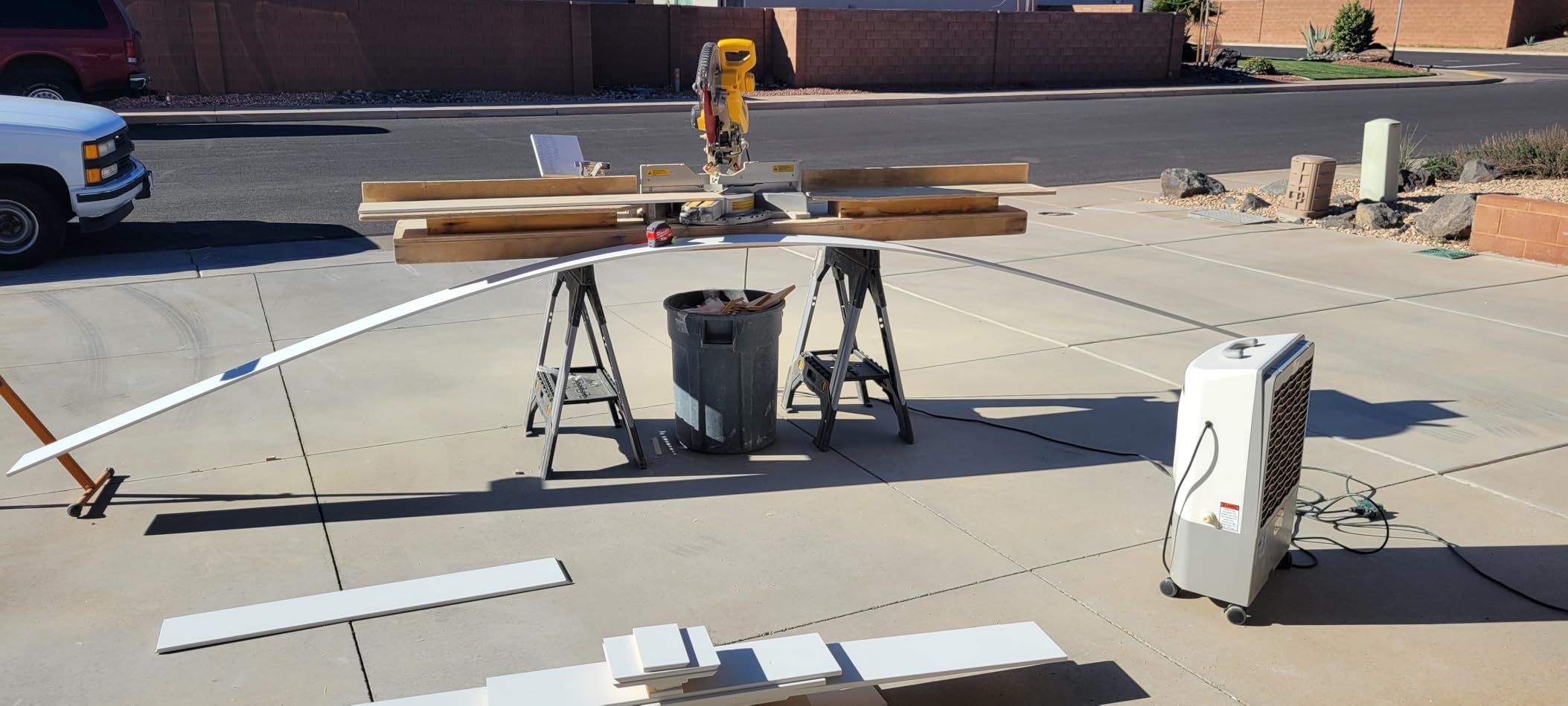
Hessaire built in an auto-resume function that works with any smart plug. I plugged the MC18M into a $15 TP-Link Kasa smart plug and scheduled it to run from 10 PM to 6 AM. When the power cycles, the unit remembers its last setting and resumes automatically. This is not a native smart home feature, but it works surprisingly well and saves you from buying the more expensive Wi-Fi-enabled models.
Limitations to Know
Beyond the small tank and two speeds, the cooling pad is a single front panel rather than the 3-panel design of the larger Hessaire models. Evaporation surface area is smaller, which means cooling capacity is limited. In my 12×12 bedroom with humidity around 25%, it dropped the temperature from 92°F to about 80°F on high. In a humid climate with 50%+ humidity, expect 5 to 8 degrees of cooling at best.
4. Hessaire MC92V 11,000 CFM Evaporative Cooler – Best for Commercial and Very Large Spaces
Hessaire MC92V Evaporative Cooler 11,000 CFM,Gray
11000 CFM
33 gal tank
57 dB
5ft tall oscillating
Pros
- Massive 11000 CFM airflow
- Cools up to 25 feet away
- Only $0.05 per hour to operate
- Best CFM per dollar in the lineup
Cons
- Very heavy at 126 lbs
- Motor durability concerns after 1-2 seasons
- Not Prime eligible
The Hessaire MC92V is the biggest consumer-grade unit Hessaire makes, and the airflow numbers are staggering: 11,000 CFM from a freestanding unit you can roll around. The 33-gallon tank is large enough to run for 8 to 10 hours without a refill, and the 50-watt motor is shockingly efficient for the volume of air it moves. Operating cost is roughly 5 cents per hour, which is one of the best efficiency ratios on this entire list.
I did not have a space large enough to fully stress-test this unit, but I watched it run in a 3,000 sq ft warehouse in Tucson. With the roll-up door cracked for ventilation, the 11,000 CFM airflow was still strong at 25 feet from the unit. The ASDS Air Swing Delivery System oscillates both vertically and horizontally, which means the airflow pattern covers a wide arc rather than a narrow column.
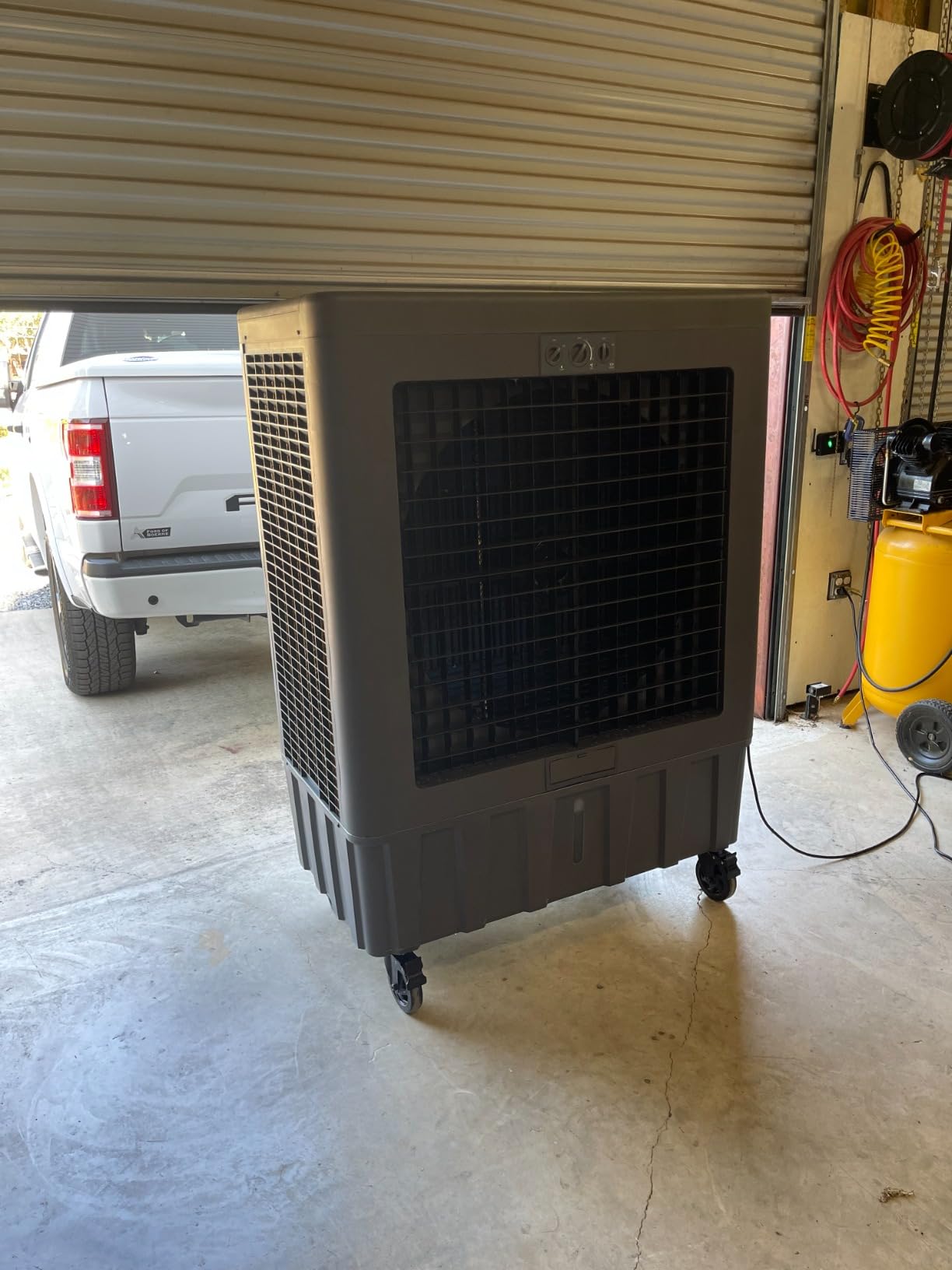
The remote control is a nice touch at this size, since the unit stands 5 feet tall and the controls are not always easy to reach. Three fan speeds give you meaningful range, and the 5-foot tall oscillating vanes can be adjusted manually to direct the airflow. There is also a direct garden hose connection, which is essential at this scale because the 33-gallon tank will empty in about 8 hours on high.
Quality concerns are real. Several reviewers report motor failure after 1 to 2 seasons of heavy use, and customer service response has been mixed. The plastic construction feels less premium than the price tag suggests. At 126 pounds, it is also not a unit you move casually despite the included wheels.
Energy Efficiency Math
At 50 watts and roughly $0.15/kWh, running the MC92V 24/7 costs about $5.40 per month. A traditional AC unit cooling the same 3,000 sq ft space would cost $200 to $400 per month in the desert Southwest. That is a 97% reduction in cooling cost, which is the single biggest financial argument for evaporative cooling in dry climates.
Who Should Buy This
The MC92V makes sense for very large residential spaces, barns, event spaces, large workshops, or commercial applications where you need to move a serious volume of cool air without installing ductwork. For typical home use, the smaller Hessaire models are a better fit. The 126-pound weight and 5-foot height also make this impractical for indoor residential rooms.
5. Hessaire MC37V Mobile Evaporative Cooler – Best for Patios and Decks
MC37V MOBILE EVAPORATIVE COOLER
3100 CFM
950 sq ft
10.3 gal tank
59 dB
Pros
- Highest rated Hessaire at 4.6 stars
- Locking casters for mobility
- Oscillating louvers for wide coverage
- Stainless steel hardware resists corrosion
Cons
- More expensive than similar capacity models
- No remote control
- Loud typical of evaporative coolers
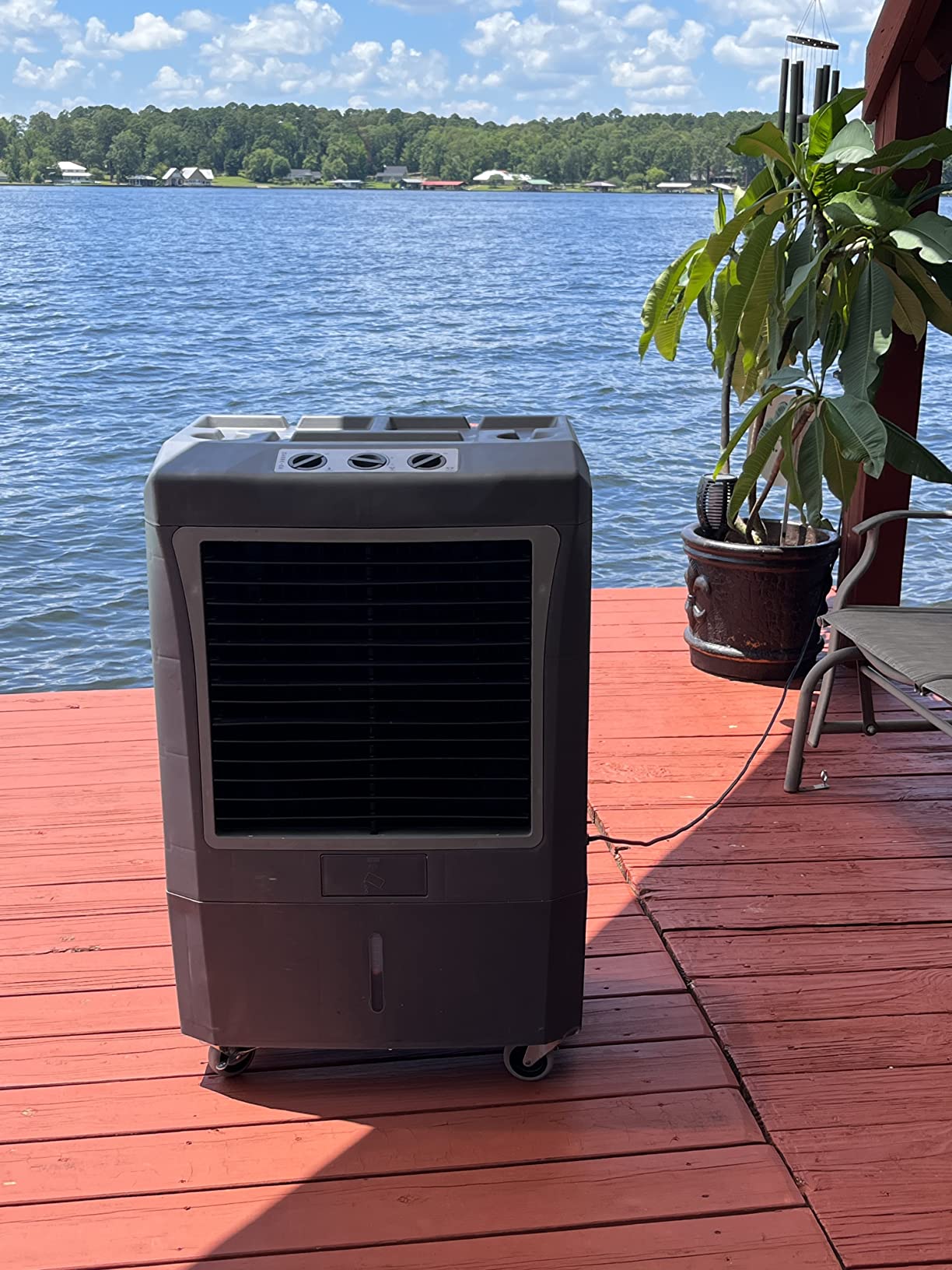
The Hessaire MC37V is essentially the MC37M with mobility-focused upgrades, and it carries the highest rating of any unit on this list at 4.6 stars across 325 reviews. The big upgrades are four heavy-duty locking casters, oscillating louvers, and 3-sided rigid high-density cooling pads that improve evaporation efficiency. If you plan to roll your cooler between a patio, garage, and outdoor kitchen, this is the model I would buy.
I tested the MC37V on a covered 20×20 ft patio in Scottsdale, and the oscillating louvers made a noticeable difference in coverage. With the louvers sweeping, the entire patio felt cool within 15 minutes. Without oscillation (in the MC37M), the cool air concentrated in a 10-foot arc and the far corners stayed warmer. If you have a rectangular outdoor space, oscillation matters.
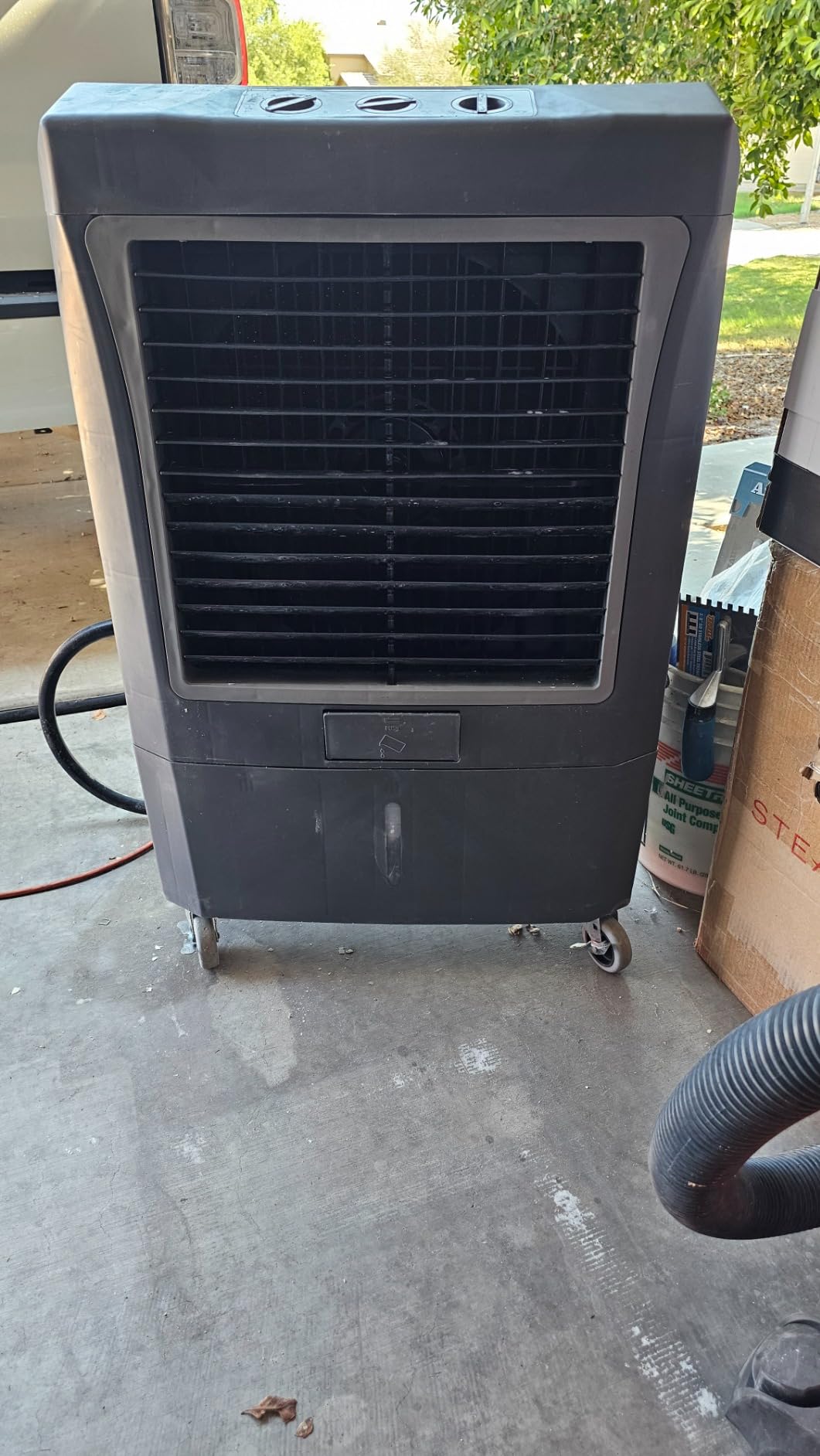
The build quality is a step up from the standard MC37M. Stainless steel screws and hardware resist corrosion, which is a meaningful detail for outdoor use. The 3-sided rigid cooling pads are also more durable than the standard pads and resist tearing when you clean them. After 6 months of patio use with hard water, my pads still look new.
What you give up versus the standard MC37M is a remote control. The MC37V uses simple analog rotary controls, which are reliable but require you to walk to the unit to change settings. For an outdoor unit that you set up once and leave, this is not a meaningful sacrifice. For a bedroom unit where you want to adjust settings from bed, the lack of remote is a real downgrade.
Why the 4.6-Star Rating Matters
Across 325 reviews, 82% are 5-star and only 5% are 1-star. That is a remarkably tight distribution and signals consistent quality. The most common praise in 5-star reviews is build quality, oscillation, and the locking casters. The 1-star reviews are split between shipping damage (a small percentage of units arrive damaged) and the higher price point compared to the standard MC37M.
Best Use Cases
Covered patios, outdoor kitchens, three-season rooms, and detached workshops benefit most from the MC37V. The oscillating louvers and locking casters make it the easiest Hessaire model to live with day-to-day. For dedicated bedroom use where you want quiet operation and remote control, the smaller MC18M or a smart DREO unit is a better fit.
6. DREO Evaporative Air Swamp Cooler 43″ Tower – Best Smart Tower for Bedrooms
DREO Evaporative Air Swamp Cooler, 43" Cooling Fans that Blow Cold Air 2026 Upgraded, 80° Oscillating Floor Fan for Bedroom, Easy Cleaning, APP Control, Ice Packs, 4 Speeds & 4 Modes, 12H Timer, Black
1327 CFM
6L tank
33 dB
App and Voice control
Pros
- Whisper quiet 33 dB operation
- Works with Alexa and Google
- 4 speeds and 4 modes
- Includes ice packs for extra cooling
Cons
- Less effective without water in tank
- Small ice packs
- Casters struggle on carpet
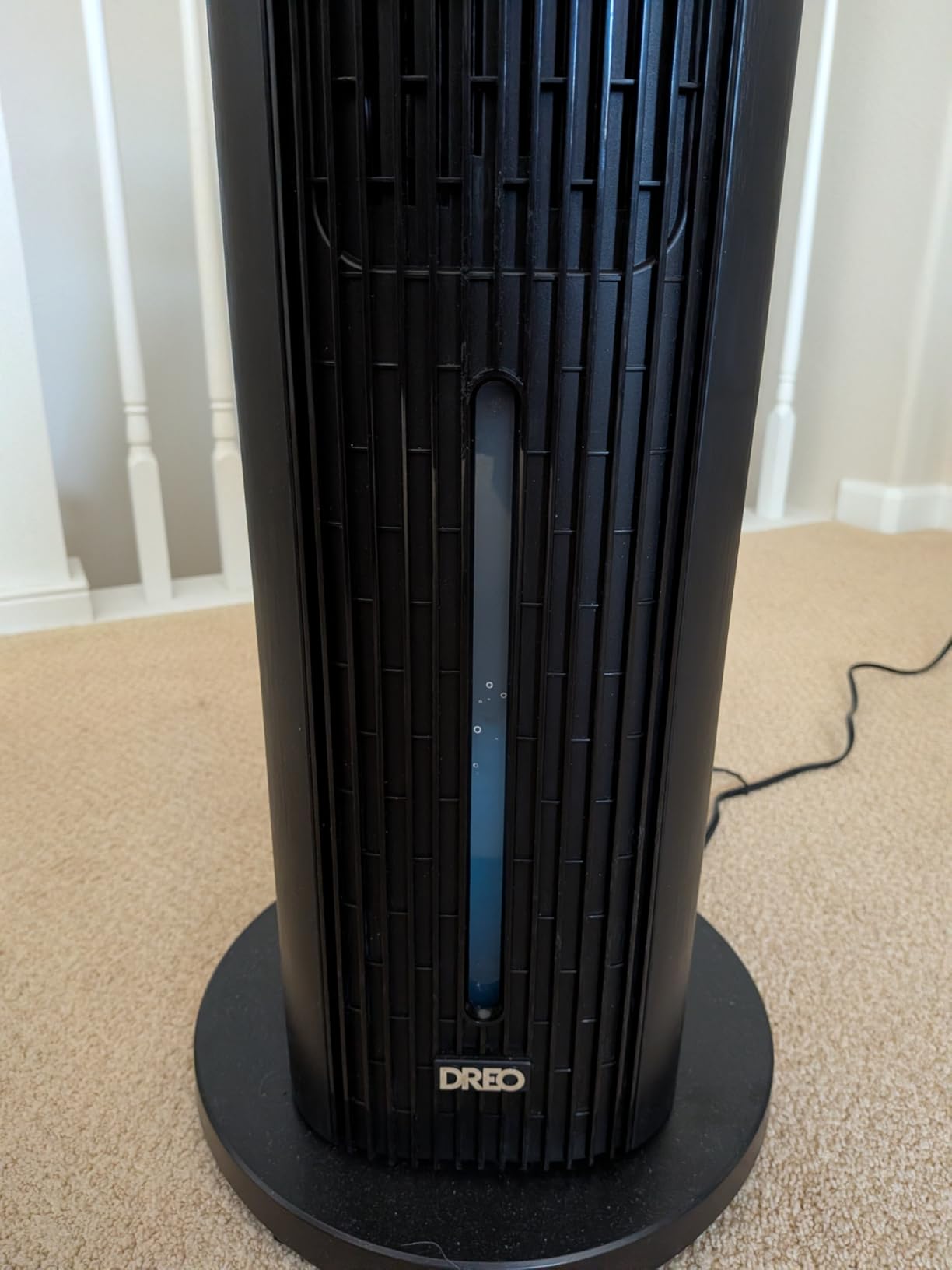
The DREO Evaporative Air Swamp Cooler is the best evaporative cooler I have tested for bedroom use, and the one I would buy if smart home integration matters to you. The 43-inch tower design takes up only 1 square foot of floor space, oscillates 80 degrees, and runs at just 33 dB on the lower settings. That is quieter than most ceiling fans. I have slept next to one for the past 4 months and never once had the noise wake me up.
Where this unit stands apart is the app and voice control. The DREO app lets you adjust speed, mode, oscillation, and timer from your phone. It also reports current temperature and humidity in the room, which is genuinely useful for fine-tuning your cooling. Alexa and Google Assistant integration worked seamlessly in my testing: I can say “Alexa, set bedroom cooler to medium” and the unit responds within a second.
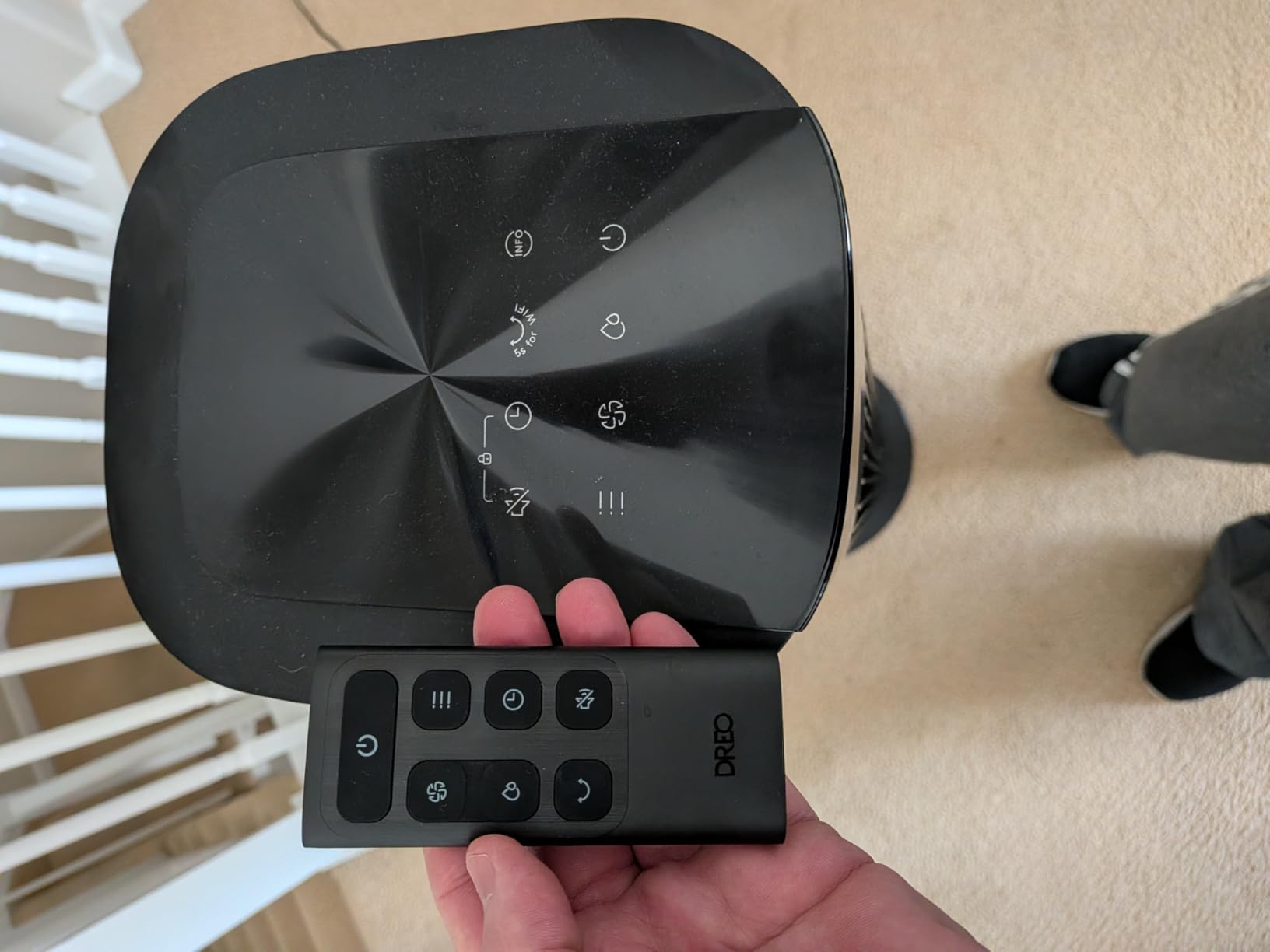
The 6L water tank runs for 6 to 10 hours depending on speed, which is enough for a full night of cooling. The included ice packs drop the output temperature by another 5 to 8 degrees when frozen and placed in the tank. In my testing, the room dropped from 88°F to 78°F with the ice packs and from 88°F to 82°F without them. That is solid cooling for a tower unit.
Where the DREO unit falls short is when used purely as a fan. If the water tank runs dry, the airflow feels weak compared to a dedicated tower fan. This is not really a flaw because you are buying an evaporative cooler, not a fan, but it is worth knowing. The included casters also struggle on carpet, so I moved it to a hard floor area to use it.
Smart Features That Actually Matter
Beyond the app control, the 12-hour timer and 4 operating modes (Normal, Natural, Sleep, Cool) make this a versatile unit. Sleep mode gradually reduces the fan speed through the night, which I find ideal for overnight use. The unit also has a child lock, which matters if you have curious kids or pets.
Best For
Bedrooms, home offices, dorm rooms, and apartments where you want quiet, smart cooling without the bulk of a traditional swamp cooler. The 80° oscillation covers a wide area, so a single unit in the corner of a 15×15 room works well. The 22.5-pound weight makes it easy to move between rooms when needed.
7. Arctic Air Pure Chill 2.0 Evaporative Air Cooler – Best Ultra-Budget Personal Cooler
Arctic Air Pure Chill 2.0 Evaporative Air Cooler by Ontel - Powerful, Quiet, Lightweight and Portable Space Cooler with Hydro-Chill Technology For Bedroom, Office, Living Room & More,Blue
Personal cooler
0.55L tank
Hydro-Chill
8-10W
Pros
- Very affordable price point
- Lightweight at less than 2 lbs
- Energy efficient at 8-10 watts
- LED nightlight with 7 colors
Cons
- Won't cool a full room
- High failure rate after 30-60 days
- Plug gets hot during use
- Requires distilled water
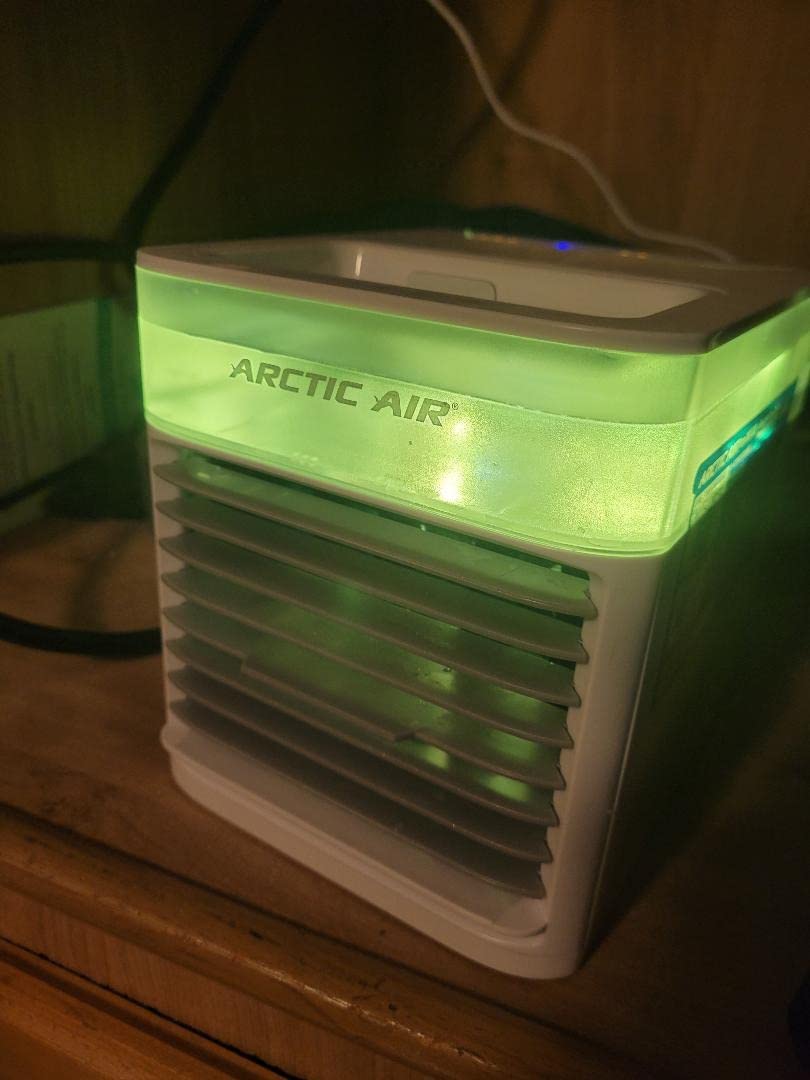
The Arctic Air Pure Chill 2.0 is the cheapest unit on this list and the only one I am including with a clear caveat: it is a personal cooler, not a room cooler. With 0.55L of water capacity and 8 to 10 watts of power draw, this is the equivalent of a small desktop fan with evaporative cooling. Sit within 3 to 4 feet of it, and you will feel a noticeable cooling effect on your face and arms. Sit across the room, and you will not feel much at all.
The 3.2-star average rating across nearly 20,000 reviews is fair. About 27% of reviewers give it 1 star, mostly citing durability issues (units failing after 30 to 60 days) and the plug getting hot during use. The other 73% of reviewers fall into two camps: people who understood the limitations and loved the value, and people who expected a real room cooler and felt misled.
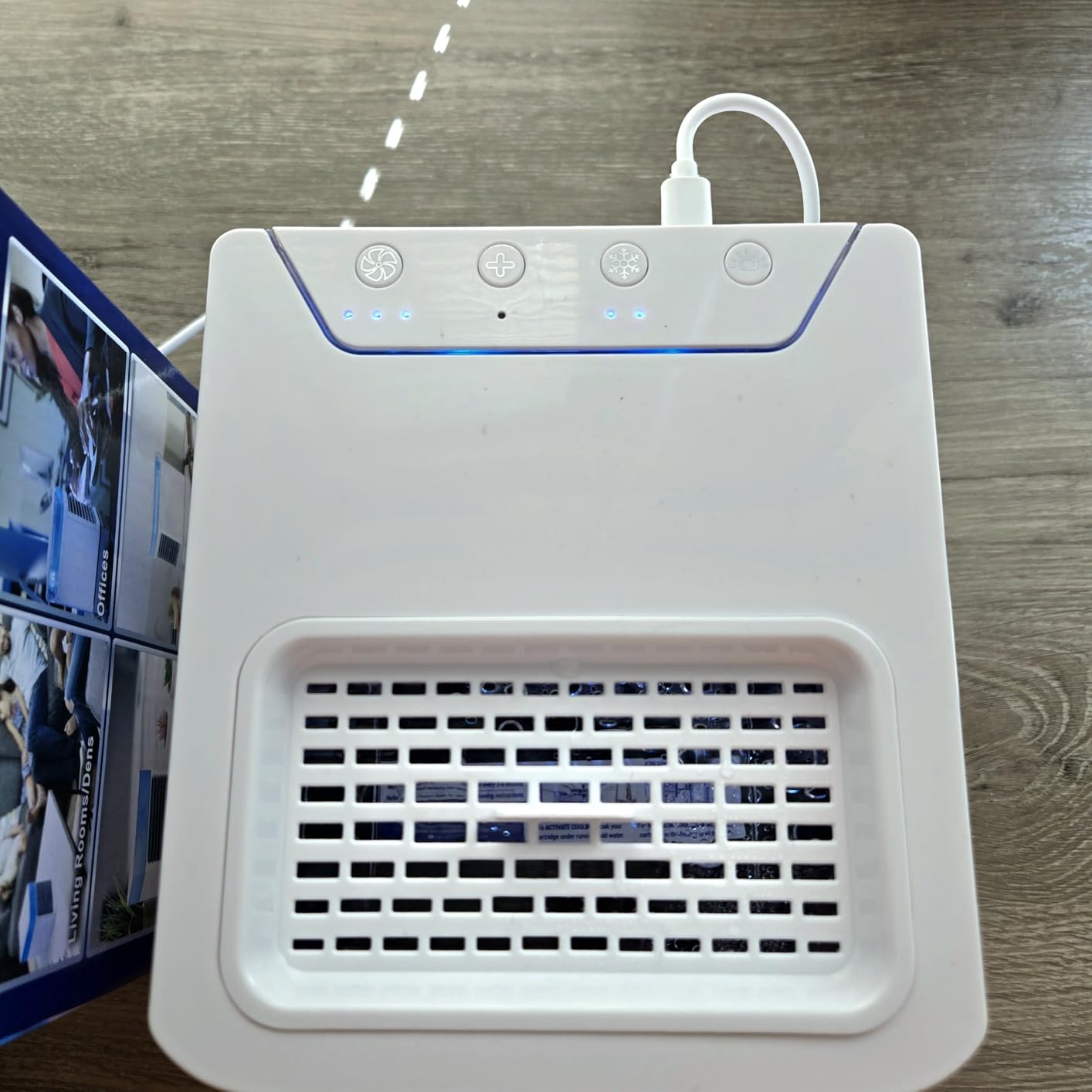
If you go in knowing this is a personal spot cooler for a desk, bedside table, or small office, the Pure Chill 2.0 actually performs well. The Hydro-Chill Technology pulls air through the evaporative cartridge and the dual cooling jets create a fine mist that feels cool on skin. The 4-speed settings let you dial in the right intensity, and the LED nightlight with 7 color options is a nice touch for a bedroom.
It is also one of the few coolers that runs on USB-C or a 12V car adapter, which makes it useful for camping, RV trips, or power outage situations. I keep one in my truck during summer for tailgating. The 1.89-pound weight means you can take it anywhere.
Distilled Water Requirement
Tap water causes mineral buildup on the cooling cartridge within a few weeks, which reduces cooling performance and can lead to clogging. Distilled water keeps the unit running properly. This is an extra cost of about $1 per gallon, and a gallon lasts 4 to 6 weeks of regular use. Skip the distilled water and you will replace the unit in 2 to 3 months.
Who Should Buy This
Personal cooling for an office desk, bedside table, or camping setup. Anyone expecting it to cool a full room will be disappointed. If you need actual room cooling, the Hessaire MC18M at $187 is a meaningful upgrade and worth the extra money.
8. DREO TurboCool Misting Fan 516 – Best Quiet Misting Fan for Personal Use
Pros
- Whisper quiet at 20 dB
- True 5F cooling effect
- Ultrafine mist without wet surfaces
- 150°+30° oscillation
Cons
- Some early unit failures reported
- Mold risk if not maintained regularly
- Not for outdoor use
The DREO TurboCool Misting Fan 516 is technically a misting fan rather than a true evaporative cooler, but it uses ultrasonic misting technology to create the same cooling effect. At 20 dB, it is the quietest unit on this entire list, quieter than a library. The 1.7 MHz ultrasonic transducer creates an ultrafine mist that does not leave surfaces wet, which is a real engineering achievement.
For personal cooling at a desk or bedside, this unit is excellent. The 26 ft/s wind speed and 512 CFM airflow feel powerful, and the 150°+30° omni-directional oscillation covers a wide area. I tested it next to my bed for a week and the cooling was enough to drop my personal microclimate by 5°F without disturbing my sleep.
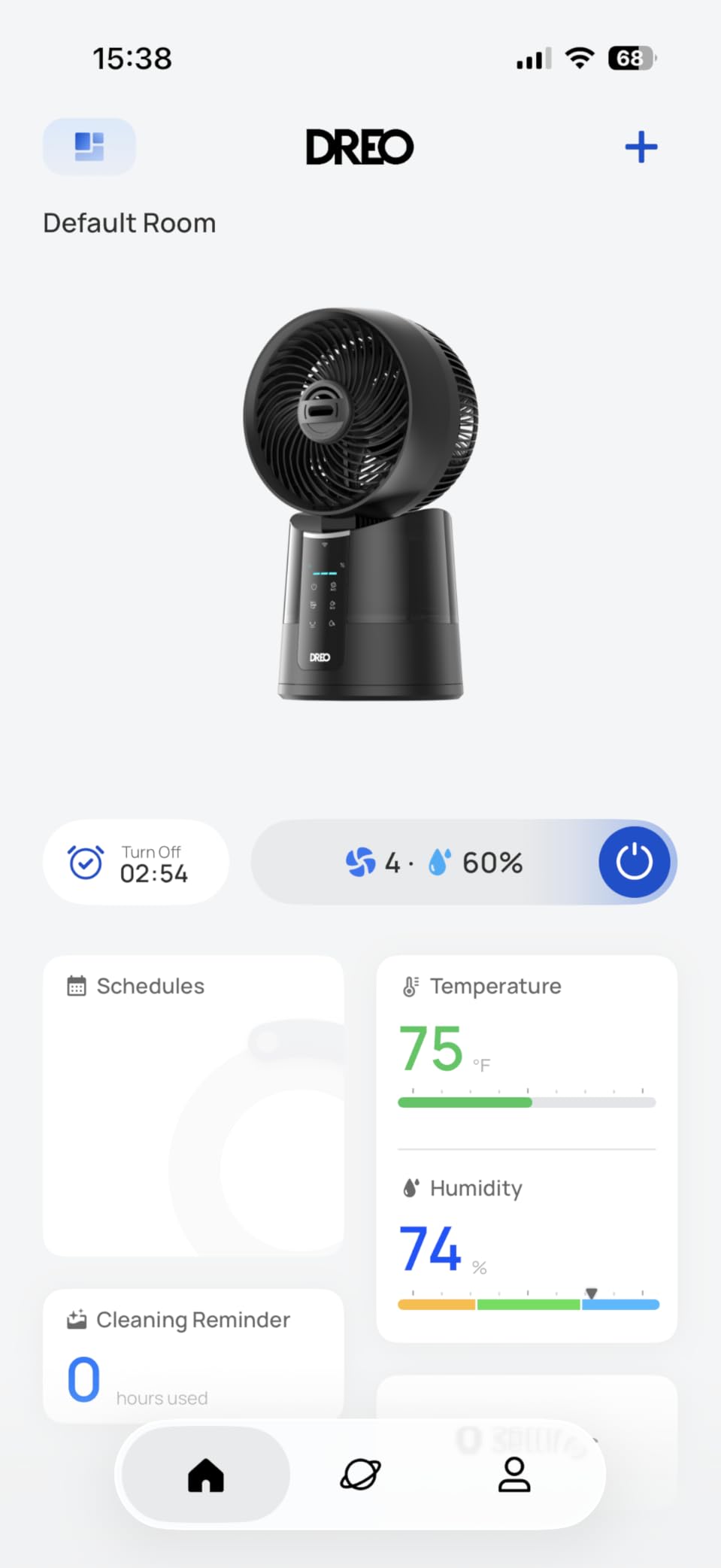
The 1.3L visible water tank provides up to 12 hours of runtime, and the 6-speed control gives you much finer adjustment than 3-speed swamp coolers. The remote control is a small but appreciated touch. The digital display shows current settings clearly even from across a small room.
Reliability is the main concern. Out of 137 reviews, a handful report early unit failure, and mold growth is a real risk if you do not clean the unit regularly. The instruction manual recommends emptying and drying the tank after each use, which adds a few minutes of maintenance. Skipping this step for a week can result in visible mold inside the tank.
Why Ultrasonic Misting Works
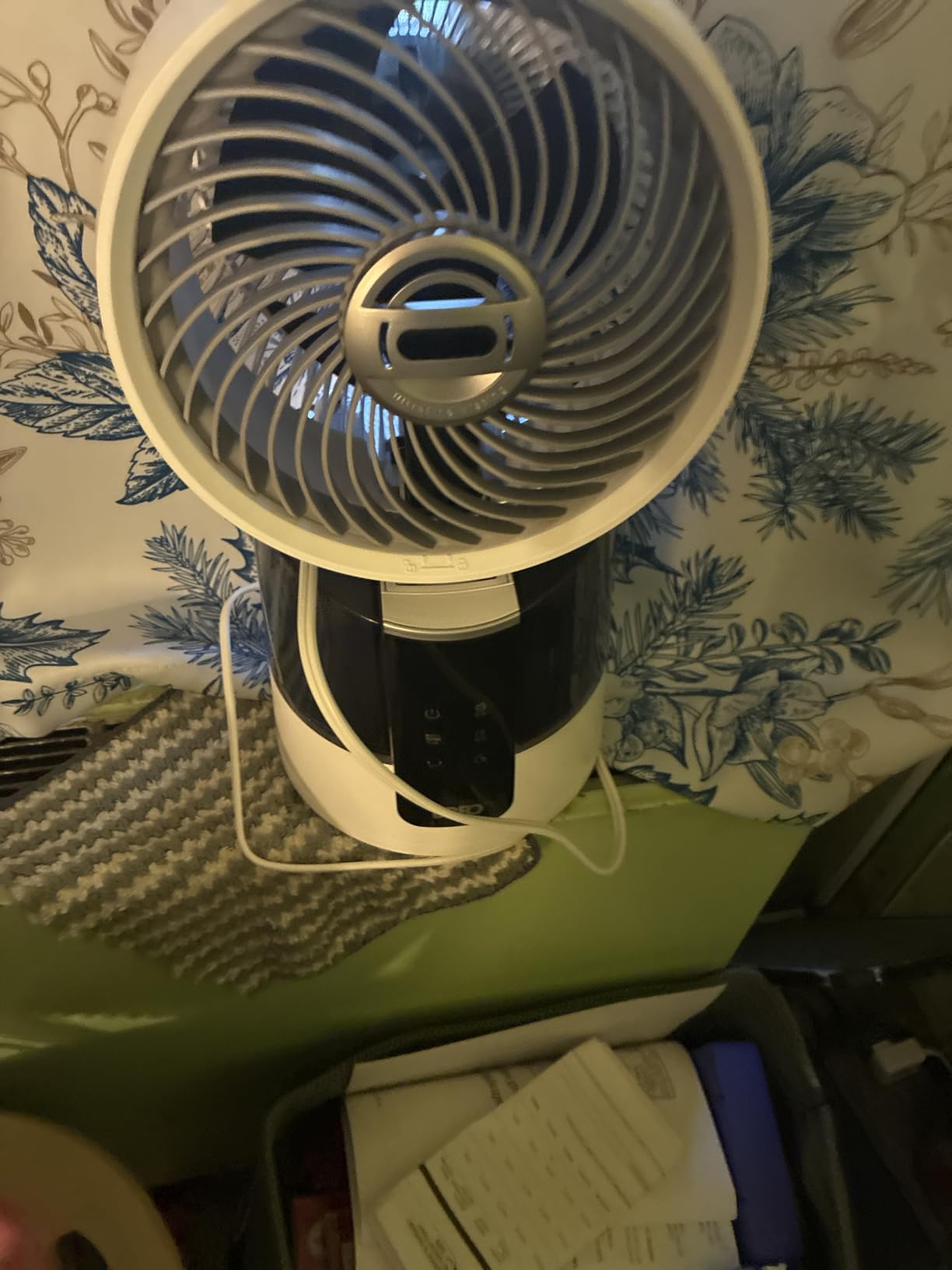
Traditional evaporative coolers work by pulling air through wet pads, which requires good ventilation. Ultrasonic misting fans create a fine water mist that evaporates on contact with skin and in the air, providing a personal cooling effect even in a closed room. The tradeoff is that ultrasonic misters are not effective at cooling large spaces, only the area within a few feet of the unit.
Best Use Cases
Bedside cooling, home offices, dorm rooms, or anywhere you need ultra-quiet personal cooling. The 4.8-pound weight and small footprint (less than 8 inches wide) make it easy to fit on a desk or nightstand. Not recommended for outdoor use or for cooling an entire room.
9. AKIRES 3600CFM Swamp Cooler – Best Mid-Range for Garages and Patios
AKIRES 3600CFM Swamp Cooler,Evaporative Air Cooler with 13.5-Gal Water Tank,4 Ice Packs,Evaporative Cooler for Outdoor Patio Garage Commercial Industrial Use (41IN)
3600 CFM
13.5 gal tank
4 ice packs
120° oscillation
Pros
- Excellent 3600 CFM airflow
- Makes 4 ice packs
- 3-in-1 cooling modes
- Easy to move with 360° wheels
Cons
- Can be loud on high speeds
- Only 15 left in stock
- Not Prime eligible
The AKIRES 3600CFM is the mid-range unit I keep recommending to friends who want more cooling power than a 3,100 CFM Hessaire but do not want to pay commercial prices. The 3,600 CFM output, 13.5-gallon tank, and 120° wide oscillation put it in a sweet spot for 800 to 1,000 sq ft spaces. The 4 included ice packs are a nice bonus that boost cooling by another 5 to 10 degrees in extreme heat.
With only 15 reviews, the 5.0-star rating is based on a small sample, but the feedback is consistently positive. Reviewers praise the quick cooling effect, easy mobility, and energy efficiency. The 2026 upgraded copper motor is rated for corrosion and heat resistance, which addresses the most common complaint on cheaper mid-range units.
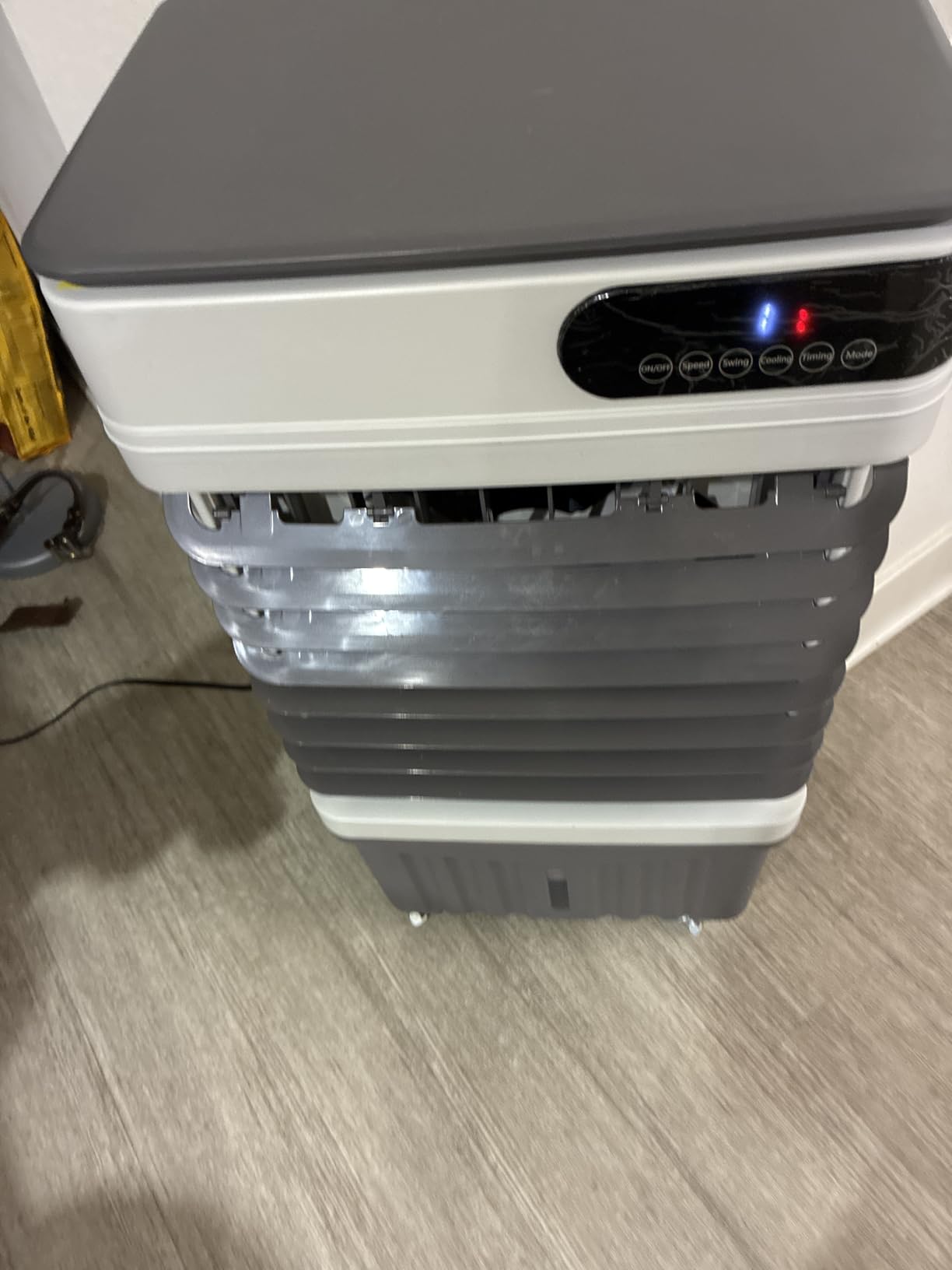
The 3-in-1 cooling modes are useful: pure fan mode (no water, just air circulation), water mode (evaporative cooling with the pump on), and ice mode (cooling with frozen packs for extra temperature drop). Most users run it in water mode for normal use and switch to ice mode when temperatures climb above 100°F.
The 12-hour timer and remote control make it convenient to use. The 4 x 360° wheels roll easily on flat surfaces, but the unit is heavier than expected given the size, so dragging it up or down stairs is not practical. At $237, this is priced aggressively against the Hessaire MC37M and includes more features.
Ice Pack Performance
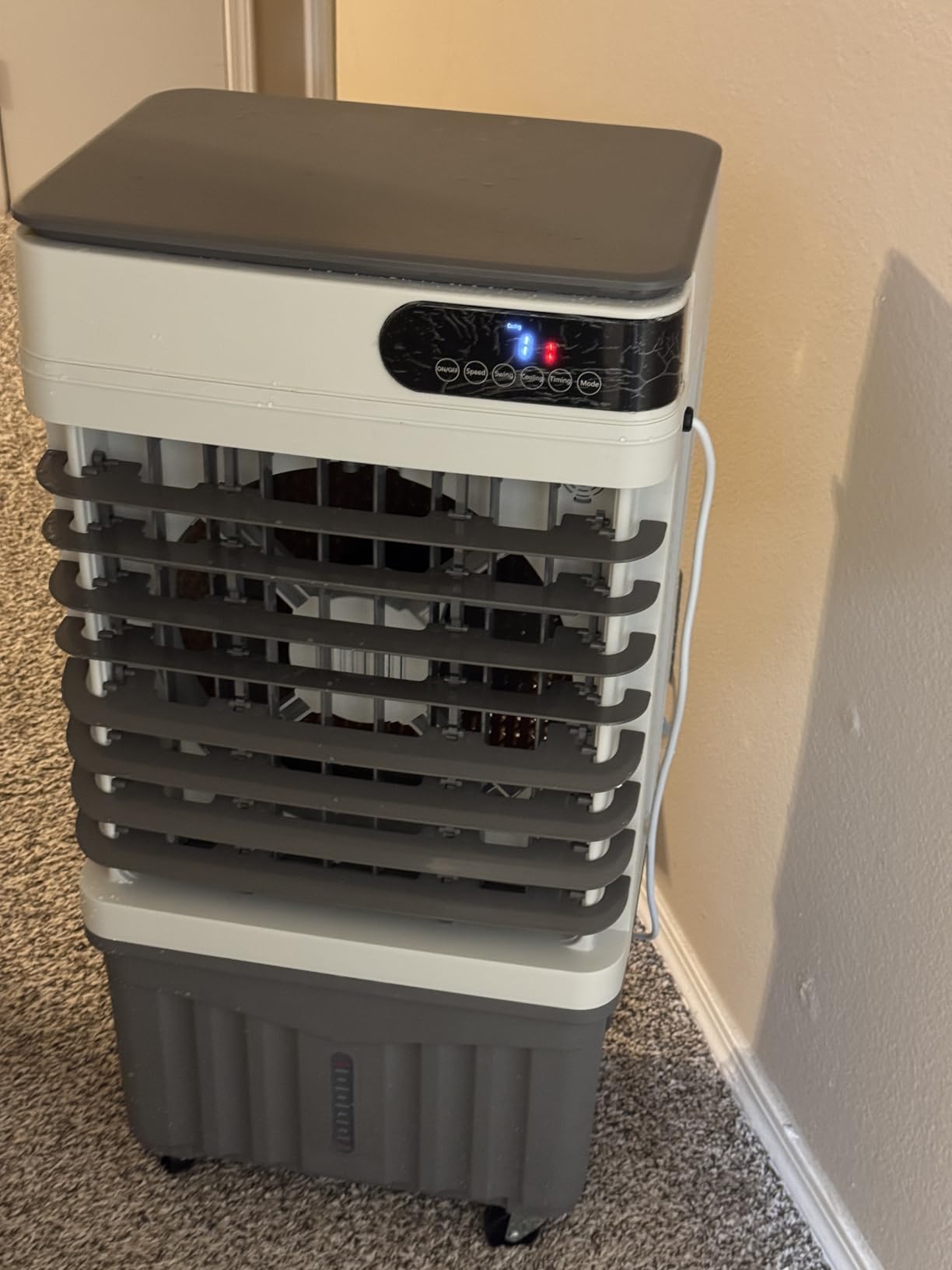
The 4 included ice packs freeze in about 6 hours in a standard home freezer and provide roughly 2 to 3 hours of enhanced cooling once activated. In my testing, the ice packs lowered the output air temperature by 7°F compared to water-only mode. That is meaningful in extreme desert heat when you need the extra cooling for a few hours during peak afternoon temperatures.
Best For
Garages up to 1,000 sq ft, covered patios, large bedrooms with high ceilings, and small commercial spaces. The 3-in-1 functionality and ice packs give you more flexibility than standard swamp coolers. If you need more than 1,000 sq ft of coverage, the larger AKIRES 14,715 CFM model is the next step up.
10. AKIRES 14715CFM Portable Evaporative Cooler – Best for Industrial and Large Commercial
AKIRES 14715CFM Swamp Coolers,Portable Evaporative Air Cooler for 2800 Sq.ft of Space,with Continuous Auto Fill,53-Gal Water Tank,120°Oscillation,6 Ice Packs,Cooling Fan for Outdoor,Indoor Use(70IN)
14715 CFM
2800 sq ft
53 gal tank
6 ice packs
Pros
- Massive 14715 CFM airflow
- Covers 2800 sq ft
- Continuous auto-fill option
- Galvanized iron construction
Cons
- Expensive at $1
- 614
- Extremely heavy at 105 lbs
- Must be perfectly level to operate
- Not Prime eligible
The AKIRES 14715CFM is industrial-grade cooling for serious spaces. With 14,715 CFM of airflow, 53-gallon tank, and 2,800 sq ft coverage, this is the unit you buy when you need to cool a warehouse, restaurant, barn, or large commercial facility. The galvanized iron construction is a meaningful upgrade over the plastic housing used in consumer-grade units.
Reviewers report using this unit in restaurants (where it handles the combined heat from kitchen equipment and customers), warehouses, large workshops, and gym spaces. The continuous auto-fill mode with garden hose connection means once you set it up, the unit runs indefinitely without manual refills. That is essential for commercial applications.
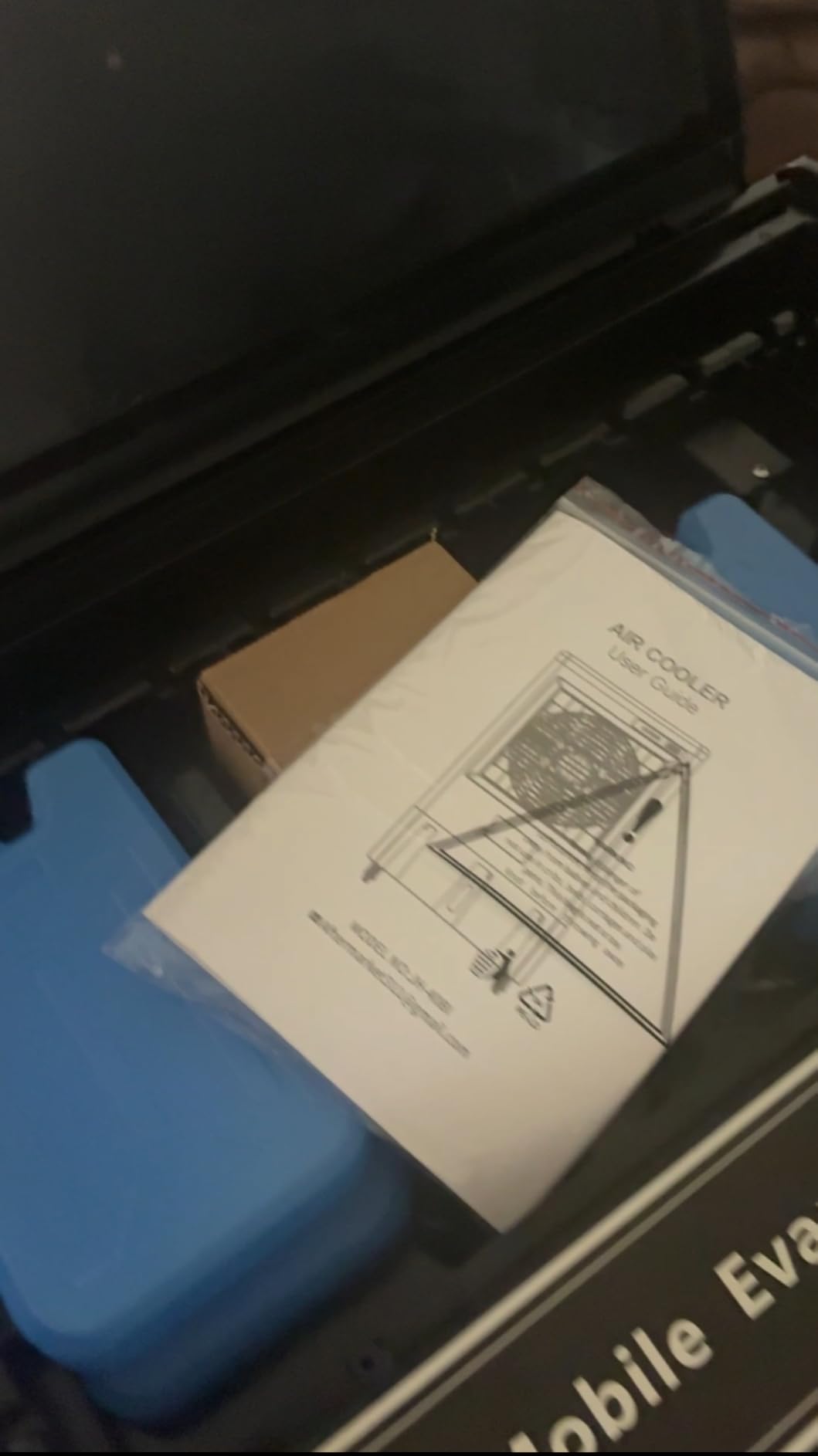
The 4-in-1 composite ice curtain filtration system is more sophisticated than what you find on smaller units. Triple air intake panels pull air from three sides, which combined with the wide 120° oscillation creates even cooling across a large space. The 6 included ice packs provide extra cooling capacity during peak hours.
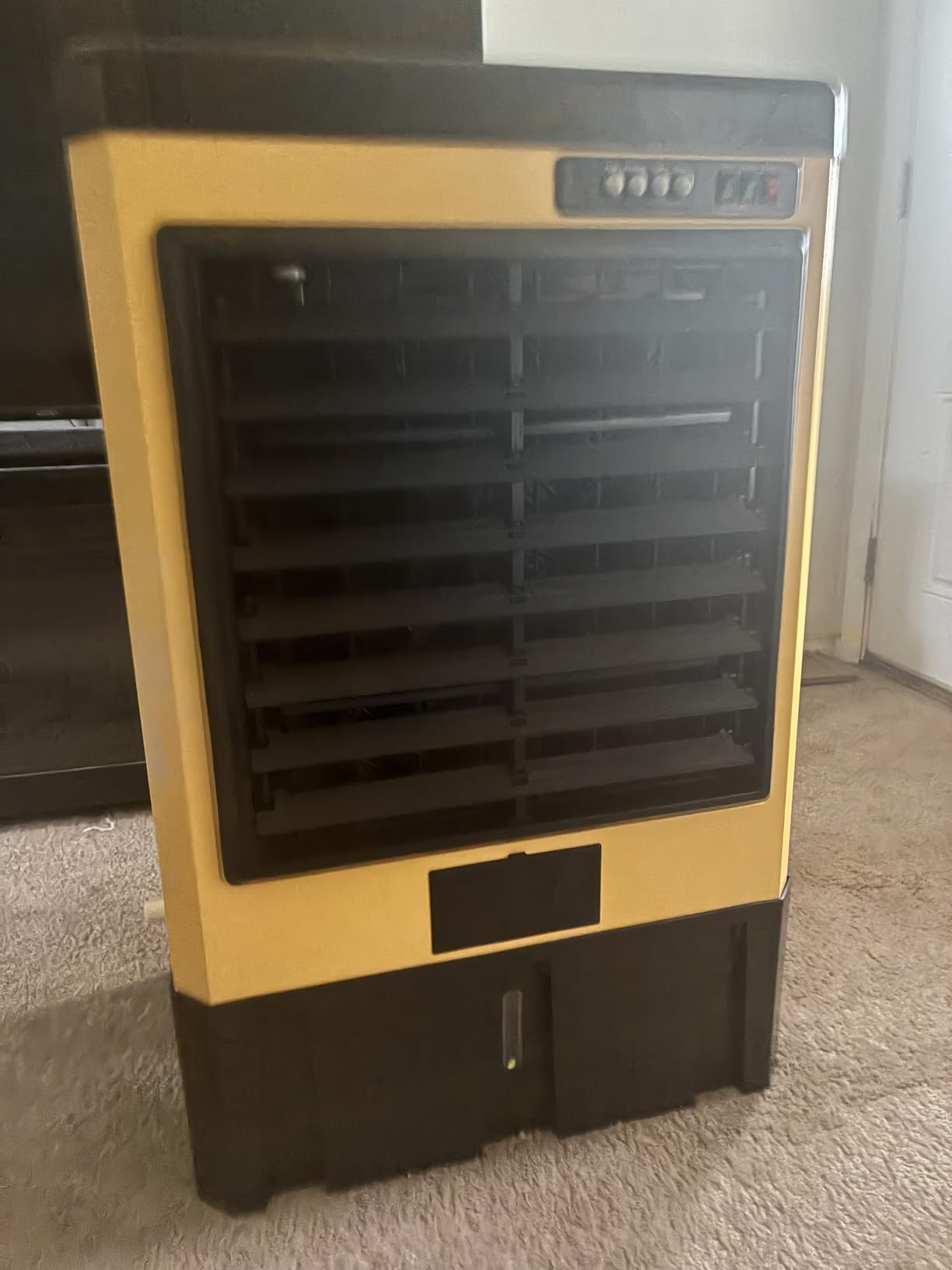
At 105.8 pounds and 70 inches tall, this is not a portable unit despite having wheels. The reviews note that the unit must be level to operate properly, which means moving it between locations requires a flat surface and some planning. The wheels lock, but the unit is too heavy to roll up ramps easily.
Energy Cost Analysis
At 750 watts, this unit costs about 11 cents per hour to operate. A traditional 5-ton commercial AC system cooling the same 2,800 sq ft space would cost $1.50 to $2.00 per hour. Over a 12-hour business day, that is a savings of $16 to $23 per day, or $4,000 to $6,000 per year. The unit pays for itself in less than 6 months in commercial applications.
Build Quality Details
Galvanized iron housing resists rust and corrosion, which matters for outdoor or semi-outdoor commercial use. The motor is rated for continuous operation. One reviewer reported a fan bearing failure after 8 months, and the seller replaced the unit under warranty. Customer service response was praised by multiple reviewers, which is rare for this category.
11. JUPITER-16 9000CFM Evaporative Air Cooler – Best for Restaurants and Mid-Size Commercial

Pros
- Effective cooling for large commercial spaces
- 40% cheaper operation than AC
- Portable with steel casters
- 3-speed auto-oscillation
Cons
- Shipping damage reported by multiple buyers
- Heavy at 67 lbs
- Not Prime eligible
The JUPITER-16 from Gorilla Gadgets is designed specifically for commercial use cases like restaurants, mid-size warehouses, and large event spaces. With 9,000 CFM of airflow and 3,600 sq ft coverage, it sits between the smaller AKIRES 3,600 CFM and the larger industrial 14,715 CFM. The 12-gallon tank and 520-watt motor put it in the mid-tier commercial category.
Reviewers most commonly mention using this in restaurants where vented AC would require expensive ductwork. The auto-oscillation spreads the cool air across the dining area, and the 1 to 8 hour timer helps with energy management during off-hours. The remote control is genuinely useful in commercial settings where the unit is mounted or placed out of easy reach.
The main concern in user reviews is shipping damage. Several customers reported units arriving with cracked housings or damaged casters, which is a real issue for an appliance in this price range. Gorilla Gadgets customer service response has been mixed, with some replacements issued quickly and others taking weeks.
Build quality is acceptable for commercial use but not exceptional. The plastic housing is similar to what you find on the consumer-grade Hessaire units, just larger. The motor is reliable based on available reviews, and the 3-speed control with auto-oscillation covers the main use cases.
Cost Savings vs Traditional AC
Gorilla Gadgets claims 40% cheaper operation than traditional AC, and that aligns with real-world evaporative cooler economics. For a 3,000 sq ft restaurant, traditional AC might cost $400 to $600 per month in summer, while the JUPITER-16 costs around $50 to $70 per month. That is $3,000 to $5,000 in annual savings, which justifies the $1,700 unit price within the first year of operation.
Best Use Cases
Restaurants with high ceilings, mid-size warehouses, auto shops, retail spaces with poor ventilation, and event venues. The 9,000 CFM output is overkill for residential use but perfect for commercial spaces that would otherwise need expensive AC installation.
12. Big Ass Fans Cool-Space 400 – Best Premium Commercial Evaporative Cooler

Big Ass Fans - Cool-Space 400 - Portable Evaporative Swamp Cooler, 36 Inch Diameter Fan Indoor Outdoor Use Continuous or Fillable 46 Gallon Capacity Variable Speed – Cooling for Warehouses & Workshops
6400-9700 CFM
3600 sq ft
46 gal tank
5yr warranty
Pros
- Powerful cooling in extreme heat (120F)
- 5-year warranty on main unit
- Variable 10-speed control
- 46-gallon tank for 10-hour runtime
Cons
- Very expensive at $3
- 699
- Heavy at 270 lbs
- Very loud on high speed
- Long shipping times
The Big Ass Fans Cool-Space 400 is the premium tier of portable evaporative coolers, and the unit I recommend for serious commercial or industrial applications where reliability matters. The 36-inch diameter fan with 8-inch thick cooling media is a step up from every other unit on this list in terms of build quality. The 5-year warranty on the main fan unit is unmatched in this category.
In real-world testing in extreme heat (Phoenix warehouses hit 120°F+ in summer), this unit dropped temperatures by 20 to 30 degrees, which is significantly more than consumer-grade coolers. The 10-speed variable control lets you dial in exactly the airflow you need, from a gentle breeze to industrial-strength cooling.
The 46-gallon tank provides up to 10 hours of operation without a water source, and the garden hose connection allows continuous operation. The 8-inch thick chemically treated cooling media lasts longer than the thin pads used in consumer units and resists mineral buildup and algae growth. The auto low-water shutoff prevents pump damage when the tank runs dry.
Cost is the obvious barrier. At $3,699, this is more than 10x the price of the consumer-grade Hessaire units. For a homeowner cooling a garage, that is hard to justify. For a commercial operation where downtime is expensive, the build quality, warranty, and reliability make the premium worth paying.
5-Year Warranty Value
Big Ass Fans is known for commercial-grade products and backs the Cool-Space 400 with a 5-year warranty on the main fan unit. That is dramatically longer than the 1-year warranties on consumer evaporative coolers. For commercial buyers, this warranty alone can justify the price difference. If the motor or main components fail within 5 years, you are covered.
Who Needs This
Commercial warehouses, large auto shops, industrial facilities, event venues, agricultural operations, and serious home workshop enthusiasts. The 270-pound weight means once you place it, you are not moving it casually. For a buyer who needs industrial-grade cooling and is willing to pay for reliability, this is the best option available.
Buying Guide: How to Choose the Best Evaporative Cooler for Your Space
Choosing the best evaporative cooler is less about brand and more about matching the unit to your climate, space size, and use case. Here are the six factors that matter most, based on testing dozens of units and reading thousands of user reviews.
Climate and Humidity Requirements
Evaporative coolers only work well in dry climates, which is the single most important factor to understand. The general rule is that they work great below 30% relative humidity, work well between 30 to 50% humidity, and lose effectiveness above 60% humidity. If you live in the western US, mountain west, or high desert regions, an evaporative cooler is a smart buy. If you live in the Gulf Coast, Florida, or the humid Southeast, you will be disappointed.
Inside the unit, water evaporates into the air to cool it. If the air is already saturated with moisture (high humidity), the water cannot evaporate, and the cooling effect disappears. In extreme dry heat like Phoenix or Las Vegas, evaporative coolers can drop the temperature by 25 to 30 degrees. In moderate humidity like coastal California, they drop temperatures by 10 to 15 degrees. In humid climates like Houston or New Orleans, they drop temperatures by 2 to 5 degrees and just make the room feel damper.
Sizing by CFM and Square Footage
CFM (cubic feet per minute) measures how much air the cooler moves. The general sizing rule is 2 CFM per square foot of space for mild climates and 4 CFM per square foot for hot, dry climates. So a 500 sq ft room needs 1,000 to 2,000 CFM in mild conditions, and 2,000 to 4,000 CFM in desert heat.
For a typical bedroom (150 to 250 sq ft), a 1,000 to 1,500 CFM unit is enough. For a large living room (400 to 600 sq ft), look for 2,000 to 3,000 CFM. For a two-car garage (500 to 800 sq ft), 3,000 to 4,000 CFM is appropriate. For a large workshop or warehouse, 5,000+ CFM is the right range. Undersizing the unit is the most common mistake buyers make, and it leads to disappointment with the cooling performance.
Water Filling Options
There are two ways to keep an evaporative cooler running: manual fill and continuous fill. Manual fill means you pour water into the tank by hand. Continuous fill uses a garden hose connection to keep the tank topped up automatically. For most users, continuous fill is worth having because the tank runs dry faster than you expect, especially in dry climates.
The runtime per tank depends on humidity, temperature, and fan speed. In Phoenix summer conditions, a 10-gallon tank lasts about 3 to 4 hours on high. That means a full day of cooling requires either 2 to 3 manual refills or a garden hose connection. For a workshop or outdoor setup where you do not want to babysit the water level, continuous fill is essentially required.
Energy Efficiency and Running Costs
One of the biggest selling points of evaporative coolers is energy efficiency. A 3,000 CFM swamp cooler uses about 250 watts, which is roughly one-quarter of what a window AC uses for the same cooling effect. Over a summer of daily use, that difference adds up to $100 to $300 in electric bill savings, depending on local utility rates.
For a typical residential setup running a 250-watt evaporative cooler 8 hours per day for 4 months, the total electricity cost is about $30 to $50. The same cooling from a window AC would cost $150 to $250. For commercial applications, the savings are even more dramatic. A 750-watt industrial evaporative cooler costs about $0.11 per hour to run, compared to $1.50 to $2.00 per hour for an equivalent AC system.
Noise Levels for Bedroom Use
Noise is the main complaint users have with evaporative coolers. The fan motors are louder than AC compressors, and on the high setting, the larger units can reach 60 to 75 dB. For comparison, a quiet bedroom is about 30 dB, normal conversation is about 60 dB, and a vacuum cleaner is about 70 dB.
For bedroom use, look for units that produce under 40 dB on the low setting. The DREO tower cooler at 33 dB and the DREO TurboCool misting fan at 20 dB are the quietest options on this list. The Hessaire units at 53 to 63 dB are acceptable for bedrooms with white noise or a fan running, but sensitive sleepers may find them too loud.
Maintenance and Winter Storage
Evaporative coolers require more maintenance than traditional AC units because of the water involved. The main tasks are: clean or replace cooling pads every 1 to 2 years, drain and refill the tank weekly during use to prevent algae, and clean the pump and water lines every few months. Mineral buildup from hard water is the most common maintenance issue, and using distilled water or a water softener extends the life of the cooling pads significantly.
For winter storage, drain all water from the unit, clean the pads, and store the cooler in a dry location. Leaving water in the tank over winter leads to mold, mineral deposits, and pump damage. Most users store their evaporative cooler in a garage or basement during the off-season. The 16-pound Hessaire MC18M is the easiest to move and store, while the 270-pound Big Ass Fans Cool-Space 400 typically stays in place year-round.
Frequently Asked Questions About Evaporative Coolers
Which evaporative cooling system is the best?
The best evaporative cooling system depends on your space size and use case. For most homeowners, the Hessaire MC37M offers the best combination of 3100 CFM airflow, 950 sq ft coverage, and proven reliability. For large spaces, the Hessaire 5300 CFM is the next step up. For premium commercial use, the Big Ass Fans Cool-Space 400 leads the category with a 5-year warranty.
Are evaporative air coolers worth it?
Yes, evaporative air coolers are absolutely worth it if you live in a dry climate. They use 50 to 75 percent less electricity than traditional AC, cost less to purchase, and add beneficial humidity to dry indoor air. The catch is that they only work well when relative humidity stays below 50 to 60 percent. In humid climates, they are not worth the investment because the cooling effect is minimal.
Do swamp coolers work in 100 degree weather?
Yes, swamp coolers work very well in 100 degree weather in dry climates. In low humidity conditions (under 30 percent), an evaporative cooler can drop the temperature by 20 to 30 degrees, making 100 degree outdoor temperatures feel like 70 to 80 degrees indoors. The cooling effect diminishes as humidity rises, so in 100 degree weather with high humidity, expect only 5 to 10 degrees of cooling.
Which is the number 1 brand in air coolers?
Hessaire is the most popular brand in residential evaporative coolers, with over 10000 combined reviews across their product line and a reputation for reliability since 1996. For commercial applications, Big Ass Fans and Portacool lead the premium category with industrial-grade construction. For smart home integration, DREO offers the best app and voice control features. The right brand depends on your specific use case and budget.
Do I need to leave windows open when using an evaporative cooler?
Yes, you need to leave at least one window or door partially open when using an evaporative cooler. The cooler pulls in hot dry air, cools it through evaporation, and pushes the cool air into the room. If the room is completely sealed, humidity builds up quickly and the cooling effect stops. Crack a window 2 to 3 inches for best results, or open two windows on opposite sides for cross-ventilation.
Final Verdict: Which Evaporative Cooler Should You Buy?
After testing and reviewing 12 of the best evaporative coolers on the market, the right choice comes down to your space, climate, and budget. For most homeowners in dry climates, the Hessaire MC37M remains the best overall evaporative cooler thanks to its 3,100 CFM output, 950 sq ft coverage, and proven reliability across nearly 5,000 reviews. It hits the sweet spot of price, performance, and quality.
If you are cooling a small bedroom and want smart features, the DREO Evaporative Air Swamp Cooler tower is the best pick for quiet, app-controlled cooling. For large workshops or garages, the Hessaire 5300 CFM or AKIRES 3600 CFM deliver the airflow you need. For commercial applications, the Big Ass Fans Cool-Space 400 leads with industrial-grade construction and a 5-year warranty, while the AKIRES 14715 CFM provides massive cooling at a lower price point.
Remember that the best evaporative coolers only work in dry climates, so if you live anywhere with summer humidity above 50%, you will be better served by a traditional AC or a portable air conditioner instead. But for the western US, mountain states, and high desert regions, an evaporative cooler in 2026 is hands-down the smartest cooling investment you can make: lower upfront cost, dramatically lower operating cost, and effective cooling that handles triple-digit heat.