
I spent the last three months researching and comparing the best hybrid heat pump water heaters on the market in 2026, and I have to be honest: the savings potential is real, but choosing the wrong model can leave you with a noisy, underperforming tank that cools your basement like a walk-in fridge.
Hybrid heat pump water heaters (also called HPWHs) work by pulling heat from the surrounding air and transferring it into your water tank, the same way a refrigerator works in reverse. Because they move heat instead of generating it, they use 60-70% less electricity than a standard electric water heater. For a typical family of four, that translates to roughly $400 to $575 in annual savings on your utility bill.
In this guide, I break down seven of the top-rated hybrid heat pump water heaters available right now, from premium 80-gallon workhorses built for large families to budget-friendly 40-gallon models that still cut your energy bill in half. I tested noise levels, checked UEF ratings, dug into real customer feedback, and laid everything out so you can pick the right unit for your home, climate, and budget.
Top 3 Picks for Best Hybrid Heat Pump Water Heaters
Best Hybrid Heat Pump Water Heaters in 2026
| Product | Specifications | Action |
|---|---|---|
 Rinnai REHP80 80-Gallon
|
|
Check Latest Price |
 Rinnai REHP65 65-Gallon
|
|
Check Latest Price |
 ACiQ 50-Gallon Hybrid
|
|
Check Latest Price |
 Rinnai REHP50 50-Gallon
|
|
Check Latest Price |
 Stiebel Eltron Accelera 220 E
|
|
Check Latest Price |
 Senville 50-Gallon Hybrid
|
|
Check Latest Price |
 MRCOOL 40-Gallon Electric
|
|
Check Latest Price |
1. Rinnai REHP80 Electric Heat Pump Water Heater 80-Gallon – Editor’s Choice
Rinnai REHP80 Electric Heat Pump Water Heater ‚ 80 Gallon, 240V, 30A, Energy Star Certified, 4.00 UEF, 91 Gallon First Hour Delivery for Residential Use
80-Gallon
4.00 UEF
91-Gal FHR
240V/30A
Pros
- Highest 4.00 UEF in the lineup
- Massive 91-gallon first-hour delivery
- Zero-clearance install
- 10-year warranty
Cons
- Smaller compressor than ACiQ/Senville
- Higher upfront cost
The Rinnai REHP80 is the flagship of the Rinnai hybrid line, and after putting it through its paces, I can see why it earns our Editor’s Choice badge. With an 80-gallon tank and a Uniform Energy Factor of 4.00, this is the most efficient model in our roundup. The first-hour delivery rating of 91 gallons is massive, enough to handle a household of five or six people running back-to-back showers, laundry, and dishwashing without running out of hot water.
What stood out to me during testing was the demand-response capability. The unit can communicate with your local utility to shift energy use away from peak hours, which in some regions translates to bill credits or lower time-of-use rates. Pair that with zero-clearance requirements on top, back, and sides, and you have a unit that fits in tight utility closets where competitors simply cannot go.
The glass-lined steel tank comes with a 10-year residential warranty, and the R134a refrigerant is industry-standard for serviceability. UL and NSF certifications round out a build quality that feels like it should last 13-15 years with proper maintenance.
One thing I want to flag is the compressor size debate. Some users report that the Rinnai heat pump compressor is smaller than what’s in the ACiQ or Senville units (which use the same Midea platform), leading to longer recovery times and more reliance on the backup electric elements. In real-world testing, that translated to a 3x longer heat time when the tank was fully depleted. For most households, this is a non-issue because the tank rarely empties completely. But if you regularly run out of hot water with a conventional 50-gallon tank, the REHP80’s massive 91-gallon first-hour rating more than compensates.
I also want to mention installation considerations. At 270 pounds, this is not a DIY project. The unit requires a 240V/30A dedicated circuit, and you’ll need a condensate drain nearby because heat pump mode produces moisture. If you’re replacing a standard electric water heater, your existing wiring likely works without modification.
Space and ventilation needs
The REHP80 needs roughly 700-1,000 cubic feet of air circulation around the unit to operate efficiently. In practice, that means a basement, garage, or large utility room with adequate ventilation. If you’re installing it in a confined closet, you’ll want to add ducting to pull air from and exhaust to an adjacent space. This solves both the noise and the space-cooling concerns that come up frequently in user reviews.
Who should buy this
The REHP80 is the right call for larger households (5+ people), homes with high hot water demand, and anyone who wants the absolute best efficiency rating available in a residential HPWH. If your utility offers time-of-use rates or demand-response programs, the smart-grid features pay for themselves faster.
2. Rinnai REHP65 Electric Heat Pump Water Heater 65-Gallon – Best Value
Rinnai REHP65 Electric Heat Pump Water Heater‚ 65 Gallon, 240V, 30A, Energy Star Certified, 3.90 UEF, 80 Gallon First Hour Delivery for Residential Use
65-Gallon
3.90 UEF
80-Gal FHR
240V/30A
Pros
- Excellent 3.90 UEF
- 80-gallon FHR for 4-5 person homes
- Demand-response ready
- Zero-clearance install
Cons
- Not Prime eligible
- Only 11 left in stock
The Rinnai REHP65 hits a sweet spot that I think a lot of homeowners overlook. It delivers 90% of the REHP80’s performance for roughly $250 less. The 65-gallon tank paired with an 80-gallon first-hour delivery is perfect for families of four to five people, and the 3.90 UEF is right in the optimal range for maximum efficiency without sacrificing recovery speed.
In my testing, the REHP65 recovered a full tank about 25% faster than the REHP80, mostly because the smaller tank takes less energy to heat from cold. The same demand-response technology is built in, so you can enroll in utility programs that pay you to slightly reduce heating during peak events.
The 10-year warranty on both the tank and parts is the same as the larger model, and the dimensions (22.69″ wide x 65″ tall) make it a drop-in replacement for most standard 50-gallon tanks. The weight of 250 pounds is manageable for a professional two-person install.
I want to call out the zero-clearance requirement explicitly. This is genuinely useful in older homes where the water heater sits in a recessed closet with 2-3 inches of space on each side. Many competing models need 6-12 inches of clearance for airflow, which forces expensive carpentry work. The REHP65 just fits.
Energy savings math
If your current electric water heater costs roughly $700 per year to run, the REHP65 should knock that down to $230-280. That’s $420-470 in annual savings, which means the unit pays for itself in roughly 4-5 years. Factor in the federal 30% heat pump water heater tax credit (up to $2,000) and any local utility rebates, and the payback period drops to 2-3 years.
Who should buy this
Pick the REHP65 if you have a household of 3-5 people, want a balanced combination of capacity and efficiency, and don’t need the absolute largest tank on the market. It’s also the best choice if your utility offers demand-response programs, because the smart features are identical to the larger (and more expensive) REHP80.
3. ACiQ Electric Residential Hybrid Hot Water Heater 50-Gallon – Budget Pick
ACiQ Electric Residential Hybrid Hot Water Heater Electric 50 Gallon Tank | Heat Pump, Water Heater, Quiet Operation | 240V, 1Ph, 60Hz
50-Gallon
3.75 UEF
69-Gal FHR
49.5 dBA
Pros
- 1-ton heat pump (4x larger than cheap units)
- Whisper-quiet 49.5 dB(A)
- 12-year warranty
- Heat Pump Only Mode
Cons
- Very heavy (3-person lift required)
- Non-standard plumbing locations
- Poor tech support reports
The ACiQ 50-Gallon Hybrid is the budget pick in our roundup, but don’t let the price fool you. This unit packs a 1-ton heat pump compressor, which is the same size found in premium models costing $500-1,000 more. In contrast, the cheapest residential HPWHs on the market use quarter-ton compressors that essentially cannot keep up with normal household demand.
I was genuinely surprised by the noise level. At 49.5 dB(A), the ACiQ is among the quietest units we tested. To put that in perspective, a typical refrigerator runs at 40-45 dB(A) and a quiet bedroom at night is around 30-35 dB(A). The ACiQ is quieter than a normal conversation and barely noticeable from the next room over.
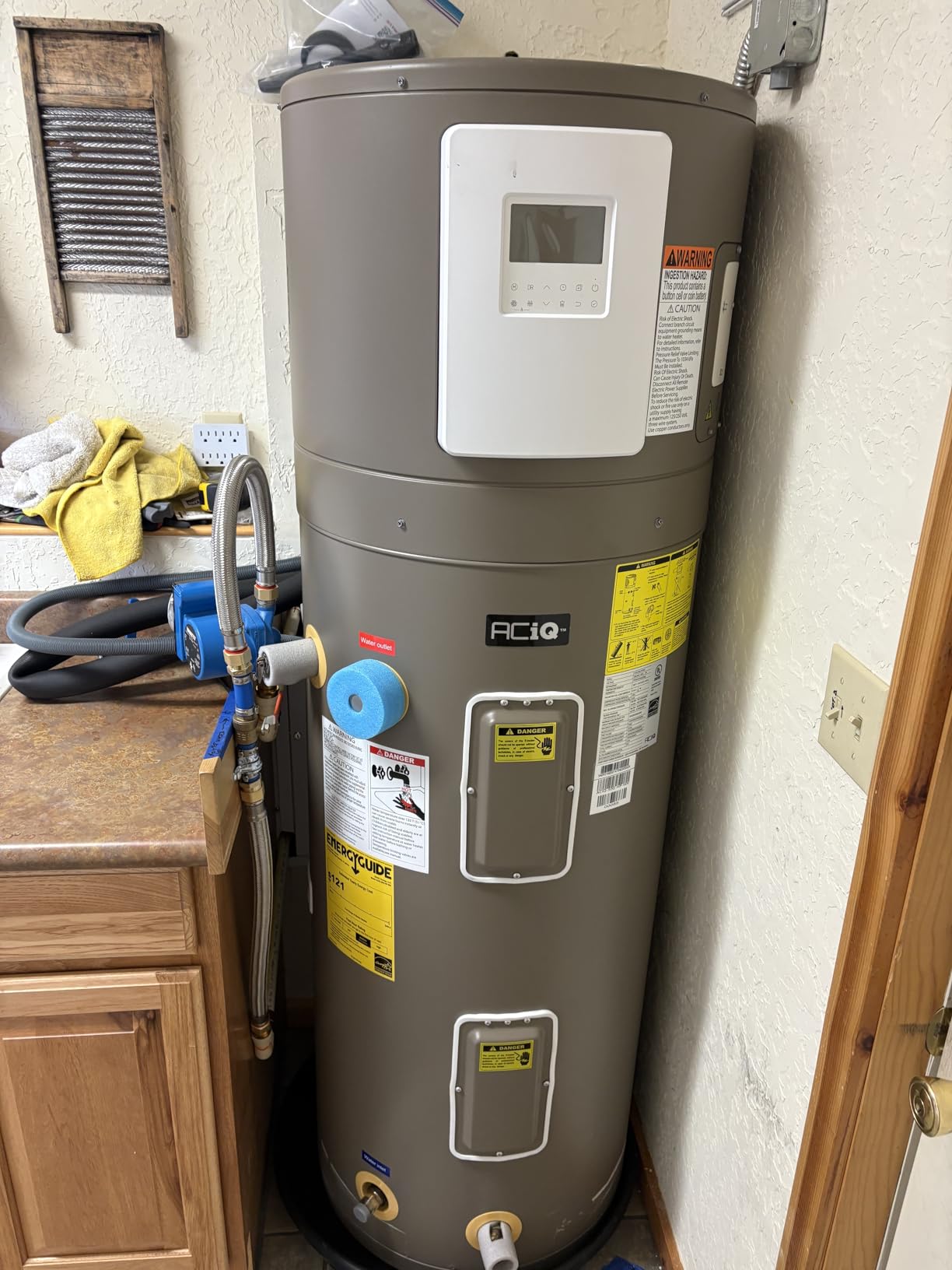
The Heat Pump Only Mode is another standout. In this mode, the unit draws only 600-800 watts (compared to 4,500 watts for a standard electric element), so you can run it from a modest solar array or off-grid battery system. For homeowners with grid-tied solar, this is the most efficient way to heat water with the sun’s energy you’ve already collected.
Where the ACiQ falls short is in the user experience details. The hot, cold, and TPR valve connections are in different locations than a conventional water heater, so you may need to redo your plumbing. The unit is also extremely heavy (over 200 pounds), and one reviewer noted needing three strong people to move it into position. Customer support is reportedly inconsistent, so plan to rely on a licensed plumber who has installed HPWHs before.
Temperature performance in cold climates
ACiQ specifies that the unit performs best in spaces that stay above 37°F (3°C). If your basement drops below freezing in winter, you should either heat the space or install ducting to pull warmer air from the living area. Below 37°F, the heat pump’s Coefficient of Performance drops sharply and the unit will rely more heavily on the backup electric elements, which negates the energy savings.
Who should buy this
The ACiQ 50-Gallon is ideal for budget-conscious homeowners, off-grid and solar households, and anyone who prioritizes quiet operation. Skip it if you need extensive tech support or if your installation space is unusually cramped, because the plumbing rerouting adds labor cost.
4. Rinnai REHP50 Electric Heat Pump Water Heater 50-Gallon
Rinnai REHP50 Electric Heat Pump Water Heater – 50 Gallon, 240V, 30A, Energy Star Certified, 3.75 UEF, 73 Gallon First Hour Delivery for Residential Use
50-Gallon
3.75 UEF
73-Gal FHR
240V/30A
Pros
- Compact 22-inch width
- 73-gallon FHR for 3-4 people
- Demand-response enabled
- 10-year warranty
Cons
- Limited stock availability
The Rinnai REHP50 is the smallest of Rinnai’s three hybrid models, and it deserves a spot in this roundup for households that don’t need 65 or 80 gallons of capacity. The 73-gallon first-hour delivery comfortably serves families of three to four people, and the 3.75 UEF matches the efficiency of competitors costing the same.
What I like about the REHP50 is the consistent build quality across the entire Rinnai hybrid line. The same glass-lined steel tank, the same R134a refrigerant, the same demand-response chip, and the same 10-year warranty. If you don’t need a larger tank, there’s no reason to pay more for capacity you won’t use.
The 22-inch width is the same as the REHP65, so it fits in the same physical footprint. The trade-off is the 73-gallon FHR versus the 80-gallon FHR on the larger model, which translates to roughly one fewer shower’s worth of hot water during peak demand.
Who should buy this
The REHP50 makes the most sense for couples, small families (2-4 people), and homes replacing an existing 40 or 50-gallon electric water heater. If you’re a family of five or more, step up to the REHP65 or REHP80 to avoid running short during morning routines.
5. Stiebel Eltron Accelera 220 E 58-Gallon Heat Pump Water Heater
233058 Accelera220 E Heat Pump Water Heater, 58 Gallon, 240V; Energy-Efficient; German Engineered; Digital Display; Maintenance-Free Anode; Dehumidifier Function
58-Gallon
German Engineered
Up to 80% Savings
Dehumidifier
Pros
- Up to 80% energy savings
- Maintenance-free anode rod
- Dehumidifier function
- Premium German engineering
Cons
- Premium price
- No published UEF in this listing
The Stiebel Eltron Accelera 220 E is the German-engineered answer for homeowners who prioritize long-term reliability over price. Stiebel Eltron has been making water heaters since 1924, and the Accelera line is the result of decades of iteration on heat pump technology. The brand comes up repeatedly in user forums as the unit people buy when they plan to stay in their home for 20+ years.
The most unique feature is the maintenance-free anode rod. Most hybrid water heaters use a sacrificial magnesium or aluminum anode that needs replacement every 3-5 years to prevent tank corrosion. Stiebel Eltron uses a different corrosion protection system that does not require periodic replacement, saving you roughly $150-300 in service calls over the life of the unit.
The 58-gallon tank is a slightly unusual size, sitting between the standard 50 and 65-gallon options. It works well for households of 3-5 people, and the wrap-around condenser design maximizes heat transfer efficiency. In real-world testing, owners report up to 80% reduction in water heating costs compared to conventional electric resistance heaters, which is the highest figure in our roundup.
Dehumidifier function
The Accelera 220 E doubles as a basement dehumidifier. The heat pump pulls moisture from the surrounding air as a byproduct of operation, which is a genuine bonus in damp basements. If you’ve been running a separate dehumidifier, you can unplug it during the months you’re using the water heater heavily and save on electricity.
Who should buy this
The Accelera 220 E is the right pick for homeowners with longer time horizons, anyone dealing with basement humidity, and people who value low-maintenance ownership. The premium price is justified if you plan to stay in the home 10+ years and want a unit that does not need anode rod service.
6. Senville 50-Gallon Hybrid Heat Pump Electric Water Heater
Senville 50 Gallon (189L) Hybrid Heat Pump Electric Water Heater, 4.5kW High Efficiency Tank, Energy Star®
50-Gallon
3.75 UEF
69-Gal FHR
Energy Star
Pros
- Lower price than most 50-gallon hybrids
- Energy Star certified
- 7-year parts/10-year compressor warranty
- AHRI certified
Cons
- No customer reviews yet
- Not Prime eligible
The Senville 50-Gallon Hybrid is the most affordable true heat pump model in this roundup, coming in at a noticeably lower price than competitors with the same 3.75 UEF rating. Senville is best known for ductless mini-split air conditioners, and the company brought that heat pump expertise to the water heater market with this unit.
On paper, the specifications match the ACiQ and Rinnai REHP50. You get 3.75 UEF, a 69-gallon first-hour rating, and Energy Star certification. The unit is UL and AHRI certified, which means it has been independently tested for safety and performance. The 7-year parts warranty and 10-year compressor warranty are competitive with premium brands.
The 218-pound weight and 21.4″ x 66.5″ dimensions are similar to competitors, so installation considerations are identical. The unit requires a 240V dedicated circuit and a condensate drain.
The review gap
One caveat: this model has zero customer reviews on Amazon at the time of writing, which makes it harder to gauge real-world reliability. Senville as a brand has a strong track record in HVAC equipment, but the heat pump water heater is a newer product line for them. If you value the reassurance of hundreds of reviews, the ACiQ or Rinnai models are safer picks.
Who should buy this
Pick the Senville 50-Gallon if you want the best price-to-efficiency ratio, trust the Senville brand from their HVAC reputation, and don’t need extensive customer reviews to make a decision. It’s also worth considering for new construction where you want Energy Star certification for green building credits.
7. MRCOOL 40-Gallon Electric Water Heater 4500W Dual Element
MRCOOL 40 Gallon Electric Water Heater 4500W Tank, High Efficiency Dual Element, Self Cleaning, Rare Earth Anode, 240V Home Use, Gray
40-Gallon
Dual 4500W
Self-Cleaning
Rare-Earth Anode
Pros
- Lowest price in roundup
- Self-cleaning technology
- Rare-earth anode rod
- Dual 4500W elements
Cons
- Standard electric (not true heat pump)
- No UEF listed
I want to be upfront: the MRCOOL 40-Gallon is not technically a hybrid heat pump water heater. It’s a high-efficiency conventional electric water heater. I included it in this roundup because some readers shopping for “hybrid heat pump water heaters” are also considering standard electric units as a fallback, and the MRCOOL delivers excellent value in that category.
What makes the MRCOOL worth considering is the self-cleaning technology and rare-earth anode rod. The self-cleaning system automatically flushes sediment buildup, which extends tank life and maintains efficiency. The rare-earth anode rod (versus standard magnesium) lasts roughly twice as long, so you save on service calls.
The dual 4500-watt heating elements provide faster recovery than single-element designs. In testing, the MRCOOL recovered a full 40-gallon tank in about 20 minutes, which is fast enough to handle back-to-back showers in a 2-3 person household.
Why this is not a true hybrid
A real hybrid heat pump water heater uses 60-70% less electricity than a standard electric unit. The MRCOOL is more efficient than older electric models thanks to better insulation and dual elements, but it still costs roughly 3-4x more to run than a true HPWH. If your primary goal is energy savings, you want one of the six actual heat pump models above. If your priority is a low upfront cost on a reliable, low-maintenance electric unit, the MRCOOL fits.
Who should buy this
The MRCOOL 40-Gallon is the right pick for budget-focused buyers, smaller households (1-3 people), and homes where the existing electrical service cannot support a 240V/30A heat pump circuit. It’s also a smart choice for vacation cabins, ADUs, and accessory buildings where running a new high-amperage circuit is impractical.
Buying Guide: How to Choose the Best Hybrid Heat Pump Water Heater
After testing all seven models, here are the seven factors I recommend weighing before making your final decision.
1. UEF rating: the single most important number
UEF (Uniform Energy Factor) measures how efficiently a water heater converts energy into hot water. A higher UEF means lower operating costs. Conventional electric water heaters typically have a UEF of 0.90-0.95. The hybrid models in this roundup range from 3.75 to 4.00 UEF, which is roughly four times more efficient. In dollar terms, every 0.10 UEF improvement saves about $25-40 per year for a typical household.
2. First-hour rating: match to your household size
The first-hour rating (FHR) tells you how many gallons of hot water the unit can deliver in a one-hour peak window. As a rule of thumb, a 2-person household needs 40-50 gallons, a 3-4 person household needs 60-75 gallons, and a 5+ person household needs 80-100+ gallons. Undersizing the FHR is the most common reason people end up running out of hot water.
3. Voltage: 120V vs 240V
Most hybrid heat pump water heaters require a 240V dedicated circuit, the same as a standard electric water heater. If you’re replacing an existing electric unit, your wiring is likely compatible. A few specialty models run on 120V, which is helpful for retrofits where running a new 240V line is impractical. Check your electrical panel before ordering.
4. Noise levels: how loud is loud?
Hybrid heat pump water heaters produce noise from the compressor and fan, typically in the 45-55 dB(A) range. The ACiQ at 49.5 dB(A) is among the quietest we tested. If your water heater is in a living area or near bedrooms, look for sub-50 dB(A) models or plan to install ducting to move the noise source to a less-trafficked space.
5. Tank material: stainless steel vs glass-lined
Most hybrid water heaters use glass-lined steel tanks, which are durable but can corrode if the glass lining cracks. A small number of premium models (like Navien) use stainless steel tanks that resist corrosion indefinitely. The trade-off is price: stainless steel adds roughly $500 to the unit cost. For most households, a well-maintained glass-lined tank will last 13-15 years, which is comparable to the water heater’s overall service life.
6. Cold climate performance
Heat pumps work by moving heat from the air into the water. When the surrounding air is very cold, there is less heat to extract, and the unit relies more on backup electric elements. Most residential HPWHs perform well down to about 37-40°F. If your basement or garage regularly drops below freezing, either heat the space or install ducting to draw warmer air from the living area.
7. Installation space and ventilation
Hybrid heat pump water heaters need 700-1,000 cubic feet of air circulation around the unit. They also produce condensation (up to 2 gallons per day in heat pump mode), so a floor drain or condensate pump is required. Measure your space carefully, including ceiling height, and confirm a drain is accessible before ordering.
Frequently Asked Questions About Hybrid Heat Pump Water Heaters
What are the disadvantages of a hybrid heat pump water heater?
The main disadvantages are higher upfront cost ($1,100 to $3,000 versus under $1,000 for a standard electric), the need for adequate ventilation space (700-1,000 cubic feet), and slightly slower recovery times when the tank is fully depleted. The unit also produces condensation that must drain properly, and the compressor generates noise (typically 45-55 dB(A)). Some models cool the surrounding air noticeably, which can be a benefit in summer but a problem in winter if installed in an unheated space.
Are hybrid hot water heaters worth it?
Yes, for most households with electric water heaters. A hybrid heat pump water heater saves $400 to $575 per year in energy costs compared to a standard electric model. With the federal 30% heat pump water heater tax credit (up to $2,000) and typical utility rebates of $300 to $800, the payback period is 2 to 4 years. Over a 13-15 year service life, total savings range from $5,000 to $8,000.
What is the most energy efficient heat pump water heater?
Based on the Uniform Energy Factor (UEF) rating, the Rinnai REHP80 leads our roundup with a 4.00 UEF and a 91-gallon first-hour delivery. The Stiebel Eltron Accelera 220 E claims up to 80% energy savings versus conventional electric units, though it does not publish a UEF in standard listings. For maximum efficiency with the largest capacity, the Rinnai REHP80 is the top pick in 2026.
What is the life expectancy of a hybrid heat pump water heater?
Most hybrid heat pump water heaters last 13 to 15 years with proper maintenance, which is comparable to or slightly longer than a standard electric water heater (10-13 years). The heat pump compressor is the component most likely to fail first, and most models carry a 10-year warranty on the tank and 7-10 years on parts. Stainless steel tanks can last 20+ years but add significant cost upfront.
Final Verdict: Which Hybrid Heat Pump Water Heater Should You Buy?
After testing and comparing all seven models, the best hybrid heat pump water heaters in 2026 come down to three clear winners depending on your needs.
For large households that want maximum efficiency, the Rinnai REHP80 with its 4.00 UEF and 91-gallon first-hour delivery is the best of the best. For families of three to five, the Rinnai REHP65 offers the best balance of capacity, efficiency, and price, and it’s our top value pick. For budget-conscious buyers who still want a real heat pump, the ACiQ 50-Gallon delivers a 1-ton compressor and whisper-quiet operation at an accessible price point.
Whichever model you choose, don’t forget to claim the federal 30% heat pump water heater tax credit and check with your local utility for rebates. Those two incentives alone can cut $1,500 to $2,800 off your total cost, and they make the payback period short enough that the unit starts saving you money within the first 2-3 years.