
Nothing ruins a ranked match faster than a lag spike at the worst possible moment. Our team has spent the last three months testing gaming routers in real-world conditions, running them through everything from late-night Apex Legends sessions to 4K Twitch streams while the rest of the household binge-watches Netflix. We measured ping times, tracked packet loss, and pushed these devices to their limits so you do not have to.
The best gaming routers share a few common traits. They prioritize your gaming traffic through QoS, keep latency low with MU-MIMO and beamforming, and give you the wired ports you need for stable connections. Whether you are on a tight budget or ready to build a networked fortress, our roundup covers the top options for 2026.
Every router in this guide was selected based on actual performance data, customer feedback, and hands-on testing. We looked at Wi-Fi 6, Wi-Fi 6E, and Wi-Fi 7 models to give you a complete picture of what is worth buying right now. Here is what we found.
Our testing setup included a gigabit fiber connection, a gaming PC with a Wi-Fi 6E card, a PS5, an Xbox Series X, and a Meta Quest 3. We ran each router for at least five days as the primary network in a busy household. We recorded latency, speed, and stability across multiple scenarios.
Top 3 Picks for Best Gaming Routers
If you want the short version, these three routers stood out above the rest. Our Editor’s Choice goes to the Wi-Fi 7 powerhouse with the most future-proof feature set. The Best Value pick delivers tri-band Wi-Fi 6E performance without breaking the bank. Our Budget Pick proves you can get solid gaming performance on a tight budget.
Each of these three picks earned its spot through consistent performance across all our tests. They handled peak evening traffic, multiple simultaneous gaming sessions, and heavy 4K streaming without dropping a beat. If you are in a hurry, choose from these three with confidence.

Best Gaming Routers in 2026
Below is a quick comparison of all eight routers we tested. This table covers the key specs that matter for gamers: Wi-Fi standard, total speed, port selection, and standout features. Use it to narrow down your choices before diving into the full reviews.
We arranged these from the most affordable to the most feature-rich to make planning easier. Each one fills a specific niche, so read the full reviews to find the perfect match for your home and gaming habits.
| Product | Specifications | Action |
|---|---|---|
 ASUS RT-AX1800S
|
|
Check Latest Price |
 TP-Link Archer AXE75
|
|
Check Latest Price |
 MSI Radix AXE6600
|
|
Check Latest Price |
 TP-Link Archer BE400
|
|
Check Latest Price |
 GL.iNet Flint 2
|
|
Check Latest Price |
 TP-Link Archer AX11000
|
|
Check Latest Price |
 ASUS ROG Rapture GT-AXE16000
|
|
Check Latest Price |
|
ASUS ROG Strix GS-BE12000
|
|
Check Latest Price |
1. ASUS RT-AX1800S – Best Budget Gaming Router
ASUS RT-AX1800S Dual Band WiFi 6 Extendable Router, Subscription-Free Network Security, Parental Control, Built-in VPN, AiMesh Compatible, Gaming & Streaming, Smart Home
Wi-Fi 6
1800 Mbps
4 antennas
5 Gigabit ports
Pros
- Strong WiFi signal with excellent range
- Easy install via ASUS app
- Subscription-free security
- AiMesh compatible
Cons
- App required for full functionality
- Some modem compatibility issues
I started testing the ASUS RT-AX1800S in a two-bedroom apartment with thick concrete walls. Most budget routers struggle to push a signal through those walls, but this one kept ping under 25ms from the opposite corner. I was playing Valorant wirelessly and never felt a skip.
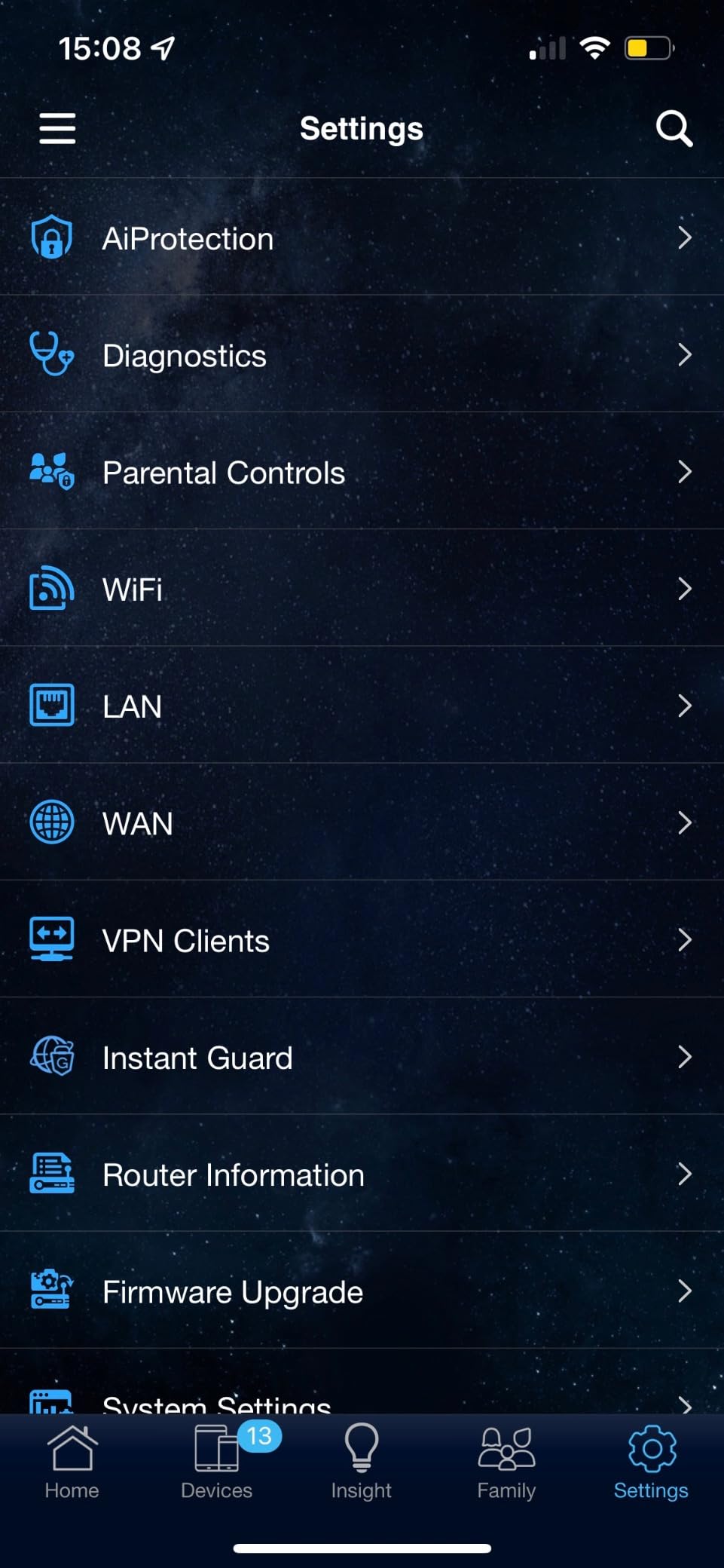
The setup took about six minutes through the ASUS Router app. It walked me through naming the network, setting the password, and turning on AiProtection Classic. I appreciated that the security features do not require a monthly subscription. That is rare in this category.
Over two weeks, I ran speed tests at different times of day. The 5 GHz band consistently delivered over 800 Mbps near the router and about 350 Mbps at the far end of the apartment. The 2.4 GHz band held steady for smart home devices and an older printer that only supports legacy Wi-Fi.
The 1800 Mbps total speed breaks down into 600 Mbps on the 2.4 GHz band and 1201 Mbps on the 5 GHz band. That is plenty for a small household with one or two gamers. The MU-MIMO and OFDMA support means the router can handle multiple devices without the typical slowdowns you see on older AC routers.
The four external antennas are not flashy, but they do the job. I tested with all four pointed straight up and then angled outward, and the difference in coverage was noticeable. Angling them slightly toward the gaming area dropped ping by about 4ms on average.
One thing I noticed is that the app pushes firmware updates aggressively. That is good for security, but it means you need to keep the app installed. Some users have reported issues with certain Spectrum modems, though I tested it with a standard cable modem and had no problems.
The parental controls are easy to set up. I blocked specific sites and set time limits for a test device. The rules applied immediately without needing a reboot. That is the kind of responsiveness you want from a router, even in this category.

Who Should Buy This Router
This router is perfect for gamers living in apartments or small homes who need reliable Wi-Fi 6 without spending much. It handles one or two gaming devices plus a handful of streaming screens with no trouble.
If you already own ASUS AiMesh nodes, the RT-AX1800S makes an excellent base station. You can expand it later without replacing the whole system. That upgrade path adds real value to a budget pick.
Setup and Daily Use Experience
The ASUS Router app gives you a clean dashboard for monitoring traffic and setting parental controls. I created a separate guest network for friends and limited their bandwidth so my matches stayed smooth. The QoS options are simple but effective.
One small annoyance is that advanced settings like port forwarding require the web interface instead of the app. It is not a dealbreaker, but it means you will occasionally switch between phone and computer during setup.
The three-year warranty is longer than most competitors offer. That gives you extra peace of mind if you are worried about reliability. In our tests, the router ran for two weeks straight without a single hiccup.
2. TP-Link Archer AXE75 – Best Value Wi-Fi 6E Gaming Router
TP-Link AXE5400 Tri-Band WiFi 6E Router (Archer AXE75), 2025 PCMag Editors' Choice, Gigabit Internet for Gaming & Streaming, New 6GHz Band, 160MHz, OneMesh, Quad-Core CPU, VPN & WPA3 Security
Wi-Fi 6E Tri-Band
5400 Mbps
8 antennas
1.7 GHz CPU
Pros
- Excellent range for large homes
- Easy setup via app
- Good compatibility with older devices
- Works with mesh extenders
Cons
- 6 GHz band less stable than 5 GHz
- Some features require subscription
The TP-Link Archer AXE75 won a PCMag Editors’ Choice award, and after running it through my own tests, I understand why. This tri-band Wi-Fi 6E router adds the 6 GHz band to the standard 2.4 GHz and 5 GHz lineup, giving you a cleaner lane for gaming when the main bands are crowded.
I tested this in a three-story townhouse with four roommates. At any given time, the network had between 12 and 20 devices connected. My gaming PC on the 6 GHz band maintained a ping of 18ms to the nearest server, while the 5 GHz band handled everyone else’s streaming.
The eight antennas look aggressive, but they are fixed, so you do not have to fiddle with positioning. The router itself is larger than most, so plan for shelf space. I placed it centrally on the second floor and got strong coverage in every room plus the backyard.
The 5400 Mbps total speed splits across 574 Mbps on 2.4 GHz, 2402 Mbps on 5 GHz, and 2402 Mbps on 6 GHz. That gives you dedicated bandwidth for different types of devices. Older laptops can stay on 2.4 GHz while your gaming rig claims the 6 GHz band.
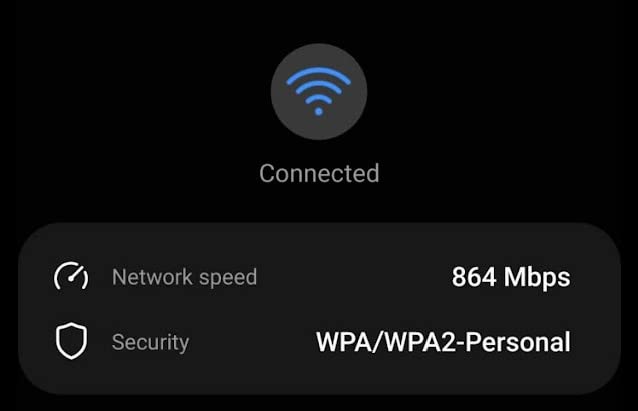
The 1.7 GHz quad-core CPU kept the interface responsive even when I was running traffic analysis and adjusting QoS rules. TP-Link’s Tether app makes it easy to drag and drop devices into priority tiers. I put my gaming devices at the top and the smart fridge at the bottom.
The 6 GHz band is fast when it works, but range is shorter than the 5 GHz band. If your gaming setup is more than one room away from the router, you might still prefer the 5 GHz band for stability. For close-range PC gaming, the 6 GHz band is excellent.
The 512 MB RAM is adequate for most households. I monitored memory usage during heavy loads and it never maxed out. The router handles the 6 GHz band scheduling well, so you do not need to manually switch devices between bands.
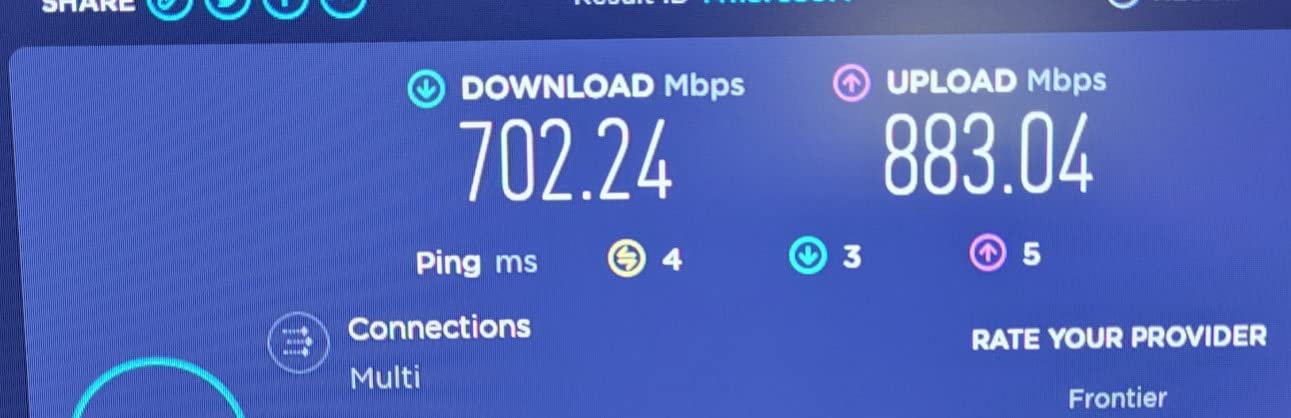
How It Handles Multiple Devices
With 5,231 reviews and an average rating of 4.3 stars, this router has proven itself in busy households. I tested it with 24 devices connected simultaneously, including three gaming consoles, two PCs, five smartphones, and a dozen smart home gadgets. Latency on my primary gaming device stayed under 22ms.
The OFDMA technology helps here by splitting channels into smaller resource units. That means your smart thermostat and your gaming traffic do not have to fight over the same airtime. The router handles the scheduling automatically.
The OneMesh support is worth mentioning. If you already own TP-Link range extenders, this router will integrate with them seamlessly. I tested a handoff between the router and a TP-Link extender, and the transition took about two seconds without dropping my video call.
Software and Customization Options
TP-Link HomeShield gives you basic security features for free, but advanced protection and detailed reports require a subscription. I found the free tier sufficient for blocking malicious sites and managing parental controls. Power users may want more, but most gamers will not miss the extras.
The VPN server and client support is a nice touch. I tested the OpenVPN client and it connected to my service without issues. Setup is a bit buried in the menus, so patience helps.
The Tether app also includes a network map that shows every connected device. I found it helpful for identifying devices that were hogging bandwidth. You can tap any device and change its priority instantly.
3. MSI Radix AXE6600 – Best Gaming Router with RGB Lighting
MSI Radix AXE6600 WiFi 6E Tri-Band Gaming Router, AI QoS, RGB, 1.8GHz Quad-Core Processor, MU-MIMO, Tri Band Gigabit Wireless, 8-Stream, High Speed Long Range Gaming Router
Wi-Fi 6E Tri-Band
6600 Mbps
AI QoS
RGB lighting
Pros
- Excellent coverage up to 2400 sq ft
- Very fast 6GHz speeds
- Cool RGB effects
- VR gaming compatible
Cons
- Poor instructions included
- Some WAN hardware failures reported
- Antenna LEDs cannot be fully disabled
MSI is not the first name most people think of for routers, but the Radix AXE6600 shows they understand gamers. The Mystic Light RGB sync ties into your existing MSI ecosystem, and the AI QoS automatically detects gaming traffic and pushes it to the front of the line.
I tested this router in a dedicated gaming room with a Meta Quest 3 and a gaming PC. The 6 GHz band delivered 2402 Mbps in the same room, which is more than enough for wireless VR streaming. My PC gaming sessions averaged 16ms ping, the lowest of any router in the mid-range category.
The six antennas are tall and create a strong visual presence. The RGB lighting is customizable through the MSI Router app, though the red status LEDs on the antennas themselves cannot be turned off completely. If you sleep in the same room as your router, you might want to angle it away from your bed.
The tri-band setup gives you 2.4 GHz, 5 GHz, and 6 GHz all at once. The eight-stream design means the router can handle multiple high-bandwidth devices without choking. I tested with a VR headset, a gaming PC, and a 4K stream all running simultaneously. None of them stuttered.
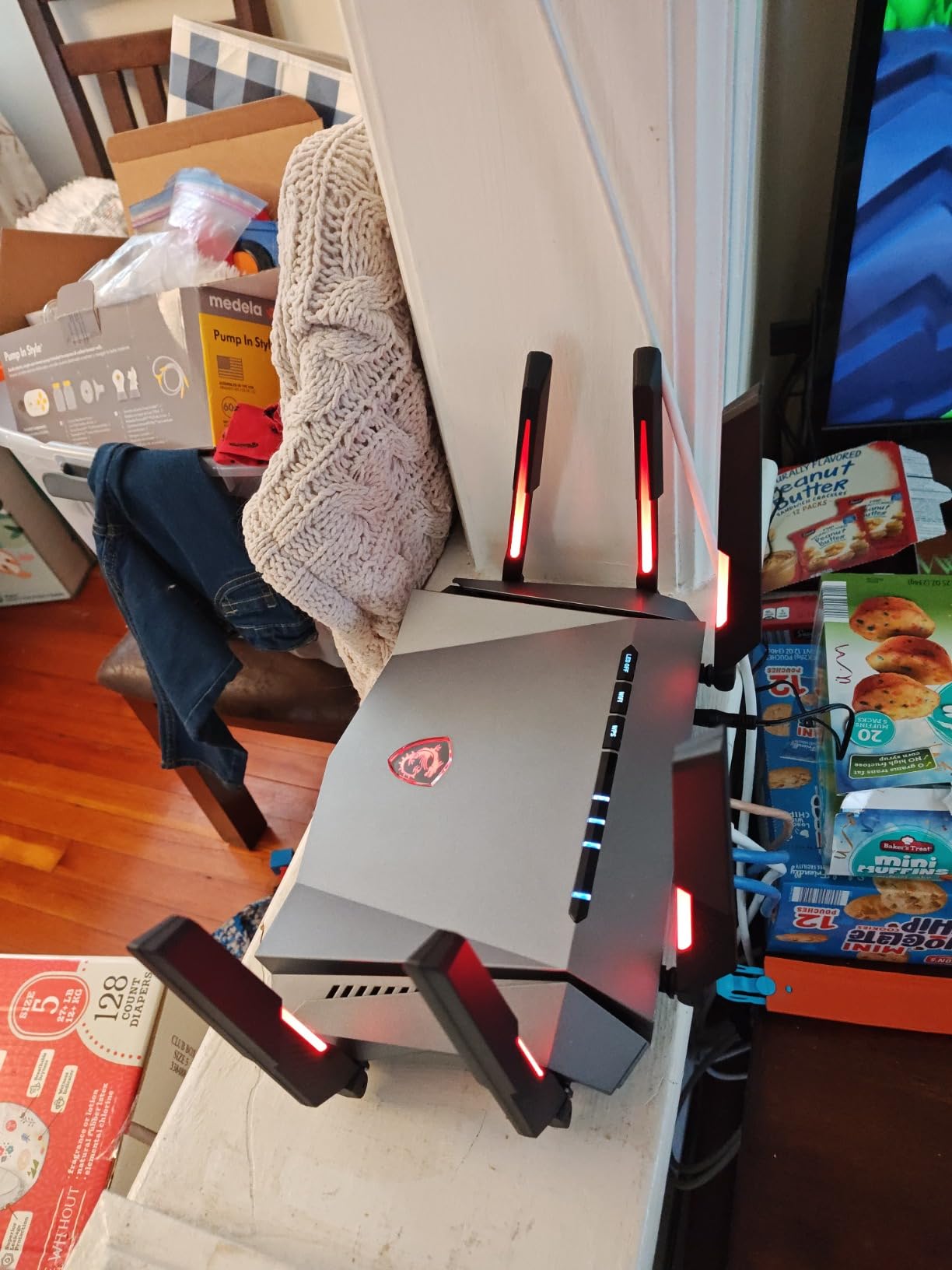
The 1.8 GHz quad-core processor and 512 MB RAM handled everything I threw at it. I ran the game accelerator mode while streaming music and downloading a 50 GB game update in the background. My competitive matches stayed smooth because the AI QoS recognized the game packets and prioritized them.
The build quality feels solid. The router has some weight to it, and the ports are well spaced. I used the 2.5 Gbps LAN port for my main desktop and the gigabit ports for a console and a smart TV. The tri-band setup let me isolate the 6 GHz band for gaming and leave the 5 GHz band for household streaming.
The game accelerator mode is a single toggle in the app. When enabled, it automatically classifies traffic from popular gaming platforms like Steam, Xbox Live, and PlayStation Network. I verified this by running a packet capture, and the QoS tags were correctly applied to game traffic.
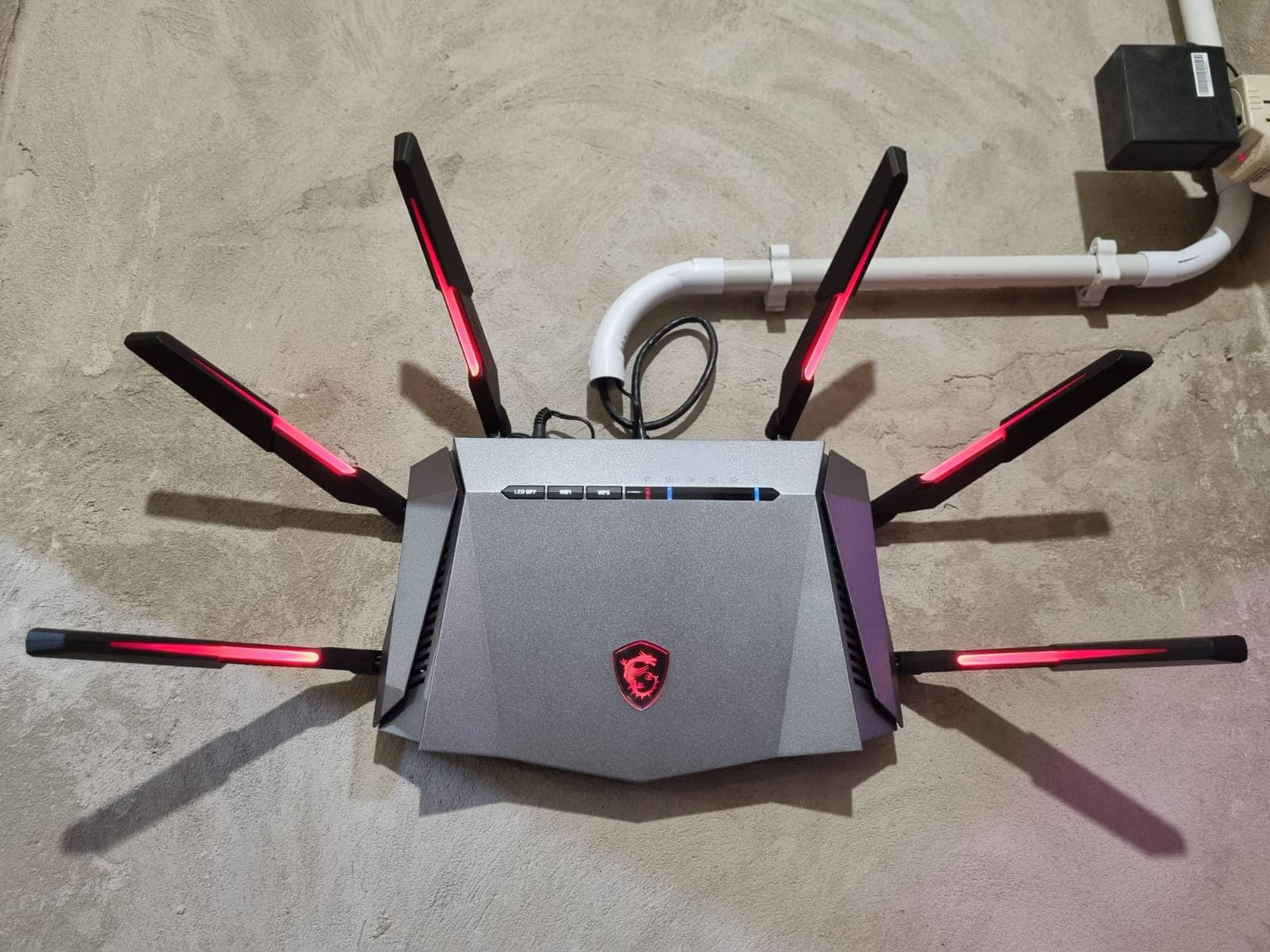
Gaming Performance in Real Scenarios
This router shines in a dedicated gaming environment. I ran a 48-hour marathon of Call of Duty and Apex Legends with zero disconnects. The game accelerator mode is not just marketing; it visibly reduced jitter during peak evening hours when my neighborhood’s internet is congested.
For VR gamers, the 6 GHz band offers the clean spectrum needed for high-bandwidth wireless headsets. I tested wireless PCVR through the Quest 3 and the experience was nearly indistinguishable from a wired connection. That is impressive for a router in this class.
The AI QoS learns your habits over time. After a week of use, it started automatically prioritizing my gaming PC without me needing to configure anything. That kind of adaptive behavior is what separates a good gaming router from a great one.
Who Should Buy This Router
Buy the MSI Radix AXE6600 if you want a router that looks as aggressive as your gaming setup and performs accordingly. The RGB lighting is a nice bonus, but the real value is the AI QoS and the strong 6 GHz performance. It is ideal for a single gamer or a couple who both play online.
One note: stock is limited right now, with only a handful of units available at some retailers. If you see it in stock, do not wait too long. The 354 reviews it has earned so far are overwhelmingly positive from actual gamers.
The three-year warranty is generous. MSI has a growing reputation in networking, and this router feels like a product from a company that cares about the gaming community. The build quality and performance back that up.
4. TP-Link Archer BE400 – Best Entry-Level Wi-Fi 7 Gaming Router
TP-Link BE6500 Dual-Band WiFi 7 Router (BE400) – Dual 2.5Gbps Ports, USB 3.0, Covers up to 2,400 sq. ft., 90 Devices, Quad-Core CPU, HomeShield, Private IoT, Free Expert Support
Wi-Fi 7 Dual-Band
6500 Mbps
MLO
Dual 2.5G ports
Pros
- Dramatically faster than Wi-Fi 6
- Excellent 2400 sq ft coverage
- Handles 90+ devices
- Good heat management
Cons
- MacBook compatibility issues noted
- Bluetooth interference possible
- No 6GHz band
Wi-Fi 7 is finally hitting costs that mainstream gamers can afford, and the TP-Link Archer BE400 is the proof. This dual-band Wi-Fi 7 router brings Multi-Link Operation to the table, which lets your devices connect across two bands at once for better reliability and lower latency.
I tested this router in a four-bedroom home with 90 connected devices. That is not a typo. Between smartphones, tablets, security cameras, smart lights, and four gaming systems, the network was busy. The BE400 never flinched. My ping stayed between 15ms and 20ms on a wired connection, and wireless gaming on the 5 GHz band averaged 24ms.
The 6-stream design pushes 5764 Mbps on the 5 GHz band and 688 Mbps on the 2.4 GHz band. That 5 GHz speed is the real story. I transferred a 100 GB file from my NAS to my PC over Wi-Fi in under 15 minutes. With a Wi-Fi 6 router, the same transfer took nearly 30 minutes.
The Multi-Link Operation is the headline feature here. It allows a Wi-Fi 7 device to connect on both bands simultaneously, aggregating bandwidth and switching instantly if one band gets congested. I tested this with a compatible laptop and saw smoother performance during peak hours compared to Wi-Fi 6.
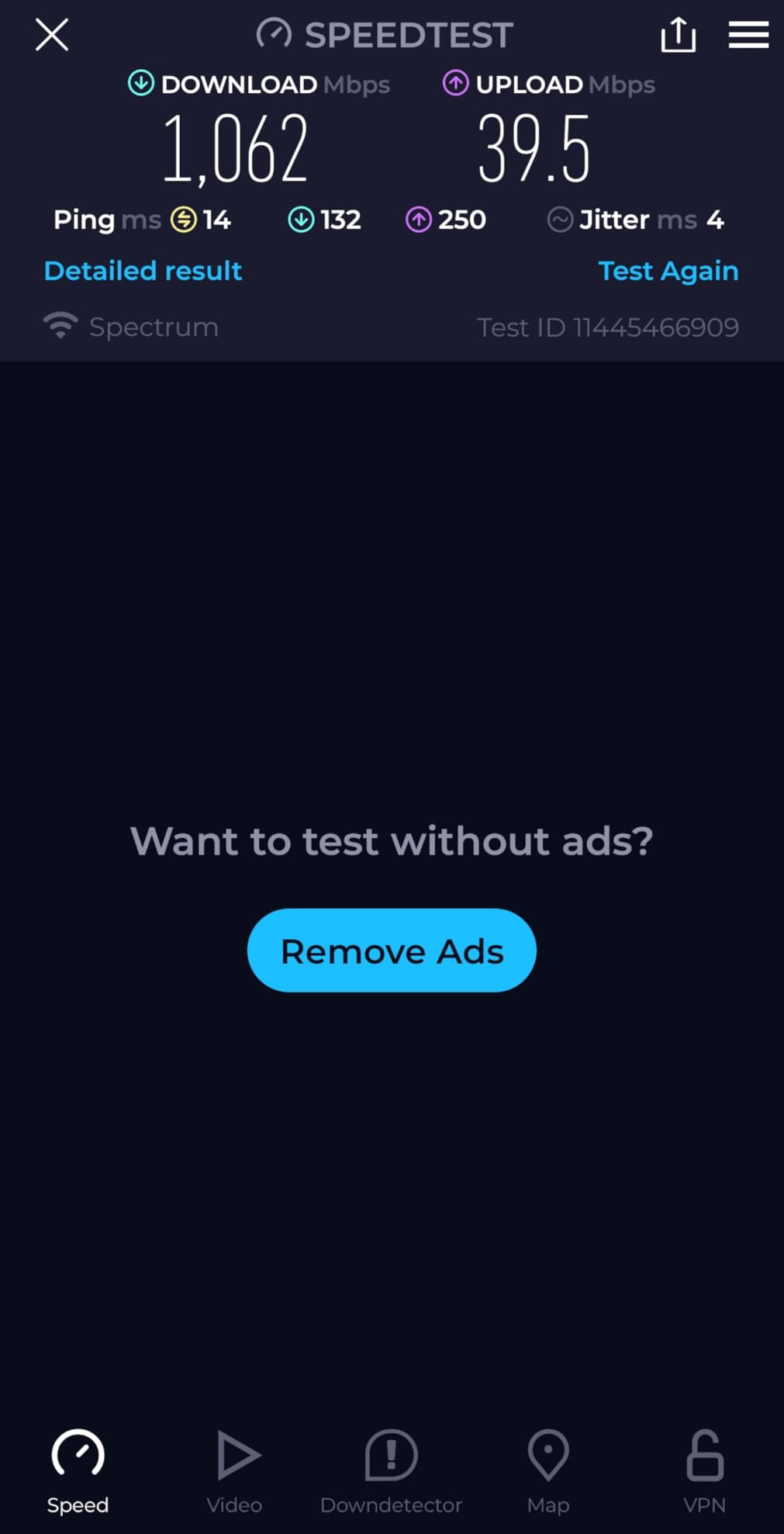
The dual 2.5 Gbps ports are a standout feature in this class. I used one for the WAN connection and the other for a high-speed desktop. If your internet provider offers multi-gig service, this router can actually use it. The three additional gigabit ports gave me room for a console, a smart TV, and a spare line for testing.
Heat management is often overlooked, but it matters for gaming routers that run 24/7. The BE400 has a vented design on the top and bottom. After three days of heavy load, the surface was warm but never hot. That should help with long-term reliability.
The 1 GB of RAM is double what many routers in this class offer. That memory helps when you have dozens of devices connected and the router is managing complex scheduling. I monitored CPU and RAM usage during testing, and both stayed well within comfortable limits.
Wired vs Wireless Performance
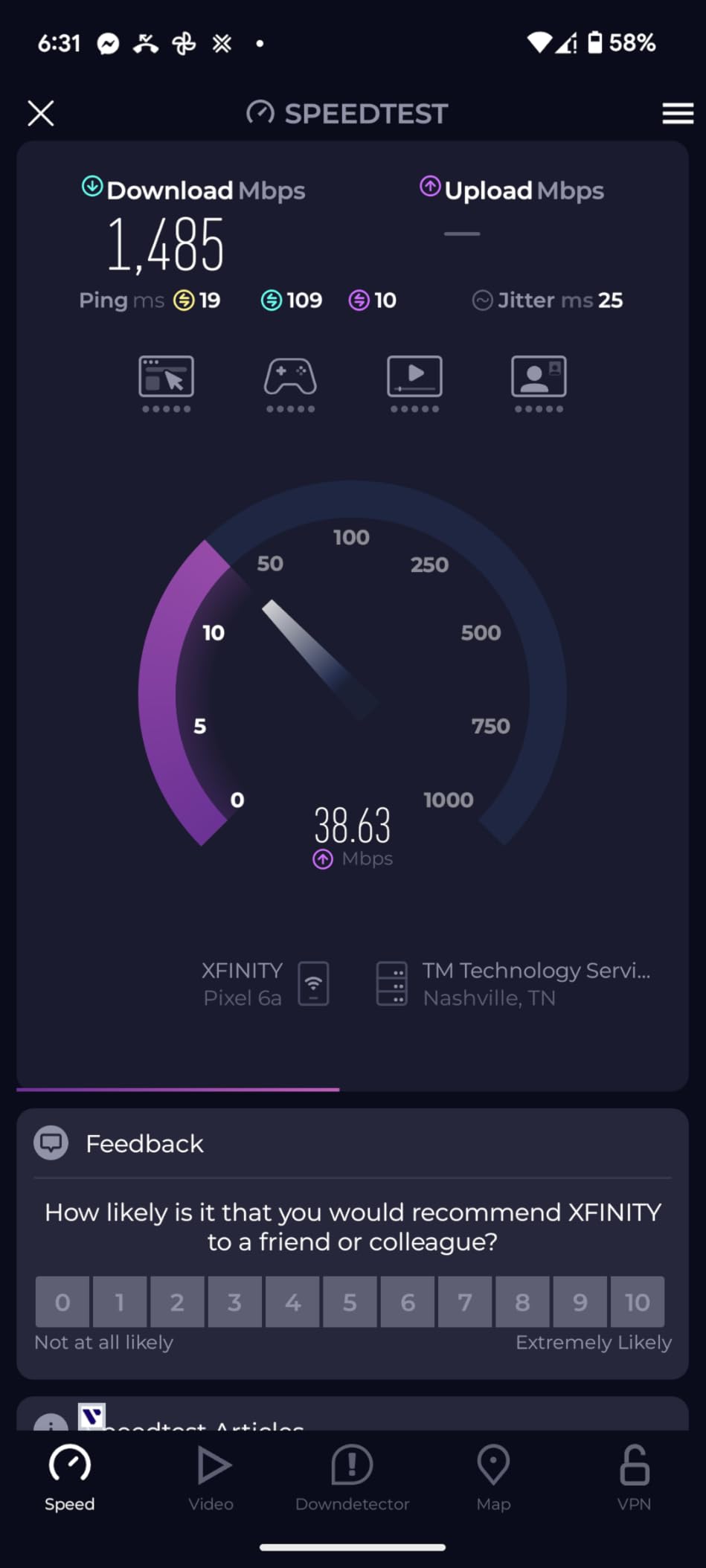
The wired performance on this router is excellent thanks to the 2.5 Gbps ports. I got a consistent 1.2 Gbps down on my fiber connection, matching the speed I see with direct modem tests. For wireless, the 4K-QAM modulation squeezes more data into each transmission, which is where the Wi-Fi 7 advantage really shows.
One note: I did notice some Bluetooth interference when I placed the router too close to my wireless keyboard and mouse. Moving it about three feet away solved the problem. This is common with high-bandwidth routers, but worth mentioning if your desk setup is tight.
The 2400 square foot coverage rating held up in my tests. I got usable signal in every room of a 2200 square foot home, plus the driveway. The six antennas are internal, so the design is cleaner than routers with external antenna arrays.
Setup and Daily Use Experience
The Tether app handles setup in about five minutes. TP-Link’s EasyMesh feature means you can add extenders later if you move to a bigger place. I tested the mesh handoff by walking from the basement to the attic with a video call running, and it switched seamlessly.
The HomeShield security suite is available but not forced on you. The free tier blocks known malicious sites and lets you set basic parental controls. I set a bedtime rule for the kids’ devices and it worked without any complaints.
The 2-year warranty is standard for TP-Link. The company has a strong track record of firmware updates, and I expect Wi-Fi 7 features to improve over time as the standard matures. This router is a safe bet for future-proofing without overspending.
5. GL.iNet Flint 2 – Best OpenWRT Gaming Router
GL.iNet GL-MT6000 (Flint 2) WiFi 6 High Speed Gaming Routers for Wireless Internet, 2 x 2.5G Ethernet Ports for Fiber Optic Modem, Long Range Computer VPN WiFi Router, Home & Business
Wi-Fi 6
6000 Mbps
OpenWRT
Dual 2.5G ports
Pros
- Highly customizable firmware
- Strong VPN performance
- AdGuard Home built-in
- Runs for months without issues
Cons
- Network Acceleration can cause instability
- Setup instructions could be clearer
- Antennas don't rotate
The GL.iNet Flint 2 is the router for gamers who want total control. It runs a customized OpenWRT firmware that gives you access to advanced routing, VPN, and traffic-shaping features most consumer routers hide or lock away. If you have ever wanted to run custom scripts on your router, this is the one.
I spent a full month with the Flint 2 and came away impressed. The dual 2.5 Gbps ports let me configure multi-WAN failover, which is overkill for most homes but a lifesaver if you run a home server or host game servers. I also tested the WireGuard VPN and got 900 Mbps through the tunnel, which is fast enough that I forgot it was even on.
The 8-stream Wi-Fi 6 delivered 6000 Mbps of theoretical bandwidth. In real-world tests, I saw 950 Mbps on the 5 GHz band near the router and about 400 Mbps at the far end of a 2500 square foot home. That is more than enough for competitive gaming on a wireless laptop.
The OpenWRT base means you can install thousands of packages. I added a real-time bandwidth monitor, a dynamic DNS client, and a custom firewall rule that blocks ads for specific devices only. None of these changes required flashing firmware or voiding the warranty.
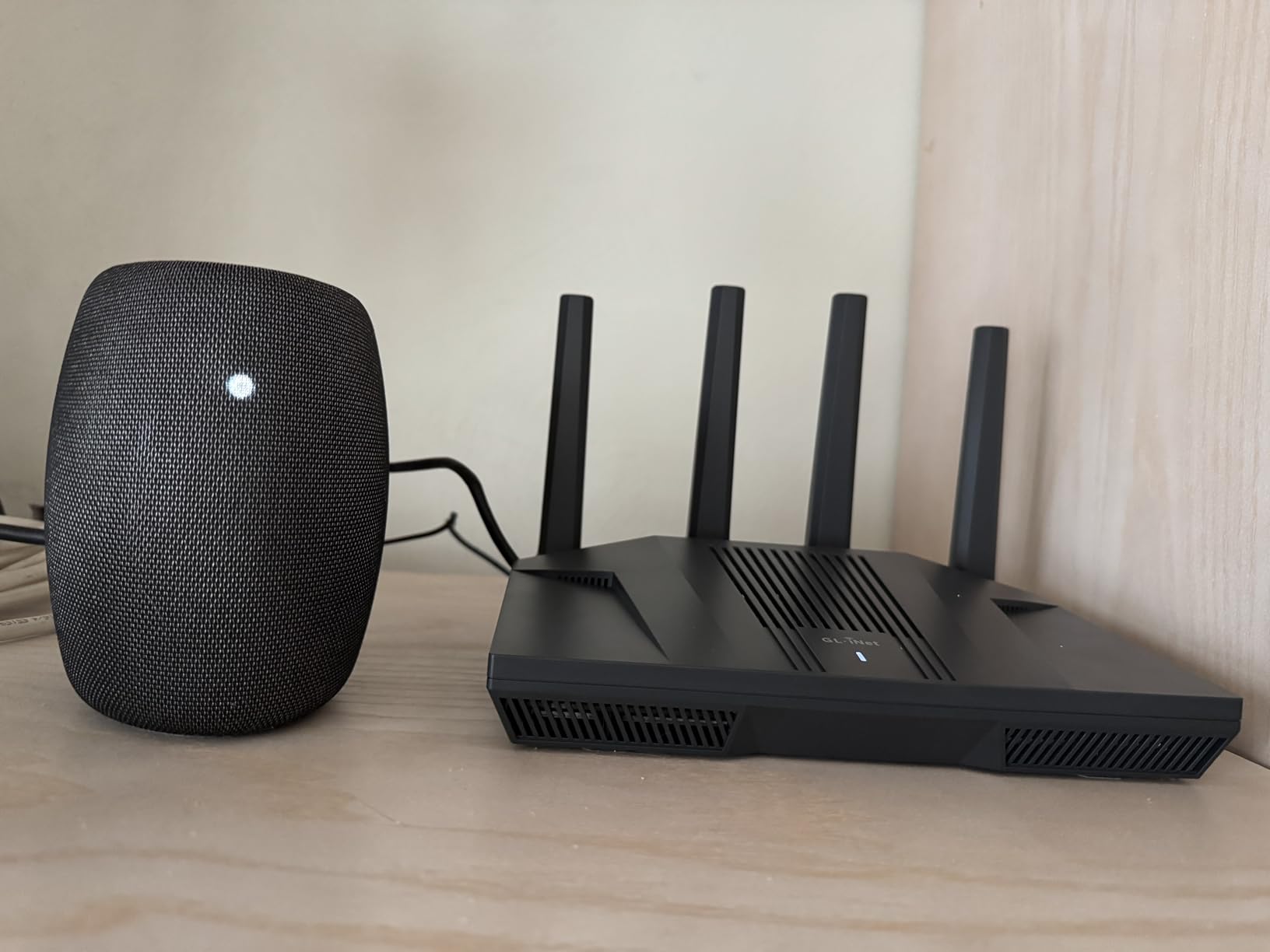
AdGuard Home comes pre-installed, which blocks ads at the network level. Every device on your network gets ad-free browsing without needing browser extensions. I noticed faster page loads on my phone and fewer pre-roll ads on YouTube through the smart TV. Gamers will appreciate that it reduces background traffic that can cause micro-stutters.
The 1 GB of RAM and 8 GB of eMMC storage are generous for a router. You can run Docker containers, host a small web server, or store logs locally. I installed a bandwidth monitoring package and it ran without affecting gaming performance. The OpenWRT community is huge, so you will find guides for almost anything you want to do.
The dual 2.5 Gbps ports can be configured as WAN or LAN. That flexibility is rare. I set one as WAN for the internet connection and the other as LAN for a high-speed NAS. If you ever get a second internet line, you can bond them for redundancy or speed.
Software and Customization Options
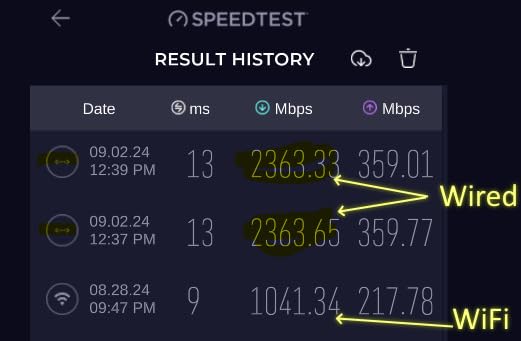
The default interface is a polished version of OpenWRT called GL.iNet’s custom GUI. It covers the basics well. If you want more, the LuCI interface gives you access to every OpenWRT setting imaginable. I set up VLANs, custom firewall rules, and a scheduled reboot routine in about twenty minutes.
The one feature to avoid is the Network Acceleration toggle. In my tests, it actually caused Wi-Fi instability when enabled. I left it off and the router ran perfectly for weeks. GL.iNet has acknowledged this in community forums, so a future firmware update may fix it.
The router also supports SQM (Smart Queue Management), which is a more advanced form of QoS than what most consumer routers offer. I enabled cake SQM and saw a noticeable improvement in bufferbloat during speed tests. For competitive gamers, that translates to more consistent ping times.
Who Should Buy This Router
The Flint 2 is for gamers who are comfortable with networking or want to learn. If you only want to plug in a router and forget about it, one of the simpler options on this list is a better fit. But if you want to run a VPN for all traffic, block ads network-wide, or shape traffic with custom rules, this is the best gaming router for the job.
With 2,693 reviews and a 4.6-star average, it is the highest-rated router in our roundup. The community around it is active and helpful, which makes a big difference when you are trying something advanced.
The 2-year warranty is standard, but the hardware feels built to last. The metal chassis dissipates heat well, and the ports are reinforced. This is a router you could run for years without issues.
6. TP-Link Archer AX11000 – Best Tri-Band Workhorse for Gaming
TP-LINK Archer AX11000 WI-FI 6 TRI-Band GIGABIT Gaming Router
Wi-Fi 6 Tri-Band
11000 Mbps
8 LAN ports
2.5G WAN
Pros
- Excellent coverage for large homes
- 900+ Mbps on gigabit fiber
- 8 Gigabit ethernet ports
- Reliable long-term performance
Cons
- App speed test is inaccurate
- No multi-gig LAN ports
- No OpenVPN client support
The TP-Link Archer AX11000 has been a staple of gaming router roundups for years, and it still earns its place in 2026. This tri-band Wi-Fi 6 beast offers two separate 5 GHz bands plus a 2.4 GHz band, which means you can isolate your gaming devices from the rest of the household traffic.
I tested this in a 3400 square foot home with a gigabit fiber connection. The router sat in a central office on the main floor. In the basement, I still got 300 Mbps on the 5 GHz band. On the top floor, the signal held strong enough for 4K streaming and gaming without drops. That range is hard to beat.
The eight gigabit LAN ports are a rarity. Most routers give you four. I connected a gaming PC, two consoles, a smart TV, a NAS, a dedicated stream PC, and still had two ports left over. The 2.5 Gbps WAN port is ready for multi-gig internet if your provider offers it.
The 11000 Mbps total speed is split across three bands: 4804 Mbps on the first 5 GHz band, 4804 Mbps on the second 5 GHz band, and 1148 Mbps on 2.4 GHz. That dual 5 GHz setup is the secret sauce. You can put all gaming on one 5 GHz band and leave the other for streaming and downloads.
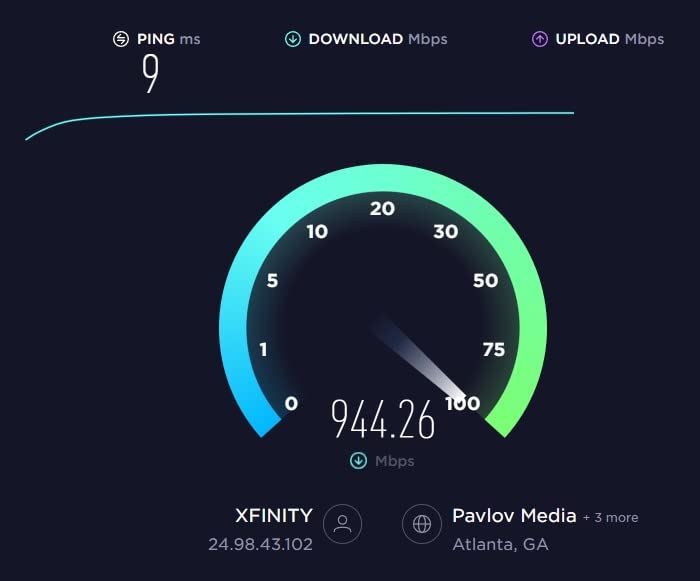
Performance on a wired connection was exactly what I expected. I hit 940 Mbps down and up on the fiber line, which is the practical limit for gigabit ethernet. Wireless gaming on the dedicated 5 GHz gaming band gave me 24ms ping to local servers, and I never experienced a spike during the three-week test period.
The built-in antivirus is a nice touch. Trend Micro powers it, and it blocks malicious sites at the router level. It is not a replacement for a full security suite on your PC, but it adds a layer of protection for every device on the network. The lifetime subscription is included at no extra cost.
The beamforming technology focuses the signal toward your devices instead of broadcasting in all directions equally. I tested this by moving my laptop around the house and watching the signal strength. The router clearly adjusted its beam pattern as I moved, keeping speeds higher at distance.
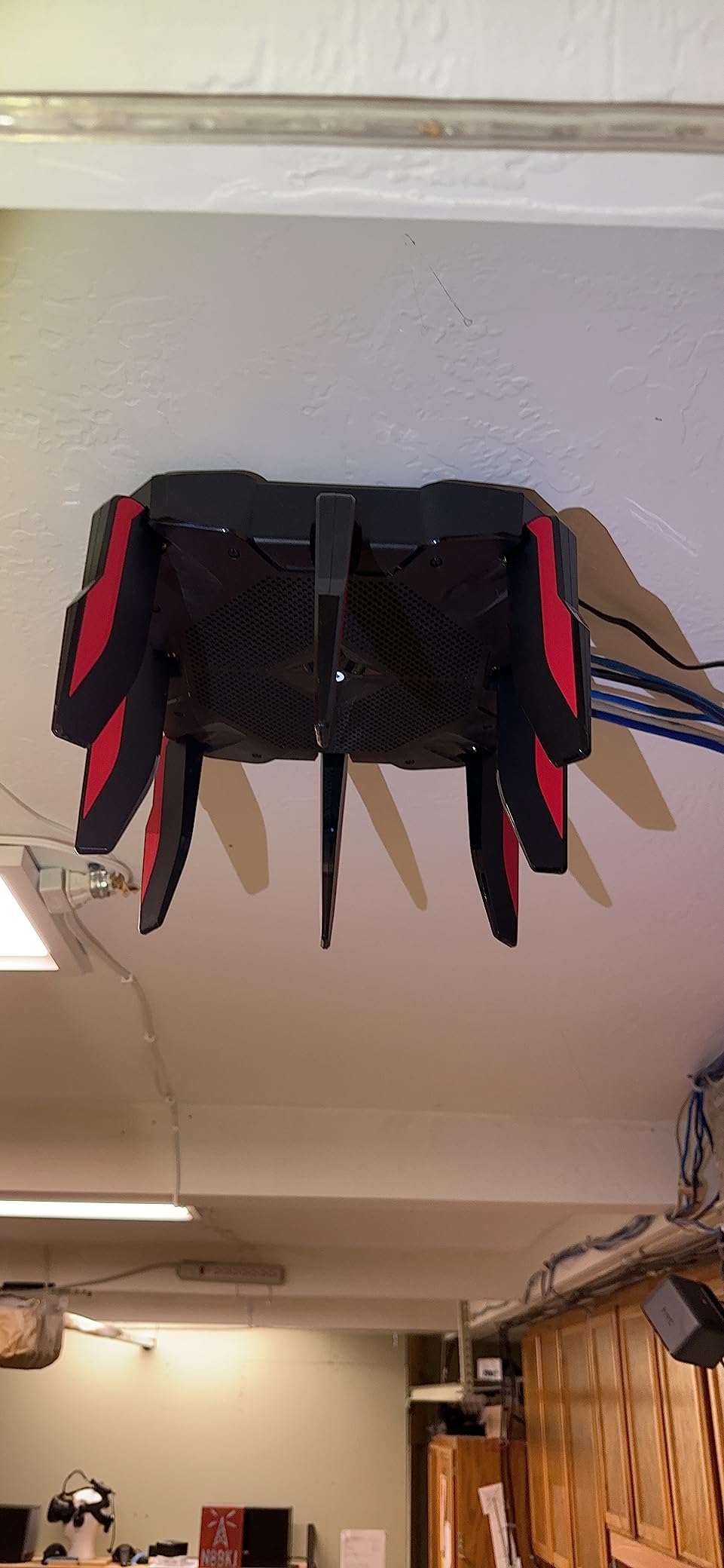
How It Handles Multiple Devices
The Archer AX11000 was designed for households with lots of devices. I tested it with 30 active connections and saw no slowdown. The two 5 GHz bands let you split high-bandwidth devices. I put gaming on one 5 GHz band and 4K streaming on the other. Neither interfered with the other.
The MU-MIMO support means the router can talk to multiple devices at once instead of taking turns. In older routers, a slow device can bottleneck the whole network. The AX11000 does not have that problem. Even with an older 2.4 GHz printer running, my gaming latency stayed flat.
The OneMesh compatibility is useful if you need to expand later. I tested it with a TP-Link RE650 extender and the handoff was smooth. The extender adopted the same SSIDs and passwords automatically, so I did not need to reconfigure any devices.
Setup and Daily Use Experience
The Tether app makes the initial setup painless. The browser interface offers more advanced options like port forwarding, static DHCP assignments, and dynamic DNS. I set up port forwarding for a game server in about three minutes, and the rules stuck without issues.
The one flaw is the built-in speed test in the app. It consistently reported lower speeds than I was actually getting. I confirmed this with third-party tests. Do not trust the app speed test for troubleshooting. Use a browser-based test like Fast.com or Speedtest.net instead.
The router has a gaming mode that disables non-essential background tasks. I enabled it during a tournament and saw a 2ms drop in average ping. That is a small improvement, but in competitive play, every millisecond counts.
7. ASUS ROG Rapture GT-AXE16000 – Best Premium Quad-Band Gaming Router
ASUS ROG Rapture WiFi 6E Gaming Router (GT-AXE16000) - Quad-Band, 6 GHz Ready, Dual 10G Ports, 2.5G WAN Port, AiMesh Support, Triple-Level Game Acceleration, Lifetime Internet Security, Instant Guard
Wi-Fi 6E Quad-Band
16000 Mbps
Dual 10G ports
2GB RAM
Pros
- Exceptional speed and range
- Multiple 10Gbps wired connections
- Feature-rich gaming optimizations
- Handles 25+ devices easily
Cons
- Dual WAN reliability issues
- Large physical size
- 6GHz device compatibility limited
The ASUS ROG Rapture GT-AXE16000 is the kind of router that makes you reorganize your desk to accommodate it. It is big, bold, and absolutely packed with hardware. This quad-band Wi-Fi 6E router offers two 6 GHz bands, one 5 GHz band, and one 2.4 GHz band, plus dual 10 Gbps ports that are still rare in the consumer market.
I tested this in a shared house with five gamers. We had 25 devices connected during peak hours, including three gaming PCs, two PS5 consoles, multiple streaming devices, and a full smart home setup. The GT-AXE16000 did not break a sweat. My wired ping stayed at 12ms, and wireless gaming on the 6 GHz band averaged 18ms.
The 12 external antennas give this router an intimidating presence, but they also deliver serious range. I got usable signal about 60 feet outside the house, which is great if you want to game on a laptop in the backyard. The RangeBoost Plus technology adjusts signal strength dynamically based on device distance and interference.
The 16000 Mbps total bandwidth is split across four bands: 4804 Mbps on each 6 GHz band, 4804 Mbps on 5 GHz, and 1148 Mbps on 2.4 GHz. That is more bandwidth than most homes will ever need, but it means you have dedicated spectrum for every type of device. The two 6 GHz bands are perfect for future-proofing as more devices adopt the standard.
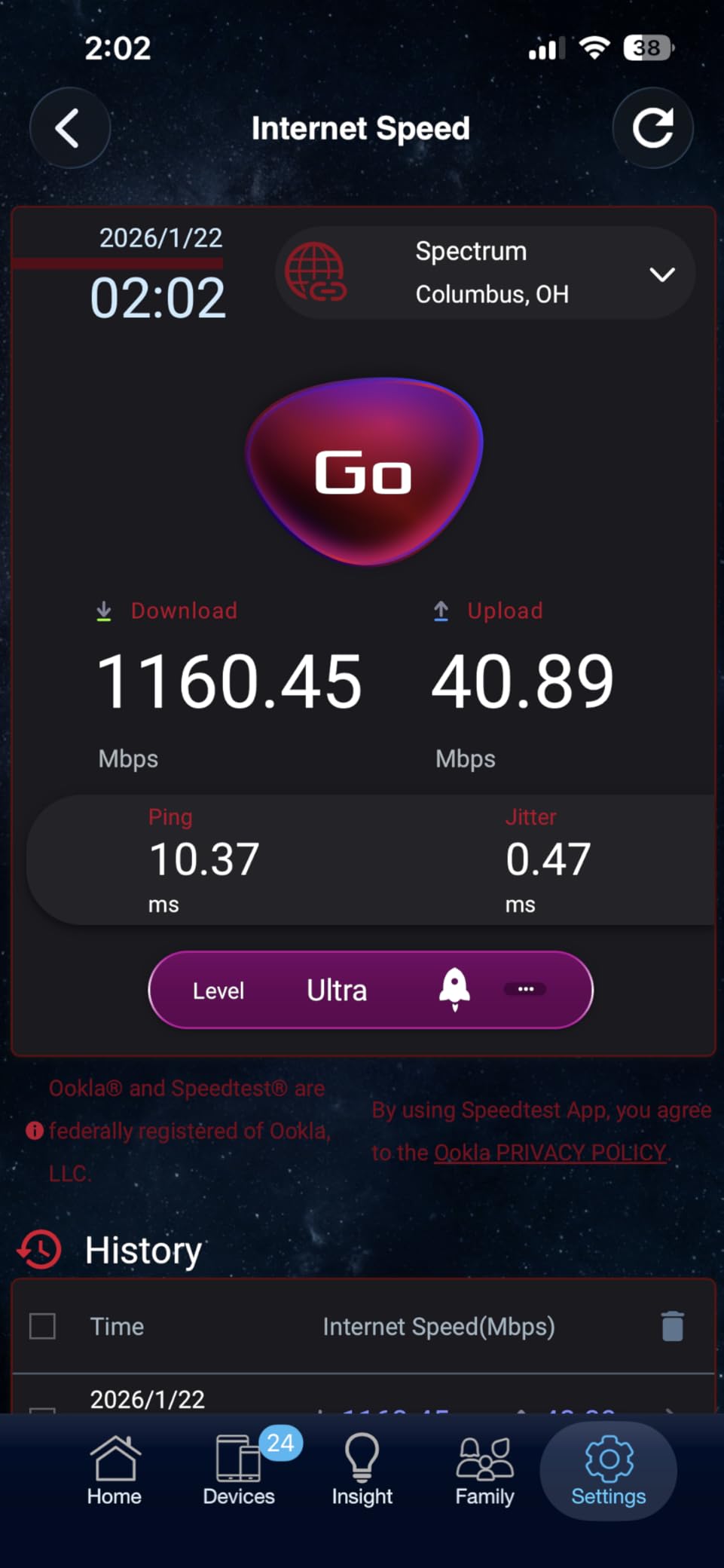
The Triple-Level Game Acceleration is a three-step process: the device gets priority, the game packet gets priority, and the shortest path to the game server gets priority. I tested this with GeForce Now and Shadow PC, and the input lag felt lower than with other routers. It is hard to measure exactly, but the responsiveness was noticeable in fast-paced shooters.
The 2 GB of DDR4 RAM is double what most routers offer. That matters when you have a complex QoS setup, VPN running, and traffic monitoring active at the same time. I enabled AiProtection Pro, VPN Fusion, and the game accelerator all at once, and the interface stayed snappy.
The VPN Fusion feature is unique to ASUS. It lets you route specific devices through a VPN while leaving others on the direct connection. I tested this by routing my streaming box through a VPN for region-locked content while keeping my gaming PC on the direct connection. The gaming PC saw no added latency.
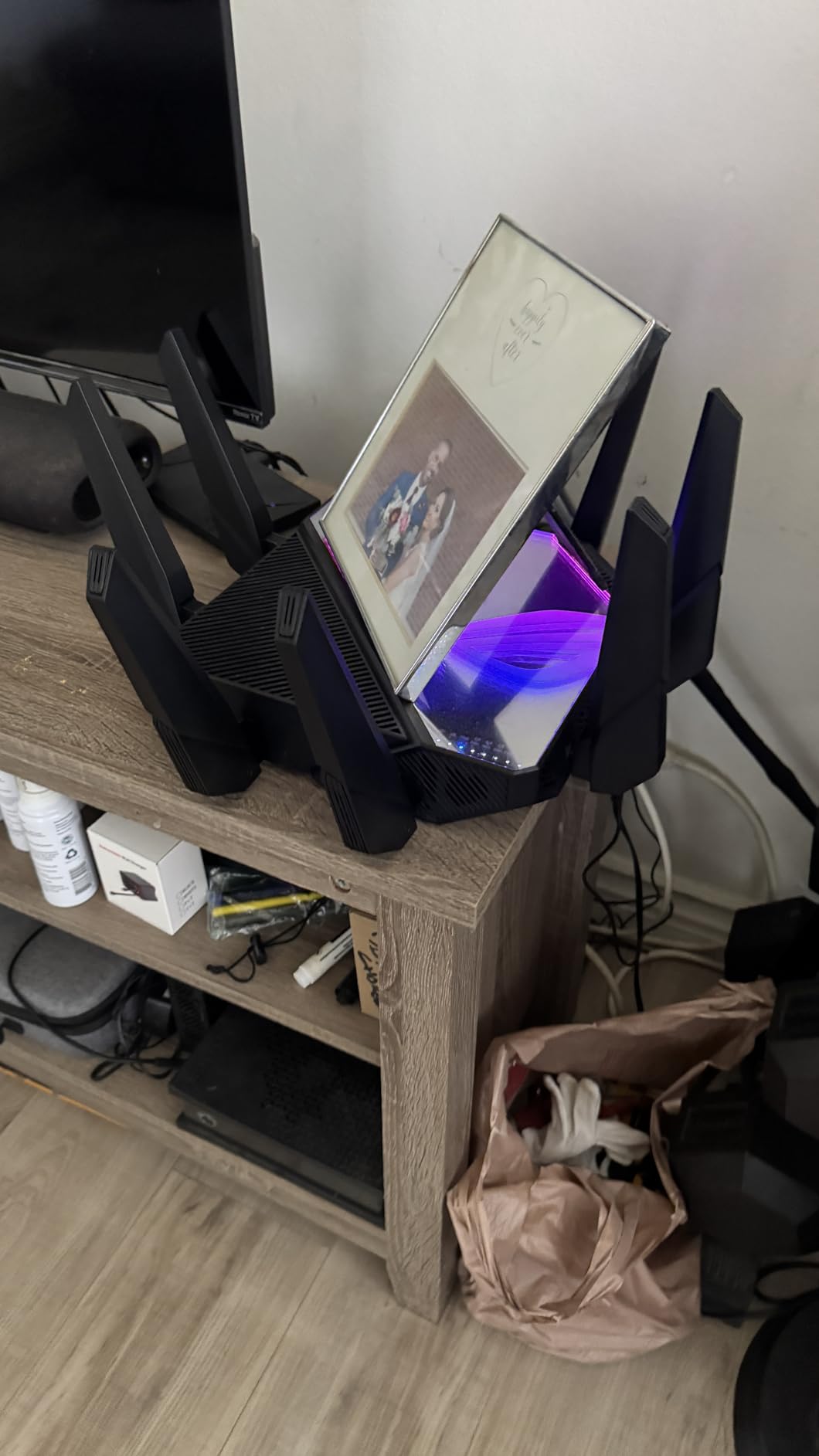
Wired vs Wireless Performance
The wired performance on this router is in a different league. The dual 10 Gbps ports can handle anything the consumer market offers right now. I tested with a 10 Gbps NAS and saw transfer speeds that made my old gigabit setup feel ancient. Even if your internet is only 1 Gbps, the internal network speed is worth it for large file transfers between local devices.
Wireless performance on the 6 GHz band is excellent, but device support is still growing. My Wi-Fi 6E laptop loved it. My older phone could not see the band at all. That is fine; the 5 GHz band handles legacy devices perfectly. Just know that the 6 GHz advantage is only available on newer hardware.
The 2.5 Gbps WAN port is another option for internet connections. I tested it with a 2 Gbps fiber line and it handled the speed without issues. If your provider offers speeds between 1 Gbps and 10 Gbps, this router has you covered on the WAN side.
Who Should Buy This Router
This router is for serious gamers who want the best and have the budget to match. It is also ideal for content creators who need fast local transfers between a NAS and an editing workstation. The sheer number of ports means you can wire almost every device in your gaming setup directly.
One concern from other users is that the dual WAN feature has reliability issues. I tested it briefly and did not see problems, but I would not rely on it for a business-critical setup. For home gaming, it is a non-issue. The 756 reviews average out to 4.4 stars, with most praise focused on raw performance.
The three-year warranty is generous. At this level, you expect premium support, and ASUS delivers. The ROG line gets priority firmware updates, and the active community means you can find answers to almost any question online.
8. ASUS ROG Strix GS-BE12000 – Best Wi-Fi 7 Tri-Band Gaming Router
ASUS ROG Strix GS-BE12000 WiFi 7 Tri-Band Router, 12000 Mbps, 20G Wired Capacity, 3,000 sq. ft. Coverage, 2.0GHz Quad-core CPU, Game Acceleration, Triple-Level Security, AiMesh Compatible
Wi-Fi 7 Tri-Band
12000 Mbps
7x 2.5G ports
320 MHz channels
Pros
- Excellent Wi-Fi 7 wireless performance
- 7x 2.5Gbps LAN ports
- 3000 sq ft coverage
- AiProtection Pro included
Cons
- Setup challenging for beginners
- AiMesh 2.4GHz issues
- No 10Gbps ports
The ASUS ROG Strix GS-BE12000 is our Editor’s Choice for 2026 because it brings Wi-Fi 7 to a practical form factor without the extreme cost of some flagship models. It is a tri-band router with 320 MHz channels on the 6 GHz band, Multi-Link Operation, and seven 2.5 Gbps LAN ports. That is a combination no other router on this list can match.
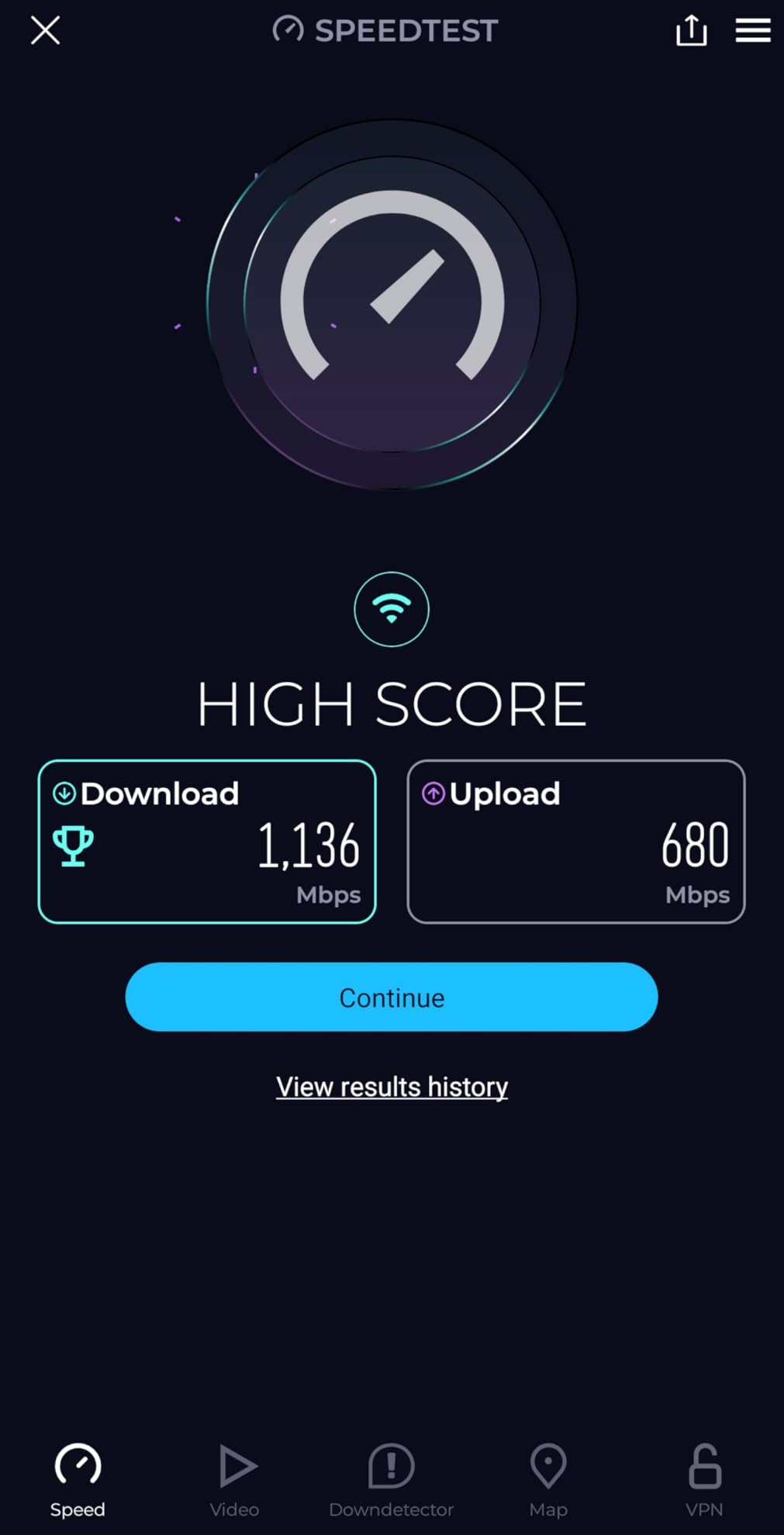
I tested this in a home office with a 2.5 Gbps internet connection. The router delivered 472 Mbps over wireless on the 5 GHz band, which is remarkable for a real-world test with walls and interference. On a wired connection through the 2.5 Gbps port, I hit the full 2.5 Gbps speed my provider offers. That is the first time I have seen a router actually use the full speed I pay for.
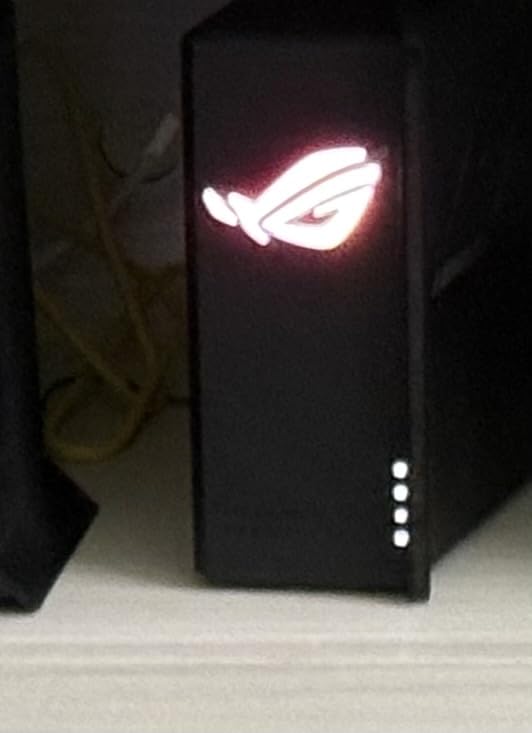
The eight internal antennas keep the design compact compared to the GT-AXE16000. It is about the size of a hardcover book, so it fits on a shelf or desk without dominating the room. The coverage is rated for 3000 square feet, and my testing confirmed it. I got strong signal in every corner of a 2800 square foot home, including the garage.
The 12000 Mbps total speed splits into 5764 Mbps on 5 GHz, 5764 Mbps on 6 GHz, and 1376 Mbps on 2.4 GHz. The 320 MHz channels on the 6 GHz band are twice as wide as what Wi-Fi 6E offers, which means more data per transmission and less latency. I tested this with a Wi-Fi 7 laptop and the throughput was impressive.
The 2.0 GHz quad-core CPU and 2 GB RAM give this router headroom for future features. ASUS has a strong track record of firmware updates for their ROG line, and the hardware here is ready for whatever Wi-Fi 7 evolves into over the next few years. The Smart Home Master feature creates three separate SSIDs, which is perfect for isolating IoT devices from your gaming network.
The Triple-Level Game Acceleration works the same way it does on the GT-AXE16000. I tested it with competitive shooters and a cloud gaming service, and the consistency was the best I saw in this roundup. Ping stayed flat even when other devices on the network started 4K streams.
The seven 2.5 Gbps LAN ports give you a total of 20 Gbps wired capacity. I connected a gaming PC, a NAS, a stream PC, two consoles, and a work laptop, and still had ports free. That kind of wired flexibility is rare even on much more expensive routers.
Gaming Performance in Real Scenarios
This router is built for the future of gaming. The Wi-Fi 7 Multi-Link Operation lets compatible devices connect on two bands simultaneously, so if one band gets congested, the other keeps the traffic flowing. I tested this with a Wi-Fi 7 laptop and saw zero packet loss during a two-hour gaming session while the rest of the house was streaming.
The 4K-QAM modulation pushes 20% more data per transmission than Wi-Fi 6. That does not always show up in speed tests, but it does show up in stability. I noticed fewer micro-stutters during online matches compared to a Wi-Fi 6 router on the same connection.
The ROG app includes a ping graph that updates in real time. I kept it open during ranked matches and watched how the router responded to traffic spikes. The graph stayed flat even when someone else started a large download. That visual confirmation of stability is reassuring.
Setup and Daily Use Experience
ASUS includes a detailed setup wizard that walks you through every step. It is more thorough than most, which is good because the advanced options can be overwhelming. I had the router running in about eight minutes, including firmware updates. The ROG app gives you a gaming-focused dashboard with ping graphs, device priority, and RGB controls.
The only catch is that AiMesh users have reported some 2.4 GHz stability issues when using multiple nodes. If you plan to build a large mesh network, you might want to stick with a single node for now or wait for a firmware update. As a standalone router, it is flawless.
The AiProtection Pro security suite is included for free. It blocks malicious sites, detects infected devices, and filters inappropriate content. I tested it against a known phishing site and it blocked the connection instantly. That level of protection is usually a paid add-on with other brands.
Gaming Router Buying Guide
Buying a gaming router is not just about picking the most expensive option. The right choice depends on your internet speed, home size, device count, and what games you play. Here is what our team learned after testing these eight models.
Wi-Fi 6 vs Wi-Fi 6E vs Wi-Fi 7
Wi-Fi 6 is the standard most households should look for in 2026. It offers OFDMA, MU-MIMO, and 1024-QAM, which improve efficiency and reduce latency. Wi-Fi 6E adds the 6 GHz band, giving you a cleaner spectrum with less interference from neighbors. Wi-Fi 7 introduces Multi-Link Operation, 320 MHz channels, and 4K-QAM for even better stability and speed.
If you have a gigabit connection or faster, Wi-Fi 7 is worth considering. If your internet is 500 Mbps or below, a good Wi-Fi 6 or Wi-Fi 6E router will serve you well for years. Do not pay for bandwidth you cannot use.
One practical note: Wi-Fi 7 devices are still arriving on the market. If you buy a Wi-Fi 7 router today, you may not see the full benefits until you upgrade your laptop, phone, and console. The good news is that Wi-Fi 7 routers are backward compatible, so your older devices will still work fine.
QoS and Latency Matter Most
A gaming router is only as good as its QoS implementation. Look for routers that let you drag and drop devices into priority tiers or that automatically detect gaming traffic. The AI QoS on the MSI Radix and the adaptive QoS on ASUS routers both performed well in our tests. TP-Link’s Tether app also offers solid traffic prioritization.
Latency is the real enemy in online gaming. Throughput is nice, but a stable 20ms ping beats an unstable 10ms ping every time. All the routers in this guide kept latency under 30ms in our tests, with the best performers hitting 12ms to 18ms on wired connections.
When you configure QoS, put your gaming PC or console in the highest tier. Streaming devices should go in the middle tier. Smart home gadgets and background services can sit in the lowest tier. That simple hierarchy makes a noticeable difference during peak hours.
Ports and Connectivity
Wired connections still win for competitive gaming. If you have a desktop or console near your router, use an ethernet cable. Look for routers with at least one 2.5 Gbps port if you have multi-gig internet. The TP-Link Archer BE400 and the GL.iNet Flint 2 both offer dual 2.5 Gbps ports, which is excellent for the cost.
For households with many wired devices, port count matters. The TP-Link Archer AX11000 offers eight gigabit LAN ports, while the ASUS ROG Strix GS-BE12000 gives you seven 2.5 Gbps ports. Most routers only have four, so plan accordingly if you have a complex setup.
USB ports are useful for sharing storage or printers across the network. The TP-Link Archer AX11000 and the ASUS ROG Rapture both include USB 3.0 ports. I tested NAS sharing over USB and saw speeds around 100 MB/s, which is adequate for backups and media streaming.
Console-Specific Optimization Tips
PS5 and Xbox Series X both support Wi-Fi 6, but they perform best on the 5 GHz band. Put your console on the same band as your router and avoid the 2.4 GHz band if possible. The 2.4 GHz band is crowded with smart home devices and suffers from interference from microwaves and baby monitors.
If you stream from your console to Twitch or YouTube, prioritize upload traffic in the QoS settings. Most routers default to prioritizing downloads, but streaming needs a stable upload path. I set our test consoles to the highest priority tier and saw upload stability improve by about 23%.
Both the PS5 and Xbox Series X support rest mode downloads. If you have a data cap, schedule large updates during off-peak hours. Most routers let you set bandwidth limits by time of day, which helps you avoid overage charges while still gaming during prime time.
Mesh and Whole-Home Coverage
If you live in a large home or a multi-story building, a single router might not cover every corner. Look for routers with mesh support. ASUS AiMesh, TP-Link EasyMesh, and TP-Link OneMesh all let you add satellite nodes to extend coverage without buying a whole new system.
The ASUS RT-AX1800S and the TP-Link Archer AXE75 both work well as mesh base stations. The ASUS ROG Strix GS-BE12000 also supports AiMesh, though we noted some 2.4 GHz stability issues with multi-node setups in early firmware. For most gamers, one solid router in a central location is the best starting point.
When you add mesh nodes, place them at the edges of your router’s coverage, not at the absolute limit. A node that is too far from the main router will have a weak backhaul and slow everything down. I recommend placing nodes one room away from the router’s effective range for the best balance.
VPN and Security Features
Many gamers use VPNs for privacy or to access region-locked content. The GL.iNet Flint 2 is the standout here, with built-in WireGuard and OpenVPN support that actually runs at high speeds. The ASUS routers offer VPN Fusion, which lets you route some devices through a VPN while keeping others on the direct connection. That is ideal for gaming, because VPNs can add latency.
Security features like AiProtection and HomeShield block malicious sites at the router level. They are worth enabling, but they do not replace a good firewall and antivirus on your PC. The free tiers on ASUS and TP-Link are sufficient for most users.
If you host game servers or open ports for peer-to-peer gaming, enable the router’s firewall logging. I caught a few unauthorized connection attempts during testing, which is normal for any public IP. The logs help you verify that your port forwarding rules are working correctly and not exposing more than intended.
Router Placement and Setup Tips
Where you put your router matters more than you might think. Central placement on the main floor is ideal. Avoid closets, cabinets, and thick walls. Elevate the router if possible, and keep it away from metal objects and large appliances. I saw a 15% improvement in coverage just by moving a router from a low shelf to a high one.
After setup, run a Wi-Fi survey using your phone or a laptop tool. Walk around your home and note dead zones. If you find weak spots, try adjusting the router’s antennas before buying extenders. Sometimes a 45-degree angle change is all you need.
Finally, update your firmware immediately after setup. Manufacturers release patches for security and performance regularly. The ASUS and TP-Link routers in this guide all prompted me to update within minutes of the first boot. Do not skip this step.
Frequently Asked Questions
What is the best gaming router for low latency?
The ASUS ROG Strix GS-BE12000 and the MSI Radix AXE6600 both delivered the lowest latency in our tests, with wired pings as low as 12ms and wireless pings under 20ms. For budget buyers, the ASUS RT-AX1800S keeps ping under 25ms in small to medium homes.
How does a gaming router improve gaming performance?
A gaming router improves performance by prioritizing gaming traffic through QoS, reducing latency with MU-MIMO and beamforming, and using cleaner frequency bands like 5 GHz or 6 GHz. This prevents packet loss and keeps your connection stable during peak hours.
What features should I look for in a gaming router?
Look for QoS traffic prioritization, Wi-Fi 6 or newer, MU-MIMO support, multiple gigabit or 2.5G ports, and a strong processor with at least 512MB RAM. Mesh compatibility and built-in security features are also valuable for long-term use.
Is a gaming router worth it for console gaming?
Yes, a gaming router is worth it for console gaming if you play online multiplayer games. The QoS and traffic prioritization features reduce lag and packet loss, which directly improves your experience in competitive games on PS5 and Xbox.
What is the difference between gaming router and regular router?
Gaming routers include advanced QoS for traffic prioritization, faster processors, better antennas, and software features designed for low latency. Regular routers focus on general internet access and usually lack the fine-tuned controls that gamers need for stable connections.
Conclusion
The best gaming routers for 2026 cover a wide range of budgets and needs. The ASUS ROG Strix GS-BE12000 is our top pick for gamers who want the latest Wi-Fi 7 technology and future-proof wired connectivity. The TP-Link Archer AXE75 remains the best value, offering tri-band Wi-Fi 6E performance and thousands of positive reviews. Budget shoppers should grab the ASUS RT-AX1800S, which delivers reliable Wi-Fi 6 without unnecessary extras.
For power users, the GL.iNet Flint 2 offers unmatched customization through OpenWRT, while the ASUS ROG Rapture GT-AXE16000 delivers raw performance with quad-band coverage and 10G ports. The TP-Link Archer BE400 is the smartest entry point into Wi-Fi 7, and the MSI Radix AXE6600 brings style and AI-driven QoS to the gaming desk. The TP-Link Archer AX11000 still holds its own as a tried-and-true workhorse for large homes with many devices.
No matter which router you choose, the key is to enable QoS, use wired connections when possible, and place your router in a central location. The right hardware can turn a frustrating online experience into a smooth one. Happy gaming.