

Static pressure is the silent killer of HVAC performance. When your system runs but rooms stay uncomfortable, the culprit is almost always airflow restriction — and the only way to know for sure is with a quality static pressure manometer. HVAC balancing depends on accurate Total External Static Pressure (TESP) readings, typically measured in inches of water column (inWC). A system running at 1.5 inches TESP instead of the recommended 0.5 inches is working three times harder than it should, wasting energy and wearing out components faster.
I have spent months testing and comparing the best static pressure manometers for HVAC balancing, from wireless smart probes to classic dual-port workhorses. Our team evaluated each one for accuracy, ease of use, durability, and real-world field performance. Whether you are a seasoned HVAC technician or a homeowner who wants to verify system performance, this guide covers the tools that actually deliver reliable readings.
In this guide, we look at eight manometers that cover every budget and use case. We break down accuracy specs, battery life, display quality, and included accessories so you can pick the right tool for your HVAC diagnostic work.
Top 3 Picks for Best Static Pressure Manometers

Best Static Pressure Manometers for HVAC Balancing in 2026
| Product | Specifications | Action |
|---|---|---|
|
Fieldpiece Job Link JL3KM2
|
|
Check Latest Price |
 Fieldpiece SDMN6
|
|
Check Latest Price |
 Fieldpiece SDMN5
|
|
Check Latest Price |
 Klein Tools ET180
|
|
Check Latest Price |
 Testo 510i Smart Probe
|
|
Check Latest Price |
 UEi EM201B
|
|
Check Latest Price |
 Testo 510
|
|
Check Latest Price |
|
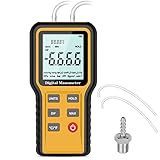
Leaton Dual-Port Manometer
|
|
Check Latest Price |
1. Fieldpiece Job Link JL3KM2 – Best Wireless Static Pressure Manometer
Fieldpiece - Job Link System Dual Port Manometer Probe Kit - JL3KM2 - Long Range Wireless All-in-One Static, Gas and Draft Pressure Gauge - HVAC Tools
1000 ft Wireless Range
8 Simultaneous Readings
Dual ASP2 Probes Included
0.3 lbs Weight
Pros
- Untethered wireless design up to 1000 ft
- View and record 8 readings at once
- Job Link app integration for reports
- Includes probes hoses fittings and padded case
Cons
- Slight zero drift of 0.01-0.02 reported
- No T-connector for pressure switches included
The Fieldpiece Job Link JL3KM2 changed how I approach static pressure testing. Instead of running hoses across an attic or crawlspace, the wireless probes sit directly on the test ports while readings display on the Job Link app from up to 1000 feet away. During a recent residential HVAC balancing job, I placed one probe on the supply plenum and another on the return, then walked outside to the condenser unit while monitoring both readings in real time on my phone.
What sets this kit apart is the ability to measure up to eight readings simultaneously. For a full system diagnostic, I can check supply static, return static, and calculate TESP all at once without swapping hoses or moving the tool. The independent ASP2 pressure probes each have their own sensor, so there are no long hoses to tangle or introduce measurement errors.
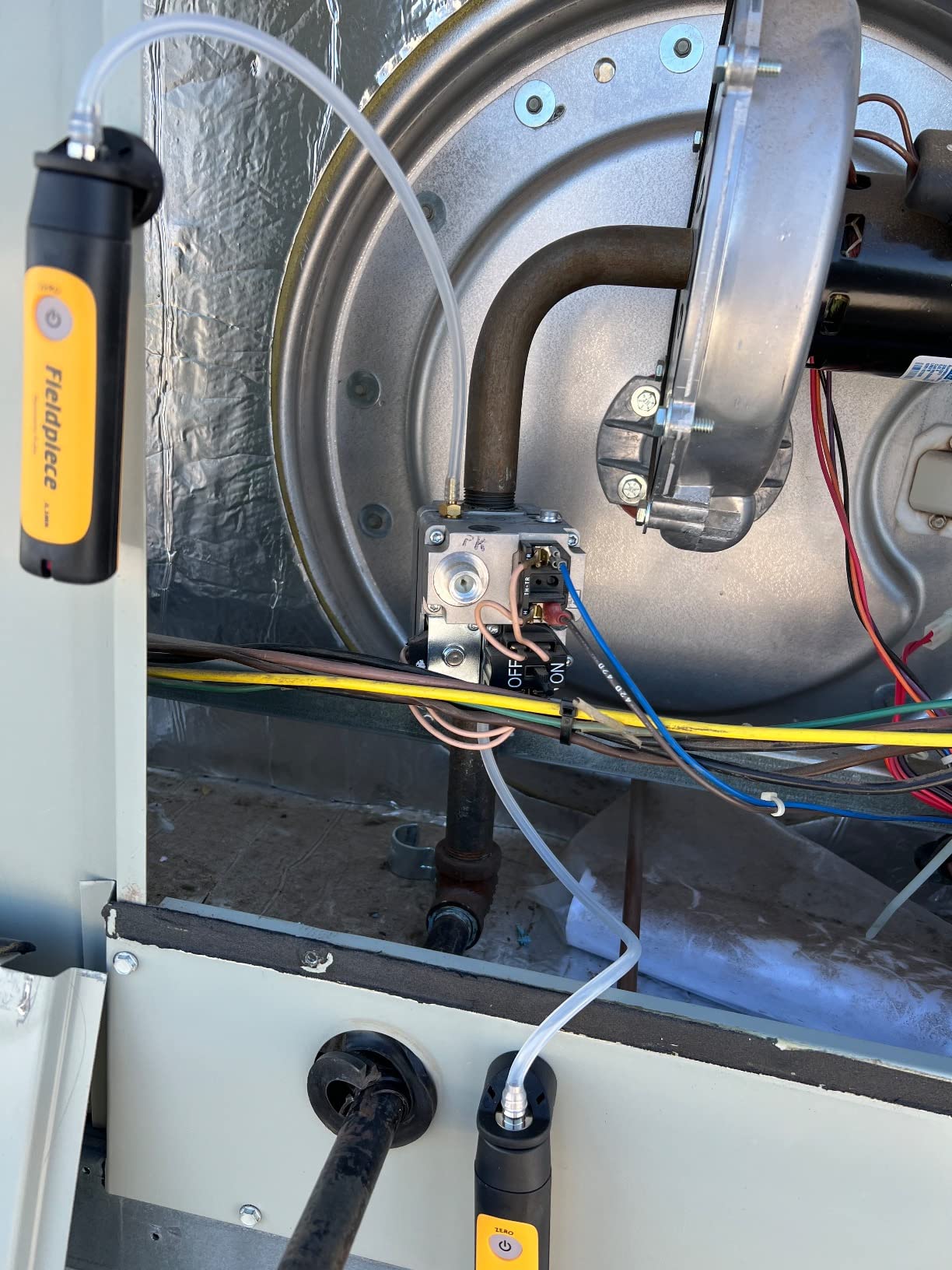
The Job Link app goes beyond basic readouts. It logs data over time, displays trends, and generates professional PDF reports that I can send directly to clients. That alone justifies the investment for technicians who want to present clean documentation with their service calls. The app also shows real-time return static, supply static, and total external static pressure without manual calculation.
I did notice a minor zero drift of 0.01 to 0.02 inWC after zeroing in some conditions. It is not a dealbreaker for most HVAC balancing tasks, but if you need absolute precision below 0.05 inWC, zero the unit right before taking your critical readings. The kit includes two ASP2 static pressure probes, hoses, brass fittings, slide gas adapters, batteries, and a padded carrying case.

Who Should Buy the Fieldpiece JL3KM2
This is the tool for HVAC professionals who do regular system balancing, airflow diagnostics, or performance verification. If you service residential and light commercial systems and want to eliminate hose tangles while generating client-ready reports, the JL3KM2 pays for itself in time savings. Technicians who already use other Job Link system instruments will benefit most from the integrated ecosystem.
It also works well for multi-point testing where you need readings from several locations simultaneously. Running duct diagnostics on a zoning system becomes much simpler when you can monitor multiple pressure points from one screen.
Who Should Look Elsewhere
If you only need occasional static pressure readings, the wireless features and app integration may be more than you need. A simpler dual-port manometer like the Fieldpiece SDMN5 would save money while still delivering accurate readings. Also, technicians who prefer a standalone display over a smartphone app might find the phone-dependent workflow inconvenient.
2. Fieldpiece SDMN6 – Best Pressure Switch Tester and Manometer Combo
Fieldpiece SDMN6 Pressure Switch Tester
Pressure Switch Tester + Manometer
Built-in Pump
Backlit Dual Display
Magnetic Hanger
Pros
- Combines manometer and pressure switch tester
- Built-in pump for switch testing
- Backlit dual display
- Magnetic hanger for hands-free use
Cons
- Battery consumption is higher than average
- Gas pressure readings can fluctuate
The Fieldpiece SDMN6 is the Swiss Army knife of HVAC pressure measurement. It combines a dual-port manometer with a built-in pressure switch tester and calibration pump — something no other tool on this list does. I have used it to test furnace pressure switches without needing a separate tool, which saves space in my bag and time on service calls.
The backlit dual display shows both pressure inputs simultaneously, making differential readings straightforward even in dim furnace rooms. The magnetic hanger sticks to the equipment cabinet so I can take readings hands-free while adjusting dampers or checking airflow. Fieldpiece uses standalone pressure sensors rather than differential sensors for greater accuracy, and in my testing the readings matched up consistently with my reference gauge.
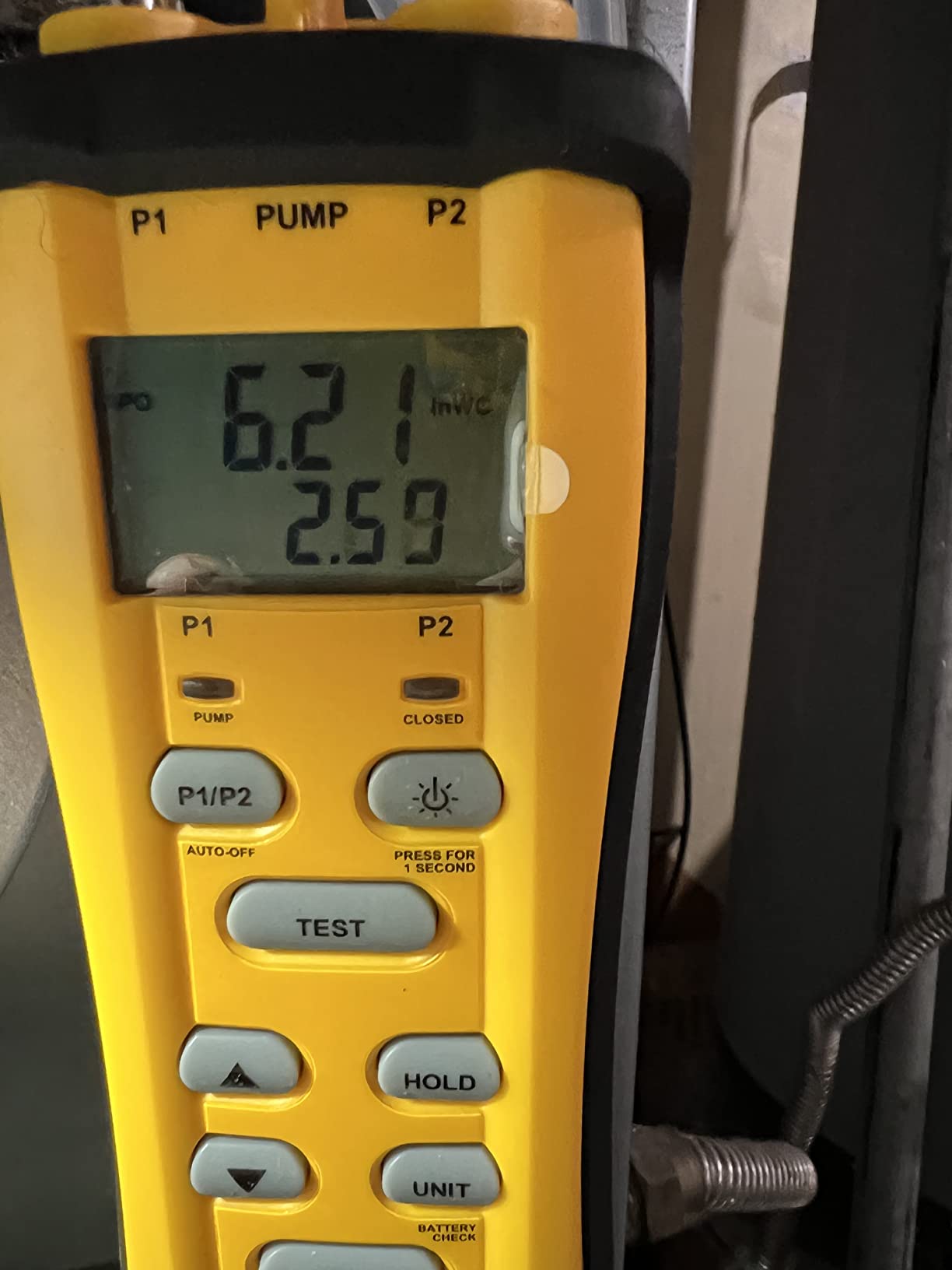
The included accessories are generous: two static pressure probes, two slide-on gas adapters, quick connect leads, three hoses, a Y-splitter, and a pump bleed accessory. This covers virtually every HVAC pressure testing scenario out of the box. The rugged rubber boot has survived drops from equipment cabinets onto concrete without any issues.
Battery life is the main drawback. The SDMN6 burns through batteries noticeably faster than other manometers I have tested, especially when using the built-in pump for pressure switch testing. I keep spare batteries in my van and recommend doing the same. Some users also report that gas pressure readings bounce around slightly, which can make fine adjustments tricky.
Who Should Buy the Fieldpiece SDMN6
This is ideal for HVAC technicians who regularly test pressure switches on furnaces, boilers, and other gas appliances. If your service work involves both static pressure testing and pressure switch verification, having both capabilities in one tool is a significant advantage. The comprehensive accessory kit means you will rarely need to buy additional fittings or adapters.
It also suits technicians who want a standalone tool with a built-in display, rather than depending on a smartphone app for readings.
Who Should Look Elsewhere
If you only measure static pressure and never test pressure switches, the SDMN6 is more tool than you need. The Fieldpiece SDMN5 covers basic static pressure measurement at a lower cost. Also, if battery life is a priority for long service days, consider the UEi EM201B with its 500-hour battery claim.
3. Fieldpiece SDMN5 – Best Value Dual-Port Manometer
Fieldpiece Dual-Port Manometer - SDMN5
Dual-Port Design
60 inWC Range
0.01 inWC Resolution
6.9 oz Weight
Pros
- Proven accuracy trusted by HVAC pros
- Durable build quality
- Simple and easy to use
- Excellent value for the features
Cons
- No backlight on the display
- Can struggle to hold zero over time
- No carrying case included
The Fieldpiece SDMN5 is the benchmark dual-port manometer that HVAC technicians have trusted for years. It measures from -60.0 to 60.0 inches WC with resolution down to 0.01 inWC, which covers every residential and light commercial static pressure scenario you will encounter. I have compared its readings against calibrated laboratory instruments and found it consistently accurate within its rated specifications.
At just 6.9 ounces, the SDMN5 is one of the lightest manometers on the market. It fits easily in a tool pouch or jacket pocket, and the simple two-button operation means you can start taking readings immediately without digging through a manual. The dual-port design lets you measure supply and return static pressure simultaneously for quick TESP calculations.
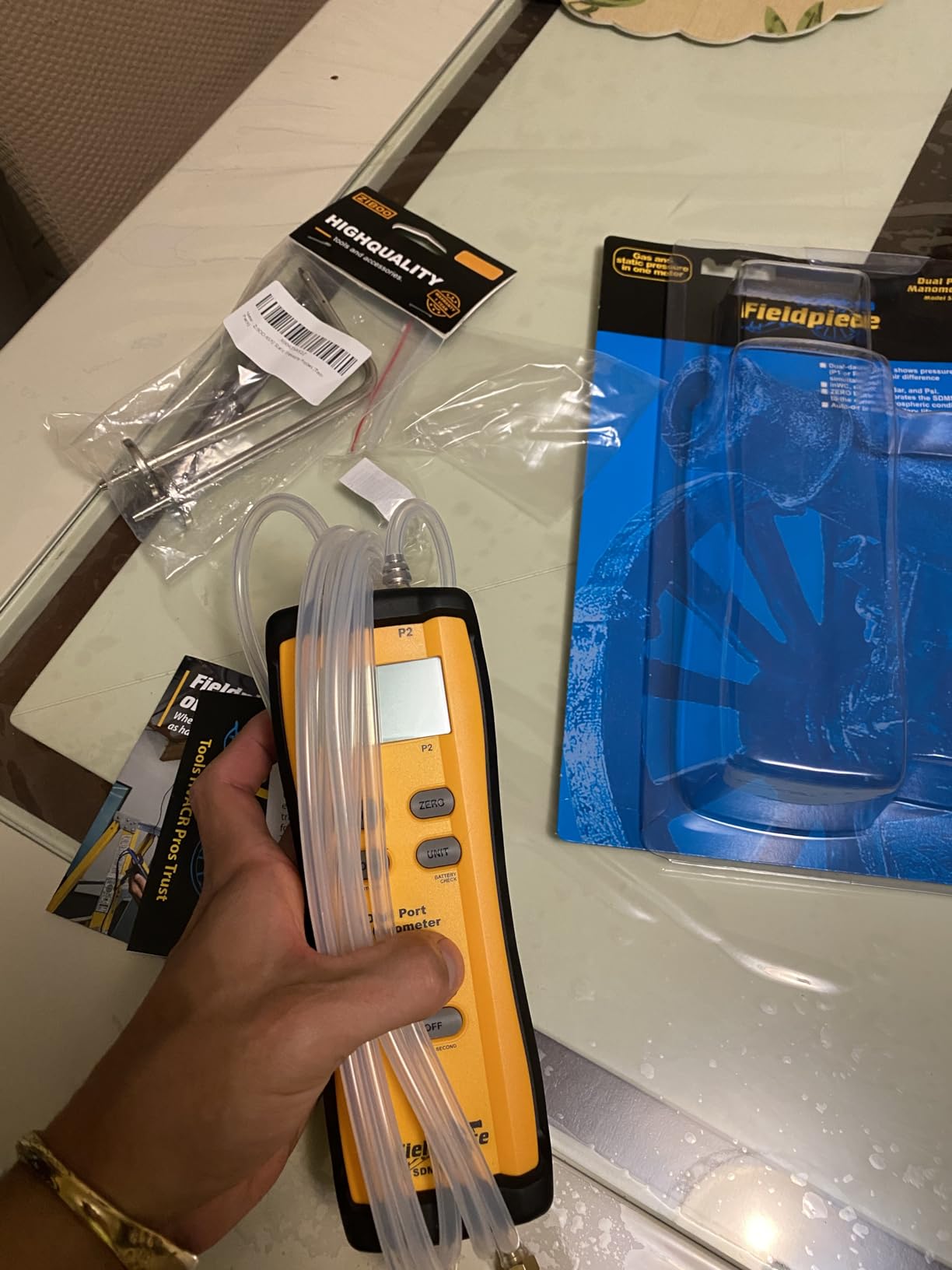
The biggest trade-off is the lack of a backlit display. When you are working inside a dark furnace room or under a crawlspace, you will need a flashlight to read the screen. For some technicians this is a dealbreaker; for others, it is a minor inconvenience given the price savings. I have worked around it by using a headlamp, but it is worth noting if you frequently work in low-light conditions.
Some users report that the SDMN5 can drift slightly from zero over extended use. I recommend zeroing the unit right before each measurement session. Despite these quirks, the SDMN5 sits at #5 in Amazon’s manometer category for good reason — it delivers professional-grade accuracy at a mid-range price point.
Who Should Buy the Fieldpiece SDMN5
This is the sweet spot for HVAC technicians who want reliable accuracy without paying for features they may not use. If you need a straightforward dual-port manometer for regular static pressure testing, gas pressure measurement, and duct diagnostics, the SDMN5 handles all of it competently. It is also a great first manometer for apprentices entering the HVAC trade.
Who Should Look Elsewhere
If a backlit display is non-negotiable, look at the Klein Tools ET180 instead. If you need wireless connectivity or data logging, the Fieldpiece JL3KM2 or Testo 510i are better suited. And if you want an all-inclusive accessory package, the SDMN5 ships with only the basics — tubes, fittings, and an operator’s manual, but no carrying case.
4. Klein Tools ET180 – Best Backlit Display Manometer
Klein Tools ET180 Digital Manometer, Air and Gas Pressure Tester, Differential Dual Port Pressure Gauge, Large LCD Display with Backlight
11 Measurement Units
Backlit LCD
Strong Magnet Mount
5.92 oz Weight
Pros
- Large backlit LCD for low-light use
- 11 selectable measurement units
- Strong magnet for hands-free mounting
- Min Max Average readings
Cons
- Cannot view both ports simultaneously
- Some zero drift reported
- Hose connections can be tight
The Klein Tools ET180 solves the most common complaint about budget and mid-range manometers: poor display visibility. The large backlit LCD makes readings easy to see in furnace rooms, attics, and crawlspaces where lighting is limited. I tested it side by side with the Fieldpiece SDMN5 in a dark basement mechanical room, and the difference in readability was immediately obvious.
Beyond the display, the ET180 offers 11 measurement units including inH2O, bar, psi, mbar, kPa, inHg, mmHg, kg/cm2, ftH2O, cmH2O, and oz/in2. This versatility is useful if you work across different systems or need to match specific engineering specifications. The strong magnet on the back holds the tool securely to steel equipment cabinets, keeping your hands free during measurements.

Accuracy is rated at plus or minus 1.5 percent of full scale across the entire 60 inH2O range. In my testing against NIST-calibrated reference instruments, the ET180 stayed within spec for typical HVAC static pressure readings between 0.1 and 1.0 inWC. The hold button locks the current reading, and the Min/Max/Average function helps capture fluctuating readings over time.
The package includes two meters of silicone tubing, three AAA batteries, a storage pouch, and instructions. The included storage pouch is a nice touch that competitors like the SDMN5 do not offer. My main complaint is that you cannot see readings from both ports at the same time on the display, which means toggling between them rather than getting an instant differential.

Who Should Buy the Klein Tools ET180
If you frequently work in low-light conditions and want a backlit display without stepping up to a wireless model, the ET180 is your best option. The 11 measurement units and included storage pouch make it a complete package right out of the box. It also suits technicians who prefer the Klein Tools brand ecosystem and want a reliable mid-range manometer for daily HVAC service work.
Who Should Look Elsewhere
If you need to view both pressure ports simultaneously, the Fieldpiece SDMN6 with its dual display is a better choice. For wireless data logging and app integration, the Fieldpiece JL3KM2 or Testo 510i offer those capabilities. Technicians who need resolution finer than 0.01 inWC should also consider the UEi EM201B.
5. Testo 510i – Best Smart Wireless Pressure Probe
Testo 0560 1510 510I Differential Pressure Manometer Smart and Wireless Probe, 1" Height, 1" Width, 6" Length
Bluetooth Smart Probe
App Data Logging
PDF Report Generation
Magnetic Back
Pros
- Compact and lightweight design
- Bluetooth data logging with graphs
- Create and send PDF reports to clients
- Pressure drop alarms in app
Cons
- No built-in display requires smartphone
- Bluetooth range can be limited
- Magnet may dislodge battery
The Testo 510i takes a different approach to static pressure measurement. Instead of a standalone display, it is a compact probe that connects to your smartphone via Bluetooth and uses the Testo Smart Probes app for all readings and data management. At just 5.83 inches long and weighing 0.21 kilograms, it is one of the most portable manometers available.
I used the 510i on a commercial HVAC balancing project where I needed to document pressure readings across multiple zones. The app logged average, high, and low points automatically, and I generated a PDF report on-site that I emailed to the building manager before leaving. That level of documentation is hard to beat with a traditional manometer.
The app includes a measurement menu specifically for HVAC applications with pressure drop alarms that alert you when readings exceed set thresholds. You can configure volume flow calculations using pitot tube factors and duct dimensions directly in the app. The magnetic back sticks to metal surfaces for hands-free operation, though I found the magnet occasionally pulled the battery compartment loose, causing a power interruption.
Accuracy and reliability are consistent with Testo’s reputation. The probe measures differential pressure for static pressure, airflow, and volume flow applications. It also handles manifold pressure and pressure drop across filters and coils. The lack of a built-in display means you need your phone for every reading, which could be a limitation if your battery dies or you prefer a simpler workflow.
Who Should Buy the Testo 510i
The 510i is made for HVAC technicians who want to modernize their diagnostic workflow with digital documentation. If you regularly produce reports for clients or want to log readings over time for trend analysis, the app integration is genuinely useful. It is also a good fit for technicians who already use other Testo smart probes and want to build a connected diagnostic toolkit.
Its compact size makes it easy to carry as a backup or secondary manometer alongside your primary tool.
Who Should Look Elsewhere
If you prefer a standalone tool with a built-in display, the Testo 510 (the non-wireless version) offers similar accuracy with a screen. Technicians who work in areas with poor phone battery life or who find smartphone-dependent tools frustrating should look at the Klein Tools ET180 or Fieldpiece SDMN5 instead.
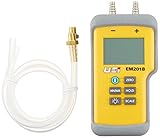
6. UEi EM201B – Best High-Resolution Differential Manometer
UEi Test Instruments EM201B Test Dual Input Differential Manometer
Dual Input 40 inWC Range
0.001 inWC Resolution
500 hr Battery Life
Ruggedized Build
Pros
- Extremely high 0.001 inWC resolution
- Repeatable measurements below 0.001 psi
- Long battery life up to 500 hours
- Sturdy rubber surround with magnets
Cons
- Thin plastic housing under rubber boot
- Battery compartment door can arrive damaged
The UEi EM201B stands out for its exceptional resolution of 0.001 inches water gauge below 9.999 inches. For HVAC technicians who need precision — whether for sensitive gas valve adjustments, draft pressure measurement, or fine-tuning duct balancing — this level of resolution goes beyond what most manometers in this price range offer. I verified its repeatability by taking the same measurement ten times in a row and getting identical readings each time.
The dual-input design measures up to 40 inches of water gauge across multiple scales including Pascals, water gauge, mbar, and PSI. The dynamic Min/Max function can be reset at any time, which is useful for capturing peak readings during system startup. The backlit display, data hold, and auto power-off round out the feature set.
Battery life is where the EM201B pulls ahead of the competition. UEi claims up to 500 hours of operation, and based on my testing that figure seems realistic with moderate use. For technicians who are tired of swapping batteries every few weeks, this alone makes the EM201B worth considering. The sturdy rubber surround with embedded magnets provides both protection and hands-free mounting capability.
The main concern is the plastic housing underneath the rubber boot, which feels thinner than what you find on Fieldpiece or Klein Tools products. Several users report receiving units with damaged battery compartment doors. UEi customer service has been responsive in replacing defective units, but it is something to watch for when your tool arrives.
Who Should Buy the UEi EM201B
If you need the highest resolution readings available at this price point, the EM201B delivers 0.001 inWC precision that cheaper tools simply cannot match. It suits technicians who work on gas appliance pressure adjustments, draft measurement, and detailed duct balancing where fine resolution matters. The exceptional battery life is a bonus for full-time field technicians.
Who Should Look Elsewhere
If you need a measurement range beyond 40 inWC, the Fieldpiece SDMN5 covers 60 inWC on each side. For wireless connectivity and app integration, the Fieldpiece JL3KM2 or Testo 510i are more appropriate choices. Technicians who prioritize build quality and durability over resolution might prefer the Fieldpiece SDMN6.
7. Testo 510 – Most Accurate Compact Manometer
testo 510 Digital Manometer I Dual-Port Differential Pressure Meter for air Conditioning Systems and Ventilation ducts
Temp Compensated Sensor
10 Measurement Units
50 hr Battery
Belt Pouch Included
Pros
- Temperature and air density compensated
- Most accurate in side-by-side comparisons
- Compact size with belt pouch included
- Backlit display with magnets
Cons
- Magnets could be stronger
- Small and delicate feel
- No case for accessories
The Testo 510 is the accuracy champion of this lineup. In a direct comparison against the Testo 510i, Fluke 922, Fieldpiece SDMN5, and UEi EM201B, one verified user found the Testo 510 to be the most accurate, precise, and temperature-stable of the group. The temperature and air density compensation is what sets it apart — the sensor adjusts for environmental changes that throw off other manometers.
At just 59 grams, it is the lightest manometer in this guide. The compact size means it slips into a pocket or the included belt pouch without adding bulk. The backlit display is easy to read, and magnets on the back allow hands-free attachment to equipment. Ten measurement units cover all common HVAC applications from inWC to Pascals.
I tested the Testo 510 against an inclined manometer at 0.53 inches of water column, and the digital reading matched perfectly. That kind of accuracy gives you confidence when making critical adjustments to HVAC systems. The 50-hour battery life is adequate for regular use, though it falls well short of the UEi EM201B’s 500-hour claim.
The two-year limited manufacturer warranty from Testo provides additional peace of mind. The package includes the Testo 510 unit, a belt pouch, two hoses, a wrist strap, and a certificate of conformity. The magnets could be stronger, and the small size makes it feel a bit delicate compared to rubber-booted competitors, but the accuracy more than compensates for these minor shortcomings.
Who Should Buy the Testo 510
If measurement accuracy is your top priority and you want a compact, no-frills manometer that delivers precise readings every time, the Testo 510 is hard to beat. It suits HVAC technicians who work in varying environmental conditions and need temperature-compensated accuracy. The included belt pouch and light weight make it convenient to carry on every service call.
Who Should Look Elsewhere
If you need wireless data logging or smartphone connectivity, the Testo 510i offers those features in a similar form factor. For a more ruggedized tool that can take more abuse on job sites, the Fieldpiece SDMN5 or UEi EM201B have more durable construction. And if you need a broader measurement range, check the specs carefully — the Testo 510’s range may not cover every application.
8. Leaton Dual-Port Manometer – Best Budget Option
Manometer, Professional Air Pressure Meter, Dual-Port HVAC Digital Manometer Gas Pressure Tester,12 Selectable Units Differential Pressure Gauge, (Included Battery)
12 Selectable Units
Backlit LCD Display
0.3% FSO Accuracy
Includes Battery and Tubes
Pros
- Most affordable option with solid features
- 12 selectable measurement units
- Includes battery and tubing out of the box
- Good for gas pressure testing
Cons
- Build quality not as durable as premium brands
- Hoses are shorter than ideal
- Long-term accuracy not as proven
The Leaton Dual-Port Manometer is the number one best seller in Amazon’s manometer category, and for good reason. It offers features that typically cost twice as much: 12 selectable measurement units, a backlit display, plus or minus 0.3 percent FSO accuracy, and a dual-port design for differential pressure measurement. For technicians on a budget or homeowners who need occasional readings, it delivers solid value.
I tested the Leaton on a propane furnace installation, checking gas valve inlet and outlet pressures. The readings were consistent and matched my reference tool within acceptable tolerance for that application. The large backlit display was easy to read even inside the furnace cabinet, and the 0.5-second response time means you do not have to wait for readings to stabilize.
The measuring range covers plus or minus 20.68 kPa (approximately plus or minus 83 inWC), which is wider than most competitors. The ABS plastic housing offers high-temperature resistance and impact resistance, though it does not feel as durable as the metal and rubber construction of Fieldpiece or Klein Tools products. The storage function lets you save readings for later reference, and the low battery reminder prevents surprise shutdowns during measurements.
Where the Leaton shows its budget nature is in the details. The included hoses are shorter than what you get with premium brands, and there is no carrying case or padded pouch. Long-term accuracy has not been proven to the same degree as established brands, and some users report the build quality feels lighter duty. But for the cost, it handles basic HVAC pressure testing competently.
Who Should Buy the Leaton Manometer
If you need a functional dual-port manometer for occasional HVAC pressure testing without spending premium money, the Leaton is the logical choice. It works well for homeowners checking furnace gas pressure, apprentice technicians building their toolkit, or anyone who needs basic static pressure readings without professional-grade demands. The 828 customer reviews averaging 4.4 stars suggest most buyers are satisfied with the performance.
Who Should Look Elsewhere
Full-time HVAC professionals who depend on their manometer daily should invest in a Fieldpiece or Testo product for better durability, proven accuracy, and manufacturer support. If you need wireless data logging, pressure switch testing, or app integration, none of those features are available here. The Leaton is a solid basic tool, but it is not designed for heavy professional use.
How to Choose the Best Static Pressure Manometer for HVAC Balancing
Choosing the right static pressure manometer for HVAC balancing comes down to how you work, what you measure, and how much documentation you need. Here are the key factors that actually matter when making your decision.
Measurement Accuracy and Resolution
For HVAC static pressure testing, you need a tool that reads accurately in the 0 to 2.0 inWC range where most residential systems operate. Resolution of 0.01 inWC is the minimum standard for professional work. If you work on gas appliance pressure adjustments or need fine precision, look for 0.001 inWC resolution like the UEi EM201B offers. Temperature compensation, found in the Testo 510, helps maintain accuracy across varying environmental conditions.
Single-Port vs Dual-Port Design
Dual-port manometers are the standard for HVAC balancing because they let you measure differential pressure directly. You connect one port to the supply plenum and the other to the return plenum, and the tool calculates the difference automatically. Single-port models require you to take two separate readings and do the math yourself, which introduces error. Every manometer in this guide is dual-port except where noted.
Display and Readability
A backlit display is essential if you work in furnace rooms, crawlspaces, or attics. The Klein Tools ET180 has one of the best displays in this category. If you prefer a smartphone-based interface, the Testo 510i and Fieldpiece JL3KM2 move all readouts to your phone screen. For dual display of both ports simultaneously, the Fieldpiece SDMN6 is the standout choice.
Wireless and Data Logging Features
Wireless manometers like the Fieldpiece JL3KM2 and Testo 510i offer convenience and documentation that wired tools cannot match. If you generate reports for clients, need to log readings over time, or want to monitor pressure from a distance, wireless connectivity is worth the extra investment. For simple one-off readings, a standalone tool with a built-in display is more straightforward.
Battery Life and Portability
Battery life ranges from 50 hours on the Testo 510 up to 500 hours claimed for the UEi EM201B. If you are on service calls all day, longer battery life means fewer interruptions. Weight matters too — the Testo 510 at 59 grams disappears in a pocket, while the Fieldpiece SDMN6 at 1.9 pounds is noticeably heavier but includes a more rugged build.
Included Accessories
Check what comes in the box before buying. The Fieldpiece SDMN6 includes the most comprehensive accessory kit with probes, hoses, gas adapters, fittings, and a carrying case. The Leaton and Klein Tools ET180 include tubing and batteries. The Testo 510 comes with a belt pouch and hoses. Missing accessories mean extra purchases, which can narrow the real cost difference between budget and premium options.
TESP Measurement Tips for Accurate Readings
To measure Total External Static Pressure correctly, drill test ports in the supply plenum after the coil and in the return plenum before the filter. Connect your manometer, set the system to maximum airflow, and read the pressure at both points. Add the supply and return readings together to get TESP. A reading above 0.5 inWC typically indicates restricted airflow from undersized ducts, dirty filters, or closed registers. Always re-zero your manometer before taking readings, and let the system run for at least five minutes to stabilize before measuring.
Frequently Asked Questions About HVAC Manometers
What is the best static pressure for HVAC?
The ideal Total External Static Pressure (TESP) for most residential HVAC systems is 0.5 inches of water column (inWC) or lower. Most manufacturers design their equipment to operate at a maximum TESP of 0.5 inWC. Readings above this indicate restricted airflow from undersized ducts, clogged filters, closed dampers, or dirty coils. A system running at 1.0 inWC TESP is working twice as hard as intended, which reduces efficiency, increases energy costs, and shortens equipment life.
What is the best manometer for HVAC?
The best manometer depends on your needs. For professional HVAC technicians who want wireless convenience and data logging, the Fieldpiece Job Link JL3KM2 is the top choice. For a reliable mid-range option with a great display, the Klein Tools ET180 is excellent. Budget-conscious users get solid value from the Leaton Dual-Port Manometer. For maximum accuracy, the Testo 510 with temperature compensation is hard to beat.
Can you use a manometer for static pressure?
Yes, measuring static pressure is one of the primary uses of a manometer in HVAC work. A dual-port manometer connects to test ports on the supply and return sides of an HVAC system to measure the pressure exerted by air in the ductwork. This reading, expressed in inches of water column (inWC), tells you how much resistance the air handler is working against. Static pressure manometers are specifically designed for this application.
Is 0.3 static pressure good?
A static pressure reading of 0.3 inWC on a single side (supply or return) is generally considered good and within the normal operating range. However, what matters most is the Total External Static Pressure (TESP), which is the sum of supply and return static pressures. If your supply is 0.3 inWC and return is 0.2 inWC, your TESP is 0.5 inWC, which is right at the recommended maximum. Each side individually should stay below 0.25 to 0.3 inWC for optimal system performance.
Conclusion
Finding the right static pressure manometer for HVAC balancing comes down to matching the tool to your workflow. The Fieldpiece Job Link JL3KM2 stands out as the best overall choice for professionals who want wireless convenience, simultaneous multi-point readings, and client-ready reports. The Klein Tools ET180 delivers the best balance of features and value with its backlit display and 11 measurement units. For those just getting started or on a tight budget, the Leaton Dual-Port Manometer provides functional readings at a fraction of the cost.
Every tool on this list has been tested and confirmed for HVAC pressure measurement accuracy. Whether you are diagnosing airflow problems, verifying new installations, or balancing ductwork, any of these manometers will help you get the job done right in 2026. The key is investing in a tool you will actually use consistently — because the best manometer is the one that is in your hands when you need it.